

ASTM F1386-92(2021)
(Guide)Standard Guide for Construction of Sounding Tube and Striker Plate for Tank Sounding
General Information
- Abstract
SIGNIFICANCE AND USE
5.1 Sounding tubes may be fabricated from 11/2 NPS or larger. Only when otherwise specified, Schedule 40 components, manufactured from the list of material indicated in Practice F1155 and Specification A53/A53M, Grade S or Grade ERW. In addition, sounding tubes may be fabricated in stainless steel for stainless steel tanks.
5.1.1 Sounding tubes passing through or terminating in fuel tanks, potable water tanks, or clean salt water ballast tanks should be constructed of 70-30 copper nickel, but other suitable material is acceptable.
5.2 Striker plates shall be fabricated in accordance with Specification A36/A36M.
5.3 The fittings shall be designed in accordance with ASME B16.5, ASME B16.9, ASME B16.28, or ASME B16.11 as applicable (see Table 21 in Practice F1155), and the installation shall be in accordance with ASME B31.1 as modified by Specification F722. These standards cover the fitting tolerances.
5.4 Some cargo may preclude the use of materials specified in this guide. However, configuration examples are applicable for all applications.
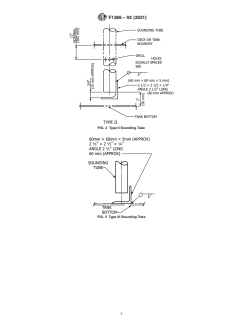
5.5 When a sounding tube is combined with the air escape, either three 11/4-in. (approximately 30-mm) diameter holes approximately 12 in. (305 mm) from the tank top equally spaced or six 1/2-in. (approximately 15-mm) diameter holes approximately 6 in. (150 mm) from the tank top equally spaced can be used for perforations. See Fig. 2.
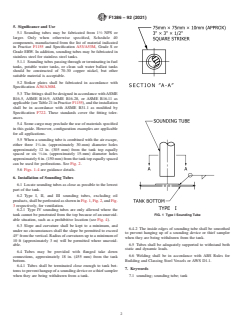
5.6 Figs. 1-4 are guidance details.
FIG. 1 Type I Sounding Tube
FIG. 2 Type II Sounding Tube
FIG. 3 Type III Sounding Tube
FIG. 4 Type IV Sounding Tube
SCOPE
1.1 This guide covers design and construction criteria for striker plates and sounding tubes, excluding deck penetrations and caps, for use with sounding rods or tapes in freshwater, saltwater, and oil tanks.
1.2 The values stated in inch-pound units are to be regarded as standard. The values given in parentheses are mathematical conversions to SI units that are provided for information only and are not considered standard.
1.3 This standard does not purport to address all of the safety concerns, if any, associated with its use. It is the responsibility of the user of this standard to establish appropriate safety, health, and environmental practices and determine the applicability of regulatory limitations prior to use.
1.4 This international standard was developed in accordance with internationally recognized principles on standardization established in the Decision on Principles for the Development of International Standards, Guides and Recommendations issued by the World Trade Organization Technical Barriers to Trade (TBT) Committee.
- Status
- Published
- Publication Date
- 14-Apr-2021
- Technical Committee
- F25 - Ships and Marine Technology
- Drafting Committee
- F25.11 - Machinery and Piping Systems

Overview
ASTM F1386-92(2021), "Standard Guide for Construction of Sounding Tube and Striker Plate for Tank Sounding," provides comprehensive guidance for the design and fabrication of sounding tubes and striker plates. These components are essential for accurate manual measurement (sounding) of fluid levels in tanks, including freshwater, saltwater, oil, and ballast tanks. The standard, developed by ASTM Committee F25 on Ships and Marine Technology, ensures safe, reliable, and consistent tank sounding procedures by outlining construction materials, design criteria, installation practices, and relevant referenced standards.
Key Topics
- Scope of Application: Addresses design and construction criteria for striker plates and internal or external sounding tubes, excluding deck penetrations and caps. Applicable for tanks used in marine and industrial settings.
- Material Selection:
- Sounding tubes typically fabricated from 1½ NPS or larger, using Schedule 40 components as specified in Practice ASTM F1155 and ASTM A53/A53M (Grade S or ERW).
- Stainless steel for stainless tanks and 70-30 copper nickel for fuel, potable water, or clean salt water ballast tank applications.
- Striker plates constructed according to ASTM A36/A36M.
- Fittings and Installation:
- Fittings to comply with ASME B16.5, B16.9, B16.28, or B16.11 standards, and installation must align with ASME B31.1 as modified by ASTM F722.
- Fitting tolerances, welding standards, and support requirements ensure safe and effective operation.
- Tube and Plate Configuration:
- Provides four types of configurations (Type I-IV) for internal and external installations.
- Offers guidance on tubing perforations for air escape and fluid sampling.
- Safety & Compliance: Emphasizes the importance of user responsibility in implementing appropriate safety, health, and environmental practices.
Applications
The guidelines outlined in ASTM F1386-92(2021) are widely adopted in the following contexts:
- Marine Vessels: Ensures precise fluid level measurement in shipboard tanks, aiding in cargo, ballast, and water management.
- Industrial Storage Tanks: Supports safe and consistent manual sounding for routine maintenance and inventory control in oil, chemical, and water storage tanks.
- Port and Terminal Operations: Facilitates compliance with international maritime and port authority regulations for tank soundings and inspections.
- Engineering & Maintenance: Used by engineers, shipbuilders, and maintenance personnel to design, install, or retrofit tank sounding systems according to recognized standards.
Key practical benefits include enhanced measurement accuracy, material compatibility with diverse tank contents, reduced equipment wear, and improved maintenance safety.
Related Standards
ASTM F1386-92(2021) references and aligns with several closely related standards to ensure compatibility and comprehensive coverage:
- ASTM A36/A36M - Specification for Carbon Structural Steel
- ASTM A53/A53M - Specification for Pipe, Steel, Black and Hot-Dipped, Zinc-Coated, Welded and Seamless
- ASTM F1155 - Practice for Selection and Application of Piping System Materials
- ASTM F722 - Specification for Welded Joints for Shipboard Piping Systems
- ASME B16.5, B16.9, B16.11, B16.28 - Pipe flange and fitting standards
- ASME B31.1 - Power Piping
- ABS Rules for Building and Classing Steel Vessels - Installation and welding requirements for marine vessels
- AWS D1.1 - Structural Welding Code
By adhering to these referenced standards, users of ASTM F1386-92(2021) ensure not only technical compliance but also international interoperability and regulatory acceptance.
Keywords: ASTM F1386, tank sounding, sounding tube, striker plate, marine tank standards, sounding rod, fluid measurement, piping materials, ASME piping, shipboard tank measurement, industry standards, storage tank maintenance.
Relations
- Effective Date
- 01-Mar-2024
- Refers
ASTM F1155-10(2019) - Standard Practice for Selection and Application of Piping System Materials - Effective Date
- 01-Dec-2019
- Refers
ASTM F1155-10(2015) - Standard Practice for Selection and Application of Piping System Materials - Effective Date
- 01-May-2015
- Effective Date
- 01-Nov-2014
- Effective Date
- 01-Nov-2012
- Effective Date
- 01-Mar-2012
- Effective Date
- 15-Dec-2010
- Effective Date
- 01-Oct-2010
- Effective Date
- 01-Nov-2008
- Effective Date
- 15-May-2008
- Effective Date
- 01-Sep-2007
- Effective Date
- 01-Oct-2006
- Effective Date
- 01-May-2006
- Effective Date
- 01-Oct-2005
- Effective Date
- 01-Mar-2005
Get Certified
Connect with accredited certification bodies for this standard

Institut za varilstvo d.o.o. (Welding Institute)
Slovenia's leading welding institute since 1952. ISO 3834, EN 1090, pressure equipment certification, NDT personnel, welder qualification. Only IIW Au
Sponsored listings
Frequently Asked Questions
ASTM F1386-92(2021) is a guide published by ASTM International. Its full title is "Standard Guide for Construction of Sounding Tube and Striker Plate for Tank Sounding". This standard covers: SIGNIFICANCE AND USE 5.1 Sounding tubes may be fabricated from 11/2 NPS or larger. Only when otherwise specified, Schedule 40 components, manufactured from the list of material indicated in Practice F1155 and Specification A53/A53M, Grade S or Grade ERW. In addition, sounding tubes may be fabricated in stainless steel for stainless steel tanks. 5.1.1 Sounding tubes passing through or terminating in fuel tanks, potable water tanks, or clean salt water ballast tanks should be constructed of 70-30 copper nickel, but other suitable material is acceptable. 5.2 Striker plates shall be fabricated in accordance with Specification A36/A36M. 5.3 The fittings shall be designed in accordance with ASME B16.5, ASME B16.9, ASME B16.28, or ASME B16.11 as applicable (see Table 21 in Practice F1155), and the installation shall be in accordance with ASME B31.1 as modified by Specification F722. These standards cover the fitting tolerances. 5.4 Some cargo may preclude the use of materials specified in this guide. However, configuration examples are applicable for all applications. 5.5 When a sounding tube is combined with the air escape, either three 11/4-in. (approximately 30-mm) diameter holes approximately 12 in. (305 mm) from the tank top equally spaced or six 1/2-in. (approximately 15-mm) diameter holes approximately 6 in. (150 mm) from the tank top equally spaced can be used for perforations. See Fig. 2. 5.6 Figs. 1-4 are guidance details. FIG. 1 Type I Sounding Tube FIG. 2 Type II Sounding Tube FIG. 3 Type III Sounding Tube FIG. 4 Type IV Sounding Tube SCOPE 1.1 This guide covers design and construction criteria for striker plates and sounding tubes, excluding deck penetrations and caps, for use with sounding rods or tapes in freshwater, saltwater, and oil tanks. 1.2 The values stated in inch-pound units are to be regarded as standard. The values given in parentheses are mathematical conversions to SI units that are provided for information only and are not considered standard. 1.3 This standard does not purport to address all of the safety concerns, if any, associated with its use. It is the responsibility of the user of this standard to establish appropriate safety, health, and environmental practices and determine the applicability of regulatory limitations prior to use. 1.4 This international standard was developed in accordance with internationally recognized principles on standardization established in the Decision on Principles for the Development of International Standards, Guides and Recommendations issued by the World Trade Organization Technical Barriers to Trade (TBT) Committee.
SIGNIFICANCE AND USE 5.1 Sounding tubes may be fabricated from 11/2 NPS or larger. Only when otherwise specified, Schedule 40 components, manufactured from the list of material indicated in Practice F1155 and Specification A53/A53M, Grade S or Grade ERW. In addition, sounding tubes may be fabricated in stainless steel for stainless steel tanks. 5.1.1 Sounding tubes passing through or terminating in fuel tanks, potable water tanks, or clean salt water ballast tanks should be constructed of 70-30 copper nickel, but other suitable material is acceptable. 5.2 Striker plates shall be fabricated in accordance with Specification A36/A36M. 5.3 The fittings shall be designed in accordance with ASME B16.5, ASME B16.9, ASME B16.28, or ASME B16.11 as applicable (see Table 21 in Practice F1155), and the installation shall be in accordance with ASME B31.1 as modified by Specification F722. These standards cover the fitting tolerances. 5.4 Some cargo may preclude the use of materials specified in this guide. However, configuration examples are applicable for all applications. 5.5 When a sounding tube is combined with the air escape, either three 11/4-in. (approximately 30-mm) diameter holes approximately 12 in. (305 mm) from the tank top equally spaced or six 1/2-in. (approximately 15-mm) diameter holes approximately 6 in. (150 mm) from the tank top equally spaced can be used for perforations. See Fig. 2. 5.6 Figs. 1-4 are guidance details. FIG. 1 Type I Sounding Tube FIG. 2 Type II Sounding Tube FIG. 3 Type III Sounding Tube FIG. 4 Type IV Sounding Tube SCOPE 1.1 This guide covers design and construction criteria for striker plates and sounding tubes, excluding deck penetrations and caps, for use with sounding rods or tapes in freshwater, saltwater, and oil tanks. 1.2 The values stated in inch-pound units are to be regarded as standard. The values given in parentheses are mathematical conversions to SI units that are provided for information only and are not considered standard. 1.3 This standard does not purport to address all of the safety concerns, if any, associated with its use. It is the responsibility of the user of this standard to establish appropriate safety, health, and environmental practices and determine the applicability of regulatory limitations prior to use. 1.4 This international standard was developed in accordance with internationally recognized principles on standardization established in the Decision on Principles for the Development of International Standards, Guides and Recommendations issued by the World Trade Organization Technical Barriers to Trade (TBT) Committee.
ASTM F1386-92(2021) is classified under the following ICS (International Classification for Standards) categories: 23.020.99 - Other fluid storage devices. The ICS classification helps identify the subject area and facilitates finding related standards.
ASTM F1386-92(2021) has the following relationships with other standards: It is inter standard links to ASTM A53/A53M-24, ASTM F1155-10(2019), ASTM F1155-10(2015), ASTM F722-82(2014), ASTM A36/A36M-12, ASTM A53/A53M-12, ASTM F1155-10, ASTM A53/A53M-10, ASTM F722-82(2008), ASTM A36/A36M-08, ASTM A53/A53M-07, ASTM A53/A53M-06a, ASTM A53/A53M-06, ASTM A53/A53M-05, ASTM A36/A36M-05. Understanding these relationships helps ensure you are using the most current and applicable version of the standard.
ASTM F1386-92(2021) is available in PDF format for immediate download after purchase. The document can be added to your cart and obtained through the secure checkout process. Digital delivery ensures instant access to the complete standard document.
Standards Content (Sample)
This international standard was developed in accordance with internationally recognized principles on standardization established in the Decision on Principles for the
Development of International Standards, Guides and Recommendations issued by the World Trade Organization Technical Barriers to Trade (TBT) Committee.
Designation: F1386 − 92 (Reapproved 2021) An American National Standard
Standard Guide for
Construction of Sounding Tube and Striker Plate for Tank
Sounding
This standard is issued under the fixed designation F1386; the number immediately following the designation indicates the year of
original adoption or, in the case of revision, the year of last revision. A number in parentheses indicates the year of last reapproval. A
superscript epsilon (´) indicates an editorial change since the last revision or reapproval.
1. Scope 2.2 ASME Standards:
ASME B16.5 Pipe Flanges and Flanged Fittings: NPS 1/2
1.1 This guide covers design and construction criteria for
through NPS 24 Metric/Inch Standard
striker plates and sounding tubes, excluding deck penetrations
ASME B16.9 Factory-Made Wrought Buttwelding Fittings
and caps, for use with sounding rods or tapes in freshwater,
ASME B16.11 Forged Fittings, Socket-Welding and
saltwater, and oil tanks.
Threaded
ASME B16.28 Wrought Steel Buttwelding Short Radius
1.2 The values stated in inch-pound units are to be regarded
Elbows and Returns
as standard. The values given in parentheses are mathematical
ASME B31.1 Power Piping
conversions to SI units that are provided for information only
and are not considered standard.
2.3 ABS Standard:
ABS Rules for Building and Classing Steel Vessels
1.3 This standard does not purport to address all of the
safety concerns, if any, associated with its use. It is the 2.4 AWS Standard:
responsibility of the user of this standard to establish appro- AWS D1.1 Structural Welding Code
priate safety, health, and environmental practices and deter-
3. Terminology
mine the applicability of regulatory limitations prior to use.
1.4 This international standard was developed in accor-
3.1 Definitions of Terms Specific to This Standard:
dance with internationally recognized principles on standard-
3.1.1 external sounding tube, n—a sounding tube located
ization established in the Decision on Principles for the
outside the boundaries of the tank being sounded.
Development of International Standards, Guides and Recom-
3.1.2 internal sounding tube, n—a sounding tube located
mendations issued by the World Trade Organization Technical
inside the tank being sounded.
Barriers to Trade (TBT) Committee.
3.1.3 sounding, n—measurement by sounding; a place or
part of a body of liquid where a hand sounding line will reach
2. Referenced Documents
bottom.
2.1 ASTM Standards:
A36/A36M Specification for Carbon Structural Steel 4. Classification
A53/A53M Specification for Pipe, Steel, Black and Hot-
4.1 Type I—Internal sounding tube, with separate striker
Dipped, Zinc-Coated, Welded and Seamless
plate.
F722 Specification for Welded Joints for Shipboard Piping
4.2 Type II—Internal sounding tube, with attached striker
Systems
plate.
F1155 Practice for Selection and Application of Piping
System Materials 4.3 Type III—Internal sounding tube, with angle striker
plate.
4.4 Type IV—External sounding tube.
This guide is under the jurisdiction of ASTM Committee F25 on Ships and
Marine Technology and is the direct responsibility of Subcommittee F25.11 on
Machinery and Piping Systems.
Current edition approved April 15, 2021. Published April 2021. Originally Available from American Society of Mechanical Engineers (ASME), ASME
ɛ1
approved in 1992. Last previous edition approved in 2016 as F1386 – 92 (2016) . International Headquarters, Two Park Ave., New York, NY 10016-5990, http://
DOI: 10.1520/F1386-92R21. www.asme.org.
2 4
For referenced ASTM standards, visit the ASTM website, www.astm.org, or Available from American Bureau of Shipping (ABS), ABS Plaza, 1701 City
contact ASTM Customer Service at service@astm.org. For Annual Book of ASTM Plaza Dr., Spring, TX 77389, http://www.eagle.org.
Standards volume information, refer to the standard’s Document Summary page on Available from American Welding Society (AWS), 8669 NW 36 St., #130,
the ASTM website. Miami, FL 33166-6672, http://www.aws.org.
Copyright © ASTM International, 100 Barr Harbor Drive, PO Box C700, West Conshohocken, PA 19428-2959. United States
F1386 − 92 (2021)
5. Significance and Use
5.1 Sounding tubes may be fabricated from 1 ⁄2 NPS or
larger. Only when otherwise specified, Schedule 40
components, manufactured from the list of material indicated
in Practic
...