

ASTM C1917-23
(Specification)Standard Specification for Rigid Polyvinyl Chloride (PVC) Jacketing for Insulation
General Information
- Abstract
SCOPE
1.1 This specification covers rigid polyvinyl (PVC) jacketing for thermal and acoustical insulation for pipe, rigid tubing and equipment operating at either above or below ambient temperatures in non-direct sunlight exposure.
1.2 This material specification does not cover exposure to direct sunlight. Refer to manufacturer’s guidelines for direct sunlight exposure.
1.3 This specification does not address PVC jacketing used as fitting covers over thermal insulation.
1.4 This is a material specification and does not cover insulation systems of which this material is a component, nor imply that an installed insulation system using these materials will provide the physical properties and performance characteristics specified in Section 7.
1.5 This material specification does not cover sizing calculations or installation of rigid PVC jacketing.
1.6 The values stated in inch-pound units are to be regarded as standard. The values given in parentheses are mathematical conversions to SI units that are provided for information only and are not considered standard.
1.7 This standard does not purport to address all of the safety concerns, if any, associated with its use. It is the responsibility of the user of this standard to establish appropriate safety, health, and environmental practices and determine the applicability of regulatory limitations prior to use.
1.8 This international standard was developed in accordance with internationally recognized principles on standardization established in the Decision on Principles for the Development of International Standards, Guides and Recommendations issued by the World Trade Organization Technical Barriers to Trade (TBT) Committee.
- Status
- Published
- Publication Date
- 14-Nov-2023
- Technical Committee
- C16 - Thermal Insulation
- Drafting Committee
- C16.40 - Insulation Systems

Overview
ASTM C1917-23: Standard Specification for Rigid Polyvinyl Chloride (PVC) Jacketing for Insulation defines material and performance requirements for rigid PVC jacketing used in thermal and acoustical insulation systems. This standard is essential for specifying rigid PVC jacketing applied over pipe, rigid tubing, and equipment that operate at temperatures above or below ambient, provided these installations are not exposed to direct sunlight. By adhering to ASTM C1917-23, manufacturers, designers, and purchasers can ensure product consistency, performance, and safety in insulation system applications.
Key Topics
Material Requirements:
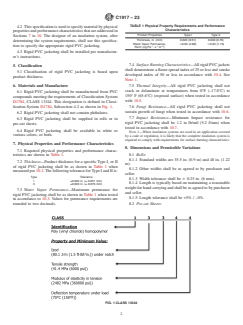
Rigid PVC jacketing must be manufactured from compounds meeting ASTM D1784, CLASS 13344, and must not contain phthalates. The material is available in rolls or pre-cut sheets in various colors, most commonly white.Performance Criteria:
- Thickness: Products are classified by thickness, with tolerances specified for both standard types.
- Physical Protection: The jacketing must provide adequate protection against physical damage and moisture ingress.
- Surface Burning Characteristics: Rigid PVC jackets must meet strict indices for flame spread (≤25) and smoke developed (≤50) as tested per ASTM E84.
- Thermal Integrity: The jacketing must not crack or delaminate when subjected to temperatures from 0°F to 150°F.
- Water Vapor Permeance: Maximum permeance values are specified to control moisture transmission.
- Fungi Resistance: The material must not sustain fungal growth under test conditions.
- Impact Resistance: Defined minimum values ensure the jacketing can withstand impacts during handling and service.
Dimensional Requirements:
Covers standard and customizable sizes for rolls and pre-cut sheets, including specific tolerances for width and length.Workmanship and Appearance:
The finished product must be free from defects such as holes, wrinkles, or roughness that could impact performance or aesthetics.Testing and Certification:
All products should be tested per referenced ASTM methods, with test reports and certifications available upon request.
Applications
Industrial Piping Systems:
Rigid PVC jacketing is widely used in industrial environments to protect pipe and rigid tubing insulation from mechanical damage and moisture.Commercial Insulation:
Provides a finished appearance and resilience for building equipment and piping insulation in commercial facilities.Mechanical Rooms and Equipment:
Ensures long-lasting protection and maintains performance of insulation in HVAC and plumbing installations.Acoustical Insulation:
Used in applications that require both thermal and sound-dampening properties, while offering robust outer protection.
Note: This standard does not apply to PVC jacketing used as fitting covers or to installations exposed to direct sunlight. Additionally, sizing calculations, installation practices, and the performance of complete insulation systems are outside the scope of ASTM C1917-23.
Related Standards
- ASTM D1784: Classification System for Rigid Poly(Vinyl Chloride) (PVC) Compounds.
- ASTM C168: Terminology Relating to Thermal Insulation.
- ASTM C1263: Test Method for Thermal Integrity of Flexible Water Vapor Retarders.
- ASTM C1338: Test Method for Determining Fungi Resistance of Insulation Materials and Facings.
- ASTM D5420: Test Method for Impact Resistance of Flat, Rigid Plastic Specimens.
- ASTM D5947: Test Methods for Physical Dimensions of Solid Plastics Specimens.
- ASTM E84: Test Method for Surface Burning Characteristics of Building Materials.
- ASTM E96/E96M: Test Methods for Gravimetric Determination of Water Vapor Transmission Rate of Materials.
Practical Value
By specifying ASTM C1917-23 compliant rigid PVC jacketing, engineers, architects, contractors, and facility managers ensure their insulation systems are durable, safe, and moisture-resistant. The standard supports regulatory compliance, enhances system longevity, and provides clear requirements for procurement and quality assurance within the insulation industry.
Relations
- Effective Date
- 15-Apr-2024
- Effective Date
- 01-Mar-2024
- Effective Date
- 01-Dec-2023
- Effective Date
- 15-Nov-2023
- Effective Date
- 01-Sep-2023
- Effective Date
- 15-Oct-2022
- Effective Date
- 01-May-2022
Frequently Asked Questions
ASTM C1917-23 is a technical specification published by ASTM International. Its full title is "Standard Specification for Rigid Polyvinyl Chloride (PVC) Jacketing for Insulation". This standard covers: SCOPE 1.1 This specification covers rigid polyvinyl (PVC) jacketing for thermal and acoustical insulation for pipe, rigid tubing and equipment operating at either above or below ambient temperatures in non-direct sunlight exposure. 1.2 This material specification does not cover exposure to direct sunlight. Refer to manufacturer’s guidelines for direct sunlight exposure. 1.3 This specification does not address PVC jacketing used as fitting covers over thermal insulation. 1.4 This is a material specification and does not cover insulation systems of which this material is a component, nor imply that an installed insulation system using these materials will provide the physical properties and performance characteristics specified in Section 7. 1.5 This material specification does not cover sizing calculations or installation of rigid PVC jacketing. 1.6 The values stated in inch-pound units are to be regarded as standard. The values given in parentheses are mathematical conversions to SI units that are provided for information only and are not considered standard. 1.7 This standard does not purport to address all of the safety concerns, if any, associated with its use. It is the responsibility of the user of this standard to establish appropriate safety, health, and environmental practices and determine the applicability of regulatory limitations prior to use. 1.8 This international standard was developed in accordance with internationally recognized principles on standardization established in the Decision on Principles for the Development of International Standards, Guides and Recommendations issued by the World Trade Organization Technical Barriers to Trade (TBT) Committee.
SCOPE 1.1 This specification covers rigid polyvinyl (PVC) jacketing for thermal and acoustical insulation for pipe, rigid tubing and equipment operating at either above or below ambient temperatures in non-direct sunlight exposure. 1.2 This material specification does not cover exposure to direct sunlight. Refer to manufacturer’s guidelines for direct sunlight exposure. 1.3 This specification does not address PVC jacketing used as fitting covers over thermal insulation. 1.4 This is a material specification and does not cover insulation systems of which this material is a component, nor imply that an installed insulation system using these materials will provide the physical properties and performance characteristics specified in Section 7. 1.5 This material specification does not cover sizing calculations or installation of rigid PVC jacketing. 1.6 The values stated in inch-pound units are to be regarded as standard. The values given in parentheses are mathematical conversions to SI units that are provided for information only and are not considered standard. 1.7 This standard does not purport to address all of the safety concerns, if any, associated with its use. It is the responsibility of the user of this standard to establish appropriate safety, health, and environmental practices and determine the applicability of regulatory limitations prior to use. 1.8 This international standard was developed in accordance with internationally recognized principles on standardization established in the Decision on Principles for the Development of International Standards, Guides and Recommendations issued by the World Trade Organization Technical Barriers to Trade (TBT) Committee.
ASTM C1917-23 has the following relationships with other standards: It is inter standard links to ASTM C168-24, ASTM E96/E96M-24, ASTM E84-23d, ASTM E96/E96M-23, ASTM E84-23c, ASTM E96/E96M-22ae1, ASTM C168-22. Understanding these relationships helps ensure you are using the most current and applicable version of the standard.
ASTM C1917-23 is available in PDF format for immediate download after purchase. The document can be added to your cart and obtained through the secure checkout process. Digital delivery ensures instant access to the complete standard document.
Standards Content (Sample)
This international standard was developed in accordance with internationally recognized principles on standardization established in the Decision on Principles for the
Development of International Standards, Guides and Recommendations issued by the World Trade Organization Technical Barriers to Trade (TBT) Committee.
Designation: C1917 − 23
Standard Specification for
Rigid Polyvinyl Chloride (PVC) Jacketing for Insulation
This standard is issued under the fixed designation C1917; the number immediately following the designation indicates the year of
original adoption or, in the case of revision, the year of last revision. A number in parentheses indicates the year of last reapproval. A
superscript epsilon (´) indicates an editorial change since the last revision or reapproval.
1. Scope 2. Referenced Documents
2.1 ASTM Standards:
1.1 This specification covers rigid polyvinyl (PVC) jacket-
ing for thermal and acoustical insulation for pipe, rigid tubing C168 Terminology Relating to Thermal Insulation
C1263 Test Method for Thermal Integrity of Flexible Water
and equipment operating at either above or below ambient
temperatures in non-direct sunlight exposure. Vapor Retarders
C1338 Test Method for Determining Fungi Resistance of
1.2 This material specification does not cover exposure to
Insulation Materials and Facings
direct sunlight. Refer to manufacturer’s guidelines for direct
D1784 Classification System and Basis for Specification for
sunlight exposure.
Rigid Poly(Vinyl Chloride) (PVC) Compounds and Chlo-
1.3 This specification does not address PVC jacketing used
rinated Poly(Vinyl Chloride) (CPVC) Compounds
as fitting covers over thermal insulation.
D5420 Test Method for Impact Resistance of Flat, Rigid
Plastic Specimen by Means of a Striker Impacted by a
1.4 This is a material specification and does not cover
Falling Weight (Gardner Impact)
insulation systems of which this material is a component, nor
D5947 Test Methods for Physical Dimensions of Solid
imply that an installed insulation system using these materials
Plastics Specimens
will provide the physical properties and performance charac-
E84 Test Method for Surface Burning Characteristics of
teristics specified in Section 7.
Building Materials
1.5 This material specification does not cover sizing calcu-
E96/E96M Test Methods for Gravimetric Determination of
lations or installation of rigid PVC jacketing.
Water Vapor Transmission Rate of Materials
1.6 The values stated in inch-pound units are to be regarded
3. Terminology
as standard. The values given in parentheses are mathematical
3.1 Definitions—Definitions in Terminology C168 apply to
conversions to SI units that are provided for information only
terms used in this specification.
and are not considered standard.
3.2 Definitions of Terms Specific to This Standard:
1.7 This standard does not purport to address all of the
3.2.1 circumferential dimension, n—the length of PVC jack-
safety concerns, if any, associated with its use. It is the
eting to fit around the installed pipe or tubing insulation.
responsibility of the user of this standard to establish appro-
priate safety, health, and environmental practices and deter-
3.2.2 crazing, n—the phenomenon that produces a network
mine the applicability of regulatory limitations prior to use.
of fine cracks on the surface of a material.
1.8 This international standard was developed in accor-
3.2.3 rigid PVC, n—Poly Vinyl Chloride in sheet form
dance with internationally recognized principles on standard-
having high impact resistance and low flexibility, using com-
ization established in the Decision on Principles for the
pounds as characterized per Classification System D1784.
Development of International Standards, Guides and Recom-
4. Significance and Use
mendations issued by the World Trade Organization Technical
Barriers to Trade (TBT) Committee.
4.1 The primary functions of rigid PVC jacketing are to
provide physical damage protection, moisture protection, and
finished system aesthetics.
This specification is under the jurisdiction of ASTM Committee C16 on
Thermal Insulation and is the direct responsibility of Subcommittee C16.40 on For referenced ASTM standards, visit the ASTM website, www.astm.org, or
Insulation Systems. contact ASTM Customer Service at service@astm.org. For Annual Book of ASTM
Current edition approved Nov. 15, 2023. Published January 2024. DOI: 10.1520/ Standards volume information, refer to the standard’s Document Summary page on
C1917-23. the ASTM website.
Copyright © ASTM International, 100 Barr Harbor Drive, PO Box C700, West Conshohocken, PA 19428-2959. United States
C1917 − 23
TABLE 1 Physical Property Requirements and Performance
4.2 This specification is used to specify material by physical
Characteristics
properties and performance characteristics that are addressed in
Product Properties Type I Type II
Sections 7 to 10. The designer of an insulation system, after
Thickness, in. (mm) 0.020 (0.51) 0.030 (0.76)
determining the system requirements, shall use this specifica-
Water Vapor Permeance, #0.05 (2.88) #0.03 (1.73)
tion to specify the appropriate rigid PVC jacketing.
-1 -1 -2
Perm (ng·Pa · s ·m )
4.3 Rigid PVC jacketing shall be installed per manufactur-
er’s instructions.
7.4 Surface Burning Characteristics—All rigid PVC jackets
5. Classification
shall demonstrate a flame spread index of 25 or less and smoke
5.1 Classification of rigid PVC jacketing is based upon
developed index of 50 or less in accordance with 10.4. See
product thickness.
Note 1.
6. Materials and Manufacture
7.5 Thermal Integrity—All rigid PVC jacketing shall not
crack or delaminate at temperatures from 0°F (–17.8°C) to
6.1 Rigid PVC jacketing shall be manufactured from PVC
150° F (65.6°C) (exposed surface) when tested in accordance
compounds meeting the requirements of Classification System
with 10.5.
D1784, CLASS 13344. This designation is defined in Classi-
fication System D1784, Subsection 4.2 as shown in Fig. 1.
7.6 Fungi Resistance—All rigid PVC jacketing shall not
sustain growth of fungi when tested in accordance with 10.6.
6.2 Rigid PVC jacketing shall not contain phthalates.
7.7 Impact Resistance—Minimum Impact resistance for
6.3 Rigid PVC jacketing shall be supplied in rolls or in
rigid PVC jacketing shall be 1.2 in lb/mil (5.2 J/mm) when
pre-cut sheets.
tested in accordance with 10.7.
6.4 Rigid PVC jacketing shall be available in white or
NOTE 1—When insulation systems are used in an application covered
various colors, or both.
by a code or regulation, it is likely that the complete insulation system is
required to comply with requirements for surface burning characteristics.
7. Physical Properties and Performance Characteristics
8. Dimensions and Permissible Variations
7.1 Required physical properties and performance charac-
8.1 Rolls:
teristics are shown in Table 1.
8.1.1 Standard widths are 35.5 in. (0.9 m) and 48 in. (1.22
7.2 Thickness—Product thickness for a specific Type I, or II
m).
of rigid PVC jacketing shall be as shown in Table 1 when
8.1.2 Other widths shall be as agreed to by purchaser and
measured per 10.2. The following tolerance for Type I and II is:
seller.
Type Tolerance
...