

ASTM A937/A937M-12(2019)
(Test Method)Standard Test Method for Determining Interlaminar Resistance of Insulating Coatings Using Two Adjacent Test Surfaces
General Information
- Abstract
SIGNIFICANCE AND USE
5.1 This test method is particularly suitable for quality control in the application of insulating coatings. This test method measures the interlaminar resistance of insulating coatings, as defined in 3.1.4. Interlaminar resistance is the measure of the insulating quality of the coating. Interlaminar resistance is reported in units of kΩ.
5.2 The interlaminar resistance determined in accordance with this test method is not the same quantity determined by Test Method A717/A717M.
5.3 This test method is particularly useful for electrical steels coated with inorganic insulating coatings having surface insulation resistivities in excess of 0.3 kΩ·cm2 [30 kΩ·mm2] when tested using Test Method A717/A717M (a Franklin current less than 0.02 A). This test method can readily be extended to any range of insulation resistivity that the equipment comprising the two-surface tester allows. For the equipment specified herein, the maximum measurable resistance is 1200 kΩ for the 10-μA current setting and 12 000 kΩ for the 1-μA current setting; the maximum voltage for the test system is 12 V.
5.4 Repeat readings on the same set of two electrical steel laminations using different contact positions, as well as the testing of multiple laminations from the same lot of electrical steel, are recommended. Several readings are suggested because the coating thickness may vary across the surface of a given electrical steel lamination. Additionally, the coating thickness may vary across several laminations taken from the same lot of electrical steel. Such variations in coating thickness are likely to yield variations in the measured interlaminar resistance. The required number of readings depends on the nature of the coating and the accuracy required.
SCOPE
1.1 This test method covers a means of testing the interlaminar resistance of electrically insulating coatings as applied to adjacent laminations of flat-rolled electrical steel, under predetermined conditions of voltage, pressure and temperature. It indicates the effectiveness of surface coatings on electrical sheet steels for limiting interlaminar losses in electrical machinery. The interlaminar resistance is measured directly in units of resistance (kΩ).
1.2 This test method is particularly useful for, but not limited to, electrical steels coated with inorganic insulating coatings.
1.3 The values and equations stated in customary (cgs-emu and inch-pound) or SI units are to be regarded separately as standard. Within this standard, SI units are shown in brackets. The values stated in each system may not be exact equivalents; therefore, each system shall be used independently of the other. Combining values from the two systems may result in nonconformance with this standard.
1.4 This standard does not purport to address all of the safety concerns, if any, associated with its use. It is the responsibility of the user of this standard to establish appropriate safety, health, and environmental practices and determine the applicability of regulatory limitations prior to use.
1.5 This international standard was developed in accordance with internationally recognized principles on standardization established in the Decision on Principles for the Development of International Standards, Guides and Recommendations issued by the World Trade Organization Technical Barriers to Trade (TBT) Committee.
- Status
- Published
- Publication Date
- 31-Mar-2019
- Technical Committee
- A06 - Magnetic Properties
- Drafting Committee
- A06.01 - Test Methods
Overview
ASTM A937/A937M-12(2019), titled Standard Test Method for Determining Interlaminar Resistance of Insulating Coatings Using Two Adjacent Test Surfaces, is a crucial standard developed by ASTM for the electrical steel industry. This test method provides a reliable approach for measuring the interlaminar resistance of electrically insulating coatings applied to adjacent laminations of flat-rolled electrical steel. Interlaminar resistance, expressed in kilo-ohms (kΩ), is an important indicator of the insulating quality of coatings designed to limit interlaminar losses in electrical machinery such as transformers and motors. The test method is well-suited for quality control during the production and application of such coatings, particularly inorganic types.
Key Topics
- Objective of the Test: To determine the interlaminar resistance, which measures how effectively an insulating coating prevents current flow between steel laminations.
- Test Specimen: Typically, two flat electrical steel laminations, each with insulating coatings on both sides, are placed in intimate contact for measurement.
- Measurement Method: A four-probe, two-surface tester applies constant current and measures the resulting voltage to directly determine resistance.
- Test Parameters: Tests are performed under controlled voltage, pressure, and temperature conditions, with standard pressure typically at 300 psi (2.1 MPa) and temperature at 25°C.
- Repeatability: Multiple measurements are recommended because coating thickness and properties can vary across laminations and lots.
- Reporting Units: Results are reported in kΩ, with provisions for conversion to area resistivity (e.g., kΩ·cm² per lamination).
Applications
- Quality Control in Manufacturing: This test method is especially valuable for manufacturers of flat-rolled electrical steel and insulating coatings, enabling verification of insulating performance in real time.
- Electrical Machinery: Interlaminar resistance measurements help ensure optimal performance of electrical steels in transformers, motors, and generators by minimizing interlaminar losses.
- Product Development: R&D teams benefit from the ability to benchmark and improve insulating coatings for electrical steel applications, optimizing for higher resistance values and better efficiency.
- Purchasing and Specification: Producers and end-users can specify and ensure compliance with insulation resistance requirements in contracts and technical documentation.
- Industry Versatility: While particularly important for inorganic coatings and high-resistivity surfaces, the method can be extended to a variety of insulating materials as long as suitable equipment is available.
Related Standards
- ASTM A717/A717M: Test Method for Surface Insulation Resistivity of Single-Strip Specimens. While both A937/A937M and A717/A717M measure insulating properties, they cover different aspects-A717/A717M focuses on surface insulation, while A937/A937M addresses interlaminar resistance between adjacent laminations.
- ASTM A34/A34M: Practice for Sampling and Procurement Testing of Magnetic Materials. This standard is referenced regarding specimen sampling for consistent and representative results.
- International Standardization Principles: ASTM A937/A937M-12(2019) was developed in alignment with World Trade Organization guidelines for international standards, promoting global harmonization.
Practical Value
This standard provides an essential, reproducible method for assessing the quality of insulating coatings used in energy-efficient electrical machines. By adhering to ASTM A937/A937M-12(2019), manufacturers and users can:
- Ensure product quality and performance through standardized testing.
- Communicate clear insulation resistance criteria in supply agreements.
- Enhance the reliability and efficiency of electrical machinery.
Keywords: ASTM A937, interlaminar resistance, insulating coatings, electrical steel, quality control, two-surface tester, resistance measurement, electrical machinery, inorganic insulation, standard test method.
Relations
- Effective Date
- 01-Apr-2019
- Effective Date
- 01-Nov-2012
- Effective Date
- 01-May-2012
- Refers
ASTM A34/A34M-06 - Standard Practice for Sampling and Procurement Testing of Magnetic Materials - Effective Date
- 01-Nov-2006
- Effective Date
- 01-May-2006
- Refers
ASTM A34/A34M-96 - Standard Practice for Sampling and Procurement Testing of Magnetic Materials - Effective Date
- 10-Oct-2001
- Refers
ASTM A34/A34M-01 - Standard Practice for Sampling and Procurement Testing of Magnetic Materials - Effective Date
- 10-Oct-2001
- Effective Date
- 10-May-2001
- Effective Date
- 10-May-2001
- Referred By
ASTM A677-16 - Standard Specification for Nonoriented Electrical Steel Fully Processed Types - Effective Date
- 01-Apr-2019
- Effective Date
- 01-Apr-2019
- Effective Date
- 01-Apr-2019
- Effective Date
- 01-Apr-2019
- Referred By
ASTM A345-19 - Standard Specification for Flat-Rolled Electrical Steels for Magnetic Applications - Effective Date
- 01-Apr-2019
- Effective Date
- 01-Apr-2019
Get Certified
Connect with accredited certification bodies for this standard

IMQ S.p.A. (Certification)
Italian electrical product certification.

SLG Prüf- und Zertifizierungs GmbH
German testing and certification body.

UL Solutions
Global safety science company with testing, inspection and certification.
Sponsored listings
Frequently Asked Questions
ASTM A937/A937M-12(2019) is a standard published by ASTM International. Its full title is "Standard Test Method for Determining Interlaminar Resistance of Insulating Coatings Using Two Adjacent Test Surfaces". This standard covers: SIGNIFICANCE AND USE 5.1 This test method is particularly suitable for quality control in the application of insulating coatings. This test method measures the interlaminar resistance of insulating coatings, as defined in 3.1.4. Interlaminar resistance is the measure of the insulating quality of the coating. Interlaminar resistance is reported in units of kΩ. 5.2 The interlaminar resistance determined in accordance with this test method is not the same quantity determined by Test Method A717/A717M. 5.3 This test method is particularly useful for electrical steels coated with inorganic insulating coatings having surface insulation resistivities in excess of 0.3 kΩ·cm2 [30 kΩ·mm2] when tested using Test Method A717/A717M (a Franklin current less than 0.02 A). This test method can readily be extended to any range of insulation resistivity that the equipment comprising the two-surface tester allows. For the equipment specified herein, the maximum measurable resistance is 1200 kΩ for the 10-μA current setting and 12 000 kΩ for the 1-μA current setting; the maximum voltage for the test system is 12 V. 5.4 Repeat readings on the same set of two electrical steel laminations using different contact positions, as well as the testing of multiple laminations from the same lot of electrical steel, are recommended. Several readings are suggested because the coating thickness may vary across the surface of a given electrical steel lamination. Additionally, the coating thickness may vary across several laminations taken from the same lot of electrical steel. Such variations in coating thickness are likely to yield variations in the measured interlaminar resistance. The required number of readings depends on the nature of the coating and the accuracy required. SCOPE 1.1 This test method covers a means of testing the interlaminar resistance of electrically insulating coatings as applied to adjacent laminations of flat-rolled electrical steel, under predetermined conditions of voltage, pressure and temperature. It indicates the effectiveness of surface coatings on electrical sheet steels for limiting interlaminar losses in electrical machinery. The interlaminar resistance is measured directly in units of resistance (kΩ). 1.2 This test method is particularly useful for, but not limited to, electrical steels coated with inorganic insulating coatings. 1.3 The values and equations stated in customary (cgs-emu and inch-pound) or SI units are to be regarded separately as standard. Within this standard, SI units are shown in brackets. The values stated in each system may not be exact equivalents; therefore, each system shall be used independently of the other. Combining values from the two systems may result in nonconformance with this standard. 1.4 This standard does not purport to address all of the safety concerns, if any, associated with its use. It is the responsibility of the user of this standard to establish appropriate safety, health, and environmental practices and determine the applicability of regulatory limitations prior to use. 1.5 This international standard was developed in accordance with internationally recognized principles on standardization established in the Decision on Principles for the Development of International Standards, Guides and Recommendations issued by the World Trade Organization Technical Barriers to Trade (TBT) Committee.
SIGNIFICANCE AND USE 5.1 This test method is particularly suitable for quality control in the application of insulating coatings. This test method measures the interlaminar resistance of insulating coatings, as defined in 3.1.4. Interlaminar resistance is the measure of the insulating quality of the coating. Interlaminar resistance is reported in units of kΩ. 5.2 The interlaminar resistance determined in accordance with this test method is not the same quantity determined by Test Method A717/A717M. 5.3 This test method is particularly useful for electrical steels coated with inorganic insulating coatings having surface insulation resistivities in excess of 0.3 kΩ·cm2 [30 kΩ·mm2] when tested using Test Method A717/A717M (a Franklin current less than 0.02 A). This test method can readily be extended to any range of insulation resistivity that the equipment comprising the two-surface tester allows. For the equipment specified herein, the maximum measurable resistance is 1200 kΩ for the 10-μA current setting and 12 000 kΩ for the 1-μA current setting; the maximum voltage for the test system is 12 V. 5.4 Repeat readings on the same set of two electrical steel laminations using different contact positions, as well as the testing of multiple laminations from the same lot of electrical steel, are recommended. Several readings are suggested because the coating thickness may vary across the surface of a given electrical steel lamination. Additionally, the coating thickness may vary across several laminations taken from the same lot of electrical steel. Such variations in coating thickness are likely to yield variations in the measured interlaminar resistance. The required number of readings depends on the nature of the coating and the accuracy required. SCOPE 1.1 This test method covers a means of testing the interlaminar resistance of electrically insulating coatings as applied to adjacent laminations of flat-rolled electrical steel, under predetermined conditions of voltage, pressure and temperature. It indicates the effectiveness of surface coatings on electrical sheet steels for limiting interlaminar losses in electrical machinery. The interlaminar resistance is measured directly in units of resistance (kΩ). 1.2 This test method is particularly useful for, but not limited to, electrical steels coated with inorganic insulating coatings. 1.3 The values and equations stated in customary (cgs-emu and inch-pound) or SI units are to be regarded separately as standard. Within this standard, SI units are shown in brackets. The values stated in each system may not be exact equivalents; therefore, each system shall be used independently of the other. Combining values from the two systems may result in nonconformance with this standard. 1.4 This standard does not purport to address all of the safety concerns, if any, associated with its use. It is the responsibility of the user of this standard to establish appropriate safety, health, and environmental practices and determine the applicability of regulatory limitations prior to use. 1.5 This international standard was developed in accordance with internationally recognized principles on standardization established in the Decision on Principles for the Development of International Standards, Guides and Recommendations issued by the World Trade Organization Technical Barriers to Trade (TBT) Committee.
ASTM A937/A937M-12(2019) is classified under the following ICS (International Classification for Standards) categories: 19.080 - Electrical and electronic testing; 29.035.01 - Insulating materials in general. The ICS classification helps identify the subject area and facilitates finding related standards.
ASTM A937/A937M-12(2019) has the following relationships with other standards: It is inter standard links to ASTM A937/A937M-12, ASTM A34/A34M-06(2012), ASTM A717/A717M-12, ASTM A34/A34M-06, ASTM A717/A717M-06, ASTM A34/A34M-96, ASTM A34/A34M-01, ASTM A717/A717M-01, ASTM A717/A717M-95, ASTM A677-16, ASTM A1086-20, ASTM A876-17e1, ASTM A976-18, ASTM A345-19, ASTM A726-18. Understanding these relationships helps ensure you are using the most current and applicable version of the standard.
ASTM A937/A937M-12(2019) is available in PDF format for immediate download after purchase. The document can be added to your cart and obtained through the secure checkout process. Digital delivery ensures instant access to the complete standard document.
Standards Content (Sample)
This international standard was developed in accordance with internationally recognized principles on standardization established in the Decision on Principles for the
Development of International Standards, Guides and Recommendations issued by the World Trade Organization Technical Barriers to Trade (TBT) Committee.
Designation: A937/A937M −12 (Reapproved 2019)
Standard Test Method for
Determining Interlaminar Resistance of Insulating Coatings
Using Two Adjacent Test Surfaces
This standard is issued under the fixed designationA937/A937M; the number immediately following the designation indicates the year
of original adoption or, in the case of revision, the year of last revision.Anumber in parentheses indicates the year of last reapproval.
A superscript epsilon (´) indicates an editorial change since the last revision or reapproval.
1. Scope 2. Referenced Documents
1.1 This test method covers a means of testing the inter- 2.1 ASTM Standards:
laminar resistance of electrically insulating coatings as applied A34/A34MPractice for Sampling and Procurement Testing
to adjacent laminations of flat-rolled electrical steel, under of Magnetic Materials
predeterminedconditionsofvoltage,pressureandtemperature. A717/A717MTestMethodforSurfaceInsulationResistivity
It indicates the effectiveness of surface coatings on electrical of Single-Strip Specimens
sheet steels for limiting interlaminar losses in electrical ma-
3. Terminology
chinery. The interlaminar resistance is measured directly in
units of resistance (kΩ). 3.1 Definitions of Terms Specific to This Standard:
3.1.1 bad contact—acontactwhichresultsinavoltagedrop
1.2 This test method is particularly useful for, but not
in excess of 0.6 V as described in 6.1.3.
limited to, electrical steels coated with inorganic insulating
coatings. 3.1.2 exposed test surface—the insulating top surface of the
top lamination or the insulating bottom surface of the bottom
1.3 The values and equations stated in customary (cgs-emu
lamination of the test specimen.
and inch-pound) or SI units are to be regarded separately as
3.1.3 four-terminal measuring technique, often referred to
standard. Within this standard, SI units are shown in brackets.
as four-probe measuring technique—a common method to
Thevaluesstatedineachsystemmaynotbeexactequivalents;
measure resistance when a high degree of accuracy is re-
therefore,eachsystemshallbeusedindependentlyoftheother.
quired. In this standard, the circuit configuration for this
Combining values from the two systems may result in noncon-
technique is referred to as a four-probe configuration.Inthe
formance with this standard.
two-surface tester, this configuration features two probes con-
1.4 This standard does not purport to address all of the
nected to the top lamination test surface and two probes
safety concerns, if any, associated with its use. It is the
connected to the bottom lamination test surface. One of the
responsibility of the user of this standard to establish appro-
probesineachpaircarriesthemeasuringcurrent,andtheother
priate safety, health, and environmental practices and deter-
providesacontactforthevoltagemeasurement.Becauseofthe
mine the applicability of regulatory limitations prior to use.
extremely high impedance of the measuring circuit, very little
1.5 This international standard was developed in accor-
current flows through the voltage contacts, and thus very little
dance with internationally recognized principles on standard-
voltage is produced across the contacts to influence the true
ization established in the Decision on Principles for the
reading,thatis,anyeffectfromcontactresistanceisavoidedor
Development of International Standards, Guides and Recom-
reduced to a negligible amount. The two-surface tester has
mendations issued by the World Trade Organization Technical
provision to check the integrity of the contacts made between
Barriers to Trade (TBT) Committee.
the probes and the test surfaces.
1 2
This test method is under the jurisdiction of ASTM Committee A06 on For referenced ASTM standards, visit the ASTM website, www.astm.org, or
MagneticPropertiesandisthedirectresponsibilityofSubcommitteeA06.01onTest contact ASTM Customer Service at service@astm.org. For Annual Book of ASTM
Methods. Standards volume information, refer to the standard’s Document Summary page on
Current edition approved April 1, 2019. Published April 2019. Originally the ASTM website.
approved in 1995. Last previous edition approved in 2012 as A937/A937M–12. Harris,F.K., Electrical Measurements,RobertE.KriegerPublishingCompany,
DOI: 10.1520/A0937_A0937M-12R19. Huntington, New York, 1975, pp. 220–224.
Copyright © ASTM International, 100 Barr Harbor Drive, PO Box C700, West Conshohocken, PA 19428-2959. United States
A937/A937M − 12 (2019)
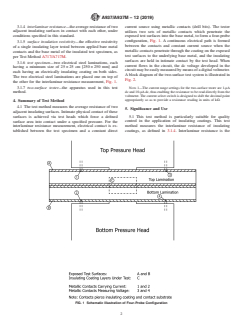
3.1.4 interlaminar resistance—theaverageresistanceoftwo current source using metallic contacts (drill bits). The tester
adjacent insulating surfaces in contact with each other, under utilizes two sets of metallic contacts which penetrate the
conditions specified in this standard.
exposed test surfaces into the base metal, to form a four-probe
configuration, Fig. 1. A continuous electrical path is formed
3.1.5 surface insulation resistivity—the effective resistivity
between the contacts and constant current source when the
of a single insulating layer tested between applied bare metal
metallic contacts penetrate through the coating on the exposed
contacts and the base metal of the insulated test specimen, as
test surfaces to the underlying base metal, and the insulating
per Test Method A717/A717M.
surfaces are held in intimate contact by the test head. When
3.1.6 test specimen—two electrical steel laminations, each
current flows in the circuit, the dc voltage developed in the
having a minimum size of 25×25 cm [250×250 mm] and
circuitmaybeeasilymeasuredbymeansofadigitalvoltmeter.
each having an electrically insulating coating on both sides.
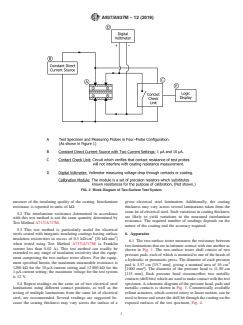
Ablock diagram of the two-surface test system is illustrated in
The two electrical steel laminations are placed one on top of
Fig. 2.
the other for the interlaminar resistance measurement, Fig. 1.
3.1.7 two-surface tester—the apparatus used in this test NOTE 1—The current range settings for the two-surface tester are 1-µA
dc and 10-µAdc, thus enabling the resistance to be read directly from the
method.
voltmeter. The current select switch is designed to shift the decimal point
appropriately so as to provide a resistance reading in units of kΩ.
4. Summary of Test Method
4.1 The test method measures the average resistance of two
5. Significance and Use
adjacent insulating surfaces. Intimate physical contact of these
5.1 This test method is particularly suitable for quality
surfaces is achieved via test heads which force a defined
surface area into contact under a specified pressure. For the control in the application of insulating coatings. This test
interlaminar resistance measurement, electrical contact is es- method measures the interlaminar resistance of insulating
tablished between the test specimen and a constant direct coatings, as defined in 3.1.4. Interlaminar resistance is the
FIG. 1 Schematic Illustration of Four-Probe Configuration
A937/A937M − 12 (2019)
FIG. 2 Block Diagram of Two-Surface Test System
measure of the insulating quality of the coating. Interlaminar given electrical steel lamination. Additionally, the coating
resistance is reported in units of kΩ. thickness may vary across several laminations taken from the
samelotofelectricalsteel.Suchvariationsincoatingthickness
5.2 The interlaminar resistance determined in accordance
are likely to yield variations in the measured interlaminar
with this test method is not the same quantity determined by
resistance. The required number of readings depends on the
Test Method A717/A717M.
nature of the coating and the accuracy required.
5.3 This test method is particularly useful for electrical
steels coated with inorganic insulating coatings having surface 6. Apparatus
2 2
insulation resistivities in excess of 0.3 kΩ·cm [30 kΩ·mm ]
6.1 The two-surface tester measures the resistance between
when tested using Test Method A717/A717M (a Franklin
twolaminationsthatareinintimatecontactwithoneanotheras
current less than 0.02 A). This test method can readily be
shown in Fig. 1. The two-surface tester shall consist of two
extended to any range of insulation resistivity that the equip-
pressure pads, each of which is mounted to one of the heads of
ment comprising the two-surface tester allows. For the equip-
a hydraulic or pneumatic press. The diameter of each pressure
ment specified herein, the maximum measurable resistance is 2
pad is 3.57 cm [35.7 mm], giving a nominal area of 10 cm
1200 kΩ for the 10-µA current setting and 12000 kΩ for the
[1000 mm ]. The diameter of the pressure head is 11.50 cm
1-µAcurrent setting; the maximum voltage for the test system
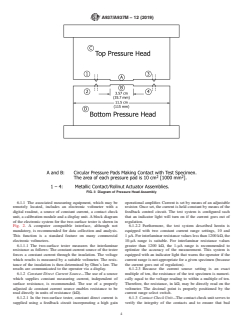
[115 mm]. Each pressure head circumscribes two metallic
is 12 V.
contacts(drillbits)whichareusedtomakecontactwiththetest
5.4 Repeat readings on the same set of two electrical steel specimen.Aschematic diagram of the pressure head, pads and
laminations using different contact positions, as well as the metallic contacts is shown in Fig. 3. Commercially available
testing of multiple laminations from the same lot of electrical rollnut actuators, which convert rotary to linear motion, can be
steel, are recommended. Several readings are suggested be- used to house and rotate the drill bit through the coating on the
cause the coating thickness may vary across the surface of a exposed surfaces of the test specimen, Fig. 4.
A937/A937M − 12 (2019)
FIG. 3 Diagram of Pressure Head Assembly
6.1.1 The associated measuring equipment, which may be operational amplifier. Current is set by means of an adjustable
remotely located, includes an electronic voltmeter with a resistor. Once set, the current is held constant by means of the
digital readout, a source of constant current, a contact check feedback control circuit. The test system is configured such
unit, a calibration module and a display unit.Ablock diagram that an indicator light will turn on if the current goes out of
of the electronic system for the two-surface tester is shown in regulation.
Fig. 2. A computer compatible interface, although not 6.1.2.2 Furthermore, the test system described herein is
mandatory, is recommended for data collection and analysis. equipped with two constant current range settings, 10 and
This function is a standard feature on many commercial 1µA.Forinterlaminarresistancevalueslessthan1200kΩ,the
electronic voltmeters. 10-µA range is suitable. For interlaminar resistance values
6.1.1.1 The two-surface tester measures the interlaminar greater than 1200 kΩ, the 1-µA range is recommended to
resistance as follows: The constant current source of the tester optimize the accuracy of the measurement. This system is
forces a constant current through the insulation. The voltage equipped with an indicator light that warns the operator if the
which results is measured by a suitable voltmeter. The resis- current range is not appropriate for a given specimen (because
tance of the insulation is then determined by Ohm’s law. The the current goes out of regulation).
results are communicated to the operator via a display. 6.1.2.3 Because the current source setting is an exact
6.1.2 Constant Direct Current Source—The use of a source multiple of ten, the resistance of the test specimen is numeri-
which supplies constant measuring current, independent of cally equal to the voltage reading to within a multiple of ten.
surface resistance, is recommended. The use of a properly Therefore, the resistance, in kΩ, may be directly read on the
adjusted dc constant current source enables resistance to be voltmeter. The decimal point is properly positioned by the
read directly in units of resistance (kΩ). current range select switch.
6.1.2.1 In the two-surface tester, constant direct current is 6.1.3 Contact Check Unit—The contact check unit serves to
supplied using a feedback circuit incorporating a high gain verify the integrity of the contacts and to ensure that bad
A937/A937M − 12 (2019)
FIG. 4 Schematic Diagram of Metallic Co
...