


ASTM D5932-20
(Test Method)Standard Test Method for Determination of 2,4-Toluene Diisocyanate (2,4-TDI) and 2,6-Toluene Diisocyanate (2,6-TDI) in Air (with 9-(N-Methylaminomethyl) Anthracene Method) (MAMA) in the Workplace
Standard Test Method for Determination of 2,4-Toluene Di<emph type="bdit">iso</emph >cyanate (2,4-TDI) and 2,6-Toluene Di<emph type="bdit">iso</emph>cyanate (2,6-TDI) in Air (with 9-(N-Methylaminomethyl) Anthracene Method) (MAMA) in the Workplace
SIGNIFICANCE AND USE
5.1 TDI is used mostly in the preparation of rigid and semi-rigid foams and adhesives.
5.2 Diisocyanates and polyisocyanates are irritants to skin, eyes, and mucous membranes. They are recognized to cause respiratory allergic sensitization, asthmatic bronchitis, and acute respiratory intoxication (6-9).
5.3 The American Conference of Governmental Industrial Hygienists (ACGIH) has adopted a Threshold Limit Value–Time Weighted Average (TLV-TWA) of 0.001 ppm of 0.007 mg/m3 with a Short-Term Exposure Limit (STEL) of 0.005 ppm or 0.036 mg/m3 for either 2,4–TDI, or 2,6–TDI, or for a mixture of 2,4– and 2,6–TDI (10). The Occupational Safety and Health Administration of the U.S. Department of Labor (OSHA) has a permissible exposure limit of 0.02 ppm(V) or 0.14 mg/m3 of 2,4-TDI as a ceiling limit and 0.005 ppm (V) or 0.036 mg/m3 as a time-weighted average (11).
5.4 Monitoring of respiratory and other problems related to diisocyanates and polyisocyanates is aided through the utilization of this test method, due to its sensitivity and low volume requirements (15 L). Its short sampling times are compatible with the duration of many industrial processes and its low quantification limit also suits the concentrations often found in the working area.
5.5 The segregating sampling device pertaining to this proposed test method physically separates gas and aerosol allowing isocyanate concentrations in both physical states to be obtained, thus helping in the selection of ventilation systems and personal protection.
5.6 This test method is used to measure gaseous concentrations of 2,4- and 2,6-TDI in air for workplace and ambient atmospheres.
SCOPE
1.1 This test method covers the determination of gaseous 2,4-toluene diisocyanate (2,4-TDI) and 2,6-toluene diisocyanate (2,6-TDI) in air samples collected from workplace and ambient atmospheres.
1.2 Differential air sampling is performed with a segregating device.2 The gaseous fraction is collected on a glass fiber filter (GFF) impregnated with 9-(N-methylaminomethyl) anthracene (MAMA).
1.3 The analysis of the gaseous fraction is performed with a high performance liquid chromatograph (HPLC) equipped with ultraviolet (UV) and fluorescence detectors. An ultra high performance liquid chromatograph (UPLC) can also be used, provided that its performance is equivalent to what is stated in this standard.
1.4 The analysis of the aerosol fraction is performed separately as described in Ref (1).3
1.5 The range of application of this test method, utilizing UV and a fluorescence detector, is validated for 0.014 to 1.16 μg of monomer 2,4- and 2,6-TDI/2.0 mL of desorption solution, which corresponds to concentrations of 0.001 to 0.077 mg/m3 of TDI based on a 15-L air sample. This corresponds to 0.0.14 to 11 ppb(V) and brackets the established TLV value of 1 ppb(v).
1.6 A field blank sampling system is used to check the possibility of contamination during the entire sampling and analysis.
1.7 The values stated in SI units are to be regarded as standard. No other units of measurement are included in this standard.
1.8 This standard does not purport to address all of the safety concerns, if any, associated with its use. It is the responsibility of the user of this standard to establish appropriate safety, health, and environmental practices and determine the applicability of regulatory limitations prior to use. See Section 9 for additional hazards.
1.9 This international standard was developed in accordance with internationally recognized principles on standardization established in the Decision on Principles for the Development of International Standards, Guides and Recommendations issued by the World Trade Organization Technical Barriers to Trade (TBT) Committee.
General Information
- Status
- Published
- Publication Date
- 29-Feb-2020
- Technical Committee
- D22 - Air Quality
- Drafting Committee
- D22.04 - Workplace Air Quality
Relations
- Effective Date
- 01-Mar-2020
- Effective Date
- 01-Sep-2020
- Effective Date
- 15-Mar-2020
- Effective Date
- 01-Aug-2019
- Effective Date
- 15-Aug-2018
- Effective Date
- 15-Oct-2015
- Effective Date
- 01-Jul-2015
- Effective Date
- 01-Dec-2014
- Effective Date
- 01-May-2014
- Effective Date
- 15-Jan-2014
- Effective Date
- 15-Nov-2011
- Effective Date
- 01-Oct-2011
- Effective Date
- 01-Apr-2010
- Effective Date
- 01-Feb-2010
- Effective Date
- 01-Mar-2006
Overview
ASTM D5932-20 is the Standard Test Method for Determination of 2,4-Toluene Diisocyanate (2,4-TDI) and 2,6-Toluene Diisocyanate (2,6-TDI) in Air using the 9-(N-Methylaminomethyl) Anthracene Method (MAMA) in the workplace. Developed by ASTM International, this standard provides a reliable procedure for the measurement of airborne diisocyanates in occupational and ambient environments.
Applications include compliance monitoring, workplace safety assessment, and exposure evaluation where isocyanates are used, such as in the production of foams and adhesives. With its sensitive detection and compatibility with short sampling times, this method is especially suitable for industrial hygiene and occupational health contexts.
Key Topics
Purpose and Scope
- Offers a validated method for detecting and quantifying 2,4-TDI and 2,6-TDI vapors in air samples.
- Designed for air samples collected from workplace and ambient atmospheres.
- Utilizes a segregating air sampling device and sensitive analytical techniques for accurate measurements.
Method Summary
- Differential air sampling is performed using a dual-filter device.
- The gaseous TDI fraction is collected on a glass fiber filter impregnated with MAMA, while aerosols are collected separately.
- Analysis is carried out with high-performance liquid chromatography (HPLC) equipped with ultraviolet (UV) and fluorescence detectors.
- The method covers a detection range suitable for compliance with regulatory exposure limits.
Occupational Health and Safety
- Highlights the health risks of diisocyanates, including skin, eye, mucous membrane irritation, and respiratory sensitization.
- Supports monitoring for compliance with exposure limits set by organizations such as OSHA and ACGIH.
Quality Control
- Incorporates the use of field blanks and laboratory blanks to detect contamination.
- Ensures sample integrity and data traceability through standardized chain-of-custody procedures.
Applications
ASTM D5932-20 is widely used for:
Industrial Hygiene and Worker Protection
- Assesses airborne concentration of hazardous isocyanates in environments where TDI is manufactured or used.
- Provides data to inform ventilation requirements and selection of personal protective equipment.
Regulatory Compliance
- Supports compliance with exposure limits, including OSHA and ACGIH standards for TDI vapors.
- Enables facilities to meet legal and best-practice requirements for workplace air quality.
Process Control and Risk Assessment
- Monitors TDI levels during production or application processes, especially where rapid changes or short tasks are involved.
- Aids in the evaluation of engineering controls and operational procedures meant to minimize isocyanate exposure.
Research and Environmental Monitoring
- Facilitates studies of ambient and occupational air quality involving diisocyanate compounds.
- Assists in the characterization of emissions from industrial processes and in the implementation of corrective actions.
Related Standards
- ASTM D1193 - Specification for Reagent Water, ensuring water purity in analytical procedures.
- ASTM D1356 - Terminology relating to sampling and analysis of atmospheres.
- ASTM D1357 - Practice for planning the sampling of ambient atmospheres.
- ASTM D4840 - Guide for sample chain-of-custody procedures.
- ASTM D5337 - Practice for flow rate adjustment of personal sampling pumps.
Additional context: Occupational exposure to 2,4-TDI and 2,6-TDI is a recognized hazard in industries using polyurethanes and related materials. Technical standards such as ASTM D5932-20 help ensure accurate monitoring, thus supporting workplace safety and regulatory compliance in air quality management.
Keywords: ASTM D5932-20, TDI air monitoring, workplace diisocyanates, 2,4-toluene diisocyanate, 2,6-toluene diisocyanate, industrial hygiene, HPLC isocyanate analysis, MAMA method, occupational exposure, air sample analysis.
Buy Documents
ASTM D5932-20 - Standard Test Method for Determination of 2,4-Toluene Di<emph type="bdit">iso</emph >cyanate (2,4-TDI) and 2,6-Toluene Di<emph type="bdit">iso</emph>cyanate (2,6-TDI) in Air (with 9-(N-Methylaminomethyl) Anthracene Method) (MAMA) in the Workplace
REDLINE ASTM D5932-20 - Standard Test Method for Determination of 2,4-Toluene Di<emph type="bdit">iso</emph >cyanate (2,4-TDI) and 2,6-Toluene Di<emph type="bdit">iso</emph>cyanate (2,6-TDI) in Air (with 9-(N-Methylaminomethyl) Anthracene Method) (MAMA) in the Workplace
Get Certified
Connect with accredited certification bodies for this standard

ECOCERT
Organic and sustainability certification.

NSF International
Global independent organization facilitating standards development and certification.

CIS Institut d.o.o.
Personal Protective Equipment (PPE) certification body. Notified Body NB-2890 for EU Regulation 2016/425 PPE.
Sponsored listings
Frequently Asked Questions
ASTM D5932-20 is a standard published by ASTM International. Its full title is "Standard Test Method for Determination of 2,4-Toluene Di<emph type="bdit">iso</emph >cyanate (2,4-TDI) and 2,6-Toluene Di<emph type="bdit">iso</emph>cyanate (2,6-TDI) in Air (with 9-(N-Methylaminomethyl) Anthracene Method) (MAMA) in the Workplace". This standard covers: SIGNIFICANCE AND USE 5.1 TDI is used mostly in the preparation of rigid and semi-rigid foams and adhesives. 5.2 Diisocyanates and polyisocyanates are irritants to skin, eyes, and mucous membranes. They are recognized to cause respiratory allergic sensitization, asthmatic bronchitis, and acute respiratory intoxication (6-9). 5.3 The American Conference of Governmental Industrial Hygienists (ACGIH) has adopted a Threshold Limit Value–Time Weighted Average (TLV-TWA) of 0.001 ppm of 0.007 mg/m3 with a Short-Term Exposure Limit (STEL) of 0.005 ppm or 0.036 mg/m3 for either 2,4–TDI, or 2,6–TDI, or for a mixture of 2,4– and 2,6–TDI (10). The Occupational Safety and Health Administration of the U.S. Department of Labor (OSHA) has a permissible exposure limit of 0.02 ppm(V) or 0.14 mg/m3 of 2,4-TDI as a ceiling limit and 0.005 ppm (V) or 0.036 mg/m3 as a time-weighted average (11). 5.4 Monitoring of respiratory and other problems related to diisocyanates and polyisocyanates is aided through the utilization of this test method, due to its sensitivity and low volume requirements (15 L). Its short sampling times are compatible with the duration of many industrial processes and its low quantification limit also suits the concentrations often found in the working area. 5.5 The segregating sampling device pertaining to this proposed test method physically separates gas and aerosol allowing isocyanate concentrations in both physical states to be obtained, thus helping in the selection of ventilation systems and personal protection. 5.6 This test method is used to measure gaseous concentrations of 2,4- and 2,6-TDI in air for workplace and ambient atmospheres. SCOPE 1.1 This test method covers the determination of gaseous 2,4-toluene diisocyanate (2,4-TDI) and 2,6-toluene diisocyanate (2,6-TDI) in air samples collected from workplace and ambient atmospheres. 1.2 Differential air sampling is performed with a segregating device.2 The gaseous fraction is collected on a glass fiber filter (GFF) impregnated with 9-(N-methylaminomethyl) anthracene (MAMA). 1.3 The analysis of the gaseous fraction is performed with a high performance liquid chromatograph (HPLC) equipped with ultraviolet (UV) and fluorescence detectors. An ultra high performance liquid chromatograph (UPLC) can also be used, provided that its performance is equivalent to what is stated in this standard. 1.4 The analysis of the aerosol fraction is performed separately as described in Ref (1).3 1.5 The range of application of this test method, utilizing UV and a fluorescence detector, is validated for 0.014 to 1.16 μg of monomer 2,4- and 2,6-TDI/2.0 mL of desorption solution, which corresponds to concentrations of 0.001 to 0.077 mg/m3 of TDI based on a 15-L air sample. This corresponds to 0.0.14 to 11 ppb(V) and brackets the established TLV value of 1 ppb(v). 1.6 A field blank sampling system is used to check the possibility of contamination during the entire sampling and analysis. 1.7 The values stated in SI units are to be regarded as standard. No other units of measurement are included in this standard. 1.8 This standard does not purport to address all of the safety concerns, if any, associated with its use. It is the responsibility of the user of this standard to establish appropriate safety, health, and environmental practices and determine the applicability of regulatory limitations prior to use. See Section 9 for additional hazards. 1.9 This international standard was developed in accordance with internationally recognized principles on standardization established in the Decision on Principles for the Development of International Standards, Guides and Recommendations issued by the World Trade Organization Technical Barriers to Trade (TBT) Committee.
SIGNIFICANCE AND USE 5.1 TDI is used mostly in the preparation of rigid and semi-rigid foams and adhesives. 5.2 Diisocyanates and polyisocyanates are irritants to skin, eyes, and mucous membranes. They are recognized to cause respiratory allergic sensitization, asthmatic bronchitis, and acute respiratory intoxication (6-9). 5.3 The American Conference of Governmental Industrial Hygienists (ACGIH) has adopted a Threshold Limit Value–Time Weighted Average (TLV-TWA) of 0.001 ppm of 0.007 mg/m3 with a Short-Term Exposure Limit (STEL) of 0.005 ppm or 0.036 mg/m3 for either 2,4–TDI, or 2,6–TDI, or for a mixture of 2,4– and 2,6–TDI (10). The Occupational Safety and Health Administration of the U.S. Department of Labor (OSHA) has a permissible exposure limit of 0.02 ppm(V) or 0.14 mg/m3 of 2,4-TDI as a ceiling limit and 0.005 ppm (V) or 0.036 mg/m3 as a time-weighted average (11). 5.4 Monitoring of respiratory and other problems related to diisocyanates and polyisocyanates is aided through the utilization of this test method, due to its sensitivity and low volume requirements (15 L). Its short sampling times are compatible with the duration of many industrial processes and its low quantification limit also suits the concentrations often found in the working area. 5.5 The segregating sampling device pertaining to this proposed test method physically separates gas and aerosol allowing isocyanate concentrations in both physical states to be obtained, thus helping in the selection of ventilation systems and personal protection. 5.6 This test method is used to measure gaseous concentrations of 2,4- and 2,6-TDI in air for workplace and ambient atmospheres. SCOPE 1.1 This test method covers the determination of gaseous 2,4-toluene diisocyanate (2,4-TDI) and 2,6-toluene diisocyanate (2,6-TDI) in air samples collected from workplace and ambient atmospheres. 1.2 Differential air sampling is performed with a segregating device.2 The gaseous fraction is collected on a glass fiber filter (GFF) impregnated with 9-(N-methylaminomethyl) anthracene (MAMA). 1.3 The analysis of the gaseous fraction is performed with a high performance liquid chromatograph (HPLC) equipped with ultraviolet (UV) and fluorescence detectors. An ultra high performance liquid chromatograph (UPLC) can also be used, provided that its performance is equivalent to what is stated in this standard. 1.4 The analysis of the aerosol fraction is performed separately as described in Ref (1).3 1.5 The range of application of this test method, utilizing UV and a fluorescence detector, is validated for 0.014 to 1.16 μg of monomer 2,4- and 2,6-TDI/2.0 mL of desorption solution, which corresponds to concentrations of 0.001 to 0.077 mg/m3 of TDI based on a 15-L air sample. This corresponds to 0.0.14 to 11 ppb(V) and brackets the established TLV value of 1 ppb(v). 1.6 A field blank sampling system is used to check the possibility of contamination during the entire sampling and analysis. 1.7 The values stated in SI units are to be regarded as standard. No other units of measurement are included in this standard. 1.8 This standard does not purport to address all of the safety concerns, if any, associated with its use. It is the responsibility of the user of this standard to establish appropriate safety, health, and environmental practices and determine the applicability of regulatory limitations prior to use. See Section 9 for additional hazards. 1.9 This international standard was developed in accordance with internationally recognized principles on standardization established in the Decision on Principles for the Development of International Standards, Guides and Recommendations issued by the World Trade Organization Technical Barriers to Trade (TBT) Committee.
ASTM D5932-20 is classified under the following ICS (International Classification for Standards) categories: 13.040.30 - Workplace atmospheres; 71.040.40 - Chemical analysis. The ICS classification helps identify the subject area and facilitates finding related standards.
ASTM D5932-20 has the following relationships with other standards: It is inter standard links to ASTM D5932-08(2013)e1, ASTM D1356-20a, ASTM D1356-20, ASTM D1357-95(2019), ASTM D4840-99(2018)e1, ASTM D1356-15a, ASTM D1356-15, ASTM D1356-14b, ASTM D1356-14a, ASTM D1356-14, ASTM D5337-11, ASTM D1357-95(2011), ASTM D1356-05(2010), ASTM D4840-99(2010), ASTM D1193-06. Understanding these relationships helps ensure you are using the most current and applicable version of the standard.
ASTM D5932-20 is available in PDF format for immediate download after purchase. The document can be added to your cart and obtained through the secure checkout process. Digital delivery ensures instant access to the complete standard document.
Standards Content (Sample)
This international standard was developed in accordance with internationally recognized principles on standardization established in the Decision on Principles for the
Development of International Standards, Guides and Recommendations issued by the World Trade Organization Technical Barriers to Trade (TBT) Committee.
Designation: D5932 − 20
Standard Test Method for
Determination of 2,4-Toluene Diisocyanate (2,4-TDI) and 2,6-
Toluene Diisocyanate (2,6-TDI) in Air (with 9-(N-
Methylaminomethyl) Anthracene Method) (MAMA) in the
Workplace
This standard is issued under the fixed designation D5932; the number immediately following the designation indicates the year of
original adoption or, in the case of revision, the year of last revision. A number in parentheses indicates the year of last reapproval. A
superscript epsilon (´) indicates an editorial change since the last revision or reapproval.
1. Scope 1.7 The values stated in SI units are to be regarded as
standard. No other units of measurement are included in this
1.1 This test method covers the determination of gaseous
standard.
2,4-toluene diisocyanate (2,4-TDI) and 2,6-toluene diisocya-
1.8 This standard does not purport to address all of the
nate (2,6-TDI) in air samples collected from workplace and
ambient atmospheres. safety concerns, if any, associated with its use. It is the
responsibility of the user of this standard to establish appro-
1.2 Differential air sampling is performed with a segregat-
priate safety, health, and environmental practices and deter-
ing device. The gaseous fraction is collected on a glass fiber
mine the applicability of regulatory limitations prior to use.
filter (GFF) impregnated with 9-(N-methylaminomethyl) an-
See Section 9 for additional hazards.
thracene (MAMA).
1.9 This international standard was developed in accor-
1.3 The analysis of the gaseous fraction is performed with a
dance with internationally recognized principles on standard-
high performance liquid chromatograph (HPLC) equipped
ization established in the Decision on Principles for the
with ultraviolet (UV) and fluorescence detectors.An ultra high
Development of International Standards, Guides and Recom-
performance liquid chromatograph (UPLC) can also be used,
mendations issued by the World Trade Organization Technical
provided that its performance is equivalent to what is stated in
Barriers to Trade (TBT) Committee.
this standard.
2. Referenced Documents
1.4 The analysis of the aerosol fraction is performed sepa-
rately as described in Ref (1).
2.1 ASTM Standards:
D1193 Specification for Reagent Water
1.5 The range of application of this test method, utilizing
UV and a fluorescence detector, is validated for 0.014 to 1.16 D1356 Terminology Relating to Sampling and Analysis of
Atmospheres
µg of monomer 2,4- and 2,6-TDI/2.0 mL of desorption
solution, which corresponds to concentrations of 0.001 to D1357 Practice for Planning the Sampling of the Ambient
Atmosphere
0.077 mg/m of TDI based on a 15-L air sample. This
correspondsto0.0.14to11ppb(V)andbracketstheestablished D4840 Guide for Sample Chain-of-Custody Procedures
D5337 Practice for Flow RateAdjustment of Personal Sam-
TLV value of 1 ppb(v).
pling Pumps
1.6 A field blank sampling system is used to check the
2.2 Other Documents:
possibility of contamination during the entire sampling and
Sampling Guide for Air Contaminants in the Workplace
analysis.
3. Terminology
This test method is under the jurisdiction of ASTM Committee D22 on Air
Quality and is the direct responsibility of Subcommittee D22.04 on Workplace Air
3.1 For definitions of terms used in this test method, refer to
Quality.
Terminology D1356.
Current edition approved March 1, 2020. Published May 2020. Originally
ɛ1
approved in 1996. Last previous edition approved in 2013 as D5932 – 08 (2013) .
DOI: 10.1520/D5932-20.
2 4
ASTM International takes no position respecting the validity of any patent For referenced ASTM standards, visit the ASTM website, www.astm.org, or
rights asserted in connection with any item mentioned in this standard. Users of this contact ASTM Customer Service at service@astm.org. For Annual Book of ASTM
standard are expressly advised that determination of the validity of any such patent Standards volume information, refer to the standard’s Document Summary page on
rights, and the risk of infringement of such rights, are entirely their own the ASTM website.
responsibility. Available from Institut de Recherche en Santé et en Sécurité du Travail
The boldface numbers in parentheses refer to a list of references at the end of (IRSST), Laboratory Division, Montreal, QC, 2012, http://www.irsst.qc.ca/media/
this standard. documents/Pubirsst/T-15.pdf.
Copyright © ASTM International, 100 Barr Harbor Drive, PO Box C700, West Conshohocken, PA 19428-2959. United States
D5932 − 20
4. Summary of Test Method with the duration of many industrial processes and its low
quantification limit also suits the concentrations often found in
4.1 A known volume of air is drawn through a segregating
the working area.
sampling device.
5.5 The segregating sampling device pertaining to this
4.2 Gaseous and aerosol fraction are sampled simultane-
proposed test method physically separates gas and aerosol
ously with a two filter loaded cassette. The aerosol is collected
allowing isocyanateconcentrationsinbothphysicalstatestobe
on the first filter made of polytetrafluoroethylene (PTFE), the
obtained, thus helping in the selection of ventilation systems
gaseous counterpart being adsorbed on the second filter made
and personal protection.
of glass fiber (GFF) impregnated with MAMA.
5.6 This test method is used to measure gaseous concentra-
4.3 The analysis of the monomer and oligomer in the
tions of 2,4- and 2,6-TDI in air for workplace and ambient
aerosol fraction is performed separately in accordance with the
atmospheres.
procedure described in Refs (1, 2).
4.4 The diisocyanate present as a gas reacts with the
6. Interference
secondary amine function of the MAMA impregnated on the
6.1 Any substance that can react with MAMA reagent
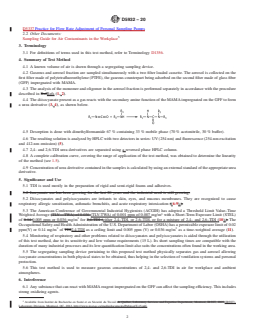
GFF to form a urea derivative (3, 4), as shown below.
impregnated on the GFF can affect the sampling efficiency.
This includes strong oxidizing agents.
6.2 Any compound that has the same retention time as the
TDIU derivative and gives the same UV/fluorescence detector
response factor ratio can cause interference. Chromatographic
4.5 Desorption is done with dimethylformamide 67 % con-
conditions can be changed to eliminate an interference.
taining 33 % mobile phase (70 % acetonitrile, 30 % buffer).
6.3 A field blank double-filter sampling system is used to
4.6 The resulting solution is analyzed by HPLC with two
check contamination during the combined sampling,
detectors in series: UV (254 nm) and fluorescence (254-nm
transportation, and sample storage process.Alaboratory blank
excitation and 412-nm emission) (5).
is used to check contamination occurring during the analytical
4.7 2,4- and 2,6-TDI urea derivatives are separated using a process.
reversed phase HPLC column.
7. Apparatus
4.8 A complete calibration curve, covering the range of
application of the test method, was obtained to determine the
7.1 Sampling Equipment:
linearity of the method (see 1.5).
7.1.1 Personal Sampling Pump, capable of sampling 1.0
L/min or less for 4 h.
4.9 Concentration of urea derivative contained in the
7.1.2 Double Filter Sampling Device, 37 mm in diameter,
samples is calculated by using an external standard of the
three-piece personal monitor, plastic holder loaded with a
appropriate urea derivative.
PTFE filter close to the mouth, followed by a glass fiber filter
impregnated with MAMAand a plastic back-up pad. The glass
5. Significance and Use
fiber filter is impregnated with an amount of MAMA in the
5.1 TDI is used mostly in the preparation of rigid and
range of 0.07 to 0.25 mg.
semi-rigid foams and adhesives.
7.1.3 Flow Measuring Device.
5.2 Diisocyanates and polyisocyanates are irritants to skin,
7.2 Analytical Equipment:
eyes, and mucous membranes. They are recognized to cause
7.2.1 Liquid Chromatograph, a high-performance liquid
respiratory allergic sensitization, asthmatic bronchitis, and
chromatograph equipped with UV (254-nm wavelength) and
acute respiratory intoxication (6-9).
fluorescence detectors (412-nm emission and 254-nm excita-
5.3 The American Conference of Governmental Industrial
tion)andanautomaticormanualsampleinjector.AsecondUV
Hygienists (ACGIH) has adopted a Threshold Limit Valu-
wavelength is recommended for identify confirmation if no
e–Time WeightedAverage (TLV-TWA) of 0.001 ppm of 0.007
fluorescence detector is utilized. An ultra high performance
mg/m with a Short-Term Exposure Limit (STEL) of 0.005
liquid chromatography (UPLC) providing at least the same or
ppm or 0.036 mg/m for either 2,4–TDI, or 2,6–TDI, or for a
equivalent performance of HPLC can be also used.
mixture of 2,4– and 2,6–TDI (10). The Occupational Safety
7.2.2 Liquid Chromatographic Column, an HPLC stainless
and Health Administration of the U.S. Department of Labor
steel column, capable of separating the urea derivatives. This
(OSHA) has a permissible exposure limit of 0.02 ppm(V) or
proposed method recommends a 150- by 4.6-mm internal
0.14 mg/m of 2,4-TDI as a ceiling limit and 0.005 ppm (V) or
diameter stainless steel column packed with 3.5-µm C18, or an
0.036 mg/m as a time-weighted average (11).
equivalent column.
7.2.3 Electronic Integrator, an electronic integrator or any
5.4 Monitoring of respiratory and other problems related to
other effective method for determining peak areas.
diisocyanates and polyisocyanates is aided through the utiliza-
tion of this test method, due to its sensitivity and low volume 7.2.4 Analytical Balance, an analytical balance capable of
requirements (15 L). Its short sampling times are compatible weighing to 0.001 g.
D5932 − 20
7.2.5 Microsyringes and Pipets—Microsyringes are used in 8.10 Mobile Phase—A solvent mixture of acetonitrile
the preparation of urea derivatives and standards.An automatic (CH CN) (8.3) and buffer (8.4) in the percentage of 70 and 30
pipet, or any equivalent method, is required for sample (v/v), respectively, suitably degassed.
preparation.
8.11 Phosphoric Acid (H PO )—Reagent grade.
3 4
7.2.6 pH Meter—A pH meter or any equivalent device
8.12 2,4-Toluene Diisocyanate (2,4-TDI)—(F.W. 174.2)
capable of assaying a pH range between 2.5 and 7.
97 % purity.
7.2.7 Specialized Flasks—Three-necked flask and an addi-
tional flask for the synthesis of the TDIU standard. 8.13 2,6-Toluene Diisocyanate (2,6-TDI)—(F.W. 174.2)
7.2.8 Magnetic Stirrer—A magnetic stirrer or any other
97 % purity.
equivalent method.
8.14 2,4-Toluene Diisocyanate 9-(N-Methylaminomethyl)
7.2.9 Glass Jars, 30 mL, and lid, capable of receiving
Anthracene Derivative (2,4-TDIU).
37-mm filters, used for desorption of samples.
8.14.1 Add 575 µL of 2,4-TDI (8.13) (2 mmoles) to dichlo-
7.2.10 Reciprocating Shaker—Areciprocatingshakerorany
romethane (8.6) and dilute to 25 mL in a volumetric flask.
other equivalent device.
Place the 2,4-TDI solution in an additional flask.
7.2.11 Vacuum Filtration System—Vacuum filtration system
8.14.2 Dilute approximately 1.3 g (6 mmoles) of 9-(N-
with0.22-µmporositynylonfiltersoranyequivalentmethodto
methylaminomethyl) anthracene (MAMA) (8.9)in25mLof
degas the mobile phase.
dichloromethane (8.6). Place the MAMA solution in a three-
7.2.12 Syringe Operated Filter Unit—Syringes with polyvi-
necked flask.
nylidenefluoride0.22-µmporosityfilterunit,oranyequivalent
8.14.3 Add the TDI (8.13) drop by drop at a temperature of
method.
25°C to the MAMAsolution (8.14.2), stirring continuously for
7.2.13 Injection Vials, 1.5-mL vials with PTFE-coated sep-
60 to 90 min.
tums for injection.
8.14.4 Cool the resulting solution on crushed ice.
7.2.14 Bottle—Amber-colored bottle with cap and PTFE-
8.14.5 Filter on a medium speed ashless filter paper or any
coated septum for conservation of stock and standard solutions
equivalent device.
of 2,4- and 2,6-TDIU or any equivalent method.
8.14.6 Dissolvetheprecipitateinhotdichloromethane(8.6).
Place in an ice bath to recrystallize and filter as in 8.14.5.
8. Reagents and Materials
8.14.7 The compound has a melting point of 270°C.
8.1 Purity of Reagents—Reagent grade chemicals shall be
8.14.8 Confirm that the urea derivative with the mass
usedinalltests.Allreagentsshallconformtothespecifications
spectrum, the 2,4-TDI-MAMA has a molecular weight of
of the Committee on Analytical Reagents of the American
616.75 g.
Chemical Society where such specifications are available.
8.14.9 The conversion factor for TDIU to TDI is 0.2823.
Other grades may be used, provided it is first ascertained that
8.15 2,6-Toluene Diisocyanate 9-(N-Methylaminomethyl)
the reagent is of sufficiently high purity to permit its use
Anthracene Derivative (2,6-TDIU)—Same preparation as 2,4-
without lessening the accuracy of the determination.
TDIU but use 2,6-TDI. The compound starts to show decom-
8.2 Purity of Water—Unlessotherwiseindicated,watershall
position at 275°C.
be reagent water as defined by Type 2 of Specification D1193,
8.16 Triethylamine—Purity 98 % min.
HPLC grade.
8.3 Acetonitrile (CH CN)—HPLC grade.
3 9. Hazards
8.4 Buffer—Place 30 mL of triethylamine (8.16) in water
9.1 Warning—Diisocyanates are hazardous chemicals and
and dilute to 1 L in a volumetric flask. Add phosphoric acid
extremely reactive. Warning on compressed gas cylinders.
(H PO)(8.11) to acidify to pH = 3.0. Filter the buffer under
3 4
Refer to SD datasheets for reagents.
vacuum with a 0.22-µm porosity filter.
9.2 Precaution—Avoid exposure to diisocyanate standards.
8.5 Desorption Solution—Asolvent mixture of dimethylfor-
Sample and standard preparations should be done in an
mamide (8.7) and mobile phase (8.10) in the percentage of 67
efficient operating hood. For remedial statement see Ref (12).
and 33 (v/v), respectively.
9.3 Precaution—Avoid skin contact with all solvents and
8.6 Dichloromethane—Reagent grade.
isocyanates.
8.7 Dimethylformamide—Reagent grade.
9.4 Wear safety glasses at all times and other laboratory
protective equipment as necessary.
8.8 Helium (He)—Ultra high purity, 99.999 %.
8.9 9-(N-Methylaminomethyl) Anthracene (MAMA), (F.W.
10. Sampling
221.31) 99 % purity.
10.1 Refer to the Practice D1357 for general information on
sampling.
ACS Reagent Chemicals, Specifications and Procedures for Reagents and
Standard-Grade Reference Materials, American Chemical Society, Washington,
10.2 Adjust the personal sampling pumps to the recom-
DC. For suggestions on the testing of reagents not listed by theAmerican Chemical
mended flow rate with an assembled cassette between the
Society, see Analar Standards for Laboratory Chemicals, BDH Ltd., Poole, Dorset,
pump and the flow-measuring device in accordance with
U.K., and the United States Pharmacopeia and National Formulary, U.S. Pharma-
copeial Convention, Inc. (USPC), Rockville, MD. Practice D5337. After the sampling, perform a post sampling
D5932 − 20
flow rate verification. If the post sampling flow rate varies fluorescence detector, dilute the stock solutions in desorption
more than 65 % from the recommended flow rate, invalidate
...
This document is not an ASTM standard and is intended only to provide the user of an ASTM standard an indication of what changes have been made to the previous version. Because
it may not be technically possible to adequately depict all changes accurately, ASTM recommends that users consult prior editions as appropriate. In all cases only the current version
of the standard as published by ASTM is to be considered the official document.
´1
Designation: D5932 − 08 (Reapproved 2013) D5932 − 20
Standard Test Method for
Determination of 2,4-Toluene DiisocyanateDiisocyanate (2,4-
TDI) and 2,6-Toluene DiisocyanateDiisocyanate (2,6-TDI) in
Air (with 9-(N-Methylaminomethyl) Anthracene Method)
(MAMA) in the Workplace
This standard is issued under the fixed designation D5932; the number immediately following the designation indicates the year of
original adoption or, in the case of revision, the year of last revision. A number in parentheses indicates the year of last reapproval. A
superscript epsilon (´) indicates an editorial change since the last revision or reapproval.
ε NOTE—Editorial corrections were made to 8.14.8 and 11.2.1 in March 2015.
1. Scope
1.1 This test method covers the determination of gaseous 2,4-toluene diisocyanate (2,4-TDI) and 2,6-toluene diisocyanate
(2,6-TDI) in air samples collected from workplace and ambient atmospheres.
2,
1.2 Differential air sampling is performed with a segregating device. The gaseous fraction is collected on a glass fiber filter
(GFF) impregnated with 9-(N-methylaminomethyl) anthracene (MAMA).
1.3 The analysis of the gaseous fraction is performed with a high performance liquid chromatograph (HPLC) equipped with
ultraviolet (UV) and fluorescence detectors. An ultra high performance liquid chromatograph (UPLC) can also be used, provided
that its performance is equivalent to what is stated in this standard.
1.4 The analysis of the aerosol fraction is performed separately as described in Ref (1).
1.5 The range of application of this test method, utilizing UV and a fluorescence detector, is validated for 0.0290.014 to 1.16
μg of monomer 2,4- and 2,6-TDI/2.0 mL of desorption solution, which corresponds to concentrations of 0.0020.001 to 0.077
mg/m of TDI based on a 15-L air sample. This corresponds to 0.280.0.14 to 11 ppb(V) and brackets the established TLV value
of 51 ppb(v).
1.6 A field blank sampling system is used to check the possibility of contamination during the entire sampling and analysis.
1.7 The values stated in SI units are to be regarded as the standard. No other units of measurement are included in this standard.
1.8 This standard does not purport to address all of the safety concerns, if any, associated with its use. It is the responsibility
of the user of this standard to establish appropriate safety safety, health, and healthenvironmental practices and determine the
applicability of regulatory limitations prior to use. See Section 9 for additional hazards.
1.9 This international standard was developed in accordance with internationally recognized principles on standardization
established in the Decision on Principles for the Development of International Standards, Guides and Recommendations issued
by the World Trade Organization Technical Barriers to Trade (TBT) Committee.
2. Referenced Documents
2.1 ASTM Standards:
D1193 Specification for Reagent Water
D1356 Terminology Relating to Sampling and Analysis of Atmospheres
D1357 Practice for Planning the Sampling of the Ambient Atmosphere
D4840 Guide for Sample Chain-of-Custody Procedures
This test method is under the jurisdiction of ASTM Committee D22 on Air Quality and is the direct responsibility of Subcommittee D22.04 on Workplace Air Quality.
Current edition approved April 1, 2013March 1, 2020. Published April 2013May 2020. Originally approved in 1996. Last previous edition approved in 20082013 as D5932
ɛ1
– 08. – 08 (2013) . DOI: 10.1520/D5932-08R13E01.10.1520/D5932-20.
The American Society for Testing and Materials ASTM International takes no position respecting the validity of any patent rights asserted in connection with any item
mentioned in this standard. Users of this standard are expressly advised that determination of the validity of any such patent rights, and the risk of infringement of such rights,
are entirely their own responsibility.
The boldface numbers in parentheses refer to thea list of references at the end of this test method.standard.
For referenced ASTM standards, visit the ASTM website, www.astm.org, or contact ASTM Customer Service at service@astm.org. For Annual Book of ASTM Standards
volume information, refer to the standard’s Document Summary page on the ASTM website.
Copyright © ASTM International, 100 Barr Harbor Drive, PO Box C700, West Conshohocken, PA 19428-2959. United States
D5932 − 20
D5337 Practice for Flow Rate Adjustment of Personal Sampling Pumps
2.2 Other Documents:
Sampling Guide for Air Contaminants in the Workplace
3. Terminology
3.1 For definitions of terms used in this test method, refer to Terminology D1356.
4. Summary of Test Method
4.1 A known volume of air is drawn through a segregating sampling device.
4.2 Gaseous and aerosol fraction are sampled simultaneously with a two filter loaded cassette. The aerosol is collected on the
first filter made of polytetrafluoroethylene (PTFE), the gaseous counterpart being adsorbed on the second filter made of glass fiber
(GFF) impregnated with MAMA.
4.3 The analysis of the monomer and oligomer in the aerosol fraction is performed separately in accordance with the procedure
described in RefRefs (1, 2).
4.4 The diisocyanate present as a gas reacts with the secondary amine function of the MAMA impregnated on the GFF to form
a urea derivative (3, 4), as shown below.
4.5 Desorption is done with dimethylformamide 67 % containing 33 % mobile phase (70 % acetonitrile, 30 % buffer).
4.6 The resulting solution is analyzed by HPLC with two detectors in series: UV (254 nm) and fluorescence (254-nm excitation
and 412-nm emission) (5).
4.7 2,4- and 2,6-TDI urea derivatives are separated using a reversed phase HPLC column.
4.8 A complete calibration curve, covering the range of application of the test method, was obtained to determine the linearity
of the method (see 1.5).
4.9 Concentration of urea derivative contained in the samples is calculated by using an external standard of the appropriate urea
derivative.
5. Significance and Use
5.1 TDI is used mostly in the preparation of rigid and semi-rigid foams and adhesives.
5.2 Isocyanate use has been growing for the last 20 years and the industrial need is still growing.
5.2 Diisocyanates and polyisocyanates are irritants to skin, eyes, and mucous membranes. They are recognized to cause
respiratory allergic sensitization, asthmatic bronchitis, and acute respiratory intoxication ((6-9).).
5.3 The American Conference of Governmental Industrial Hygienists (ACGIH) has adopted a Threshold Limit Value–Time
Weighted Average (TLV—TWA) of 0.036 (TLV-TWA) of 0.001 ppm of 0.007 mg/m with a Short-Term Exposure Limit (STEL)
of 0.14 0.005 ppm or 0.036 mg/m for 2,4-TDI (either 2,4–TDI, or 2,6–TDI, or for a mixture of 2,4– and 2,6–TDI (10).). The
Occupational Safety and Health Administration of the U.S. Department of Labor (OSHA) has a permissible exposure limit of 0.02
3 3
ppm(V) or 0.14 mg/m of TDI2,4-TDI as a ceiling limit and 0.005 ppm (V) or 0.036 mg/m as a time-weighted average (11).
5.4 Monitoring of respiratory and other problems related to diisocyanates and polyisocyanates is aided through the utilization
of this test method, due to its sensitivity and low volume requirements (15 L). Its short sampling times are compatible with the
duration of many industrial processes and its low quantification limit also suits the concentrations often found in the working area.
5.5 The segregating sampling device pertaining to this proposed test method physically separates gas and aerosol allowing
isocyanate concentrations in both physical states to be obtained, thus helping in the selection of ventilation systems and personal
protection.
5.6 This test method is used to measure gaseous concentrations of 2,4- and 2,6-TDI in air for workplace and ambient
atmospheres.
6. Interference
6.1 Any substance that can react with MAMA reagent impregnated on the GFF can affect the sampling efficiency. This includes
strong oxidizing agents.
Available from Institut de Recherche en Santé et en Sécurité du Travail du Québec, Laboratory Services and Expertise Department, Montreal, IRSST, 2005.(IRSST),
Laboratory Division, Montreal, QC, 2012, http://www.irsst.qc.ca/media/documents/Pubirsst/T-15.pdf.
D5932 − 20
6.2 Any compound that has the same retention time as the TDIU derivative and gives the same UV/fluorescence detector
response factor ratio can cause interference. Chromatographic conditions can be changed to eliminate an interference.
6.3 A field blank double-filter sampling system is used to check contamination during the combined sampling, transportation,
and sample storage process. A laboratory blank is used to check contamination occurring during the analytical process.
7. Apparatus
7.1 Sampling Equipment:
7.1.1 Personal Sampling Pump, capable of sampling 1.0 L/min or less for 4 h.
7.1.2 Double Filter Sampling Device, 37 mm in diameter, three-piece personal monitor, plastic holder loaded with a PTFE filter
close to the mouth, followed by a glass fiber filter impregnated with MAMA and a plastic back-up pad. The glass fiber filter is
impregnated with an amount of MAMA in the range of 0.07 to 0.25 mg.
7.1.3 Flow Measuring Device. Flow Measuring Device.
7.2 Analytical Equipment:
7.2.1 Liquid Chromatograph, a high-performance liquid chromatograph equipped with UV (254-nm wavelength) and
fluorescence detectors (412-nm emission and 254-nm excitation) and an automatic or manual sample injector. A second UV
wavelength is recommended for identify confirmation if no fluorescence detector is utilized. An ultra high performance liquid
chromatography (UPLC) providing at least the same or equivalent performance of HPLC can be also used.
7.2.2 Liquid Chromatographic Column, an HPLC stainless steel column, capable of separating the urea derivatives. This
proposed method recommends a 150- by 4.6-mm internal diameter stainless steel column packed with 0.5-μm3.5-μm C18, or an
equivalent column.
7.2.3 Electronic Integrator, an electronic integrator or any other effective method for determining peak areas.
7.2.4 Analytical Balance, an analytical balance capable of weighing to 0.001 g.
7.2.5 Microsyringes and Pipets, Pipets—microsyringesMicrosyringes are used in the preparation of urea derivatives and
standards. An automatic pipet, or any equivalent method, is required for sample preparation.
7.2.6 pH Meter, Meter—aA pH meter or any equivalent device capable of assaying a pH range between 2.5 and 7.
7.2.7 Specialized Flasks, Flasks—three-neckedThree-necked flask and an additional flask for the synthesis of the TDIU
standard.
7.2.8 Magnetic Stirrer, Stirrer—aA magnetic stirrer or any other equivalent method.
7.2.9 Glass Jars, 30 mL, and lid, capable of receiving 37-mm filters, used for desorption of samples.
7.2.10 Reciprocating Shaker, Shaker—aA reciprocating shaker or any other equivalent device.
7.2.11 Vacuum Filtration System, System—vacuumVacuum filtration system with 0.45-μm0.22-μm porosity nylon filters or any
equivalent method to degas the mobile phase.
7.2.12 Syringe Operated Filter Unit, Unit—syringesSyringes with polyvinylidene fluoride 0.22-μm porosity filter unit, or any
equivalent method.
7.2.13 Injection Vials, 1.5-mL vials with PTFE-coated septums for injection.
7.2.14 Bottle, Bottle—amber-coloredAmber-colored bottle with cap and PTFE-coated septum for conservation of stock and
standard solutions of 2,4- and 2,6-TDIU or any equivalent method.
8. Reagents and Materials
8.1 Purity of Reagents—Reagent grade chemicals shall be used in all tests. All reagents shall conform to the specifications of
the Committee on Analytical Reagents of the American Chemical Society where such specifications are available. Other grades
may be used, provided it is first ascertained that the reagent is of sufficiently high purity to permit its use without lessening the
accuracy of the determination.
8.2 Purity of Water—Unless otherwise indicated, water shall be reagent water as defined by Type 2 of Specification D1193,
HPLC grade.
8.3 Acetonitrile (CH CN)—HPLC grade.
8.4 Buffer—Place 30 mL of triethylamine (8.16) in water and dilute to 1 L in a volumetric flask. Add phosphoric acid (H PO )
3 4
(8.11) to acidify to pH = 3.0. Filter the buffer under vacuum with a 0.45-μm0.22-μm porosity filter.
8.5 Desorption Solution—A solvent mixture of dimethylformamide (8.7) and mobile phase (8.10) in the percentage of 67 and
33 (v/v), respectively.
8.6 Dichloromethane—Reagent grade.
Reagent Chemicals, American Chemical Society Specifications,ACS Reagent Chemicals, Specifications and Procedures for Reagents and Standard-Grade Reference
Materials, American Chemical Society, Washington, DC. For suggestions on the testing of reagents not listed by the American Chemical Society, see Analar Standards for
Laboratory Chemicals, BDH Ltd., Poole, Dorset, U.K., and the United States Pharmacopeia and National Formulary, U.S. Pharmacopeial Convention, Inc. (USPC),
Rockville, MD.
D5932 − 20
8.7 Dimethylformamide—Reagent grade.
8.8 Helium (He)—High Ultra high purity, 99.999 %.
8.9 9-(N-Methylaminomethyl) Anthracene (MAMA), (F.W. 221.31) 99 % purity.
8.10 Mobile Phase—A solvent mixture of acetonitrile (CH CN) (8.3) and buffer (8.4) in the percentage of 70 and 30 (v/v),
respectively, suitably degassed.
8.11 Phosphoric Acid (H PO )—Reagent grade.
3 4
8.12 2,4-Toluene Diisocyanate (2,4-TDI)—(F.W. 174.2) 97 % purity.
8.13 2,6-Toluene Diisocyanate (2,6-TDI)—(F.W. 174.2) 97 % purity.
8.14 2,4-Toluene Diisocyanate 9-(N-Methylaminomethyl) Anthracene Derivative (2,4-TDIU).
8.14.1 Add 320575 μL of 2,4-TDI (8.13) (2 mmoles) to dichloromethane (8.6) and dilute to 25 mL in a volumetric flask. Place
the 2,4-TDI solution in an additional flask.
8.14.2 Dilute approximately 1.3 g (6 mmoles) of 9-(N-methylaminomethyl) anthracene (MAMA) (8.9) in 5025 mL of
dichloromethane (8.6). Place the MAMA solution in a three-necked flask.
8.14.3 Add the TDI (8.13) drop by drop at a temperature of 25°C to the MAMA solution (8.14.2), stirring continuously for 60
to 90 min.
8.14.4 Cool the resulting solution on crushed ice.
8.14.5 Filter on a medium speed ashless filter paper or any equivalent device.
8.14.6 Dissolve the precipitate in hot dichloromethane (8.6). Place in an ice bath to recrystallize and filter as in 8.14.5.
8.14.7 The compound has a melting point of 270°C.
8.14.8 Confirm that the urea derivative with the mass spectrum, the 2,4-TDI-MAMA has a molecular weight of 616.75 g.
8.14.9 The conversion factor for TDIU to TDI is 0.2823.
8.15 2,6-Toluene Diisocyanate 9-(N-Methylaminomethyl) Anthracene Derivative (2,6-TDIU)—Same preparation as 2,4-TDIU
but use 2,6-TDI. The compound starts to show decomposition at 275°C.
8.16 Triethylamine—Purity 98 % min.
9. Hazards
9.1 Warning—Diisocyanates are potentially hazardous chemicals and extremely reactive. Warning on compressed gas
cylinders. Refer to MSD sheetsSD datasheets for reagents.
9.2 Precaution—Avoid exposure to diisocyanate standards. Sample and standard preparations should be done in an efficient
operating hood. For remedial statement see Ref (12).
9.3 Precaution—Avoid skin contact with all solvents and isocyanates.
9.4 Wear safety glasses at all times and other laboratory protective equipment as necessary.
10. Sampling
10.1 Refer to the PracticesPractice D1357 for general information on sampling.
10.2 Adjust the personal sampling pumps to the recommended flow rate with an assembled cassette between the pump and the
flow-measuring device in accordance with Practice D5337. After the sampling, perform a post sampling flow rate verification. If
the post sampling flow rate varies more than 65 % from the recommended flow rate, invalidate the sample.
10.3 This proposed test method recommends sampling in accordance with the method described in RefRefs (13, 14) of this test
method.
10.4 Equip the worker, whose exposure is to be evaluated, with a filter holder connected to a belt-supported sampling pump.
Place the filter, holder pointing downward, in the breathing zone of the worker. Draw air through the sampling device and collect
15 L at a rate of approximately 1.0 L/min.
10.5 For stationary monitoring
...
Questions, Comments and Discussion
Ask us and Technical Secretary will try to provide an answer. You can facilitate discussion about the standard in here.
Loading comments...