

ASTM F2436-14(2019)
(Test Method)Standard Test Method for Measuring the Performance of Synthetic Rope Rescue Belay Systems Using a Drop Test
General Information
- Abstract
SIGNIFICANCE AND USE
5.1 The types of rope rescue systems to which this test method apply use a tensioned mainline and untensioned belay line. If a fall occurs because of a mainline system failure or misuse, considerable energy must be absorbed by the belay for a successful arrest. This drop test method simulates a “worst case” condition when systems are operated as designed, and is designed to help evaluate and compare the performance of various rope rescue belay systems under such conditions. (See Note 1.) The successful catching of a load does not imply that the tested system is suitable for any and all belaying. See X1.2.
Note 1: Higher forces may be encountered under some circumstances, such as the belay being operated with excessive slack.
SCOPE
1.1 This test method covers drop test procedures to measure rope rescue belay system performance. It applies only to belay systems consisting of an untensioned rope connecting the load to an anchored belay device. This test method does not address other types of belays, such as self-belays or belays for lead climbing, nor does it test the rescuer's belaying ability.
1.2 This test method may be used to help measure a rescue belay system's performance under controlled drop test conditions, but it will not necessarily provide guidance as to which belay method is most suited to a particular application. Other considerations, such as ease of handling, performance on different types and diameters of rope, portability, versatility, system safety factor, cost, and automatic operation that do not require the positive action of the belayer may influence the selection of a belay system and are not dealt with in this test method. See X1.1.
1.3 The values stated in SI units are to be regarded as standard.
1.4 This standard may involve hazardous materials, operations, and equipment. This standard does not purport to address all of the safety concerns associated with its use. It is the responsibility of whoever uses this standard to consult and establish appropriate safety, health, and environmental practices and determine the applicability of regulatory limitations prior to use. Additional precautions for this test method are given in 8.1 and 8.2.
1.5 This international standard was developed in accordance with internationally recognized principles on standardization established in the Decision on Principles for the Development of International Standards, Guides and Recommendations issued by the World Trade Organization Technical Barriers to Trade (TBT) Committee.
- Status
- Published
- Publication Date
- 31-Mar-2019
- Technical Committee
- F32 - Search and Rescue
- Drafting Committee
- F32.01 - Equipment, Testing, and Maintenance
Overview
ASTM F2436-14(2019) is an international standard that provides a test method for measuring the performance of synthetic rope rescue belay systems using a drop test procedure. Developed by ASTM International, this standard is crucial for evaluating how belay systems will perform in high-stress rescue situations, where effective fall arrest is essential for safety. The method simulates a “worst case” scenario to establish a baseline for comparing belay device performance, focusing on systems that include an untensioned belay line and an anchored belay device.
Key Topics
- Drop Test Procedure: The standard defines a series of drop tests that simulate sudden mainline failure in a rescue scenario. It specifies test block masses and outlines procedures for accurate measurement and repeatable setup.
- Performance Measurement:
- Maximum Arrest Force (MAF): The highest force exerted during fall arrest is recorded for each test.
- System Extension (Stopping Distance): The elongation or stretch experienced by the system during a drop is measured to evaluate the ability of the belay system to absorb energy and prevent further fall.
- Applicability: This test method applies strictly to belay systems that feature an untensioned backup rope and do not address lead climbing, self-belays, or the skills of individual operators.
- Materials and Apparatus: Guidance regarding test facility requirements, mass types, rope specifications, and the use of an artificial hand for manually operated devices.
- Reporting and Documentation: The standard emphasizes comprehensive data collection, requiring documentation of apparatus used, environmental conditions, rope specifications, force/time curves, and any deviations from standard procedures.
Applications
ASTM F2436-14(2019) is widely applicable in the following areas:
- Search and Rescue Operations: Ensures that belay systems used in vertical rescues meet a consistent and measurable safety standard, providing confidence during critical operations.
- Equipment Testing and Certification: Manufacturers and testing laboratories rely on this standard to benchmark new or existing rescue belay devices and systems for regulatory compliance and quality control.
- Rope Access: Organizations involved in rope access or work-at-height industries use these drop test methods to evaluate secondary safety systems.
- Training and Research: The standard serves as a foundation for training programs and research studies focused on rope rescue gear, contributing empirical data for device improvement and operational guidelines.
Practitioners should note that passing the drop test does not automatically signify suitability for all field scenarios. Other factors such as rope compatibility, device handling, portability, cost, and system integration must also be considered when selecting rescue equipment.
Related Standards
- ASTM F2266: Specification for Masses Used in Testing Rescue Systems and Components, referenced for test block requirements within the drop test.
- ASTM D1776: Practice for Conditioning and Testing Textiles, cited for conditioning requirements when environmental influences may impact testing.
- Cordage Institute CI 1801-98: Defines specifications for low stretch and static kernmantle life safety ropes, which are commonly used in belay systems.
Other relevant international standards for rope rescue and belay systems may include EN and UIAA specifications for rope and belay device performance.
Keywords: ASTM F2436-14, synthetic rope, rescue belay, belay systems, drop test, fall arrest, maximum arrest force, system extension, rope rescue standards, performance testing, safety compliance
Relations
- Effective Date
- 01-Apr-2019
- Refers
ASTM F2266-24e1 - Standard Specification for Masses Used in Testing Rescue Systems and Components - Effective Date
- 01-Apr-2024
- Effective Date
- 01-Dec-2015
- Effective Date
- 01-Nov-2008
- Effective Date
- 01-Aug-2008
- Effective Date
- 01-Aug-2008
- Effective Date
- 01-Mar-2004
- Refers
ASTM F2266-03 - Standard Specification for Masses Used in Testing Rescue Systems and Components - Effective Date
- 10-Apr-2003
- Effective Date
- 10-Dec-1998
Get Certified
Connect with accredited certification bodies for this standard

CIS Institut d.o.o.
Personal Protective Equipment (PPE) certification body. Notified Body NB-2890 for EU Regulation 2016/425 PPE.

Kiwa BDA Testing
Building and construction product certification.
Kmetijski inštitut Slovenije
Agricultural Institute of Slovenia. Soil testing, plant health, agricultural product analysis.
Sponsored listings
Frequently Asked Questions
ASTM F2436-14(2019) is a standard published by ASTM International. Its full title is "Standard Test Method for Measuring the Performance of Synthetic Rope Rescue Belay Systems Using a Drop Test". This standard covers: SIGNIFICANCE AND USE 5.1 The types of rope rescue systems to which this test method apply use a tensioned mainline and untensioned belay line. If a fall occurs because of a mainline system failure or misuse, considerable energy must be absorbed by the belay for a successful arrest. This drop test method simulates a “worst case” condition when systems are operated as designed, and is designed to help evaluate and compare the performance of various rope rescue belay systems under such conditions. (See Note 1.) The successful catching of a load does not imply that the tested system is suitable for any and all belaying. See X1.2. Note 1: Higher forces may be encountered under some circumstances, such as the belay being operated with excessive slack. SCOPE 1.1 This test method covers drop test procedures to measure rope rescue belay system performance. It applies only to belay systems consisting of an untensioned rope connecting the load to an anchored belay device. This test method does not address other types of belays, such as self-belays or belays for lead climbing, nor does it test the rescuer's belaying ability. 1.2 This test method may be used to help measure a rescue belay system's performance under controlled drop test conditions, but it will not necessarily provide guidance as to which belay method is most suited to a particular application. Other considerations, such as ease of handling, performance on different types and diameters of rope, portability, versatility, system safety factor, cost, and automatic operation that do not require the positive action of the belayer may influence the selection of a belay system and are not dealt with in this test method. See X1.1. 1.3 The values stated in SI units are to be regarded as standard. 1.4 This standard may involve hazardous materials, operations, and equipment. This standard does not purport to address all of the safety concerns associated with its use. It is the responsibility of whoever uses this standard to consult and establish appropriate safety, health, and environmental practices and determine the applicability of regulatory limitations prior to use. Additional precautions for this test method are given in 8.1 and 8.2. 1.5 This international standard was developed in accordance with internationally recognized principles on standardization established in the Decision on Principles for the Development of International Standards, Guides and Recommendations issued by the World Trade Organization Technical Barriers to Trade (TBT) Committee.
SIGNIFICANCE AND USE 5.1 The types of rope rescue systems to which this test method apply use a tensioned mainline and untensioned belay line. If a fall occurs because of a mainline system failure or misuse, considerable energy must be absorbed by the belay for a successful arrest. This drop test method simulates a “worst case” condition when systems are operated as designed, and is designed to help evaluate and compare the performance of various rope rescue belay systems under such conditions. (See Note 1.) The successful catching of a load does not imply that the tested system is suitable for any and all belaying. See X1.2. Note 1: Higher forces may be encountered under some circumstances, such as the belay being operated with excessive slack. SCOPE 1.1 This test method covers drop test procedures to measure rope rescue belay system performance. It applies only to belay systems consisting of an untensioned rope connecting the load to an anchored belay device. This test method does not address other types of belays, such as self-belays or belays for lead climbing, nor does it test the rescuer's belaying ability. 1.2 This test method may be used to help measure a rescue belay system's performance under controlled drop test conditions, but it will not necessarily provide guidance as to which belay method is most suited to a particular application. Other considerations, such as ease of handling, performance on different types and diameters of rope, portability, versatility, system safety factor, cost, and automatic operation that do not require the positive action of the belayer may influence the selection of a belay system and are not dealt with in this test method. See X1.1. 1.3 The values stated in SI units are to be regarded as standard. 1.4 This standard may involve hazardous materials, operations, and equipment. This standard does not purport to address all of the safety concerns associated with its use. It is the responsibility of whoever uses this standard to consult and establish appropriate safety, health, and environmental practices and determine the applicability of regulatory limitations prior to use. Additional precautions for this test method are given in 8.1 and 8.2. 1.5 This international standard was developed in accordance with internationally recognized principles on standardization established in the Decision on Principles for the Development of International Standards, Guides and Recommendations issued by the World Trade Organization Technical Barriers to Trade (TBT) Committee.
ASTM F2436-14(2019) is classified under the following ICS (International Classification for Standards) categories: 13.340.60 - Protection against falling and slipping. The ICS classification helps identify the subject area and facilitates finding related standards.
ASTM F2436-14(2019) has the following relationships with other standards: It is inter standard links to ASTM F2436-14, ASTM F2266-24e1, ASTM F2266-03(2015), ASTM F2266-03(2008)e1, ASTM D1776-08e1, ASTM D1776-08, ASTM D1776-04, ASTM F2266-03, ASTM D1776-98e1. Understanding these relationships helps ensure you are using the most current and applicable version of the standard.
ASTM F2436-14(2019) is available in PDF format for immediate download after purchase. The document can be added to your cart and obtained through the secure checkout process. Digital delivery ensures instant access to the complete standard document.
Standards Content (Sample)
This international standard was developed in accordance with internationally recognized principles on standardization established in the Decision on Principles for the
Development of International Standards, Guides and Recommendations issued by the World Trade Organization Technical Barriers to Trade (TBT) Committee.
Designation: F2436 − 14 (Reapproved 2019)
Standard Test Method for
Measuring the Performance of Synthetic Rope Rescue Belay
Systems Using a Drop Test
This standard is issued under the fixed designation F2436; the number immediately following the designation indicates the year of
original adoption or, in the case of revision, the year of last revision. A number in parentheses indicates the year of last reapproval. A
superscript epsilon (´) indicates an editorial change since the last revision or reapproval.
1. Scope 2. Referenced Documents
2.1 ASTM Standards:
1.1 This test method covers drop test procedures to measure
D1776 Practice for Conditioning and Testing Textiles
rope rescue belay system performance. It applies only to belay
F2266 Specification for Masses Used in Testing Rescue
systems consisting of an untensioned rope connecting the load
Systems and Components
to an anchored belay device.This test method does not address
2.2 Other Document:
other types of belays, such as self-belays or belays for lead
CI 1801-98 Low Stretch and Static Kernmantle Life Safety
climbing, nor does it test the rescuer’s belaying ability.
Rope
1.2 This test method may be used to help measure a rescue
3. Terminology
belay system’s performance under controlled drop test
conditions, but it will not necessarily provide guidance as to
3.1 Definitions:
which belay method is most suited to a particular application.
3.1.1 belay, n—a secondary system, or the system
Otherconsiderations,suchaseaseofhandling,performanceon
components, used to arrest the load in the event of a failure in
different types and diameters of rope, portability, versatility,
the system.
system safety factor, cost, and automatic operation that do not
3.1.2 belay, v—in rope rescue systems, to operate an unten-
require the positive action of the belayer may influence the
sioned secondary rope (belay line) so that it may be taken in or
selection of a belay system and are not dealt with in this test
let out as the load is raised or lowered, and then hold the load
method. See X1.1.
in case of failure of the lifting line (working line) system.
1.3 The values stated in SI units are to be regarded as 3.1.3 belay assembly, n—all elements of the belay system,
standard. but not including the belay line and the belay anchor.
3.1.4 belay assembly extension, L, (cm),n—the increase in
1.4 This standard may involve hazardous materials,
length of the belay assembly, due to stretch or other extension,
operations, and equipment. This standard does not purport to
measured from the anchorage to the farthest gripping point of
address all of the safety concerns associated with its use. It is
the belay assembly while statically tensioned, post-drop, ex-
the responsibility of whoever uses this standard to consult and
pressed in centimetres (cm).
establish appropriate safety, health, and environmental prac-
3.1.5 belay device, n—that element of the belay system
tices and determine the applicability of regulatory limitations
prior to use. Additional precautions for this test method are providingamoveableconnectionpointtothebelayline,which
can secure the belay line when necessary.
given in 8.1 and 8.2.
1.5 This international standard was developed in accor- 3.1.6 belay line, n—in rope rescue systems, a secondary
dance with internationally recognized principles on standard- line, generally untensioned, acting as a back-up to the lifting
ization established in the Decision on Principles for the line as distinguished from the lifting line (working line) that
Development of International Standards, Guides and Recom- actually raises, lowers, or transports the load.
mendations issued by the World Trade Organization Technical
3.1.7 belay system, n—the belay assembly and the belay
Barriers to Trade (TBT) Committee.
line, but for the purposes of this test method, not including the
belay anchor.
1 2
This test method is under the jurisdiction of ASTM Committee F32 on Search For referenced ASTM standards, visit the ASTM website, www.astm.org, or
and Rescue and is the direct responsibility of Subcommittee F32.01 on Equipment, contact ASTM Customer Service at service@astm.org. For Annual Book of ASTM
Testing, and Maintenance. Standards volume information, refer to the standard’s Document Summary page on
Current edition approved April 1, 2019. Published April 2019. Originally the ASTM website.
approved in 2005. Last previous edition approved in 2014 as F2436 – 14. DOI: AvailablefromCordageInstitute,994OldEagleSchoolRd.,Wayne,PA19087,
10.1520/F2436-14R19. http://www.ropecord.com.
Copyright © ASTM International, 100 Barr Harbor Drive, PO Box C700, West Conshohocken, PA 19428-2959. United States
F2436 − 14 (2019)
3.1.8 belay system extension,L,(cm),n—thedistancebelow Note 1.) The successful catching of a load does not imply that
the zero line (this excludes drop height) reached at the the tested system is suitable for any and all belaying. See X1.2.
maximum extension during fall arrest, prior to rebound; also
NOTE1—Higherforcesmaybeencounteredundersomecircumstances,
known as stopping distance, expressed in centimetres (cm).
such as the belay being operated with excessive slack.
3.1.9 belay system failure, n—when the test block hits the
6. Interferences
ground.
6.1 The method used to release the test block could affect
3.1.10 drop height, L, (cm),n—the free-fall distance the
the results by imparting motion to the block, in addition to the
block falls before the belay system begins to arrest its fall.
straight fall caused by gravity.
3.1.11 elongation classification, n—in rope rescue systems,
6.1.1 Residual magnetism of an electromagnetic release
elongation of new rope as measured by CI 1801-98 at 10 % of
shall be guarded against.
the manufacturer’s rated breaking strength: static <6 %
6.1.2 The use of a light cord between the test block and the
elongation, low-stretch >6 % and <10 % elongation
hoist line, which is cut by a heated nichrome wire or stick
3.1.12 extension, L,n—the change in length of a material,
mounted knife, is also satisfactory.
device, or system due to a change in an applied force, usually
6.1.3 Any release buckle, latch, or device that might impart
measured at some specified force, force rate, or duration of
a sideways force to the suspended mass shall not be used.
force, or combination thereof.
6.1.4 Any restriction imposed on the test block, such as the
use of guide rails to contain and control the block’s fall, or the
3.1.13 final rope length, [L], (cm), n—the distance between
use of a linear motion transducer, shall be constructed and
the inside of the bowline where it contacts the shackle of the
maintained so that the combined effect shall not reduce the
test block and the lowest gripping portion of the belay
velocity of the mass more than 2 % from the velocity of a free
assembly after the test block has rebounded and come to rest.
falling block of similar mass. Velocity measurements shall be
3.1.14 lifting line, n—the line that lifts the test block and
made and recorded at the beginning of each test day when
from which a quick disconnection is made to drop the test
guide rail type test rigs are to be used.
block (working line).
6.2 If the lifting line’s system uses a twisted cable, there
3.1.15 maximum arrest force, MAF, (N), n—the peak force
may be difficulties with the test block turning and twisting the
measured during the fall arrest.
rope. This can be prevented by light “anti-twister” cords
3.1.16 pre-grip slippage, L, (cm), n—rope movement
runningofftothesideoftheblockthatarereleasedatthesame
through the belay device before gripping stops movement.
time as the lifting line connection.
3.1.17 rope rescue system, n—a system using fiber ropes to
6.3 Inconsistency in the tightening of knots shall be
raise, lower, or transport a load.
avoided.
3.1.18 zero line, n—the level of the contact between the
7. Apparatus
inside of the bowline and test block shackle when it is 3 m
below the lowest gripping portion of the belay assembly, prior
7.1 The test facility shall be a structure with less than 1 mm
to the drop.
of immediate elastic deformation at a force of 50 kN at the
anchor point and having a natural frequency above 200 Hz.
4. Summary of Test Method
7.1.1 Failing this, a distinct cautionary note should be made
in all reports generated at the test facility regarding the anchor
4.1 Arigid test block of the correct mass simulates a rescue
rigidity or natural frequency.
load. A rope of given length connects the test block to a belay
assembly that is in turn connected to a suitably rigid overhead
7.2 The test block shall have an appropriate mass and, if
anchor point. The test block is raised a given distance with a madefromacollectionofplates,bars,oringots,shallbejoined
separate lifting system and is then released.After the block has
in a fashion that prevents play or relative movement of parts
free-fallen to its starting point, the belay system (the rope and
during the testing. It shall be provided with a shackle for the
belay assembly) begins to arrest its fall. Among other things,
attachment of the belay line and the lifting line (through the
maximum arrest force and belay system extension are mea-
quick-disconnectfitting)fromwhichithangsinsymmetry.The
sured. The belay system may or may not be successful in
shackle shall have less than 1 mm of immediate elastic
stopping the falling test block.
deformation at a force of 50 kN.
7.2.1 The mass of the rigid test block shall be Type II (100
5. Significance and Use kg), Type IV (200 kg), or Type V (280 kg) 6 1 %, including
attachment hardware, for the testing of equipment intended for
5.1 The types of rope rescue systems to which this test
use with various rescue systems, in accordance with Specifi-
method apply use a tensioned mainline and untensioned belay
cationF2266.Theusershouldselectthemostappropriatemass
line. If a fall occurs because of a mainline system failure or
to the intended application. Adequate attachment point,
misuse, considerable energy must be absorbed by the belay for
rigidity, and symmetry shall be maintained. The mass used
a successful arrest. This drop test method simulates a “worst
shall be included in the report.
case” condition when systems are operated as designed, and is
designed to help evaluate and compare the performance of 7.3 The belay line shall be tied directly to the test block
various rope rescue belay systems under such conditions. (See using a bowline knot. Use of a setup where the rope is tied to
F2436 − 14 (2019)
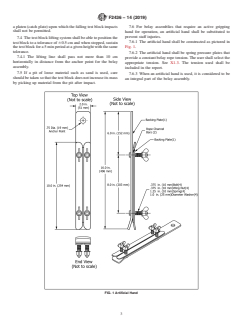
a platen (catch plate) upon which the falling test block impacts 7.6 For belay assemblies that require an active gripping
shall not be permitted. hand for operation, an artificial hand shall be substituted to
prevent staff injuries.
7.4 Thetestblockliftingsystemshallbeabletopositionthe
7.6.1 The artificial hand shall be constructed as pictured in
test block to a tolerance of 60.5 cm and when stopped, sustain
thetestblockfora5minperiodatagivenheightwiththesame Fig. 1.
tolerance.
7.6.2 The artificial hand shall be spring pressure plates that
7.4.1 The lifting line shall pass not more than 10 cm
provide a constant belay rope tension. The user shall select the
horizontally in distance from the anchor point for the belay
appropriate tension. See X1.3. The tension used shall be
assembly.
included in the report.
7.5 If a pit of loose material such as sand is used, care
7.6.3 When an artificial hand is used, it is considered to be
shouldbetakensothatthetestblockdoesnotincreaseitsmass
an integral part of the belay assembly.
by picking up material from the pit after impact.
FIG. 1 Artificial Hand
F2436 − 14 (2019)
7.6.4 Hanging a mass on the belay rope in place of an 9. Sampling
artificial hand is not permitted.
9.1 If the belay assembly is intended for use on various
7.6.5 The point where the rope leaves the artificial hand
diameters of ropes, tests shall be done on both the largest and
(when required) shall be within 40 cm of the point where the
smallest and, if the range exceeds 2 mm, on representative
rope enters the belay assembly. There shall be no slack in the
diameters in between. If the belay assembly is intended for use
rope between the artificial hand and the belay assembly.
with various brands and designs of ropes, each rope brand and
7.6.6 Various anchor points for the artificial hand, each with
construction should be tested. (See Note 2.)
an immediate elastic deformation of less than 1 mm under the
NOTE 2—Different rope brands of same diameter can have unexpected
application of a 500 N force, shall be provided so that the
differences in performance, apparently, due to fairly small differences in
position relative to the belay assembly can duplicate the
rope construction. It should be clearly stated which rope brands, sizes and
position of function in actual use.
constructions were tested and the condition they were in at the start of
testing.
7.7 The test facility shall have a rope flaking area, where
additional rope can be loosely flaked out. The test block shall
10. Conditioning
be able to reach the ground without using up this additional
rope. 10.1 Whiledifferentconditionsoftemperatureandhumidity
7.7.1 The flaking area shall be a flat horizontal surface on may affect impact forces and other test results, conditioning of
thetestingfacilitywithnoroughnessorirregularitiestoimpede ropesisnotfeasibleformosttesting.Ifconditioningisfeasible,
the free flow of the rope.
standard conditions of Practice D1776 shall be used and be
7.7.2 The rope (belay line) shall be flaked at an angle less recorded in test results.
than 15° of directly in line with the device’s intended manner
10.2 If conditioning is not an option, temperature and
of use for braking, and the flaking area shall be positioned to
humidityduringthetestsshallbethoseunderwhichequipment
provide1m(610cm)ofunsupportedropebetweentheflaking
would normally be used. These conditions shall be noted in
area and the belay device being tested.
your test report.
7.8 The maximum arrest force (MAF) shall be measured by 10.2.1 Storage conditions prior to the tests shall be those
a system, which is accurate to 61 % of the MAF, free from under which equipment would normally be stored prior to use.
artifact, and whose calibration is traceable to a recognized These conditions shall be noted in the
...