

ASTM E1855-20
(Test Method)Standard Test Method for Use of 2N2222A Silicon Bipolar Transistors as Neutron Spectrum Sensors and Displacement Damage Monitors
General Information
- Abstract
SIGNIFICANCE AND USE
5.1 The neutron test spectrum must be known in order to use a measured device response to predict the device performance in an operational environment (Practice E1854). Typically, neutron spectra are determined using a set of sensors with response functions sensitive over the neutron energy region to which the device under test (DUT) responds (Guide E721). For silicon bipolar devices exposed in reactor neutron spectra, this effective energy range is between 0.01 and 10 MeV. A typical set of activation reactions that lack fission reactions from nuclides such as 235U, 237Np, or 239Pu, will have very poor sensitivity to the spectrum between 0.01 and 2 MeV. For a pool-type reactor spectrum, 70 % of the DUT electronic damage response may lie in this range making its determination of critical importance.
5.2 When dosimeters with a significant response in the 0.01 to 2 MeV energy region, such as fission foils, are unavailable, silicon transistors can provide a dosimeter with the needed response to define the spectrum in this critical energy range. When fission foils are part of the sensor set, the silicon sensor provides confirmation of the spectral shape in this energy region.
5.3 Silicon bipolar transistors, such as type 2N2222A, are inexpensive, smaller than fission foils contained in a boron ball, and sensitive to a part of the neutron spectrum important to the damage of modern silicon electronics. They also can be used directly in arrays to spatially map 1-MeV(Si) equivalent displacement damage fluence. The proper set of steps to take in reading the transistor-gain degradation is described in this test method.
5.4 The energy-dependence of the displacement damage function for silicon is found in Practice E722. The major portion of the response for the silicon transistors will generally be above 100 keV.
SCOPE
1.1 This test method covers the use of 2N2222A silicon bipolar transistors as dosimetry sensors in the determination of neutron energy spectra and as 1-MeV(Si) equivalent displacement damage fluence monitors.
1.2 The neutron displacement in silicon can serve as a neutron spectrum sensor in the range 0.1 to 2.0 MeV and can serve as a substitute when fission foils are not available. It has been applied in the fluence range between 2 × 10¹² n/cm 2 to 1 × 10¹⁴ n/cm2 and should be useful up to 1 × 10¹⁵ n/cm2. This test method details the acquisition and use of 1-MeV(Si) equivalent fluence information for the partial determination of the neutron spectra by using 2N2222A transistors.
1.3 This sensor yields a direct measurement of the silicon 1-MeV equivalent fluence by the transfer technique.
1.4 The values stated in SI units are to be regarded as standard. No other units of measurement are included in this standard.
1.5 This standard does not purport to address all of the safety concerns, if any, associated with its use. It is the responsibility of the user of this standard to establish appropriate safety, health, and environmental practices and determine the applicability of regulatory limitations prior to use.
1.6 This international standard was developed in accordance with internationally recognized principles on standardization established in the Decision on Principles for the Development of International Standards, Guides and Recommendations issued by the World Trade Organization Technical Barriers to Trade (TBT) Committee.
- Status
- Published
- Publication Date
- 31-Jan-2020
- Technical Committee
- E10 - Nuclear Technology and Applications
Buy Documents
ASTM E1855-20 - Standard Test Method for Use of 2N2222A Silicon Bipolar Transistors as Neutron Spectrum Sensors and Displacement Damage Monitors
REDLINE ASTM E1855-20 - Standard Test Method for Use of 2N2222A Silicon Bipolar Transistors as Neutron Spectrum Sensors and Displacement Damage Monitors
Overview
ASTM E1855-20 defines a standard test method for the use of 2N2222A silicon bipolar transistors as neutron spectrum sensors and displacement damage monitors. Developed by ASTM International, this standard provides guidance for laboratories and engineering teams involved in neutron radiation testing, neutron dosimetry, and radiation hardness assurance of electronic devices. The method is intended to characterize neutron energy spectra and directly measure the 1-MeV(Si) equivalent displacement damage fluence-essential for predicting silicon device performance in various irradiation environments. Using 2N2222A transistors offers a practical, cost-effective, and compact alternative to traditional fission foil dosimeters, especially in energy regions where other sensors are less sensitive.
Key Topics
- Neutron Energy Spectrum Determination: The method enables partial determination of neutron spectra, specifically over the critical 0.01 to 2 MeV range, by leveraging the response function of silicon bipolar transistors.
- Displacement Damage Monitoring: 2N2222A transistors provide direct measurement of the 1-MeV(Si) equivalent neutron fluence, essential for evaluating displacement damage in modern silicon electronics.
- Calibration and Measurement Procedure: The standard outlines a process for calibrating transistors in a reference environment, measurement of gain degradation post-irradiation, and correction for temperature or gamma-ray effects to ensure accuracy.
- Sensor Array Application: Arrays of 2N2222A transistors can be deployed to spatially map displacement damage, offering high-resolution insight across electronic assemblies, components, or irradiation test fixtures.
- Versatility When Fission Foils Are Unavailable: 2N2222A-based dosimetry is especially useful when conventional fission foils are not available or practical for the energy region of interest.
- Quality Assurance and Error Considerations: The standard discusses uncertainty, error amplification in gain measurements, and the importance of consistent experimental conditions.
Applications
- Radiation Hardness Testing: Laboratories and industries performing radiation hardness assurance on electronic components use this method to quantify neutron-induced displacement damage, an important reliability factor in aerospace, defense, and nuclear power applications.
- Neutron Dosimetry in Nuclear Reactors: The test method supports research and operational monitoring in nuclear facilities by providing accurate neutron fluence measurements in silicon-based test structures.
- Spectrum Validation and Adjustment: When included as part of a dosimeter suite, 2N2222A transistors help validate and adjust calculated neutron spectra, improving overall accuracy of reactor surveillance programs and benchmarking.
- Supplemental Dosimetry: The method serves as a supplementary or confirmatory approach alongside traditional activation foils, particularly enhancing assessment in the 0.01–2 MeV neutron energy range.
Related Standards
ASTM E1855-20 is closely associated with several other ASTM standards and guides that underpin the principles of neutron dosimetry, spectrum measurement, and radiation effects on electronics:
- ASTM E170: Terminology relating to radiation measurements and dosimetry
- ASTM E261 and ASTM E265: Practices and test methods for neutron fluence determination via radioactivation
- ASTM E720, E721: Guides for selection and use of neutron sensors and neutron spectrum determination
- ASTM E722: Practice for characterizing neutron fluence spectra in terms of an equivalent monoenergetic neutron fluence
- ASTM E844, E944: Guides for irradiation procedures and spectrum adjustment methods in reactor surveillance
- ASTM E1854: Practice to ensure consistency in neutron-induced displacement damage testing
- ASTM E2005, E2450: Guides for neutron dosimetry benchmarking and mixed neutron-photon environment applications
For more detailed information on standard implementation or cross-referenced guidelines, these related standards provide additional technical context.
Keywords: ASTM E1855-20, neutron spectrum sensors, displacement damage monitors, silicon transistors, 2N2222A, neutron dosimetry, radiation hardness, 1-MeV(Si) equivalent fluence, nuclear reactor testing, spectrum validation.
Relations
- Effective Date
- 01-Feb-2020
- Effective Date
- 01-Jul-2020
- Effective Date
- 01-Oct-2019
- Effective Date
- 01-Oct-2019
- Effective Date
- 01-Oct-2019
- Effective Date
- 01-Jun-2018
- Effective Date
- 01-Jun-2017
- Effective Date
- 01-Oct-2016
- Effective Date
- 15-Feb-2016
- Effective Date
- 01-Sep-2015
- Effective Date
- 01-Jun-2015
- Effective Date
- 01-Jun-2015
- Effective Date
- 15-Mar-2015
- Effective Date
- 15-Oct-2014
- Effective Date
- 01-Sep-2014
Buy Documents
ASTM E1855-20 - Standard Test Method for Use of 2N2222A Silicon Bipolar Transistors as Neutron Spectrum Sensors and Displacement Damage Monitors
REDLINE ASTM E1855-20 - Standard Test Method for Use of 2N2222A Silicon Bipolar Transistors as Neutron Spectrum Sensors and Displacement Damage Monitors
Frequently Asked Questions
ASTM E1855-20 is a standard published by ASTM International. Its full title is "Standard Test Method for Use of 2N2222A Silicon Bipolar Transistors as Neutron Spectrum Sensors and Displacement Damage Monitors". This standard covers: SIGNIFICANCE AND USE 5.1 The neutron test spectrum must be known in order to use a measured device response to predict the device performance in an operational environment (Practice E1854). Typically, neutron spectra are determined using a set of sensors with response functions sensitive over the neutron energy region to which the device under test (DUT) responds (Guide E721). For silicon bipolar devices exposed in reactor neutron spectra, this effective energy range is between 0.01 and 10 MeV. A typical set of activation reactions that lack fission reactions from nuclides such as 235U, 237Np, or 239Pu, will have very poor sensitivity to the spectrum between 0.01 and 2 MeV. For a pool-type reactor spectrum, 70 % of the DUT electronic damage response may lie in this range making its determination of critical importance. 5.2 When dosimeters with a significant response in the 0.01 to 2 MeV energy region, such as fission foils, are unavailable, silicon transistors can provide a dosimeter with the needed response to define the spectrum in this critical energy range. When fission foils are part of the sensor set, the silicon sensor provides confirmation of the spectral shape in this energy region. 5.3 Silicon bipolar transistors, such as type 2N2222A, are inexpensive, smaller than fission foils contained in a boron ball, and sensitive to a part of the neutron spectrum important to the damage of modern silicon electronics. They also can be used directly in arrays to spatially map 1-MeV(Si) equivalent displacement damage fluence. The proper set of steps to take in reading the transistor-gain degradation is described in this test method. 5.4 The energy-dependence of the displacement damage function for silicon is found in Practice E722. The major portion of the response for the silicon transistors will generally be above 100 keV. SCOPE 1.1 This test method covers the use of 2N2222A silicon bipolar transistors as dosimetry sensors in the determination of neutron energy spectra and as 1-MeV(Si) equivalent displacement damage fluence monitors. 1.2 The neutron displacement in silicon can serve as a neutron spectrum sensor in the range 0.1 to 2.0 MeV and can serve as a substitute when fission foils are not available. It has been applied in the fluence range between 2 × 10¹² n/cm 2 to 1 × 10¹⁴ n/cm2 and should be useful up to 1 × 10¹⁵ n/cm2. This test method details the acquisition and use of 1-MeV(Si) equivalent fluence information for the partial determination of the neutron spectra by using 2N2222A transistors. 1.3 This sensor yields a direct measurement of the silicon 1-MeV equivalent fluence by the transfer technique. 1.4 The values stated in SI units are to be regarded as standard. No other units of measurement are included in this standard. 1.5 This standard does not purport to address all of the safety concerns, if any, associated with its use. It is the responsibility of the user of this standard to establish appropriate safety, health, and environmental practices and determine the applicability of regulatory limitations prior to use. 1.6 This international standard was developed in accordance with internationally recognized principles on standardization established in the Decision on Principles for the Development of International Standards, Guides and Recommendations issued by the World Trade Organization Technical Barriers to Trade (TBT) Committee.
SIGNIFICANCE AND USE 5.1 The neutron test spectrum must be known in order to use a measured device response to predict the device performance in an operational environment (Practice E1854). Typically, neutron spectra are determined using a set of sensors with response functions sensitive over the neutron energy region to which the device under test (DUT) responds (Guide E721). For silicon bipolar devices exposed in reactor neutron spectra, this effective energy range is between 0.01 and 10 MeV. A typical set of activation reactions that lack fission reactions from nuclides such as 235U, 237Np, or 239Pu, will have very poor sensitivity to the spectrum between 0.01 and 2 MeV. For a pool-type reactor spectrum, 70 % of the DUT electronic damage response may lie in this range making its determination of critical importance. 5.2 When dosimeters with a significant response in the 0.01 to 2 MeV energy region, such as fission foils, are unavailable, silicon transistors can provide a dosimeter with the needed response to define the spectrum in this critical energy range. When fission foils are part of the sensor set, the silicon sensor provides confirmation of the spectral shape in this energy region. 5.3 Silicon bipolar transistors, such as type 2N2222A, are inexpensive, smaller than fission foils contained in a boron ball, and sensitive to a part of the neutron spectrum important to the damage of modern silicon electronics. They also can be used directly in arrays to spatially map 1-MeV(Si) equivalent displacement damage fluence. The proper set of steps to take in reading the transistor-gain degradation is described in this test method. 5.4 The energy-dependence of the displacement damage function for silicon is found in Practice E722. The major portion of the response for the silicon transistors will generally be above 100 keV. SCOPE 1.1 This test method covers the use of 2N2222A silicon bipolar transistors as dosimetry sensors in the determination of neutron energy spectra and as 1-MeV(Si) equivalent displacement damage fluence monitors. 1.2 The neutron displacement in silicon can serve as a neutron spectrum sensor in the range 0.1 to 2.0 MeV and can serve as a substitute when fission foils are not available. It has been applied in the fluence range between 2 × 10¹² n/cm 2 to 1 × 10¹⁴ n/cm2 and should be useful up to 1 × 10¹⁵ n/cm2. This test method details the acquisition and use of 1-MeV(Si) equivalent fluence information for the partial determination of the neutron spectra by using 2N2222A transistors. 1.3 This sensor yields a direct measurement of the silicon 1-MeV equivalent fluence by the transfer technique. 1.4 The values stated in SI units are to be regarded as standard. No other units of measurement are included in this standard. 1.5 This standard does not purport to address all of the safety concerns, if any, associated with its use. It is the responsibility of the user of this standard to establish appropriate safety, health, and environmental practices and determine the applicability of regulatory limitations prior to use. 1.6 This international standard was developed in accordance with internationally recognized principles on standardization established in the Decision on Principles for the Development of International Standards, Guides and Recommendations issued by the World Trade Organization Technical Barriers to Trade (TBT) Committee.
ASTM E1855-20 is classified under the following ICS (International Classification for Standards) categories: 31.200 - Integrated circuits. Microelectronics. The ICS classification helps identify the subject area and facilitates finding related standards.
ASTM E1855-20 has the following relationships with other standards: It is inter standard links to ASTM E1855-15, ASTM E265-15(2020), ASTM E1854-19, ASTM E722-19, ASTM E944-19, ASTM E844-18, ASTM E170-17, ASTM E170-16a, ASTM E170-16, ASTM E170-15a, ASTM E265-15, ASTM E261-15, ASTM E170-15, ASTM E170-14a, ASTM E170-14. Understanding these relationships helps ensure you are using the most current and applicable version of the standard.
ASTM E1855-20 is available in PDF format for immediate download after purchase. The document can be added to your cart and obtained through the secure checkout process. Digital delivery ensures instant access to the complete standard document.
Standards Content (Sample)
This international standard was developed in accordance with internationally recognized principles on standardization established in the Decision on Principles for the
Development of International Standards, Guides and Recommendations issued by the World Trade Organization Technical Barriers to Trade (TBT) Committee.
Designation: E1855 − 20
Standard Test Method for
Use of 2N2222A Silicon Bipolar Transistors as Neutron
Spectrum Sensors and Displacement Damage Monitors
This standard is issued under the fixed designation E1855; the number immediately following the designation indicates the year of
original adoption or, in the case of revision, the year of last revision.Anumber in parentheses indicates the year of last reapproval.A
superscript epsilon (´) indicates an editorial change since the last revision or reapproval.
1. Scope standards referenced in the list discuss relevant terminology,
the choice of sensors, spectrum determinations with sensor
1.1 This test method covers the use of 2N2222A silicon
data, and the prediction of neutron displacement damage in
bipolar transistors as dosimetry sensors in the determination of
some semiconductor devices, particularly silicon.
neutron energy spectra and as 1-MeV(Si) equivalent displace-
ment damage fluence monitors. 2.2 ASTM Standards:
E170Terminology Relating to Radiation Measurements and
1.2 The neutron displacement in silicon can serve as a
Dosimetry
neutron spectrum sensor in the range 0.1 to 2.0 MeV and can
E261Practice for Determining Neutron Fluence, Fluence
serve as a substitute when fission foils are not available. It has
12 2 Rate, and Spectra by Radioactivation Techniques
been applied in the fluence range between2×10 n/cm to 1
14 2 15 2 E265Test Method for Measuring Reaction Rates and Fast-
×10 n/cm and should be useful up to1×10 n/cm . This
Neutron Fluences by Radioactivation of Sulfur-32
test method details the acquisition and use of 1-MeV(Si)
E720Guide for Selection and Use of Neutron Sensors for
equivalent fluence information for the partial determination of
Determining Neutron Spectra Employed in Radiation-
the neutron spectra by using 2N2222A transistors.
Hardness Testing of Electronics
1.3 This sensor yields a direct measurement of the silicon
E721Guide for Determining Neutron Energy Spectra from
1-MeV equivalent fluence by the transfer technique.
Neutron Sensors for Radiation-Hardness Testing of Elec-
1.4 The values stated in SI units are to be regarded as tronics
E722PracticeforCharacterizingNeutronFluenceSpectrain
standard. No other units of measurement are included in this
standard. Terms of an Equivalent Monoenergetic Neutron Fluence
for Radiation-Hardness Testing of Electronics
1.5 This standard does not purport to address all of the
E844Guide for Sensor Set Design and Irradiation for
safety concerns, if any, associated with its use. It is the
Reactor Surveillance
responsibility of the user of this standard to establish appro-
E944Guide for Application of Neutron Spectrum Adjust-
priate safety, health, and environmental practices and deter-
ment Methods in Reactor Surveillance
mine the applicability of regulatory limitations prior to use.
E1854Practice for Ensuring Test Consistency in Neutron-
1.6 This international standard was developed in accor-
Induced Displacement Damage of Electronic Parts
dance with internationally recognized principles on standard-
E2005Guide for Benchmark Testing of Reactor Dosimetry
ization established in the Decision on Principles for the
in Standard and Reference Neutron Fields
Development of International Standards, Guides and Recom-
E2450Practice for Application of CaF (Mn) Thermolumi-
mendations issued by the World Trade Organization Technical
nescence Dosimeters in Mixed Neutron-Photon Environ-
Barriers to Trade (TBT) Committee.
ments
2. Referenced Documents
3. Terminology
2.1 The ASTM standards E170, E261, and E265 provide a
3.1 Symbols:
background for understanding how sensors are used in radia-
Φ =thesilicon1-MeVequivalentfluence(seePracticeE722).
tion measurements and general dosimetry. The rest of the
h = i /i where i is the collector current and i is the base
FE c b c b
current, in a common-emitter circuit.
ThistestmethodisunderthejurisdictionofASTMCommitteeE10onNuclear
Technology and Applications and is the direct responsibility of Subcommittee
E10.07 on Radiation Dosimetry for Radiation Effects on Materials and Devices. For referenced ASTM standards, visit the ASTM website, www.astm.org, or
Current edition approved Feb. 1, 2020. Published February 2020. Originally contact ASTM Customer Service at service@astm.org. For Annual Book of ASTM
approved in 1996. Last previous edition approved in 2015 as E1855–15. DOI: Standards volume information, refer to the standard’s Document Summary page on
10.1520/E1855-20. the ASTM website.
Copyright © ASTM International, 100 Barr Harbor Drive, PO Box C700, West Conshohocken, PA 19428-2959. United States
E1855 − 20
4. Summary of Test Method 6. Apparatus
4.1 Gain degradation resulting from neutron displacement
6.1 The 2N2222A silicon bipolar transistor has a demon-
damagein2N2222Asiliconbipolartransistorsthatisproduced
strated response in agreement with calculated Φ values in
by a test environment is compared with gain degradation
widely varied environments (5). It is recommended that a
produced by a reference neutron environment. The Φ in the
1r
minimumofthreetransistorsbecalibratedtogetherandusedat
reference environment is derived from the known reference
each location to be characterized. In addition, at least three
spectrum and serves to calibrate the device response for future
transistors should be used as control devices that will not be
determinationofameasuredΦ inthetestenvironment (1, 2) .
1t
irradiated during the test exposure. The control transistors
The subscripts r and t refer to the reference and test environ-
should be exposed one time to a calibration exposure of about
ments respectively.
13 2
1.0×10 n/cm 1-MeV(Si) equivalent fluence and then
4.2 The measured Φ may be used as a sensor response in
annealed(bakedout)at180°Cfor24hfollowedbyambientair
1t
a spectrum adjustment code. The results given by this sensor
cooling to room temperature before being used as controls.
can be combined with reaction foil activities to determine the
These control transistors are not exposed again to radiation
spectrum (3, 4).
during the testing steps, but are read with the exposed
transistors to provide temperature correction.
4.3 Spectra compatible with the responses of many sensors
may be used to calculate a more reliable measure of the
6.2 Adry oven for annealing is needed to stabilize the gain
displacement damage.
after both the calibration-exposure and gain readout are com-
pletedforthereferenceenvironment.Theovenshallbeableto
5. Significance and Use
maintain the set temperature to within 63.0°C at 80°C and at
5.1 Theneutrontestspectrummustbeknowninordertouse
180°C. It would be prudent to have a timer for automatic
a measured device response to predict the device performance
shutdown and an emergency power system (UPS). Shutdown
in an operational environment (Practice E1854). Typically,
with a timer will require a door-opening mechanism to initiate
neutron spectra are determined using a set of sensors with
ambient air-cooling.
response functions sensitive over the neutron energy region to
6.3 Anelectronicsystemisrequiredtomaintainappropriate
whichthedeviceundertest(DUT)responds(GuideE721).For
transistorbiasandcurrentsandtoreadthecurrentsforthegain
silicon bipolar devices exposed in reactor neutron spectra, this
measurements. A programmable tester or parameter analyzer
effective energy range is between 0.01 and 10 MeV.Atypical
can operate in pulsed mode to mitigate heating effects and
set of activation reactions that lack fission reactions from
235 237 239
nuclides such as U, Np, or Pu, will have very poor provide gain values quickly. The parameter tester determines
sensitivity to the spectrum between 0.01 and 2 MeV. For a thecommon-emittercurrentgainbyinjectingapulseofcurrent
pool-type reactor spectrum, 70 % of the DUT electronic
into the base region, measuring the collector current, and
damage response may lie in this range making its determina- determining the current ratio i /i at a fixed bias of 10Von the
c b
tion of critical importance.
collector terminal. The bias voltage is measured between the
collector and the base (see Ref (6)).
5.2 When dosimeters with a significant response in the 0.01
to 2 MeV energy region, such as fission foils, are unavailable,
6.4 A reference neutron source (Guide E2005) for calibra-
silicon transistors can provide a dosimeter with the needed
tion of the transistors is required. The neutron fluence and
response to define the spectrum in this critical energy range.
neutron fluence spectrum of the reference source must be
When fission foils are part of the sensor set, the silicon sensor
known. National Institute for Standards and Technology
provides confirmation of the spectral shape in this energy
(NIST) benchmark fields (7) are recommended for use as
region.
primary standards, and a well characterized fast burst reactor,
5.3 Silicon bipolar transistors, such as type 2N2222A, are
suchastheoneatWhiteSandsMissileRange,isrecommended
inexpensive, smaller than fission foils contained in a boron
as a reference benchmark field.
ball, and sensitive to a part of the neutron spectrum important
6.5 Asuitablefluencemonitor,suchasanickelfoil,shallbe
to the damage of modern silicon electronics. They also can be
exposedalongwiththetransistorsduringexposures.Aphoton-
used directly in arrays to spatially map 1-MeV(Si) equivalent
sensitivedetectorsuchasaCaF thermolumenescencedetector
displacementdamagefluence.Thepropersetofstepstotakein 2
(TLD) shall be included in each test package to monitor the
reading the transistor-gain degradation is described in this test
gamma ray dose. Care must be taken in the determination of
method.
the gamma environment to correct for any neutron response
5.4 The energy-dependence of the displacement damage
from the photon-sensitive detector that is used. Practice E2450
function for silicon is found in Practice E722. The major
provides guidance on how to correct a CaF :Mn TLD for the
portionoftheresponseforthesilicontransistorswillgenerally
neutron response.
be above 100 keV.
NOTE1—Ionizingdoseisproducedbyphotonirradiationinbulksilicon
and SiO .The ionizing dose can induce trapped holes and interface states
in the oxide of the silicon devices. This resulting trapped charge can
induce electric fields and create interface traps that change the gain in a
The boldface numbers in parentheses refer to a list of references at the end of
this test method. bipolar device.
E1855 − 20
7. Description of the Test Method 1 1 1
∆ 5 2 (2)
S D
h h h
FEΦ FEO
7.1 2N2222A transistors exhibit a range of initial gain
values and responses, but each responds linearly with
This is the change in reciprocal gain and should have a
1-MeV(Si) equivalent displacement damage fluence, Φ,at
positive value (for example, the gain should decrease after
fixed collector current according to the Messenger-Spratt
irradiation). A subscript of r is used to denote the reciprocal
equation (8), if gamma rays do not contribute to the change of
gain change in the reference calibration environment. A sub-
gain.
script of t is used to denote the reciprocal gain change in the
test or unknown environment. This measurement and the
1 1
2 5 K Φ 1 MeV (1)
~ !
τ
known value of Φ provide the calibration for the transistor,
h h 1r
FEΦ FEO
K .
τ
The term h is the common-emitter current gain at some
FEO
7.6 When the ∆ (1/h) is measured in the unknown test
fixed collector current before irradiation in the test
environment, the Φ can be found in the following manner.
1t
environment, and h is measured gain value taken at the
FEΦ
Take the ratio of equations (Eq 1) for the reference and test
same collector current after irradiation. K is the damage
τ
environments and rearrange the terms to yield Eq 3 (3).
constant. If gamma-ray dose contributes to the change in the
reciprocalofthegain,thenthatcontributionmustbesubtracted 1
∆
S D
from the left side of Eq 1 (see 8.3). h 1 1
t
Φ 5 Φ 5 ∆ (3)
S D
1t 1r
1 K h
τ
t
7.2 A basic schematic circuit used by semiconductor ana-
∆
S D
h
r
lyzers for measuring h = i /i is shown in Fig. 1.Asemicon-
FE c b
ductor parameter analyzer may be used to determine h .Any 7.7 The Φ is the quantity needed as a sensor value in the
FE 1t
spectrum determination procedure. The ∆ (1/h) is the change
equivalent method for making the electrical measurement is
t
acceptable as long as the measurement is taken at a consistent inreciprocalgaininducedbythetestenvironment.Forneutron
damage on 2N2222A transistors, K is a constant for neutron
collector current. The experimenter must ensure that the
τ
15 2
currents do not exceed the limits detailed in 8.1.2 and 8.1.3. fluences up to about1×10 n/cm . The method described
here provides a direct determination of Φ .
1t
7.3 Since K differs for each transistor, each must be
τ
calibrated; see paragraph 8.1.1.Atypical value for K is about 7.8 The 2N2222A may be used as a 1-MeV(Si) displace-
τ
–15 2
ment monitor. In this use, Eq 3 gives the desired quantity
1.5×10 cm /neutron for a collector current of 1 mA.
directly, independent of the neutron spectrum. This may be
7.4 The linearity of response of a given batch of transistors
useful, for example, to measure the 1-MeV(Si) displacement
shallbeverifiedbyexposureofsamplesofthebatchtoatleast
damage at several locations inside a massive test item without
three levels of neutron fluence covering the range in which the
a full spectral measurement at each point. The gamma-ray
devices will be used. This step is important because manufac-
corrections especially must be made if the DUT receives
turing processes may change over time and can impact device
significant ionizing dose during the irradiation.
response.
7.5 The calibration is accomplished by exposing the tran-
8. Experimental Procedure
sistors in a reference field for which the absolute values of the
8.1 To ensure proper calibration of the sensor, follow steps
neutronfluencespectrumareknownacrossthe0.01to10MeV
8.1.1 – 8.1.9.
neutron energy range in which significant damage is caused.
8.1.1 Step 1—Measuretheinitialgainvaluesat I =1mAof
c
The1-MeV(Si)equivalentdisplacementdamagefluenceofthe
all the 2N2222A transistors in the batch. Throw out all those
reference environment, Φ , is obtained by folding the spec-
1r
with gain less than 100 and then remove the top and bottom
trum with the silicon displacement damage response as is
5%oftheremainingset.Ifthecalibrationenvironmentislarge
described in Practice E722. The gain values, h before
FEO
enoughtoprovideauniformfluencetoallthetransistorsonthe
irradiation,and h afterirradiationaremeasured,andtheleft
FEΦ
same run, it is best to calibrate the whole batch together.Three
side of Eq 1 is calculated. The following quantity can be
is the minimum number of transistors needed for test measure-
defined.
ment.
8.1.2 The gain measurements may conveniently be made
with a programmable semiconductor parameter analyzer, or
with a specially designed circuit tester.
8.1.2.1 Setup—I should be variable from 100 pAto 1 mA.
B
The V compliancevoltageis10V. V isafixedparameterof
B CE
10 V with a compliance current of 18 mA. I is assigned a
C
compliance current of 18 mA.
NOTE 2—The upper bound placed on the base current range will never
be reached given a nominal device gain of 100 and a maximum collector
current of 1 mA. The nominal maximum base current seen during a
pre-irradiationmeasurementis ;0.01mA.Thebasecurrentrangeissetso
that it does not prove to be a limiting factor for a properly operating
FIG. 1 Schematic for Transistor Read-Out 2N2222A transistor.
E1855 − 20
8.1.2.2 Measurement—Varyresistancehightolowtill I is1 shorted.AppendixX1showshowthenonlinearpropagationof
c
mA. Measure I , h = I /I . For pulsed measurements the gain measurement error into the implied 1–MeV(Si) fluence
B FE c B
transistor measurements are made witha3ms pulse at each of can result in significantly larger fluence uncertainties. For
the defined base current settings. smaller exposed fluences, the multiplication factor in the
gain-to-fluence uncertainty is much larger. For a nominal
8.1.2.3 Data Recording—Record all I and I measure-
C B
irradiation where the gain is degraded by 30 %,a1%
ments. Use the I value at 1 mA to calculate I /I .
C C B
uncertainty in the gain measurements can, in a worst-case
8.1.3 The measurement procedure was designed to avoid
anti-correlated scenario addressed in Appendix X1, result in a
large currents that would saturate the device or result in
5%uncertaintyintheimpliedneutronfluence.Sinceuseofthe
current-injection annealing of the radiation-induced damage to
silicon gain degradation as a dosimeter requires that the
the test 2N2222A transistor. Collector currents larger than 1
uncertainty in the implied neutron fluence be small, the
mA should not be permitted except in a pulsed mode of
irradiation should be sufficient to degrade the gain by .30%
operation. In pulsed mode, collector currents of up to 20 mA
or more.An upper limit on the neutron fluence is motivated by
are permitted with pulse widths less than ;4 ms. The mea-
the larger fractional measurement uncertainty when the tran-
surement procedure detailed in 8.1.2 had a maximum collector
sistorgainisdegradedtolevelslessthan~5.Forafastneutron
current of 18 mA. If a different pulsed readout method is used,
spectrum and using a representative damage constant of K =
τ
the amount of time spent at collector currents greater than 1
–15 2
1.5×10 cm /neutron and an initial gain of 90, this desired
mAshould not significantly exceed that which results from the
30 % change in gain and consideration of the maximum gain
described procedure.At higher collector currents, there can be
12 2
degradation means that ~5×10 1–MeV(Si)-eqv.-n/cm ≤Φ
emitter crowding, nonlinearities and heating effects. A stan-
14 2
≤ .1×10 1-MeV(Si)-eqv.-n/cm . Include monitor foils
dardized sequence and duration of measurement is necessary
nickel or sulfur and include TLDs in the irradiation package.
because of variations of the charge state of traps within the
8.1.6 Step 4—In order to remove the variations associated
devices, particularly after exposure to ionizing radiation (from
with ambient temperature annealing during and after the
sources such as the gamma ray background). Collector current
irradiation, a “stabilization” anneal step at 80°C for two hours
measurements of 1 mA and down to 0.1 mA may be made in
shallbeperformedbeforeeveryreadout,evenbeforetheinitial
a steady-state mode.At collector currents lower than 1 mAthe
irradiation.Thiswillonlybeeffectiveinensuringreproducible
gains are less reproducible and are more sensitive to tempera-
results if the environmental conditions during irradiation and
ture and gamma ray background contributions. There can also
subsequent handling do not include exposure at temperatures
be surface and emitter losses.
above 60°C. An additional precaution is to standardize the
NOTE3—Avoidhandlingthetransistorswithfingersjustbeforereading,
delay time between irradiation and readout.Annealing at 80°C
because the warmed transistors will exhibit a higher gain. When reading
for 2 h removes no more than 20% of the displacement
thegains,interspersethecontroltransistorswiththetesttransistorsandtry
damage (9). Under this condition, fading (further annealing)
tomaintainuniformtemperaturethroughoutthereadoutprocess.Itisgood
practice to have all transistors in the same temperature environment for has not been observed. Do not anneal the control transistors.
approximately 5 min before the device readout begins.
NOTE 4—The importance of limiting the exposure of the device to high
8.1.4 Step 2—Isolate three transistors to be used as controls
currents was discussed in 8.1.3. In addition to the annealing by high
current charge injection, there are other high current-related effects that
forcorrectingthegainmeasurementstoaccountfordifferences
can reverse the annealing of some types of silicon defects. There is a
in the temperature of the transistors when they are read after
bi-stable silicon defect (10, 11) that, under high current charge injection,
each exposure and anneal step of the transistors. The tempera-
can reverse the effects of the stabilizing anneal step discussed in 8.1.6.
ture dependence of the gain is expected to be different for
This results in a decrease in the gain. After a high current exposure, the
un-irradiated and irradiated transistor. Therefore, the control
transistor may again be subjected to a time-dependent annealing under
ambient temperature/time conditions.
transistors shall be exposed to a neutron fluence of ;10
n/cm and then annealed at 180°C for 24 h followed by
8.1.7 Step 5—Measure the gains of the controls and sensors
ambient air cooling before use. Controls shall not be further
under standardized conditions.The environmental temperature
exposedorannealed.Forexample,afterthecalibrationrun,the
during this measurement shall be within 10°C of the pre-
control transistors are read for gain along with the exposed
irradiation measurement temperature. If available, mount the
transistors. The temperature correction factor R , is computed
c
device in a temperature-controlled block.
using:
8.1.8 Step 6—Applyacorrectiontothepost-irradiationgain
n
1 R values for the effect of the difference in temperature between
i
R 5 (4)
c (
theinitialcharacterizationandthepresentreading.Thismaybe
n C
i51
i
done either by means of a measured temperature coefficient of
where:
irradiated transistors that have been annealed (see 8.1.4), or by
n = number of control transistors,
multiplyingtheobservedgainvaluesbytheratiooftheaverage
R = transistor gain of the present readout for the ith control
i
of the control values as measured when the sensors were first
transistor, and
being read, to their average gain values measured at the same
C = transistorgainofthe ithcontroltransistordeterminedin
i
time as the post-irradiation measurement.
8.1.1.
8.1.9 Step 7—Use the monitor foil activity as a normalizing
8.1.5 Step 3—Exposethesensortransistorsuniformlyinthe factor and the reference environment spectrum to determine
reference neutron environment, unbiased and with the leads Φ , which was experienced during the sensor calibration. The
1r
E1855 − 20
normalization is accomplished by multiplying Φ , determined 8.3.2 To monitor for gamma-ray contributions, TLDs or an
when the spectrum was measured by the ratio of the monitor ionizing dose sensor shall be included with all sensor sets. For
foil activities in the respective spectrum and calibration expo- this discussion, define the symbol γ, when not used in an
sure. Then calculate K from Eq 1 for each transistor. expressionsuchas(n,γ),tomeanthegamma-rayionizingdose
τ
tosilicon.Usethe1-MeV(Si)equivalentdisplacementdamage
8.2 Determination of the Measured Φ in the Test Environ-
1t
fluence from the reference spectrum and that derived from Eq
ment:
3 for the test spectrum to calculate Φ /γ ratios for the two
8.2.1 Step 8—After the calibration readout and before ex-
environments. The γ values are obtained from the TLD
posure in the test environment, the transistors shall be given a
readings for the two cases. If either of these ratios is less than
“recoveryanneal”tofurtherstabilizeandresetthegainsbefore
11 2
10 neutrons/cm /Gy(Si) then a correction may have to be
the next exposure. The recommended annealing is 180°C for
applied to the ∆ (1/h) for gamma ray damage. This means that
24 h. This annealing will recover about 70% of the damage
the ∆ (1/h) from the gamma ray induced damage must be
γ
caused by the latest irradiation (see Ref (9)) so that the sensor
subtracted from the total measured ∆ (1/h) to yield ∆ (1/h)
T
can be used in more than one test environment.
from the neutrons to be used in Eq 1.An approximate value of
8.2.2 Step 9—The initial gain, h , to be used in this
FEO
∆ (1/h) can be determined by exposing the transistors to a
γ
second application of Messenger’s Eq 1 is the gain after the
Co source along with TLD monitors. In the γ sensitivity
“recoveryanneal”describedin8.2.1,becauseitisthenewgain
calibration, the transistors shall also be annealed at 80 °C for
change induced by the test environment that we want
...
This document is not an ASTM standard and is intended only to provide the user of an ASTM standard an indication of what changes have been made to the previous version. Because
it may not be technically possible to adequately depict all changes accurately, ASTM recommends that users consult prior editions as appropriate. In all cases only the current version
of the standard as published by ASTM is to be considered the official document.
Designation: E1855 − 15 E1855 − 20
Standard Test Method for
Use of 2N2222A Silicon Bipolar Transistors as Neutron
Spectrum Sensors and Displacement Damage Monitors
This standard is issued under the fixed designation E1855; the number immediately following the designation indicates the year of
original adoption or, in the case of revision, the year of last revision. A number in parentheses indicates the year of last reapproval. A
superscript epsilon (´) indicates an editorial change since the last revision or reapproval.
1. Scope
1.1 This test method covers the use of 2N2222A silicon bipolar transistors as dosimetry sensors in the determination of neutron
energy spectra and as 1 Mev(Si) 1-MeV(Si) equivalent displacement damage fluence monitors.
1.2 The neutron displacement in silicon can serve as a neutron spectrum sensor in the range 0.1 to 2.0 MeV and can serve as
12 2 14 2
a substitute when fission foils are not available. It has been applied in the fluence range between 2 × 10 n/cm to 1 × 10 n/cm
15 2
and should be useful up to 1 × 10 n/cm . This test method details the acquisition and use of 1 Mev(Si) 1-MeV(Si) equivalent
fluence information for the partial determination of the neutron spectra by using 2N2222A transistors.
1.3 This sensor yields a direct measurement of the silicon 1 Mev 1-MeV equivalent fluence by the transfer technique.
1.4 The values stated in SI units are to be regarded as standard. No other units of measurement are included in this standard.
1.5 This standard does not purport to address all of the safety concerns, if any, associated with its use. It is the responsibility
of the user of this standard to establish appropriate safety safety, health, and healthenvironmental practices and determine the
applicability of regulatory requirementslimitations prior to use.
1.6 This international standard was developed in accordance with internationally recognized principles on standardization
established in the Decision on Principles for the Development of International Standards, Guides and Recommendations issued
by the World Trade Organization Technical Barriers to Trade (TBT) Committee.
2. Referenced Documents
2.1 The ASTM standards E170, E261, and E265 provide a background for understanding how sensors are used in radiation
measurements and general dosimetry. The rest of the standards referenced in the list discuss relevant terminology, the choice of
sensors, spectrum determinations with sensor data, and the prediction of neutron displacement damage in some semiconductor
devices, particularly silicon.
2.2 ASTM Standards:
E170 Terminology Relating to Radiation Measurements and Dosimetry
E261 Practice for Determining Neutron Fluence, Fluence Rate, and Spectra by Radioactivation Techniques
E265 Test Method for Measuring Reaction Rates and Fast-Neutron Fluences by Radioactivation of Sulfur-32
E720 Guide for Selection and Use of Neutron Sensors for Determining Neutron Spectra Employed in Radiation-Hardness
Testing of Electronics
E721 Guide for Determining Neutron Energy Spectra from Neutron Sensors for Radiation-Hardness Testing of Electronics
E722 Practice for Characterizing Neutron Fluence Spectra in Terms of an Equivalent Monoenergetic Neutron Fluence for
Radiation-Hardness Testing of Electronics
E844 Guide for Sensor Set Design and Irradiation for Reactor Surveillance
E944 Guide for Application of Neutron Spectrum Adjustment Methods in Reactor Surveillance
E1854 Practice for Ensuring Test Consistency in Neutron-Induced Displacement Damage of Electronic Parts
E2005 Guide for Benchmark Testing of Reactor Dosimetry in Standard and Reference Neutron Fields
E2450 Practice for Application of CaF (Mn) Thermoluminescence Dosimeters in Mixed Neutron-Photon Environments
This test method is under the jurisdiction of ASTM Committee E10 on Nuclear Technology and Applications and is the direct responsibility of Subcommittee E10.07
on Radiation Dosimetry for Radiation Effects on Materials and Devices.
Current edition approved Oct. 1, 2015Feb. 1, 2020. Published November 2015February 2020. Originally approved in 1996. Last previous edition approved in 20102015
as E1855 – 10.E1855 – 15. DOI: 10.1520/E1855-15.10.1520/E1855-20.
For referenced ASTM standards, visit the ASTM website, www.astm.org, or contact ASTM Customer Service at service@astm.org. For Annual Book of ASTM Standards
volume information, refer to the standard’s Document Summary page on the ASTM website.
Copyright © ASTM International, 100 Barr Harbor Drive, PO Box C700, West Conshohocken, PA 19428-2959. United States
E1855 − 20
3. Terminology
3.1 Symbols:
Φ = the silicon 1 Mev 1-MeV equivalent fluence (see Practice E722).
h = i /i where i is the collector current and i is the base current, in a common emitter common-emitter circuit.
FE c b c b
4. Summary of Test Method
4.1 Gain degradation of resulting from neutron displacement damage in 2N2222A silicon bipolar transistors measured in that
is produced by a test (simulation) environment is compared with a measured gain degradation produced by a reference neutron
environment. The Φ in the reference environment is derived from the known reference spectrum and is used to determine serves
1r
to calibrate the device response for future determination of a measured Φ in the test environment (1, 2) . The subscripts r and
1t
t refer to the reference and test environments respectively.
4.2 The measured Φ may be used as a sensor response in a spectrum adjustment code code. The results given by this sensor
1t
can be combined with reaction foil activities to determine the spectrum (3, 4).
4.3 Spectra compatible with the responses of many sensors may be used to calculate a more reliable measure of the displacement
damage.
5. Significance and Use
5.1 The neutron test spectrum must be known in order to use a measured device response to predict the device performance in
an operational environment ((Practice E1854). Typically, neutron spectra are determined by use of using a set of sensors with
response functions sensitive over the neutron energy region to which the device under test (DUT) responds ((Guide E721). For
silicon bipolar devices exposed in reactor neutron spectra, this effective energy range is between 0.01 and 10 MeV. A typical set
235 237 239
of activation reactions that lack fission reactions from nuclides such as U, Np, or Pu, will have very poor sensitivity to
the spectrum between 0.01 and 2 MeV. For a pool-type reactor spectrum, 70 % of the DUT electronic damage response may lie
in this range.range making its determination of critical importance.
5.2 When dosimeters with a significant response in the 10 keV 0.01 to 2 MeV energy region, such as fission foils, are
unavailable, silicon transistors maycan provide a dosimeter with the needed response to define the spectrum in this critical energy
range. When fission foils are part of the sensor set, the silicon sensor provides confirmation of the spectral shape in this energy
region.
5.3 Silicon bipolar transistors, such as type 2N2222A, are inexpensive, smaller than fission foils contained in a boron ball, and
sensitive to a part of the neutron spectrum important to the damage of modern silicon electronics. They also can be used directly
in arrays to spatially map 1 Mev(Si) 1-MeV(Si) equivalent displacement damage fluence. The proper set of steps to take in reading
the transistor-gain degradation is described in this test method.
5.4 The energy-dependence of the displacement damage function for silicon is found in Practice E722. The major portion of
the response for the silicon transistors will generally be above 100 keV.
6. Apparatus
6.1 The 2N2222A silicon bipolar transistor has a demonstrated response in agreement with calculated Φ values in widely varied
environments (5). It is recommended that three or more a minimum of three transistors be calibrated together and used at each
location to be characterized. At In addition, at least three transistors should be used as control devices. devices that will not be
irradiated during the test exposure. The control transistors should be exposed one time to a calibration exposure of about 1.0 × 10
n/cm 1 Mev(Si) 1-MeV(Si) equivalent fluence and then annealed (baked out) at 180°C for 24 h followed by ambient air cooling
to room temperature before being used as controls. These control transistors are not exposed again to radiation during the testing
steps, but are read with the exposed transistors to provide temperature correction.
6.2 A dry oven for annealing is needed to stabilize the gain after both the calibration-exposure and gain readout are completed
for the reference environment. The oven shall be able to maintain the set temperature to within 63.0°C at 80°C and at 180°C. It
would be prudent to have a timer for automatic shutdown and an emergency power system (UPS). Shutdown with a timer will
require a door-opening mechanism for to initiate ambient air-cooling.
6.3 An electronic system is required to maintain appropriate transistor bias and currents and to read the currents for the gain
measurements. A programmable tester or parameter analyzer can operate in pulsed mode to controlmitigate heating effects and
provide gain values quickly. The parameter tester determines the common emitter common-emitter current gain by injecting a pulse
of current into the base region, measuring the collector current, and determining the current ratio i /i at a fixed bias of 10 V. V
c b
on the collector terminal. The bias voltage is measured between the collector and the base (see Ref (6)).
The boldface numbers in parentheses refer to a list of references at the end of this test method.
E1855 − 20
6.4 A reference neutron source ((Guide E2005) for calibration of the transistors is required. The neutron fluence and neutron
fluence spectrum of the reference source must be known. National Institute for Standards and Technology (NIST) benchmark fields
(7) are recommended for use as primary standards, and a well characterized fast burst reactor, such as the one at White Sands
Missile Range, is recommended as a reference benchmark field.
6.5 A suitable fluence monitor, such as a nickel foil, shall be exposed along with the transistors during exposures. A
photon-sensitive detector such as a CaF thermolumenescence detector (TLD) shall be included in each test package to monitor
the gamma ray dose. Care must be taken in the determination of the gamma environment to correct for any neutron response from
the photon-sensitive detector that is used. Practice E2450 provides guidance on how to correct a CaF :Mn TLD for the neutron
response.
NOTE 1—Ionizing dose is produced by photon irradiation in bulk silicon and SiO . The ionizing dose can induce trapped holes and interface states in
the oxide of the silicon devices. This resulting trapped charge can induce electric fields and create interface traps that change the gain in a bipolar device.
7. Description of the Test Method
7.1 2N2222A transistors exhibit a range of initial gain values and responses, but each responds linearly with 1 Mev(Si)
1-MeV(Si) equivalent displacement damage fluence, Φ , at fixed collector current according to the Messenger-Spratt equation (8),
if gamma rays do not contribute to the change of gain.
1 1
2 5 K Φ 1 MeV (1)
~ !
τ
h h
FEΦ FEO
The term h is the common emitter common-emitter current gain at some fixed collector current before irradiation in the test
FEO
environment, and h is the quantity measured measured gain value taken at the same collector current after irradiation. K is the
FEΦ τ
damage constant. If gamma-ray dose contributes to the change in the reciprocal of the gain, then that contribution must be
subtracted from the left side of Eq 1 (see 8.3).
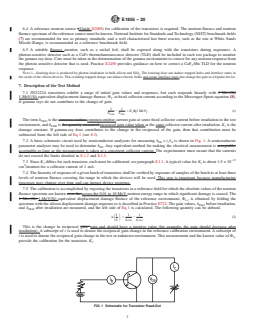
7.2 A basic schematic circuit used by semiconductor analyzers for measuring h = i /i is shown in Fig. 1. A semiconductor
FE c b
parameter analyzer may be used to determine h . Any equivalent method for making the electrical measurement is acceptable.
FE
acceptable as long as the measurement is taken at a consistent collector current. The experimenter must ensure that the currents
do not exceed the limits detailed in 8.1.2 and 8.1.3.
–15
7.3 Since K differs for each transistor, each must be calibrated; see paragraph 8.1.1. A typical value for K is about 1.5 × 10
τ τ
cm /neutron for a collector current of 1 mA.
7.4 The linearity of response of a given batch of transistors shall be verified by exposure of samples of the batch to at least three
levels of neutron fluence covering the range in which the devices will be used. This step is important because manufacturing
processes may change over time and can impact device response.
7.5 The calibration is accomplished by exposing the transistors in a reference field for which the absolute values of the neutron
fluence spectrum are known over the across the 0.01 to 10 MeV neutron energy range in which significant damage is caused. The
1 Mev(Si) 1-MeV(Si) equivalent displacement damage fluence of the reference environment, Φ , is obtained by folding the
1r
spectrum with the silicon displacement damage response as is described in Practice E722. The gain values, h before irradiation,
FEO
and h after irradiation are measured, and the left side of Eq 1 is calculated. The following quantity can be defined.
FEΦ
1 1 1
Δ 5 2 (2)
S D
h h h
FEΦ FEO
This is the change in reciprocal gain. gain and should have a positive value (for example, the gain should decrease after
irradiation). A subscript of r is used to denote the reciprocal gain change in the reference calibration environment. A subscript of
t is used to denote the reciprocal gain change in the test or unknown environment. This measurement and the known value of Φ
1r
provide the calibration for the transistor, K .
τ
FIG. 1 Schematic for Transistor Read-Out
E1855 − 20
7.6 When the Δ (1/h) is measured in the unknown test environment, the Φ can be found in the following manner. Take the
1t
ratio of equations (Eq 1) for the reference and test environments and rearrange the terms to yield Eq 3 (3).
Δ
S D
h 1 1
t
Φ 5 Φ 5 Δ (3)
S D
1t 1r
1 K h
τ t
Δ
S D
h
r
7.7 The Φ is the quantity needed as a sensor value in the spectrum determination procedure. The Δ (1/h) is the change in
1t t
reciprocal gain induced by the test environment. For neutron damage on 2N2222A transistors, K is a constant for neutron fluences
τ
15 2
up to about 1 × 10 n/cm . The method described here provides a direct determination of Φ .
1t
7.8 The 2N2222A may be used as a 1 MeV-(Si) 1-MeV(Si) displacement monitor. In this use, Eq 3 gives the desired quantity
directly, independent of the neutron spectrum. The gamma-ray corrections must be made. This may be useful, for example, to
measure the 1 Mev(Si) 1-MeV(Si) displacement damage at several locations inside a massive test item without a full spectral
measurement at each point. The gamma-ray corrections especially must be made if the DUT receives significant ionizing dose
during the irradiation.
8. Experimental Procedure
8.1 To ensure proper calibration of the sensor, follow steps 8.1.1 – 8.1.9.
8.1.1 Step 1—Measure, at 1 mA, Measure the initial gain values at I , the initial gain values = 1 mA of all the 2N2222A
c
transistors in the batch. Throw out all those with gain less than 100 and then remove the top and bottom 5 % of the remaining set.
If the calibration environment is large enough to provide a uniform fluence to all the transistors on the same run, it is best to
calibrate the whole batch together. Three is the minimum number of transistors.transistors needed for test measurement.
8.1.2 The gain measurements may conveniently be made with a programmable semiconductor parameter analyzer, or with a
specially designed circuit tester.
8.1.2.1 Setup—I should be variable from 100 pA to 1 mA. The V compliance voltage is 10 V. V is a fixed parameter of 10
B B CE
V with a compliance current of 18 mA. I is assigned a compliance current of 18 mA.
C
NOTE 2—The upper bound placed on the base current range will never be reached given a nominal device gain of 100 and a maximum collector current
of 1 mA. The nominal maximum base current seen during a pre-irradiation measurement is ;0.01 mA. The base current range is set so that it does not
prove to be a limiting factor for a properly operating 2N2222A transistor.
8.1.2.2 Measurement—Vary resistance high to low till I is 1 mA. Measure I ,h = I /I . For pulsed measurements the transistor
c B FE c B
measurements are made with a 3 ms pulse at each of the defined base current settings.
8.1.2.3 Data Recording—Record all I and I measurements. Use the I value at 1 mA to calculate I /I .
C B C C B
8.1.3 The measurement procedure was designed to avoid large currents that would saturate the device or result in
current-injection annealing of the radiation-induced damage to the test 2N2222A transistor. Collector currents larger than 1 mA
should not be permitted except in a pulsed mode of operation. In pulsed mode, collector currents of up to 20 mA are permitted
with pulse widths less than ;4 ms. The measurement procedure detailed in 8.1.2 had a maximum collector current of 18 mA. If
a different pulsed readout method is used, the amount of time spent at collector currents greater than 1 mA should not significantly
exceed that which results from the described procedure. At higher collector currents, there can be emitter crowding, nonlinearities
and heating effects. A standardized sequence and duration of measurement is necessary because of variations of the charge state
of traps within the devices, particularly after exposure to ionizing radiation (from sources such as the gamma ray background).
Collector current measurements of 1 mA and down to 0.1 mA may be made in a steady state steady-state mode. At collector
currents lower than 1 mA the gains are less reproducible and are more sensitive to temperature and gamma ray background
contributions. There arecan also be surface and emitter losses.
NOTE 3—Avoid handling the transistors with fingers just before reading, because the warmed transistors will exhibit a higher gain. When reading the
gains, intersperse the control transistors with the test transistors and try to maintain uniform temperature throughout the readout process. It is good practice
to have all transistors in the same temperature environment for approximately 5 min before the device readout begins.
8.1.4 Step 2—Isolate three transistors to be used as controls for correcting the gain measurements to account for differences in
the temperature of the transistors when they are read after each exposure and anneal step of the transistors. The temperature
dependence of the gain is expected to be different for un-irradiated and irradiated transistor. Therefore, the control transistors shall
13 2
be exposed to a neutron fluence of ;10 n/cm and then annealed at 180°C for 24 h followed by ambient air cooling before use.
Controls shall not be further exposed or annealed. For example, after the calibration run, the control transistors are read for gain
along with the exposed transistors. The temperature correction factor R , is computed using:
c
n
1 R
i
R 5 (4)
c (
n C
i51
i
where:
n = number of control transistors,
E1855 − 20
R = transistor gain of the present readout for the ith control transistor, and
i
C = transistor gain of the ith control transistor determined in 8.1.1.
i
8.1.5 Step 3—Expose the sensor transistors uniformly in the reference neutron environment, unbiased and with the leads
shorted. Appendix X1 shows how the nonlinear propagation of gain measurement error into the implied 1–MeV(Si) fluence can
result in significantly larger fluence uncertainties. For smaller exposed fluences, the multiplication factor in the gain-to-fluence
uncertainty is much larger. For a nominal irradiation where the gain is degraded by 30 %, a 1 % uncertainty in the gain
measurements can, in a worst-case anti-correlated scenario addressed in Appendix X1, result in a 5 % uncertainty in the implied
neutron fluence. Since use of the silicon gain degradation as a dosimeter requires that the uncertainty in the implied neutron fluence
be small, the irradiation should be sufficient to degrade the gain by .30 % or more. An upper limit on the neutron fluence is
motivated by the larger fractional measurement uncertainty when the transistor gain is degraded to levels less than ~5. For a fast
–15 2
neutron spectrum and using a representative damage constant of K = 1.5 × 10 cm /neutron and an initial gain of 90, this desired
τ
12 2
30 % change in gain and consideration of the maximum gain degradation means that ~5 × 10 1–MeV(Si)-eqv.-n/cm ≤ Φ ≤
14 2
.1 × 10 1 Mev(Si)-eqv.-n/cm1-MeV(Si)-eqv.-n/cm . Include monitor foils nickel or sulfur and include TLDs in the irradiation
package.
8.1.6 Step 4—In order to remove the variations associated with ambient temperature annealing during and after the irradiation,
an annealing a “stabilization” anneal step at 80°C for two hours shall be performed before readout. every readout, even before the
initial irradiation. This will only be effective in ensuring reproducible results if the environmental conditions during irradiation and
subsequent handling do not include exposure at temperatures above 60°C. An additional precaution is to standardize the delay time
between irradiation and readout. Annealing at 80°C for 2 h removes no more than 20 % of the displacement damage (9). Under
this condition, fading (further annealing) has not been observed. Do not anneal the control transistors.
NOTE 4—The importance of limiting the exposure of the device to high currents was discussed in 8.1.3. In addition to the annealing by high current
charge injection, there are other high current-related effects that can reverse the annealing of some types of silicon defects. There is a bi-stable silicon
defect (10, 11) that, under high current charge injection, can reverse the effects of the stabilizing anneal step discussed in 8.1.6. This results in a decrease
in the gain. After a high current exposure, the transistor may again be subjected to a time-dependent annealing under ambient temperature/time conditions.
8.1.7 Step 5—Measure the gains of the controls and sensors under standardized conditions. The environmental temperature
during this measurement shall be within 10°C of the pre-irradiation measurement temperature. If available, mount the device in
a temperature-controlled block.
8.1.8 Step 6—Apply a correction to the post-irradiation gain values for the effect of the difference in temperature between the
initial characterization and the present reading. This may be done either by means of a measured temperature coefficient of
irradiated transistors that have been annealed (see 8.1.4), or by multiplying the observed gain values by the ratio of the average
of the control values as measured when the sensors were first being read, to their average gain values measured at the same time
as the post-irradiation measurement.
8.1.9 Step 7—Use the monitor foil activity as a normalizing factor and the reference environment spectrum to determine Φ ,
1r
which was experienced during the sensor calibration. The normalization is accomplished by multiplying Φ , determined when the
spectrum was measured by the ratio of the monitor foil activities in the respective spectrum and calibration exposure. Then
calculate K from Eq 1 for each transistor.
τ
8.2 Determination of the Measured Φ in the Test Environment:
1t
8.2.1 Step 8—After the calibration readout and before exposure in the test environment, the transistors shall be given a
“hard“recovery anneal” to further stabilize and reset the gains before the next exposure. The recommended annealing is 180°C for
24 h. This annealing will recover about 70 % of the damage caused by the latest irradiation (see Ref (9)) so that the sensor can
be used in more than one test environment.
8.2.2 Step 9—The initial gain, h , to be used in this second application of Messenger’s Eq 1 is the gain after the
FEO
“hard“recovery anneal” described in 8.2.1, because it is the new gain change induced by the test environment that we want to
determine. Measure the gain of each transistor after the above hardrecovery anneal. Make certain the transistors have cooled to
ambient temperature before reading these gains. Apply the temperature correction described in 8.1.4 by using the control transistor
gain ratios obtained in Step 1 and Step 9 (the latter obtained by reading the controls again with the test transistors).
8.2.3 Step 10—Expose the calibrated transistor sensors in the test environment along with monitor foils. Steps 3 through 5 must
be repeated.
NOTE 5—If the same transistor is exposed three times or more with hardrecovery anneals between each irradiation, a correction for the gain recovery
during hardrecovery anneals for earlier groups must be made.
8.2.4 Step 11—Apply the temperature correction to the exposed transistors in accordance with 8.1.4.
8.2.5 Step 12—Use the new gain values obtained in 8.2.2 with those obtained in 8.2.4 to calculate the change in the reciprocal
of the gains, Δ (1/h), in Eq 3. Multiply Δ (1/h) by 1/K to determine Φ for each transist
...