

ASTM D7894/D7894M-19
(Test Method)Standard Test Method for Thermal Endurance of Coating Powders Used for Integral Bus Bar Insulation Systems
General Information
- Abstract
SIGNIFICANCE AND USE
5.1 A major factor affecting the life of insulating materials is thermal degradation. It is possible that other factors, such as moisture and vibration, will cause failures after the material has been weakened by thermal degradation.
5.2 Electrical insulation is effective in electrical equipment only as long as it retains its physical and electrical integrity. The following are potential indicators of thermal degradation: weight change, porosity, crazing, and generally a reduction in flexibility. Thermal degradation is usually accompanied by an ultimate reduction in dielectric breakdown.
5.3 This test method is useful in determining the thermal endurance of coating powders applied over a copper or aluminum substrate material.
SCOPE
1.1 This test method provides a procedure for evaluating thermal endurance of coating powders by determining the length of aging time at selected elevated temperatures required to achieve dielectric breakdown at room temperature at a pre-determined proof voltage. Thermal endurance is expressed in terms of a temperature index.
1.2 This test method is applicable to insulating powders used over a substrate material of copper or aluminum.
1.3 Units—The values stated in either SI units or inch-pound units are to be regarded separately as standard. The values stated in each system are not necessarily exact equivalents; therefore, each system shall be used independently of the other. Combining values from the two systems is likely to result in non-conformance with the standard.
1.4 This standard does not purport to address all of the safety concerns, if any, associated with its use. It is the responsibility of the user of this standard to establish appropriate safety, health, and environmental practices and determine the applicability of regulatory limitations prior to use. Specific precautionary statements are given in Section 7.
1.5 This international standard was developed in accordance with internationally recognized principles on standardization established in the Decision on Principles for the Development of International Standards, Guides and Recommendations issued by the World Trade Organization Technical Barriers to Trade (TBT) Committee.
- Status
- Published
- Publication Date
- 31-Oct-2019
- Technical Committee
- D09 - Electrical and Electronic Insulating Materials
- Drafting Committee
- D09.01 - Electrical Insulating Products
Buy Documents
ASTM D7894/D7894M-19 - Standard Test Method for Thermal Endurance of Coating Powders Used for Integral Bus Bar Insulation Systems
REDLINE ASTM D7894/D7894M-19 - Standard Test Method for Thermal Endurance of Coating Powders Used for Integral Bus Bar Insulation Systems
Overview
ASTM D7894/D7894M-19 is the Standard Test Method for Thermal Endurance of Coating Powders Used for Integral Bus Bar Insulation Systems, published by ASTM International. This standard outlines a precise methodology for evaluating the thermal endurance of insulating coating powders, particularly when they are applied over copper or aluminum substrates-a common configuration in bus bar insulation systems. The procedure determines the length of aging time at various elevated temperatures needed for the coating to reach dielectric breakdown at a set proof voltage. The outcome is expressed as a temperature index, facilitating the comparison of coating materials for reliability and longevity in electrical applications.
Key Topics
Thermal Degradation of Insulating Materials
Thermal endurance determines how long a coating powder can withstand elevated temperatures before failing. Key indicators of thermal degradation include:- Weight changes
- Increased porosity or crazing
- Reduction in flexibility
- Lower dielectric breakdown strength
Test Methodology
The standard specifies the use of test specimens coated and cured as in their intended application. Specimens are aged at multiple elevated temperatures, then cycled through controlled conditions including:- Heat exposure
- Cold exposure (indoor or outdoor simulation)
- Vibration (to simulate real-world operational stresses)
- High-humidity environments
Dielectric Breakdown Testing
The test measures the voltage at which the insulation fails, both before and after thermal aging. This enables the determination of the end-of-life point for the insulation, correlating thermal life with specific temperature indices.Temperature Index and Thermal Life Curves
The resulting data is plotted as a thermal endurance (life) curve, from which a temperature index is derived. This index is critical for selecting materials suitable for specific voltage and temperature conditions.
Applications
ASTM D7894/D7894M-19 provides essential guidance for:
Electric Power Equipment Manufacturing
- Selection and qualification of powder coatings for bus bars in circuit breakers, switchgear, and panel boards
- Ensuring the long-term reliability of integral bus bar insulation in high-stress environments
Coating Powder Suppliers
- Certification of products for use in demanding thermal and electrical conditions
- Product development to meet the performance expectations of electrical OEMs
Quality Control and Compliance
- Validation of powder coating processes and formulations
- Comparative evaluation of insulation systems for regulatory approvals or customer specifications
Utilizing this standard helps manufacturers and suppliers ensure their bus bar insulation systems exhibit robust performance under anticipated thermal, electrical, and mechanical stressors.
Related Standards
Several ASTM and IEEE standards are referenced or linked to the procedures in ASTM D7894/D7894M-19:
- ASTM D149: Standard Test Method for Dielectric Breakdown Voltage and Dielectric Strength of Solid Electrical Insulating Materials
- ASTM D1711: Terminology Relating to Electrical Insulation
- ASTM D5423: Specification for Forced-Convection Laboratory Ovens for Evaluation of Electrical Insulation
- IEEE 101A: Simplified Method for Calculation of the Regression Line
For professionals in the electrical and coating industries, understanding and applying ASTM D7894/D7894M-19 is vital for ensuring the safety, reliability, and durability of insulated bus bar systems using powder coatings. Integrating these practices supports compliance, customer confidence, and the development of robust electrical infrastructure.
Relations
- Effective Date
- 01-Nov-2019
- Effective Date
- 01-Mar-2024
- Effective Date
- 01-Jan-2020
- Effective Date
- 01-Nov-2015
- Effective Date
- 01-Nov-2014
- Effective Date
- 01-May-2014
- Effective Date
- 01-Nov-2013
- Effective Date
- 01-Aug-2011
- Effective Date
- 01-May-2008
- Effective Date
- 01-Sep-2005
- Effective Date
- 01-Mar-2004
- Effective Date
- 10-Mar-2002
- Effective Date
- 10-Oct-1999
- Effective Date
- 10-Mar-1999
- Effective Date
- 01-Jan-1997
Buy Documents
ASTM D7894/D7894M-19 - Standard Test Method for Thermal Endurance of Coating Powders Used for Integral Bus Bar Insulation Systems
REDLINE ASTM D7894/D7894M-19 - Standard Test Method for Thermal Endurance of Coating Powders Used for Integral Bus Bar Insulation Systems
Get Certified
Connect with accredited certification bodies for this standard

IMQ S.p.A. (Certification)
Italian electrical product certification.

SLG Prüf- und Zertifizierungs GmbH
German testing and certification body.

UL Solutions
Global safety science company with testing, inspection and certification.
Sponsored listings
Frequently Asked Questions
ASTM D7894/D7894M-19 is a standard published by ASTM International. Its full title is "Standard Test Method for Thermal Endurance of Coating Powders Used for Integral Bus Bar Insulation Systems". This standard covers: SIGNIFICANCE AND USE 5.1 A major factor affecting the life of insulating materials is thermal degradation. It is possible that other factors, such as moisture and vibration, will cause failures after the material has been weakened by thermal degradation. 5.2 Electrical insulation is effective in electrical equipment only as long as it retains its physical and electrical integrity. The following are potential indicators of thermal degradation: weight change, porosity, crazing, and generally a reduction in flexibility. Thermal degradation is usually accompanied by an ultimate reduction in dielectric breakdown. 5.3 This test method is useful in determining the thermal endurance of coating powders applied over a copper or aluminum substrate material. SCOPE 1.1 This test method provides a procedure for evaluating thermal endurance of coating powders by determining the length of aging time at selected elevated temperatures required to achieve dielectric breakdown at room temperature at a pre-determined proof voltage. Thermal endurance is expressed in terms of a temperature index. 1.2 This test method is applicable to insulating powders used over a substrate material of copper or aluminum. 1.3 Units—The values stated in either SI units or inch-pound units are to be regarded separately as standard. The values stated in each system are not necessarily exact equivalents; therefore, each system shall be used independently of the other. Combining values from the two systems is likely to result in non-conformance with the standard. 1.4 This standard does not purport to address all of the safety concerns, if any, associated with its use. It is the responsibility of the user of this standard to establish appropriate safety, health, and environmental practices and determine the applicability of regulatory limitations prior to use. Specific precautionary statements are given in Section 7. 1.5 This international standard was developed in accordance with internationally recognized principles on standardization established in the Decision on Principles for the Development of International Standards, Guides and Recommendations issued by the World Trade Organization Technical Barriers to Trade (TBT) Committee.
SIGNIFICANCE AND USE 5.1 A major factor affecting the life of insulating materials is thermal degradation. It is possible that other factors, such as moisture and vibration, will cause failures after the material has been weakened by thermal degradation. 5.2 Electrical insulation is effective in electrical equipment only as long as it retains its physical and electrical integrity. The following are potential indicators of thermal degradation: weight change, porosity, crazing, and generally a reduction in flexibility. Thermal degradation is usually accompanied by an ultimate reduction in dielectric breakdown. 5.3 This test method is useful in determining the thermal endurance of coating powders applied over a copper or aluminum substrate material. SCOPE 1.1 This test method provides a procedure for evaluating thermal endurance of coating powders by determining the length of aging time at selected elevated temperatures required to achieve dielectric breakdown at room temperature at a pre-determined proof voltage. Thermal endurance is expressed in terms of a temperature index. 1.2 This test method is applicable to insulating powders used over a substrate material of copper or aluminum. 1.3 Units—The values stated in either SI units or inch-pound units are to be regarded separately as standard. The values stated in each system are not necessarily exact equivalents; therefore, each system shall be used independently of the other. Combining values from the two systems is likely to result in non-conformance with the standard. 1.4 This standard does not purport to address all of the safety concerns, if any, associated with its use. It is the responsibility of the user of this standard to establish appropriate safety, health, and environmental practices and determine the applicability of regulatory limitations prior to use. Specific precautionary statements are given in Section 7. 1.5 This international standard was developed in accordance with internationally recognized principles on standardization established in the Decision on Principles for the Development of International Standards, Guides and Recommendations issued by the World Trade Organization Technical Barriers to Trade (TBT) Committee.
ASTM D7894/D7894M-19 is classified under the following ICS (International Classification for Standards) categories: 29.060.10 - Wires; 29.080.01 - Electrical insulation in general; 87.040 - Paints and varnishes. The ICS classification helps identify the subject area and facilitates finding related standards.
ASTM D7894/D7894M-19 has the following relationships with other standards: It is inter standard links to ASTM D7894/D7894M-14(2018), ASTM D1711-24, ASTM D149-20, ASTM D1711-15, ASTM D1711-14a, ASTM D1711-14, ASTM D1711-13, ASTM D1711-11a, ASTM D1711-08, ASTM D5423-93(2005), ASTM D149-97a(2004), ASTM D1711-02, ASTM D1711-99, ASTM D5423-93(1999), ASTM D149-97a. Understanding these relationships helps ensure you are using the most current and applicable version of the standard.
ASTM D7894/D7894M-19 is available in PDF format for immediate download after purchase. The document can be added to your cart and obtained through the secure checkout process. Digital delivery ensures instant access to the complete standard document.
Standards Content (Sample)
This international standard was developed in accordance with internationally recognized principles on standardization established in the Decision on Principles for the
Development of International Standards, Guides and Recommendations issued by the World Trade Organization Technical Barriers to Trade (TBT) Committee.
Designation: D7894/D7894M − 19
Standard Test Method for
Thermal Endurance of Coating Powders Used for Integral
Bus Bar Insulation Systems
This standard is issued under the fixed designation D7894/D7894M; the number immediately following the designation indicates the
year of original adoption or, in the case of revision, the year of last revision. A number in parentheses indicates the year of last
reapproval. A superscript epsilon (´) indicates an editorial change since the last revision or reapproval.
1. Scope at Commercial Power Frequencies
D1711 Terminology Relating to Electrical Insulation
1.1 This test method provides a procedure for evaluating
D5423 Specification for Forced-Convection Laboratory Ov-
thermal endurance of coating powders by determining the
ens for Evaluation of Electrical Insulation
length of aging time at selected elevated temperatures required
2.2 IEEE Document:
to achieve dielectric breakdown at room temperature at a
IEEE 101A Simplified Method for Calculation of the Re-
pre-determined proof voltage. Thermal endurance is expressed
gression Line
in terms of a temperature index.
1.2 This test method is applicable to insulating powders
3. Terminology
used over a substrate material of copper or aluminum.
3.1 Definitions:
1.3 Units—The values stated in either SI units or inch-
3.1.1 For definitions of terms used in this test method refer
pound units are to be regarded separately as standard. The
to Terminology D1711.
values stated in each system are not necessarily exact equiva-
3.2 Definitions of Terms Specific to This Standard:
lents; therefore, each system shall be used independently of the
3.2.1 thermal endurance, n—an expression for the stability
other. Combining values from the two systems is likely to
of an electrical insulating material, or a simple combination of
result in non-conformance with the standard.
materials, when maintained at elevated temperatures for ex-
tended periods of time.
1.4 This standard does not purport to address all of the
safety concerns, if any, associated with its use. It is the
4. Summary of Test Method
responsibility of the user of this standard to establish appro-
priate safety, health, and environmental practices and deter- 4.1 Specimens are aged in air at a minimum of three
mine the applicability of regulatory limitations prior to use.
temperatures above the expected use temperature of the mate-
Specific precautionary statements are given in Section 7.
rial. Exposure to ambient stress conditions, followed by
1.5 This international standard was developed in accor-
dielectric proof voltage tests in an electrically conductive
dance with internationally recognized principles on standard-
solution, are periodically conducted to determine the time of
ization established in the Decision on Principles for the
aging at each elevated temperature required to reduce the
Development of International Standards, Guides and Recom-
breakdown voltage to a pre-selected percentage of the original
mendations issued by the World Trade Organization Technical
breakdown value. These thermal life values are used to
Barriers to Trade (TBT) Committee.
construct a thermal endurance graph by means of which it is
possible to estimate a temperature index, corresponding to a
2. Referenced Documents
thermal life as specified in the material specification or as
2.1 ASTM Standards: agreed upon between the user and the supplier. It is possible
D149 Test Method for Dielectric Breakdown Voltage and that a material will have multiple indices, each corresponding
to a different thermal life as required by a given application.
Dielectric Strength of Solid Electrical Insulating Materials
5. Significance and Use
This test method is under the jurisdiction of ASTM Committee D09 on
5.1 Amajorfactoraffectingthelifeofinsulatingmaterialsis
Electrical and Electronic Insulating Materials and is the direct responsibility of
Subcommittee D09.01 on Electrical Insulating Products.
thermal degradation. It is possible that other factors, such as
Current edition approved Nov. 1, 2019. Published November 2019. Originally
moisture and vibration, will cause failures after the material
approved in 2014. Last previous edition approved in 2018 as D7894/
has been weakened by thermal degradation.
D7894M – 14 (2018). DOI: 10.1520/D7894_D7894M-19.
For referenced ASTM standards, visit the ASTM website, www.astm.org, or
contact ASTM Customer Service at service@astm.org. For Annual Book of ASTM
Standards volume information, refer to the standard’s Document Summary page on Available from Institute of Electrical and Electronics Engineers, Inc. (IEEE),
the ASTM website. 445 Hoes Ln., P.O. Box 1331, Piscataway, NJ 08854-1331, http://www.ieee.org.
Copyright © ASTM International, 100 Barr Harbor Drive, PO Box C700, West Conshohocken, PA 19428-2959. United States
D7894/D7894M − 19
5.2 Electrical insulation is effective in electrical equipment to it, be properly designed and installed for safe operation.
only as long as it retains its physical and electrical integrity. Solidly ground all electrically conductive parts which are
The following are potential indicators of thermal degradation: possible for a person to contact during the test. Provide means
weight change, porosity, crazing, and generally a reduction in for use at the completion of any test to ground any parts which
flexibility. Thermal degradation is usually accompanied by an
were at high voltage during the test, or have the potential for
ultimate reduction in dielectric breakdown. acquiring an induced charge during the test, or retain a charge
even after disconnection of the voltage source. Thoroughly
5.3 This test method is useful in determining the thermal
instruct all operators as to the correct procedures for perform-
endurance of coating powders applied over a copper or
ingtestssafely.Whenmakinghighvoltagetests,particularlyin
aluminum substrate material.
compressed gas or in oil, it is possible for the energy released
at breakdown to be sufficient to result in fire, explosion, or
6. Apparatus
rupture of the test chamber. Design test equipment, test
6.1 Dielectric Breakdown Test Set—The set shall meet the
chambers, and test specimens so as to minimize the possibility
requirements of Test Method D149.
of such occurrences and to eliminate the possibility of personal
6.2 Ovens—Ovens shall meet the requirements of Specifi-
injury. If the potential for fire exists, have fire suppression
cation D5423, Type I.
equipment available.
6.3 Electrically Conductive Solution:
8. Test Specimens
6.3.1 An appropriate container shall be selected for the
electrically conductive solution.
8.1 The substrate material to be used for evaluating integral
6.3.2 Prepare a solution having a conductivity of at least
bus-bar insulation systems shall be copper or aluminum, or
2.5 mS (millisiemens).
both. It is preferred that the configuration of the substrate
material be representative of the end application. One configu-
NOTE 1—A solution comprised of tap water and a solute such as NaCl
orNH Clhasbeenfoundtobeacceptable.Sincethewatersolutionisused
4 ration that has been found to be useful is shown in Fig. 1.
to detect (not cause) material decomposition/breakdown, the solution is
Alternative configurations are acceptable if agreed to by all
acceptable for use as long as it meets the minimum conductivity
interested parties.
requirements. It is recommended to change the solution when it becomes
difficult to observe breakdown due to cloudiness or other contamination.
8.2 The substrate shall be coated with the powder and cured
6.3.3 During testing, the conductive solution is at ground
using the manufacturer’s standard process. One end of the
potential. The ground connection, using an immersed
specimens shall be left uncoated for making an electrical
electrode, is made using Nichrome, stainless steel, or other
connection during the dielectric strength tests.
non-corrosive metal.
6.3.4 Fit the container with a cover to prevent evaporation
9. Number of Test Specimens
of the solution when not in use.
9.1 A set of specimens for thermal aging shall consist of at
least ten specimens. Prepare one set for each aging temperature
7. Hazards
chosen.
7.1 Warning—Lethal voltages are a potential hazard during
the performance of this test. It is essential that the test 9.2 The initial value (unaged) set shall consist of at least
apparatus, and all associated equipment electrically connected twenty specimens.
FIG. 1 Example Specimen Dimensions
D7894/D7894M − 19
9.3 The minimum number of test specimens is 50. It is 12.4 Make one measurement on each specimen and com-
recommended to prepare extra specimens for situations such as pute the average dielectric breakdown voltage for the set.
the need to add additional aging temperatures, or to have Record this as the initial value.
replacement specimens available for any specimens that are
found during the screening test to be unsuitable for use in
13. Screening Test
thermal aging.
13.1 Prior to thermal aging, all specimens shall be subjected
to a screening test in order to remove defective units. Any
10. Calibration and Standardization
specimen that cannot pass the screening test shall be discarded
10.1 Expose the test material to at least three aging tem-
and a replacement specimen selected for thermal aging.
peratures. The preferred number of aging temperatures is four.
13.2 Selectascreeningtestvoltagelevelthatisapercentage
10.2 Minimum thermal life target values for the high and
of the average initial value.
low temperatures shall be selected based on application.
13.3 Selectascreeningtestperiodoftimethatisexpectedto
10.3 Aging temperatures shall differ by at least 10 °C.
causefailureinweakspecimenswithoutcausingdamagetothe
NOTE 2—Experience has shown that the suggested target thermal life remaining specimens.
values listed in Table 1 are generally satisfactory.
NOTE 4—Experience has shown that a screening test voltage level of
75 % of the initial value for a period of 10 s is generally satisfactory.
11. Selection of Aging Cycles
13.4 Suspend each specimen in the electrically conductive
11.1 To provide approximately equal exposures to the other
solution in the same manner as described for the initial value
conditionings, and to more accurately determine the property
test. Apply voltage uniformly to the test electrode in accor-
endpoint, the heat aging
...
This document is not an ASTM standard and is intended only to provide the user of an ASTM standard an indication of what changes have been made to the previous version. Because
it may not be technically possible to adequately depict all changes accurately, ASTM recommends that users consult prior editions as appropriate. In all cases only the current version
of the standard as published by ASTM is to be considered the official document.
Designation: D7894/D7894M − 14 (Reapproved 2018) D7894/D7894M − 19
Standard Test Method for
Thermal Endurance of Coating Powders Used for Integral
Bus Bar Insulation Systems
This standard is issued under the fixed designation D7894/D7894M; the number immediately following the designation indicates the
year of original adoption or, in the case of revision, the year of last revision. A number in parentheses indicates the year of last
reapproval. A superscript epsilon (´) indicates an editorial change since the last revision or reapproval.
1. Scope
1.1 This test method provides a procedure for evaluating thermal endurance of coating powders by determining the length of
aging time at selected elevated temperatures required to achieve dielectric breakdown at room temperature at a pre-determined
proof voltage. Thermal endurance is expressed in terms of a temperature index.
1.2 This test method is applicable to insulating powders used over a substrate material of copper or aluminum.
1.3 Units—The values stated in either SI units or inch-pound units are to be regarded separately as standard. The values stated
in each system are not necessarily exact equivalents; therefore, each system shall be used independently of the other. Combining
values from the two systems is likely to result in non-conformance with the standard.
1.4 This standard does not purport to address all of the safety concerns, if any, associated with its use. It is the responsibility
of the user of this standard to establish appropriate safety, health, and environmental practices and determine the applicability of
regulatory limitations prior to use. Specific precautionary statements are given in Section 7.
1.5 This international standard was developed in accordance with internationally recognized principles on standardization
established in the Decision on Principles for the Development of International Standards, Guides and Recommendations issued
by the World Trade Organization Technical Barriers to Trade (TBT) Committee.
2. Referenced Documents
2.1 ASTM Standards:
D149 Test Method for Dielectric Breakdown Voltage and Dielectric Strength of Solid Electrical Insulating Materials at
Commercial Power Frequencies
D1711 Terminology Relating to Electrical Insulation
D5423 Specification for Forced-Convection Laboratory Ovens for Evaluation of Electrical Insulation
2.2 IEEE Document:
IEEE 101A Simplified Method for Calculation of the Regression Line
3. Terminology
3.1 Definitions—For definitions of terms used in this test method refer to Terminology D1711.
3.1 Definitions:
3.1.1 For definitions of terms used in this test method refer to Terminology D1711.
3.2 Definitions of Terms Specific to This Standard:
3.2.1 thermal endurance, n—an expression for the stability of an electrical insulating material, or a simple combination of
materials, when maintained at elevated temperatures for extended periods of time.
4. Summary of Test Method
4.1 Specimens are aged in air at a minimum of three temperatures above the expected use temperature of the material. Exposure
to ambient stress conditions, followed by dielectric proof voltage tests in an electrically conductive solution, are periodically
This test method is under the jurisdiction of ASTM Committee D09 on Electrical and Electronic Insulating Materials and is the direct responsibility of Subcommittee
D09.01 on Electrical Insulating Products.
Current edition approved Nov. 1, 2018Nov. 1, 2019. Published November 2018November 2019. Originally approved in 2014. Last previous edition approved in 20142018
as D7894/D7894M – 14.D7894/D7894M – 14 (2018). DOI: 10.1520/D7894_D7894M-14R18.10.1520/D7894_D7894M-19.
For referenced ASTM standards, visit the ASTM website, www.astm.org, or contact ASTM Customer Service at service@astm.org. For Annual Book of ASTM Standards
volume information, refer to the standard’s Document Summary page on the ASTM website.
Available from Institute of Electrical and Electronics Engineers, Inc. (IEEE), 445 Hoes Ln., P.O. Box 1331, Piscataway, NJ 08854-1331, http://www.ieee.org.
Copyright © ASTM International, 100 Barr Harbor Drive, PO Box C700, West Conshohocken, PA 19428-2959. United States
D7894/D7894M − 19
conducted to determine the time of aging at each elevated temperature required to reduce the breakdown voltage to a pre-selected
percentage of the original breakdown value. These thermal life values are used to construct a thermal endurance graph by means
of which it is possible to estimate a temperature index, corresponding to a thermal life as specified in the material specification
or as agreed upon between the user and the supplier. It is possible that a material will have multiple indices, each corresponding
to a different thermal life as required by a given application.
5. Significance and Use
5.1 A major factor affecting the life of insulating materials is thermal degradation. It is possible that other factors, such as
moisture and vibration, will cause failures after the material has been weakened by thermal degradation.
5.2 Electrical insulation is effective in electrical equipment only as long as it retains its physical and electrical integrity. The
following are potential indicators of thermal degradation: weight change, porosity, crazing, and generally a reduction in flexibility.
Thermal degradation is usually accompanied by an ultimate reduction in dielectric breakdown.
5.3 This test method is useful in determining the thermal endurance of coating powders applied over a copper or aluminum
substrate material.
6. Apparatus
6.1 Dielectric Breakdown Test Set—The set shall meet the requirements of Test Method D149.
6.2 Ovens—Ovens shall meet the requirements of Specification D5423, Type I.
6.3 Electrically Conductive Solution:
6.3.1 An appropriate container shall be selected for the electrically conductive solution.
6.3.2 Prepare a solution having a conductivity of at least 2.5 mS (millisiemens).
NOTE 1—A solution comprised of tap water and a solute such as NaCl or NH Cl has been found to be acceptable. Since the water solution is used
to detect (not cause) material decomposition/breakdown, the solution is acceptable for use as long as it meets the minimum conductivity requirements.
It is recommended to change the solution when it becomes difficult to observe breakdown due to cloudiness or other contamination.
6.3.3 During testing, the conductive solution is at ground potential. The ground connection, using an immersed electrode, is
made using Nichrome, stainless steel, or other non-corrosive metal.
6.3.4 Fit the container with a cover to prevent evaporation of the solution when not in use.
7. Hazards
7.1 Warning—Lethal voltages are a potential hazard during the performance of this test. It is essential that the test apparatus,
and all associated equipment electrically connected to it, be properly designed and installed for safe operation. Solidly ground all
electrically conductive parts which are possible for a person to contact during the test. Provide means for use at the completion
of any test to ground any parts which were at high voltage during the test, or have the potential for acquiring an induced charge
during the test, or retain a charge even after disconnection of the voltage source. Thoroughly instruct all operators as to the correct
procedures for performing tests safely. When making high voltage tests, particularly in compressed gas or in oil, it is possible for
the energy released at breakdown to be sufficient to result in fire, explosion, or rupture of the test chamber. Design test equipment,
test chambers, and test specimens so as to minimize the possibility of such occurrences and to eliminate the possibility of personal
injury. If the potential for fire exists, have fire suppression equipment available.
8. Test Specimens
8.1 The substrate material to be used for evaluating integral bus-bar insulation systems shall be copper or aluminum, or both.
It is preferred that the configuration of the substrate material be representative of the end application. One configuration that has
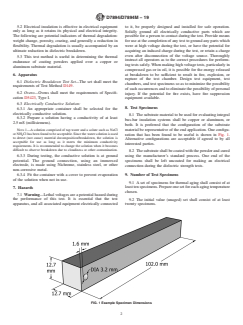
been found to be useful is shown in Fig. 1. Alternative configurations are acceptable if agreed to by all interested parties.
8.2 The substrate shall be coated with the powder and cured using the manufacturer’s standard process. One end of the
specimens shall be left uncoated for making an electrical connection during the dielectric strength tests.
9. Number of Test Specimens
9.1 A set of specimens for thermal aging shall consist of at least ten specimens. Prepare one set for each aging temperature
chosen.
9.2 The initial value (unaged) set shall consist of at least twenty specimens.
9.3 The minimum number of test specimens is 50. It is recommended to prepare extra specimens for situations such as the need
to add additional aging temperatures, or to have replacement specimens available for any specimens that are found during the
screening test to be unsuitable for use in thermal aging.
D7894/D7894M − 19
FIG. 1 Example Specimen Dimensions
10. Calibration and Standardization
10.1 Expose the test material to at least three aging temperatures. The preferred number of aging temperatures is four.
10.2 Minimum thermal life target values for the high and low temperatures shall be selected based on application.
10.3 Aging temperatures shall differ by at least 10°C.10 °C.
NOTE 2—Experience has shown that the suggested target thermal life values listed in Table 1 are generally satisfactory.
11. Selection of Aging Cycles
11.1 To provide approximately equal exposures to the other conditionings, and to more accurately determine the property
endpoint, the heat aging time per cycle shall be shorter for the higher aging temperatures and longer for the lower aging
temperatures.
11.2 Cycle times shall be selected such that each set undergoes an adequate (but not excessive) number of cycles before
completion. In order to obtain an appropriate number of cycles, the following adjustments to the cycle time are recommended:
11.2.1 If no specimens in a set fail by the end of the fourth cycle, double the heat aging period of the test cycle.
11.2.2 If three or more specimens in a set fail by the end of the fourth cycle, halve the heat aging period of the test cycle.
11.2.3 Use observations in the highest temperature set to select appropriate adjustments to the other temperature sets.
NOTE 3—Experience has shown that the suggested cycle times in Table 1 are generally satisfactory.
12. Initial Value Test
12.1 To determine an initial dielectric strength le
...