

ASTM C1924-24
(Practice)Standard Practice for Design of Buried Precast Concrete Low-Head Pressure Pipe
General Information
- Abstract
SCOPE
1.1 This practice covers the design of buried precast concrete low head pressure pipe having a circular shape and manufactured in accordance with Specification C361/C361M subject to internal pressure not exceeding a pressure head of 125 ft (54 psi), or as otherwise limited herein.
1.2 When buried, concrete pipe is part of a composite system comprised of the pipe and the surrounding soil envelope. Both the pipe and soil envelope contribute to the strength and structural behavior of the system.
1.3 This practice presents the method for evaluating the effects of external loads combined with internal pressure on buried precast concrete low-head pressure pipe manufactured per Specification C361/C361M. This method includes an analysis that accounts for the interaction between the pipe and soil envelope in determining external loads, earth pressure distributions, and the moments, thrusts, and shears for the pipe. It also includes a detailed procedure for designing reinforcement for these installations.
1.4 Construction requirements for precast concrete low-head pressure pipe are in accordance with Specification C361/C361M.
1.5 This practice may be used as a reference by the owner and the owner's engineer in preparing project specifications for low head pressure pipe.
1.6 The design procedures given in this standard are intended for use by engineers who are familiar with the installation and pipe characteristics that affect the structural behavior of buried concrete pipe installations and the significance of the installation requirements.
1.7 This standard does not purport to address all of the safety concerns, if any, associated with its use. It is the responsibility of the user of this standard to establish appropriate safety, health, and environmental practices and determine the applicability of regulatory limitations prior to use.
1.8 This international standard was developed in accordance with internationally recognized principles on standardization established in the Decision on Principles for the Development of International Standards, Guides and Recommendations issued by the World Trade Organization Technical Barriers to Trade (TBT) Committee.
- Status
- Published
- Publication Date
- 28-Feb-2024
- Technical Committee
- C13 - Concrete Pipe
- Drafting Committee
- C13.04 - Low Head Pressure Pipe
Overview
ASTM C1924-24, Standard Practice for Design of Buried Precast Concrete Low-Head Pressure Pipe, establishes recognized procedures for the design of buried circular precast concrete pipes intended for low-head pressure applications. Issued by ASTM International, this practice addresses design for pipes manufactured per Specification C361/C361M, ensuring sufficient strength and structural integrity for installations subject to internal pressures up to 125 feet of head (approximately 54 psi). It provides engineers and project owners with a methodical approach for incorporating both pipe characteristics and the critical supportive role of surrounding soil.
This standard is intended for use by professionals familiar with precast concrete pipe installations, and it prescribes design and analysis methods that integrate the effects of internal pressure, external loads, and pipe-soil interaction. The guidance also aligns with international standardization principles and acknowledges the responsibilities of the user regarding safety, health, and regulatory compliance.
Key Topics
- Composite Behavior: Recognizes that buried concrete pipe functions as a composite system with its surrounding soil envelope, affecting the strength, load distribution, and overall performance.
- Load Analysis: Outlines procedures for evaluating the impact of combined internal pressure and external forces such as earth weight, pipe weight, live loads, and fluid loads.
- Structural Design: Provides detailed steps for calculating moments, shears, and thrusts, and establishing appropriate reinforcement in compliance with Specification C361/C361M.
- Design Criteria: Enumerates requirements that must be specified by the owner or engineer, including intended pipeline use, pipe dimensions, design pressures, soil conditions, bedding configurations, and performance criteria such as crack control and joint integrity.
- Material Requirements: Stipulates use of compliant concrete, steel reinforcement, and rubber gaskets, referencing relevant ASTM material specifications.
- Field Installation: Directs that installation practices align with Specification C361/C361M to ensure the design assumptions are realized during actual construction.
Applications
ASTM C1924-24 is vital across numerous industries where buried precast concrete low-head pressure pipes are used, including:
- Municipal Water and Wastewater: Assists in the design of pressurized trunk lines, effluent mains, and force mains where moderate internal pressure must be safely contained.
- Stormwater Management: Guides design for buried conduits handling low-head pressurized flows in drainage and flood control systems.
- Industrial Infrastructure: Supports reliable buried pipeline design for process and utility water systems within industrial facilities.
- Agricultural Irrigation: Ensures structural performance for buried pipelines serving low-head pumped irrigation and distribution lines.
- Transportation Projects: Used in culverts and underground utility corridors requiring robust pressure pipe design under roads or railways.
The standard is a reference for owners, engineers, and manufacturers to prepare project-specific specifications, select materials, and verify structural requirements consistent with best practices.
Related Standards
For successful implementation and compliance, ASTM C1924-24 should be used alongside several referenced and companion standards, including:
- ASTM C361/C361M – Specification for Reinforced Concrete Low-Head Pressure Pipe
- ASTM C443 – Specification for Joints for Concrete Pipe and Manholes, Using Rubber Gaskets
- ASTM A1064/A1064M – Specification for Steel Reinforcement for Concrete
- ASTM C655 – Specification for Reinforced Concrete Culvert, Storm Drain, and Sewer Pipe
- ASTM C822 – Terminology Relating to Concrete Pipe and Related Products
- ASTM D2487/D2488 – Soil Classification and Identification for Engineering Purposes
- ASCE 15 – Standard Practice for Direct Design of Buried Precast Concrete Pipe
- AASHTO LRFD Bridge Design Specifications – For live load and design factors
- AREMA Manuals & AWWA M9 – For design references with rail and water applications
Consulting these documents ensures comprehensive design, material selection, and installation practices, supporting project reliability and regulatory acceptance.
Keywords: ASTM C1924-24, buried concrete pipe, low-head pressure, design standard, precast concrete pipe, soil-structure interaction, pipeline engineering, ASTM standards, reinforced concrete pipe, pressure pipe installation
Relations
- Replaces
ASTM C1924-23 - Standard Practice for Design of Buried Precast Concrete Low-Head Pressure Pipe - Effective Date
- 29-Feb-2024
- Effective Date
- 15-Apr-2024
- Effective Date
- 01-Nov-2022
Get Certified
Connect with accredited certification bodies for this standard

Institut za varilstvo d.o.o. (Welding Institute)
Slovenia's leading welding institute since 1952. ISO 3834, EN 1090, pressure equipment certification, NDT personnel, welder qualification. Only IIW Au
Sponsored listings
Frequently Asked Questions
ASTM C1924-24 is a standard published by ASTM International. Its full title is "Standard Practice for Design of Buried Precast Concrete Low-Head Pressure Pipe". This standard covers: SCOPE 1.1 This practice covers the design of buried precast concrete low head pressure pipe having a circular shape and manufactured in accordance with Specification C361/C361M subject to internal pressure not exceeding a pressure head of 125 ft (54 psi), or as otherwise limited herein. 1.2 When buried, concrete pipe is part of a composite system comprised of the pipe and the surrounding soil envelope. Both the pipe and soil envelope contribute to the strength and structural behavior of the system. 1.3 This practice presents the method for evaluating the effects of external loads combined with internal pressure on buried precast concrete low-head pressure pipe manufactured per Specification C361/C361M. This method includes an analysis that accounts for the interaction between the pipe and soil envelope in determining external loads, earth pressure distributions, and the moments, thrusts, and shears for the pipe. It also includes a detailed procedure for designing reinforcement for these installations. 1.4 Construction requirements for precast concrete low-head pressure pipe are in accordance with Specification C361/C361M. 1.5 This practice may be used as a reference by the owner and the owner's engineer in preparing project specifications for low head pressure pipe. 1.6 The design procedures given in this standard are intended for use by engineers who are familiar with the installation and pipe characteristics that affect the structural behavior of buried concrete pipe installations and the significance of the installation requirements. 1.7 This standard does not purport to address all of the safety concerns, if any, associated with its use. It is the responsibility of the user of this standard to establish appropriate safety, health, and environmental practices and determine the applicability of regulatory limitations prior to use. 1.8 This international standard was developed in accordance with internationally recognized principles on standardization established in the Decision on Principles for the Development of International Standards, Guides and Recommendations issued by the World Trade Organization Technical Barriers to Trade (TBT) Committee.
SCOPE 1.1 This practice covers the design of buried precast concrete low head pressure pipe having a circular shape and manufactured in accordance with Specification C361/C361M subject to internal pressure not exceeding a pressure head of 125 ft (54 psi), or as otherwise limited herein. 1.2 When buried, concrete pipe is part of a composite system comprised of the pipe and the surrounding soil envelope. Both the pipe and soil envelope contribute to the strength and structural behavior of the system. 1.3 This practice presents the method for evaluating the effects of external loads combined with internal pressure on buried precast concrete low-head pressure pipe manufactured per Specification C361/C361M. This method includes an analysis that accounts for the interaction between the pipe and soil envelope in determining external loads, earth pressure distributions, and the moments, thrusts, and shears for the pipe. It also includes a detailed procedure for designing reinforcement for these installations. 1.4 Construction requirements for precast concrete low-head pressure pipe are in accordance with Specification C361/C361M. 1.5 This practice may be used as a reference by the owner and the owner's engineer in preparing project specifications for low head pressure pipe. 1.6 The design procedures given in this standard are intended for use by engineers who are familiar with the installation and pipe characteristics that affect the structural behavior of buried concrete pipe installations and the significance of the installation requirements. 1.7 This standard does not purport to address all of the safety concerns, if any, associated with its use. It is the responsibility of the user of this standard to establish appropriate safety, health, and environmental practices and determine the applicability of regulatory limitations prior to use. 1.8 This international standard was developed in accordance with internationally recognized principles on standardization established in the Decision on Principles for the Development of International Standards, Guides and Recommendations issued by the World Trade Organization Technical Barriers to Trade (TBT) Committee.
ASTM C1924-24 is classified under the following ICS (International Classification for Standards) categories: 23.040.50 - Pipes and fittings of other materials. The ICS classification helps identify the subject area and facilitates finding related standards.
ASTM C1924-24 has the following relationships with other standards: It is inter standard links to ASTM C1924-23, ASTM A1064/A1064M-24, ASTM A1064/A1064M-22. Understanding these relationships helps ensure you are using the most current and applicable version of the standard.
ASTM C1924-24 is available in PDF format for immediate download after purchase. The document can be added to your cart and obtained through the secure checkout process. Digital delivery ensures instant access to the complete standard document.
Standards Content (Sample)
This international standard was developed in accordance with internationally recognized principles on standardization established in the Decision on Principles for the
Development of International Standards, Guides and Recommendations issued by the World Trade Organization Technical Barriers to Trade (TBT) Committee.
Designation: C1924 − 24
Standard Practice for
Design of Buried Precast Concrete Low-Head Pressure
Pipe
This standard is issued under the fixed designation C1924; the number immediately following the designation indicates the year of
original adoption or, in the case of revision, the year of last revision. A number in parentheses indicates the year of last reapproval. A
superscript epsilon (´) indicates an editorial change since the last revision or reapproval.
NOTE—Equations 25, 35, 37, 38, and 56 were corrected and the yeardate changed on February 29, 2024.
1. Scope responsibility of the user of this standard to establish appro-
priate safety, health, and environmental practices and deter-
1.1 This practice covers the design of buried precast con-
mine the applicability of regulatory limitations prior to use.
crete low head pressure pipe having a circular shape and
1.8 This international standard was developed in accor-
manufactured in accordance with Specification C361/C361M
dance with internationally recognized principles on standard-
subject to internal pressure not exceeding a pressure head of
ization established in the Decision on Principles for the
125 ft (54 psi), or as otherwise limited herein.
Development of International Standards, Guides and Recom-
1.2 When buried, concrete pipe is part of a composite
mendations issued by the World Trade Organization Technical
system comprised of the pipe and the surrounding soil enve-
Barriers to Trade (TBT) Committee.
lope. Both the pipe and soil envelope contribute to the strength
2. Referenced Documents
and structural behavior of the system.
2.1 ASTM Standards:
1.3 This practice presents the method for evaluating the
A1064/A1064M Specification for Carbon-Steel Wire and
effects of external loads combined with internal pressure on
Welded Wire Reinforcement, Plain and Deformed, for
buried precast concrete low-head pressure pipe manufactured
Concrete
per Specification C361/C361M. This method includes an
C361/C361M Specification for Reinforced Concrete Low-
analysis that accounts for the interaction between the pipe and
Head Pressure Pipe
soil envelope in determining external loads, earth pressure
C443 Specification for Joints for Concrete Pipe and
distributions, and the moments, thrusts, and shears for the pipe.
Manholes, Using Rubber Gaskets
It also includes a detailed procedure for designing reinforce-
C655 Specification for Reinforced Concrete D-Load
ment for these installations.
Culvert, Storm Drain, and Sewer Pipe
1.4 Construction requirements for precast concrete low-
C822 Terminology Relating to Concrete Pipe and Related
head pressure pipe are in accordance with Specification C361/
Products
C361M.
D2487 Practice for Classification of Soils for Engineering
1.5 This practice may be used as a reference by the owner
Purposes (Unified Soil Classification System)
and the owner’s engineer in preparing project specifications for
D2488 Practice for Description and Identification of Soils
low head pressure pipe.
(Visual-Manual Procedures)
2.2 ASCE Standards:
1.6 The design procedures given in this standard are in-
ASCE 15 Standard Practice for Direct Design of Buried
tended for use by engineers who are familiar with the instal-
Precast Concrete Pipe Using Standard Installations
lation and pipe characteristics that affect the structural behavior
(SIDD)
of buried concrete pipe installations and the significance of the
2.3 AASHTO Documents:
installation requirements.
LRFD Bridge Design Specifications
1.7 This standard does not purport to address all of the
safety concerns, if any, associated with its use. It is the
For referenced ASTM standards, visit the ASTM website, www.astm.org, or
contact ASTM Customer Service at service@astm.org. For Annual Book of ASTM
Standards volume information, refer to the standard’s Document Summary page on
This test method is under the jurisdiction of ASTM Committee C13 on the ASTM website.
Concrete Pipe and is the direct responsibility of Subcommittee C13.04 on Low Head Available from American Society of Civil Engineers (ASCE), 1801 Alexander
Pressure Pipe. Bell Dr., Reston, VA 20191, http://www.asce.org.
Current edition approved Feb. 29, 2024. Published March 2024. Originally Available from American Association of State Highway and Transportation
approved in 1987. Last previous edition approved in 2023 as C1924 – 23. DOI: Officials (AASHTO), 444 N. Capitol St., NW, Suite 249, Washington, DC 20001,
10.1520/C1924-24. http://www.transportation.org.
Copyright © ASTM International, 100 Barr Harbor Drive, PO Box C700, West Conshohocken, PA 19428-2959. United States
C1924 − 24
2.4 AREMA Documents: 3.2.2.1 Discussion—The designated (design) internal hydro-
Railroad Engineering Manual static pressure includes operating pressure and transient pres-
2.5 AWWA Documents: sure. Transient pressure includes surge, water hammer and any
Manual M9 Design of Reinforced Concrete Pressure Pipe other dynamic pressure specified by the owner. The designated
internal hydrostatic pressure is measured from the springline of
3. Terminology
the pipe as is customary in pressure pipe terminology, however,
precast concrete low head pressure pipe is designed by
3.1 Definitions:
3.1.1 For definitions of terms relating to concrete pipe, see considering the weight of fluid up to the crown of the pipe and
then the pressure above the crown.
Terminology C822.
3.1.2 For terminology related to soil classifications, see
3.2.3 prism load, n—weight of column of earth over the
Practices D2487 and D2488.
outside diameter of pipe.
3.1.3 For terminology and definition of terms relating to
3.2.4 radial tension strength, n—the limiting average tensile
structural design, see AASHTO LRFD Bridge Design Speci-
strength of the concrete in the plane of the inner reinforcement
fication.
and concrete at the crown and invert regions.
3.2 Definitions of Terms Specific to This Standard:
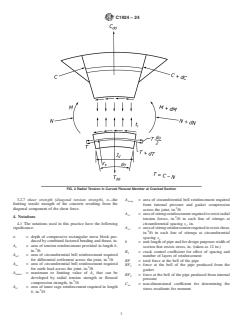
3.2.5 radial tension stress, n—(See Fig. 2.) radial tension
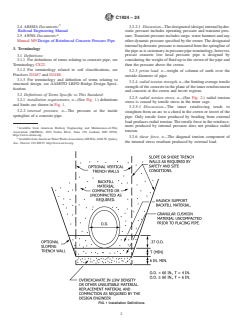
3.2.1 installation requirements, n—(See Fig. 1.) definitions
stress is caused by tensile stress in the inner cage.
and limits are shown in Fig. 1.
3.2.5.1 Discussion—The inner reinforcing tends to
3.2.2 internal pressure, n—The pressure at the inside
straighten from an arc to a chord in the crown or invert of the
springline of a concrete pipe.
pipe. Only tensile force produced by bending from external
load produces radial tension. The tensile force in the reinforce-
ment produced by internal pressure does not produce radial
Available from American Railway Engineering and Maintenance-of-Way
Association (AREMA), 4501 Forbes Blvd., Suite 130, Lanham, MD 20706, tension.
https://www.arema.org.
3.2.6 shear force, n—The diagonal tension component of
Available from American Water Works Association (AWWA), 6666 W. Quincy
the internal stress resultant produced by external load.
Ave., Denver, CO 80235, http://www.awwa.org.
FIG. 1 Installation Definitions
C1924 − 24
FIG. 2 Radial Tension in Curved Flexural Member at Cracked Section
3.2.7 shear strength (diagonal tension strength), n—the
A = area of circumferential bell reinforcement required
sreq
limiting tensile strength of the concrete resulting from the
from internal pressure and gasket compression
diagonal component of the shear force.
across the joint, in. /ft
A = area of stirrup reinforcement required to resist radial
vr
4. Notations
tension forces, in. /ft in each line of stirrups at
4.1 The notations used in this practice have the following
circumferential spacing s , in.
v
significance: A = area of stirrup reinforcement required to resist shear,
vs
in. /ft in each line of stirrups at circumferential
α = depth of compressive rectangular stress block pro-
spacing s
v
duced by combined factored bending and thrust, in.
b = unit length of pipe and for design purposes width of
A = area of tension reinforcement provided in length b,
s
section that resists stress, in. (taken as 12 in.)
in. /ft
B = crack control coefficient for effect of spacing and
A = area of circumferential bell reinforcement required
sd
number of layers of reinforcement
for differential settlement across the joint, in. /ft
BF = total force at the bell of the pipe
A = area of circumferential bell reinforcement required
se BF = force at the bell of the pipe produced from the
for earth load across the joint, in. /ft
gasket
A = maximum or limiting value of A that can be
smax s BF = force at the bell of the pipe produced from internal
developed by radial tension strength or flexural
pressure
compression strength, in. /ft
C = non-dimensional coefficient for determining the
m
A = area of inner cage reinforcement required in length
si
stress resultants for moment
b, in. /ft
C1924 − 24
C = non-dimensional coefficient for determining the M = factored moment from gravity loads acting on
n u
stress resultants for thrust length b, in.-lb/ft
C = non-dimensional coefficient for determining the M = factored moment caused by all loads section of
v uv
stress resultants for shear maximum shear, based on load factor for shear,
C = crack control coefficient for various types of rein- in.-lb/ft
forcement M = factored moment caused by external loads and
ure
d = distance from compression face to centroid of ten-
weight of fluid at section of maximum moment,
sion reinforcement, in.
based on load factor for radial tension or for
D = inside diameter of bell, in.
ib concrete compression, in.-lb/ft
D = outside diameter of bell, in.
n = number of layers of tension reinforcement, not to
ob
D = inside diameter of pipe, in.
i exceed 2 when used in design
D = mean diameter of pipe, in.
m N = thrust resulting from the weight of the pipe, lb/ft
P
D = outside diameter of pipe, in.
o N = service load axial thrust, lb/ft (+ when compressive,
s
d = bell thickness, in.
– when tensile)
d = effective section depth, in.
2 N = factored thrust from gravity loads acting on length
u
e = thrust eccentricity
b, in.-lb/ft
E = modulus of elasticity of steel, psi
s
N = factored thrust force due to internal pressure, (lb/ft)
΄ 2 up
f = design compressive strength of concrete, lb/in.
c
N = factored compressive thrust at section of maximum
ure
f = service load limit of concrete tensile stress caused
ct
moment produced by external load (+ when
by internal pressure only, psi
compressive, – when tensile), based on load factor
f = maximum developable strength of stirrup material,
v
for radial tension or compressive thrust, lb/ft
lb/in.
N = factored compressive thrust at section of maximum
2 uv
f = design yield strength of reinforcement, lb/in.
y
shear produced by all loads except internal pressure
F = curvature factor that accounts for the small addi-
c
(+ when compressive, – when tensile), based on
tional shear associated with the effects of curvature
load factor for compressive thrust, lb/ft
on the pipe wall thrust
r = radius to centerline of pipe wall, in.
F = the crack control factor
cr
r = radius of the inside reinforcement, in.
s
F = size factor that accounts for the increased shear
d
s = spacing of the circumferential reinforcement, in.
stress capacity exhibited by small diameter pipe
s = circumferential spacing of stirrups, in.
v
with thin walls
t = clear concrete cover over reinforcement, in.
b
F = strain factor to account for the reduction in aggre-
ɛx
V = shear strength provided by concrete without stirrups
c
gate interlock from higher tensile strains
in length b, lb/ft
F = factor for pipe size effect on radial tension strength
rt
V = shear resulting from weight of the pipe, lb/in.
P
F = process and material factor for radial tension
rp
V = factored shear force at section of maximum shear
uv
strength = 1.00, unless a higher value substantiated
produced by all loads, lb/ft
by test data obtained in accordance with Specifica-
W = total weight of earth acting on length b of pipe, lb/ft
E
tion C655 is approved by the engineer
W = weight of pipe for length b, lb/ft
P
f = service load reinforcing steel tensile stress caused
sd W = weight of fluid that fills length b of pipe, lb/ft
f
by internal pressure only, on cracked section, psi
y = distance to the neutral axis, in.
F = process and material factor for shear strength
α = total bedding angle measured from top of pipe, rad
vp
h = pipe wall thickness, in.
α’ = bedding angle, rad
i = coefficient for effect of axial force at service limits
β = angle to any point on pipe measured from top of
state
pipe, rad
I = moment of inertia, in.
β = coefficient for determining compression stress block
j = coefficient for moment arm at service limit state
height, α
H = design height of earth above top of pipe, ft
θ = orientation angle, degrees
H = hydrostatic head, ft
w Θ = bell stress, psi
l = total additional arc length beyond calculated arc
θ θ = approximate inclination of diagonal tension crack,
v
lengths requiring stirrups, in.
degrees
L = depth (inside longitudinal dimension) of bell, in.
b ɛ = strain in reinforcement produced by factored
xu
M = moment resulting from the earth load above the top
E moments, thrusts and shears at section of maximum
of the pipe, in.lb/ft
shear, in./in.
M = moment resulting from the weight of the pipe,
P
ρ = reinforcement ratio producing balanced strain con-
b
in.-lb/ft
ditions
M = service load bending moment, in.-lb/ft (always posi-
s
tive)
C1924 − 24
drawings and design calculations are to be submitted to the
φ = live load angle, rad
owner for review and approval prior to manufacture.
φ = strength reduction factor for flexure
f
6.2.2 An alternative to 6.2.1 is that the owner provides the
φ = strength reduction factor for shear
v
φ = strength reduction factor for radial tension design to the pipe manufacturer for preparation of shop
r
φ = strength reduction factor for crack control
drawings for submittal to the owner for approval.
cr
ω = effective width factor
6.2.3 If the owner prepares a design, the manufacturer may
submit an alternate design to the owner for consideration for
5. Summary of Practice
approval.
5.1 This standard accounts for the interaction between the
7. Design Requirements
pipe and soil envelope in determining external loads and
distribution of earth pressure on a buried pipe using a radial
7.1 General Requirements—The owner/owner’s engineer
pressure distribution. The external loads and earth pressure
shall establish the following design criteria:
distributions are used to calculate moments, thrusts, and shears
7.1.1 Intended use of pipeline
in the pipe wall, and together with the pipe weight, water
7.1.2 Pipe inside diameter, D
i
weight, and internal pressure to calculate required pipe rein-
7.1.3 Design internal pressure head, H
w
forcement for the installations.
7.1.4 Pipeline plan and profile drawings with installation
cross sections as required.
5.2 Load and earth pressure effects are determined from the
7.1.5 Design earth cover height above the top of the pipe, H.
radial pressure distribution.
7.1.6 In situ soil data sufficient to determine conditions for
5.3 The structural design of concrete low-head pressure pipe
design (including in situ soil classification and standard pen-
is based on a limits state design procedure that accounts for
etration test result or unconfined compression strength) and
strength and serviceability criteria, specific procedures for
overfill weight, lb/ft .
calculating design limits based on shear and radial tension
7.1.7 Available bedding and backfill materials.
strengths without stirrups, and requirements for stirrup rein-
forcement. The design procedures are based on current rein- NOTE 1—Owner may specify backfill with imported materials or in situ
materials classified in terms of Practice D2487.
forced concrete strength and serviceability design concepts.
The design criteria include: structural aspects, such as flexure,
7.1.8 Manufacturing specification: Specification C361/
thrust, shear and radial tension strengths; handling and instal-
C361M.
lation; and control of reinforcing and concrete tensile strains.
7.1.9 Performance requirements for pipe joints.
The reinforcement and concrete tensile stress (and strain) limits
7.1.10 Design live and surcharge loadings, if any.
used in this practice are consistent with those used in previous
7.1.11 Design intermittent internal hydrostatic pressures
practice based on Specification C361/C361M.
(transient pressure), if required.
7.1.12 Crack width control criteria.
5.4 Concrete tensile stresses, based on an uncracked wall,
7.1.13 Cement type, if different than Specification C361/
and reinforcement stresses, based on a cracked pipe
C361M.
assumption, produced by internal pressure acting alone are
limited as prescribed in Specification C361/C361M to control
7.2 Structural Design Criteria:
strain to preclude excessive cracking and leakage and also to
7.2.1 Combined Loads—The pipe shall be designed to resist
maintain shear resistance.
the flexural and axial stresses from each of the following
conditions:
5.5 The design of a concrete low-head pressure pipe for a
particular installation is based on the assumption that the Condition 1 Internal pressure only
Condition 2 External loads (Dead: earth, pipe, and
specified design bedding and fill requirements will be achieved
gravity water—Live load) with no
during construction of the installation.
internal pressure
Condition 3 A combination of external and internal
5.6 For a structural design equivalent to those found in the
load acting concurrently
tables in Specification C361/C361M, the following bedding
7.2.2 Load Factors:
assumptions are assumed for design:
7.2.2.1 Earth, Pipe Weight, and Water Weight:
Load Condition Bedding Angle
Dead and Earth Load 1.6
Earth 90°
Compressive Thrust 1.0
Water 90°
Tensile Thrust/Internal Pressure 1.5
Live 90°
Design for Shear and Radial Tension 1.3
Dead 45°
7.2.2.2 Live Load:
6. General
Moment, Shear and Radial Tension 1.75
Load Factors
6.1 Design procedures and criteria shall conform to appli-
Compressive Thrust Load Factor 1.3
cable sections of this practice.
7.2.3 Strength Reduction:
6.2 Design Submittals:
Factors Flexure (φ ) 0.95
f
6.2.1 The intent of this practice is that the pipe be designed
Radial Tension (φ ) 0.9
v
and detailed by the manufacturer in accordance with criteria Diagonal Tension (φ ) 0.9
r
Crack Control (φ ) 0.9
cr
furnished by the owner and as provided in this standard. Shop
C1924 − 24
7.3 Design Criteria by Pipe Manufacturer—The pipe manu- distance between the top of the pipe and the bottom of the
facturer shall submit the following manufacturing design data pavement slab shall be a minimum of 9 in. (AASHTO table
to the owner for approval. 12.6.6.3-1) of compacted granular fill.
7.3.1 Pipe Wall Thickness 10.1.4 The dead load of fluid in the pipe, W , shall be based
f
7.3.2 Concrete Strength on a unit weight of 62.4 lb/ft , unless otherwise specified.
7.3.3 Reinforcement:
10.2 Live Load:
reinforcement type and specification,
10.2.1 Truck loads shall be calculated for the AASHTO
design yield strength,
HL-93 truck load and distributed in accordance with the
ultimate strength,
AASHTO LRFD Bridge Design Specifications. The lane load
placement and design concrete cover,
portion of HL-93 need not be applied.
cross-sectional areas and diameters,
10.2.2 Railroad live loads shall be calculated for the speci-
spacing,
fied AREMA Cooper E-series loading and distributed in
description of longitudinal members, and
accordance with the AREMA Manual for Railway Engineer-
if stirrups used, developable stirrup design stress, stirrup
ing.
shape, placement, and anchorage details.
10.2.3 Aircraft or other live loads shall be as specified by
7.3.3.1 The design yield strength and ultimate (tensile)
the owner and distributed in accordance with accepted engi-
strength of the tension reinforcement used for design shall be
neering procedures.
as specified in 8.2.1.
NOTE 2—Live loads are not accounted for in Specification C361/
7.3.3.2 The minimum design concrete cover over the rein-
C361M.
forcement shall be in accordance with Specification C361/
10.3 Internal Hydrostatic Pressure:
C361M, subsection 7.4.
10.3.1 Internal operating and transient hydrostatic design
7.3.4 Pipe Laying Length and Joint Information
pressure shall be as specified by the owner.
8. Materials
10.3.2 Analysis shall include the weight of the water in the
pipe.
8.1 Concrete:
10.3.3 The maximum total internal hydrostatic pressure
8.1.1 Concrete shall conform to the requirements of the
shall not exceed a head of 125 ft.
manufacturing specification (Specification C361/C361M).
8.2 Reinforcement:
11. Earth Pressure Distribution
8.2.1 Reinforcement shall consist of cold-drawn steel wire,
11.1 Dead Load Earth Pressures—Dead load and earth
cold-drawn steel welded wire reinforcement, cold-drawn de-
pressures around the pipe shall utilize a radial pressure
formed steel wire, or cold-drawn deformed steel welded wire
distribution based on theory by Olander . The coefficient for
reinforcement conforming to Specification A1064/A1064M.
the dead load pressures (earth, pipe weight, and fluid weight)
8.3 Rubber Gaskets:
are given in Table 1 and Table 2 for different locations around
8.3.1 Rubber Gaskets shall conform to the material require-
the perimeter of the pipe.
ments of Specification C361/C361M.
11.1.1 Pipe Weight—For pipe weight, a radial pressure
distribution at the pipe support shall be assumed to be
9. Field Installation Procedures
sinusoidal, with the peak at the center and zero at the edges.
9.1 Field installation requirements shall follow the require- The bedding angle for the pipe weight load is assumed to be
ments of Specification C361/C361M. 45°.
11.1.2 Earth Weight—For earth weight, a radial pressure
10. Loads
distribution at the pipe shall be assumed to be supported at the
bottom over an arc length subtended by a bedding angle. For an
10.1 Dead Loads:
installation meeting the description of Specification C361/
10.1.1 The dead load of the pipe weight, W , shall be
p
C361M, Appendix X1, a 90° bedding may be assumed.
considered in the design and shall be based on a reinforced
11.1.3 Fluid Weight—For fluid weight, a radial pressure
concrete unit weight of 150 lb/ft , unless otherwise specified.
distribution at the pipe shall be assumed to be supported at the
10.1.2 The earth load is based on a one-foot length of the
bottom over an arc length subtended by an angle of 90°
prism of earth directly over the outside diameter of the pipe.
degrees.
The effective unit weight of earth in pounds per cubic foot is:
11.2 Live Load Earth Pressure—For live load a uniformly
H
w 5 120124 # 168lb/ft (1)
D
S
e distributed surcharge of any width and a cosine-shaped radial
D
bedding reaction pressure are assumed, as shown in Fig. 3. The
The earth load on the pipe is:
recommended coefficients are presented in Table 3. When
W 5 w H~D !,lb/lin. ft (2) β = 90° use a radial pressure distribution as earth load in Table
E e o
2.
10.1.3 Minimum Fill—For unpaved and flexible pavement
areas, the minimum fill, including flexible pavement thickness,
over the top outside of the pipe shall be 1 ft, or ⁄8 of the outside
Olander, H.C., Stress Analysis of Concrete Pipe, Engineering Monograph No.
diameter, whichever is greater. Under rigid pavements, the 6, U.S. Bureau of Reclamation, October 1950
C1924 − 24
TABLE 1 Radial Stress Distribution coefficient for Self-Weight
Load (Wayne W. Smith, Stresses in Rigid Pipe, Transportation
Engineering Journal of ASCE)
Self-Weight Load
Bedding Deg. from Moment Thrust Shear
angle, deg crown
0 -0.08 -0.07 0.00
5 -0.08 -0.07 0.02
10 -0.07 -0.07 0.04
15 -0.07 -0.06 0.06
20 -0.06 -0.05 0.08
25 -0.06 -0.04 0.09
30 -0.05 -0.02 0.11
35 -0.04 -0.01 0.12
40 -0.03 0.01 0.13
45 -0.01 0.04 0.14
50 0.00 0.06 0.15
55 0.01 0.08 0.15
60 0.02 0.11 0.15
65 0.04 0.13 0.14
70 0.05 0.16 0.14
75 0.06 0.18 0.13
80 0.07 0.21 0.11
85 0.08 0.23 0.10
90 0.09 0.25 0.07
95 0.09 0.27 0.05
100 0.10 0.29 0.03
105 0.10 0.30 0.00
106.67 0.10 0.31 -0.01
110 0.10 0.31 -0.03
115 0.09 0.32 -0.07
120 0.09 0.33 -0.10
125 0.07 0.33 -0.14
130 0.06 0.32 -0.17
135 0.04 0.32 -0.21
140 0.02 0.31 -0.25
145 0.00 0.29 -0.29
150 -0.03 0.27 -0.32
155 -0.06 0.25 -0.36
160 -0.09 0.22 -0.38
165 -0.12 0.19 -0.36
170 -0.15 0.17 -0.27
175 -0.17 0.15 -0.15
180 -0.17 0.15 0.00
C1924 − 24
TABLE 2 Radial Stress Distribution Coefficient for Earth and
Fluid Loads (Wayne W. Smith, Stresses in Rigid Pipe,
Transportation Engineering Journal of ASCE)
Fluid Load Earth Load
Bedding Deg. Moment Thrust Shear Moment Thrust Shear
angle, from
deg crown
0 -0.07 -0.22 0.00 -0.07 0.38 0.00
5 -0.07 -0.22 0.02 -0.07 0.38 0.02
10 -0.07 -0.22 0.04 -0.07 0.38 0.04
15 -0.06 -0.21 0.06 -0.06 0.39 0.05
20 -0.06 -0.21 0.07 -0.06 0.39 0.07
25 -0.05 -0.20 0.09 -0.05 0.40 0.08
30 -0.04 -0.19 0.10 -0.04 0.41 0.10
35 -0.03 -0.18 0.11 -0.03 0.42 0.11
40 -0.02 -0.17 0.12 -0.02 0.43 0.12
45 -0.01 -0.16 0.13 -0.01 0.44 0.13
50 0.00 -0.15 0.14 0.00 0.45 0.13
55 0.01 -0.14 0.14 0.01 0.46 0.13
60 0.02 -0.12 0.14 0.02 0.47 0.13
65 0.04 -0.11 0.13 0.03 0.48 0.13
70 0.05 -0.10 0.12 0.05 0.50 0.12
75 0.06 -0.09 0.11 0.06 0.51 0.11
80 0.07 -0.08 0.10 0.07 0.52 0.10
85 0.07 -0.07 0.08 0.07 0.52 0.09
90 0.08 -0.07 0.06 0.08 0.53 0.07
95 0.09 -0.06 0.04 0.09 0.54 0.04
100 0.09 -0.06 0.01 0.09 0.54 0.02
103.53 0.09 -0.06 -0.01 0.09 0.54 0.00
105 0.09 -0.06 -0.02 0.09 0.54 -0.01
110 0.08 -0.06 -0.05 0.09 0.54 -0.04
115 0.08 -0.07 -0.08 0.08 0.53 -0.07
120 0.07 -0.08 -0.11 0.07 0.52 -0.11
125 0.06 -0.09 -0.15 0.06 0.51 -0.15
130 0.04 -0.10 -0.19 0.05 0.50 -0.19
135 0.03 -0.12 -0.22 0.03 0.48 -0.23
140 0.01 -0.14 -0.25 0.01 0.46 -0.26
145 -0.02 -0.17 -0.26 -0.01 0.44 -0.27
150 -0.04 -0.19 -0.26 -0.04 0.41 -0.27
155 -0.06 -0.21 -0.24 -0.06 0.39 -0.25
160 -0.08 -0.23 -0.21 -0.08 0.37 -0.22
165 -0.10 -0.25 -0.17 -0.10 0.35 -0.18
170 -0.11 -0.26 -0.12 -0.11 0.34 -0.12
175 -0.12 -0.27 -0.06 -0.12 0.33 -0.06
180 -0.12 -0.27 0.00 -0.12 0.33 0.00
C1924 − 24
FIG. 3 Live Load Surcharge and Bedding Terminology
TABLE 3 Live Load Stress Distribution (Hurnung/Kittel Structural Analysis of Buried Pipes)
β=15 α’=45
Live Load
φ Moment Thrust Shear
0 0.126 -0.0142 0
5 0.123 -0.0217 0.0884
10 0.111 -0.0441 0.174
15 0.0933 -0.0807 0.255
20 0.0721 -0.102 0.249
25 0.0517 -0.122 0.242
30 0.0323 -0.142 0.233
35 0.0139 -0.16 0.222
40 -0.00328 -0.177 0.21
45 -0.0191 -0.193 0.196
50 -0.0334 -0.207 0.18
55 -0.0462 -0.22 0.163
60 -0.0573 -0.231 0.145
65 -0.0666 -0.241 0.126
70 -0.0741 -0.248 0.105
75 -0.0797 -0.254 0.0842
80 -0.0834 -0.257 0.0625
85 -0.0851 -0.259 0.0404
90 -0.0849 -0.259 0.0179
95 -0.0826 -0.257 -0.00476
100 -0.0785 -0.252 -0.0274
105 -0.0724 -0.246 -0.0497
110 -0.0644 -0.238 -0.0717
115 -0.0546 -0.229 -0.0932
120 -0.0431 -0.217 -0.114
125 -0.0299 -0.204 -0.134
130 -0.0152 -0.189 -0.153
135 0.000965 -0.173 -0.335
140 0.0173 -0.157 -0.336
145 0.0325 -0.141 -0.332
C1924 − 24
150 0.0463 -0.128 -0.323
155 0.0584 -0.116 -0.311
160 0.0686 -0.105 -0.295
165 0.0768 -0.0972 -0.275
170 0.0827 -0.0913 -0.253
175 0.0863 -0.0877 -0.228
180 0.0875 -0.0865 -0.201
β=30 α’=45
Live Load
φ Moment Thrust Shear
0 0.198 -0.0177 0
5 0.195 -0.0252 0.0907
10 0.183 -0.0476 0.179
15 0.165 -0.0841 0.261
20 0.141 -0.134 0.337
25 0.111 -0.195 0.402
30 0.0757 -0.265 0.455
35 0.0397 -0.301 0.435
40 0.00603 -0.335 0.411
45 -0.0251 -0.366 0.385
50 -0.0534 -0.394 0.355
55 -0.0787 -0.42 0.323
60 -0.101 -0.442 0.288
65 -0.12 -0.461 0.251
70 -0.135 -0.476 0.213
75 -0.147 -0.488 0.172
80 -0.154 -0.495 0.13
85 -0.159 -0.5 0.0876
90 -0.159 -0.5 0.0442
95 -0.156 -0.497 0.000471
100 -0.148 -0.489 -0.0433
105 -0.137 -0.478 -0.0867
110 -0.123 -0.464 -0.129
115 -0.105 -0.446 -0.171
120 -0.0832 -0.424 -0.212
125 -0.0584 -0.399 -0.251
130 -0.0307 -0.372 -0.288
135 -0.0000649 -0.341 -0.641
140 0.031 -0.31 -0.642
145 0.0599 -0.281 -0.635
150 0.086 -0.255 -0.619
155 0.109 -0.232 -0.596
160 0.128 -0.213 -0.566
165 0.144 -0.197 -0.529
170 0.155 -0.186 -0.487
175 0.162 -0.179 -0.44
180 0.164 -0.177 -0.389
β=45 α’=45
Live Load
φ Moment Thrust Shear
0 0.236 -0.00626 0
5 0.232 -0.0138 0.0939
10 0.221 -0.0363 0.185
15 0.202 -0.073 0.271
20 0.178 -0.123 0.349
25 0.147 -0.184 0.417
30 0.112 -0.255 0.474
35 0.0724 -0.334 0.516
40 0.0306 -0.418 0.545
45 -0.0124 -0.504 0.557
50 -0.0537 -0.546 0.517
55 -0.0908 -0.583 0.472
60 -0.124 -0.616 0.424
65 -0.152 -0.644 0.373
70 -0.175 -0.667 0.318
75 -0.193 -0.685 0.262
80 -0.205 -0.697 0.203
85 -0.213 -0.705 0.143
90 -0.215 -0.707 0.0813
95 -0.212 -0.704 0.0194
100 -0.203 -0.695 -0.0427
105 -0.189 -0.681 -0.104
110 -0.17 -0.662 -0.165
115 -0.146 -0.638 -0.225
120 -0.117 -0.609 -0.283
125 -0.0836 -0.576 -0.339
C1924 − 24
130 -0.0456 -0.538 -0.392
135 -0.00357 -0.496 -0.893
140 0.0392 -0.453 -0.896
145 0.0791 -0.413 -0.887
150 0.115 -0.377 -0.867
155 0.147 -0.345 -0.835
160 0.174 -0.318 -0.794
165 0.195 -0.297 -0.743
170 0.211 -0.281 -0.685
175 0.22 -0.272 -0.62
180 0.223 -0.269 -0.55
β=60 α’=45
Live Load
φ Moment Thrust Shear
0 0.255 0.0153 0
5 0.251 0.00765 0.0975
10 0.24 -0.0151 0.192
15 0.221 -0.0522 0.282
20 0.196 -0.103 0.363
25 0.165 -0.165 0.435
30 0.128 -0.237 0.494
35 0.088 -0.316 0.54
40 0.0451 -0.401 0.571
45 0.000817 -0.489 0.587
50 -0.0436 -0.577 0.586
55 -0.0867 -0.662 0.57
60 -0.127 -0.742 0.539
65 -0.163 -0.778 0.477
70 -0.194 -0.809 0.411
75 -0.218 -0.833 0.342
80 -0.235 -0.85 0.271
85 -0.246 -0.861 0.198
90 -0.251 -0.866 0.123
95 -0.249 -0.864 0.0466
100 -0.241 -0.856 -0.0297
105 -0.225 -0.84 -0.106
110 -0.204 -0.819 -0.181
115 -0.176 -0.791 -0.255
120 -0.143 -0.758 -0.327
125 -0.103 -0.718 -0.396
130 -0.0583 -0.673 -0.463
135 -0.00819 -0.623 -1.08
140 0.0429 -0.572 -1.08
145 0.0905 -0.525 -1.07
150 0.134 -0.481 -1.05
155 0.172 -0.443 -1.01
160 0.204 -0.411 -0.964
165 0.229 -0.386 -0.904
170 0.248 -0.367 -0.835
175 0.259 -0.356 -0.758
180 0.263 -0.352 -0.674
β=75 α=45
Live Load
φ Moment Thrust Shear
0 0.263 0.0296 0
5 0.259 0.0219 0.1
10 0.247 -0.000964 0.198
15 0.228 -0.0384 0.29
20 0.203 -0.0891 0.375
25 0.171 -0.152 0.499
30 0.134 -0.224 0.511
35 0.093 -0.305 0.559
40 0.0493 -0.39 0.592
45 0.00419 -0.479 0.61
50 -0.0411 -0.568 0.611
55 -0.0853 -0.654 0.597
60 -0.127 -0.735 0.568
65 -0.165 -0.809 0.524
70 -0.198 -0.873 0.467
75 -0.226 -0.925 0.4
80 -0.246 -0.946 0.321
85 -0.26 -0.96 0.239
90 -0.266 -0.966 0.155
95 -0.265 -0.965 0.0706
100 -0.257 -0.956 -0.0147
105 -0.241 -0.941 -0.0999
C1924 − 24
110 -0.218 -0.918 -0.184
115 -0.188 -0.888 -0.267
120 -0.152 -0.851 -0.348
125 -0.109 -0.808 -0.427
130 -0.0593 -0.759 -0.502
135 -0.00424 -0.704 -1.19
140 0.0509 -0.649 -1.2
145 0.101 -0.599 -1.19
150 0.145 -0.555 -1.16
155 0.182 -0.517 -1.12
160 0.214 -0.486 -1.07
165 0.238 -0.462 -1
170 0.256 -0.444 -0.928
175 0.266 -0.433 -0.844
180 0.27 -0.43 -0.751
β=90 α=45
Live Load
φ Moment Thrust Shear
0 0.269 0.044 0.000
5 0.265 0.036 0.102
10 0.254 0.013 0.200
15 0.234 -0.024 0.293
20 0.209 -0.076 0.379
25 0.176 -0.139 0.454
30 0.138 -0.212 0.517
35 0.097 -0.293 0.567
40 0.053 -0.379 0.601
45 0.006 -0.469 0.619
50 -0.040 -0.559 0.621
55 -0.085 -0.646 0.608
60 -0.128 -0.728 0.579
65 -0.167 -0.803 0.535
70 -0.201 -0.868 0.479
75 -0.230 -0.922 0.412
80 -0.252 -0.962 0.337
85 -0.268 -0.988 0.255
90 -0.275 -1.000 0.168
95 -0.275 -1.000 0.080
100 -0.267 -0.989 -0.008
105 -0.252 -0.977 -0.096
110 -0.230 -0.955 -0.184
115 -0.200 -0.925 -0.270
120 -0.163 -0.888 -0.354
125 -0.120 -0.845 -0.436
130 -0.069 -0.794 -0.515
135 -0.013 -0.738 -1.226
140 0.044 -0.681 -1.234
145 0.098 -0.627 -1.225
150 0.146 -0.579 -1.199
155 0.190 -0.536 -1.158
160 0.226 -0.500 -1.100
165 0.254 -0.471 -1.038
170 0.275 -0.450 -0.959
175 0.287 -0.438 -0.873
180 0.292 -0.433 -0.778
12. Stress Analysis respectively, at governing locations at the crown, invert,
springline and at the critical locations for shear in the invert
12.1 Stress Analysis for moments, thrusts and shears shall
and crown regions are given in Table 1, Table 2, and Table 3 for
be performed for the pipe subject to the loads specified in
the above types of applied load.
Section 10 and the pressure distributions specified in Section
12.2.1 Pipe Weight—The moment, thrust, and shear result-
11, based on an elastic analysis using the sectional properties of
ing from the weight of the pipe may be calculated through the
the uncracked pipe wall. It is not necessary to include the
transformed area of the reinforcement in this analysis. utilization of the coefficients in Table 1 as follows:
12.2 The non-dimensional coefficients; C , C , and C for D
mi ni vi m
M 5 W C (3)
P P mP
determining the stress resultants for moment, thrust, and shear, 2
C1924 − 24
N 5 W C (4) 13. Reinforcement Design
P P nP
V 5 W C (5)
P P vP 13.1 Minimum Wall Thickness—The minimum wall thick-
ness shall be as required in the applicable manufacturing
where:
specification for the specified pipe inside diameter.
M , N , and V = pipe weight moment, thrust, and shear
P P P
13.2 Design Pipe Parameters:
respectively (in.-lb/ft, lb/ft, and lb/ft),
C , C , and C = pipe weight moment coefficient, thrust 13.2.1 The pipe diameter for calculating stresses produced
mP nP vP
coefficient, and shear coefficient
by internal pressure shall be D .
i
respectively, and
13.2.2 The pipe diameter for calculating stresses produced
W = weight of pipe (lb/ft).
by external loads and water weight shall be D .
P
m
12.2.2 Earth Load—The moment, thrust, and shear resulting
13.3 Concrete Strength:
from the earth load above the top of the pipe may be calculated
13.3.1 Minimum design concrete strength shall be 4,500
through the utilization of the coefficients in Table 2 as follows:
psi.
13.3.2 Maximum design concrete strength shall be 7,000
D
m
M 5 W C (6)
E E mE
psi.
13.4 Condition 1 - Concrete Stress Limit from Internal Pres-
N 5 W C (7)
E E nE
sure Acting Alone—The concrete stress produced by the tensile
V 5 W C (8)
E E vE
thrust resulting from the internal pressure is:
where:
0.433H D
w i
f 5 (12)
M , N , and V = earth weight moment, thrust, and shear
ct
E E E
2h
respectively (in.-lb/ft, lb/ft, and lb/ft),
f shall not exceed:
C , C , and C = earth weight moment coefficient,
ct
mE nE vE
thrust coefficient, and shear coefficient
'
f 5 4.5=f (13)
ct c
respectively, and
W = total weight of earth above the pipe
13.4.1 Reinforcement Stress Limit:
E
acting on a length b (lb/ft).
13.4.1.1 The reinforcement stress produced by the internal
pressure, based on the reinforcement resisting the full circum-
12.2.3 Fluid Load—Using coefficients found in Table 2, the
ferential tension is:
calculation of the moments, shears, and thrusts follows the
6 0.433 H D
same procedure as shown above for pipe weight and earth ~ !
w i
f 5 (14)
sd
A
loads.
s
12.2.4 Live Load—The live load coefficients for moments,
f shall not exceed:
sd
shears, and thrusts are presented in Table 3 and may be used in
f 5 17,000 2 35H (15)
sd w
a similar fashion as those used for pipe weight, earth load, and
fluid load by using Eq 9-11.
13.4.1.2 For elliptical reinforcement, the minimum area of
reinforcement is 1.6 times that required for circular reinforce-
D
m
M 5 W C (9)
S D
L L mL ment for hydrostatic head alone.
13.5 Condition 2 - Reinforcement for External Load With-
D
m
N 5 W C (10)
S D
L L nL
out Internal Pressure:
13.5.1 Flexure Design—The design procedure for the flex-
D
m
V 5 W C (11)
S D ural reinforcement is divided into four limit states:
L L vL
(1) Required flexural steel based on the applied forces,
where:
(2) Maximum radial tension limit,
M , N , and V = live load moment, thrust, and shear (3) Maximum concrete compression limit, and
L L L
respectively (in.-lb/ft, lb/ft, and lb/ft), (4) Cracking of the concrete limits.
C , C , and C = live load moment coefficient, thrust
13.5.1.1 Reinforcement required for flexure and compres-
mL nL vL
coefficient, and shear coefficient
sive thrust without internal pressure.
respectively, and
Flexure Limit State—The area of reinforcement required for
W = total live load pressure applied to the
L
the ultimate flexural loads shall be calculated per the method
top of the pipe acting on a length b
described below:
(lb/ft/in.).
Depth of compressive stress block, a, produced by bending
and axial thrust:
However, the depth of the pipe under the soil will change the
length of the live load pressure distribution that reaches the top
2M
ure
of the pipe, and thus the portion of the table with the proper
a 5 dF 1 2 Œ1 2 G (16)
' 2
0.85f bd
c
angle for β must be chosen based on the calculated load
distribution over the pipe. Coefficients for β values not found in N is positive when compression and negative when
ure
Table 3 may be extrapolated from existing values in the table. tension:
C1924 − 24
'
0.85f ab N If:
c ure
A 5 2 (17)
s
f f F < 1, the probability of an 0.01-inch crack is reduced
y y cr
F > 1, the probability of an 0.01-inch crack width is
cr
13.5.1.2 Maximum A limited by radial tension without
s
increased
stirrups:
e
φ
r j 5 0.7410.1 # 0.9 (26)
'
=
16 r F f F d
F S D G
s rp c rt
b φ
f
A 5 (18)
S D
smax
12 f
y
i 5 (27)
jd
where: 1 2
e
b = 12 in.,
M h
s
r = radius of the inside reinforcement, in.
e 5 1d 2 (28)
s
N 2
s
F = process and material factor for radial tension strength =
rp
1.00, unless a higher value substantiated by test data
e⁄d,1.15
obtained in accordance with Specification C655 is
t s
approved by the Engineer
b
B 5 (29)
Œ
2n
F 5 110.00833 72 2 D for 12 # D # 72 (19)
~ !
rt i i
2 13.5.3 Shear Design—Shear stirrups are required when
~144 2 D !
i
F 5 10.80□ for 72,D # 144 (20)
rt i V > V . V is the factored shear force at the section of
26,000 uv c uv
maximum shear in length b from external load only. V is the
c
F 5 0.8 for□D .144 (21)
rt i
shear strength provided by concrete without stirrups at section
If the radial tension limit is smaller than the flexural of maximum shear, calculated based on 13.5.3.1.
reinforcement provided, the section should be re-designed
13.5.3.1 Shear capacity, V , where V is maximum:
c uv
using a higher concrete compressive strength, a thicker wall, or
F F
d ϵx
'
V 5 2φ bdF =f (30)
stirrups for radial tension. F G
c v vp c
F
c
13.5.1.3 Maximum A limited to ensure a level of ductile
s
where:
behavior by limiting the ratio of reinforcement to 0.75 of the
balanced ratio ρ without compression reinforcement and F = process and material factor for shear strength = 1.0,
b vp
without stirrups. unless a higher value substantiated be test data ob-
tained in accordance with Specification C655 is ap-
A 5 0.75*ρ *b*d
smax b
proved by the Engineer and
87,000
'
F = size factor that accounts for the increased shear stress
5 0.75* 0.85 * b * d * β * f * d
S S D
1 c
~87 , 000 1 f !*f
y y
capacity exhibited by small diameter pipe with thin
N
ure
walls.
2 (22)
D
f
y
1.6
'
F 5 0.81 (31)
~f 2 4 , 000! d
c
d
0.65 # β 5 0.85 2 0.05 # 0.85 (23)
1,000
where:
If the steel area limited by concrete compression is smaller
max F = 1.3 for pipe with two cages or single elliptical
d
than the flexural reinforcement provided, the section needs to
cage,
'
be re-designed, that is, increase f , increase wall thickness.
c c
max F = 1.4 for pipe through 36 inches with a single cage,
d
13.5.2 Concrete Crack Resistance—The circumferential re-
and
inforcement to resist the cracking of the concrete shall be
F = curvature factor that accounts for the small addi-
c
determined in this section. The flexural reinforcement, A ,
s
tional shear associated with the effects of curva-
determined by Eq 17 is used in this section. If F is higher than
cr
ture on the pipe wall thrust.
the strength reduction factor for crack control, then the
required reinforcement, A , is increased by the ratio of the
s
strength reduction factor by the crack control value. When
TABLE 4 Crack Control Coefficient for Type of Reinforcement
thrust is compressive:
Type of Reinforcement C
1 Smooth wire plain bars 1.0
h
2 Welded smooth wire reinforcement, 1.5
M 1N d 2
S D
s s
B 2
1 8 in. maximum spacing of
F 2 'G
F 5 2 C b h =f
cr 1 c
longitudinals
A 30,000 φ d ij
s f
Welded deformed wire
(24)
reinforcement
Deformed wire
When thrust is tensile:
Note: 8 in. maximum spacing applied
to welded smooth wire reinforcement
B
2 '
only
F 5 @1.1 M 2 0.6 N d 2 C b h =f # (25)
cr s s 1 c
A 30,000φ d
s f 3 Deformed bars
Any reinforcement with stirrup 1.9
An F value of 1.0 is representative of an expected average
cr anchored thereto
crack width of 0.01 inch.
C1924 − 24
d
V = factored shear force at section of maximum shear due
uv
F 5 16 (32)
c
2r
to all loads (external and internal), (lb/ft), always
positive,
(+) for tension on the inside of the pipe,
N = factored thrust force at section of maximum shear due
uv
(–) for tension on the outside of the pipe, and
to all loads except internal pressure (lb/ft), compres-
F = strain factor to account for the reduction in aggregate
ɛx
sion is positive, tension is negative, and
interlock from higher tensile strains.
N = factored thrust force due to internal pressure, (lb/ft)
up
0.25
F 5 2.2~1 2 2.75 ϵ ! (33)
always negative
ϵx xu
0,ϵ ,0.002 (34)
13.7 Reinforcement Arrangement—Reinforcement shall
xu
consist of a single elliptical cage, one or more circular cages or
where:
a combination of an elliptical cage and one or more circular
M
uv
cages, as defined in Specification C361/C361M, subsection
10.5V cotθ 2 0.4N
S D
uv v uv
0.9d
7.4.
ϵ 5 (35)
xu
E A
s si
13.7.1 Shear and Radial Tension Strength with Stirrups—If
37 stirrups are required for radial tension strength by 13.5.1.2, or
θ 5 ,degrees (36)
v
F for shear strength by 13.5.3 and/or 13.6.4, they shall meet the
d
following requirements. Use moment, compressive thrust,
where:
tensile thrust, and shear load factors for shear and radial
M = factored moment at section of maximum shear due to
uv
tension given in Section 7 for M , N , and V stress
uv ure uv
all loads resulting from Condition 2, (in.-lb/ft), always
resultants in this section.
positive,
13.7.1.1 Radial Tension
V = factored shear force at section of maximum shear due
uv
1.1s M 2 0.45 N φ d
~ !
v ure ure r
to all loads resulting from Condition 2, (lb/ft), always
A 5 (38)
vr
f r φ d
v s r
positive,
N = factored thrust force at section of maximum shear due
uv 13.7.1.2 Shear and Radial Tension
to all loads resulting from Condition 2 (lb/ft), com-
1.1s
v
pression is positive, tension is negative,
A 5 @V F 2 V #1A (39)
vs uv c c vr
f φ d
v r
r = radius to centerline of pipe wall, (in.),
E = 29 * 10 , modulus of elasticity of steel, (psi), and
s where:
A = area of inner cage reinforcement per length of pipe b,
si
f = f or anchorage strength, whichever is less.
2 vmax y
(in. /ft).
The maximum shear strength of the concrete that can be used
13.6 Condition 3 - Reinforcement for Combined External
in combination with stirrup reinforcement strength is the
Load and Internal Pressure:
concrete shear strength given by Eq 40, which is the same as
13.6.1 The load factors used to determine moment, thrust,
Eq 30 with F , F , and F set to 1.0 for additional conserva-
c d ɛx
and shear in this section shall be those given in Section 7. The
tism.
effects of live load and transient internal pressure need not be
'
maxV 5 2φ bdF =f (40)
c v vp c
combined.
13.6.2 Flexure Design:
13.7.2 Spacing:
13.6.2.1 Area of reinforcement required for flexure and
13.7.2.1 Circumferential
compressive thrust with internal pressure shall be calculated by
s 5 0.75φ d (41)
vmax v
Eq 16 and 17.
13.7.2.2 Longitudinal—Stirrups shall have the same longi-
13.6.3 Concrete Crack Resistance—The circumferential re-
tudinal spacing as the inside circumferential reinforcement.
inforcement to resist the cracking of the concrete shall be
They shall be anchored to each inside circumferential wire or
determined as explained in 13.5.2. The flexural reinforcement,
bar.
A , required by Eq 17 is used here. If F is higher than the
s cr
13.7.3 Extent of Stirrups:
strength reduction factor for crack control, then the required
13.7.3.1 When stirrups are required at the invert or crown
reinforcement would be ca
...