

ASTM D7760-18
(Test Method)Standard Test Method for Measurement of Hydraulic Conductivity of Materials Derived from Scrap Tires Using a Rigid Wall Permeameter
General Information
- Abstract
SIGNIFICANCE AND USE
4.1 This test method is used to measure one-dimensional vertical flow of water through initially saturated samples of materials derived from scrap tires under an applied hydraulic gradient. Hydraulic conductivity is required in various civil engineering applications of scrap tires.
4.2 Samples are to be tested at a unit weight and under an overburden pressure representative of field conditions. Data from the literature indicate a reduction in hydraulic conductivity with increasing vertical pressure (1).
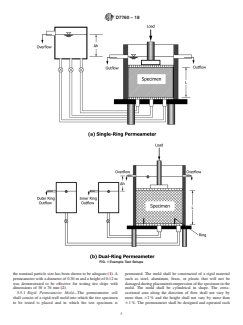
4.3 Use of a dual-ring permeameter is included in this test method in addition to a single-ring permeameter. The dual-ring permeameter allows for minimizing potential adverse effects of sidewall leakage on measured hydraulic conductivity of the test specimens. The use of a bottom plate with an inner ring with a diameter smaller than the diameter of the permeameter and two outflow ports (one from the inner ring, one from the annular space between the inner ring and the permeameter) allows for separating the flow from the central part of the test specimen from the flow near the sidewall of the permeameter.
4.4 Darcy's law is assumed to be valid, flow is assumed to be laminar (Reynolds number less than approximately 2000–3000), and the hydraulic conductivity is assumed to be essentially independent of hydraulic gradient. The validity of Darcy's law may be evaluated by measuring the hydraulic conductivity of a specimen at three hydraulic gradients. The discharge velocity (v = k × i) is plotted against the applied hydraulic gradient. If the resulting relationship is linear and the measured hydraulic conductivity values are similar (i.e., within 25 %), then Darcy’s law may be taken as valid.
Note 1: The quality of the result produced by this standard is dependent of the competence of the personnel using this standard and the suitability of the equipment and facilities. Agencies that meet the criteria of Practice D3740 are generally considered capable of competen...
SCOPE
1.1 This test method covers laboratory measurement of the hydraulic conductivity (also referred to as coefficient of permeability) of water-saturated samples obtained from materials derived from scrap tires using a rigid-wall permeameter. The scrap tire materials covered in this method include tire chips, tire shreds, and tire derived aggregate (TDA) as described in Practice D6270 with particle sizes ranging from approximately 12 to 305 mm. Whole scrap tires are not included in this standard. A clear trend between hydraulic conductivity and shred size has not been established at a given vertical pressure for shreds ≥50 mm (1).2
1.2 A single- or dual-ring permeameter may be used in the tests. A dual-ring permeameter may be preferred over a single-ring permeameter to take into account and prevent short-circuiting of permeant along the sidewalls of the permeameter. The effects of sidewall flow is more significant at high stresses and when the cell diameter is less than 6 times the particle size (1).
1.3 The test method is used under constant head conditions.
1.4 Water is used as the permeant with the test method.
1.5 Test Method D2434 also can be used for determination of hydraulic conductivity of materials derived from scrap tires with sizes smaller than 19 mm under constant head conditions in a rigid-wall permeameter. Method D2434 includes the use of a permeameter with a single ring.
1.6 The values stated in SI units are to be regarded as the standard. Hydraulic conductivity has traditionally been expressed in cm/s in the US, even though the official SI unit for hydraulic conductivity is m/s.
1.7 This standard does not purport to address all of the safety concerns, if any, associated with its use. It is the responsibility of the user of this standard to establish appropriate safety, health, and environmental practices and determine the applicability of regulatory limitations prior to use.
1.8 This int...
- Status
- Published
- Publication Date
- 31-Dec-2017
- Technical Committee
- D18 - Soil and Rock
- Drafting Committee
- D18.14 - Geotechnics of Sustainable Construction
Buy Documents
ASTM D7760-18 - Standard Test Method for Measurement of Hydraulic Conductivity of Materials Derived from Scrap Tires Using a Rigid Wall Permeameter
REDLINE ASTM D7760-18 - Standard Test Method for Measurement of Hydraulic Conductivity of Materials Derived from Scrap Tires Using a Rigid Wall Permeameter
Overview
ASTM D7760-18 outlines a standard test method for the laboratory measurement of hydraulic conductivity (also known as coefficient of permeability) in materials derived from scrap tires. Using a rigid wall permeameter, this standard enables the precise evaluation of the vertical, one-dimensional water flow through saturated samples such as tire chips, tire shreds, and tire-derived aggregate (TDA). The method supports the assessment of hydraulic properties necessary for a wide range of civil engineering applications, especially projects that utilize recycled scrap tire materials for drainage or filtration.
Key Topics
- Hydraulic Conductivity Measurement: The standard details the laboratory procedure for evaluating water flow through tire-derived materials under a constant hydraulic head. It addresses the relevance of reproducing field conditions, including representative unit weight and overburden pressure.
- Single- and Dual-Ring Permeameters: Testing may use either a single- or a dual-ring permeameter. The dual-ring option is recommended to limit error due to sidewall leakage, particularly at higher vertical pressures or when the permeameter diameter is less than six times the largest particle size.
- Applicability to TDA Particle Sizes: ASTM D7760-18 covers scrap tire-derived materials with particle sizes ranging from approximately 12 mm to 305 mm, excluding whole tires. For particle sizes less than 19 mm, ASTM D2434 is referenced.
- Darcy’s Law Validation: The test assumes that Darcy’s law (linear flow under laminar conditions) is valid for interpreting the hydraulic conductivity, with confirmation through measurement at three different hydraulic gradients.
- Quality and Competence: The accuracy of results depends on both proper equipment and skilled operators. Laboratories adhering to ASTM D3740 are recognized for their competence in soil and rock testing.
- Reporting Requirements: The standard prescribes comprehensive reporting, including all sample characteristics, test conditions, measurements, and calculated values necessary to ensure test result reproducibility and transparency.
Applications
Hydraulic conductivity measurements for scrap tire-derived materials have significant practical value in civil engineering and geoenvironmental design, especially as the reuse of recycled tires increases in construction projects. Key application areas include:
- Drainage Systems: TDA materials are increasingly used in landfill drainage layers, road subbases, and other systems that require efficient water conveyance.
- Filtration and Permeable Barriers: Knowledge of hydraulic conductivity allows for the appropriate specification and quality control of TDA in stormwater management, leachate collection, and permeable reactive barriers.
- Lightweight Fill: In embankment construction or retaining wall backfill, TDA provides a lightweight alternative with favorable hydraulic properties.
- Environmental Engineering: Accurate measurement of permeability supports risk assessments and the design of protective measures in recycled material installations.
Related Standards
Several ASTM standards are referenced or relevant when conducting hydraulic conductivity testing on scrap tire-derived materials:
- ASTM D653: Terminology Relating to Soil, Rock, and Contained Fluids
- ASTM D2434: Permeability of Granular Soils (Constant Head) (applies to finer scrap tire materials)
- ASTM D3740: Practice for Minimum Requirements for Agencies Engaged in Testing and/or Inspection of Soil and Rock
- ASTM D4753: Guide for Evaluating, Selecting, and Specifying Balances and Standard Masses
- ASTM D6026: Practice for Using Significant Digits in Geotechnical Data
- ASTM D6270: Practice for Use of Scrap Tires in Civil Engineering Applications
Practical Value
Implementing ASTM D7760-18 facilitates quality assurance in sustainable construction projects utilizing scrap tire-derived materials. By systematically measuring and reporting hydraulic conductivity, engineers and environmental professionals can ensure the long-term performance of TDA in drainage, filtration, and fill applications while advancing the responsible reuse of scrap tires. This standard contributes to project sustainability, cost savings, and regulatory compliance in geotechnical engineering.
Relations
- Effective Date
- 01-Jan-2018
- Effective Date
- 01-Feb-2024
- Effective Date
- 01-Nov-2023
- Effective Date
- 01-Oct-2019
- Effective Date
- 01-May-2015
- Effective Date
- 01-Aug-2014
- Refers
ASTM D6270-08(2012) - Standard Practice for Use of Scrap Tires in Civil Engineering Applications - Effective Date
- 01-Sep-2012
- Effective Date
- 01-May-2012
- Effective Date
- 01-Mar-2012
- Effective Date
- 01-Sep-2011
- Effective Date
- 01-Sep-2011
- Effective Date
- 01-Mar-2010
- Effective Date
- 01-Jan-2009
- Effective Date
- 01-Dec-2008
- Effective Date
- 01-Nov-2008
Buy Documents
ASTM D7760-18 - Standard Test Method for Measurement of Hydraulic Conductivity of Materials Derived from Scrap Tires Using a Rigid Wall Permeameter
REDLINE ASTM D7760-18 - Standard Test Method for Measurement of Hydraulic Conductivity of Materials Derived from Scrap Tires Using a Rigid Wall Permeameter
Get Certified
Connect with accredited certification bodies for this standard

DIN CERTCO
DIN Group product certification.

Smithers Quality Assessments
US management systems and product certification.
Sponsored listings
Frequently Asked Questions
ASTM D7760-18 is a standard published by ASTM International. Its full title is "Standard Test Method for Measurement of Hydraulic Conductivity of Materials Derived from Scrap Tires Using a Rigid Wall Permeameter". This standard covers: SIGNIFICANCE AND USE 4.1 This test method is used to measure one-dimensional vertical flow of water through initially saturated samples of materials derived from scrap tires under an applied hydraulic gradient. Hydraulic conductivity is required in various civil engineering applications of scrap tires. 4.2 Samples are to be tested at a unit weight and under an overburden pressure representative of field conditions. Data from the literature indicate a reduction in hydraulic conductivity with increasing vertical pressure (1). 4.3 Use of a dual-ring permeameter is included in this test method in addition to a single-ring permeameter. The dual-ring permeameter allows for minimizing potential adverse effects of sidewall leakage on measured hydraulic conductivity of the test specimens. The use of a bottom plate with an inner ring with a diameter smaller than the diameter of the permeameter and two outflow ports (one from the inner ring, one from the annular space between the inner ring and the permeameter) allows for separating the flow from the central part of the test specimen from the flow near the sidewall of the permeameter. 4.4 Darcy's law is assumed to be valid, flow is assumed to be laminar (Reynolds number less than approximately 2000–3000), and the hydraulic conductivity is assumed to be essentially independent of hydraulic gradient. The validity of Darcy's law may be evaluated by measuring the hydraulic conductivity of a specimen at three hydraulic gradients. The discharge velocity (v = k × i) is plotted against the applied hydraulic gradient. If the resulting relationship is linear and the measured hydraulic conductivity values are similar (i.e., within 25 %), then Darcy’s law may be taken as valid. Note 1: The quality of the result produced by this standard is dependent of the competence of the personnel using this standard and the suitability of the equipment and facilities. Agencies that meet the criteria of Practice D3740 are generally considered capable of competen... SCOPE 1.1 This test method covers laboratory measurement of the hydraulic conductivity (also referred to as coefficient of permeability) of water-saturated samples obtained from materials derived from scrap tires using a rigid-wall permeameter. The scrap tire materials covered in this method include tire chips, tire shreds, and tire derived aggregate (TDA) as described in Practice D6270 with particle sizes ranging from approximately 12 to 305 mm. Whole scrap tires are not included in this standard. A clear trend between hydraulic conductivity and shred size has not been established at a given vertical pressure for shreds ≥50 mm (1).2 1.2 A single- or dual-ring permeameter may be used in the tests. A dual-ring permeameter may be preferred over a single-ring permeameter to take into account and prevent short-circuiting of permeant along the sidewalls of the permeameter. The effects of sidewall flow is more significant at high stresses and when the cell diameter is less than 6 times the particle size (1). 1.3 The test method is used under constant head conditions. 1.4 Water is used as the permeant with the test method. 1.5 Test Method D2434 also can be used for determination of hydraulic conductivity of materials derived from scrap tires with sizes smaller than 19 mm under constant head conditions in a rigid-wall permeameter. Method D2434 includes the use of a permeameter with a single ring. 1.6 The values stated in SI units are to be regarded as the standard. Hydraulic conductivity has traditionally been expressed in cm/s in the US, even though the official SI unit for hydraulic conductivity is m/s. 1.7 This standard does not purport to address all of the safety concerns, if any, associated with its use. It is the responsibility of the user of this standard to establish appropriate safety, health, and environmental practices and determine the applicability of regulatory limitations prior to use. 1.8 This int...
SIGNIFICANCE AND USE 4.1 This test method is used to measure one-dimensional vertical flow of water through initially saturated samples of materials derived from scrap tires under an applied hydraulic gradient. Hydraulic conductivity is required in various civil engineering applications of scrap tires. 4.2 Samples are to be tested at a unit weight and under an overburden pressure representative of field conditions. Data from the literature indicate a reduction in hydraulic conductivity with increasing vertical pressure (1). 4.3 Use of a dual-ring permeameter is included in this test method in addition to a single-ring permeameter. The dual-ring permeameter allows for minimizing potential adverse effects of sidewall leakage on measured hydraulic conductivity of the test specimens. The use of a bottom plate with an inner ring with a diameter smaller than the diameter of the permeameter and two outflow ports (one from the inner ring, one from the annular space between the inner ring and the permeameter) allows for separating the flow from the central part of the test specimen from the flow near the sidewall of the permeameter. 4.4 Darcy's law is assumed to be valid, flow is assumed to be laminar (Reynolds number less than approximately 2000–3000), and the hydraulic conductivity is assumed to be essentially independent of hydraulic gradient. The validity of Darcy's law may be evaluated by measuring the hydraulic conductivity of a specimen at three hydraulic gradients. The discharge velocity (v = k × i) is plotted against the applied hydraulic gradient. If the resulting relationship is linear and the measured hydraulic conductivity values are similar (i.e., within 25 %), then Darcy’s law may be taken as valid. Note 1: The quality of the result produced by this standard is dependent of the competence of the personnel using this standard and the suitability of the equipment and facilities. Agencies that meet the criteria of Practice D3740 are generally considered capable of competen... SCOPE 1.1 This test method covers laboratory measurement of the hydraulic conductivity (also referred to as coefficient of permeability) of water-saturated samples obtained from materials derived from scrap tires using a rigid-wall permeameter. The scrap tire materials covered in this method include tire chips, tire shreds, and tire derived aggregate (TDA) as described in Practice D6270 with particle sizes ranging from approximately 12 to 305 mm. Whole scrap tires are not included in this standard. A clear trend between hydraulic conductivity and shred size has not been established at a given vertical pressure for shreds ≥50 mm (1).2 1.2 A single- or dual-ring permeameter may be used in the tests. A dual-ring permeameter may be preferred over a single-ring permeameter to take into account and prevent short-circuiting of permeant along the sidewalls of the permeameter. The effects of sidewall flow is more significant at high stresses and when the cell diameter is less than 6 times the particle size (1). 1.3 The test method is used under constant head conditions. 1.4 Water is used as the permeant with the test method. 1.5 Test Method D2434 also can be used for determination of hydraulic conductivity of materials derived from scrap tires with sizes smaller than 19 mm under constant head conditions in a rigid-wall permeameter. Method D2434 includes the use of a permeameter with a single ring. 1.6 The values stated in SI units are to be regarded as the standard. Hydraulic conductivity has traditionally been expressed in cm/s in the US, even though the official SI unit for hydraulic conductivity is m/s. 1.7 This standard does not purport to address all of the safety concerns, if any, associated with its use. It is the responsibility of the user of this standard to establish appropriate safety, health, and environmental practices and determine the applicability of regulatory limitations prior to use. 1.8 This int...
ASTM D7760-18 is classified under the following ICS (International Classification for Standards) categories: 83.160.01 - Tyres in general. The ICS classification helps identify the subject area and facilitates finding related standards.
ASTM D7760-18 has the following relationships with other standards: It is inter standard links to ASTM D7760-12, ASTM D4753-24, ASTM D3740-23, ASTM D3740-19, ASTM D4753-15, ASTM D653-14, ASTM D6270-08(2012), ASTM D3740-12a, ASTM D3740-12, ASTM D653-11, ASTM D3740-11, ASTM D3740-10, ASTM D653-09, ASTM D653-08a, ASTM D653-08. Understanding these relationships helps ensure you are using the most current and applicable version of the standard.
ASTM D7760-18 is available in PDF format for immediate download after purchase. The document can be added to your cart and obtained through the secure checkout process. Digital delivery ensures instant access to the complete standard document.
Standards Content (Sample)
This international standard was developed in accordance with internationally recognized principles on standardization established in the Decision on Principles for the
Development of International Standards, Guides and Recommendations issued by the World Trade Organization Technical Barriers to Trade (TBT) Committee.
Designation: D7760 − 18
Standard Test Method for
Measurement of Hydraulic Conductivity of Materials Derived
from Scrap Tires Using a Rigid Wall Permeameter
This standard is issued under the fixed designation D7760; the number immediately following the designation indicates the year of
original adoption or, in the case of revision, the year of last revision.Anumber in parentheses indicates the year of last reapproval.A
superscript epsilon (´) indicates an editorial change since the last revision or reapproval.
1. Scope responsibility of the user of this standard to establish appro-
priate safety, health, and environmental practices and deter-
1.1 This test method covers laboratory measurement of the
mine the applicability of regulatory limitations prior to use.
hydraulic conductivity (also referred to as coeffıcient of per-
1.8 This international standard was developed in accor-
meability) of water-saturated samples obtained from materials
dance with internationally recognized principles on standard-
derived from scrap tires using a rigid-wall permeameter. The
ization established in the Decision on Principles for the
scrap tire materials covered in this method include tire chips,
Development of International Standards, Guides and Recom-
tire shreds, and tire derived aggregate (TDA) as described in
mendations issued by the World Trade Organization Technical
PracticeD6270withparticlesizesrangingfromapproximately
Barriers to Trade (TBT) Committee.
12 to 305 mm. Whole scrap tires are not included in this
standard. A clear trend between hydraulic conductivity and
2. Referenced Documents
shred size has not been established at a given vertical pressure
2 3
for shreds ≥50 mm (1). 2.1 ASTM Standards:
D653Terminology Relating to Soil, Rock, and Contained
1.2 A single- or dual-ring permeameter may be used in the
Fluids
tests. A dual-ring permeameter may be preferred over a
D2434Test Method for Permeability of Granular Soils
single-ring permeameter to take into account and prevent
(Constant Head) (Withdrawn 2015)
short-circuiting of permeant along the sidewalls of the per-
D3740Practice for Minimum Requirements for Agencies
meameter. The effects of sidewall flow is more significant at
Engaged in Testing and/or Inspection of Soil and Rock as
highstressesandwhenthecelldiameterislessthan6timesthe
Used in Engineering Design and Construction
particle size (1).
D4753Guide for Evaluating, Selecting, and Specifying Bal-
1.3 The test method is used under constant head conditions.
ances and Standard Masses for Use in Soil, Rock, and
1.4 Water is used as the permeant with the test method. Construction Materials Testing
D6026Practice for Using Significant Digits in Geotechnical
1.5 Test Method D2434 also can be used for determination
Data
of hydraulic conductivity of materials derived from scrap tires
D6270Practice for Use of Scrap Tires in Civil Engineering
with sizes smaller than 19 mm under constant head conditions
Applications
inarigid-wallpermeameter.MethodD2434includestheuseof
a permeameter with a single ring.
3. Terminology
1.6 The values stated in SI units are to be regarded as the
3.1 Definitions:
standard. Hydraulic conductivity has traditionally been ex-
3.1.1 Forcommondefinitionsoftermsinthisstandard,refer
pressed in cm/s in the US, even though the official SI unit for
to Terminology D653.
hydraulic conductivity is m/s.
3.1.2 For definitions of terms related to scrap tires, refer to
1.7 This standard does not purport to address all of the
Practice D6270.
safety concerns, if any, associated with its use. It is the
3.1.3 hydraulic conductivity, k—(also referred to as coeffı-
cient of permeability or permeability) the rate of discharge of
ThistestmethodisunderthejurisdictionofASTMCommitteeD18onSoiland
Rock and is the direct responsibility of Subcommittee D18.14 on Geotechnics of
Sustainable Construction. For referenced ASTM standards, visit the ASTM website, www.astm.org, or
Current edition approved Jan. 1, 2018. Published February 2018. Originally contact ASTM Customer Service at service@astm.org. For Annual Book of ASTM
approved in 2012. Last previous edition approved in 2012 as D7760–12. DOI: Standards volume information, refer to the standard’s Document Summary page on
10.1520/D7760–18. the ASTM website.
2 4
The boldface numbers in parentheses refer to a list of references at the end of The last approved version of this historical standard is referenced on
this standard. www.astm.org.
Copyright © ASTM International, 100 Barr Harbor Drive, PO Box C700, West Conshohocken, PA 19428-2959. United States
D7760 − 18
water under laminar flow conditions through a unit cross- tubing, valves, and connections. Pressure application setups
sectional area of porous medium under a unit hydraulic may also be used to pressurize influent and effluent liquids, in
gradient and standard temperature conditions (20 °C). particular to apply high hydraulic gradients. The system shall
allow for maintaining constant hydraulic head to within 65%
3.1.4 hydraulic gradient, i—the change in total head (head
or better accuracy during a test. The system shall allow for
loss, ∆h) per unit distance (L) in the direction of fluid flow, in
measurement of the constant head to within 65% or better
which i = ∆h/L.
accuracy during a test. The head shall be measured with a
3.1.5 permeameter—the apparatus (cell) containing the test
graduated pipette, engineer’s scale, pressure gauge, electronic
specimen in a hydraulic conductivity test.
pressure transducer, or any other device that has the resolution
requiredforthedeterminationofheadtotheaccuracyprovided
4. Significance and Use
above.
4.1 This test method is used to measure one-dimensional
5.2.1 System De-airing—The hydraulic system shall be
vertical flow of water through initially saturated samples of
designed to facilitate rapid and complete removal of free air
materials derived from scrap tires under an applied hydraulic
bubblesfromflowlines.Thiscanbeaccomplishedforexample
gradient. Hydraulic conductivity is required in various civil
by using properly sized tubing and ball valves, and fittings
engineering applications of scrap tires.
without pipe threads. Properly sized components are small
4.2 Samples are to be tested at a unit weight and under an
enough to prevent entrapment of air bubbles, but are large
overburden pressure representative of field conditions. Data
enough not to cause head losses as described in 6.1.
from the literature indicate a reduction in hydraulic conductiv-
5.3 Flow-Measurement System—Flow-measurement system
ity with increasing vertical pressure (1).
is used to determine the amount of inflow and outflow from a
4.3 Use of a dual-ring permeameter is included in this test
specimen during a test. The measurement device shall allow
methodinadditiontoasingle-ringpermeameter.Thedual-ring
for the measurement of the quantity of flow (both inflow and
permeameterallowsforminimizingpotentialadverseeffectsof
outflow) over an interval of time to within 65% or better
sidewallleakageonmeasuredhydraulicconductivityofthetest
accuracy. Flow-measurement system may consist of a gradu-
specimens.The use of a bottom plate with an inner ring with a
ated accumulator, Mariotte bottle, vertical standpipe in con-
diametersmallerthanthediameterofthepermeameterandtwo
junction with an electronic pressure transducer, electromag-
outflow ports (one from the inner ring, one from the annular
netic flow meter, or other volume-measuring device that has
space between the inner ring and the permeameter) allows for
the resolution required to determine flow to the accuracy
separating the flow from the central part of the test specimen
provided above. In most cases, these devices are common to
from the flow near the sidewall of the permeameter.
the hydraulic system.
4.4 Darcy’s law is assumed to be valid, flow is assumed to
5.3.1 De-airing and Dimensional Stability of the System—
be laminar (Reynolds number less than approximately
The flow-measurement system shall contain a minimum of
2000–3000), and the hydraulic conductivity is assumed to be
dead space and shall be equipped to allow for complete and
essentially independent of hydraulic gradient. The validity of
rapid de-airing. Dimensional stability of the system with
Darcy’s law may be evaluated by measuring the hydraulic
respect to changes in pressure shall be ensured by using a stiff
conductivity of a specimen at three hydraulic gradients. The
flow-measurement system that includes glass pipe or rigid
discharge velocity (v = k × i) is plotted against the applied
metallic or thermoplastic tubing.
hydraulicgradient.Iftheresultingrelationshipislinearandthe
5.4 Vertical Pressure Application System—The system for
measuredhydraulicconductivityvaluesaresimilar(i.e.,within
applying vertical pressure on the test specimen in the per-
25%), then Darcy’s law may be taken as valid.
meameter(ifused)shallallowforapplyingandcontrollingthe
NOTE 1—The quality of the result produced by this standard is
pressure to within 65% or better accuracy. The vertical
dependent of the competence of the personnel using this standard and the
suitability of the equipment and facilities.Agencies that meet the criteria pressure application system may include a dead-weight load
of Practice D3740 are generally considered capable of competent and
application setup; a hydraulic load application system; or any
objective testing/sampling/inspection/etc. Users of this standard are cau-
other system that allows for application of the desired level of
tioned that compliance with Practice D3740 does not in itself assure
pressure to a specimen via the top of the specimen.
reliable results. Reliable results depend on many factors; Practice D3740
provides a means of evaluating some of these factors.
5.5 Permeameter—The permeameter shall consist of a per-
meameter cell and attached equipment that allow for connect-
5. Apparatus
ing the permeameter to the hydraulic system, the flow-
5.1 Schematics of the various components of two setups
measurement system, and the pressure application system, as
used to determine hydraulic conductivity of samples of mate-
well as provisions to support a specimen and to permeate the
rials derived from scrap tires using rigid-wall permeameters
specimen. The permeameter cell shall consist of a rigid mold,
underconstantheadconditionsareprovidedforsingle-ringand
coverplate,baseplate,andattachmentstoholdthecomponents
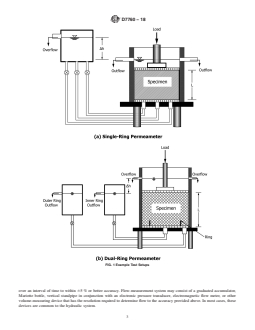
dual-ring devices in Fig. 1(a) and (b), respectively.
together without leakage during a test. The diameter of the
5.2 Constant-Head Hydraulic System—The hydraulic sys- permeameter shall be determined based on the nominal size
temisusedtoapply,maintain,andmeasureheadsandresulting (defined as the average particle size that comprises more than
hydraulic gradients in a test. The hydraulic system mainly 50% of a sample per Practice D6270) of the scrap tire derived
consists of reservoirs that hold water and associated piping, material to be tested.Apermeameter diameter at least 6 times
D7760 − 18
FIG. 1 Example Test Setups
the nominal particle size has been shown to be adequate (1).A permeated. The mold shall be constructed of a rigid material
permeameter with a diameter of 0.30 m and a height of 0.12 m such as steel, aluminum, brass, or plastic that will not be
was demonstrated to be effective for testing tire chips with damagedduringplacement/compressionofthespecimeninthe
dimensions of 38 × 76 mm (2). mold. The mold shall be cylindrical in shape. The cross-
5.5.1 Rigid Permeameter Mold—The permeameter cell sectional area along the direction of flow shall not vary by
shall consist of a rigid-wall mold into which the tire specimen more than 62% and the height shall not vary by more than
to be tested is placed and in which the test specimen is 61%. The permeameter shall be designed and operated such
D7760 − 18
that permeant water flows downward through the test the cell wall using a cathetometer, camera setup, or other
specimen, although upward flow may be used if the top of the instrument that has the resolution required for the determina-
specimen is protected from upward movement by a rigid tion of deformation as prescribed above. The height of a
porouselement.Provisionsmaybeincludedalongthesidewall specimen also may be monitored using a deformation gauge
of the permeameter to directly attach the mold to the constant- connected to the top plate above a specimen or a deformation
head hydraulic system or the flow-measurement system or gauge attached to a loading piston connected to the top plate
both.Hydraulicgradientmeasurementsmaybemadeusingthe above a specimen.The deformation can be determined using a
stand pipe piezometer attachments on the sidewall. dial gauge, LVDT, or other device that has the resolution
required for the determination of deformation as prescribed
5.5.2 Top Plate—The top plate shall be constructed of a
above.
rigid mater
...
This document is not an ASTM standard and is intended only to provide the user of an ASTM standard an indication of what changes have been made to the previous version. Because
it may not be technically possible to adequately depict all changes accurately, ASTM recommends that users consult prior editions as appropriate. In all cases only the current version
of the standard as published by ASTM is to be considered the official document.
Designation: D7760 − 12 D7760 − 18
Standard Test Method for
Measurement of Hydraulic Conductivity of Tire Derived
Aggregates Materials Derived from Scrap Tires Using a
Rigid Wall Permeameter
This standard is issued under the fixed designation D7760; the number immediately following the designation indicates the year of
original adoption or, in the case of revision, the year of last revision. A number in parentheses indicates the year of last reapproval. A
superscript epsilon (´) indicates an editorial change since the last revision or reapproval.
1. Scope
1.1 This test method covers laboratory measurement of the hydraulic conductivity (also referred to as coeffıcient of permeability)
of water-saturated tired derived aggregates (TDA) obtainedsamples obtained from materials derived from scrap tires using a
rigid-wall permeameter. The scrap tire materials covered in this method include tire chips, tire shreds, and tire derived aggregate
(TDA) as described in Practice D6270 with particle sizes ranging from approximately 12 to 305 mm. Whole scrap tires are not
included in this standard. A clear trend between hydraulic conductivity and shred size has not been established at a given vertical
pressure for shreds ≥50 mm (1).
1.2 A single- or dual-ring permeameter may be used in the tests. A dual-ring permeameter may be preferred over a single-ring
permeameter to take into account and prevent short-circuiting of permeant along the sidewalls of the permeameter. The effects of
sidewall flow is more significant at high stresses and when the cell diameter is less than 6 times the particle size (1).
1.3 The test method is used under constant head conditions.
1.4 Water is used as the permeant with the test method.
1.5 Test Method D2434 also can be used for determination of hydraulic conductivity of TDAs materials derived from scrap tires
with sizes smaller than 19 mm under constant head conditions in a rigid-wall permeameter. Method D2434 includes the use of a
permeameter with a single ring.
1.6 The standard units for the hydraulic conductivity values are the SI units, unless other units are specified. values stated in
SI units are to be regarded as the standard. Hydraulic conductivity has traditionally been expressed in cm/s in the U.S.,US, even
though the official SI unit for hydraulic conductivity is m/s.
1.7 This standard does not purport to address all of the safety concerns, if any, associated with its use. It is the responsibility
of the user of this standard to establish appropriate safety safety, health, and healthenvironmental practices and determine the
applicability of regulatory limitations prior to use.
1.8 This international standard was developed in accordance with internationally recognized principles on standardization
established in the Decision on Principles for the Development of International Standards, Guides and Recommendations issued
by the World Trade Organization Technical Barriers to Trade (TBT) Committee.
2. Referenced Documents
2.1 ASTM Standards:
D653 Terminology Relating to Soil, Rock, and Contained Fluids
D2434 Test Method for Permeability of Granular Soils (Constant Head) (Withdrawn 2015)
D3740 Practice for Minimum Requirements for Agencies Engaged in Testing and/or Inspection of Soil and Rock as Used in
Engineering Design and Construction
This test method is under the jurisdiction of ASTM Committee D18 on Soil and Rock and is the direct responsibility of Subcommittee D18.14 on Geotechnics of
Sustainable Construction.
Current edition approved June 1, 2012Jan. 1, 2018. Published August 2012February 2018. Originally approved in 2012. Last previous edition approved in 2012 as
D7760–12. DOI: 10.1520/D7760–1210.1520/D7760–18.
The boldface numbers in parentheses refer to a list of references at the end of this standard.
For referenced ASTM standards, visit the ASTM website, www.astm.org, or contact ASTM Customer Service at service@astm.org. For Annual Book of ASTM Standards
volume information, refer to the standard’s Document Summary page on the ASTM website.
The last approved version of this historical standard is referenced on www.astm.org.
Copyright © ASTM International, 100 Barr Harbor Drive, PO Box C700, West Conshohocken, PA 19428-2959. United States
D7760 − 18
D4753 Guide for Evaluating, Selecting, and Specifying Balances and Standard Masses for Use in Soil, Rock, and Construction
Materials Testing
D6026 Practice for Using Significant Digits in Geotechnical Data
D6270 Practice for Use of Scrap Tires in Civil Engineering Applications
3. Terminology
3.1 Definitions:
3.1.1 For common definitions of terms in this standard, refer to Terminology D653.
3.1.2 For definitions of terms related to scrap tires, refer to Practice D6270.
3.1 Definitions of Terms Specific to This Standard:Definitions:
3.1.1 For common definitions of terms in this standard, refer to Terminology D653.
3.1.2 For definitions of terms related to scrap tires, refer to Practice D6270.
3.1.3 hydraulic conductivity, k—(also referred to as coeffıcient of permeability or permeability) the rate of discharge of water
under laminar flow conditions through a unit cross-sectional area of porous medium under a unit hydraulic gradient and standard
temperature conditions (20 °C).
3.1.4 hydraulic gradient, i—the change in total head (head loss, Δh) per unit distance (L) in the direction of fluid flow, in which
i = Δh/L.
3.1.5 permeameter—the apparatus (cell) containing the test specimen in a hydraulic conductivity test.
4. Significance and Use
4.1 This test method is used to measure one-dimensional vertical flow of water through initially saturated TDAs samples of
materials derived from scrap tires under an applied hydraulic gradient. Hydraulic conductivity is required in various civil
engineering applications of TDAs.scrap tires.
4.2 TDAsSamples are to be tested at a unit weight and under an overburden pressure representative of field conditions. Data
from the literature indicate a reduction in hydraulic conductivity with increasing vertical pressure (1).
4.3 Use of a dual-ring permeameter is included in this test method in addition to a single-ring permeameter. The dual-ring
permeameter allows for minimizing potential adverse effects of sidewall leakage on measured hydraulic conductivity of the test
specimens. The use of a bottom plate with an inner ring with a diameter smaller than the diameter of the permeameter and two
outflow ports (one from the inner ring, one from the annular space between the inner ring and the permeameter) allows for
separating the flow from the central part of the test specimen from the flow near the sidewall of the permeameter.
4.4 Darcy’s law is assumed to be valid, flow is assumed to be laminar (Reynolds number less than approximately 2000–3000),
and the hydraulic conductivity is assumed to be essentially independent of hydraulic gradient. The validity of Darcy’s law may
be evaluated by measuring the hydraulic conductivity of a specimen at three hydraulic gradients. The discharge velocity (v = k ×
i) is plotted against the applied hydraulic gradient. If the resulting relationship is linear and the measured hydraulic conductivity
values are similar (i.e., within 25 %), then Darcy’s law may be taken as valid.
NOTE 1—The quality of the result produced by this standard is dependent of the competence of the personnel using this standard and the suitability
of the equipment and facilities. Agencies that meet the criteria of Practice D3740 are generally considered capable of competent and objective
testing/sampling/inspection/etc. Users of this standard are cautioned that compliance with Practice D3740 does not in itself assure reliable results. Reliable
results depend on many factors; Practice D3740 provides a means of evaluating some of these factors.
5. Apparatus
5.1 Schematics of the various components of two setups used to determine hydraulic conductivity of TDAs samples of materials
derived from scrap tires using rigid-wall permeameters under constant head conditions are provided for single-ring and dual-ring
devices in Fig. 1(a) and (b), respectively.
5.2 Constant-Head Hydraulic System—The hydraulic system is used to apply, maintain, and measure heads and resulting
hydraulic gradients in a test. The hydraulic system mainly consists of reservoirs that hold water and associated piping, tubing,
valves, and connections. Pressure application setups may also be used to pressurize influent and effluent liquids, in particular to
apply high hydraulic gradients. The system shall allow for maintaining constant hydraulic head to within 65 % or better accuracy
during a test. The system shall allow for measurement of the constant head to within 65 % or better accuracy during a test. The
head shall be measured with a graduated pipette, engineer’s scale, pressure gauge, electronic pressure transducer, or any other
device that has the resolution required for the determination of head to the accuracy provided above.
5.2.1 System De-airing—The hydraulic system shall be designed to facilitate rapid and complete removal of free air bubbles
from flow lines. This can be accomplished for example by using properly sized tubing and ball valves, and fittings without pipe
threads. Properly sized components are small enough to prevent entrapment of air bubbles, but are large enough not to cause head
losses as described in 6.1.
5.3 Flow-Measurement System—Flow-measurement system is used to determine the amount of inflow and outflow from a
specimen during a test. The measurement device shall allow for the measurement of the quantity of flow (both inflow and outflow)
D7760 − 18
FIG. 1 Example Test Setups
over an interval of time to within 65 % or better accuracy. Flow-measurement system may consist of a graduated accumulator,
Mariotte bottle, vertical standpipe in conjunction with an electronic pressure transducer, electromagnetic flow meter, or other
volume-measuring device that has the resolution required to determine flow to the accuracy provided above. In most cases, these
devices are common to the hydraulic system.
D7760 − 18
5.3.1 De-airing and Dimensional Stability of the System—The flow-measurement system shall contain a minimum of dead space
and shall be equipped to allow for complete and rapid de-airing. Dimensional stability of the system with respect to changes in
pressure shall be ensured by using a stiff flow-measurement system that includes glass pipe or rigid metallic or thermoplastic
tubing.
5.4 Vertical Pressure Application System—The system for applying vertical pressure on the TDAtest specimen in the
permeameter (if used) shall allow for applying and controlling the pressure to within 65 % or better accuracy. The vertical pressure
application system may include a dead-weight load application setup; a hydraulic load application system; or any other system that
allows for application of the desired level of pressure to a specimen via the top of the specimen.
5.5 Permeameter—The permeameter shall consist of a permeameter cell and attached equipment that allow for connecting the
permeameter to the hydraulic system, the flow-measurement system, and the pressure application system, as well as provisions to
support a specimen and to permeate the specimen. The permeameter cell shall consist of a rigid mold, cover plate, base plate, and
attachments to hold the components together without leakage during a test. The diameter of the permeameter shall be determined
based on the nominal size (defined as the average particle size that comprises more than 50 % of a TDA sample per Practice
D6270) of the TDA scrap tire derived material to be tested. A permeameter diameter at least 6 times the nominal particle size has
been shown to be adequate (1). A permeameter with a diameter of 0.30 m and a height of 0.12 m was demonstrated to be effective
for testing tire chips with dimensions of 38 × 76 mm (2).
5.5.1 Rigid Permeameter Mold—The permeameter cell shall consist of a rigid-wall mold into which the tire specimen to be
tested is placed and in which the test specimen is permeated. The mold shall be constructed of a rigid material such as steel,
aluminum, brass, or plastic that will not be damaged during placement/compression of the specimen in the mold. The mold shall
be cylindrical in shape. The cross-sectional area along the direction of flow shall not vary by more than 62 % and the height shall
not vary by more than 61 %. The permeameter shall be designed and operated such that permeant water flows downward through
the test specimen, although upward flow may be used if the top of the specimen is protected from upward movement by a rigid
porous element. Provisions may be included along the sidewall of the permeameter to directly attach the mold to the constant-head
hydraulic system or the flow-measurement system or both. Hydraulic gradient measurements may be made using the stand pipe
piezometer attachments on the sidewall.
5.5.2 Top Plate—The top plate shall be constructed of a rigid material that does not react adversely with the test material or
permeant water. The top plate may be sealed to the rigid-wall permeameter cell using an O-ring or similar preventing leakage or
the plate may be perforated and not sealed to the permeameter cell based on the design of the test setup. A sealed top plate is used
whe
...