

ASTM D8181-19
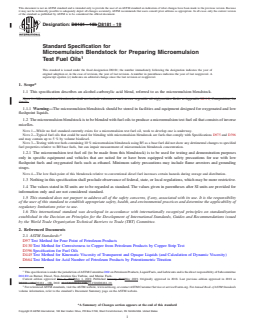
(Specification)Standard Specification for Microemulsion Blendstock for Preparing Microemulsion Test Fuel Oils
General Information
- Abstract
SCOPE
1.1 This specification describes an alcohol-carboxylic acid blend, referred to as the microemulsion blendstock.
1.1.1 Warning—The microemulsion blendstock should be stored in facilities and equipment designed for oxygenated and low flashpoint liquids.
1.2 The microemulsion blendstock is to be blended with fuel oils to produce a microemulsion test fuel oil that consists of inverse micelles.
Note 1: While no fuel standard currently exists for a microemulsion test fuel oil, work to develop one is underway.
Note 2: Typical fuel oils that could be used for blending with microemulsion blendstock are fuels that comply with Specifications D975 and D396 and may contain up to 5 % by volume biodiesel.
Note 3: Testing with test fuels containing 10 % microemulsion blendstock using B5 as a base fuel did not show any detrimental changes to specified fuel properties relative to B0 base fuels, but can impair measurement of microemulsion blendstock concentration.
1.2.1 The microemulsion test fuel oil (to be made from this blendstock) is to be used for testing and demonstration purposes only in specific equipment and vehicles that are suited for or have been equipped with safety precautions for use with low flashpoint fuels and oxygenated fuels such as ethanol. Minimum safety precautions may include flame arrestors and grounding straps.
Note 4: The low flash point of this blendstock relative to conventional diesel fuel increases certain hazards during storage and distribution.
1.3 Nothing in this specification shall preclude observance of federal, state, or local regulations, which may be more restrictive.
1.4 The values stated in SI units are to be regarded as standard. The values given in parentheses after SI units are provided for information only and are not considered standard.
1.5 This standard does not purport to address all of the safety concerns, if any, associated with its use. It is the responsibility of the user of this standard to establish appropriate safety, health, and environmental practices and determine the applicability of regulatory limitations prior to use.
1.6 This international standard was developed in accordance with internationally recognized principles on standardization established in the Decision on Principles for the Development of International Standards, Guides and Recommendations issued by the World Trade Organization Technical Barriers to Trade (TBT) Committee.
- Status
- Published
- Publication Date
- 30-Apr-2019
- Technical Committee
- D02 - Petroleum Products, Liquid Fuels, and Lubricants
- Drafting Committee
- D02.E0 - Burner, Diesel and Non-Aviation Gas Turbine Fuels
Buy Documents
ASTM D8181-19 - Standard Specification for Microemulsion Blendstock for Preparing Microemulsion Test Fuel Oils
REDLINE ASTM D8181-19 - Standard Specification for Microemulsion Blendstock for Preparing Microemulsion Test Fuel Oils
Overview
ASTM D8181-19: Standard Specification for Microemulsion Blendstock for Preparing Microemulsion Test Fuel Oils is a comprehensive international standard that defines the requirements for alcohol-carboxylic acid blendstocks intended for blending with fuel oils. These blendstocks enable the preparation of microemulsion test fuel oils, which are valuable for research, testing, and demonstration purposes in the fuel industry. This standard addresses the composition, performance, storage, and safety aspects of microemulsion blendstocks, supporting advancements in renewable and alternative diesel fuels.
Key Topics
- Microemulsion Blendstock Definition: The standard specifies an alcohol-carboxylic acid blend, excluding raw vegetable oil triglycerides. These blendstocks typically include biomass-derived oxygenated components such as water, an alcohol co-solvent (e.g., ethanol), and a long-chain carboxylic acid surfactant.
- Intended Use: Microemulsion blendstock is designed for blending with fuel oils (such as those meeting ASTM D975 or ASTM D396, which may contain up to 5% biodiesel) to produce a microemulsion test fuel oil. The resulting fuel is characterized by inverse micelle structures for improved fuel stability and performance testing.
- Safety and Storage: Due to the low flashpoint and oxygenated nature of the microemulsion blendstock, specialized storage and handling procedures are required. Facilities and equipment should be suitable for oxygenated and low flashpoint liquids, incorporating minimum safety features like flame arrestors and grounding straps.
- Quality and Purity Requirements: The blendstock must be visually clear and bright, free from sediment and undissolved water. Limits are set for properties such as kinematic viscosity, acid number, glycerin content, and copper strip corrosion.
- Testing and Verification: Detailed test procedures ensure proper micelle formation, stability, and property compliance using recognized ASTM methods. Methods include kinematic viscosity measurement, acid and base number titration, pour point testing, dynamic light scattering for micelle size verification, and accelerated aging for stability assessment.
Applications
- Fuel and Engine Testing: Microemulsion blendstock enables the creation of test fuels for evaluating engine performance, emissions characteristics, and compatibility with alternative or renewable fuels.
- Research and Development: Laboratories and fuel developers use microemulsion blendstocks as a platform for innovation in biofuels and oxygenated diesel alternatives, supporting the transition to cleaner energy sources.
- Quality Control: The standardized requirements allow for consistent production, handling, and quality assurance of test fuels, facilitating comparative studies and regulatory compliance.
- Demonstration Projects: The blendstocks are intended for controlled demonstrations and pilot-scale studies in specific vehicles or equipment engineered for low flashpoint, oxygenated fuels.
Important: Microemulsion test fuel oils prepared following ASTM D8181-19 are not yet standardized as commercial fuels and should only be used in safety-qualified, non-public applications.
Related Standards
The following ASTM standards are closely associated with ASTM D8181-19, supporting the specification and testing of blendstocks and resultant test fuels:
- ASTM D975 - Standard Specification for Diesel Fuel Oils
- ASTM D396 - Standard Specification for Fuel Oils
- ASTM D6584 - Test Method for Determination of Glycerin in Biodiesel Blendstocks
- ASTM D4806 - Specification for Denatured Fuel Ethanol for Blending
- ASTM D445 / D7042 - Methods for Kinematic & Dynamic Viscosity
- ASTM D130 - Corrosiveness to Copper by Copper Strip Test
- ASTM D97 - Pour Point of Petroleum Products
- ASTM D7545 - Oxidation Stability of Middle Distillate Fuels
- ASTM D6751 - Specification for Biodiesel Fuel Blend Stock
- ASTM D7862 - Specification for Butanol for Blending with Gasoline
Practical Value
ASTM D8181-19 provides a critical foundation for the safe, consistent design and evaluation of microemulsion blendstocks as part of broader fuel innovation initiatives. By adhering to this standard, organizations can ensure safer storage, reliable quality, and reproducible performance in engine testing and R&D, paving the way for new classes of biofuel and renewable diesel alternatives.
Keywords: ASTM D8181-19, microemulsion blendstock, test fuel oils, alcohol-carboxylic acid blend, renewable fuels, biofuel, diesel alternative, fuel oil blending, oxygenated diesel, standard specification, fuel testing.
Relations
- Effective Date
- 01-May-2019
- Effective Date
- 01-Apr-2024
- Effective Date
- 15-Dec-2023
- Refers
ASTM D4175-23a - Standard Terminology Relating to Petroleum Products, Liquid Fuels, and Lubricants - Effective Date
- 15-Dec-2023
- Effective Date
- 01-Dec-2023
- Effective Date
- 01-Nov-2023
- Effective Date
- 01-Nov-2023
- Refers
ASTM D4175-23e1 - Standard Terminology Relating to Petroleum Products, Liquid Fuels, and Lubricants - Effective Date
- 01-Jul-2023
- Effective Date
- 15-Dec-2019
- Effective Date
- 01-Dec-2019
- Effective Date
- 01-Dec-2019
- Effective Date
- 15-Sep-2019
- Effective Date
- 01-May-2019
- Effective Date
- 01-Mar-2019
- Effective Date
- 01-Feb-2019
Buy Documents
ASTM D8181-19 - Standard Specification for Microemulsion Blendstock for Preparing Microemulsion Test Fuel Oils
REDLINE ASTM D8181-19 - Standard Specification for Microemulsion Blendstock for Preparing Microemulsion Test Fuel Oils
Get Certified
Connect with accredited certification bodies for this standard

Element Materials Technology
Materials testing and product certification.

ABS Group Brazil
ABS Group certification services in Brazil.

ABS Quality Evaluations Inc.
American Bureau of Shipping quality certification.
Sponsored listings
Frequently Asked Questions
ASTM D8181-19 is a technical specification published by ASTM International. Its full title is "Standard Specification for Microemulsion Blendstock for Preparing Microemulsion Test Fuel Oils". This standard covers: SCOPE 1.1 This specification describes an alcohol-carboxylic acid blend, referred to as the microemulsion blendstock. 1.1.1 Warning—The microemulsion blendstock should be stored in facilities and equipment designed for oxygenated and low flashpoint liquids. 1.2 The microemulsion blendstock is to be blended with fuel oils to produce a microemulsion test fuel oil that consists of inverse micelles. Note 1: While no fuel standard currently exists for a microemulsion test fuel oil, work to develop one is underway. Note 2: Typical fuel oils that could be used for blending with microemulsion blendstock are fuels that comply with Specifications D975 and D396 and may contain up to 5 % by volume biodiesel. Note 3: Testing with test fuels containing 10 % microemulsion blendstock using B5 as a base fuel did not show any detrimental changes to specified fuel properties relative to B0 base fuels, but can impair measurement of microemulsion blendstock concentration. 1.2.1 The microemulsion test fuel oil (to be made from this blendstock) is to be used for testing and demonstration purposes only in specific equipment and vehicles that are suited for or have been equipped with safety precautions for use with low flashpoint fuels and oxygenated fuels such as ethanol. Minimum safety precautions may include flame arrestors and grounding straps. Note 4: The low flash point of this blendstock relative to conventional diesel fuel increases certain hazards during storage and distribution. 1.3 Nothing in this specification shall preclude observance of federal, state, or local regulations, which may be more restrictive. 1.4 The values stated in SI units are to be regarded as standard. The values given in parentheses after SI units are provided for information only and are not considered standard. 1.5 This standard does not purport to address all of the safety concerns, if any, associated with its use. It is the responsibility of the user of this standard to establish appropriate safety, health, and environmental practices and determine the applicability of regulatory limitations prior to use. 1.6 This international standard was developed in accordance with internationally recognized principles on standardization established in the Decision on Principles for the Development of International Standards, Guides and Recommendations issued by the World Trade Organization Technical Barriers to Trade (TBT) Committee.
SCOPE 1.1 This specification describes an alcohol-carboxylic acid blend, referred to as the microemulsion blendstock. 1.1.1 Warning—The microemulsion blendstock should be stored in facilities and equipment designed for oxygenated and low flashpoint liquids. 1.2 The microemulsion blendstock is to be blended with fuel oils to produce a microemulsion test fuel oil that consists of inverse micelles. Note 1: While no fuel standard currently exists for a microemulsion test fuel oil, work to develop one is underway. Note 2: Typical fuel oils that could be used for blending with microemulsion blendstock are fuels that comply with Specifications D975 and D396 and may contain up to 5 % by volume biodiesel. Note 3: Testing with test fuels containing 10 % microemulsion blendstock using B5 as a base fuel did not show any detrimental changes to specified fuel properties relative to B0 base fuels, but can impair measurement of microemulsion blendstock concentration. 1.2.1 The microemulsion test fuel oil (to be made from this blendstock) is to be used for testing and demonstration purposes only in specific equipment and vehicles that are suited for or have been equipped with safety precautions for use with low flashpoint fuels and oxygenated fuels such as ethanol. Minimum safety precautions may include flame arrestors and grounding straps. Note 4: The low flash point of this blendstock relative to conventional diesel fuel increases certain hazards during storage and distribution. 1.3 Nothing in this specification shall preclude observance of federal, state, or local regulations, which may be more restrictive. 1.4 The values stated in SI units are to be regarded as standard. The values given in parentheses after SI units are provided for information only and are not considered standard. 1.5 This standard does not purport to address all of the safety concerns, if any, associated with its use. It is the responsibility of the user of this standard to establish appropriate safety, health, and environmental practices and determine the applicability of regulatory limitations prior to use. 1.6 This international standard was developed in accordance with internationally recognized principles on standardization established in the Decision on Principles for the Development of International Standards, Guides and Recommendations issued by the World Trade Organization Technical Barriers to Trade (TBT) Committee.
ASTM D8181-19 is classified under the following ICS (International Classification for Standards) categories: 75.160.20 - Liquid fuels. The ICS classification helps identify the subject area and facilitates finding related standards.
ASTM D8181-19 has the following relationships with other standards: It is inter standard links to ASTM D8181-18b, ASTM D445-24, ASTM D975-23a, ASTM D4175-23a, ASTM D665-23, ASTM D3242-23, ASTM D445-23, ASTM D4175-23e1, ASTM D396-19a, ASTM D665-19, ASTM D7545-14(2019)e1, ASTM D4806-19a, ASTM D396-19, ASTM D4806-19, ASTM D975-19. Understanding these relationships helps ensure you are using the most current and applicable version of the standard.
ASTM D8181-19 is available in PDF format for immediate download after purchase. The document can be added to your cart and obtained through the secure checkout process. Digital delivery ensures instant access to the complete standard document.
Standards Content (Sample)
This international standard was developed in accordance with internationally recognized principles on standardization established in the Decision on Principles for the
Development of International Standards, Guides and Recommendations issued by the World Trade Organization Technical Barriers to Trade (TBT) Committee.
Designation:D8181 −19
Standard Specification for
Microemulsion Blendstock for Preparing Microemulsion
Test Fuel Oils
This standard is issued under the fixed designation D8181; the number immediately following the designation indicates the year of
original adoption or, in the case of revision, the year of last revision. A number in parentheses indicates the year of last reapproval. A
superscript epsilon (´) indicates an editorial change since the last revision or reapproval.
1. Scope* responsibility of the user of this standard to establish appro-
priate safety, health, and environmental practices and deter-
1.1 This specification describes an alcohol-carboxylic acid
mine the applicability of regulatory limitations prior to use.
blend, referred to as the microemulsion blendstock.
1.6 This international standard was developed in accor-
1.1.1 Warning—The microemulsion blendstock should be
dance with internationally recognized principles on standard-
stored in facilities and equipment designed for oxygenated and
ization established in the Decision on Principles for the
low flashpoint liquids.
Development of International Standards, Guides and Recom-
1.2 The microemulsion blendstock is to be blended with
mendations issued by the World Trade Organization Technical
fuel oils to produce a microemulsion test fuel oil that consists
Barriers to Trade (TBT) Committee.
of inverse micelles.
2. Referenced Documents
NOTE 1—While no fuel standard currently exists for a microemulsion
test fuel oil, work to develop one is underway.
2.1 ASTM Standards:
NOTE 2—Typical fuel oils that could be used for blending with
D97 Test Method for Pour Point of Petroleum Products
microemulsion blendstock are fuels that comply with Specifications D975
D130 Test Method for Corrosiveness to Copper from Petro-
and D396 and may contain up to5%by volume biodiesel.
leum Products by Copper Strip Test
NOTE 3—Testing with test fuels containing 10 % microemulsion
blendstock using B5 as a base fuel did not show any detrimental changes D396 Specification for Fuel Oils
to specified fuel properties relative to B0 base fuels, but can impair
D445 Test Method for Kinematic Viscosity of Transparent
measurement of microemulsion blendstock concentration.
and Opaque Liquids (and Calculation of Dynamic Viscos-
1.2.1 The microemulsion test fuel oil (to be made from this
ity)
blendstock) is to be used for testing and demonstration
D664 Test Method for Acid Number of Petroleum Products
purposesonlyinspecificequipmentandvehiclesthataresuited
by Potentiometric Titration
for or have been equipped with safety precautions for use with
D665 Test Method for Rust-Preventing Characteristics of
low flashpoint fuels and oxygenated fuels such as ethanol.
Inhibited Mineral Oil in the Presence of Water
Minimum safety precautions may include flame arrestors and
D974 Test Method for Acid and Base Number by Color-
grounding straps.
Indicator Titration
D975 Specification for Diesel Fuel Oils
NOTE 4—The low flash point of this blendstock relative to conventional
D3242 Test Method for Acidity in Aviation Turbine Fuel
diesel fuel increases certain hazards during storage and distribution.
D4057 Practice for Manual Sampling of Petroleum and
1.3 Nothing in this specification shall preclude observance
Petroleum Products
of federal, state, or local regulations, which may be more
D4175 Terminology Relating to Petroleum Products, Liquid
restrictive.
Fuels, and Lubricants
1.4 The values stated in SI units are to be regarded as
D4625 Test Method for Middle Distillate Fuel Storage
standard. The values given in parentheses after SI units are
Stability at 43 °C (110 °F)
provided for information only and are not considered standard.
D4806 Specification for Denatured Fuel Ethanol for Blend-
ing with Gasolines for Use as Automotive Spark-Ignition
1.5 This standard does not purport to address all of the
safety concerns, if any, associated with its use. It is the Engine Fuel
D6584 Test Method for Determination of Total
Monoglycerides, Total Diglycerides, Total Triglycerides,
This specification is under the jurisdiction of ASTM Committee D02 on
Petroleum Products, Liquid Fuels, and Lubricants and is the direct responsibility of
Subcommittee D02.E0 on Burner, Diesel, Non-Aviation Gas Turbine, and Marine
Fuels. For referenced ASTM standards, visit the ASTM website, www.astm.org, or
Current edition approved May 1, 2019. Published May 2019. Originally contact ASTM Customer Service at service@astm.org. For Annual Book of ASTM
approved in 2018. Last previous edition approved in 2018 as D8181 – 18b. DOI: Standards volume information, refer to the standard’s Document Summary page on
10.1520/D8181-19. the ASTM website.
*A Summary of Changes section appears at the end of this standard
Copyright © ASTM International, 100 Barr Harbor Drive, PO Box C700, West Conshohocken, PA 19428-2959. United States
D8181−19
and Free and Total Glycerin in B-100 Biodiesel Methyl 4. Requirements
Esters by Gas Chromatography
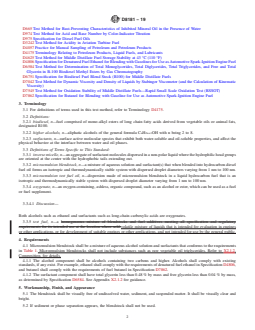
4.1 Microemulsionblendstockshallbeamixtureofaqueous
D6751 Specification for Biodiesel Fuel Blend Stock (B100)
alcohol solution and surfactants that conforms to the require-
for Middle Distillate Fuels
ments in Table 1. Microemulsion blendstocks shall not include
D7042 Test Method for Dynamic Viscosity and Density of
substances such as raw vegetable oil triglycerides. Refer to
Liquids by Stabinger Viscometer (and the Calculation of
X2.1.2, Composition, for details.
Kinematic Viscosity)
4.1.1 The alcohol component shall be alcohols containing
D7545 Test Method for Oxidation Stability of Middle Dis-
two carbons and higher. Alcohols shall comply with existing
tillate Fuels—Rapid Small Scale Oxidation Test (RSSOT)
standards, if any exist. For example, ethanol shall comply with
D7862 Specification for Butanol for Blending with Gasoline
the requirements of denatured fuel ethanol in Specification
for Use as Automotive Spark-Ignition Engine Fuel
D4806, and butanol shall comply with the requirements of fuel
butanol in Specification D7862.
3. Terminology
4.1.2 The surfactant component shall have total glycerin
3.1 For definitions of terms used in this test method, refer to
less than 0.48 % by mass and free glycerin less than 0.04 % by
Terminology D4175.
mass, as determined by Specification D6584. See Appendix
X2.1.2 for guidance.
3.2 Definitions:
3.2.1 biodiesel, n—fuel comprised of mono-alkyl esters of
5. Workmanship, Finish, and Appearance
long chain fatty acids derived from vegetable oils or animal
fats, designated B100.
5.1 The blendstock shall be visually free of undissolved
3.2.2 higher alcohols, n—aliphatic alcohols of the general water,sediment,andsuspendedmatter.Itshallbevisuallyclear
formula C H OH with n being 2 to 8. and bright.
n 2n+1
3.2.3 surfactants, n—surface active molecular species that
5.2 If sediment or phase separation appears, the blendstock
exhibitbothwater-solubleandoil-solubleproperties,andaffect
shall not be used.
the physical behavior at the interface between water and oil
phases.
6. Keywords
3.3 Definitions of Terms Specific to This Standard: 6.1 biofuel; blendstock; diesel alternative; inverse micelle;
3.3.1 inverse micelle, n—an aggregate of surfactant mol-
micelle; microemulsion; oxygenated diesel; renewable fuel;
ecules dispersed in a non-polar liquid where the hydrophilic test fuel oils
head groups are oriented at the center with the hydrophobic
tails extending out.
3.3.2 microemulsion blendstock, n—a mixture of aqueous
TABLE 1 Requirements for Microemulsion Blendstock
solution and surfactant(s) that when blended into hydrocarbon
Property Limit Test Method
diesel fuel oil forms an isotropic and thermodynamically stable
A
Kinematic Viscosity, 40 °C, cSt 9.0 to 12.0 ASTM D7042
system with dispersed droplet diameters varying from 1 nm to
100 nm. Copper strip corrosion, max No. 1 ASTM D130
3.3.3 microemulsion test fuel oil, n—dispersion made of
A
Iron Corrosion, max ASTM D665
microemulsion blendstock in a liquid hydrocarbon fuel that is
Oxidation stability, 140 °C, 700 kPa, Report ASTM D7545
an isotropic and thermodynamically stable system with dis-
minutes
persed droplet diameter varying from 1 nm to 100 nm.
Pour Point, °C –13 to 15 ASTM D97
3.3.4 oxygenate, n—an oxygen-containing, ashless, organic
compound, such as an alcohol or ester, which can be used as a
Blending Requirement
fuel or fuel supplement. (1) Formation of microemulsion 50 See Annex A1 and
test fuel—size of inverse micelles, Annex A2
3.3.4.1 Discussion—Both alcohols such as ethanol and sur-
nm, max
factants such as long-chain carboxylic acids are oxygenates.
(2) Stability of blendstock in certifi- 60 See Annex A3
3.3.5 test fuel, n—a volatile mixture of liquids that is
cation fuel, days, min
intended for evaluation in engines or other applications, or for
A
Test Method D445 may also be used. Test Method D7042 is the referee test
development of suitable engines or other applications, and not
method.
intended for use by the general public.
D8181−19
ANNEXES
(Mandatory Information)
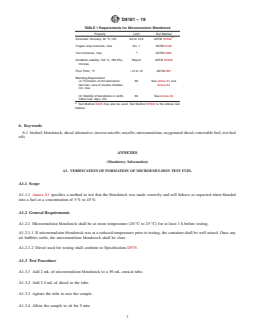
A1. VERIFICATION OF FORMATION OF MICROEMULSION TEST FUEL
A1.1 Scope A1.3.8 Allow the sample to sit for 5 min.
A1.3.9 Ensure the mixture is monophasic and the clarity of
A1.1.1 Annex A1 specifies a method to test that the blend-
stock was made correctly and will behave as expected when diesel. This represents blending at 31 %.
blended into a fuel at a concentration of 5 % to 45 %.
A1.3.10 Add an additional 6 mL of diesel to the tube.
A1.2 General Requirements A1.3.11 Agitate the tube to mix the sample.
A1.3.12 Allow the sample to sit for 5 min.
A1.2.1 Microemulsionblendstockshallbeatroomtempera-
ture (20 °C to 25 °C) for at least 1 h before testing.
A1.3.13 Ensurethemixtureismonophasicandtheclarityof
A1.2.1.1 If microemulsion blendstock was at a reduced
diesel. This represents blending at 16 %.
temperature prior to testing, the container shall be well mixed.
A1.3.14 Add an additional 26.5 mL of diesel to the tube.
Once any air bubbles settle, the microemulsion blendstock
A1.3.15 Agitate the tube to mix the sample.
shall be clear.
A1.2.1.2 Diesel used for testing shall conform to Specifica-
A1.3.16 Allow the sample to sit for 5 min.
tion D975.
A1.3.17 Ensurethemixtureismonophasicandtheclarityof
diesel. This represents blending at 5 %.
A1.3 Test Procedure
A1.3.18 Retain the 5 % blended test fuel for 24 h at room
A1.3.1 Add 2 mL of microemulsion blendstock to a 50 mL
temperature.
conical tube.
A1.3.19 Ensurethemixtureismonophasicandtheclarityof
A1.3.2 Add 2.5 mL of diesel to the tube.
diesel.
A1.3.3 Agitate the tube to mix the sample.
A1.4 Results
A1.3.4 Allow the sample to sit for 5 min.
A1.4.1 If all of the above samples are monophasic and the
A1.3.5 Ensure the mixture is clear and bright. This repre-
clarity of diesel, the microemulsion blendstock passes and is
sents blending at 44 %.
confirmed to form micelles in a hydrocarbon solution.
A1.3.6 Add an additional 2 mL of diesel to the tube.
A1.4.2 Appendix X1 provides information on correlating
A1.3.7 Agitate the tube to mix the sample. concentration of the blendstock to the inverse micelle size.
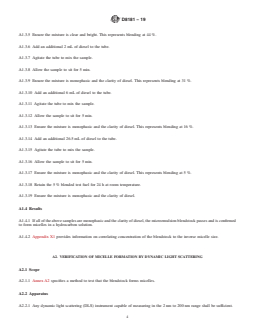
A2. VERIFICATION OF MICELLE FORMATION BY DYNAMIC LIGHT SCATTERING
A2.1 Scope A2.3.2 Before adding the test fuel to the cuvette, add 0.5 %
water by volume and mix well.
A2.1.1 Annex A2 specifies a method to test that the blend-
A2.3.2.1 If the sample becomes cloudy, the test fails.
stock forms micelles.
A2.3.3 Sample shall retain the same clarity as the original
A2.2 Apparatus
test fuel.
A2.2.1 Any dynamic light scattering (DLS) instrument
A2.3.4 Samples shall be measured in triplicate and average
capable of measuring in the 2 nm to 200 nm range shall be
values taken.
sufficient.
A2.2.2 Cuvettes shall be made of a material that is compat-
A2.4 Results
ible with all components of the test fuel.
A2.4.1 The average size of the inverse micelles shall be
recorded.
A2.3 Procedure
A2.3.1 A test fuel shall be made of 10 % microemulsion A2.4.2 Use Appendix X1 as guidance of typical sizes
blendstock in diesel in sufficient quantity to fill the cuvette. observed.
D8181−19
A3. VERIFICATION OF STABILITY OF BLENDSTOCK IN CERTIFICATION FUEL
A3.1 Scope A3.4.1.2 Visual inspection of clarity.
A3.1.1 Annex A3 specifies a method to test that a micro- A3.4.2 Aging at 55 °C:
emulsionblendstockhasadequatelong-termstabilityforusein
A3.4.2.1 50 mL of test fuel shall be added to three glass
a microemulsion test fuel. vials whose caps provide adequate sealing at 55 °C.
(1) Glass vials should not be filled to the top and should be
A3.2 Apparatus
left with adequate headspace.
A3.2.1 Oven, of adequate size to fit the samples. The oven A3.4.2.2 Record the temperature of the oven and verify it is
should be adequately vented.
within 1 °C of 55 °C.
A3.4.2.3 Over the next 7 days, verify that the oven has
A3.2.
...
This document is not an ASTM standard and is intended only to provide the user of an ASTM standard an indication of what changes have been made to the previous version. Because
it may not be technically possible to adequately depict all changes accurately, ASTM recommends that users consult prior editions as appropriate. In all cases only the current version
of the standard as published by ASTM is to be considered the official document.
Designation: D8181 − 18b D8181 − 19
Standard Specification for
Microemulsion Blendstock for Preparing Microemulsion
Test Fuel Oils
This standard is issued under the fixed designation D8181; the number immediately following the designation indicates the year of
original adoption or, in the case of revision, the year of last revision. A number in parentheses indicates the year of last reapproval. A
superscript epsilon (´) indicates an editorial change since the last revision or reapproval.
1. Scope*
1.1 This specification describes an alcohol-carboxylic acid blend, referred to as the microemulsion blendstock.
NOTE 1—Microemulsion blendstocks shall not include substances such as raw vegetable oil triglycerides. Refer to Appendix X2.1.2, Composition, for
details.
1.1.1 Warning—The microemulsion blendstock should be stored in facilities and equipment designed for oxygenated and low
flashpoint liquids.
1.2 The microemulsion blendstock is to be blended with fuel oils to produce a microemulsion test fuel oil that consists of inverse
micelles.
NOTE 1—While no fuel standard currently exists for a microemulsion test fuel oil, work to develop one is underway.
NOTE 2—Typical fuel oils that could be used for blending with microemulsion blendstock are fuels that comply with Specifications D975 and D396
and may contain up to 5 % by volume biodiesel.
NOTE 3—Testing with test fuels containing 10 % microemulsion blendstock using B5 as a base fuel did not show any detrimental changes to specified
fuel properties relative to B0 base fuels, but can impair measurement of microemulsion blendstock concentration.
1.2.1 The microemulsion test fuel oil (to be made from this blendstock) is to be used for testing and demonstration purposes
only in specific equipment and vehicles that are suited for or have been equipped with safety precautions for use with low
flashpoint fuels and oxygenated fuels such as ethanol. Minimum safety precautions may include flame arrestors and grounding
straps.
NOTE 4—The low flash point of this blendstock relative to conventional diesel fuel increases certain hazards during storage and distribution.
1.3 Nothing in this specification shall preclude observance of federal, state, or local regulations, which may be more restrictive.
1.4 The values stated in SI units are to be regarded as standard. The values given in parentheses after SI units are provided for
information only and are not considered standard.
1.5 This standard does not purport to address all of the safety concerns, if any, associated with its use. It is the responsibility
of the user of this standard to establish appropriate safety, health, and environmental practices and determine the applicability of
regulatory limitations prior to use.
1.6 This international standard was developed in accordance with internationally recognized principles on standardization
established in the Decision on Principles for the Development of International Standards, Guides and Recommendations issued
by the World Trade Organization Technical Barriers to Trade (TBT) Committee.
2. Referenced Documents
2.1 ASTM Standards:
D97 Test Method for Pour Point of Petroleum Products
D130 Test Method for Corrosiveness to Copper from Petroleum Products by Copper Strip Test
D396 Specification for Fuel Oils
D445 Test Method for Kinematic Viscosity of Transparent and Opaque Liquids (and Calculation of Dynamic Viscosity)
D664 Test Method for Acid Number of Petroleum Products by Potentiometric Titration
This specification is under the jurisdiction of ASTM Committee D02 on Petroleum Products, Liquid Fuels, and Lubricants and is the direct responsibility of Subcommittee
D02.E0 on Burner, Diesel, Non-Aviation Gas Turbine, and Marine Fuels.
Current edition approved Dec. 1, 2018May 1, 2019. Published January 2019May 2019. Originally approved in 2018. Last previous edition approved in 2018 as
D8181 – 18a.D8181 – 18b. DOI: 10.1520/D8181-18B.10.1520/D8181-19.
For referenced ASTM standards, visit the ASTM website, www.astm.org, or contact ASTM Customer Service at service@astm.org. For Annual Book of ASTM Standards
volume information, refer to the standard’s Document Summary page on the ASTM website.
*A Summary of Changes section appears at the end of this standard
Copyright © ASTM International, 100 Barr Harbor Drive, PO Box C700, West Conshohocken, PA 19428-2959. United States
D8181 − 19
D665 Test Method for Rust-Preventing Characteristics of Inhibited Mineral Oil in the Presence of Water
D974 Test Method for Acid and Base Number by Color-Indicator Titration
D975 Specification for Diesel Fuel Oils
D3242 Test Method for Acidity in Aviation Turbine Fuel
D4057 Practice for Manual Sampling of Petroleum and Petroleum Products
D4175 Terminology Relating to Petroleum Products, Liquid Fuels, and Lubricants
D4625 Test Method for Middle Distillate Fuel Storage Stability at 43 °C (110 °F)
D4806 Specification for Denatured Fuel Ethanol for Blending with Gasolines for Use as Automotive Spark-Ignition Engine Fuel
D6584 Test Method for Determination of Total Monoglycerides, Total Diglycerides, Total Triglycerides, and Free and Total
Glycerin in B-100 Biodiesel Methyl Esters by Gas Chromatography
D6751 Specification for Biodiesel Fuel Blend Stock (B100) for Middle Distillate Fuels
D7042 Test Method for Dynamic Viscosity and Density of Liquids by Stabinger Viscometer (and the Calculation of Kinematic
Viscosity)
D7545 Test Method for Oxidation Stability of Middle Distillate Fuels—Rapid Small Scale Oxidation Test (RSSOT)
D7862 Specification for Butanol for Blending with Gasoline for Use as Automotive Spark-Ignition Engine Fuel
3. Terminology
3.1 For definitions of terms used in this test method, refer to Terminology D4175.
3.2 Definitions:
3.2.1 biodiesel, n—fuel comprised of mono-alkyl esters of long chain fatty acids derived from vegetable oils or animal fats,
designated B100.
3.2.2 higher alcohols, n—aliphatic alcohols of the general formula C H OH with n being 2 to 8.
n 2n+1
3.2.3 surfactants, n—surface active molecular species that exhibit both water-soluble and oil-soluble properties, and affect the
physical behavior at the interface between water and oil phases.
3.3 Definitions of Terms Specific to This Standard:
3.3.1 inverse micelle, n—an aggregate of surfactant molecules dispersed in a non-polar liquid where the hydrophilic head groups
are oriented at the center with the hydrophobic tails extending out.
3.3.2 microemulsion blendstock, n—a mixture of aqueous solution and surfactant(s) that when blended into hydrocarbon diesel
fuel oil forms an isotropic and thermodynamically stable system with dispersed droplet diameters varying from 1 nm to 100 nm.
3.3.3 microemulsion test fuel oil, n—dispersion made of microemulsion blendstock in a liquid hydrocarbon fuel that is an
isotropic and thermodynamically stable system with dispersed droplet diameter varying from 1 nm to 100 nm.
3.3.4 oxygenate, n—an oxygen-containing, ashless, organic compound, such as an alcohol or ester, which can be used as a fuel
or fuel supplement.
3.3.4.1 Discussion—
Both alcohols such as ethanol and surfactants such as long-chain carboxylic acids are oxygenates.
3.3.5 test fuel, n—a homogeneous mixture of blendstocks and fuel additives meeting all specification and regulatory
requirements for its intended use at the location where sold.volatile mixture of liquids that is intended for evaluation in engines
or other applications, or for development of suitable engines or other applications, and not intended for use by the general public.
4. Requirements
4.1 Microemulsion blendstock shall be a mixture of aqueous alcohol solution and surfactants that conforms to the requirements
in Table 1. Microemulsion blendstocks shall not include substances such as raw vegetable oil triglycerides. Refer to X2.1.2,
Composition, for details.
4.1.1 The alcohol component shall be alcohols containing two carbons and higher. Alcohols shall comply with existing
standards, if any exist. For example, ethanol shall comply with the requirements of denatured fuel ethanol in Specification D4806,
and butanol shall comply with the requirements of fuel butanol in Specification D7862.
4.1.2 The surfactant component shall have total glycerin less than 0.48 % by mass and free glycerin less than 0.04 % by mass,
as determined by Specification D6584. See Appendix X2.1.2 for guidance.
5. Workmanship, Finish, and Appearance
5.1 The blendstock shall be visually free of undissolved water, sediment, and suspended matter. It shall be visually clear and
bright.
5.2 If sediment or phase separation appears, the blendstock shall not be used.
D8181 − 19
TABLE 1 Requirements for Microemulsion Blendstock
Property Limit Test Method
A
Kinematic Viscosity, 40 °C, cSt 9.0 to 12.0 ASTM D7042
Copper strip corrosion, max No. 1 ASTM D130
A
Iron Corrosion, max ASTM D665
Oxidation stability, 140 °C, 700 kPa, Report ASTM D7545
minutes
Pour Point, °C –13 to 15 ASTM D97
Blending Requirement
(1) Formation of microemulsion 50 See Annex A1 and
test fuel—size of inverse micelles, Annex A2
nm, max
(2) Stability of blendstock in certifi- 60 See Annex A3
cation fuel, days, min
A
Test Method D445 may also be used. Test Method D7042 is the referee test
method.
6. Keywords
6.1 biofuel; blendstock; diesel alternative; inverse micelle; micelle; microemulsion; oxygenated diesel; renewable fuel; test fuel
oils
ANNEXES
(Mandatory Information)
A1. VERIFICATION OF FORMATION OF MICROEMULSION TEST FUEL
A1.1 Scope
A1.1.1 Annex A1 specifies a method to test that the blendstock was made correctly and will behave as expected when blended
into a fuel at a concentration of 5 % to 45 %.
A1.2 General Requirements
A1.2.1 Microemulsion blendstock shall be at room temperature (20 °C to 25 °C) for at least 1 h before testing.
A1.2.1.1 If microemulsion blendstock was at a reduced temperature prior to testing, the container shall be well mixed. Once any
air bubbles settle, the microemulsion blendstock shall be clear.
A1.2.1.2 Diesel used for testing shall conform to Specification D975.
A1.3 Test Procedure
A1.3.1 Add 2 mL of microemulsion blendstock to a 50 mL conical tube.
A1.3.2 Add 2.5 mL of diesel to the tube.
A1.3.3 Agitate the tube to mix the sample.
A1.3.4 Allow the sample to sit for 5 min.
D8181 − 19
A1.3.5 Ensure the mixture is clear and bright. This represents blending at 44 %.
A1.3.6 Add an additional 2 mL of diesel to the tube.
A1.3.7 Agitate the tube to mix the sample.
A1.3.8 Allow the sample to sit for 5 min.
A1.3.9 Ensure the mixture is monophasic and the clarity of diesel. This represents blending at 31 %.
A1.3.10 Add an additional 6 mL of diesel to the tube.
A1.3.11 Agitate the tube to mix the sample.
A1.3.12 Allow the sample to sit for 5 min.
A1.3.13 Ensure the mixture is monophasic and the clarity of diesel. This represents blending at 16 %.
A1.3.14 Add an additional 26.5 mL of diesel to the tube.
A1.3.15 Agitate the tube to mix the sample.
A1.3.16 Allow the sample to sit for 5 min.
A1.3.17 Ensure the mixture is monophasic and the clarity of diesel. This represents blending at 5 %.
A1.3.18 Retain the 5 % blended test fuel for 24 h at room temperature.
A1.3.19 Ensure the mixture is monophasic and the clarity of diesel.
A1.4 Results
A1.4.1 If all of the above samples are monophasic and the clarity of diesel, the microemulsion blendstock passes and is confirmed
to form micelles in a hydrocarbon solution.
A1.4.2 Appendix X1 provides information on correlating concentration of the blendstock to the inverse micelle size.
A2. VERIFICATION OF MICELLE FORMATION BY DYNAMIC LIGHT SCATTERING
A2.1 Scope
A2.1.1 Annex A2 specifies a method to test that the blendstock forms micelles.
A2.2 Apparatus
A2.2.1 Any dynamic light scattering (DLS) instrument capable of measuring in the 2 nm to 200 nm range shall be sufficient.
D8181 − 19
A2.2.2 Cuvettes shall be made of a material that is compatible with all components of the test fuel.
A2.3 Procedure
A2.3.1 A test fuel shall be made of 10 % microemulsion blendstock in diesel in sufficient quantity to fill the cuvette.
A2.3.2 Before adding the test fuel to the cuvette, add 0.5 % water by volume and mix well.
A2.3.2.1 If the sample becomes cloudy, the test fails.
A2.3.3 Sample shall retain the same clarity as the original test fuel.
A2.3.4 Samples shall be measured in triplicate and average values taken.
A2.4 Results
A2.4.1 The average size of the inverse micelles shall be recorded.
A2.4.2 Use Appendix X1 as guidance of typical sizes observed.
A3. VERIFICATION OF STABILITY OF BLENDSTOCK IN CERTIFICATION FUEL
A3.1 Scope
A3.1.1 Annex A3 specifies a method to test that a microemulsion blendstock has adequate long-term stability for use in a
microemulsion test fuel.
A3.2 Apparatus
A3.2.1 Oven, of adequate size to fit the samples. The oven should be adequately vented.
A3.2.2 Thermometer—Any temperature-measuring device may be used, provided it can accurately indicate the temperature to
within 0.1 °C or 0.2 °F and properl
...