

ASTM C1113/C1113M-09(2019)
(Test Method)Standard Test Method for Thermal Conductivity of Refractories by Hot Wire (Platinum Resistance Thermometer Technique)
General Information
- Abstract
SIGNIFICANCE AND USE
5.1 The k-values determined at one or more temperatures can be used for ranking products in relative order of their thermal conductivities.
5.2 Estimates of heat flow, interface temperatures, and cold face temperatures of single and multi-component linings can be calculated using k-values obtained over a wide temperature range.
5.3 The k-values determined are “at temperature” measurements rather than “mean temperature” measurements. Thus, a wide range of temperatures can be measured, and the results are not averaged over the large thermal gradient inherent in water-cooled calorimeters.
5.4 The k-values measured are the combination of the k-values for the width and thickness of the sample, as the heat flow from the hot wire is in both of those directions. The water-cooled calorimeter measures k-value in one direction, through the sample thickness.
5.5 The test method used should be specified when reporting k-values, as the results obtained may vary with the type of test method that is used. Data obtained by the hot wire method are typically 10 to 30 % higher than data obtained by the water calorimeter method given in Test Method C201.
SCOPE
1.1 This test method covers the determination of thermal conductivity of non-carbonacious, dielectric refractories.
1.2 Applicable refractories include refractory brick, refractory castables, plastic refractories, ramming mixes, powdered materials, granular materials, and refractory fibers.
1.3 Thermal conductivity k-values can be determined from room temperature to 1500 °C [2732 °F], or the maximum service limit of the refractory, or to the temperature at which the refractory is no longer dielectric.
1.4 This test method is applicable to refractories with k-values less than 15 W/m·K [100 Btu·in./h·ft2·°F].
1.5 In general it is difficult to make accurate measurements of anisotropic materials, particularly those containing fibers, and the use of this test method for such materials should be agreed between the parties concerned.
1.6 Units—The values stated in either SI units or inch-pound units are to be regarded separately as standard. The values stated in each system may not be exact equivalents; therefore, each system shall be used independently of the other. Combining values from the two systems may result in nonconformance with the standard.
1.7 This standard does not purport to address all of the safety concerns, if any, associated with its use. It is the responsibility of the user of this standard to establish appropriate safety, health, and environmental practices and determine the applicability of regulatory limitations prior to use.
1.8 This international standard was developed in accordance with internationally recognized principles on standardization established in the Decision on Principles for the Development of International Standards, Guides and Recommendations issued by the World Trade Organization Technical Barriers to Trade (TBT) Committee.
- Status
- Published
- Publication Date
- 31-Dec-2018
- Technical Committee
- C08 - Refractories
- Drafting Committee
- C08.02 - Thermal Properties
Overview
ASTM C1113/C1113M-09(2019) is the internationally recognized standard for determining the thermal conductivity of non-carbonaceous, dielectric refractories using the hot wire (platinum resistance thermometer) technique. Published by ASTM International, this method is especially valuable for accurate measurement of refractories such as bricks, castables, plastics, ramming mixes, powders, granular materials, and fiber products. The test produces “at temperature” k-values from room temperature up to 1500 °C (2732 °F), crucial for product comparison and engineering calculations in high-temperature applications.
This standard enables direct measurement of heat transfer properties, supporting critical decisions in refractory selection, design, and performance assessment. The hot wire method offers significant advantages over traditional mean temperature calorimeter methods, providing higher accuracy and broader temperature coverage for industries relying on thermal insulation and heat containment.
Key Topics
- Scope of Applicability: The standard applies to a range of refractory materials, including bricks, castables, plastics, ramming mixes, fibers, powdered, and granular forms. The technique is suitable for materials with thermal conductivity (k) values below 15 W/m·K [100 Btu·in./h·ft²·°F].
- Measurement Technique: The hot wire method involves a platinum wire set between refractory samples. An electrical current increases the wire's temperature, and the subsequent resistance change is monitored to calculate the sample's thermal conductivity.
- Test Conditions: Measurements are performed across a wide temperature range, from room temperature to the material's maximum service limit, typically up to 1500 °C.
- Data Reporting and Comparison:
- Provides k-values at discrete temperatures rather than mean values, essential for precise thermal profiling.
- Results are typically 10–30% higher than those from water-cooled calorimeter methods.
- The test method used must be specified due to potential variations between measurement techniques.
- Sampling and Preparation:
- Specimens must be carefully prepared to ensure intimate contact with the hot wire and uniformity in density and structure.
- Special considerations are needed for anisotropic or fiber-containing refractories.
Applications
The ASTM C1113/C1113M-09(2019) standard is vital in several areas of refractory and thermal engineering:
- Product Ranking: Allows ranking of refractory materials based on their thermal conductivity at various temperatures, enabling selection of optimal products for insulation and heat containment.
- Thermal Design Calculations: Supports accurate estimates of heat flow, interface, and cold-face temperatures in single and multi-layer refractory linings, which is critical for furnaces, kilns, and incinerators.
- Quality Control and Specification Compliance: Used by manufacturers and users to certify material performance before installation.
- Research and Development: Assists researchers in evaluating new refractory formulations, especially non-carbonaceous and dielectric types, over a broad temperature spectrum.
- Troubleshooting: Used to assess in-service materials for degradation or performance losses due to changes in thermal conductivity.
Related Standards
For comprehensive evaluation and compliance, consider the following related standards:
- ASTM C201 - Test Method for Thermal Conductivity of Refractories (Water-Calorimeter Method)
- ASTM C134 - Test Methods for Size, Dimensional Measurements, and Bulk Density of Refractory Brick and Insulating Firebrick
- ASTM C865 - Practice for Firing Refractory Concrete Specimens
- ASTM E691 - Practice for Conducting an Interlaboratory Study to Determine the Precision of a Test Method
- ISO DIS 8894-2 - Refractory Materials - Determination of Thermal Conductivity up to 1250 °C by the Hot Wire Parallel Method
Keywords: ASTM C1113, thermal conductivity, hot wire method, refractories, platinum resistance thermometer, high-temperature testing, insulation materials, k-value testing.
Relations
- Effective Date
- 01-Jan-2019
- Effective Date
- 01-Sep-2013
- Effective Date
- 01-Sep-2013
- Effective Date
- 01-May-2013
- Effective Date
- 01-Nov-2011
- Effective Date
- 01-Apr-2010
- Effective Date
- 01-Mar-2009
- Effective Date
- 01-Oct-2008
- Effective Date
- 01-Oct-2007
- Effective Date
- 01-Dec-2005
- Effective Date
- 01-Nov-2005
- Effective Date
- 01-Sep-2004
- Effective Date
- 10-Nov-2002
- Effective Date
- 10-May-1999
- Effective Date
- 01-Jan-1999
Frequently Asked Questions
ASTM C1113/C1113M-09(2019) is a standard published by ASTM International. Its full title is "Standard Test Method for Thermal Conductivity of Refractories by Hot Wire (Platinum Resistance Thermometer Technique)". This standard covers: SIGNIFICANCE AND USE 5.1 The k-values determined at one or more temperatures can be used for ranking products in relative order of their thermal conductivities. 5.2 Estimates of heat flow, interface temperatures, and cold face temperatures of single and multi-component linings can be calculated using k-values obtained over a wide temperature range. 5.3 The k-values determined are “at temperature” measurements rather than “mean temperature” measurements. Thus, a wide range of temperatures can be measured, and the results are not averaged over the large thermal gradient inherent in water-cooled calorimeters. 5.4 The k-values measured are the combination of the k-values for the width and thickness of the sample, as the heat flow from the hot wire is in both of those directions. The water-cooled calorimeter measures k-value in one direction, through the sample thickness. 5.5 The test method used should be specified when reporting k-values, as the results obtained may vary with the type of test method that is used. Data obtained by the hot wire method are typically 10 to 30 % higher than data obtained by the water calorimeter method given in Test Method C201. SCOPE 1.1 This test method covers the determination of thermal conductivity of non-carbonacious, dielectric refractories. 1.2 Applicable refractories include refractory brick, refractory castables, plastic refractories, ramming mixes, powdered materials, granular materials, and refractory fibers. 1.3 Thermal conductivity k-values can be determined from room temperature to 1500 °C [2732 °F], or the maximum service limit of the refractory, or to the temperature at which the refractory is no longer dielectric. 1.4 This test method is applicable to refractories with k-values less than 15 W/m·K [100 Btu·in./h·ft2·°F]. 1.5 In general it is difficult to make accurate measurements of anisotropic materials, particularly those containing fibers, and the use of this test method for such materials should be agreed between the parties concerned. 1.6 Units—The values stated in either SI units or inch-pound units are to be regarded separately as standard. The values stated in each system may not be exact equivalents; therefore, each system shall be used independently of the other. Combining values from the two systems may result in nonconformance with the standard. 1.7 This standard does not purport to address all of the safety concerns, if any, associated with its use. It is the responsibility of the user of this standard to establish appropriate safety, health, and environmental practices and determine the applicability of regulatory limitations prior to use. 1.8 This international standard was developed in accordance with internationally recognized principles on standardization established in the Decision on Principles for the Development of International Standards, Guides and Recommendations issued by the World Trade Organization Technical Barriers to Trade (TBT) Committee.
SIGNIFICANCE AND USE 5.1 The k-values determined at one or more temperatures can be used for ranking products in relative order of their thermal conductivities. 5.2 Estimates of heat flow, interface temperatures, and cold face temperatures of single and multi-component linings can be calculated using k-values obtained over a wide temperature range. 5.3 The k-values determined are “at temperature” measurements rather than “mean temperature” measurements. Thus, a wide range of temperatures can be measured, and the results are not averaged over the large thermal gradient inherent in water-cooled calorimeters. 5.4 The k-values measured are the combination of the k-values for the width and thickness of the sample, as the heat flow from the hot wire is in both of those directions. The water-cooled calorimeter measures k-value in one direction, through the sample thickness. 5.5 The test method used should be specified when reporting k-values, as the results obtained may vary with the type of test method that is used. Data obtained by the hot wire method are typically 10 to 30 % higher than data obtained by the water calorimeter method given in Test Method C201. SCOPE 1.1 This test method covers the determination of thermal conductivity of non-carbonacious, dielectric refractories. 1.2 Applicable refractories include refractory brick, refractory castables, plastic refractories, ramming mixes, powdered materials, granular materials, and refractory fibers. 1.3 Thermal conductivity k-values can be determined from room temperature to 1500 °C [2732 °F], or the maximum service limit of the refractory, or to the temperature at which the refractory is no longer dielectric. 1.4 This test method is applicable to refractories with k-values less than 15 W/m·K [100 Btu·in./h·ft2·°F]. 1.5 In general it is difficult to make accurate measurements of anisotropic materials, particularly those containing fibers, and the use of this test method for such materials should be agreed between the parties concerned. 1.6 Units—The values stated in either SI units or inch-pound units are to be regarded separately as standard. The values stated in each system may not be exact equivalents; therefore, each system shall be used independently of the other. Combining values from the two systems may result in nonconformance with the standard. 1.7 This standard does not purport to address all of the safety concerns, if any, associated with its use. It is the responsibility of the user of this standard to establish appropriate safety, health, and environmental practices and determine the applicability of regulatory limitations prior to use. 1.8 This international standard was developed in accordance with internationally recognized principles on standardization established in the Decision on Principles for the Development of International Standards, Guides and Recommendations issued by the World Trade Organization Technical Barriers to Trade (TBT) Committee.
ASTM C1113/C1113M-09(2019) is classified under the following ICS (International Classification for Standards) categories: 81.080 - Refractories. The ICS classification helps identify the subject area and facilitates finding related standards.
ASTM C1113/C1113M-09(2019) has the following relationships with other standards: It is inter standard links to ASTM C1113/C1113M-09(2013), ASTM C201-93(2013), ASTM C865-13, ASTM E691-13, ASTM E691-11, ASTM C134-95(2010), ASTM C201-93(2009), ASTM E691-08, ASTM C865-02(2007), ASTM C134-95(2005), ASTM E691-05, ASTM C201-93(2004), ASTM C865-02, ASTM E691-99, ASTM C134-95(1999). Understanding these relationships helps ensure you are using the most current and applicable version of the standard.
ASTM C1113/C1113M-09(2019) is available in PDF format for immediate download after purchase. The document can be added to your cart and obtained through the secure checkout process. Digital delivery ensures instant access to the complete standard document.
Standards Content (Sample)
This international standard was developed in accordance with internationally recognized principles on standardization established in the Decision on Principles for the
Development of International Standards, Guides and Recommendations issued by the World Trade Organization Technical Barriers to Trade (TBT) Committee.
Designation: C1113/C1113M − 09 (Reapproved 2019)
Standard Test Method for
Thermal Conductivity of Refractories by Hot Wire (Platinum
Resistance Thermometer Technique)
ThisstandardisissuedunderthefixeddesignationC1113/C1113M;thenumberimmediatelyfollowingthedesignationindicatestheyear
of original adoption or, in the case of revision, the year of last revision.Anumber in parentheses indicates the year of last reapproval.
A superscript epsilon (´) indicates an editorial change since the last revision or reapproval.
1. Scope 2. Referenced Documents
2.1 ASTM Standards:
1.1 This test method covers the determination of thermal
conductivity of non-carbonacious, dielectric refractories. C134Test Methods for Size, Dimensional Measurements,
and Bulk Density of Refractory Brick and Insulating
1.2 Applicable refractories include refractory brick, refrac-
Firebrick
tory castables, plastic refractories, ramming mixes, powdered
C201Test Method forThermal Conductivity of Refractories
materials, granular materials, and refractory fibers.
C865Practice for Firing Refractory Concrete Specimens
1.3 Thermal conductivity k-values can be determined from
E691Practice for Conducting an Interlaboratory Study to
room temperature to 1500°C [2732°F], or the maximum
Determine the Precision of a Test Method
service limit of the refractory, or to the temperature at which
2.2 ISO Standard:
the refractory is no longer dielectric.
DIS*8894-2Refractory Materials - Determination of Ther-
1.4 This test method is applicable to refractories with
mal Conductivity up to 1250°C of Dense and Insulating
k-values less than 15 W/m·K [100 Btu·in./h·ft ·°F].
Refractory Products According to the Hot Wire Parallel
Method
1.5 In general it is difficult to make accurate measurements
of anisotropic materials, particularly those containing fibers,
3. Terminology
and the use of this test method for such materials should be
agreed between the parties concerned. 3.1 Symbols:
3.1.1 R —hot wire resistance at any temperature, ohms.
T
1.6 Units—The values stated in either SI units or inch-
3.1.2 R —hot wire resistance at 0°C [32°F] (from an ice
pound units are to be regarded separately as standard. The
bath), ohms.
values stated in each system may not be exact equivalents;
therefore,eachsystemshallbeusedindependentlyoftheother.
3.1.3 L—hot wire length, cm.
Combining values from the two systems may result in noncon-
3.1.4 T—sample test temperature, °C.
formance with the standard.
3.1.5 V—average voltage drop across hot wire, volts.
1.7 This standard does not purport to address all of the
3.1.6 V —average voltage drop across standard resistor,
s
safety concerns, if any, associated with its use. It is the
volts.
responsibility of the user of this standard to establish appro-
3.1.7 R —average resistance of standard resistor, ohms.
priate safety, health, and environmental practices and deter-
s
mine the applicability of regulatory limitations prior to use.
3.1.8 I—average current through hot wire (V /R ), amperes.
s s
1.8 This international standard was developed in accor-
3.1.9 Q—average power input to hot wire (I*V*100/L)
dance with internationally recognized principles on standard-
during test, watts/m.
ization established in the Decision on Principles for the
3.1.10 t—time, min.
Development of International Standards, Guides and Recom-
3.1.11 B—slope of linear region in R versus ln(t) plot.
mendations issued by the World Trade Organization Technical
T
Barriers to Trade (TBT) Committee.
3.1.12 k—thermal conductivity, W/m·K.
1 2
This test method is under the jurisdiction of ASTM Committee C08 on For referenced ASTM standards, visit the ASTM website, www.astm.org, or
Refractories and is the direct responsibility of Subcommittee C08.02 on Thermal contact ASTM Customer Service at service@astm.org. For Annual Book of ASTM
Properties. Standards volume information, refer to the standard’s Document Summary page on
Current edition approved Jan. 1, 2019. Published January 2019. Originally the ASTM website.
approved in 1990. Last previous edition approved in 2013 as C1113/C1113M–09 Available fromAmerican National Standards Institute (ANSI), 25 W. 43rd St.,
(2013). DOI: 10.1520/C1113_C1113M-09R19. 4th Floor, New York, NY 10036, http://www.ansi.org.
Copyright © ASTM International, 100 Barr Harbor Drive, PO Box C700, West Conshohocken, PA 19428-2959. United States
C1113/C1113M − 09 (2019)
3.1.13 a, b, c—coefficients of a second-degree polynomial
equation relating hot wire resistance and temperature.
3.1.14 V, I, and Q are preferably measured in the linear
region of the R versus ln(t) plot for maximum data accuracy.
T
4. Summary of Test Method
4.1 A constant electrical current is applied to a pure plati-
numwireplacedbetweentwobrick.Therateatwhichthewire
heats is dependent upon how rapidly heat flows from the wire
into the constant-temperature mass of the refractory brick.The
rate of temperature increase of the platinum wire is accurately
determined by measuring its increase in resistance in the same
way a platinum resistance thermometer is used. A Fourier
equation is used to calculate the k-value based on the rate of
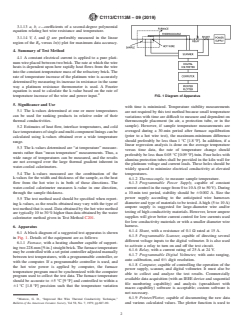
temperature increase of the wire and power input. FIG. 1 Diagram of Apparatus
5. Significance and Use
with time is minimized. Temperature stability measurements
5.1 The k-values determined at one or more temperatures
are not required by this test method because small temperature
can be used for ranking products in relative order of their
variations with time are difficult to measure and dependent on
thermal conductivities.
thermocouple placement (in air, a protection tube, or in the
sample). However, if sample temperature measurements are
5.2 Estimates of heat flow, interface temperatures, and cold
averaged during a 30-min period after furnace equilibration
facetemperaturesofsingleandmulti-componentliningscanbe
(prior to a hot wire test), the maximum-minimum difference
calculated using k-values obtained over a wide temperature
should preferably be less than 1°C [1.8°F]. In addition, if a
range.
linear regression analysis is done on the average temperature
5.3 The k-values determined are “at temperature” measure-
versus time data, the rate of temperature change should
ments rather than “mean temperature” measurements. Thus, a
preferably be less than 0.05°C [0.09°F]⁄min. Four holes with
wide range of temperatures can be measured, and the results
alumina protection tubes shall be provided in the kiln wall for
are not averaged over the large thermal gradient inherent in
the platinum voltage and current leads. These holes should be
water-cooled calorimeters.
widely spaced to minimize electrical conductivity at elevated
5.4 The k-values measured are the combination of the
temperatures.
k-values for the width and thickness of the sample, as the heat
6.1.2 Thermocouple, to measure sample temperature.
flow from the hot wire is in both of those directions. The
6.1.3 Programmable Power Supply, capable of constant
water-cooled calorimeter measures k-value in one direction,
current control in the range from 0 to 10A(0 to 50V). During
through the sample thickness.
a 10-min test period, stability should be 60.002 A. Size the
power supply according to the anticipated wire harnesses
5.5 The test method used should be specified when report-
diameter and type of materials to be tested.Ahigh (5 to 10A)
ing k-values, as the results obtained may vary with the type of
ampere supply is suggested for large-diameter wire and/or
test method that is used. Data obtained by the hot wire method
testing of high conductivity materials. However, lower ampere
are typically 10 to 30% higher than data obtained by the water
supplies will giver better current control for low currents used
calorimeter method given in Test Method C201.
for low conductivity materials or with a smaller diameter wire
harness.
6. Apparatus
6.1.4 Shunt, with a resistance of 0.1 Ω rated at 15 A.
6.1 Ablock diagram of a suggested test apparatus is shown
6.1.5 Programmable Scanner, capable of directing several
in Fig. 1. Details of the equipment are as follows:
different voltage inputs to the digital voltmeter. It is also used
6.1.1 Furnace, with a heating chamber capable of support-
to activate a relay to turn on and off the test circuit.
ingtwo228-mm[9-in.]straightbrick.Thefurnacetemperature
6.1.6 Relay, with a current rating of 25 A at 24 V.
maybecontrolledwithasetpointcontrolleradjustedmanually
6.1.7 Programmable Digital Voltmeter, with auto ranging,
between test temperatures, with a programmable controller, or
auto calibration, and 6 ⁄2 digit resolution.
with the computer. If a programmable controller is used, and
6.1.8 Computer, capable of controlling the operation of the
the hot wire power is applied by computer, the furnace
power supply, scanner, and digital voltmeter. It must also be
temperature program must be synchronized with the computer
able to collect and analyze the test results. Commercially
program used to collect the test data. The furnace temperature
available data acquisition (with an IEEE device and sequential
should be accurate to 65°C [9°F] and controlled to within a
file numbering capability) and analysis (spreadsheet with
61°C [1.8°F] precision such that the temperature variation
macro capability) software is acceptable; custom software is
not necessary.
6.1.9 Printer/Plotter, capable of documenting the raw data
Morrow, G. D., “Improved Hot Wire Thermal Conductivity Technique,”
Bulletin of the American Ceramic Society, Vol 58, No. 7, 1979, pp.687–90. and various calculated values. The plotter function is used to
C1113/C1113M − 09 (2019)
plot the resistance versus ln (time) relationship.This is used to mity of structure and bulk density. Bulk density should be
visually determine if a linear relationship was obtained and the determined in accordance with Test Methods C134.
location of the linear region.
7.2 The hot wire harness is positioned near the center of the
6.2 Reusable Test Harness,consistingofastraightsectionat
two brick-shaped specimens and in intimate contact with both,
least 30 cm [11.8 in.] long with two perpendicular voltage
either by using samples with a step diamond ground into the
leads about 15 cm [5.9 in.] apart near the center per Fig. 2.To
mating surface, by forming the sample around the harness, or
avoid thermocouple effect voltage errors, use pure platinum
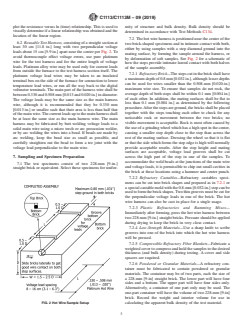
by deformation of soft samples. See Fig. 2 for a schematic of
wire for the test harness and for the entire length of voltage
how the steps provide intimate lateral contact with both halves
leads. Platinum alloy wire may be used only for current leads
of the sample assembly.
from outside the furnace to the test harness section itself. The
7.2.1 Refractory Brick—Thestepscutinthebrickshallhave
platinum voltage lead wires may be taken to an insulated
amaximumdepthof0.8mm[0.032in.],althoughlesserdepths
terminal box on the side of the furnace for connection to lower
can be used for wires smaller than the 0.508-mm [0.020-in.]
temperature lead wires, or run all the way back to the digital
maximum wire size. To ensure that samples do not rock, the
voltmeter terminals.The main part of the harness wire shall be
average depth of both steps shall be within 0.1 mm [0.004 in.]
between0.330and0.508mm[0.013and0.020in.]indiameter.
of each other. In addition, the mating surfaces shall be flat to
The voltage leads may be the same size as the main harness
less than 0.1 mm [0.004 in.] as determined by the following
wire, although it is recommended that they be 0.330 mm
procedure.Afterthestepsareground,thebricksshallbeplaced
[0.013in.] or smaller such that their area is less than half that
together with the steps touching each other to check for any
ofthemainwire.Thecurrentleadsuptothemainharnessshall
noticeable rock or movement between the two bricks; no
be at least the same size as the main harness wire. The main
visible movement is acceptable. Rock is most often caused by
harness may be fabricated by butt welding voltage leads to a
theuseofagrindingwheelwhichhasahighspotinthecenter,
solid main wire using a micro torch or arc percussion welder,
causing a smaller step depth close to the step than across the
or by arc welding the wires into a bead. If beads are made by
rest of the mating surface. Dressing the wheel so that it is flat
arc welding, keep the bead size as small as possible, and
orthatthesidewhichformsthestepedgeishighwillnormally
carefully straighten out the bead to form a tee joint with the
voltage lead perpendicular to the main wire. provide acceptable results. After the step height and mating
surfaces are acceptable, voltage lead grooves shall be cut
7. Sampling and Specimen Preparation across the high part of the step in one of the samples. To
accommodate the weld beads at the junctions of the main wire
7.1 The test specimens consist of two 228-mm [9-in.]
and voltage leads, it is permissible to chip out small cavities in
straight brick or equivalent. Select these specimens for unifor-
the brick at these locations using a hammer and center punch.
7.2.2 Refractory Castables—Refractory castables speci-
mens can be cut into brick shapes and prepared as in 7.2.1 or
aspecialcastablemoldwiththe0.8-mm[0.032-in.]stepcanbe
usedtoformthebrickshapes.Twothingroovesmustbecutfor
the perpendicular voltage leads in one of the brick. The hot
wire harness can also be cast in place for a single usage.
7.2.3 Plastic Refractories and Ramming Mixes—
Immediately after forming, press the hot wire harness between
two 228-mm [9-in.] straight bricks. Pressure should be applied
during drying to keep the brick in very close contact.
7.2.4 Low-Strength Materials—Use a sharp knife to scribe
grooves i
...