


ASTM C150/C150M-22
(Specification)Standard Specification for Portland Cement
Standard Specification for Portland Cement
ABSTRACT
This specification covers eight types of portland cement: type I, type IA, type II, type IIA, type III, type IIIA, type IV, and type V. The cement covered by this specification shall only contain the following ingredients: portland cement clinker; water or calcium sulfate, or both; limestone; processing additions; and air-entraining addition for air-entraining portland cement. Portland cement of each of the eight types must have the following chemical compositions: aluminum oxide, ferric oxide, magnesium oxide, sulfur trioxide, tricalcium silicate, dicalcium silicate, tricalcium aluminate, and tetracalcium aluminofernite. Applicable properties enumerated in this specification will be determined by the following test methods: air content of mortar, chemical analysis, strength, false set, fineness by air permeability, fineness by turbidimeter, heat of hydration, autoclave expansion, time of setting by gillmore needles, time of setting by vicat needles, sulfate resistance, calcium sulfate, and compressive strength. The cement shall be stored in such a manner as to permit easy access for proper inspection and identification of each shipment, and in a suitable weather-tight building that will protect the cement from dampness and minimize warehouse set.
SCOPE
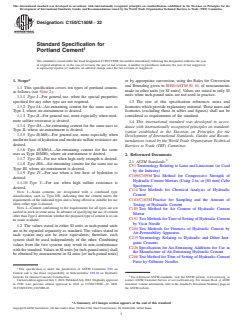
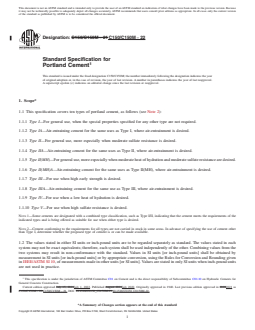
1.1 This specification covers ten types of portland cement, as follows (see Note 2):
1.1.1 Type I—For general use, when the special properties specified for any other type are not required.
1.1.2 Type IA—Air-entraining cement for the same uses as Type I, where air-entrainment is desired.
1.1.3 Type II—For general use, more especially when moderate sulfate resistance is desired.
1.1.4 Type IIA—Air-entraining cement for the same uses as Type II, where air-entrainment is desired.
1.1.5 Type II(MH)—For general use, more especially when moderate heat of hydration and moderate sulfate resistance are desired.
1.1.6 Type II(MH)A—Air-entraining cement for the same uses as Type II(MH), where air-entrainment is desired.
1.1.7 Type III—For use when high early strength is desired.
1.1.8 Type IIIA—Air-entraining cement for the same use as Type III, where air-entrainment is desired.
1.1.9 Type IV—For use when a low heat of hydration is desired.
1.1.10 Type V—For use when high sulfate resistance is desired.
Note 1: Some cements are designated with a combined type classification, such as Type I/II, indicating that the cement meets the requirements of the indicated types and is being offered as suitable for use when either type is desired.
Note 2: Cement conforming to the requirements for all types are not carried in stock in some areas. In advance of specifying the use of cement other than Type I, determine whether the proposed type of cement is or can be made available.
1.2 The values stated in either SI units or inch-pound units are to be regarded separately as standard. The values stated in each system may not be exact equivalents; therefore, each system shall be used independently of the other. Combining values from the two systems may result in non-conformance with the standard. Values in SI units [or inch-pound units] shall be obtained by measurement in SI units [or inch-pound units] or by appropriate conversion, using the Rules for Conversion and Rounding given in IEEE/ASTM SI 10, of measurements made in other units [or SI units]. Values are stated in only SI units when inch-pound units are not used in practice.
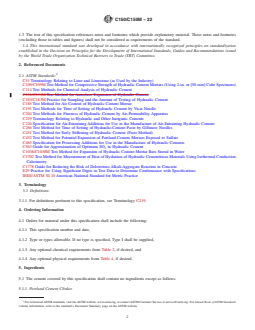
1.3 The text of this specification references notes and footnotes which provide explanatory material. These notes and footnotes (excluding those in tables and figures) shall not be considered as requirements of the standard.
1.4 This international standard was developed in accordance with internationally recognized principles on standardization established in the Decision on Principles for the Development of International Standards, Guides and Recommendations issued by the World Trade Organization Technical Barrie...
General Information
- Status
- Published
- Publication Date
- 30-Jun-2022
- Technical Committee
- C01 - Cement
- Drafting Committee
- C01.10 - Hydraulic Cements for General Concrete Construction
Relations
- Effective Date
- 01-Apr-2024
- Effective Date
- 01-Apr-2024
- Refers
ASTM C204-24 - Standard Test Methods for Fineness of Hydraulic Cement by Air-Permeability Apparatus - Effective Date
- 01-Jan-2024
- Effective Date
- 15-Dec-2023
- Effective Date
- 01-Dec-2023
- Effective Date
- 01-Oct-2023
- Effective Date
- 01-Oct-2023
- Effective Date
- 01-Aug-2020
- Effective Date
- 01-Apr-2020
- Effective Date
- 01-Apr-2020
- Effective Date
- 15-Dec-2019
- Effective Date
- 01-Dec-2019
- Effective Date
- 01-Dec-2019
- Effective Date
- 15-Nov-2019
- Effective Date
- 01-Oct-2019
Overview
ASTM C150/C150M-22: Standard Specification for Portland Cement defines the chemical and physical requirements for ten standard types of portland cement. Developed by ASTM International, this voluntary consensus standard is widely recognized in the construction and concrete industries for establishing uniformity and quality control in the manufacture and use of portland cement. It addresses material composition, permissible additives, testing protocols, and mandatory documentation for both bulk and packaged cement. The specified types are tailored to meet the needs of diverse construction scenarios, including general use, high sulfate resistance, low heat of hydration, and early strength gain.
Key Topics
Types of Portland Cement:
The standard covers ten types:- Type I – General use
- Type IA – Air-entraining, general use
- Type II – Moderate sulfate resistance
- Type IIA – Air-entraining, moderate sulfate resistance
- Type II(MH) – Moderate heat of hydration, moderate sulfate resistance
- Type II(MH)A – Air-entraining, moderate heat and sulfate resistance
- Type III – High early strength
- Type IIIA – Air-entraining, high early strength
- Type IV – Low heat of hydration
- Type V – High sulfate resistance
Composition Requirements:
- Only portland cement clinker, calcium sulfate or water, limestone, processing additions (organic/inorganic), and air-entraining additions (where applicable) are allowed as ingredients.
- Chemical requirements cover key oxides including aluminum oxide, ferric oxide, magnesium oxide, and sulfur trioxide, among others.
Physical Properties:
- Tests include: air content, compressive strength, false set, fineness, heat of hydration, autoclave expansion, and setting time.
- Units of measure may be in either SI (metric) or inch-pound (imperial) systems, but not mixed.
Quality Assurance:
- Mandatory documentation, packaging, storage, and marking requirements support traceability and maintain cement quality during shipment and storage.
- Manufacturer’s certification ensures compliance with all relevant requirements at the time of delivery.
Applications
Construction Materials: Cement specified by ASTM C150/C150M-22 is used in concrete, mortar, and grouts across all construction sectors, including commercial, residential, industrial, and infrastructure projects.
Selection for Exposure Conditions:
- Types II, II(MH), and V provide options for structures exposed to sulfate soils or waters.
- Types III and IIIA support projects requiring rapid strength gain, such as precast components or repair works.
- Type IV is optimal for mass concrete in dams or large footings, where heat control is critical.
Project Specification & Procurement:
- The standard offers guidance on ordering, specifying type, and ensuring compatibility with local material availability.
- Documentation, including test reports and updated certifications, are critical for compliance demonstration and regulatory approval.
Related Standards
- ASTM C109/C109M – Test Method for Compressive Strength of Hydraulic Cement Mortars
- ASTM C114 – Test Methods for Chemical Analysis of Hydraulic Cement
- ASTM C185 – Test Method for Air Content of Hydraulic Cement Mortar
- ASTM C204 – Test Methods for Fineness of Hydraulic Cement
- ASTM C226 – Specification for Air-Entraining Additions for Use in the Manufacture of Air-Entraining Hydraulic Cement
- ASTM C465 – Specification for Processing Additions for Use in the Manufacture of Hydraulic Cements
- IEEE/ASTM SI 10 – American National Standard for Metric Practice
These related ASTM standards provide additional methods for testing, analysis, and terminology necessary for proper application and compliance with ASTM C150/C150M-22.
Keywords: portland cement, ASTM C150, standard specification, hydraulic cement, sulfate resistance, air-entraining, heat of hydration, compressive strength, concrete standards, cement types, construction materials, quality control
Buy Documents
ASTM C150/C150M-22 - Standard Specification for Portland Cement
REDLINE ASTM C150/C150M-22 - Standard Specification for Portland Cement
Get Certified
Connect with accredited certification bodies for this standard

ICC Evaluation Service
Building products evaluation and certification.

QAI Laboratories
Building and construction product testing and certification.

Aboma Certification B.V.
Specialized in construction, metal, and transport sectors.
Sponsored listings
Frequently Asked Questions
ASTM C150/C150M-22 is a technical specification published by ASTM International. Its full title is "Standard Specification for Portland Cement". This standard covers: ABSTRACT This specification covers eight types of portland cement: type I, type IA, type II, type IIA, type III, type IIIA, type IV, and type V. The cement covered by this specification shall only contain the following ingredients: portland cement clinker; water or calcium sulfate, or both; limestone; processing additions; and air-entraining addition for air-entraining portland cement. Portland cement of each of the eight types must have the following chemical compositions: aluminum oxide, ferric oxide, magnesium oxide, sulfur trioxide, tricalcium silicate, dicalcium silicate, tricalcium aluminate, and tetracalcium aluminofernite. Applicable properties enumerated in this specification will be determined by the following test methods: air content of mortar, chemical analysis, strength, false set, fineness by air permeability, fineness by turbidimeter, heat of hydration, autoclave expansion, time of setting by gillmore needles, time of setting by vicat needles, sulfate resistance, calcium sulfate, and compressive strength. The cement shall be stored in such a manner as to permit easy access for proper inspection and identification of each shipment, and in a suitable weather-tight building that will protect the cement from dampness and minimize warehouse set. SCOPE 1.1 This specification covers ten types of portland cement, as follows (see Note 2): 1.1.1 Type I—For general use, when the special properties specified for any other type are not required. 1.1.2 Type IA—Air-entraining cement for the same uses as Type I, where air-entrainment is desired. 1.1.3 Type II—For general use, more especially when moderate sulfate resistance is desired. 1.1.4 Type IIA—Air-entraining cement for the same uses as Type II, where air-entrainment is desired. 1.1.5 Type II(MH)—For general use, more especially when moderate heat of hydration and moderate sulfate resistance are desired. 1.1.6 Type II(MH)A—Air-entraining cement for the same uses as Type II(MH), where air-entrainment is desired. 1.1.7 Type III—For use when high early strength is desired. 1.1.8 Type IIIA—Air-entraining cement for the same use as Type III, where air-entrainment is desired. 1.1.9 Type IV—For use when a low heat of hydration is desired. 1.1.10 Type V—For use when high sulfate resistance is desired. Note 1: Some cements are designated with a combined type classification, such as Type I/II, indicating that the cement meets the requirements of the indicated types and is being offered as suitable for use when either type is desired. Note 2: Cement conforming to the requirements for all types are not carried in stock in some areas. In advance of specifying the use of cement other than Type I, determine whether the proposed type of cement is or can be made available. 1.2 The values stated in either SI units or inch-pound units are to be regarded separately as standard. The values stated in each system may not be exact equivalents; therefore, each system shall be used independently of the other. Combining values from the two systems may result in non-conformance with the standard. Values in SI units [or inch-pound units] shall be obtained by measurement in SI units [or inch-pound units] or by appropriate conversion, using the Rules for Conversion and Rounding given in IEEE/ASTM SI 10, of measurements made in other units [or SI units]. Values are stated in only SI units when inch-pound units are not used in practice. 1.3 The text of this specification references notes and footnotes which provide explanatory material. These notes and footnotes (excluding those in tables and figures) shall not be considered as requirements of the standard. 1.4 This international standard was developed in accordance with internationally recognized principles on standardization established in the Decision on Principles for the Development of International Standards, Guides and Recommendations issued by the World Trade Organization Technical Barrie...
ABSTRACT This specification covers eight types of portland cement: type I, type IA, type II, type IIA, type III, type IIIA, type IV, and type V. The cement covered by this specification shall only contain the following ingredients: portland cement clinker; water or calcium sulfate, or both; limestone; processing additions; and air-entraining addition for air-entraining portland cement. Portland cement of each of the eight types must have the following chemical compositions: aluminum oxide, ferric oxide, magnesium oxide, sulfur trioxide, tricalcium silicate, dicalcium silicate, tricalcium aluminate, and tetracalcium aluminofernite. Applicable properties enumerated in this specification will be determined by the following test methods: air content of mortar, chemical analysis, strength, false set, fineness by air permeability, fineness by turbidimeter, heat of hydration, autoclave expansion, time of setting by gillmore needles, time of setting by vicat needles, sulfate resistance, calcium sulfate, and compressive strength. The cement shall be stored in such a manner as to permit easy access for proper inspection and identification of each shipment, and in a suitable weather-tight building that will protect the cement from dampness and minimize warehouse set. SCOPE 1.1 This specification covers ten types of portland cement, as follows (see Note 2): 1.1.1 Type I—For general use, when the special properties specified for any other type are not required. 1.1.2 Type IA—Air-entraining cement for the same uses as Type I, where air-entrainment is desired. 1.1.3 Type II—For general use, more especially when moderate sulfate resistance is desired. 1.1.4 Type IIA—Air-entraining cement for the same uses as Type II, where air-entrainment is desired. 1.1.5 Type II(MH)—For general use, more especially when moderate heat of hydration and moderate sulfate resistance are desired. 1.1.6 Type II(MH)A—Air-entraining cement for the same uses as Type II(MH), where air-entrainment is desired. 1.1.7 Type III—For use when high early strength is desired. 1.1.8 Type IIIA—Air-entraining cement for the same use as Type III, where air-entrainment is desired. 1.1.9 Type IV—For use when a low heat of hydration is desired. 1.1.10 Type V—For use when high sulfate resistance is desired. Note 1: Some cements are designated with a combined type classification, such as Type I/II, indicating that the cement meets the requirements of the indicated types and is being offered as suitable for use when either type is desired. Note 2: Cement conforming to the requirements for all types are not carried in stock in some areas. In advance of specifying the use of cement other than Type I, determine whether the proposed type of cement is or can be made available. 1.2 The values stated in either SI units or inch-pound units are to be regarded separately as standard. The values stated in each system may not be exact equivalents; therefore, each system shall be used independently of the other. Combining values from the two systems may result in non-conformance with the standard. Values in SI units [or inch-pound units] shall be obtained by measurement in SI units [or inch-pound units] or by appropriate conversion, using the Rules for Conversion and Rounding given in IEEE/ASTM SI 10, of measurements made in other units [or SI units]. Values are stated in only SI units when inch-pound units are not used in practice. 1.3 The text of this specification references notes and footnotes which provide explanatory material. These notes and footnotes (excluding those in tables and figures) shall not be considered as requirements of the standard. 1.4 This international standard was developed in accordance with internationally recognized principles on standardization established in the Decision on Principles for the Development of International Standards, Guides and Recommendations issued by the World Trade Organization Technical Barrie...
ASTM C150/C150M-22 is classified under the following ICS (International Classification for Standards) categories: 91.100.10 - Cement. Gypsum. Lime. Mortar. The ICS classification helps identify the subject area and facilitates finding related standards.
ASTM C150/C150M-22 has the following relationships with other standards: It is inter standard links to ASTM C1038/C1038M-24, ASTM C219-24, ASTM C204-24, ASTM C109/C109M-23, ASTM C1778-23, ASTM C114-23, ASTM C51-23, ASTM C219-20a, ASTM C185-20, ASTM C219-20, ASTM C1038/C1038M-19, ASTM C1778-19b, ASTM C185-19, ASTM C219-19a, ASTM C563-19. Understanding these relationships helps ensure you are using the most current and applicable version of the standard.
ASTM C150/C150M-22 is available in PDF format for immediate download after purchase. The document can be added to your cart and obtained through the secure checkout process. Digital delivery ensures instant access to the complete standard document.
Standards Content (Sample)
This international standard was developed in accordance with internationally recognized principles on standardization established in the Decision on Principles for the
Development of International Standards, Guides and Recommendations issued by the World Trade Organization Technical Barriers to Trade (TBT) Committee.
Designation:C150/C150M −22
Standard Specification for
Portland Cement
This standard is issued under the fixed designation C150/C150M; the number immediately following the designation indicates the year
of original adoption or, in the case of revision, the year of last revision.Anumber in parentheses indicates the year of last reapproval.
A superscript epsilon (´) indicates an editorial change since the last revision or reapproval.
1. Scope* or by appropriate conversion, using the Rules for Conversion
and Rounding given in IEEE/ASTM SI 10, of measurements
1.1 This specification covers ten types of portland cement,
made in other units [or SI units]. Values are stated in only SI
as follows (see Note 2):
units when inch-pound units are not used in practice.
1.1.1 Type I—For general use, when the special properties
specified for any other type are not required. 1.3 The text of this specification references notes and
1.1.2 Type IA—Air-entraining cement for the same uses as footnotes which provide explanatory material.These notes and
Type I, where air-entrainment is desired. footnotes (excluding those in tables and figures) shall not be
1.1.3 Type II—For general use, more especially when mod- considered as requirements of the standard.
erate sulfate resistance is desired.
1.4 This international standard was developed in accor-
1.1.4 Type IIA—Air-entraining cement for the same uses as
dance with internationally recognized principles on standard-
Type II, where air-entrainment is desired.
ization established in the Decision on Principles for the
1.1.5 Type II(MH)—For general use, more especially when
Development of International Standards, Guides and Recom-
moderate heat of hydration and moderate sulfate resistance are
mendations issued by the World Trade Organization Technical
desired.
Barriers to Trade (TBT) Committee.
1.1.6 Type II(MH)A—Air-entraining cement for the same
uses as Type II(MH), where air-entrainment is desired.
2. Referenced Documents
1.1.7 Type III—For use when high early strength is desired.
2.1 ASTM Standards:
1.1.8 Type IIIA—Air-entraining cement for the same use as
C51Terminology Relating to Lime and Limestone (as Used
Type III, where air-entrainment is desired.
by the Industry)
1.1.9 Type IV—For use when a low heat of hydration is
C109/C109MTest Method for Compressive Strength of
desired.
Hydraulic Cement Mortars (Using 2-in. or [50 mm] Cube
1.1.10 Type V—For use when high sulfate resistance is
Specimens)
desired.
C114Test Methods for Chemical Analysis of Hydraulic
NOTE 1—Some cements are designated with a combined type
Cement
classification, such as Type I/II, indicating that the cement meets the
requirementsoftheindicatedtypesandisbeingofferedassuitableforuse C183/C183MPractice for Sampling and the Amount of
when either type is desired.
Testing of Hydraulic Cement
NOTE 2—Cement conforming to the requirements for all types are not
C185Test Method for Air Content of Hydraulic Cement
carried in stock in some areas. In advance of specifying the use of cement
Mortar
otherthanTypeI,determinewhethertheproposedtypeofcementisorcan
C191TestMethodsforTimeofSettingofHydraulicCement
be made available.
by Vicat Needle
1.2 The values stated in either SI units or inch-pound units
C204Test Methods for Fineness of Hydraulic Cement by
are to be regarded separately as standard. The values stated in
Air-Permeability Apparatus
each system may not be exact equivalents; therefore, each
C219Terminology Relating to Hydraulic and Other Inor-
system shall be used independently of the other. Combining
ganic Cements
values from the two systems may result in non-conformance
C226Specification for Air-Entraining Additions for Use in
withthestandard.ValuesinSIunits[orinch-poundunits]shall
the Manufacture of Air-Entraining Hydraulic Cement
be obtained by measurement in SI units [or inch-pound units]
C266Test Method forTime of Setting of Hydraulic-Cement
Paste by Gillmore Needles
This specification is under the jurisdiction of ASTM Committee C01 on
Cement and is the direct responsibility of Subcommittee C01.10 on Hydraulic
Cements for General Concrete Construction. For referenced ASTM standards, visit the ASTM website, www.astm.org, or
CurrenteditionapprovedJuly1,2022.PublishedJuly2022.Originallyapproved contact ASTM Customer Service at service@astm.org. For Annual Book of ASTM
in 1940. Last previous edition approved in 2021 as C150/C150M–21. DOI: Standards volume information, refer to the standard’s Document Summary page on
10.1520/C0150_C0150M-22. the ASTM website.
*A Summary of Changes section appears at the end of this standard
Copyright © ASTM International, 100 Barr Harbor Drive, PO Box C700, West Conshohocken, PA 19428-2959. United States
C150/C150M−22
C451Test Method for Early Stiffening of Hydraulic Cement 4.1.2 Type or types allowable. If no type is specified, Type
(Paste Method) I shall be supplied,
C452Test Method for Potential Expansion of Portland- 4.1.3 Any optional chemical requirements from Table 2,if
Cement Mortars Exposed to Sulfate desired, and
C465Specification for Processing Additions for Use in the 4.1.4 Any optional physical requirements from Table 4,if
Manufacture of Hydraulic Cements desired.
C563GuideforApproximationofOptimumSO inHydrau-
lic Cement 5. Ingredients
C1038/C1038MTest Method for Expansion of Hydraulic
5.1 The cement covered by this specification shall contain
Cement Mortar Bars Stored in Water
no ingredients except as follows:
C1702Test Method for Measurement of Heat of Hydration
5.1.1 Portland Cement Clinker.
of Hydraulic Cementitious Materials Using Isothermal
5.1.2 Water or Calcium Sulfate, or Both—Theamountsshall
Conduction Calorimetry
be such that the limits shown in Table 1 for sulfur trioxide and
C1778Guide for Reducing the Risk of Deleterious Alkali-
loss-on-ignition are not exceeded.
Aggregate Reaction in Concrete
5.1.3 Limestone—The amount shall not be more than 5.0%
E29Practice for Using Significant Digits in Test Data to
by mass such that the chemical and physical requirements of
Determine Conformance with Specifications
this specification are met (see Note 3). The limestone, defined
IEEE/ASTM SI 10American National Standard for Metric
inTerminologyC51,shallbenaturallyoccurringandconsistof
Practice
at least 70% by mass of one or more of the mineral forms of
calcium carbonate. If limestone is used, the manufacturer shall
3. Terminology
report the amount used, expressed as a percentage of cement
3.1 Definitions:
mass, as determined using Annex A2, along with the oxide
3.1.1 For definitions pertinent to this specification, see
composition of the limestone.
Terminology C219.
NOTE 3—This specification permits portland cement to contain
limestone, but does not require that limestone be an ingredient in the
4. Ordering Information
cement.Cementwithoutgroundlimestonecanbespecifiedinthecontract
or order.
4.1 Ordersformaterialunderthisspecificationshallinclude
the following: 5.1.4 Inorganic Processing Additions—The amount shall be
4.1.1 This specification number and date, not more than 5.0% by mass of cement. Not more than one
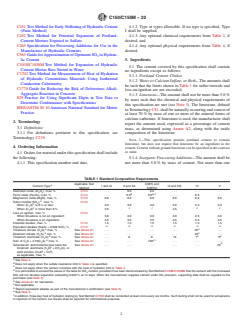
TABLE 1 Standard Composition Requirements
Applicable Test II(MH) and
A
Cement Type I and IA II and IIA III and IIIA IV V
Method II(MH)A
Aluminum oxide (Al O ), max, % C114 . 6.0 6.0 . . .
2 3
B B,C
Ferric oxide (Fe O ), max, % C114 . 6.0 6.0 . 6.5 .
2 3
Magnesium oxide (MgO), max, % C114 6.0 6.0 6.0 6.0 6.0 6.0
D
Sulfur trioxide (SO ), max, % C114
E
When (C A) is 8 % or less 3.0 3.0 3.0 3.5 2.3 2.3
E FF FF
When (C A) is more than 8 % 3.5 4.5
Loss on ignition, max, % C114
When limestone is not an ingredient 3.0 3.0 3.0 3.0 2.5 3.0
When limestone is an ingredient 3.5 3.5 3.5 3.5 3.5 3.5
Insoluble residue, max, % C114 1.5 1.5 1.5 1.5 1.5 1.5
GG GGGG
Equivalent alkalies (NaO+0.658K O), % C114
2 2
E C
Tricalcium silicate (C S), max, % See Annex A1 . . . . 35 .
E C
Dicalcium silicate (C S), min, % See Annex A1 . . . . 40 .
E C B
Tricalcium aluminate (C A), max, % See Annex A1 . 8 8 15 7 5
H C,I
Sum of C S+4.75(C A), max, % See Annex A1 . . 100 . . .
3 3
B
Tetracalcium aluminoferrite plus twice the See Annex A1 . . . . . 25
tricalcium aluminate (C AF+2(C A)), or
4 3
solid solution (C AF+C F),
4 2
as applicable, max, %
A
See Note 2.
B
Does not apply when the sulfate resistance limit in Table 4 is specified.
C
Does not apply when the cement complies with the heat of hydration limit in Table 4.
D
ItispermissibletoexceedthevaluesinthetableforSO content,providedithasbeendemonstratedbyTestMethodC1038/C1038Mthatthecementwiththeincreased
SO will not develop expansion exceeding 0.020 % at 14 days. When the manufacturer supplies cement under this provision, supporting data shall be suppliedtothe
purchaser (see Note 7).
E
See Annex A1 for calculation.
F
Not applicable.
G
Report equivalent alkalies as part of the manufacturer’s certification (see Note 5).
H
See Note 6.
I
In addition, three-day heat of hydration testing by Test Method C1702 shall be conducted at least once every six months. Such testing shall not be used for acceptance
or rejection of the cement, but results shall be reported for informational purposes.
C150/C150M−22
A
TABLE 2 Optional Composition Requirements
Applicable Test II(MH) and III and
Cement Type I and IA II and IIA IV V Remarks
Method II(MH)A IIIA
B
Tricalcium aluminate (C A), max, % See Annex A1 . . . . . . . . . 8 . . . . . . For moderate sulfate resistance.
B
Tricalcium aluminate (C A), max, % See Annex A1 . . . . . . . . . 5 . . . . . . For high sulfate resistance.
A
These optional requirements apply only when specifically requested. Verify availability before ordering (see Note 2).
B
See Annex A1 for calculation.
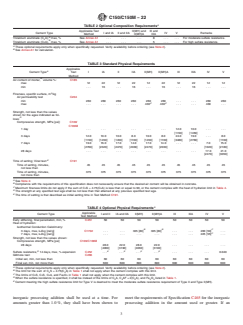
TABLE 3 Standard Physical Requirements
Applicable
A
Cement Type Test I IA II IIA II(MH) II(MH)A III IIIA IV V
Method
B
Air content of mortar, volume %: C185
max 12 22 12 22 12 22 12 22 12 12
min . 16 . 16 . 16 . 16 . .
Fineness, specific surface, m /kg
Air permeability test C204
min 260 260 260 260 260 260 . . . . . . 260 260
C C
max . . . . 430 430 . . 430 .
Strength, not less than the values
shown for the ages indicated as fol-
D
lows:
Compressive strength, MPa [psi]: C109/
C109M
1day . . . . . . 12.0 10.0 . .
[1740] [1450]
3 days 12.0 10.0 10.0 8.0 10.0 8.0 24.0 19.0 . 8.0
[1740] [1450] [1450] [1160] [1450] [1160] [3480] [2760] [1160]
7 days 19.0 16.0 17.0 14.0 17.0 14.0 . . 7.0 15.0
[2760] [2320] [2470] [2030] [2470] [2030] [1020] [2180]
28 days . . . . . . . . . . . . . . . . . . . . . . . . 17.0 21.0
[2470] [3050]
E
Time of setting; Vicat test: C191
Time of setting, minutes, 45 45 45 45 45 45 45 45 45 45
not less than
Time of setting, minutes, 375 375 375 375 375 375 375 375 375 375
not more than
A
See Note 2.
B
Compliance with the requirements of this specification does not necessarily ensure that the desired air content will be obtained in concrete.
C
Maximum fineness limits do not apply if the sum of CS+4.75(C A) is less than or equal to 90, or the cement complies with the heat of hydration limit in Table 4.
3 3
D
The strength at any specified test age shall be not less than that attained at any previous specified test age.
E
The time of setting is that described as initial setting time in Test Method C191.
A
TABLE 4 Optional Physical Requirements
Applicable
Cement Type I and II IA and IIA II(MH) II(MH)A III IIIA IV V
Test Method
Early stiffening, final penetration, min, % C451 50 50 50 50 50 50 50 50
Heat of hydration:
Isothermal Conduction Calorimetry:
B B C
3 days, max, kJ/kg [cal/g] C1702 . . 335[80] 335 [80] . . 200[50] .
C
7 days, max, kJ/kg [cal/g] . . . . . . . . . . . . . . . . . . 225 [55] .
Strength, not less than the values shown:
Compressive strength, MPa [psi] C109/C109M
28 days 28.0 22.0 28.0 22.0 . . . .
[4060] [3190] [4060] [3190]
D E E E E
Sulfate resistance, 14 days, max, % expansion C452 . . . . . . . 0.040
Gillmore test: C266
Initial set, min, not less than 60 60 60 60 60 60 60 60
Final set, min, not more than 600 600 600 600 600 600 600 600
A
These optional requirements apply only when specifically requested. Verify availability before ordering (see Note 2).
B
The limit for the sum of C S+4.75(C A) in Table 1 shall not apply when the cement complies with this limit.
3 3
C
The limits of C S, C S, C A, and Fe O in Table 1 shall not apply when the cement complies with this limit.
3 2 3 2 3
D
When the sulfate resistance is specified, it shall be instead of the limits of C A, C AF+2(C A), and Fe O listed in Table 1.
3 4 3 2 3
E
Cement meeting the high sulfate resistance limit for Type V is deemed to meet the moderate sulfate resistance requirement of Type II and Type II(MH).
inorganic processing addition shall be used at a time. For meet the requirements of Specification C465 for the inorganic
amounts greater than 1.0%, they shall have been shown to processing addition in the amount used or greater. If an
C150/C150M−22
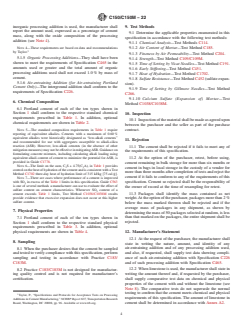
inorganic processing addition is used, the manufacturer shall 9. Test Methods
report the amount used, expressed as a percentage of cement
9.1 Determine the applicable properties enumerated in this
mass, along with the oxide composition of the processing
specification in accordance with the following test methods:
addition (see Note 4).
9.1.1 Chemical Analysis—Test Methods C114.
NOTE 4—These requirements are based on data and recommendations
9.1.2 Air Content of Mortar—Test Method C185.
by Taylor.
9.1.3 Fineness by Air Permeability—Test Method C204.
5.1.5 Organic Processing Additions—They shall have been 9.1.4 Strength—Test Method C109/C109M.
shown to meet the requirements of Specification C465 in the
9.1.5 Time of Setting by Vicat Needles—Test Method C191.
amounts used or greater and the total amount of organic
9.1.6 Early Stiffening—Test Method C451.
processing additions used shall not exceed 1.0% by mass of
9.1.7 Heat of Hydration—Test Method C1702.
cement.
9.1.8 Sulfate Resistance—TestMethodC452(sulfateexpan-
5.1.6 Air-entraining Addition (for Air-entraining Portland
sion).
Cement Only)—The interground addition shall conform to the
9.1.9 Time of Setting by Gillmore Needles—Test Method
requirements of Specification C226.
C266.
9.1.10 Calcium Sulfate (Expansion of) Mortar—Test
6. Chemical Composition
Method C1038/C1038M.
6.1 Portland cement of each of the ten types shown in
Section 1 shall conform to the respective standard chemical 10. Inspection
requirements prescribed in Table 1. In addition, optional
10.1 Inspectionofthematerialshallbemadeasagreedupon
chemical requirements are shown in Table 2.
between the purchaser and the seller as part of the purchase
NOTE 5—The standard composition requirements in Table 1 require contract.
reporting of equivalent alkalies. Cements with a maximum of 0.60%
equivalent alkalies were historically designated as “low-alkali cements”
11. Rejection
and recommended for use with aggregates susceptible to alkali-silica
reaction (ASR). However, low-alkali cements (in the absence of other
11.1 The cement shall be rejected if it fails to meet any of
mitigationmeasures)maynotbeeffectiveinmitigatingASR.Guidanceon
the requirements of this specification.
formulating concrete mixtures, including calculating alkali loading using
equivalent alkali content of cement to minimize the potential forASR, is
11.2 At the option of the purchaser, retest, before using,
provided in Guide C1778.
cement remaining in bulk storage for more than six months or
NOTE 6—The limit on the sum, C S + 4.75(C A), in Table 1 provides
3 3
cement in bags in local storage in the custody of a vendor for
controlontheheatofhydrationofthecementandisconsistentwithaTest
more than three months after completion of tests and reject the
Method C1702 three-day heat of hydration limit of 315 kJ/kg [75cal⁄g].
cement if it fails to conform to any of the requirements of this
NOTE 7—There are cases where performance of a cement is improved
with SO in excess of the Table 1 limits in this specification. Guide C563
specification. Cement so rejected shall be the responsibility of
is one of several methods a manufacturer can use to evaluate the effect of
the owner of record at the time of resampling for retest.
sulfate content on cement characteristics. Whenever SO content of a
11.3 Packages shall identify the mass contained as net
cement exceeds Table 1 limits, Test Method C1038/C1038M results
provide evidence that excessive expansion does not occur at this higher
weight.Attheoptionofthepurchaser,packagesmorethan2%
sulfate content.
below the mass marked thereon shall be rejected and if the
average mass of packages in any shipment, as shown by
7. Physical Properties
determiningthemassof50packagesselectedatrandom,isless
than that marked on the packages, the entire shipment shall be
7.1 Portland cement of each of the ten types shown in
rejected.
Section 1 shall conform to the respective standard physical
requirements prescribed in Table 3. In addition, optional
physical requirements are shown in Table 4. 12. Manufacturer’s Statement
12.1 At the request of the purchaser, the manufacturer shall
8. Sampling
state in writing the nature, amount, and identity of any
air-entraining addition and of any processing addition used,
8.1 When the
...
This document is not an ASTM standard and is intended only to provide the user of an ASTM standard an indication of what changes have been made to the previous version. Because
it may not be technically possible to adequately depict all changes accurately, ASTM recommends that users consult prior editions as appropriate. In all cases only the current version
of the standard as published by ASTM is to be considered the official document.
Designation: C150/C150M − 21 C150/C150M − 22
Standard Specification for
Portland Cement
This standard is issued under the fixed designation C150/C150M; the number immediately following the designation indicates the year
of original adoption or, in the case of revision, the year of last revision. A number in parentheses indicates the year of last reapproval.
A superscript epsilon (´) indicates an editorial change since the last revision or reapproval.
1. Scope*
1.1 This specification covers ten types of portland cement, as follows (see Note 2):
1.1.1 Type I—For general use, when the special properties specified for any other type are not required.
1.1.2 Type IA—Air-entraining cement for the same uses as Type I, where air-entrainment is desired.
1.1.3 Type II—For general use, more especially when moderate sulfate resistance is desired.
1.1.4 Type IIA—Air-entraining cement for the same uses as Type II, where air-entrainment is desired.
1.1.5 Type II(MH)—For general use, more especially when moderate heat of hydration and moderate sulfate resistance are desired.
1.1.6 Type II(MH)A—Air-entraining cement for the same uses as Type II(MH), where air-entrainment is desired.
1.1.7 Type III—For use when high early strength is desired.
1.1.8 Type IIIA—Air-entraining cement for the same use as Type III, where air-entrainment is desired.
1.1.9 Type IV—For use when a low heat of hydration is desired.
1.1.10 Type V—For use when high sulfate resistance is desired.
NOTE 1—Some cements are designated with a combined type classification, such as Type I/II, indicating that the cement meets the requirements of the
indicated types and is being offered as suitable for use when either type is desired.
NOTE 2—Cement conforming to the requirements for all types are not carried in stock in some areas. In advance of specifying the use of cement other
than Type I, determine whether the proposed type of cement is or can be made available.
1.2 The values stated in either SI units or inch-pound units are to be regarded separately as standard. The values stated in each
system may not be exact equivalents; therefore, each system shall be used independently of the other. Combining values from the
two systems may result in non-conformance with the standard. Values in SI units [or inch-pound units] shall be obtained by
measurement in SI units [or inch-pound units] or by appropriate conversion, using the Rules for Conversion and Rounding given
in IEEE/ASTM SI 10, of measurements made in other units [or SI units]. Values are stated in only SI units when inch-pound units
are not used in practice.
This specification is under the jurisdiction of ASTM Committee C01 on Cement and is the direct responsibility of Subcommittee C01.10 on Hydraulic Cements for
General Concrete Construction.
Current edition approved July 15, 2021July 1, 2022. Published August 2021July 2022. Originally approved in 1940. Last previous edition approved in 20202021 as
C150/C150M – 20.C150/C150M – 21. DOI: 10.1520/C0150_C0150M-21.10.1520/C0150_C0150M-22.
*A Summary of Changes section appears at the end of this standard
Copyright © ASTM International, 100 Barr Harbor Drive, PO Box C700, West Conshohocken, PA 19428-2959. United States
C150/C150M − 22
1.3 The text of this specification references notes and footnotes which provide explanatory material. These notes and footnotes
(excluding those in tables and figures) shall not be considered as requirements of the standard.
1.4 This international standard was developed in accordance with internationally recognized principles on standardization
established in the Decision on Principles for the Development of International Standards, Guides and Recommendations issued
by the World Trade Organization Technical Barriers to Trade (TBT) Committee.
2. Referenced Documents
2.1 ASTM Standards:
C51 Terminology Relating to Lime and Limestone (as Used by the Industry)
C109/C109M Test Method for Compressive Strength of Hydraulic Cement Mortars (Using 2-in. or [50 mm] Cube Specimens)
C114 Test Methods for Chemical Analysis of Hydraulic Cement
C151/C151M Test Method for Autoclave Expansion of Hydraulic Cement
C183/C183M Practice for Sampling and the Amount of Testing of Hydraulic Cement
C185 Test Method for Air Content of Hydraulic Cement Mortar
C191 Test Methods for Time of Setting of Hydraulic Cement by Vicat Needle
C204 Test Methods for Fineness of Hydraulic Cement by Air-Permeability Apparatus
C219 Terminology Relating to Hydraulic and Other Inorganic Cements
C226 Specification for Air-Entraining Additions for Use in the Manufacture of Air-Entraining Hydraulic Cement
C266 Test Method for Time of Setting of Hydraulic-Cement Paste by Gillmore Needles
C451 Test Method for Early Stiffening of Hydraulic Cement (Paste Method)
C452 Test Method for Potential Expansion of Portland-Cement Mortars Exposed to Sulfate
C465 Specification for Processing Additions for Use in the Manufacture of Hydraulic Cements
C563 Guide for Approximation of Optimum SO in Hydraulic Cement
C1038/C1038M Test Method for Expansion of Hydraulic Cement Mortar Bars Stored in Water
C1702 Test Method for Measurement of Heat of Hydration of Hydraulic Cementitious Materials Using Isothermal Conduction
Calorimetry
C1778 Guide for Reducing the Risk of Deleterious Alkali-Aggregate Reaction in Concrete
E29 Practice for Using Significant Digits in Test Data to Determine Conformance with Specifications
IEEE/ASTM SI 10 American National Standard for Metric Practice
3. Terminology
3.1 Definitions:
3.1.1 For definitions pertinent to this specification, see Terminology C219.
4. Ordering Information
4.1 Orders for material under this specification shall include the following:
4.1.1 This specification number and date,
4.1.2 Type or types allowable. If no type is specified, Type I shall be supplied,
4.1.3 Any optional chemical requirements from Table 2, if desired, and
4.1.4 Any optional physical requirements from Table 4, if desired.
5. Ingredients
5.1 The cement covered by this specification shall contain no ingredients except as follows:
5.1.1 Portland Cement Clinker.
For referenced ASTM standards, visit the ASTM website, www.astm.org, or contact ASTM Customer Service at service@astm.org. For Annual Book of ASTM Standards
volume information, refer to the standard’s Document Summary page on the ASTM website.
C150/C150M − 22
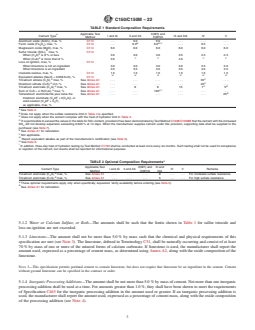
TABLE 1 Standard Composition Requirements
Applicable Test II(MH) and
A
Cement Type I and IA II and IIA III and IIIA IV V
Method II(MH)A
Aluminum oxide (Al O ), max, % C114 . . . 6.0 6.0 . . . . . . . . .
2 3
B B,C
Ferric oxide (Fe O ), max, % C114 . . . 6.0 6.0 . . . 6.5 . . .
2 3
Magnesium oxide (MgO), max, % C114 6.0 6.0 6.0 6.0 6.0 6.0
D
Sulfur trioxide (SO ), max, % C114
E
When (C A) is 8 % or less 3.0 3.0 3.0 3.5 2.3 2.3
E F F F F
When (C A) is more than 8 % 3.5 4.5
Loss on ignition, max, % C114
When limestone is not an ingredient 3.0 3.0 3.0 3.0 2.5 3.0
When limestone is an ingredient 3.5 3.5 3.5 3.5 3.5 3.5
Insoluble residue, max, % C114 1.5 1.5 1.5 1.5 1.5 1.5
G G G G G G
Equivalent alkalies (Na O + 0.658 K O), % C114
2 2
E C
Tricalcium silicate (C S), max, % See Annex A1 . . . . . . . . . . . . 35 . . .
E C
Dicalcium silicate (C S), min, % See Annex A1 . . . . . . . . . . . . 40 . . .
E C B
Tricalcium aluminate (C A), max, % See Annex A1 . . . 8 8 15 7 5
H C,I
Sum of C S + 4.75(C A), max, % See Annex A1 . . . . . . 100 . . . . . . . . .
3 3
B
Tetracalcium aluminoferrite plus twice the See Annex A1 . . . . . . . . . . . . . . . 25
tricalcium aluminate (C AF + 2(C A)), or
4 3
solid solution (C AF + C F),
4 2
as applicable, max, %
A
See Note 2.
B
Does not apply when the sulfate resistance limit in Table 4 is specified.
C
Does not apply when the cement complies with the heat of hydration limit in Table 4.
D
It is permissible to exceed the values in the table for SO content, provided it has been demonstrated by Test Method C1038/C1038M that the cement with the increased
SO will not develop expansion exceeding 0.020 % at 14 days. When the manufacturer supplies cement under this provision, supporting data shall be supplied to the
purchaser (see Note 7).
E
See Annex A1 for calculation.
F
Not applicable.
G
Report equivalent alkalies as part of the manufacturer’s certification (see Note 5).
H
See Note 6.
I
In addition, three-day heat of hydration testing by Test Method C1702 shall be conducted at least once every six months. Such testing shall not be used for acceptance
or rejection of the cement, but results shall be reported for informational purposes.
A
TABLE 2 Optional Composition Requirements
Applicable Test II(MH) and III and
Cement Type I and IA II and IIA IV V Remarks
Method II(MH)A IIIA
B
Tricalcium aluminate (C A), max, % See Annex A1 . . . . . . . . . 8 . . . . . . For moderate sulfate resistance.
B
Tricalcium aluminate (C A), max, % See Annex A1 . . . . . . . . . 5 . . . . . . For high sulfate resistance.
A
These optional requirements apply only when specifically requested. Verify availability before ordering (see Note 2).
B
See Annex A1 for calculation.
5.1.2 Water or Calcium Sulfate, or Both—The amounts shall be such that the limits shown in Table 1 for sulfur trioxide and
loss-on-ignition are not exceeded.
5.1.3 Limestone—The amount shall not be more than 5.0 % by mass such that the chemical and physical requirements of this
specification are met (see Note 3). The limestone, defined in Terminology C51, shall be naturally occurring and consist of at least
70 % by mass of one or more of the mineral forms of calcium carbonate. If limestone is used, the manufacturer shall report the
amount used, expressed as a percentage of cement mass, as determined using Annex A2, along with the oxide composition of the
limestone.
NOTE 3—This specification permits portland cement to contain limestone, but does not require that limestone be an ingredient in the cement. Cement
without ground limestone can be specified in the contract or order.
5.1.4 Inorganic Processing Additions—The amount shall be not more than 5.0 % by mass of cement. Not more than one inorganic
processing addition shall be used at a time. For amounts greater than 1.0 %, they shall have been shown to meet the requirements
of Specification C465 for the inorganic processing addition in the amount used or greater. If an inorganic processing addition is
used, the manufacturer shall report the amount used, expressed as a percentage of cement mass, along with the oxide composition
of the processing addition (see Note 4).
C150/C150M − 22
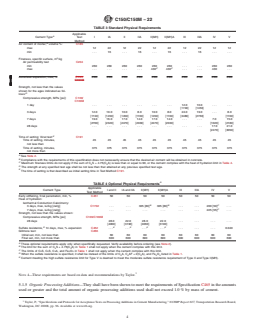
TABLE 3 Standard Physical Requirements
Applicable
A
Cement Type Test I IA II IIA II(MH) II(MH)A III IIIA IV V
Method
B
Air content of mortar, volume %: C185
max 12 22 12 22 12 22 12 22 12 12
min . . . 16 . . . 16 . . . 16 . . . 16 . . . . . .
Fineness, specific surface, m /kg
Air permeability test C204
min 260 260 260 260 260 260 . . . . . . 260 260
C C
max . . . . . . . . . . . . 430 430 . . . . . . 430 . . .
Autoclave expansion, max, % C151/ 0.80 0.80 0.80 0.80 0.80 0.80 0.80 0.80 0.80 0.80
C151M
Strength, not less than the values
shown for the ages indicated as fol-
D
lows:
Compressive strength, MPa [psi]: C109/
C109M
1 day . . . . . . . . . . . . . . . . . . 12.0 10.0 . . . . . .
[1740] [1450]
3 days 12.0 10.0 10.0 8.0 10.0 8.0 24.0 19.0 . . . 8.0
[1740] [1450] [1450] [1160] [1450] [1160] [3480] [2760] [1160]
7 days 19.0 16.0 17.0 14.0 17.0 14.0 . . . . . . 7.0 15.0
[2760] [2320] [2470] [2030] [2470] [2030] [1020] [2180]
28 days . . . . . . . . . . . . . . . . . . . . . . . . 17.0 21.0
[2470] [3050]
E
Time of setting; Vicat test: C191
Time of setting, minutes, 45 45 45 45 45 45 45 45 45 45
not less than
Time of setting, minutes, 375 375 375 375 375 375 375 375 375 375
not more than
A
See Note 2.
B
Compliance with the requirements of this specification does not necessarily ensure that the desired air content will be obtained in concrete.
C
Maximum fineness limits do not apply if the sum of C S + 4.75(C A) is less than or equal to 90, or the cement complies with the heat of hydration limit in Table 4.
3 3
D
The strength at any specified test age shall be not less than that attained at any previous specified test age.
E
The time of setting is that described as initial setting time in Test Method C191.
A
TABLE 4 Optional Physical Requirements
Applicable
Cement Type I and II IA and IIA II(MH) II(MH)A III IIIA IV V
Test Method
Early stiffening, final penetration, min, % C451 50 50 50 50 50 50 50 50
Heat of hydration:
Isothermal Conduction Calorimetry:
B B C
3 days, max, kJ/kg [cal/g] C1702 . . . . . . 335 [80] 335 [80] . . . . . . 200 [50] . . .
C
7 days, max, kJ/kg [cal/g] . . . . . . . . . . . . . . . . . . 225 [55] . . .
Strength, not less than the values shown:
Compressive strength, MPa [psi] C109/C109M
28 days 28.0 22.0 28.0 22.0 . . . . . . . . . . . .
[4060] [3190] [4060] [3190]
D E E E E
Sulfate resistance, 14 days, max, % expansion C452 . . . . . . . . . . . . . . . . . . . . . 0.040
Gillmore test: C266
Initial set, min, not less than 60 60 60 60 60 60 60 60
Final set, min, not more than 600 600 600 600 600 600 600 600
A
These optional requirements apply only when specifically requested. Verify availability before ordering (see Note 2).
B
The limit for the sum of C S + 4.75(C A) in Table 1 shall not apply when the cement complies with this limit.
3 3
C
The limits of C S, C S, C A, and Fe O in Table 1 shall not apply when the cement complies with this limit.
3 2 3 2 3
D
When the sulfate resistance is specified, it shall be instead of the limits of C A, C AF + 2(C A), and Fe O listed in Table 1.
3 4 3 2 3
E
Cement meeting the high sulfate resistance limit for Type V is deemed to meet the moderate sulfate resistance requirement of Type II and Type II(MH).
NOTE 4—These requirements are based on data and recommendations by Taylor.
5.1.5 Organic Processing Additions—They shall have been shown to meet the requirements of Specification C465 in the amounts
used or greater and the total amount of organic processing additions used shall not exceed 1.0 % by mass of cement.
Taylor, P., “Specifications and Protocols for Acceptance Tests on Processing Additions in Cement Manufacturing,” NCHRP Report 607, Transportation Research Board,
Washington, DC 20008, pp. 96. Available at www.trb.org.
C150/C150M − 22
5.1.6 Air-entraining Addition (for Air-entraining Portland Cement Only)—The interground addition shall conform to the
requirements of Specification C226.
6. Chemical Composition
6.1 Portland cement of each of the ten types shown in Section 1 shall conform to the respective standard chemical requirements
prescribed in Table 1. In addition, optional chemical requirements are shown in Table 2.
NOTE 5—The standard composition requirements in Table 1 require reporting of equivalent alkalies. Cements with a maximum of 0.60 % equivalent
alkalies were historically designated as “low-alkali cements” and recommended for use with aggregates susceptible to alkali-silica reaction (ASR).
However, low-alkali cements (in the absence of other mitigation measures) may not be effective in mitigating ASR. Guidance on formulating concrete
mixtures, including calculating alkali loading using equivalent alkali content of cement to minimize the potential for ASR, is provided in Guide C1778.
NOTE 6—The limit on the sum, C S + 4.75(C A), in Table 1 provides control on the heat of hydration of the cement and is consistent with a Test Method
3 3
C1702 three-day heat of hydration limit of 315 kJ/kg [75 cal ⁄g].
NOTE 7—There are cases where performance of a cement is improved with SO in excess of the Table 1 limits in this specification. Guide C563 is one
of several methods a manufacturer can use to evaluate the effect of sulfate content on cement characteristics. Whenever SO content of a cement exceeds
Table 1 limits, Test Method C1038/C1038M results provide evidence that excessive expansion does not occur at this higher sulfate content.
7. Physical Properties
7.1 Portland cement of each of the ten types shown in Section 1 shall conform to the respective standard physical requirements
prescribed in Table 3. In addition, optional physical requirements are shown in Table 4.
8. Sampling
8.1 When the purchaser desires that the cement be sampled and tested to verify compliance with this specification, perform
sampling and testing in accordance with Practice C183/C183M.
8.2 Practice C183/C183M is not designed for manufacturing quality control and is not required for manufacturer’s certification.
9. Test Methods
9.1 Determine the applicable properties enumerated in this specification in accordance with the following test methods:
9.1.1 Chemical Analysis—Test Methods C114.
9.1.2 Air Content of Mortar—Test Method C185.
9.1.3 Fineness by Air Permeability—Test Method C204.
9.1.4 Autoclave Expansion—Test Method C151/C151M.
9.1.4 Strength—Test Method C109/C109M.
9.1.5 Time of Setting by Vicat Needles—Test Method C191.
9.1.6 Early Stiffening—Test Method C451.
9.1.7 Heat of Hydration—Test Method C1702.
9.1.8 Sulfate Resistance—Test Method C452 (sulfate expansion).
9.1.9 Time of Setting by Gillmore Needles—Test Method C266.
9.1.10 Calcium Sulfate (Expansion of) Mortar—Test Method C1038/C1038M.
C150/C150M − 22
10. Inspection
10.1 Inspection of the material shall be made as agreed upon between the purchaser and the seller as part of the purchase contract.
11. Rejection
11.1 The cement shall be rejected if it fails to meet any of the requirements of this specification.
11.2 At the option of the purchaser, retest, before using, cement remaining in bulk storage for more than six months or cement
in bags in local storage in the custody of a vendor for more than three months after completion of tests and reject the cement if
it fails to conform to any of the requirements of this specification. Cement so rejected shall be the responsibility of the owner of
record at the time of resampling for retest.
11.3 Packages shall identify the mass contained as net weight. At the option of the purchaser, packages more than 2 % below the
mass marked thereon shall be rejected and if the
...
Questions, Comments and Discussion
Ask us and Technical Secretary will try to provide an answer. You can facilitate discussion about the standard in here.
Loading comments...