

ASTM E534-18
(Test Method)Standard Test Methods for Chemical Analysis of Sodium Chloride
General Information
- Abstract
SIGNIFICANCE AND USE
3.1 Sodium chloride occurs in nature. It is a necessary article of diet as well as the source for production of many sodium compounds and chlorine. The methods listed in 1.2 provide procedures for analyzing sodium chloride to determine if it is suitable for its intended use.
SCOPE
1.1 These test methods cover the chemical analyses usually required for sodium chloride.
1.2 The analytical procedures appear in the following sections:
Section
Sample Preparation
5 to 9
Moisture
10 to 17
Water Insolubles
18 to 26
Calcium and Magnesium
27 to 34
Sulfate
35 to 42
Reporting of Analyses
43 to 45
1.3 The values stated in SI units are to be regarded as standard. No other units of measurement are included in this standard.
1.4 This standard does not purport to address all of the safety concerns, if any, associated with its use. It is the responsibility of the user of this standard to establish appropriate safety, health, and environmental practices and determine the applicability of regulatory limitations prior to use.
1.5 Review the current safety data sheets (SDS) for detailed information concerning toxicity, first-aid procedures, handling, and safety precautions.
1.6 This international standard was developed in accordance with internationally recognized principles on standardization established in the Decision on Principles for the Development of International Standards, Guides and Recommendations issued by the World Trade Organization Technical Barriers to Trade (TBT) Committee.
- Status
- Published
- Publication Date
- 31-Jan-2018
- Technical Committee
- D16 - Aromatic, Industrial, Specialty and Related Chemicals
- Drafting Committee
- D16.13 - Chlorine
Overview
ASTM E534-18 - Standard Test Methods for Chemical Analysis of Sodium Chloride provides established procedures for the precise chemical evaluation of sodium chloride (NaCl). Developed by ASTM, this international standard is crucial for ensuring sodium chloride’s suitability across numerous industrial, commercial, and dietary applications. The test methods outlined address the core analytical requirements for sodium chloride, including the evaluation of impurities and quality-related parameters.
The chemical analysis of sodium chloride according to ASTM E534-18 includes sample preparation, determination of moisture, water insolubles, calcium, magnesium, and sulfate content, as well as standardized reporting practices. These procedures are designed to confirm the purity and usability of sodium chloride for its intended application, and to support consistent quality control across industries.
Key Topics
- Sample Preparation: Guidelines ensure samples are representative and prepared using standardized techniques for reliable results.
- Moisture Determination: Quantifies free (surface) moisture in sodium chloride, ensuring accurate content specification and product stability.
- Water Insolubles: Measures the content of materials in NaCl that do not dissolve in water, indicating potential contamination or processing issues.
- Calcium and Magnesium Content: Employs EDTA titrimetric procedures, with calcium determined directly and magnesium by difference, to assess the quality and purity of sodium chloride.
- Sulfate Content: Determined via gravimetric analysis, identifying levels of sulfate impurities which may impact end-use requirements.
- Reporting of Analyses: Defines precise methods for result calculation and reporting, tailored for raw, evaporated, and purified salt types.
- Quality Guidelines: Emphasizes the importance of laboratory quality control systems and adherence to recognized quality assurance practices.
- Use of SI Units: All measurements and results are reported in International System of Units to support global consistency.
Applications
ASTM E534-18 is widely used wherever sodium chloride analysis is crucial to product quality, regulatory compliance, and process efficiency. Key applications include:
- Industrial Production: Evaluation of sodium chloride for chemical manufacturing, including the production of sodium-based compounds and chlorine.
- Food Industry: Testing purity and suitability of salt intended for dietary use, helping to meet food safety and regulatory standards.
- Pharmaceuticals: Ensuring sodium chloride used in drug manufacture and medical products meets stringent quality requirements.
- Water Treatment: Assessing salt quality for water softening and purification processes.
- Quality Control Laboratories: Standardizing sodium chloride testing to guarantee the consistency of supply and compliance with contractual specifications.
By following ASTM E534-18, laboratories and quality control departments can guarantee accurate, reproducible results, strengthening overall product assurance and supporting regulatory or customer requirements.
Related Standards
Several ASTM standards support or reference the procedures in ASTM E534-18:
- ASTM D1193 - Specification for Reagent Water: Defines water quality required for analytical procedures.
- ASTM D6809 - Guide for Quality Control and Quality Assurance Procedures: Offers guidance on maintaining analytical reliability and laboratory quality systems.
- ASTM E180 (Withdrawn) - Practice for Determining Precision of ASTM Methods: Referenced for statistical methods in assessing laboratory performance.
- ASTM E200 - Practice for Preparation, Standardization, and Storage of Standard and Reagent Solutions.
These related standards enhance repeatability, accuracy, and traceability in the chemical analysis of sodium chloride, ensuring that testing meets international best practice.
Keywords: sodium chloride analysis, ASTM E534-18, chemical analysis, salt purity testing, moisture determination, calcium content, magnesium analysis, sulfate testing, industrial salt, laboratory quality control, impurities in salt, international standard.
Relations
- Effective Date
- 01-Feb-2018
- Effective Date
- 01-Nov-2016
- Effective Date
- 01-Jun-2007
- Effective Date
- 01-Mar-2006
- Effective Date
- 10-Jun-2002
- Effective Date
- 10-Feb-1999
- Effective Date
- 10-Feb-1999
- Effective Date
- 01-Feb-2018
Get Certified
Connect with accredited certification bodies for this standard

ECOCERT
Organic and sustainability certification.

Eurofins Food Testing Global
Global leader in food, environment, and pharmaceutical product testing.

Intertek Bangladesh
Intertek certification and testing services in Bangladesh.
Sponsored listings
Frequently Asked Questions
ASTM E534-18 is a standard published by ASTM International. Its full title is "Standard Test Methods for Chemical Analysis of Sodium Chloride". This standard covers: SIGNIFICANCE AND USE 3.1 Sodium chloride occurs in nature. It is a necessary article of diet as well as the source for production of many sodium compounds and chlorine. The methods listed in 1.2 provide procedures for analyzing sodium chloride to determine if it is suitable for its intended use. SCOPE 1.1 These test methods cover the chemical analyses usually required for sodium chloride. 1.2 The analytical procedures appear in the following sections: Section Sample Preparation 5 to 9 Moisture 10 to 17 Water Insolubles 18 to 26 Calcium and Magnesium 27 to 34 Sulfate 35 to 42 Reporting of Analyses 43 to 45 1.3 The values stated in SI units are to be regarded as standard. No other units of measurement are included in this standard. 1.4 This standard does not purport to address all of the safety concerns, if any, associated with its use. It is the responsibility of the user of this standard to establish appropriate safety, health, and environmental practices and determine the applicability of regulatory limitations prior to use. 1.5 Review the current safety data sheets (SDS) for detailed information concerning toxicity, first-aid procedures, handling, and safety precautions. 1.6 This international standard was developed in accordance with internationally recognized principles on standardization established in the Decision on Principles for the Development of International Standards, Guides and Recommendations issued by the World Trade Organization Technical Barriers to Trade (TBT) Committee.
SIGNIFICANCE AND USE 3.1 Sodium chloride occurs in nature. It is a necessary article of diet as well as the source for production of many sodium compounds and chlorine. The methods listed in 1.2 provide procedures for analyzing sodium chloride to determine if it is suitable for its intended use. SCOPE 1.1 These test methods cover the chemical analyses usually required for sodium chloride. 1.2 The analytical procedures appear in the following sections: Section Sample Preparation 5 to 9 Moisture 10 to 17 Water Insolubles 18 to 26 Calcium and Magnesium 27 to 34 Sulfate 35 to 42 Reporting of Analyses 43 to 45 1.3 The values stated in SI units are to be regarded as standard. No other units of measurement are included in this standard. 1.4 This standard does not purport to address all of the safety concerns, if any, associated with its use. It is the responsibility of the user of this standard to establish appropriate safety, health, and environmental practices and determine the applicability of regulatory limitations prior to use. 1.5 Review the current safety data sheets (SDS) for detailed information concerning toxicity, first-aid procedures, handling, and safety precautions. 1.6 This international standard was developed in accordance with internationally recognized principles on standardization established in the Decision on Principles for the Development of International Standards, Guides and Recommendations issued by the World Trade Organization Technical Barriers to Trade (TBT) Committee.
ASTM E534-18 is classified under the following ICS (International Classification for Standards) categories: 71.040.40 - Chemical analysis; 71.060.50 - Salts. The ICS classification helps identify the subject area and facilitates finding related standards.
ASTM E534-18 has the following relationships with other standards: It is inter standard links to ASTM E534-13, ASTM D6809-02(2016), ASTM D6809-02(2007), ASTM D1193-06, ASTM D6809-02, ASTM D1193-99e1, ASTM D1193-99, ASTM D632-12(2020)e1. Understanding these relationships helps ensure you are using the most current and applicable version of the standard.
ASTM E534-18 is available in PDF format for immediate download after purchase. The document can be added to your cart and obtained through the secure checkout process. Digital delivery ensures instant access to the complete standard document.
Standards Content (Sample)
This international standard was developed in accordance with internationally recognized principles on standardization established in the Decision on Principles for the
Development of International Standards, Guides and Recommendations issued by the World Trade Organization Technical Barriers to Trade (TBT) Committee.
Designation: E534 − 18
Standard Test Methods for
Chemical Analysis of Sodium Chloride
This standard is issued under the fixed designation E534; the number immediately following the designation indicates the year of
original adoption or, in the case of revision, the year of last revision.Anumber in parentheses indicates the year of last reapproval.A
superscript epsilon (´) indicates an editorial change since the last revision or reapproval.
1. Scope* Procedures for Aromatic Hydrocarbons and Related Ma-
terials
1.1 These test methods cover the chemical analyses usually
E180Practice for Determining the Precision of ASTM
required for sodium chloride.
Methods for Analysis and Testing of Industrial and Spe-
1.2 The analytical procedures appear in the following sec- 3
cialty Chemicals (Withdrawn 2009)
tions:
E200Practice for Preparation, Standardization, and Storage
Section
of Standard and Reagent Solutions for ChemicalAnalysis
Sample Preparation 5 to 9
Moisture 10 to 17
3. Significance and Use
Water Insolubles 18 to 26
Calcium and Magnesium 27 to 34
3.1 Sodium chloride occurs in nature. It is a necessary
Sulfate 35 to 42
article of diet as well as the source for production of many
Reporting ofAnalyses 43 to 45
sodium compounds and chlorine. The methods listed in 1.2
1.3 The values stated in SI units are to be regarded as
provideproceduresforanalyzingsodiumchloridetodetermine
standard. No other units of measurement are included in this
if it is suitable for its intended use.
standard.
1.4 This standard does not purport to address all of the
4. Reagents
safety concerns, if any, associated with its use. It is the
4.1 Purity of Reagents—Unless otherwise indicated, it is
responsibility of the user of this standard to establish appro-
intended that all reagents should conform to the specifications
priate safety, health, and environmental practices and deter-
of the Committee on Analytical Reagents of the American
mine the applicability of regulatory limitations prior to use.
Chemical Society, where such specifications are available.
1.5 Reviewthecurrentsafetydatasheets(SDS)fordetailed
4.2 Purity of Water—Unless otherwise indicated, references
informationconcerningtoxicity,first-aidprocedures,handling,
to water shall be understood to mean Type II or III reagent
and safety precautions.
water conforming to Specification D1193.
1.6 This international standard was developed in accor-
dance with internationally recognized principles on standard-
SAMPLE PREPARATION
ization established in the Decision on Principles for the
Development of International Standards, Guides and Recom- 5. Scope
mendations issued by the World Trade Organization Technical
5.1 Thistestmethodcoverspreparationofasamplethatwill
Barriers to Trade (TBT) Committee.
beasrepresentativeaspossibleoftheentirebulkquantity.The
results of any analysis pertain only to the sample used.
2. Referenced Documents
6. Apparatus
2.1 ASTM Standards:
D1193Specification for Reagent Water
6.1 Coarse Grinder.
D6809Guide for Quality Control and Quality Assurance
6.2 High-Speed Blender.
6.3 Oven.
These test methods are under the jurisdiction of ASTM Committee D16 on
Aromatic, Industrial, Specialty and Related Chemicals and are under the direct
responsibility of Subcommittee D16.13 on Chlorine. The last approved version of this historical standard is referenced on
Current edition approved Feb. 1, 2018. Published April 2018. Originally www.astm.org.
approved in 1975. Last previous edition approved in 2013 as E534–13. DOI: Reagent Chemicals, American Chemical Society Specifications, American
10.1520/E0534-18. Chemical Society, Washington, DC. For suggestions on the testing of reagents not
For referenced ASTM standards, visit the ASTM website, www.astm.org, or listed by the American Chemical Society, see Analar Standards for Laboratory
contact ASTM Customer Service at service@astm.org. For Annual Book of ASTM Chemicals, BDH Ltd., Poole, Dorset, U.K., and the United States Pharmacopeia
Standards volume information, refer to the standard’s Document Summary page on and National Formulary, U.S. Pharmacopeial Convention, Inc. (USPC), Rockville,
the ASTM website. MD.
*A Summary of Changes section appears at the end of this standard
Copyright ©ASTM International, 100 Barr Harbor Drive, PO Box C700, West Conshohocken, PA19428-2959. United States
E534 − 18
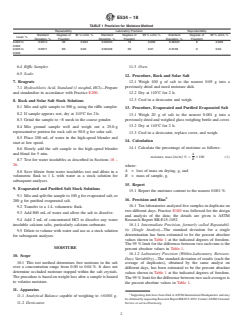
TABLE 1 Precision for Moisture Method
Repeatability Laboratory Precision Reproducibility
Standard Degrees of 95% Limit, % Standard Degrees of 95% Limit, % Standard Degrees of 95% Limit, %
Level, %
Deviation, % Freedom Deviation, % Freedom Deviation, % Freedom
0.003 to 0.0014 36 0.004 0.00223 18 0.006 0.00322 8 0.009
0.004
0.025 to 0.0071 60 0.02 0.00428 30 0.01 0.0138 9 0.04
0.035
6.4 Riffle Sampler. 11.3 Oven.
6.5 Scale.
12. Procedure, Rock and Solar Salt
7. Reagents
12.1 Weigh 100 g of salt to the nearest 0.05 g into a
previously dried and tared moisture dish.
7.1 Hydrochloric Acid, Standard (1 meq/mL HCl)—Prepare
and standardize in accordance with Practice E200.
12.2 Dry at 110°C for 2 h.
12.3 Cool in a desiccator and weigh.
8. Rock and Solar Salt Stock Solutions
8.1 Mix and split sample to 500g, using the riffle sampler.
13. Procedure, Evaporated and Purified Evaporated Salt
8.2 If sample appears wet, dry at 110°C for 2h.
13.1 Weigh 20 g of salt to the nearest 0.001 g into a
previously dried and weighed glass weighing bottle and cover.
8.3 Grind the sample to −8 mesh in the coarse grinder.
13.2 Dry at 110°C for 2 h.
8.4 Mix ground sample well and weigh out a 25.0-g
representative portion for rock salt or 50.0 g for solar salt.
13.3 Cool in a desiccator, replace cover, and weigh.
8.5 Place 200 mL of water in the high-speed blender and
14. Calculation
start at low speed.
14.1 Calculate the percentage of moisture as follows:
8.6 Slowly add the salt sample to the high-speed blender
and blend for 5 min. A
moisture, mass ~m/m! % 5 3100 (1)
B
8.7 Test for water insolubles as described in Sections 18 –
26.
where:
A = loss of mass on drying, g, and
8.8 Save filtrate from water insolubles test and dilute in a
B = mass of sample, g.
volumetric flask to 1 L with water as a stock solution for
subsequent analyses.
15. Report
9. Evaporated and Purified Salt Stock Solutions
15.1 Report the moisture content to the nearest 0.001%.
9.1 Mixandsplitthesampleto100gforevaporatedsalt,or
16. Precision and Bias
200 g for purified evaporated salt.
16.1 Ten laboratories analyzed five samples in duplicate on
9.2 Transfer to a 1-L volumetric flask.
two different days. Practice E180 was followed for the design
9.3 Add 800 mL of water and allow the salt to dissolve.
and analysis of the data; the details are given is ASTM
9.4 Add 2 mL of concentrated HCl to dissolve any water
Research Report RR:E15-1052.
insoluble calcium salts, particularly calcium carbonate.
16.1.1 Intermediate Precision, formerly called Repeatabil-
ity (Single Analyst)—The standard deviation for a single
9.5 Dilute to volume with water and use as a stock solution
determination has been estimated to be the percent absolute
for subsequent analyses.
values shown in Table 1 at the indicated degrees of freedom.
The 95% limit for the difference between two such runs is the
MOISTURE
percent absolute values in Table 1.
16.1.2 Laboratory Precision (Within-Laboratory, Between-
10. Scope
Days Variability)—The standard deviation of results (each the
10.1 This test method determines free moisture in the salt
average of duplicates), obtained by the same analyst on
over a concentration range from 0.00 to 0.04%. It does not
different days, has been estimated to be the percent absolute
determine occluded moisture trapped within the salt crystals.
values shown in Table 1 at the indicated degrees of freedom.
The procedure is based on weight loss after a sample is heated
The95%limitforthedifferencebetweentwosuchaveragesis
to volatize moisture.
the percent absolute values in Table 1.
11. Apparatus
Supporting data have been filed atASTM International Headquarters and may
11.1 Analytical Balance capable of weighing to 60.001 g.
beobtainedbyrequestingResearchReportRR:E15-1052.ContactASTMCustomer
11.2 Desiccator. Service at service@astm.org.
E534 − 18
16.1.3 Reproducibility (Multilaboratory)—The standard de- the Parabella funnel. Transfer all insolubles to the paper and
viation of results (each the average of duplicates), obtained by wash free of chlorides with water until the filtrate shows no
analysts in different laboratories, has been estimated to be turbidity when tested with 0.1 meq/mLAgNO solution.
percent absolute values shown in Table 1. The 95% limit for
21.4 Dilute filtrate and washings to 1 L with water in
the difference between two such averages is the percent
volumetric flask.
absolute values in Table 1.
21.5 Dry the filter disk at 110°C for 1 h.
16.2 Bias—The bias of this test method has not been
21.6 Cool in a desiccator and weigh the disk on an analyti-
determined due to the unavailability of suitable reference
cal balance.
materials.
21.7 Save the filtrate for subsequent analyses.
17. Quality Guidelines
22. Procedure, Evaporated and Purified Evaporated Salts
17.1 Laboratories shall have a quality control system in
22.1 Place a well mixed sample in a 2-Lbeaker. Use 100-g
place.
sample for evaporated or 200 g for purified evaporated salt.
17.1.1 Confirm the performance of the test instrument or
test method by analyzing a quality control sample following
22.2 Add 750 mL of water.
the guidelines of standard statistical quality control practices.
22.3 Mix with a mechanical stirrer until solution is com-
17.1.2 Aquality control sample is a stable material isolated
plete.
from the production process and representative of the sample
22.4 Filter the solution by vacuum through a previously
being analyzed.
dried (110°C for 1 h) and accurately weighed filter disk using
17.1.3 When QA/QC protocols are already established in
the Parabella funnel. Transfer all insolubles to the paper and
the testing facility, these protocols are acceptable when they
wash free of chlorides with water until the filtrate shows no
confirm the validity of test results.
turbidity when tested with 0.1 meq/mLAgNO solution.
17.1.4 When there are no QA/QC protocols established in
the testing facility, use the guidelines described in Guide
22.5 Dry the filter disk at 110°C for 1 h.
D6809 or similar statistical quality control practices.
22.6 Cool in a desiccator and weigh on an analytical
balance.
WATER INSOLUBLES
22.7 Dilute the filtration and washings to 1 L with water in
18. Scope
a volumetric flask and reserve for subsequent analyses.
18.1 This gravimetric method determines only the amount
23. Calculation
of insolubles present in sodium chloride which will not
dissolve in water.
23.1 Calculate the percentage of water insolubles as fol-
lows:
19. Apparatus
A
insolubles, % mass ~m/m! 5 3100 (2)
19.1 Analytical Balance.
B
19.2 Desiccator.
where:
19.3 Magnetic Stirrer with Stirring Bar.
A = increase in mass of filter disk, g, and
B = sample mass, g.
19.4 Parabella Filter Funnel Assembly, 1000-mL, or its
equivalent with 0.3-µm glass fiber filter disk.
24. Report
24.1 Reportthepercentageofwaterinsolublestothenearest
20. Reagents
percentage shown as follows:
20.1 Silver Nitrate, Standard Solution, 0.1 meq/mL
Range, % Report to, %
AgNO —Prepare and standardize in accordance with Practice
0.002 to 0.005 0.001
E200.
0.01 to 0.04 0.01
0.15 to 0.35 0.01
21. Procedure, Rock and Solar Salts
25. Precision and Bias
21.1 Transfer a sample prepared in accordance with 8.1 to
25.1 Ten laboratories analyzed six samples in duplicate on
8.6 to a 1-L Erlenmeyer flask, washing out the blender with
two different days. Practice E180 was followed for the design
100 mL of water. Add 300 mL of water to give a total of 600
and analysis of the data; the details are given is ASTM
mL of water added.
Research Report RR:E15-1052.
21.2 Stir on a magnetic stirrer for 1 h. Adjust the stirrer
25.1.1 Intermediate Precision, formerly called Repeatabil-
speed to give maximum agitation without danger of losing any
ity (Single Analyst)—The coefficient of variation for a single
sampleduetosplashing.Placeabeakerorwatchglassovertop
determination has been estimated to be the percent relative
of the flask while stirring.
values shown in Table 2 at the indicated degrees of freedom.
21.3 Filter the solution by vacuum through a previously The 95% limit for the difference between two such runs is
dried (110°C for 1 h) and accurately weighed filter disk using percent relative values shown in Table 2.
E534 − 18
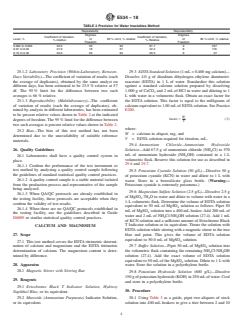
TABLE 2 Precision for Water Insolubles Method
Repeatability Reproducibility
Degrees Degrees
Coefficient of Variation, Coefficient of Variation,
Level, % of 95% Limit, % relative of 95% Limit, % relative
% relative % Relative
Freedom Freedom
0.002 to 0.005 22.0 20 62 91.7 9 257
0.01 to 0.04 21.9 18 61 42.2 8 118
0.15 to 0.35 22.0 20 62 20.5 9 57
25.1.2 Laboratory Precision (Within-Laboratory, Between- 29.3 EDTA Standard Solution(1mL=0.400mgcalcium)—
Days Variability)—The coefficient of variation of results (each Dissolve 4.0 g of disodium dihydrogen ethylene diaminetet-
the average of duplicates), obtained by the same analyst on raacetate (EDTA) in 1 L of water. Standardize this solution
different days, has been estimated to be 23.5% relative at 57 against a standard calcium solution prepared by dissolving
df. The 95% limit for the difference between two such 1.000 g of CaCO and 2 mLof HCl in water and diluting to 1
averages is 66% relative. L with water in a volumetric flask. Obtain an exact factor for
25.1.3 Reproducibility (Multilaboratory)—The coefficient the EDTA solution. This factor is equal to the milligrams of
of variation of results (each the average of duplicates), ob- calcium equivalent to 1.00 mLof EDTAsolution. See Practice
tained by analysts in different laboratories, has been estimated E200.
to be percent relative values shown in Table 2 at the indicated
W
factor 5 (3)
degrees of freedom. The 95% limit for the difference between
V
two such averages is percent relative values shown in Table 2.
where:
25.2 Bias—The bias of this test method has not been
W = calcium in aliquot, mg, and
determined due to the unavailability of suitable reference
V = EDTA solution required for titration, mL.
materials.
29.4 Ammonium Chloride–Ammonium Hydroxide
26. Quality Guidelines
Solution—Add 67.5 g of ammonium chloride (NH Cl) to 570
mL of ammonium hydroxide (NH OH) contained in a 1-L
26.1 Laboratories shall have a quality control system in 4
volumetric flask. Reserve this solution for use as described in
place.
29.6 and 29.7.
26.1.1 Confirm the performance of the test instrument or
tes
...
This document is not an ASTM standard and is intended only to provide the user of an ASTM standard an indication of what changes have been made to the previous version. Because
it may not be technically possible to adequately depict all changes accurately, ASTM recommends that users consult prior editions as appropriate. In all cases only the current version
of the standard as published by ASTM is to be considered the official document.
Designation: E534 − 13 E534 − 18
Standard Test Methods for
Chemical Analysis of Sodium Chloride
This standard is issued under the fixed designation E534; the number immediately following the designation indicates the year of
original adoption or, in the case of revision, the year of last revision. A number in parentheses indicates the year of last reapproval. A
superscript epsilon (´) indicates an editorial change since the last revision or reapproval.
1. Scope*
1.1 These test methods cover the chemical analyses usually required for sodium chloride.
1.2 The analytical procedures appear in the following sections:
Section
Sample Preparation 5 to 9
Moisture 10 to 16
Moisture 10 to 17
Water Insolubles 17 to 24
Water Insolubles 18 to 26
Calcium and Magnesium 25 to 31
Calcium and Magnesium 27 to 34
Sulfate 32 to 38
Sulfate 35 to 42
Reporting of Analyses 39 to 41
Reporting of Analyses 43 to 45
1.3 The values stated in SI units are to be regarded as standard. No other units of measurement are included in this standard.
1.4 This standard does not purport to address all of the safety concerns, if any, associated with its use. It is the responsibility
of the user of this standard to establish appropriate safety safety, health, and healthenvironmental practices and determine the
applicability of regulatory limitations prior to use.
1.5 Review the current material safety data sheets (MSDS)(SDS) for detailed information concerning toxicity, first-aid
procedures, handling, and safety precautions.
1.6 This international standard was developed in accordance with internationally recognized principles on standardization
established in the Decision on Principles for the Development of International Standards, Guides and Recommendations issued
by the World Trade Organization Technical Barriers to Trade (TBT) Committee.
2. Referenced Documents
2.1 ASTM Standards:
D1193 Specification for Reagent Water
D6809 Guide for Quality Control and Quality Assurance Procedures for Aromatic Hydrocarbons and Related Materials
E180 Practice for Determining the Precision of ASTM Methods for Analysis and Testing of Industrial and Specialty Chemicals
(Withdrawn 2009)
E200 Practice for Preparation, Standardization, and Storage of Standard and Reagent Solutions for Chemical Analysis
3. Significance and Use
3.1 Sodium chloride occurs in nature. It is a necessary article of diet as well as the source for production of many sodium
compounds and chlorine. The methods listed in 1.2 provide procedures for analyzing sodium chloride to determine if it is suitable
for its intended use.
These test methods are under the jurisdiction of ASTM Committee D16 on Aromatic Hydrocarbons Aromatic, Industrial, Specialty and Related Chemicals and are under
the direct responsibility of Subcommittee D16.16 on Industrial and Specialty Product Standards.
Current edition approved June 1, 2013Feb. 1, 2018. Published September 2013April 2018. Originally approved in 1975. Last previous edition approved in 20082013 as
E534 – 08.E534 – 13. DOI: 10.1520/E0534-13.10.1520/E0534-18.
For referenced ASTM standards, visit the ASTM website, www.astm.org, or contact ASTM Customer Service at service@astm.org. For Annual Book of ASTM Standards
volume information, refer to the standard’s Document Summary page on the ASTM website.
The last approved version of this historical standard is referenced on www.astm.org.
*A Summary of Changes section appears at the end of this standard
Copyright © ASTM International, 100 Barr Harbor Drive, PO Box C700, West Conshohocken, PA 19428-2959. United States
E534 − 18
4. Reagents
4.1 Purity of Reagents—Unless otherwise indicated, it is intended that all reagents should conform to the specifications of the
Committee on Analytical Reagents of the American Chemical Society, where such specifications are available.
4.2 Purity of Water—Unless otherwise indicated, references to water shall be understood to mean Type II or III reagent water
conforming to Specification D1193.
SAMPLE PREPARATION
5. Scope
5.1 This test method covers preparation of a sample that will be as representative as possible of the entire bulk quantity. The
results of any analysis pertain only to the sample used.
5. Scope
5.1 This test method covers preparation of a sample that will be as representative as possible of the entire bulk quantity. The
results of any analysis pertain only to the sample used.
6. Apparatus
6.1 Coarse Grinder.
6.2 High-Speed Blender.Blender.
6.3 Oven.
6.4 Riffle Sampler.
6.5 Scale.
7. Reagents
7.1 Hydrochloric Acid, Standard (1 meq/mL HCl)—Prepare and standardize in accordance with Practice E200.
8. Rock and Solar Salt Stock Solutions
8.1 Mix and split sample to 500 g, using the riffle sampler.
8.2 If sample appears wet, dry at 110°C for 2 h.
8.3 Grind the sample to −8 mesh in the coarse grinder.
8.4 Mix ground sample well and weigh out a 25.0-g representative portion for rock salt or 50.0 g for solar salt.
8.5 Place 200 mL of water in the high-speed blender and start at low speed.
8.6 Slowly add the salt sample to the high-speed blender and blend for 5 min.
8.7 Test for water insolubles as described in Sections 1718 – 2426.
8.8 Save filtrate from water insolubles test and dilute in a volumetric flask to 1 L with water as a stock solution for subsequent
analyses.
9. Evaporated and Purified Salt Stock Solutions
9.1 Mix and split the sample to 100 g for evaporated salt, or 200 g for purified evaporated salt.
9.2 Transfer to a 1-L volumetric flask.
9.3 Add 800 mL of water and allow the salt to dissolve.
TABLE 1 Precision for Moisture Method
Repeatability Laboratory Precision Reproducibility
Standard Degrees of 95 % Limit, % Standard Degrees of 95 % Limit, % Standard Degrees of 95 % Limit, %
Level, %
Deviation, % Freedom Deviation, % Freedom Deviation, % Freedom
0.003 to 0.0014 36 0.004 0.00223 18 0.006 0.00322 8 0.009
0.004
0.025 to 0.0071 60 0.02 0.00428 30 0.01 0.0138 9 0.04
0.035
Reagent Chemicals, American Chemical Society Specifications, American Chemical Society, Washington, DC. For suggestions on the testing of reagents not listed by
the American Chemical Society, see Analar Standards for Laboratory Chemicals, BDH Ltd., Poole, Dorset, U.K., and the United States Pharmacopeia and National
Formulary, U.S. Pharmacopeial Convention, Inc. (USPC), Rockville, MD.
E534 − 18
9.4 Add 2 mL of concentrated HCl to dissolve any water insoluble calcium salts, particularly calcium carbonate.
9.5 Dilute to volume with water and use as a stock solution for subsequent analyses.
MOISTURE
10. Scope
10.1 This test method determines free moisture in the salt over a concentration range from 0.00 to 0.04 %. It does not determine
occluded moisture trapped within the salt crystals. The procedure is based on weight loss after a sample is heated to volatize
moisture.
10. Scope
10.1 This test method determines free moisture in the salt over a concentration range from 0.00 to 0.04 %. It does not determine
occluded moisture trapped within the salt crystals. The procedure is based on weight loss after a sample is heated to volatize
moisture.
11. Apparatus
11.1 Analytical Balance.Balance capable of weighing to 60.001 g.
11.2 Desiccator.
11.3 Oven.
12. Procedure, Rock and Solar Salt
12.1 Weigh 100 g of salt to the nearest 0.05 g into a previously dried and tared moisture dish.
12.2 Dry at 110°C for 2 h.
12.3 Cool in a desiccator and weigh.
13. Procedure, Evaporated and Purified Evaporated Salt
13.1 Weigh 20 g of salt to the nearest 0.001 g into a previously dried and weighed glass weighing bottle and cover.
13.2 Dry at 110°C for 2 h.
13.3 Cool in a desiccator, replace cover, and weigh.
14. Calculation
14.1 Calculate the percentage of moisture as follows:
A
moisture, mass ~m/m! %5 3100 (1)
B
where:
A = loss of mass on drying, g, and
B = mass of sample, g.
15. Report
15.1 Report the moisture content to the nearest 0.001 %.
16. Precision and Bias
16.1 The following criteria should be used in judging Ten laboratories analyzed five samples in duplicate on two different days.
Practice E180the acceptability of results ( was followed for the design and analysis of the data;Note 1): the details are given is
ASTM Research Report RR:E15-1052.
16.1.1 Intermediate Precision, formerly called Repeatability (Single Analyst)—The standard deviation for a single determina-
tion has been estimated to be the percent absolute values shown in Table 1 at the indicated degrees of freedom. The 95 % limit
for the difference between two such runs is the percent absolute values in Table 1.
E534 − 18
16.1.2 Laboratory precisionPrecision (Within-Laboratory, Between-Days Variability)—The standard deviation of results (each
the average of duplicates), obtained by the same analyst on different days, has been estimated to be the percent absolute values
shown in Table 1 at the indicated degrees of freedom. The 95 % limit for the difference between two such averages is the percent
absolute values in Table 1.
16.1.3 Reproducibility (Multilaboratory)—The standard deviation of results (each the average of duplicates), obtained by
analysts in different laboratories, has been estimated to be percent absolute values shown in Table 1. The 95 % limit for the
difference between two such averages is the percent absolute values in Table 1.
NOTE 1—The preceding precision statements are based on an interlaboratory study performed around 1975 on five samples of sodium chloride
containing covering the ranges of moisture in Table 1. One analyst in each of ten laboratories performed duplicate determinations and repeated them on
a second day. Practice E180 was used in developing these precision estimates.
16.2 Bias—The bias of this test method has not been determined due to the unavailability of suitable reference materials.
17. Quality Guidelines
17.1 Laboratories shall have a quality control system in place.
17.1.1 Confirm the performance of the test instrument or test method by analyzing a quality control sample following the
guidelines of standard statistical quality control practices.
17.1.2 A quality control sample is a stable material isolated from the production process and representative of the sample being
analyzed.
17.1.3 When QA/QC protocols are already established in the testing facility, these protocols are acceptable when they confirm
the validity of test results.
17.1.4 When there are no QA/QC protocols established in the testing facility, use the guidelines described in Guide D6809 or
similar statistical quality control practices.
WATER INSOLUBLES
17. Scope
17.1 This gravimetric method determines only the amount of insolubles present in sodium chloride which will not dissolve in
water.
18. Scope
18.1 This gravimetric method determines only the amount of insolubles present in sodium chloride which will not dissolve in
water.
19. Apparatus
19.1 Analytical Balance.
19.2 Desiccator.
19.3 Magnetic Stirrer with Stirring Bar.
19.4 Parabella Filter Funnel Assembly, 1000-mL, or its equivalent with 0.3-μm glass fiber filter disk.
20. Reagents
20.1 Silver Nitrate, Standard Solution, 0.1 meq/mL AgNO —Prepare and standardize in accordance with Practice E200.
21. Procedure, Rock and Solar Salts
21.1 Transfer a sample prepared in accordance with 8.1 to 8.6 to a 1-L Erlenmeyer flask, washing out the blender with 100 mL
of water. Add 300 mL of water to give a total of 600 mL of water added.
21.2 Stir on a magnetic stirrer for 1 h. Adjust the stirrer speed to give maximum agitation without danger of losing any sample
due to splashing. Place a beaker or watch glass over top of the flask while stirring.
21.3 Filter the solution by vacuum through a previously dried (110°C for 1 h) and accurately weighed filter disk using the
Parabella funnel. Transfer all insolubles to the paper and wash free of chlorides with water until the filtrate shows no turbidity when
tested with 0.1 meq/mL AgNO solution.
21.4 Dilute filtrate and washings to 1 L with water in volumetric flask.
21.5 Dry the filter disk at 110°C for 1 h.
Supporting data have been filed at ASTM International Headquarters and may be obtained by requesting Research Report RR:E15-1052. Contact ASTM Customer
Service at service@astm.org.
E534 − 18
21.6 Cool in a desiccator and weigh the disk on an analytical balance.
21.7 Save the filtrate for subsequent analyses.
22. Procedure, Evaporated and Purified Evaporated Salts
22.1 Place a well mixed sample in a 2-L beaker. Use 100-g sample for evaporated or 200 g for purified evaporated salt.
22.2 Add 750 mL of water.
22.3 Mix with a mechanical stirrer until solution is complete.
22.4 Filter the solution by vacuum through a previously dried (110°C for 1 h) and accurately weighed filter disk using the
Parabella funnel. Transfer all insolubles to the paper and wash free of chlorides with water until the filtrate shows no turbidity when
tested with 0.1 meq/mL AgNO solution.
22.5 Dry the filter disk at 110°C for 1 h.
22.6 Cool in a desiccator and weigh on an analytical balance.
22.7 Dilute the filtration and washings to 1 L with water in a volumetric flask and reserve for subsequent analyses.
23. Calculation
23.1 Calculate the percentage of water insolubles as follows:
A
insolubles, % mass m/m 5 3100 (2)
~ !
B
where:
A = increase in mass of filter disk, g, and
B = sample mass, g.
24. Report
24.1 Report the percentage of water insolubles to the nearest percentage shown as follows:
Range, % Report to, %
0.002 to 0.005 0.001
0.01 to 0.04 0.01
0.15 to 0.35 0.01
25. Precision and Bias
25.1 The following criteria should be used in judging Ten laboratories analyzed six samples in duplicate on two different days.
Practice E180the acceptability of results ( was followed for the design and analysis of the data;Note 2): the details are given is
ASTM Research Report RR:E15-1052.
25.1.1 Intermediate Precision, formerly called Repeatability (Single Analyst)—The coefficient of variation for a single
determination has been estimated to be the percent relative values shown in Table 2 at the indicated degrees of freedom. The 95 %
limit for the difference between two such runs is percent relative values shown in Table 2.
25.1.2 Laboratory Precision (Within-Laboratory, Between-Days Variability)—The coefficient of variation of results (each the
average of duplicates), obtained by the same analyst on different days, has been estimated to be 23.5 % relative at 57 df. The 95 %
limit for the difference between two such averages is 66 % relative.
25.1.3 Reproducibility (Multilaboratory)—The coefficient of variation of results (each the average of duplicates), obtained by
analysts in different laboratories, has been estimated to be percent relative values shown in Table 2 at the indicated degrees of
freedom. The 95 % limit for the difference between two such averages is percent relative values shown in Table 2.
NOTE 2—The preceding precision statements are based on an interlaboratory study performed around 1975 on six samples of sodium chloride covering
the ranges of water insolubles in Table 2. One analyst in each of ten laboratories performed duplicate determinations and repeated them on a second day.
Practice E180 was used in developing these precision estimates.
25.2 Bias—The bias of this test method has not been determined due to the unavailability of suitable reference materials.
TABLE 2 Precision for Water Insolubles Method
Repeatability Reproducibility
Degrees Degrees
Coefficient of Variation, Coefficient of Variation,
Level, % of 95 % Limit, % relative of 95 % Limit, % relative
% relative % Relative
Freedom Freedom
0.002 to 0.005 22.0 20 62 91.7 9 257
0.01 to 0.04 21.9 18 61 42.2 8 118
0.15 to 0.35 22.0 20 62 20.5 9 57
E534 − 18
26. Quality Guidelines
26.1 Laboratories shall have a quality control system in place.
26.1.1 Confirm the performance of the test instrument or test method by analyzing a quality control sample following the
guidelines of standard statistical quality control practices.
26.1.2 A quality control sample is a stable material isolated from the production process and representative of the sample being
analyzed.
26.1.3 When QA/QC protocols are already established in the testing facility, these protocols are acceptable when they confirm
the validity of test results.
26.1.4 When there are no QA/QC protocols established in the testing facility, use the guidelines described in Guide D6809 or
similar statistical quality control practices.
CALCIUM AND MAGNESIUM
25. Scope
25.1 This test method covers the EDTA titrimetric determination of calcium and magnesium and the EDTA titrimetric
determination of calcium. The magnesium content is determined by difference.
27. Scope
27.1 This test method covers the EDTA titrimetric determination of calcium and magnesium and the EDTA titrimetric
determination of calcium. The magnesium conte
...