

ASTM D910-24
(Specification)Standard Specification for Leaded Aviation Gasolines
General Information
- Abstract
ABSTRACT
This specification covers purchases of aviation gasoline under contract and is intended primarily for use by purchasing agencies. This specification does not include all gasoline satisfactory for reciprocating aviation engines, but rather, defines the following specific types of aviation gasoline for civil use: Grade 80; Grade 91; Grade 100; and Grade 100LL. The gasoline shall adhere to octane rating requirements specified for individual grades, as follows: lean mixture knock value (motor octane number and aviation lean rating); rich mixture knock value (octane and performance number); tetraethyl lead content; color; and dye content (blue, yellow, red, and orange). Conversely, the gasoline shall meet the following requirements specified for all grades: density; distillation (initial and final boiling points, fuel evaporated, evaporated temperatures); recovery, residue, and loss volume; vapor pressure; freezing point; sulfur content; net heat of combustion; copper strip corrosion; oxidation stability (potential gum and lead precipitate); volume change during water reaction; and electrical conductivity.
SCOPE
1.1 This specification covers formulating specifications for purchases of aviation gasoline under contract and is intended primarily for use by purchasing agencies.
1.2 This specification defines specific types of aviation gasolines for civil use. It does not include all gasolines satisfactory for reciprocating aviation engines. Certain equipment or conditions of use may permit a wider, or require a narrower, range of characteristics than is shown by this specification.
1.3 The values stated in SI units are to be regarded as standard. No other units of measurement are included in this standard.
1.4 This international standard was developed in accordance with internationally recognized principles on standardization established in the Decision on Principles for the Development of International Standards, Guides and Recommendations issued by the World Trade Organization Technical Barriers to Trade (TBT) Committee.
- Status
- Published
- Publication Date
- 29-Feb-2024
- Technical Committee
- D02 - Petroleum Products, Liquid Fuels, and Lubricants
- Drafting Committee
- D02.J0.02 - Aviation Piston Engine Fuels
Overview
ASTM D910-24: Standard Specification for Leaded Aviation Gasolines defines the quality requirements for leaded aviation gasoline (avgas) primarily used in piston-engine aircraft. Developed by ASTM International, this standard is essential for purchasing agencies and fuel suppliers, providing specifications for avgas grades designated for civil use, including 100, 100LL (Low Lead), and 100VLL (Very Low Lead).
The standard outlines performance, safety, and chemical requirements for aviation gasoline at the point of delivery, ensuring reliable engine operation over a variety of operating conditions. Through specific limits and mandatory testing methods, ASTM D910-24 supports both industry safety and consistency in aviation fuel quality worldwide.
Key Topics
- Aviation Gasoline Grades: ASTM D910-24 defines grades 100, 100LL, and 100VLL, each with precise octane and performance number requirements, color identification, and allowable lead content.
- Critical Fuel Properties: Specifies octane ratings (lean and rich mixture knock values), tetraethyl lead levels, fuel density, distillation ranges, vapor pressure, sulfur content, freezing point, net heat of combustion, and electrical conductivity.
- Additive Controls: Regulates antioxidants, dyes (for grade identification), corrosion inhibitors, fuel system icing inhibitors, and electrical conductivity additives.
- Testing Requirements: Mandates established ASTM test methods for fuel quality assessment, covering knock characteristics, lead and sulfur content, distillation, freezing point, corrosion potential, and more.
- International Applicability: Stipulates the use of SI units and aligns with globally recognized principles, supporting international conformity and procurement processes.
Applications
ASTM D910-24 plays a pivotal role in the aviation sector, ensuring that aviation gasoline:
- Meets Safety Standards: The standards for vapor pressure, freezing point, and stability help guarantee reliable engine performance in varying environmental conditions.
- Supports Regulatory Compliance: The specification is referenced by civilian and governmental fleet operators, including the U.S. Department of Defense.
- Enables Global Procurement: By establishing uniform specifications, it facilitates global trade and ensures fuels sourced worldwide will be compatible with certified piston aviation engines.
- Prevents Engine Issues: Requirements such as limits on lead, sulfur, and gum content protect fuel systems and engines from fouling, corrosion, and power loss.
- Color Coding: Distinct colors for each avgas grade (e.g., blue for 100LL, green for 100) reduce the risk of misfueling and ensure safety during fueling operations.
Industries and organizations benefiting from this standard include:
- Aircraft manufacturers and operators
- Fuel producers and distributors
- Regulatory agencies and certification bodies
- Maintenance, repair, and overhaul (MRO) organizations
Related Standards
Leaded aviation gasoline quality and testing are further supported by several related ASTM standards, including:
- ASTM D7547: Specification for Hydrocarbon Unleaded Aviation Gasoline
- ASTM D4057: Practice for Manual Sampling of Petroleum and Petroleum Products
- ASTM D4177: Practice for Automatic Sampling of Petroleum and Petroleum Products
- ASTM D2700: Test Method for Motor Octane Number of Spark-Ignition Engine Fuel
- ASTM D2392: Test Method for Color of Dyed Aviation Gasolines
- ASTM D2622, D1266, D5453: Methods for Sulfur determination in petroleum products
- ASTM D873: Test Method for Oxidation Stability
- ASTM D2624: Methods for Electrical Conductivity of Aviation and Distillate Fuels
These standards, among others referenced in ASTM D910-24, create a comprehensive framework for the production, testing, and quality assurance of aviation gasolines worldwide.
Conclusion
ASTM D910-24 is critical for ensuring fuel quality, operational safety, and regulatory compliance in the aviation industry. By specifying clear requirements and methods for leaded aviation gasoline, the standard supports consistent, global fuel quality for piston-engine aircraft, safeguarding both equipment and lives. For fuel suppliers, operators, and aviation authorities, adherence to ASTM D910-24 is essential for efficient and safe flight operations.
Relations
- Effective Date
- 01-Mar-2024
- Effective Date
- 01-Mar-2024
- Effective Date
- 01-Mar-2024
- Effective Date
- 01-Dec-2023
- Effective Date
- 01-Nov-2023
- Effective Date
- 01-Mar-2023
- Effective Date
- 01-Feb-2019
- Effective Date
- 01-Mar-2024
- Effective Date
- 01-Mar-2024
- Effective Date
- 01-Mar-2024
- Effective Date
- 01-Mar-2024
- Effective Date
- 01-Mar-2024
- Referred By
ASTM D3343-22 - Standard Test Method for Estimation of Hydrogen Content of Aviation Fuels - Effective Date
- 01-Mar-2024
- Referred By
ASTM D4529-17 - Standard Test Method for Estimation of Net Heat of Combustion of Aviation Fuels - Effective Date
- 01-Mar-2024
- Referred By
ASTM F3397/F3397M-21 - Standard Practice for Aeroplane Turbine Fuel System Hot Weather Operations - Effective Date
- 01-Mar-2024
Get Certified
Connect with accredited certification bodies for this standard

Element Materials Technology
Materials testing and product certification.

ABS Group Brazil
ABS Group certification services in Brazil.

ABS Quality Evaluations Inc.
American Bureau of Shipping quality certification.
Sponsored listings
Frequently Asked Questions
ASTM D910-24 is a technical specification published by ASTM International. Its full title is "Standard Specification for Leaded Aviation Gasolines". This standard covers: ABSTRACT This specification covers purchases of aviation gasoline under contract and is intended primarily for use by purchasing agencies. This specification does not include all gasoline satisfactory for reciprocating aviation engines, but rather, defines the following specific types of aviation gasoline for civil use: Grade 80; Grade 91; Grade 100; and Grade 100LL. The gasoline shall adhere to octane rating requirements specified for individual grades, as follows: lean mixture knock value (motor octane number and aviation lean rating); rich mixture knock value (octane and performance number); tetraethyl lead content; color; and dye content (blue, yellow, red, and orange). Conversely, the gasoline shall meet the following requirements specified for all grades: density; distillation (initial and final boiling points, fuel evaporated, evaporated temperatures); recovery, residue, and loss volume; vapor pressure; freezing point; sulfur content; net heat of combustion; copper strip corrosion; oxidation stability (potential gum and lead precipitate); volume change during water reaction; and electrical conductivity. SCOPE 1.1 This specification covers formulating specifications for purchases of aviation gasoline under contract and is intended primarily for use by purchasing agencies. 1.2 This specification defines specific types of aviation gasolines for civil use. It does not include all gasolines satisfactory for reciprocating aviation engines. Certain equipment or conditions of use may permit a wider, or require a narrower, range of characteristics than is shown by this specification. 1.3 The values stated in SI units are to be regarded as standard. No other units of measurement are included in this standard. 1.4 This international standard was developed in accordance with internationally recognized principles on standardization established in the Decision on Principles for the Development of International Standards, Guides and Recommendations issued by the World Trade Organization Technical Barriers to Trade (TBT) Committee.
ABSTRACT This specification covers purchases of aviation gasoline under contract and is intended primarily for use by purchasing agencies. This specification does not include all gasoline satisfactory for reciprocating aviation engines, but rather, defines the following specific types of aviation gasoline for civil use: Grade 80; Grade 91; Grade 100; and Grade 100LL. The gasoline shall adhere to octane rating requirements specified for individual grades, as follows: lean mixture knock value (motor octane number and aviation lean rating); rich mixture knock value (octane and performance number); tetraethyl lead content; color; and dye content (blue, yellow, red, and orange). Conversely, the gasoline shall meet the following requirements specified for all grades: density; distillation (initial and final boiling points, fuel evaporated, evaporated temperatures); recovery, residue, and loss volume; vapor pressure; freezing point; sulfur content; net heat of combustion; copper strip corrosion; oxidation stability (potential gum and lead precipitate); volume change during water reaction; and electrical conductivity. SCOPE 1.1 This specification covers formulating specifications for purchases of aviation gasoline under contract and is intended primarily for use by purchasing agencies. 1.2 This specification defines specific types of aviation gasolines for civil use. It does not include all gasolines satisfactory for reciprocating aviation engines. Certain equipment or conditions of use may permit a wider, or require a narrower, range of characteristics than is shown by this specification. 1.3 The values stated in SI units are to be regarded as standard. No other units of measurement are included in this standard. 1.4 This international standard was developed in accordance with internationally recognized principles on standardization established in the Decision on Principles for the Development of International Standards, Guides and Recommendations issued by the World Trade Organization Technical Barriers to Trade (TBT) Committee.
ASTM D910-24 is classified under the following ICS (International Classification for Standards) categories: 75.160.20 - Liquid fuels. The ICS classification helps identify the subject area and facilitates finding related standards.
ASTM D910-24 has the following relationships with other standards: It is inter standard links to ASTM D910-21, ASTM D2700-24, ASTM D1094-24, ASTM D86-23ae1, ASTM D2700-23b, ASTM D86-23, ASTM D1094-07(2019), ASTM D8434-21, ASTM D7464-20, ASTM D3144-23, ASTM D2386-19, ASTM D4171-22, ASTM D3343-22, ASTM D4529-17, ASTM F3397/F3397M-21. Understanding these relationships helps ensure you are using the most current and applicable version of the standard.
ASTM D910-24 is available in PDF format for immediate download after purchase. The document can be added to your cart and obtained through the secure checkout process. Digital delivery ensures instant access to the complete standard document.
Standards Content (Sample)
This international standard was developed in accordance with internationally recognized principles on standardization established in the Decision on Principles for the
Development of International Standards, Guides and Recommendations issued by the World Trade Organization Technical Barriers to Trade (TBT) Committee.
Designation: D910 − 24
Standard Specification for
Leaded Aviation Gasolines
This standard is issued under the fixed designation D910; the number immediately following the designation indicates the year of
original adoption or, in the case of revision, the year of last revision. A number in parentheses indicates the year of last reapproval. A
superscript epsilon (´) indicates an editorial change since the last revision or reapproval.
This standard has been approved for use by agencies of the U.S. Department of Defense.
1. Scope* Replaced by D 2700 (Withdrawn 1969)
D381 Test Method for Gum Content in Fuels by Jet Evapo-
1.1 This specification covers formulating specifications for
ration
purchases of aviation gasoline under contract and is intended
D614 Method of Test for Knock Characteristics of Aviation
primarily for use by purchasing agencies.
Fuels by the Aviation Method; Replaced by D 2700
1.2 This specification defines specific types of aviation
(Withdrawn 1970)
gasolines for civil use. It does not include all gasolines
D873 Test Method for Oxidation Stability of Aviation Fuels
satisfactory for reciprocating aviation engines. Certain equip-
(Potential Residue Method)
ment or conditions of use may permit a wider, or require a
D909 Test Method for Supercharge Rating of Spark-Ignition
narrower, range of characteristics than is shown by this
Aviation Gasoline
specification.
D1094 Test Method for Water Reaction of Aviation Fuels
D1266 Test Method for Sulfur in Petroleum Products (Lamp
1.3 The values stated in SI units are to be regarded as
standard. No other units of measurement are included in this Method)
D1298 Test Method for Density, Relative Density, or API
standard.
Gravity of Crude Petroleum and Liquid Petroleum Prod-
1.4 This international standard was developed in accor-
ucts by Hydrometer Method
dance with internationally recognized principles on standard-
D1948 Method of Test for Knock Characteristics of Motor
ization established in the Decision on Principles for the
Fuels Above 100 Octane Number by the Motor Method;
Development of International Standards, Guides and Recom-
Replaced by D 2700 (Withdrawn 1968)
mendations issued by the World Trade Organization Technical
D2386 Test Method for Freezing Point of Aviation Fuels
Barriers to Trade (TBT) Committee.
D2392 Test Method for Color of Dyed Aviation Gasolines
D2622 Test Method for Sulfur in Petroleum Products by
2. Referenced Documents
Wavelength Dispersive X-ray Fluorescence Spectrometry
2.1 ASTM Standards:
D2624 Test Methods for Electrical Conductivity of Aviation
D86 Test Method for Distillation of Petroleum Products and
and Distillate Fuels
Liquid Fuels at Atmospheric Pressure
D2700 Test Method for Motor Octane Number of Spark-
D93 Test Methods for Flash Point by Pensky-Martens
Ignition Engine Fuel
Closed Cup Tester
D3338 Test Method for Estimation of Net Heat of Combus-
D130 Test Method for Corrosiveness to Copper from Petro-
tion of Aviation Fuels
leum Products by Copper Strip Test
D4052 Test Method for Density, Relative Density, and API
D323 Test Method for Vapor Pressure of Petroleum Products
Gravity of Liquids by Digital Density Meter
(Reid Method)
D4057 Practice for Manual Sampling of Petroleum and
D357 Method of Test for Knock Characteristics of Motor
Petroleum Products
Fuels Below 100 Octane Number by the Motor Method;
D4171 Specification for Fuel System Icing Inhibitors
D4177 Practice for Automatic Sampling of Petroleum and
This specification is under the jurisdiction of ASTM Committee D02 on
Petroleum Products
Petroleum Products, Liquid Fuels, and Lubricants and is the direct responsibility of
D4306 Practice for Aviation Fuel Sample Containers for
Subcommittee D02.J0.02 on Aviation Piston Engine Fuels.
Tests Affected by Trace Contamination
Current edition approved March 1, 2024. Published March 2024. Originally
D4529 Test Method for Estimation of Net Heat of Combus-
approved in 1947 (replacing former D615). Last previous edition approved in 2021
as D910 – 21. DOI: 10.1520/D0910-24
tion of Aviation Fuels
For referenced ASTM standards, visit the ASTM website, www.astm.org, or
contact ASTM Customer Service at service@astm.org. For Annual Book of ASTM
Standards volume information, refer to the standard’s Document Summary page on The last approved version of this historical standard is referenced on
the ASTM website. www.astm.org.
*A Summary of Changes section appears at the end of this standard
Copyright © ASTM International, 100 Barr Harbor Drive, PO Box C700, West Conshohocken, PA 19428-2959. United States
D910 − 24
D4809 Test Method for Heat of Combustion of Liquid 5.2 Grades 100, 100LL, and 100VLL represent aviation
Hydrocarbon Fuels by Bomb Calorimeter (Precision gasolines identical in minimum antiknock quality but differing
Method) in maximum lead content and color. The color identifies the
D4865 Guide for Generation and Dissipation of Static Elec- difference for engines that have a low tolerance to lead.
tricity in Petroleum Fuel Systems
NOTE 2—Listing of, and requirements for, Avgas Grades 91/98,
D5006 Test Method for Measurement of Fuel System Icing
108/135, and 115/145 appeared in the 1967 version of this specification.
Inhibitors (Ether Type) in Aviation Fuels
U.S. Military Specification MIL-G-5572F, dated January 24, 1978 (with-
drawn March 22, 1988), also covers grade 115/145 aviation gasoline, and
D5059 Test Methods for Lead and Manganese in Gasoline
is available as a research report. Listing of, and requirements for, Avgas
by X-Ray Fluorescence Spectroscopy
Grades 80 and 91 appeared in the 2016 and 2017 versions of this
D5191 Test Method for Vapor Pressure of Petroleum Prod-
specification respectively. Provision for unleaded Grade 91, with an
ucts and Liquid Fuels (Mini Method)
optional supercharge D909 test, has been made in Specification D7547.
D5453 Test Method for Determination of Total Sulfur in
5.3 Although the grade designations show only a single
Light Hydrocarbons, Spark Ignition Engine Fuel, Diesel
octane rating for each grade, they shall meet a minimum lean
Engine Fuel, and Engine Oil by Ultraviolet Fluorescence
mixture motor rating and a minimum rich mixture supercharge
D6469 Guide for Microbial Contamination in Fuels and Fuel
rating (see X1.2.2).
Systems
D7547 Specification for Hydrocarbon Unleaded Aviation
6. Materials and Manufacture
Gasoline
6.1 Aviation gasoline, except as otherwise specified in this
E29 Practice for Using Significant Digits in Test Data to
specification, shall consist of blends of refined hydrocarbons
Determine Conformance with Specifications
derived from crude petroleum, natural gasoline, or blends,
2.2 EI Standards:
thereof, with synthetic hydrocarbons or aromatic
IP 270 Determination of Lead Content of Gasoline – Iodine
hydrocarbons, or both.
Monochloride Method
6.2 Additives—Mandatory, shall be added to each grade of
aviation gasoline in the amount and of the composition
3. Terminology
specified in the following list of approved materials.
3.1 Definitions:
6.2.1 Tetraethyl Lead, shall be added in the form of an
3.1.1 aviation gasoline, n—gasoline possessing specific
antiknock mixture containing not less than 61 % by mass of
properties suitable for fueling aircraft powered by reciprocat-
tetraethyl lead and sufficient ethylene dibromide to provide two
ing spark ignition engines.
bromine atoms per atom of lead. The balance shall contain no
3.1.1.1 Discussion—Principal properties include volatility
added ingredients other than kerosene, an approved oxidation
limits, stability, detonation-free performance in the engine for
inhibitor, and blue dye, as specified herein. The maximum
which it is intended, and suitability for low temperature
concentration limit for each grade of gasoline is specified in
performance.
Table 1.
3.2 Abbreviations:
6.2.1.1 If mutually agreed upon by the fuel producer and
3.2.1 LL—low lead
additive vendor, tetraethyl lead antiknock mixture may be
diluted with 20 % by mass of a mixed aromatic solvent having
3.2.2 VLL—very low lead
a minimum flash point of 60 °C according to Test Methods D93
when the product is to be handled in cold climates. The TEL
4. General
content of the dilute product is reduced to 49 % by mass, so
4.1 This specification, unless otherwise provided, prescribes
that the amount of antiknock additive must be adjusted to
the required properties of aviation gasoline at the time and
achieve the necessary lead level. The dilute product still
place of delivery.
delivers two bromine atoms per atom of lead.
6.2.2 Dyes—The maximum concentration limits in each
5. Classification
grade of gasoline are specified in Table 1.
5.1 Three grades of leaded aviation gasoline are provided,
6.2.2.1 The only blue dye that shall be present in the
known as:
finished gasoline shall be essentially 1,4-
Grade 100
dialkylaminoanthraquinone.
Grade 100LL
6.2.2.2 The only yellow dyes that shall be present in the
Grade 100VLL
finished gasoline shall be essentially
NOTE 1—The above grade names are based on their octane/performance
p-diethylaminoazobenzene (Color Index No. 11021) or 1,3-
numbers as measured by the now obsolete Test Method D614 (Discon-
benzenediol 2,4-bis [(alkylphenyl)azo-].
tinued 1970). A table for converting octane/performance numbers ob-
tained by Test Method D2700 motor method into aviation ratings was last
6.3 Additives—These may be added to each grade of avia-
published in Specification D910–94 in the 1995 Annual Book of ASTM
tion gasoline in the amount and of the composition specified in
Standards, Vol 05.01.
Supporting data have been filed at ASTM International Headquarters and may
Available from Energy Institute, 61 New Cavendish St., London, W1G 7AR, be obtained by requesting Research Report RR:D02-1255. Contact ASTM Customer
U.K., http://www.energyinst.org Service at service@astm.org.
D910 − 24
A
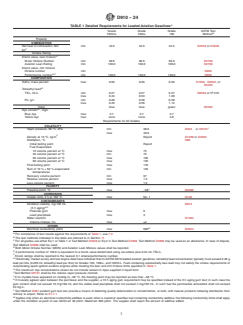
TABLE 1 Detailed Requirements for Leaded Aviation Gasolines
Grade Grade Grade ASTM Test
B
100VLL 100LL 100 Method
Property
COMBUSTION
Net heat of combustion, MJ/ min 43.5 43.5 43.5 D4529 or D3338
C
kg
Octane Rating
D
Knock value, lean mixture
Motor Octane Number min 99.6 99.6 99.6 D2700
Aviation Lean Rating min 100.0 100.0 100.0 D2700
Knock value, rich mixture
Octane number min D909
E,F
Performance number min 130.0 130.0 130.0 D909
COMPOSITION
Sulfur, mass percent max 0.05 0.05 0.05 D1266 , D2622, or
D5453
G
Tetraethyl lead
TEL, mL/L min 0.27 0.27 0.27 D5059 or IP 270
max 0.43 0.53 1.06
Pb, g/L min 0.28 0.28 0.28
max 0.45 0.56 1.12
Color blue blue green D2392
H
Dye content , mg/L
Blue dye max 2.7 2.7 2.7
Yellow dye max none none 2.8
Requirements for All Grades
VOLATILITY
I
Vapor pressure, 38 °C, kPa min 38.0 D323 or D5191
max 49.0
Density at 15 °C, kg/m Report D1298 or D4052
Distillation, °C D86
Initial boiling point Report
Fuel Evaporated
10 volume percent at °C max 75
40 volume percent at °C min 75
50 volume percent at °C max 105
90 volume percent at °C max 135
Final boiling point max 170
Sum of 10 % + 50 % evaporated min 135
temperatures
Recovery volume percent min 97
Residue volume percent max 1.5
Loss volume percent max 1.5
FLUIDITY
J
Freezing point, °C max −58 D2386
CORROSION
Copper strip, 2 h at 100 °C max No. 1 D130
CONTAMINANTS
Oxidation stability, mg/100 mL D873
K,L
(5 h aging)
Potential gum max 6
Lead precipitate max 3
Water reaction D1094
Volume change, mL max ±2
OTHER
M
Electrical conductivity, pS/m max 600 D2624
A
For compliance of test results against the requirements of Table 1, see 7.2.
B
The test methods indicated in this table are referred to in Section 11.
C
For all grades use either Eq 1 or Table 1 in Test Method D4529 or Eq 2 in Test Method D3338. Test Method D4809 may be used as an alternative. In case of dispute,
Test Method D4809 shall be used.
D
Both Motor Octane Number (MON) and Aviation Lean Mixture values shall be reported.
E
A performance number of 130.0 is equivalent to a knock value determined using iso-octane plus 0.34 mL TEL/L.
F
Knock ratings shall be reported to the nearest 0.1 octane/performance number.
G
Historically, market survey and test engine data have indicated that for ASTM D910 leaded aviation gasolines, tetraethyl lead concentration typically must exceed 0.28 g
lead per litre (0.265 mL tetraethyl lead per litre) for Grades 100, 100LL, and 100VLL. Fuels containing substantially less lead may not satisfy the octane requirements of
reciprocating spark ignition aviation engines while meeting the lean and rich mixture limits specified in Table 1.
H
The maximum dye concentrations shown do not include solvent in dyes supplied in liquid form.
I
Test Method D5191 shall be the referee vapor pressure method.
J
If no crystals have appeared on cooling to −58 °C, the freezing point may be reported as less than −58 °C.
K
If mutually agreed upon between the purchaser and the supplier, a 16 h aging gum requirement may be specified instead of the 5 h aging gum test; in such case the
gum content shall not exceed 10 mg/100 mL and the visible lead precipitate shall not exceed 4 mg/100 mL. In such fuel the permissible antioxidant shall not exceed
24 mg ⁄L.
L
Test Method D381 existent gum test can provide a means of detecting quality deterioration or contamination, or both, with heavier products following distribution from
refinery to airport. Refer to X1.7.1.
M
Applies only when an electrical conductivity additive is used; when a customer specifies fuel containing conductivity additive, the following conductivity limits shall apply
under the condition at point of use: Minimum 50 pS/m; Maximum 600 pS/m. The supplier shall report the amount of additive added.
D910 − 24
the following list of approved materials. The quantities and
TOLAD 4410 MAC = 22.5 g/m
types shall be declared by the manufacturer. Additives added
7. Detailed Requirements
after the point of manufacture shall also be declared.
6.3.1 Antioxidants—The following oxidation inhibitors may
7.1 The aviation gasoline shall conform to the requirements
be added to the gasoline separately, or in combination, in total
prescribed in Table 1.
concentration not to exceed 12 mg of inhibitor (not including
7.2 Test results shall not exceed the maximum or be less
weight of solvent) per litre of fuel.
than the minimum values specified in Table 1. No allowance
6.3.1.1 2,6-ditertiary butyl-4-methylphenol.
shall be made for the precision of the test methods. To
6.3.1.2 2,4-dimethyl-6-tertiary butylphenol.
determine the conformance to the specification requirement, a
6.3.1.3 2,6-ditertiary butylphenol.
test result may be rounded to the same number of significant
6.3.1.4 75 % minimum 2,6-ditertiary butylphenol plus 25 %
figures as in Table 1 using Practice E29. Where multiple
maximum mixed tertiary and tritertiary butylphenols.
determinations are made, the average result, rounded according
6.3.1.5 75 % minimum di- and tri-isopropyl phenols plus
to Practice E29, shall be used.
25 % maximum di- and tri-tertiary butylphenols.
6.3.1.6 72 % minimum 2,4-dimethyl-6-tertiary butylphenol
8. Workmanship, Finish and Appearance
plus 28 % maximum monomethyl and dimethyl tertiary
8.1 The aviation gasoline specified in this specification shall
butylphenols.
be free from undissolved water, sediment, and suspended
6.3.1.7 N,N'-di-isopropyl-para-phenylenediamine.
matter. The odor of the fuel shall not be nauseating or irritating.
6.3.1.8 N,N'-di-secondary-butyl-para-phenylenediamine.
No substances of known dangerous toxicity under usual
6.3.2 Fuel System Icing Inhibitor (FSII)—One of the fol-
conditions of handling and use shall be present except as
lowing may be used.
permitted in this specification.
6.3.2.1 Isopropyl Alcohol (IPA, propan-2-ol), in accordance
with the requirements of Specification D4171 (Type II). May
9. Sampling
be used in concentrations recommended by the aircraft manu-
facturer when required by the aircraft owner/operator. 9.1 Because of the importance of proper sampling proce-
dures in establishing fuel quality, use the appropriate proce-
NOTE 3—Addition of isopropyl alcohol (IPA) may reduce knock ratings
dures in Practice D4057 or Practice D4177.
below minimum specification values (see X1.2.4).
9.1.1 Although automatic sampling following Practice
6.3.2.2 Di-Ethylene Glycol Monomethyl Ether (Di-EGME),
D4177 may be useful in certain situations, initial refinery
conforming to the requirements of Specification D4171 (Type
specification compliance testing shall be performed on a
III), may be used in concentrations of 0.10 % to 0.15 % by
sample taken following procedures in Practice D4057.
volume when required by the aircraft owner/operator.
9.2 A number of aviation gasoline properties, including
6.3.2.3 Test Method D5006 can be used to determine the
copper corrosion, electrical conductivity, and others are very
concentration of Di-EGME in aviation fuels.
sensitive to trace contamination which can originate from
6.3.3 Electrical Conductivity Additive—Stadis 450 in con-
sample containers. For recommended sample containers, refer
centrations up to 3 mg/L is permitted. When loss of fuel
to Practice D4306.
conductivity necessitates retreatment with electrical conductiv-
ity additive, further addition is permissible up to a maximum
10. Reports
cumulative level of 5 mg/L of Stadis 450.
6.3.4 Corrosion Inhibitor Additive—The following corro-
10.1 The type and number of reports to ensure conformance
sion inhibitors may be added to the gasoline in concentrations
with the requirements of this specification shall be mutually
not to exceed the maximum allowable concentration (MAC)
agreed to by the purchaser and the supplier of the aviation
listed for each additive.
gasoline.
DCI-4A MAC = 24 g/m
DCI-6A MAC = 15 g/m 11. Test Methods
HITEC 580 MAC = 22.5 g/m
11.1 The requirements enumerated in this specification shall
NALCO 5403 MAC = 22.5 g/m
NALCO 5405 MAC = 11.0 g/m
be determined in accordance with the following ASTM test
PRI-19 MAC = 22.5 g/m
methods:
UNICOR J MAC = 22.5 g/m
11.1.1 Knock Value (Lean Rating)—Test Method D2700.
SPEC-AID 8Q22 MAC = 24.0 g/m
TOLAD 351 MAC = 24.0 g/m
11.1.2 Knock Value (Rich Rating)—Test Method D909.
11.1.3 Tetraethyllead—Test Method D5059 or IP 270.
11.1.4 Color—Test Method D2392.
Supporting data (guidelines for the approval or disapproval of additives) have
11.1.5 Density—Test Methods D1298 or D4052.
been filed at ASTM International Headquarters and may be obtained by requesting
11.1.6 Distillation—Test Method D86.
Research Report RR:D02-1125. Contact ASTM Customer Service at
11.1.7 Vapor Pressure—Test Methods D323 or D5191.
service@astm.org.
Supporting data have been filed at ASTM International Headquarters and may
11.1.8 Freezing Point—Test Method D2386.
be obtained by requesting Research Report RR:D02-1526. Contact ASTM Customer
11.1.9 Sulfur—Test Methods D1266, D2622, or D5453.
Service at service@astm.org.
11.1.10 Net Heat of Combustion—Test Methods D4529 or
Stadis 450 is a registered trademark marketed by Innospec Inc., Innospec
Manufacturing Park, Oil Sites Road, Ellesmere Port, Cheshire, CH65 4EY, UK. D3338.
D910 − 24
11.1.11 Corrosion (Copper Strip)—Test Method D130, 2 h 11.1.13 Water Reaction—Test Method D1094.
test at 100 °C in bomb.
11.1.14 Electrical Conductivity—Test Methods D2624.
11.1.12 Potential Gum and Visible Lead Precipitate—Test
Method D873 except that wherever the letter X occurs (refer-
12. Keywords
ring to oxidation time) insert the number 5, designating the
12.1 Avgas; aviation gasoline; gasoline
number of hours prescribed in this specification.
APPENDIX
(Nonmandatory Information)
X1. PERFORMANCE CHARACTERISTICS OF AVIATION GASOLINES
X1.1 Introduction ously in localized areas instead of progressing from the spark.
This may cause a detonation or knock, usually inaudible in
X1.1.1 Aviation gasoline is a complex mixture of relatively
aircraft engines. This knock, if permitted to continue for more
volatile hydrocarbons that vary widely in their physical and
than brief periods, may result in serious loss of power and
chemical properties. The engines and aircraft impose a variety
damage to, or destruction of, the aircraft engine. When aviation
of mechanical, physical, and chemical environments. The
gasoline is used in other types of aviation engines, for example,
properties of aviation gasoline (Table X1.1) must be properly
in certain turbine engines where specifically permitted by the
balanced to give satisfactory engine performance over an
engine manufacturers, knock or detonation characteristics may
extremely wide range of conditions.
not be critical requirements.
X1.1.2 The ASTM requirements summarized in Table 1 are
X1.2.2 Aviation gasoline grades are also identified by two
quality limits established on the basis of the broad experience
numbers separated by a slant line (/). The first number is called
and close cooperation of producers of aviation gasoline,
the lean mixture rating and the second number is called the rich
manufacturers of aircraft engines, and users of both commodi-
mixture rating. This specification describes three grades of
ties. The values given are intended to define aviation gasoline
aviation gasoline as follows: 100/130, 100/130LL, and 100/
suitable for most types of spar
...
This document is not an ASTM standard and is intended only to provide the user of an ASTM standard an indication of what changes have been made to the previous version. Because
it may not be technically possible to adequately depict all changes accurately, ASTM recommends that users consult prior editions as appropriate. In all cases only the current version
of the standard as published by ASTM is to be considered the official document.
Designation: D910 − 21 D910 − 24
Standard Specification for
Leaded Aviation Gasolines
This standard is issued under the fixed designation D910; the number immediately following the designation indicates the year of
original adoption or, in the case of revision, the year of last revision. A number in parentheses indicates the year of last reapproval. A
superscript epsilon (´) indicates an editorial change since the last revision or reapproval.
This standard has been approved for use by agencies of the U.S. Department of Defense.
1. Scope*
1.1 This specification covers formulating specifications for purchases of aviation gasoline under contract and is intended primarily
for use by purchasing agencies.
1.2 This specification defines specific types of aviation gasolines for civil use. It does not include all gasolines satisfactory for
reciprocating aviation engines. Certain equipment or conditions of use may permit a wider, or require a narrower, range of
characteristics than is shown by this specification.
1.3 The values stated in SI units are to be regarded as standard. No other units of measurement are included in this standard.
1.4 This international standard was developed in accordance with internationally recognized principles on standardization
established in the Decision on Principles for the Development of International Standards, Guides and Recommendations issued
by the World Trade Organization Technical Barriers to Trade (TBT) Committee.
2. Referenced Documents
2.1 ASTM Standards:
D86 Test Method for Distillation of Petroleum Products and Liquid Fuels at Atmospheric Pressure
D93 Test Methods for Flash Point by Pensky-Martens Closed Cup Tester
D130 Test Method for Corrosiveness to Copper from Petroleum Products by Copper Strip Test
D323 Test Method for Vapor Pressure of Petroleum Products (Reid Method)
D357 Method of Test for Knock Characteristics of Motor Fuels Below 100 Octane Number by the Motor Method; Replaced by
D 2700 (Withdrawn 1969)
D381 Test Method for Gum Content in Fuels by Jet Evaporation
D614 Method of Test for Knock Characteristics of Aviation Fuels by the Aviation Method; Replaced by D 2700 (Withdrawn
1970)
D873 Test Method for Oxidation Stability of Aviation Fuels (Potential Residue Method)
D909 Test Method for Supercharge Rating of Spark-Ignition Aviation Gasoline
D1094 Test Method for Water Reaction of Aviation Fuels
D1266 Test Method for Sulfur in Petroleum Products (Lamp Method)
This specification is under the jurisdiction of ASTM Committee D02 on Petroleum Products, Liquid Fuels, and Lubricants and is the direct responsibility of Subcommittee
D02.J0.02 on Aviation Piston Engine Fuels.
Current edition approved May 1, 2021March 1, 2024. Published June 2021March 2024. Originally approved in 1947 (replacing former D615). Last previous edition
approved in 20202021 as D910D910 – 21. – 20a. DOI: 10.1520/D0910-21.DOI: 10.1520/D0910-24
For referenced ASTM standards, visit the ASTM website, www.astm.org, or contact ASTM Customer Service at service@astm.org. For Annual Book of ASTM Standards
volume information, refer to the standard’s Document Summary page on the ASTM website.
The last approved version of this historical standard is referenced on www.astm.org.
*A Summary of Changes section appears at the end of this standard
Copyright © ASTM International, 100 Barr Harbor Drive, PO Box C700, West Conshohocken, PA 19428-2959. United States
D910 − 24
D1298 Test Method for Density, Relative Density, or API Gravity of Crude Petroleum and Liquid Petroleum Products by
Hydrometer Method
D1948 Method of Test for Knock Characteristics of Motor Fuels Above 100 Octane Number by the Motor Method; Replaced
by D 2700 (Withdrawn 1968)
D2386 Test Method for Freezing Point of Aviation Fuels
D2392 Test Method for Color of Dyed Aviation Gasolines
D2622 Test Method for Sulfur in Petroleum Products by Wavelength Dispersive X-ray Fluorescence Spectrometry
D2624 Test Methods for Electrical Conductivity of Aviation and Distillate Fuels
D2700 Test Method for Motor Octane Number of Spark-Ignition Engine Fuel
D3338 Test Method for Estimation of Net Heat of Combustion of Aviation Fuels
D3341 Test Method for Lead in Gasoline—Iodine Monochloride Method (Withdrawn 2022)
D4052 Test Method for Density, Relative Density, and API Gravity of Liquids by Digital Density Meter
D4057 Practice for Manual Sampling of Petroleum and Petroleum Products
D4171 Specification for Fuel System Icing Inhibitors
D4177 Practice for Automatic Sampling of Petroleum and Petroleum Products
D4306 Practice for Aviation Fuel Sample Containers for Tests Affected by Trace Contamination
D4529 Test Method for Estimation of Net Heat of Combustion of Aviation Fuels
D4809 Test Method for Heat of Combustion of Liquid Hydrocarbon Fuels by Bomb Calorimeter (Precision Method)
D4865 Guide for Generation and Dissipation of Static Electricity in Petroleum Fuel Systems
D5006 Test Method for Measurement of Fuel System Icing Inhibitors (Ether Type) in Aviation Fuels
D5059 Test Methods for Lead and Manganese in Gasoline by X-Ray Fluorescence Spectroscopy
D5191 Test Method for Vapor Pressure of Petroleum Products and Liquid Fuels (Mini Method)
D5453 Test Method for Determination of Total Sulfur in Light Hydrocarbons, Spark Ignition Engine Fuel, Diesel Engine Fuel,
and Engine Oil by Ultraviolet Fluorescence
D6469 Guide for Microbial Contamination in Fuels and Fuel Systems
D7547 Specification for Hydrocarbon Unleaded Aviation Gasoline
E29 Practice for Using Significant Digits in Test Data to Determine Conformance with Specifications
2.2 EI Standards:
IP 270 Determination of Lead Content of Gasoline – Iodine Monochloride Method
3. Terminology
3.1 Definitions:
3.1.1 aviation gasoline, n—gasoline possessing specific properties suitable for fueling aircraft powered by reciprocating spark
ignition engines.
3.1.1.1 Discussion—
Principal properties include volatility limits, stability, detonation-free performance in the engine for which it is intended, and
suitability for low temperature performance.
3.2 Abbreviations:
3.2.1 LL—low lead
3.2.2 VLL—very low lead
4. General
4.1 This specification, unless otherwise provided, prescribes the required properties of aviation gasoline at the time and place of
delivery.
5. Classification
5.1 Three grades of leaded aviation gasoline are provided, known as:
Grade 100
Grade 100LL
Grade 100VLL
Available from Energy Institute, 61 New Cavendish St., London, W1G 7AR, U.K., http://www.energyinst.org
D910 − 24
NOTE 1—The above grade names are based on their octane/performance numbers as measured by the now obsolete Test Method D614 (Discontinued
1970). A table for converting octane/performance numbers obtained by Test Method D2700 motor method into aviation ratings was last published in
Specification D910–94 in the 1995 Annual Book of ASTM Standards, Vol 05.01.
5.2 Grades 100, 100LL, and 100VLL represent aviation gasolines identical in minimum antiknock quality but differing in
maximum lead content and color. The color identifies the difference for engines that have a low tolerance to lead.
NOTE 2—Listing of, and requirements for, Avgas Grades 91/98, 108/135, and 115/145 appeared in the 1967 version of this specification. U.S. Military
Specification MIL-G-5572F, dated January 24, 1978 (withdrawn March 22, 1988), also covers grade 115/145 aviation gasoline, and is available as a
research report. Listing of, and requirements for, Avgas Grades 80 and 91 appeared in the 2016 and 2017 versions of this specification respectively.
Provision for unleaded Grade 91, with an optional supercharge D909 test, has been made in Specification D7547.
5.3 Although the grade designations show only a single octane rating for each grade, they shall meet a minimum lean mixture
motor rating and a minimum rich mixture supercharge rating (see X1.2.2).
6. Materials and Manufacture
6.1 Aviation gasoline, except as otherwise specified in this specification, shall consist of blends of refined hydrocarbons derived
from crude petroleum, natural gasoline, or blends, thereof, with synthetic hydrocarbons or aromatic hydrocarbons, or both.
6.2 Additives—Mandatory, shall be added to each grade of aviation gasoline in the amount and of the composition specified in
the following list of approved materials.
6.2.1 Tetraethyl Lead, shall be added in the form of an antiknock mixture containing not less than 61 % by mass of tetraethyl lead
and sufficient ethylene dibromide to provide two bromine atoms per atom of lead. The balance shall contain no added ingredients
other than kerosene, an approved oxidation inhibitor, and blue dye, as specified herein. The maximum concentration limit for each
grade of gasoline is specified in Table 1.
6.2.1.1 If mutually agreed upon by the fuel producer and additive vendor, tetraethyl lead antiknock mixture may be diluted with
20 % by mass of a mixed aromatic solvent having a minimum flash point of 60 °C according to Test Methods D93 when the
product is to be handled in cold climates. The TEL content of the dilute product is reduced to 49 % by mass, so that the amount
of antiknock additive must be adjusted to achieve the necessary lead level. The dilute product still delivers two bromine atoms per
atom of lead.
6.2.2 Dyes—The maximum concentration limits in each grade of gasoline are specified in Table 1.
6.2.2.1 The only blue dye that shall be present in the finished gasoline shall be essentially 1,4-dialkylaminoanthraquinone.
6.2.2.2 The only yellow dyes that shall be present in the finished gasoline shall be essentially p-diethylaminoazobenzene (Color
Index No. 11021) or 1,3-benzenediol 2,4-bis [(alkylphenyl)azo-].
6.3 Additives—These may be added to each grade of aviation gasoline in the amount and of the composition specified in the
following list of approved materials. The quantities and types shall be declared by the manufacturer. Additives added after the
point of manufacture shall also be declared.
6.3.1 Antioxidants—The following oxidation inhibitors may be added to the gasoline separately, or in combination, in total
concentration not to exceed 12 mg of inhibitor (not including weight of solvent) per litre of fuel.
6.3.1.1 2,6-ditertiary butyl-4-methylphenol.
6.3.1.2 2,4-dimethyl-6-tertiary butylphenol.
6.3.1.3 2,6-ditertiary butylphenol.
Supporting data have been filed at ASTM International Headquarters and may be obtained by requesting Research Report RR:D02-1255. Contact ASTM Customer
Service at service@astm.org.
Supporting data (guidelines for the approval or disapproval of additives) have been filed at ASTM International Headquarters and may be obtained by requesting Research
Report RR:D02-1125. Contact ASTM Customer Service at service@astm.org.
D910 − 24
A
TABLE 1 Detailed Requirements for Leaded Aviation Gasolines
Grade Grade Grade ASTM Test
B
100VLL 100LL 100 Method
Property
COMBUSTION
Net heat of combustion, MJ/ min 43.5 43.5 43.5 D4529 or D3338
C
kg
Octane Rating
D
Knock value, lean mixture
Motor Octane Number min 99.6 99.6 99.6 D2700
Aviation Lean Rating min 100.0 100.0 100.0 D2700
Knock value, rich mixture
Octane number min D909
E,F
Performance number min 130.0 130.0 130.0 D909
COMPOSITION
Sulfur, mass percent max 0.05 0.05 0.05 D1266 , D2622, or
D5453
G
Tetraethyl lead
TEL, mL/L min 0.27 0.27 0.27 D3341 or D5059
TEL, mL/L min 0.27 0.27 0.27 D5059 or IP 270
max 0.43 0.53 1.06
Pb, g/L min 0.28 0.28 0.28
max 0.45 0.56 1.12
Color blue blue green D2392
H
Dye content , mg/L
Blue dye max 2.7 2.7 2.7
Yellow dye max none none 2.8
Requirements for All Grades
VOLATILITY
I
Vapor pressure, 38 °C, kPa min 38.0 D323 or D5191
max 49.0
Density at 15 °C, kg/m Report D1298 or D4052
Distillation, °C D86
Initial boiling point Report
Fuel Evaporated
10 volume percent at °C max 75
40 volume percent at °C min 75
50 volume percent at °C max 105
90 volume percent at °C max 135
Final boiling point max 170
Sum of 10 % + 50 % evaporated min 135
temperatures
Recovery volume percent min 97
Residue volume percent max 1.5
Loss volume percent max 1.5
FLUIDITY
J
Freezing point, °C max −58 D2386
CORROSION
Copper strip, 2 h at 100 °C max No. 1 D130
CONTAMINANTS
Oxidation stability, mg/100 mL D873
K,L
(5 h aging)
Potential gum max 6
Lead precipitate max 3
Water reaction D1094
Volume change, mL max ±2
OTHER
M
Electrical conductivity, pS/m max 600 D2624
A
For compliance of test results against the requirements of Table 1, see 7.2.
B
The test methods indicated in this table are referred to in Section 11.
C
For all grades use either Eq 1 or Table 1 in Test Method D4529 or Eq 2 in Test Method D3338. Test Method D4809 may be used as an alternative. In case of dispute,
Test Method D4809 shall be used.
D
Both Motor Octane Number (MON) and Aviation Lean Mixture values shall be reported.
E
A performance number of 130.0 is equivalent to a knock value determined using iso-octane plus 0.34 mL TEL/L.
F
Knock ratings shall be reported to the nearest 0.1 octane/performance number.
G
Historically, market survey and test engine data have indicated that for ASTM D910 leaded aviation gasolines, tetraethyl lead concentration typically must exceed 0.28 g
lead per litre (0.265 mL tetraethyl lead per litre) for Grades 100, 100LL, and 100VLL. Fuels containing substantially less lead may not satisfy the octane requirements of
reciprocating spark ignition aviation engines while meeting the lean and rich mixture limits specified in Table 1.
H
The maximum dye concentrations shown do not include solvent in dyes supplied in liquid form.
I
Test Method D5191 shall be the referee vapor pressure method.
J
If no crystals have appeared on cooling to −58 °C, the freezing point may be reported as less than −58 °C.
K
If mutually agreed upon between the purchaser and the supplier, a 16 h aging gum requirement may be specified instead of the 5 h aging gum test; in such case the
gum content shall not exceed 10 mg/100 mL and the visible lead precipitate shall not exceed 4 mg/100 mL. In such fuel the permissible antioxidant shall not exceed
24 mg ⁄L.
L
Test Method D381 existent gum test can provide a means of detecting quality deterioration or contamination, or both, with heavier products following distribution from
refinery to airport. Refer to X1.7.1.
D910 − 24
M
Applies only when an electrical conductivity additive is used; when a customer specifies fuel containing conductivity additive, the following conductivity limits shall apply
under the condition at point of use: Minimum 50 pS/m; Maximum 600 pS/m. The supplier shall report the amount of additive added.
D910 − 24
6.3.1.4 75 % minimum 2,6-ditertiary butylphenol plus 25 % maximum mixed tertiary and tritertiary butylphenols.
6.3.1.5 75 % minimum di- and tri-isopropyl phenols plus 25 % maximum di- and tri-tertiary butylphenols.
6.3.1.6 72 % minimum 2,4-dimethyl-6-tertiary butylphenol plus 28 % maximum monomethyl and dimethyl tertiary butylphenols.
6.3.1.7 N,N'-di-isopropyl-para-phenylenediamine.
6.3.1.8 N,N'-di-secondary-butyl-para-phenylenediamine.
6.3.2 Fuel System Icing Inhibitor (FSII)—One of the following may be used.
6.3.2.1 Isopropyl Alcohol (IPA, propan-2-ol), in accordance with the requirements of Specification D4171 (Type II). May be used
in concentrations recommended by the aircraft manufacturer when required by the aircraft owner/operator.
NOTE 3—Addition of isopropyl alcohol (IPA) may reduce knock ratings below minimum specification values (see X1.2.4).
6.3.2.2 Di-Ethylene Glycol Monomethyl Ether (Di-EGME), conforming to the requirements of Specification D4171 (Type III),
may be used in concentrations of 0.10 % to 0.15 % by volume when required by the aircraft owner/operator.
6.3.2.3 Test Method D5006 can be used to determine the concentration of Di-EGME in aviation fuels.
6.3.3 Electrical Conductivity Additive—Stadis 450 in concentrations up to 3 mg/L is permitted. When loss of fuel conductivity
necessitates retreatment with electrical conductivity additive, further addition is permissible up to a maximum cumulative level of
5 mg/L of Stadis 450.
6.3.4 Corrosion Inhibitor Additive—The following corrosion inhibitors may be added to the gasoline in concentrations not to
exceed the maximum allowable concentration (MAC) listed for each additive.
DCI-4A MAC = 24 g/m
DCI-6A MAC = 15 g/m
HITEC 580 MAC = 22.5 g/m
NALCO 5403 MAC = 22.5 g/m
NALCO 5405 MAC = 11.0 g/m
PRI-19 MAC = 22.5 g/m
UNICOR J MAC = 22.5 g/m
SPEC-AID 8Q22 MAC = 24.0 g/m
TOLAD 351 MAC = 24.0 g/m
TOLAD 4410 MAC = 22.5 g/m
7. Detailed Requirements
7.1 The aviation gasoline shall conform to the requirements prescribed in Table 1.
7.2 Test results shall not exceed the maximum or be less than the minimum values specified in Table 1. No allowance shall be
made for the precision of the test methods. To determine the conformance to the specification requirement, a test result may be
rounded to the same number of significant figures as in Table 1 using Practice E29. Where multiple determinations are made, the
average result, rounded according to Practice E29, shall be used.
8. Workmanship, Finish and Appearance
8.1 The aviation gasoline specified in this specification shall be free from undissolved water, sediment, and suspended matter. The
odor of the fuel shall not be nauseating or irritating. No substances of known dangerous toxicity under usual conditions of handling
and use shall be present except as permitted in this specification.
Supporting data have been filed at ASTM International Headquarters and may be obtained by requesting Research Report RR:D02-1526. Contact ASTM Customer
Service at service@astm.org.
Stadis 450 is a registered trademark marketed by Innospec Inc., Innospec Manufacturing Park, Oil Sites Road, Ellesmere Port, Cheshire, CH65 4EY, UK.
D910 − 24
9. Sampling
9.1 Because of the importance of proper sampling procedures in establishing fuel quality, use the appropriate procedures in
Practice D4057 or Practice D4177.
9.1.1 Although automatic sampling following Practice D4177 may be useful in certain situations, initial refinery specification
compliance testing shall be performed on a sample taken following procedures in Practice D4057.
9.2 A number of aviation gasoline properties, including copper corrosion, electrical conductivity, and others are very sensitive to
trace contamination which can originate from sample containers. For recommended sample containers, refer to Practice D4306.
10. Reports
10.1 The type and number of reports to ensure conformance with the requirements of this specification shall be mutually agreed
to by the purchaser and the supplier of the aviation gasoline.
11. Test Methods
11.1 The requirements enumerated in this specification shall be determined in accordance with the following ASTM test methods:
11.1.1 Knock Value (Lean Rating)—Test Method D2700.
11.1.2 Knock Value (Rich Rating)—Test Method D909.
11.1.3 Tetraethyllead—Test MethodsMethod D3341D5059 or D5059.IP 270.
11.1.4 Color—Test Method D2392.
11.1.5 Density—Test Methods D1298 or D4052.
11.1.6 Distillation—Test Method D86.
11.1.7 Vapor Pressure—Test Methods D323 or D5191.
11.1.8 Freezing Point—Test Method D2386.
11.1.9 Sulfur—Test Methods D1266, D2622, or D5453.
11.1.10 Net Heat of Combustion—Test Methods D4529 or D3338.
11.1.11 Corrosion (Copper Strip)—Test Method D130, 2 h test at 100 °C in bomb.
11.1.12 Potential Gum and Visible Lead Precipitate—Test Method D873 except that wherever the letter X occurs (referring to
oxidation time) insert the number 5, designating the number of hours prescribed in this specification.
11.1.13 Water Reaction—Test Method D1094.
11.1.14 Electrical Conductivity—Test Methods D2624.
12. Keywords
12.1 Avgas; aviation gasoline; gasoline
D910 − 24
APPENDIX
(Nonmandatory Information)
X1. PERFORMANCE CHARACTERISTICS OF AVIATION GASOLINES
X1.1 Introduction
X1.1.1 Aviation gasoline is a complex mixture of relatively volatile hydrocarbons that vary widely in their physical and chemical
properties. The engines and aircraft impose a variety of mechanical, physical, and chemical environments. The properties of
aviation gasoline (Table X1.1) must be properly balanced to give satisfactory engine performance over an extremely wide range
of conditions.
X1.1.2 The ASTM requirements summarized in Table 1 are quality limits established on the basis of the broad experience and
close cooperation of producers of aviation gasoline, manufacturers of aircraft engines, and users of both commodities. The values
given are intended to define aviation gasoline suitable for most types of spark-ignition aviation engines; however, certain
equipment or conditions of use may require fuels having other characteristics.
X1.1.3 Specifications covering antiknock quality define the grades of aviation gasoline. The other requirements either prescribe
the proper balance of properties to ensure satisfactory engine performance or limit components of undesirable nature to
concentrations so low that they will not have an adverse effect on engine performance.
X1.2 Combustion Characteristics (Antiknock Quality and Antiknock Compound Identification)
X1.2.1 The fuel-air mixture in the cylinder of a spark-ignition engine will, under certain conditions, ignite spontaneously in
localized areas instead of progressing from the spark. This may cause a detonation or knock, usually inaudible in aircraft engines.
This knock, if permitted to continue for more than brief periods, may result in serious loss of power and damage to, or destruction
of, the aircraft engine. When aviation gasoline is used in other types of aviation engines, for example, in certai
...