

ASTM D7728-18
(Guide)Standard Guide for Selection of ASTM Analytical Methods for Implementation of International Cyanide Management Code Guidance
General Information
- Abstract
SIGNIFICANCE AND USE
5.1 This guide is intended as a means for selecting the proper methods for measuring cyanide to conform to the International Cyanide Management Code guidance related to the analysis of cyanide bearing solutions. Cyanide is analyzed in process solutions and in discharges in order to apply code guidance; however, improper sample collection and preservation can result in significant positive or negative bias, potentially resulting in over reporting or under reporting cyanide releases into the environment.
5.2 This guide contains comparative test methods that are intended for use in routine monitoring of cyanide. It is assumed that all who use methods listed in this guide will be trained analysts capable of performing them skillfully and safely. It is expected that work will be performed in a properly equipped laboratory applying appropriate quality control practices such as those described in Guide D3856.
SCOPE
1.1 This guide is applicable for the selection of appropriate ASTM standard analytical methods for metallurgical processing sites to conform to International Cyanide Management Code guidance for the analysis of cyanide bearing solutions.
1.2 The analytical methods in this guide are recommended for the sampling preservation and analysis of total cyanide, available cyanide, weak acid dissociable cyanide, and free cyanide by Test Methods D2036, D4282, D4374, D6888, D6994, D7237, D7284, and D7511.
1.3 The values stated in SI units are to be regarded as standard. No other units of measurement are included in this standard.
1.4 This standard does not purport to address all of the safety concerns, if any, associated with its use. It is the responsibility of the user of this standard to establish appropriate safety, health, and environmental practices and determine the applicability of regulatory limitations prior to use.
1.5 This international standard was developed in accordance with internationally recognized principles on standardization established in the Decision on Principles for the Development of International Standards, Guides and Recommendations issued by the World Trade Organization Technical Barriers to Trade (TBT) Committee.
- Status
- Published
- Publication Date
- 14-Jul-2018
- Technical Committee
- D19 - Water
- Drafting Committee
- D19.06 - Methods for Analysis for Organic Substances in Water
Buy Documents
ASTM D7728-18 - Standard Guide for Selection of ASTM Analytical Methods for Implementation of International Cyanide Management Code Guidance
REDLINE ASTM D7728-18 - Standard Guide for Selection of ASTM Analytical Methods for Implementation of International Cyanide Management Code Guidance
Overview
ASTM D7728-18: Standard Guide for Selection of ASTM Analytical Methods for Implementation of International Cyanide Management Code Guidance provides essential guidance for metallurgical processing sites to select appropriate ASTM analytical methods for cyanide analysis. Developed by ASTM, this standard supports compliance with the International Cyanide Management Code (ICMC), ensuring robust monitoring and management of cyanide in process solutions and environmental discharges. Accurate measurement and monitoring of cyanide are critical for environmental protection, regulatory compliance, and the safety of human health and wildlife.
Key Topics
- Selection of Analytical Methods: Recommends appropriate ASTM and ISO methods for analyzing total cyanide, available cyanide, weak acid dissociable (WAD) cyanide, and free cyanide.
- Sample Collection and Preservation: Emphasizes best practices for collecting and preserving cyanide samples to minimize analytical bias.
- Quality Control Practices: Stresses the importance of laboratory quality control as detailed in ASTM Guide D3856.
- Interferences in Cyanide Analysis: Highlights potential interferences from compounds such as oxidizers, sulfides, sulfur, and others. Refers to ASTM D7365 for mitigation procedures.
- Application of Methods to ICMC Requirements: Guides users on selecting methods specific to ICMC standards for monitoring process solutions and environmental discharges.
- Safety Considerations: Outlines the hazards of cyanide handling and the need for adequate laboratory safety and environmental protection.
Applications
ASTM D7728-18 is vital for the following practical applications:
- Metallurgical Processing: Supports gold and other metal mining operations in monitoring and optimizing cyanide use to maximize extraction efficiency while minimizing environmental impact.
- Environmental Compliance: Ensures discharges and process solutions meet cyanide concentration limits established to protect wildlife, aquatic ecosystems, and comply with governmental regulations.
- Routine Monitoring: Outlines step-by-step guidance for routine cyanide monitoring in various matrices, such as process solutions, leachates, tailings, surface water, and groundwater.
- Remediation and Response: Provides methodologies for the analysis of potentially contaminated soils and rock, supporting remediation effectiveness and environmental site assessment.
Preferred and Alternative Methods
- Preferred Methods:
- Total Cyanide: ASTM D7511
- Free Cyanide: ASTM D7237 or ISO 17690
- WAD Cyanide: ASTM D6888
- Alternative or Supplementary Methods:
- ASTM D2036, D4282, D7284, D4374 (withdrawn), and D6994 (for metal cyanide complexes)
- Special Notes: Selection depends on process matrix, method detection limits, and regulatory requirements. For accurate results, correct sample preservation and handling (as per ASTM D7365) are essential.
Related Standards
- ASTM D2036: Test Methods for Cyanides in Water
- ASTM D4282: Determination of Free Cyanide in Water and Wastewater by Microdiffusion
- ASTM D6888: Available Cyanides with Ligand Displacement and Flow Injection Analysis
- ASTM D6994: Determination of Metal Cyanide Complexes
- ASTM D7511: Total Cyanide by Segmented Flow Injection Analysis
- ASTM D7284: Total Cyanide by Micro Distillation and Flow Injection Analysis
- ASTM D7237: Free Cyanide and Aquatic Free Cyanide by Flow Injection Analysis
- ISO 17690: Determination of Available Free Cyanide (FIA, Gas Diffusion, Amperometry)
- ASTM D7365: Sampling, Preservation, and Mitigating Interferences in Water Samples for Cyanide Analysis
- International Cyanide Management Code: Code of best practices for cyanide management in gold mining
Keywords: cyanide analysis, International Cyanide Management Code, cyanide monitoring, ASTM cyanide methods, environmental compliance, metallurgical process solutions, free cyanide, WAD cyanide, total cyanide, sample preservation, mining environmental standards, laboratory quality control, cyanide management.
Relations
- Effective Date
- 15-Jul-2018
- Effective Date
- 01-Apr-2024
- Effective Date
- 15-Nov-2023
- Effective Date
- 15-Nov-2023
- Effective Date
- 01-Aug-2020
- Effective Date
- 01-May-2020
- Effective Date
- 01-May-2020
- Effective Date
- 15-Aug-2018
- Effective Date
- 01-Jul-2018
- Effective Date
- 15-Jul-2017
- Effective Date
- 01-Jul-2017
- Effective Date
- 01-Apr-2016
- Effective Date
- 01-Oct-2015
- Effective Date
- 01-Feb-2015
- Effective Date
- 01-Feb-2015
Buy Documents
ASTM D7728-18 - Standard Guide for Selection of ASTM Analytical Methods for Implementation of International Cyanide Management Code Guidance
REDLINE ASTM D7728-18 - Standard Guide for Selection of ASTM Analytical Methods for Implementation of International Cyanide Management Code Guidance
Get Certified
Connect with accredited certification bodies for this standard

ECOCERT
Organic and sustainability certification.

Eurofins Food Testing Global
Global leader in food, environment, and pharmaceutical product testing.

Intertek Bangladesh
Intertek certification and testing services in Bangladesh.
Sponsored listings
Frequently Asked Questions
ASTM D7728-18 is a guide published by ASTM International. Its full title is "Standard Guide for Selection of ASTM Analytical Methods for Implementation of International Cyanide Management Code Guidance". This standard covers: SIGNIFICANCE AND USE 5.1 This guide is intended as a means for selecting the proper methods for measuring cyanide to conform to the International Cyanide Management Code guidance related to the analysis of cyanide bearing solutions. Cyanide is analyzed in process solutions and in discharges in order to apply code guidance; however, improper sample collection and preservation can result in significant positive or negative bias, potentially resulting in over reporting or under reporting cyanide releases into the environment. 5.2 This guide contains comparative test methods that are intended for use in routine monitoring of cyanide. It is assumed that all who use methods listed in this guide will be trained analysts capable of performing them skillfully and safely. It is expected that work will be performed in a properly equipped laboratory applying appropriate quality control practices such as those described in Guide D3856. SCOPE 1.1 This guide is applicable for the selection of appropriate ASTM standard analytical methods for metallurgical processing sites to conform to International Cyanide Management Code guidance for the analysis of cyanide bearing solutions. 1.2 The analytical methods in this guide are recommended for the sampling preservation and analysis of total cyanide, available cyanide, weak acid dissociable cyanide, and free cyanide by Test Methods D2036, D4282, D4374, D6888, D6994, D7237, D7284, and D7511. 1.3 The values stated in SI units are to be regarded as standard. No other units of measurement are included in this standard. 1.4 This standard does not purport to address all of the safety concerns, if any, associated with its use. It is the responsibility of the user of this standard to establish appropriate safety, health, and environmental practices and determine the applicability of regulatory limitations prior to use. 1.5 This international standard was developed in accordance with internationally recognized principles on standardization established in the Decision on Principles for the Development of International Standards, Guides and Recommendations issued by the World Trade Organization Technical Barriers to Trade (TBT) Committee.
SIGNIFICANCE AND USE 5.1 This guide is intended as a means for selecting the proper methods for measuring cyanide to conform to the International Cyanide Management Code guidance related to the analysis of cyanide bearing solutions. Cyanide is analyzed in process solutions and in discharges in order to apply code guidance; however, improper sample collection and preservation can result in significant positive or negative bias, potentially resulting in over reporting or under reporting cyanide releases into the environment. 5.2 This guide contains comparative test methods that are intended for use in routine monitoring of cyanide. It is assumed that all who use methods listed in this guide will be trained analysts capable of performing them skillfully and safely. It is expected that work will be performed in a properly equipped laboratory applying appropriate quality control practices such as those described in Guide D3856. SCOPE 1.1 This guide is applicable for the selection of appropriate ASTM standard analytical methods for metallurgical processing sites to conform to International Cyanide Management Code guidance for the analysis of cyanide bearing solutions. 1.2 The analytical methods in this guide are recommended for the sampling preservation and analysis of total cyanide, available cyanide, weak acid dissociable cyanide, and free cyanide by Test Methods D2036, D4282, D4374, D6888, D6994, D7237, D7284, and D7511. 1.3 The values stated in SI units are to be regarded as standard. No other units of measurement are included in this standard. 1.4 This standard does not purport to address all of the safety concerns, if any, associated with its use. It is the responsibility of the user of this standard to establish appropriate safety, health, and environmental practices and determine the applicability of regulatory limitations prior to use. 1.5 This international standard was developed in accordance with internationally recognized principles on standardization established in the Decision on Principles for the Development of International Standards, Guides and Recommendations issued by the World Trade Organization Technical Barriers to Trade (TBT) Committee.
ASTM D7728-18 is classified under the following ICS (International Classification for Standards) categories: 71.040.40 - Chemical analysis. The ICS classification helps identify the subject area and facilitates finding related standards.
ASTM D7728-18 has the following relationships with other standards: It is inter standard links to ASTM D7728-11, ASTM D3694-96(2024), ASTM D6888-16(2023), ASTM D6696-16(2023), ASTM D7284-20, ASTM D1129-13(2020)e2, ASTM D1976-20, ASTM D4840-99(2018)e1, ASTM D1976-18, ASTM D7284-13(2017), ASTM D7511-12(2017)e1, ASTM D6696-16, ASTM D6994-15, ASTM D4282-02(2015), ASTM D7237-15. Understanding these relationships helps ensure you are using the most current and applicable version of the standard.
ASTM D7728-18 is available in PDF format for immediate download after purchase. The document can be added to your cart and obtained through the secure checkout process. Digital delivery ensures instant access to the complete standard document.
Standards Content (Sample)
This international standard was developed in accordance with internationally recognized principles on standardization established in the Decision on Principles for the
Development of International Standards, Guides and Recommendations issued by the World Trade Organization Technical Barriers to Trade (TBT) Committee.
Designation: D7728 − 18
Standard Guide for
Selection of ASTM Analytical Methods for Implementation of
International Cyanide Management Code Guidance
This standard is issued under the fixed designation D7728; the number immediately following the designation indicates the year of
original adoption or, in the case of revision, the year of last revision. A number in parentheses indicates the year of last reapproval. A
superscript epsilon (´) indicates an editorial change since the last revision or reapproval.
1. Scope D3694 Practices for Preparation of Sample Containers and
for Preservation of Organic Constituents
1.1 This guide is applicable for the selection of appropriate
D3856 Guide for Management Systems in Laboratories
ASTM standard analytical methods for metallurgical process-
Engaged in Analysis of Water
ing sites to conform to International Cyanide Management
D4282 Test Method for Determination of Free Cyanide in
Code guidance for the analysis of cyanide bearing solutions.
Water and Wastewater by Microdiffusion
1.2 The analytical methods in this guide are recommended
D4374 Test Methods for Cyanides in Water—Automated
for the sampling preservation and analysis of total cyanide,
Methods for Total Cyanide, Weak Acid Dissociable
available cyanide, weak acid dissociable cyanide, and free 3
Cyanide, and Thiocyanate (Withdrawn 2012)
cyanide by Test Methods D2036, D4282, D4374, D6888,
D4840 Guide for Sample Chain-of-Custody Procedures
D6994, D7237, D7284, and D7511.
D4841 Practice for Estimation of Holding Time for Water
Samples Containing Organic and Inorganic Constituents
1.3 The values stated in SI units are to be regarded as
standard. No other units of measurement are included in this D6888 Test Method for Available Cyanides with Ligand
Displacement and Flow InjectionAnalysis (FIA) Utilizing
standard.
Gas Diffusion Separation and Amperometric Detection
1.4 This standard does not purport to address all of the
D6994 Test Method for Determination of Metal Cyanide
safety concerns, if any, associated with its use. It is the
Complexes in Wastewater, Surface Water, Groundwater
responsibility of the user of this standard to establish appro-
and Drinking Water Using Anion Exchange Chromatog-
priate safety, health, and environmental practices and deter-
raphy with UV Detection
mine the applicability of regulatory limitations prior to use.
D6696 Guide for Understanding Cyanide Species
1.5 This international standard was developed in accor-
D7237 Test Method for Free Cyanide and Aquatic Free
dance with internationally recognized principles on standard-
Cyanide with Flow InjectionAnalysis (FIA) Utilizing Gas
ization established in the Decision on Principles for the
Diffusion Separation and Amperometric Detection
Development of International Standards, Guides and Recom-
D7284 Test Method for Total Cyanide in Water by Micro
mendations issued by the World Trade Organization Technical
Distillation followed by Flow InjectionAnalysis with Gas
Barriers to Trade (TBT) Committee.
Diffusion Separation and Amperometric Detection
D7365 Practice for Sampling, Preservation and Mitigating
2. Referenced Documents
2 Interferences in Water Samples for Analysis of Cyanide
2.1 ASTM Standards:
D7511 Test Method for Total Cyanide by Segmented Flow
D1129 Terminology Relating to Water
InjectionAnalysis, In-Line Ultraviolet Digestion andAm-
D1193 Specification for Reagent Water
perometric Detection
D1976 Test Method for Elements in Water by Inductively-
D7572 Guide for Recovery ofAqueous Cyanides by Extrac-
Coupled Argon Plasma Atomic Emission Spectroscopy
tion from Mine Rock and Soil
D2036 Test Methods for Cyanides in Water
2.2 ISO Standard:
ISO17690:2015 WaterQuality—DeterminationofAvailable
This guide is under the jurisdiction of ASTM Committee D19 on Water and is
FreeCyanide(pH6)UsingFlowInjectionAnalysis(FIA),
the direct responsibility of Subcommittee D19.06 on Methods for Analysis for
Gas Diffusion, and Amperometric Detection
Organic Substances in Water.
Current edition approved July 15, 2018. Published July 2018. Originally
approved in 2011. Last previous edition approved in 2011 as D7728 – 11. DOI:
10.1520/D7728-18. The last approved version of this historical standard is referenced on
For referenced ASTM standards, visit the ASTM website, www.astm.org, or www.astm.org.
contact ASTM Customer Service at service@astm.org. For Annual Book of ASTM Available from International Organization for Standardization (ISO), ISO
Standards volume information, refer to the standard’s Document Summary page on Central Secretariat, BIBC II, Chemin de Blandonnet 8, CP 401, 1214 Vernier,
the ASTM website. Geneva, Switzerland, http://www.iso.org.
Copyright © ASTM International, 100 Barr Harbor Drive, PO Box C700, West Conshohocken, PA 19428-2959. United States
D7728 − 18
2.3 Other References: diate analysis to avoid cyanide degradation due to interfer-
International Cyanide Management Code ences.Aholding time study is required if there is evidence that
National Water Quality Criteria for Cyanide cyanide degradation occurs from interferences which would
cause the holding time to be less than specified in this guide or
3. Terminology
Practice D7365. Potential interferences for cyanide analytical
methods are shown in Table 1.
3.1 Definitions:
3.1.1 For definitions of terms used in this standard, refer to
7. Reagents and Materials
Terminology D1129 and Guide D6696.
7.1 Purity of Reagents—Reagent grade chemicals shall be
3.2 Definitions of Terms Specific to This Standard:
used in this guide. Unless otherwise indicated, it is intended
3.2.1 refrigeration, n—storing the sample between its freez-
that all reagents shall conform to the specifications of the
ing point and 6°C.
Committee on Analytical Reagents of the American Chemical
3.2.2 titratable cyanide, n—cyanide measured by titration
Society, where such specifications are available. Other grades
with silver nitrate to a rhodanine or silver electrode end point.
may be used, provided it is first ascertained that the reagent is
3.2.3 weak and dissociable (WAD) cyanide, n—available
of sufficiently high purity to permit its use without lessening
cyanide and weak acid dissociable cyanides, excluding deter-
the accuracy of the determination.
mination of iron-, gold-, and cobalt-cyanide complexes.
7.2 Purity of Water—Unless otherwise indicated, references
to water shall be understood to mean reagent water that meets
4. Summary of Guide
the purity specifications of Type I or Type II water, presented
4.1 Guidance is provided for selection of the appropriate
in Specification D1193. Type III or IV water may be used if
analytical methods to determine cyanide for to apply to the
they do not cause measurable change in the blank or sample.
International Cyanide Management Code guidance foranalysis
7.3 Sample Bottles—See 9.2 for further information about
of cyanide in solution.
sample bottles.
5. Significance and Use
8. Hazards
5.1 This guide is intended as a means for selecting the
8.1 Warning—Because of the toxicity of cyanide, great
proper methods for measuring cyanide to conform to the
care must be exercised in its handling.Acidification of cyanide
International Cyanide Management Code guidance related to
solutions produces toxic hydrocyanic acid (HCN). Adequate
the analysis of cyanide bearing solutions. Cyanide is analyzed
ventilation is necessary when handling cyanide solutions and a
in process solutions and in discharges in order to apply code
fume hood should be utilized whenever possible.
guidance; however, improper sample collection and preserva-
tion can result in significant positive or negative bias, poten- 8.2 Warning—Many of the reagents used in this guide are
highly toxic. These reagents and their solutions and extracted
tially resulting in over reporting or under reporting cyanide
releases into the environment. solids must be disposed of properly.
5.2 This guide contains comparative test methods that are
9. Sampling
intendedforuseinroutinemonitoringofcyanide.Itisassumed
9.1 Obtain a representative sample of the solution to be
that all who use methods listed in this guide will be trained
tested by using, where available, ASTM sampling methods
analysts capable of performing them skillfully and safely. It is
developed for the cyanide processing industry (see Practice
expected that work will be performed in a properly equipped
D7365).
laboratory applying appropriate quality control practices such
as those described in Guide D3856.
9.2 Sampling methodology for materials of similar physical
form shall be used where no specific methods are available.
6. Interferences
9.3 Laboratory personnel and field samplers should follow
6.1 Multiple interferences could affect the cyanide analyti-
the industry best practice or acceptable metallurgical methods
cal results using methods enumerated in this guide. Refer to
for sampling and sample preparation of process solutions.
Practice D7365 for proper handling of the solutions during
9.3.1 Refer to Guide D4840 for chain-of-custody proce-
sampling, mitigation of interferences and preservation prior to
dures.
cyanide analysis.
9.4 Sample Containers:
6.2 Unless otherwise specified, samples must be analyzed
9.4.1 Sample containers shall be made of materials that will
within 14 days; however, it is recommended to estimate the
not contaminate the sample and bottles need to be cleaned
actual holding time for each new sample matrix as described in
thoroughly to remove all extraneous surface contamination
Practice D4841. Certain sample matrices may require imme-
Reagent Chemicals, American Chemical Society Specifications, American
AvailablefromInternationalCyanideManagementInstitute,1400IStreet,NW, Chemical Society, Washington, DC. For suggestions on the testing of reagents not
Suite 550, Washington, DC 20005, https://www.cyanidecode.org. listed by the American Chemical Society, see Analar Standards for Laboratory
AvailablefromUnitedStatesEnvironmentalProtectionAgency(EPA),William Chemicals, BDH Ltd., Poole, Dorset, U.K., and the United States Pharmacopeia
Jefferson Clinton Bldg., 1200 Pennsylvania Ave., NW, Washington, DC 20460, and National Formulary, U.S. Pharmacopeial Convention, Inc. (USPC), Rockville,
http://www.epa.gov. MD.
D7728 − 18
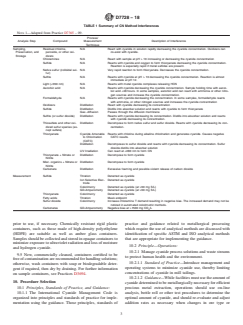
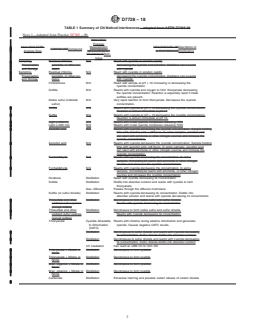
TABLE 1 Summary of CN Method Interferences
NOTE 1—Adapted from Practice D7365 – 09.
Process/
Analysis Step Compound Measurement Description of Interference
Technique
Sampling, Residual chlorine, N/A React with cyanide in solution rapidly decreasing the cyanide concentration. Oxidizers can
Preservation, and peroxide, or other oxi- co-exist with cyanide.
Storage dizers
Chloramines N/A React with sample at pH > 10 increasing or decreasing the cyanide concentration
Sulfide N/A Reacts with cyanide and oxygen to form thiocyanate decreasing the cyanide concentration.
Reaction is especially rapid if metal sulfides are present.
Native sulfur (colloidal sul- N/A Very rapid reaction to form thiocyanate. Decreases the cyanide concentration.
fur)
Sulfite N/A Reacts with cyanide at pH > 10 decreasing the cyanide concentration. Reaction is almost
immediate at pH 12.
Light (<350 nm) N/A Reacts with metal cyanide complexes releasing HCN
Ascorbic acid N/A Reacts with cyanide decreasing the cyanide concentration. Sample holding time with ascor-
bic acid <48 hours. In some samples, ascorbic acid can react with ammonia or other nitro-
gen sources and increase the cyanide concentration.
Formaldehyde N/A Reacts with cyanide decreasing the concentration. In some samples, formaldehyde reacts
with ammonia,
...
This document is not an ASTM standard and is intended only to provide the user of an ASTM standard an indication of what changes have been made to the previous version. Because
it may not be technically possible to adequately depict all changes accurately, ASTM recommends that users consult prior editions as appropriate. In all cases only the current version
of the standard as published by ASTM is to be considered the official document.
Designation: D7728 − 11 D7728 − 18
Standard Guide for
Selection of ASTM Analytical Methods for Implementation of
International Cyanide Management Code Guidance
This standard is issued under the fixed designation D7728; the number immediately following the designation indicates the year of
original adoption or, in the case of revision, the year of last revision. A number in parentheses indicates the year of last reapproval. A
superscript epsilon (´) indicates an editorial change since the last revision or reapproval.
1. Scope
1.1 This guide is applicable for the selection of appropriate ASTM standard analytical methods for metallurgical processing sites
to conform to International Cyanide Management Code guidance for the analysis of cyanide bearing solutions.
1.2 The analytical methods in this practiceguide are recommended for the sampling preservation and analysis of total cyanide,
available cyanide, weak acid dissociable cyanide, and free cyanide by Test Methods D2036, D4282, D4374, D6888, D6994,
D7237, D7284, and D7511. The values stated in SI units are to be regarded as standard. No other units of measurement are included
in this standard.
1.3 The values stated in SI units are to be regarded as standard. No other units of measurement are included in this standard.
1.4 This standard does not purport to address all of the safety concerns, if any, associated with its use. It is the responsibility
of the user of this standard to establish appropriate safety, health, and environmental practices and determine the applicability of
regulatory limitations prior to use.
1.5 This international standard was developed in accordance with internationally recognized principles on standardization
established in the Decision on Principles for the Development of International Standards, Guides and Recommendations issued
by the World Trade Organization Technical Barriers to Trade (TBT) Committee.
2. Referenced Documents
2.1 ASTM Standards:
D1129 Terminology Relating to Water
D1193 Specification for Reagent Water
D1293 Test Methods for pH of Water
D1976 Test Method for Elements in Water by Inductively-Coupled Plasma Atomic Emission Spectroscopy
D2036 Test Methods for Cyanides in Water
D3694 Practices for Preparation of Sample Containers and for Preservation of Organic Constituents
D3856 Guide for Management Systems in Laboratories Engaged in Analysis of Water
D4282 Test Method for Determination of Free Cyanide in Water and Wastewater by Microdiffusion
D4374 Test Methods for Cyanides in Water—Automated Methods for Total Cyanide, Weak Acid Dissociable Cyanide, and
Thiocyanate (Withdrawn 2012)
D4840 Guide for Sample Chain-of-Custody Procedures
D4841 Practice for Estimation of Holding Time for Water Samples Containing Organic and Inorganic Constituents
D5847 Practice for Writing Quality Control Specifications for Standard Test Methods for Water Analysis
D6888 Test Method for Available Cyanides with Ligand Displacement and Flow Injection Analysis (FIA) Utilizing Gas
Diffusion Separation and Amperometric Detection
D6994 Test Method for Determination of Metal Cyanide Complexes in Wastewater, Surface Water, Groundwater and Drinking
Water Using Anion Exchange Chromatography with UV Detection
D6696 Guide for Understanding Cyanide Species
This practiceguide is under the jurisdiction of ASTM Committee D19 on Water and is the direct responsibility of Subcommittee D19.06 on Methods for Analysis for
Organic Substances in Water.
Current edition approved Sept. 1, 2011July 15, 2018. Published September 2011July 2018. Originally approved in 2011. Last previous edition approved in 2011 as D7728
– 11. DOI: 10.1520/D7728-11.10.1520/D7728-18.
For referenced ASTM standards, visit the ASTM website, www.astm.org, or contact ASTM Customer Service at service@astm.org. For Annual Book of ASTM Standards
volume information, refer to the standard’s Document Summary page on the ASTM website.
The last approved version of this historical standard is referenced on www.astm.org.
Copyright © ASTM International, 100 Barr Harbor Drive, PO Box C700, West Conshohocken, PA 19428-2959. United States
D7728 − 18
D7237 Test Method for Free Cyanide and Aquatic Free Cyanide with Flow Injection Analysis (FIA) Utilizing Gas Diffusion
Separation and Amperometric Detection
D7284 Test Method for Total Cyanide in Water by Micro Distillation followed by Flow Injection Analysis with Gas Diffusion
Separation and Amperometric Detection
D7365 Practice for Sampling, Preservation and Mitigating Interferences in Water Samples for Analysis of Cyanide
D7511 Test Method for Total Cyanide by Segmented Flow Injection Analysis, In-Line Ultraviolet Digestion and Amperometric
Detection
D7572 Guide for Recovery of Aqueous Cyanides by Extraction from Mine Rock and Soil
2.2 ISO Standard:
ISO 17690:2015 Water Quality—Determination of Available Free Cyanide (pH 6) Using Flow Injection Analysis (FIA), Gas
Diffusion, and Amperometric Detection
2.3 Other References:
International Cyanide Management Code
National Water Quality Criteria for Cyanide
3. Terminology
3.1 Definitions—Definitions: For definitions of terms used in this practice, refer to Terminology D1129 and Guide D6696.
3.1.1 For definitions of terms used in this standard, refer to Terminology D1129 and Guide D6696.
3.2 Definitions of Terms Specific to This Standard:
3.2.1 refrigeration, n—storing the sample between its freezing point and 6°C.
3.2.2 titratable cyanide, n—cyanide measured by titration with silver nitrate to a rhodanine or silver electrode end point.
3.2.3 weak and dissociable (WAD) cyanide, n—available cyanide and weak acid dissociable cyanides, excluding determination
of iron-, gold-, and cobalt-cyanide complexes.
3.2.3 titratable cyanide, n—cyanide measured by titration with silver nitrate to a rhodanine or silver electrode end point.
4. Summary of Guide
4.1 Guidance is provided for selection of the appropriate analytical methods to determine cyanide for to apply to the
International Cyanide Management Code guidance for analysis of cyanide in solution.
5. Significance and Use
5.1 This guide is intended as a means for selecting the proper methods for measuring cyanide to conform to the International
Cyanide Management Code guidance related to the analysis of cyanide bearing solutions. Cyanide is analyzed in process solutions
and in discharges in order to apply code guidance; however, improper sample collection and preservation can result in significant
positive or negative bias, potentially resulting in over reporting or under reporting cyanide releases into the environment.
5.2 This guide contains comparative test methods that are intended for use in routine monitoring of cyanide. It is assumed that
all who use methods listed in this guide will be trained analysts capable of performing them skillfully and safely. It is expected
that work will be performed in a properly equipped laboratory applying appropriate quality control practices such as those
described in Guide D3856.
6. Interferences
6.1 Multiple interferences could affect the cyanide analytical results using methods enumerated in this guide. Refer to Practice
D7365 for proper handling of the solutions during sampling, mitigation of interferences and preservation prior to cyanide analysis.
6.2 Unless otherwise specified, samples must be analyzed within 14 days; however, it is recommended to estimate the actual
holding time for each new sample matrix as described in Practice D4841. Certain sample matrices may require immediate analysis
to avoid cyanide degradation due to interferences. A holding time study is required if there is evidence that cyanide degradation
occurs from interferences which would cause the holding time to be less than specified in this practiceguide or Practice D7365.
Potential interferences for cyanide analytical methods are shown in Table 1.
7. Reagents and Materials
7.1 Purity of Reagents—Reagent grade chemicals shall be used in this guide. Unless otherwise indicated, it is intended that all
reagents shall conform to the specifications of the Committee on Analytical Reagents of the American Chemical Society, where
Available from International Organization for Standardization (ISO), ISO Central Secretariat, BIBC II, Chemin de Blandonnet 8, CP 401, 1214 Vernier, Geneva,
Switzerland, http://www.iso.org.
Available from International Cyanide Management Institute, 1400 I Street, NW, Suite 550, Washington, DC 20005, https://www.cyanidecode.org.
Available from United States Environmental Protection Agency (EPA), William Jefferson Clinton Bldg., 1200 Pennsylvania Ave., NW, Washington, DC 20460,
http://www.epa.gov.
D7728 − 18
TABLE 1 Summary of CN Method Interferences - adapted from ASTM D7365-09
NOTE 1—Adapted from Practice D7365 – 09.
PROCESS/
Process/
ANALYSIS STEP- Measurement DESCRIPTION OFDescription of
COMPOUNDCompound
Analysis Step MEASUREMENT INTERFERENCEInterference
TECHNIQUETech-
nique
Sampling, Residual chlorine, N/A React with cyanide in solution rapidly
Preservation, peroxide, or other oxi- decreasing the cyanide concentration. Oxidizers can co-exist
and Storage dizers with cyanide
Sampling, Residual chlorine, N/A React with cyanide in solution rapidly
Preservation, peroxide, or other oxi- decreasing the cyanide concentration. Oxidizers can co-exist
and Storage dizers with cyanide.
Chloramines N/A React with sample at pH > 10 increasing or decreasing the
cyanide concentration
Sulfide N/A Reacts with cyanide and oxygen to form thiocyanate decreasing
the cyanide concentration. Reaction is especially rapid if metal
sulfides are present.
Native sulfur (colloidal N/A Very rapid reaction to form thiocyanate. Decreases the cyanide
sulfur) concentration.
Sulfite N/A Reacts with cyanide at pH > 10 decreasing the cyanide concentration.
Reaction is almost immediate at pH.12
Sulfite N/A Reacts with cyanide at pH > 10 decreasing the cyanide concentration.
Reaction is almost immediate at pH 12.
Light (<350nm) N/A Reacts with metal cyanide complexes releasing HCN
Light (<350 nm) N/A Reacts with metal cyanide complexes releasing HCN
Ascorbic acid N/A Reacts with cyanide decreasing the cyanide concentration. Sample holding
time with ascorbic acid < 48 hours. In some samples, ascorbic acid
can react with ammonia or other nitrogen sources and increase the
cyanide concentration.
Ascorbic acid N/A Reacts with cyanide decreasing the cyanide concentration. Sample holding
time with ascorbic acid <48 hours. In some samples, ascorbic acid
can react with ammonia or other nitrogen sources and increase the
cyanide concentration.
Formaldehyde N/A Reacts with cyanide decreasing the concentration. In some
samples, formaldehyde reacts with ammonia or other nitrogen
sources and increases the cyanide concentration.
Formaldehyde N/A Reacts with cyanide decreasing the concentration. In some
samples, formaldehyde reacts with ammonia, or other nitrogen
sources and increases the cyanide concentration
Oxidizers Distillation React with cyanide decreasing its concentration
Sulfide Distillation Distills into absorber solution and reacts with cyanide to form
thiocyanate
Gas -diffusion Passes through the diffusion membrane
Sulfite (or sulfur dioxide) Distillation Reacts with cyanide decreasing its concentration. Distills into
absorber solution and reacts with cyanide decreasing its concentration.
Thiosulfate and other Distillation Decompose to form native sulfur and sulfur dioxide.
oxidized sulfur species Reacts with cyanide decreasing its concentration
(except sulfate)
Thiosulfate and other Distillation Decompose to form native sulfur and sulfur dioxide.
oxidized sulfur species Reacts with cyanide decreasing its concentration.
(except sulfate)
Thiocyanate Cyanide Amenable Reacts with chlorine during alkaline chlorination and generates
to Chlorination cyanide. Causes negative CATC results.
(CATC)
Distillation Decomposes to sulfur dioxide and reacts with cyanide decreasing
its concentration. Sulfur dioxide distills into absorber solution.
Distillation Decomposes to sulfur dioxide and reacts with cyanide decreasing
its concentration. Sulfur dioxide distills into absorber solution
UV Irradiation Can react at <280 nm to form CN
Thiocyanate + Nitrate or Distillation Decompose to form cyanide.
Nitrite
Thiocyanate + Nitrate or Distillation Decompose to form cyanide
Nitrite
Misc. organics + Nitrate or Distillation Decompose to form cyanide.
Nitrite
Misc. organics + Nitrate or Distillation Decompose to form cyanide
Nitrite
Carbonate Distillation Excessive foaming and possible violent release of carbon dioxide
D7728 − 18
PROCESS/
Process/
ANALYSIS STEP- Measurement DESCRIPTION OFDescription of
COMPOUNDCompound
Analysis Step MEASUREMENT INTERFERENCEInterference
TECHNIQUETech-
nique
Measurement Sulfide Titration Detected as Cyanide
Measurement Sulfide Titration Detected as cyanide
Ion Selective Detected as Cyanide
Electrode
Ion Selective Detected as cyanide
Electrode
Colorimetry Detected as Cyanide (at > 50 mg S/L)
Colorimetry Detected as cya-
nide (at >50 mg
S/L)
GD-Amperometry Detected as Cya-
nide (at > 50 mg
S/L)
GD-Amperometry Detected as cya-
nide (at >50 mg
S/L)
Thiocyanate Colorimetry Detected as Cyanide
Thiocyanate Colorimetry Detected as cyanide
Fatty acids Titration Mask endpoint
Sulfur dioxide Colorimetry Increase chloramine T demand resulting in negative bias. The increased
demand may not be noticed in automated colorimetric methods
Sulfur dioxide Colorimetry Increase chloramine T demand resulting in negative bias. The increased
demand may not be noticed in automated colorimetric methods.
Carbonates GD-Amperometry Negative bias at > 1500 mg CO3/L
Carbonates GD-Ampe
...