

ASTM C1484-10(2018)
(Specification)Standard Specification for Vacuum Insulation Panels
General Information
- Abstract
ABSTRACT
This specification covers the general requirements for vacuum insulation panels (VIP). These panels have been used wherever high thermal resistance is desired in confined space applications, such as transportation, equipment, and appliances. The panel barrier consists of one or more layers of materials whose primary functions are to control gas diffusion to the core, and to provide mechanical protection. The core shall comprise a system of cells, microspheres, powders, fibers, aerogels, or laminates, whose chemical composition shall be organic, inorganic, or metallic. The physical and mechanical properties of vacuum insulation panels are presented in details. The compressive resistance, panel barrier permeance, and center-of-panel thermal resistivit shall be tested to meet the requirements prescribed. The effective thermal resistance differs significantly from the product of the center-of-panel resistivity and the thickness, and this system characteristic must take into account the details of the overall VIP design as well as its installation. The creep and dimensional stability at service condition shall be tested to meet the requirements prescribed.
SCOPE
1.1 This specification covers the general requirements for Vacuum Insulation Panels (VIP). These panels have been used wherever high thermal resistance is desired in confined space applications, such as transportation, equipment, and appliances.
1.2 Vacuum panels typically exhibit an edge effect due to differences between panel core and panel barrier thermal properties. This specification applies to composite panels whose center-of-panel apparent thermal resistivities (sec. 3.2.3) typically range from 87 to 870 m·K/W at 24°C mean, and whose intended service temperature boundaries range from –70 to 480°C.
1.3 The specification applies to panels encompassing evacuated space with: some means of preventing panel collapse due to atmospheric pressure, some means of reducing radiation heat transfer, and some means of reducing the mean free path of the remaining gas molecules.
1.4 Limitations:
1.4.1 The specification is intended for evacuated planar composites; it does not apply to non-planar evacuated self-supporting structures, such as containers or bottles with evacuated walls.
1.4.2 The specification describes the thermal performance considerations in the use of these insulations. Because this market is still developing, discrete classes of products have not yet been defined and standard performance values are not yet available.
1.5 The values stated in SI units are to be regarded as standard. No other units of measurement are included in this standard.
1.6 This standard does not purport to address all of the safety concerns, if any, associated with its use. It is the responsibility of the user of this standard to establish appropriate safety, health, and environmental practices and determine the applicability of regulatory limitations prior to use.
Note 1: For specific safety considerations see Annex A1.
1.7 This international standard was developed in accordance with internationally recognized principles on standardization established in the Decision on Principles for the Development of International Standards, Guides and Recommendations issued by the World Trade Organization Technical Barriers to Trade (TBT) Committee.
- Status
- Published
- Publication Date
- 31-Aug-2018
- Technical Committee
- C16 - Thermal Insulation
- Drafting Committee
- C16.22 - Organic and Nonhomogeneous Inorganic Thermal Insulations
Overview
ASTM C1484-10(2018): Standard Specification for Vacuum Insulation Panels sets forth the general requirements for vacuum insulation panels (VIP) used where high thermal resistance is required in confined spaces. Developed by ASTM International, this standard guides the manufacturing, testing, and application of VIPs, which deliver superior insulating performance for applications such as transportation, industrial equipment, and appliances.
A vacuum insulation panel typically consists of a core encased by a barrier material that reduces air and vapor diffusion and provides mechanical protection. The core can be composed of various materials, including fibers, powders, aerogels, or laminates, which may be organic, inorganic, or metallic in nature.
Key Topics
- Thermal Resistance: VIPs are designed for enhanced thermal resistance (R-value) in situations with limited spatial allowance. The standard addresses both the center-of-panel and effective thermal resistance, highlighting the influence of panel design, barrier material, and installation.
- Edge Effect: The specification notes the edge effect, where thermal properties at the panel edge differ from the center, impacting overall performance.
- Temperature Range and Applications: VIPs covered by ASTM C1484-10(2018) are capable of operation across a wide temperature range, from –70°C up to 480°C.
- Material Requirements: Panels must incorporate a barrier material to control gas diffusion and a core that prevents panel collapse and minimizes heat transfer by conduction and radiation.
- Mechanical and Physical Properties: The specification requires testing for compressive resistance, barrier permeance, creep, and dimensional stability at service conditions.
- Performance After Puncture: The standard also addresses the maintenance of thermal resistance even if puncture or barrier failure occurs.
- Safety and Marking: While the document does not cover all potential safety issues, it emphasizes the need for users to adopt appropriate health and safety practices.
Applications
Vacuum insulation panels specified under ASTM C1484-10(2018) are utilized in areas where maximizing thermal performance within minimal thickness is critical:
- Refrigeration and Appliances: Compact, energy-efficient insulating panels in consumer and industrial equipment
- Building and Construction: Specialized applications demanding superinsulation with space constraints
- Transportation: Insulated panels for vehicles, shipping containers, and cold-chain logistics where reducing heat loss is essential
- Technical Equipment: Used in sensitive instrumentation or devices operating at extreme temperatures
VIPs are selected for their high R-value and lightweight profile, supporting efficiency and design flexibility in advanced thermal management solutions. Selection and specification should include consideration of the intended environment (temperature, humidity), required service life, and performance after incidental damage.
Related Standards
For comprehensive VIP specification and quality assurance, several referenced ASTM and international standards are relevant:
- ASTM C165 – Measuring compressive properties of thermal insulations
- ASTM C177, C518, C1114, C1363 – Methods for measuring the thermal performance of insulating materials
- ASTM D1434 – Gas permeability of plastic films and sheeting
- ASTM C203, C480, D2221 – Evaluating flexural strength and creep properties
- ASTM C168, C1045, C1058 – Terminology and calculation guides for thermal insulation
- ASTM F88 – Seal strength of flexible barrier materials
- ISO 8318 – Vibration testing for transport packages
- IEC 68-2-6 – Environmental testing procedures
Summary
ASTM C1484-10(2018) is a key international standard enabling producers, engineers, and end users to specify, test, and utilize vacuum insulation panels for maximum thermal performance in minimal space. By following this specification, stakeholders ensure product consistency, quality, and reliability in critical insulation applications across many industries.
Keywords: ASTM C1484, vacuum insulation panels, VIP, thermal resistance, R-value, superinsulation, confined space insulation, barrier permeance, compressive resistance, high-performance insulation.
Relations
- Effective Date
- 01-Sep-2018
- Effective Date
- 15-Apr-2024
- Effective Date
- 01-Mar-2024
- Effective Date
- 01-Mar-2024
- Effective Date
- 01-Dec-2023
- Refers
ASTM D4169-23e1 - Standard Practice for Performance Testing of Shipping Containers and Systems - Effective Date
- 01-Dec-2023
- Effective Date
- 01-Dec-2023
- Effective Date
- 01-Nov-2023
- Effective Date
- 01-Nov-2023
- Effective Date
- 01-Apr-2020
- Refers
ASTM D3103-20 - Standard Test Method for Thermal Insulation Performance of Distribution Packages - Effective Date
- 01-Apr-2020
- Effective Date
- 01-Sep-2019
- Effective Date
- 01-Sep-2019
- Effective Date
- 01-Apr-2019
- Effective Date
- 01-Mar-2019
Get Certified
Connect with accredited certification bodies for this standard

DIBt (Deutsches Institut für Bautechnik)
German Institute for Building Technology.
DIN CERTCO
DIN Group product certification.

Aboma Certification B.V.
Specialized in construction, metal, and transport sectors.
Sponsored listings
Frequently Asked Questions
ASTM C1484-10(2018) is a technical specification published by ASTM International. Its full title is "Standard Specification for Vacuum Insulation Panels". This standard covers: ABSTRACT This specification covers the general requirements for vacuum insulation panels (VIP). These panels have been used wherever high thermal resistance is desired in confined space applications, such as transportation, equipment, and appliances. The panel barrier consists of one or more layers of materials whose primary functions are to control gas diffusion to the core, and to provide mechanical protection. The core shall comprise a system of cells, microspheres, powders, fibers, aerogels, or laminates, whose chemical composition shall be organic, inorganic, or metallic. The physical and mechanical properties of vacuum insulation panels are presented in details. The compressive resistance, panel barrier permeance, and center-of-panel thermal resistivit shall be tested to meet the requirements prescribed. The effective thermal resistance differs significantly from the product of the center-of-panel resistivity and the thickness, and this system characteristic must take into account the details of the overall VIP design as well as its installation. The creep and dimensional stability at service condition shall be tested to meet the requirements prescribed. SCOPE 1.1 This specification covers the general requirements for Vacuum Insulation Panels (VIP). These panels have been used wherever high thermal resistance is desired in confined space applications, such as transportation, equipment, and appliances. 1.2 Vacuum panels typically exhibit an edge effect due to differences between panel core and panel barrier thermal properties. This specification applies to composite panels whose center-of-panel apparent thermal resistivities (sec. 3.2.3) typically range from 87 to 870 m·K/W at 24°C mean, and whose intended service temperature boundaries range from –70 to 480°C. 1.3 The specification applies to panels encompassing evacuated space with: some means of preventing panel collapse due to atmospheric pressure, some means of reducing radiation heat transfer, and some means of reducing the mean free path of the remaining gas molecules. 1.4 Limitations: 1.4.1 The specification is intended for evacuated planar composites; it does not apply to non-planar evacuated self-supporting structures, such as containers or bottles with evacuated walls. 1.4.2 The specification describes the thermal performance considerations in the use of these insulations. Because this market is still developing, discrete classes of products have not yet been defined and standard performance values are not yet available. 1.5 The values stated in SI units are to be regarded as standard. No other units of measurement are included in this standard. 1.6 This standard does not purport to address all of the safety concerns, if any, associated with its use. It is the responsibility of the user of this standard to establish appropriate safety, health, and environmental practices and determine the applicability of regulatory limitations prior to use. Note 1: For specific safety considerations see Annex A1. 1.7 This international standard was developed in accordance with internationally recognized principles on standardization established in the Decision on Principles for the Development of International Standards, Guides and Recommendations issued by the World Trade Organization Technical Barriers to Trade (TBT) Committee.
ABSTRACT This specification covers the general requirements for vacuum insulation panels (VIP). These panels have been used wherever high thermal resistance is desired in confined space applications, such as transportation, equipment, and appliances. The panel barrier consists of one or more layers of materials whose primary functions are to control gas diffusion to the core, and to provide mechanical protection. The core shall comprise a system of cells, microspheres, powders, fibers, aerogels, or laminates, whose chemical composition shall be organic, inorganic, or metallic. The physical and mechanical properties of vacuum insulation panels are presented in details. The compressive resistance, panel barrier permeance, and center-of-panel thermal resistivit shall be tested to meet the requirements prescribed. The effective thermal resistance differs significantly from the product of the center-of-panel resistivity and the thickness, and this system characteristic must take into account the details of the overall VIP design as well as its installation. The creep and dimensional stability at service condition shall be tested to meet the requirements prescribed. SCOPE 1.1 This specification covers the general requirements for Vacuum Insulation Panels (VIP). These panels have been used wherever high thermal resistance is desired in confined space applications, such as transportation, equipment, and appliances. 1.2 Vacuum panels typically exhibit an edge effect due to differences between panel core and panel barrier thermal properties. This specification applies to composite panels whose center-of-panel apparent thermal resistivities (sec. 3.2.3) typically range from 87 to 870 m·K/W at 24°C mean, and whose intended service temperature boundaries range from –70 to 480°C. 1.3 The specification applies to panels encompassing evacuated space with: some means of preventing panel collapse due to atmospheric pressure, some means of reducing radiation heat transfer, and some means of reducing the mean free path of the remaining gas molecules. 1.4 Limitations: 1.4.1 The specification is intended for evacuated planar composites; it does not apply to non-planar evacuated self-supporting structures, such as containers or bottles with evacuated walls. 1.4.2 The specification describes the thermal performance considerations in the use of these insulations. Because this market is still developing, discrete classes of products have not yet been defined and standard performance values are not yet available. 1.5 The values stated in SI units are to be regarded as standard. No other units of measurement are included in this standard. 1.6 This standard does not purport to address all of the safety concerns, if any, associated with its use. It is the responsibility of the user of this standard to establish appropriate safety, health, and environmental practices and determine the applicability of regulatory limitations prior to use. Note 1: For specific safety considerations see Annex A1. 1.7 This international standard was developed in accordance with internationally recognized principles on standardization established in the Decision on Principles for the Development of International Standards, Guides and Recommendations issued by the World Trade Organization Technical Barriers to Trade (TBT) Committee.
ASTM C1484-10(2018) is classified under the following ICS (International Classification for Standards) categories: 91.060.10 - Walls. Partitions. Facades. The ICS classification helps identify the subject area and facilitates finding related standards.
ASTM C1484-10(2018) has the following relationships with other standards: It is inter standard links to ASTM C1484-10, ASTM C168-24, ASTM C1363-24, ASTM C390-08(2024), ASTM D999-08(2023), ASTM D4169-23e1, ASTM D4169-23, ASTM C1667-15(2023), ASTM D3763-23, ASTM C1055-20, ASTM D3103-20, ASTM C390-08(2019), ASTM C1363-19, ASTM C1045-19, ASTM C1114-06(2019). Understanding these relationships helps ensure you are using the most current and applicable version of the standard.
ASTM C1484-10(2018) is available in PDF format for immediate download after purchase. The document can be added to your cart and obtained through the secure checkout process. Digital delivery ensures instant access to the complete standard document.
Standards Content (Sample)
This international standard was developed in accordance with internationally recognized principles on standardization established in the Decision on Principles for the
Development of International Standards, Guides and Recommendations issued by the World Trade Organization Technical Barriers to Trade (TBT) Committee.
Designation:C1484 −10 (Reapproved 2018)
Standard Specification for
Vacuum Insulation Panels
This standard is issued under the fixed designation C1484; the number immediately following the designation indicates the year of
original adoption or, in the case of revision, the year of last revision. A number in parentheses indicates the year of last reapproval. A
superscript epsilon (´) indicates an editorial change since the last revision or reapproval.
NOTE 1—For specific safety considerations see Annex A1.
1. Scope
1.7 This international standard was developed in accor-
1.1 This specification covers the general requirements for
dance with internationally recognized principles on standard-
Vacuum Insulation Panels (VIP). These panels have been used
ization established in the Decision on Principles for the
wherever high thermal resistance is desired in confined space
Development of International Standards, Guides and Recom-
applications, such as transportation, equipment, and appli-
mendations issued by the World Trade Organization Technical
ances.
Barriers to Trade (TBT) Committee.
1.2 Vacuum panels typically exhibit an edge effect due to
differences between panel core and panel barrier thermal
2. Referenced Documents
properties. This specification applies to composite panels
2.1 ASTM Standards:
whose center-of-panel apparent thermal resistivities (sec.
C165 Test Method for Measuring Compressive Properties of
3.2.3) typically range from 87 to 870 m·K/W at 24°C mean,
Thermal Insulations
andwhoseintendedservicetemperatureboundariesrangefrom
C168 Terminology Relating to Thermal Insulation
–70 to 480°C.
C177 Test Method for Steady-State Heat Flux Measure-
1.3 Thespecificationappliestopanelsencompassingevacu-
ments and Thermal Transmission Properties by Means of
ated space with: some means of preventing panel collapse due
the Guarded-Hot-Plate Apparatus
to atmospheric pressure, some means of reducing radiation
C203 Test Methods for Breaking Load and Flexural Proper-
heat transfer, and some means of reducing the mean free path
ties of Block-Type Thermal Insulation
of the remaining gas molecules.
C390 Practice for Sampling and Acceptance of Thermal
Insulation Lots
1.4 Limitations:
C480 Test Method for Flexure Creep of Sandwich Construc-
1.4.1 The specification is intended for evacuated planar
tions
composites; it does not apply to non-planar evacuated self-
C518 Test Method for Steady-State Thermal Transmission
supporting structures, such as containers or bottles with evacu-
Properties by Means of the Heat Flow Meter Apparatus
ated walls.
C740 Guide for Evacuated Reflective Insulation In Cryo-
1.4.2 The specification describes the thermal performance
genic Service
considerations in the use of these insulations. Because this
C1045 Practice for Calculating Thermal Transmission Prop-
market is still developing, discrete classes of products have not
erties Under Steady-State Conditions
yet been defined and standard performance values are not yet
C1055 Guide for Heated System Surface Conditions that
available.
Produce Contact Burn Injuries
1.5 The values stated in SI units are to be regarded as
C1058 Practice for Selecting Temperatures for Evaluating
standard. No other units of measurement are included in this
and Reporting Thermal Properties of Thermal Insulation
standard.
C1114 Test Method for Steady-State Thermal Transmission
1.6 This standard does not purport to address all of the
Properties by Means of the Thin-Heater Apparatus
safety concerns, if any, associated with its use. It is the
C1136 Specification for Flexible, Low Permeance Vapor
responsibility of the user of this standard to establish appro-
Retarders for Thermal Insulation
priate safety, health, and environmental practices and deter-
C1363 Test Method for Thermal Performance of Building
mine the applicability of regulatory limitations prior to use.
Materials and Envelope Assemblies by Means of a Hot
Box Apparatus
This specification is under the jurisdiction of ASTM Committee C16 on
Thermal Insulation and is the direct responsibility of Subcommittee C16.22 on
Organic and Nonhomogeneous Inorganic Thermal Insulations. For referenced ASTM standards, visit the ASTM website, www.astm.org, or
Current edition approved Sept. 1, 2018. Published October 2018. Originally contact ASTM Customer Service at service@astm.org. For Annual Book of ASTM
approved in 2000. Last previous edition approved in 2010 as C1484 – 10. DOI: Standards volume information, refer to the standard’s Document Summary page on
10.1520/C1484-10R18. the ASTM website.
Copyright © ASTM International, 100 Barr Harbor Drive, PO Box C700, West Conshohocken, PA 19428-2959. United States
C1484−10 (2018)
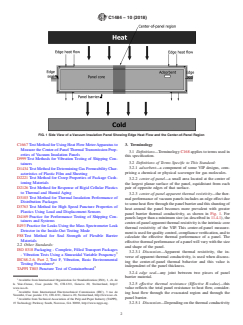
FIG. 1Side View of a Vacuum Insulation Panel Showing Edge Heat Flow and the Center-of-Panel Region
C1667 TestMethodforUsingHeatFlowMeterApparatusto 3. Terminology
Measure the Center-of-Panel Thermal Transmission Prop-
3.1 Definitions—Terminology C168 applies to terms used in
erties of Vacuum Insulation Panels
this specification.
D999 Test Methods for Vibration Testing of Shipping Con-
3.2 Definitions of Terms Specific to This Standard:
tainers
3.2.1 adsorbent—a component of some VIP designs, com-
D1434 TestMethodforDeterminingGasPermeabilityChar-
prising a chemical or physical scavenger for gas molecules.
acteristics of Plastic Film and Sheeting
D2221 Test Method for Creep Properties of Package Cush-
3.2.2 center-of-panel—a small area located at the center of
ioning Materials the largest planar surface of the panel, equidistant from each
D2126 Test Method for Response of Rigid Cellular Plastics
pair of opposite edges of that surface.
to Thermal and Humid Aging
3.2.3 center-of-panel apparent thermal resistivity—the ther-
D3103 Test Method for Thermal Insulation Performance of
mal performance of vacuum panels includes an edge effect due
Distribution Packages
tosomeheatflowthroughthepanelbarrierandthisshuntingof
D3763 Test Method for High Speed Puncture Properties of
heat around the panel becomes more prevalent with greater
Plastics Using Load and Displacement Sensors
panel barrier thermal conductivity, as shown in Fig. 1. For
D4169 Practice for Performance Testing of Shipping Con-
panels larger than a minimum size (as described in 11.4.1), the
tainers and Systems
center-of-panel apparent thermal resistivity is the intrinsic core
E493 Practice for Leaks Using the Mass Spectrometer Leak
thermal resistivity of the VIP. This center-of-panel measure-
Detector in the Inside-Out Testing Mode
mentisusedforqualitycontrol,complianceverification,andto
F88 Test Method for Seal Strength of Flexible Barrier
calculate the effective thermal performance of a panel. The
Materials
effectivethermalperformanceofapanelwillvarywiththesize
2.2 Other Standards:
and shape of the panel.
ISO 8318 Packaging - Complete, Filled Transport Packages
3.2.3.1 Discussion—Apparent thermal resistivity, the in-
- Vibration Tests Using a Sinusoidal Variable Frequency
verse of apparent thermal conductivity, is used when discuss-
IEC68-2-6, Part 2, Test F, Vibration, Basic Environmental
ing the center-of-panel thermal behavior and this value is
Testing Procedures
independent of the panel thickness.
TAPPI T803 Puncture Test of Containerboard
3.2.4 edge seal—any joint between two pieces of panel
barrier material.
Available from International Organization for Standardization (ISO), 1, ch. de
3.2.5 effective thermal resistance (Effective R-value)—this
la Voie-Creuse, Case postale 56, CH-1211, Geneva 20, Switzerland, http://
www.iso.ch.
value reflects the total panel resistance to heat flow, consider-
Available from International Electrotechnical Commission (IEC), 3 rue de
ing heat flow through the evacuated region and through the
Varembé, Case postale 131, CH-1211, Geneva 20, Switzerland, http://www.iec.ch.
5 panel barrier.
Available from TechnicalAssociation of the Pulp and Paper Industry (TAPPI),
15 Technology Parkway South, Norcross, GA 30092, http://www.tappi.org. 3.2.5.1 Discussion—Depending on the thermal conductivity
C1484−10 (2018)
and thickness of the panel barrier and the size of the panel, the 3.3.1 A = area, m .
effective thermal resistance of the panel over the edge to edge 3.3.2 g = specific outgassing rate, Pa·l/h · cm .
area may be significantly less than the thermal resistance 3.3.3 G = adsorbent capacity, Pa·m .
measured or calculated at the center of the panel. The effective 3.3.4 k = gas permeance, m/h · Pa.
thermal resistance will also depend on the temperatures im- 3.3.5 M = molecular weight, kg/mole.
posed on the two faces of the panel. 3.3.6 P = pressure, Pa.
3.2.5.2 Discussion—Thermal resistance, the inverse of ther- 3.3.7 Q = volumetric flow rate. m /h
malconductance,isusedwhendiscussingtheeffectivethermal 3.3.8 R = ideal gas constant, 8.315 J/g-mole · K.
performance of the panel. This value includes the effect of the 3.3.9 T = temperature, K.
actual panel dimensions, including the panel thickness. 3.3.10 V = internal VIP free volume, m .
3.3.11 α = outgassing exponent.
3.2.6 effective thermal resistance after puncture—this value
3.3.12 ρ = density, kg/m .
o
represents the effective thermal resistance of the panel in the
3.3.13 τ = time, h.
eventofatotalpanelbarrierfailure(completelossofvacuum).
3.3.14 Subscripts:
The edge effect is still present after a puncture.
3.3.14.1 e = environmental.
3.2.7 evacuated or vacuum insulations—insulation systems
3.3.14.2 i = refers to a specific gas, that is, P is the partial
i
whose gas phase thermal conductivity portion of the overall
th
pressure of the i gas.
apparent thermal conductivity has been significantly reduced
3.3.14.3 init = initial.
by reduction of the internal gas pressure. The level of vacuum
3.3.14.4 u = limiting (after long time).
willdependonpropertiesofthecompositepanelmaterials,and
3.3.14.5 0 = value after one h or value at standard tempera-
the desired effective thermal conductivity.
ture and pressure.
3.2.8 panel barrier—the material that envelops the evacu-
atedvolumeandisusedtoseparatetheevacuatedvolumefrom
4. Ordering Information
the environment and to provide a long term barrier to gas and
4.1 Orders shall include the following information:
vapor diffusion.
4.1.1 Title, designation, and year of issue of this
3.2.9 panel core—the material placed within the evacuated
specification,
volume in order to perform one or more of the following
4.1.2 Product name,
functions: prevent panel collapse due to atmospheric pressure,
4.1.3 Panel size and effective R-value required,
reduce radiation heat transfer, and establish interstitial spaces
4.1.4 Service environmental parameters: maximum
that are smaller in dimension than (or near to), the mean free
temperature,averagetemperature,maximumrelativehumidity,
path length of the remaining gas molecules. The thermal
average relative humidity,
conductivityofthepanelcore,orλ ,isdefinedasthethermal
core 4.1.5 Required service life,
conductivity of the core material under the same vacuum that
4.1.6 Tolerance if other than specified,
would occur within a panel, but without the panel barrier
4.1.7 Quantity of material,
material. This is the thermal conductivity that would be
4.1.8 Special requirements for inspection or testing, or both,
measured in the center of an infinitely large panel.
4.1.9 If packaging is other than specified,
4.1.10 If marking is other than specified,
3.2.10 service life—The period of time over which the
center-of-panel thermal conductivity meets the definition of a 4.1.11 Special installation instructions if applicable,
4.1.12 Required compressive resistance,
superinsulation. A standard-condition service life is defined as
that period of time over which the center-of-panel thermal 4.1.13 Required effective thermal resistance after puncture,
4.1.14 Any required fire characteristics,
conductivity meets the definition of a superinsulation under
standard conditions of 24°C and 50 % relative humidity. 4.1.15 Required creep characteristics,
4.1.16 Required edge seal strength, and
3.2.10.1 Discussion—The thermal resistance of a VIP de-
grades with time due to residual outgassing of VIP materials 4.1.17 Required dimensional stability at service environ-
mental conditions.
andgasdiffusionthroughthepanelbarrierandedgeseals.Both
of these processes are affected by the service environment,
5. Materials and Manufacture
mostimportantlybytheservicetemperatureandhumdityinthe
surrounding air. The service life in hotter or more humid
5.1 Panel Composite Design—The panel shall consist of a
conditions may be shorter; conversely drier or colder environ-
gas barrier layer(s), as described in 5.2, and an evacuated core
mental conditions can extend the life of the panel.
material or system as described in 5.3. See Fig. 1.An
engineered quantity of gas adsorbent is optional. It is not
3.2.11 superinsulation—insulation systems whose center-
necessary that the panel design be symmetrical, depending
of-panel thermal resistivity exceeds 87 m · K/W measured at
upon end-use requirements.
24°C mean.
5.2 Panel Barrier Composition—The panel barrier consists
3.3 Symbols and Units—The symbols used in this test
method have the following significance: of one or more layers of materials whose primary functions are
to control gas diffusion to the core, and to provide mechanical
protection. Candidate panel barrier materials include metallic,
For further discussion on heat flow mechanisms in evacuated insulations, see
Practice C740 . organic, inorganic or a combination thereof depending on the
C1484−10 (2018)
level of vacuum required, the desired service life, and the 6.6 Panel Barrier Permeance—The panel barrier per-
intended service temperature regimes. Panel barrier materials meance is required for the VIP Service Life calculations. The
are selected to prevent outgassing, or at least to give off only panel barrier permeance shall be measured and reported for
those gases or vapors which can be conveniently adsorbed. individual gases of interest.
5.3 Panel Core Composition—The core shall comprise a
NOTE 4—The panel barrier permeance may also be affected by the
service environment.
system of cells, microspheres, powders, fibers, aerogels, or
laminates, whose chemical composition shall be organic,
6.7 Dimensional Stability at Service Conditions—Themaxi-
inorganic, or metallic. Within the reticular portion of the core,
mum allowable change in panel dimensions caused by the
subsystems such as honeycomb or integral wall systems are
change from ambient to service environmental conditions shall
allowed.
be specified by the purchaser.
NOTE 2—The function of the core composition or system is typically
twofold: it reduces the radiative, solid, and gaseous heat transfer contri-
7. Dimensions and Tolerances
butionstooverallheattransfer,anditcanprovideastructuralcomplement
to the panel barriers. Core systems or densities will therefore vary for 7.1 Dimensions—The dimensions shall be as agreed upon
different anticipated end-uses and service temperature regimes.
by the purchaser and supplier.
7.2 Tolerances—Tolerances shall be as agreed upon by the
6. Physical and Mechanical Properties
purchaser and supplier.
6.1 Compressive Resistance—The required compressive re-
sistance shall be specified by the purchaser according to the
8. Workmanship and Finish
application.
8.1 Theinsulationshallhavenodefectsthatadverselyaffect
6.2 Effective Thermal Resistance (effective R-value)—Table
its service qualities and ability to be installed.
1 defines standard conditions and information that must be
reported with the effective thermal resistance.
9. Sampling
9.1 Quality control records shall be maintained by the
NOTE 3—Because the effective thermal resistance is affected by many
variables, manufacturers may also provide thermal resistance data at other
manufacturer, and will usually suffice in the relationship
conditions.Inadditiontotemperature,temperaturegradient,andthickness
between the purchaser and the manufacturer. If they mutually
effects, size and shape may have a significant impact on the effective
agree to accept lots on the basis of quality control records, no
thermal resistance of superinsulation panels, depending on the thermal
further sampling is required.
conductivity of the panel barrier relative to that of the core. The effective
thermal resistance can also be affected by temporary temperature excur-
9.2 Any alternate sampling procedure shall be agreed upon
sions that could occur during panel installation, as discussed further in
between the purchaser and the manufacturer.
Appendix X2.
6.3 Effective Thermal Resistance After Puncture—This
10. Qualification Requirements
value represents the effective thermal resistance of the panel in
10.1 For the purpose of initial material or product
the event of a panel barrier failure (that is, after the panel
qualification,insulationshallmeetthephysicalandmechanical
internal volume has reached ambient pressure) and shall be
properties of Section 6.
reported by the supplier.
10.2 Acceptance qualification for lots and shipments of
6.4 Fire Characteristics—The fire properties of the vacuum
qualified product shall be agreed upon by purchaser and
insulation panel shall be addressed through fire test require-
supplier.
ments that are specific to the end use.
6.5 Creep Characteristics—The creep properties of a VIP
11. Test Methods
will determine its shape and thickness in an application where
11.1 Properties of the insulation shall be determined in
the VIP is subjected to an externally applied constant stress.
accordance with the following methods.
This stress can be caused by the environmental temperature as
11.2 Compressive Resistance—Test Method C165 or an-
well as by a mechanical load. The creep properties are
other method acceptable to both the purchaser and supplier
important because the shape and thickness of the VIP directly
shall be used.
affect its thermal performance. The required creep properties
shallbespecifiedbythepurchaseraccordingtotheapplication.
11.3 Panel Barrier Permeance—The panel barrier per-
meance for each gas of interest shall be measured using Test
Method D1434, the method described in Appendix X3,or
another method acceptable to both the purchaser and supplier.
TABLE 1 Standard Effective Thermal Resistance Report
The effects of service temperature and humidity, any tempera-
Conditions and Related Information Requirements for New
ture excursion(s), and the chemical environment on the panel
Vacuum Insulation Panels
barrier permeance shall be considered.
Panel Dimensions
Maximum use temperature 11.4 Thermal Performance:
Maximum use humidity at 24°C
11.4.1 Center-of-Panel Thermal Resistivity—The center-of-
Projected standard-condition service life
panel thermal resistivity is a measured value that is used to
Initial effective thermal resistance at 24°C and 50 % relative humidity
approximate the thermal resistivity of the evacuated core
C1484−10 (2018)
region. Use Test Methods C177, C518,or C1114 in conjunc- ture shall be selected according to the standard reporting
tion with Test Method C1667and Practice C1045 to evaluate temperatures shown in Table 1.
center-of-panel heat transfer properties. In the event of dispute, (2) Calculate the effective thermal resistance of a full-size
Test Method C177 shall be the referee method. Temperature panel by the use of finite element analysis, as described in Ref
differences shall be selected from Practice C1058. The mean (1). For this analysis, the center-of-panel (or core) thermal
test temperature shall be selected according to the standard conductivity and that of the panel barrier material shall be
reporting temperatures shown in Table 1. The mean thermal known.
resistivityofthecenter-of-paneltestedshallnotbelessthanthe 11.4.2.3 Around-robin test examined the consistency of the
manufacturer’s stated values.
various mathematical models used to calculate effective ther-
mal resistance (4).
NOTE5—Duetolowthermaldiffusivityofsomesuperinsulation,itmay
be necessary to increase the time required to reach steady-state heat flow
11.5 Effective Thermal Performance after Puncture—The
in thermal resistance tests.
panel barrier shall be punctured with a hole at least 6 mm in
NOTE 6—For a sufficiently large panel, the flow through the panel
diameterandthepanelinteriorshallbeexposedtoatmospheric
barrier will be a relatively small portion of the flow measured at the center
pressure for at least seven days. Then the effective thermal
of panel, so that thermal conductivity measurements made at the center of
thepanelwillrepresenttheconductivityofthepanelcoreregionwithinan
resistance shall be measured as described in 11.4.2. The mean
adequate margin of error. The center-of-panel thermal resistivity is often
thermal resistance of the material tested shall not be less than
used, along with information about the panel barrier material and panel
the manufacturer’s stated values.
geometry, to calculate the effective panel thermal resistance.
NOTE 7—The center-of-panel measurement can be used for quality
11.6 Service Life—The actual service life of a vacuum
control purposes. If panels are tested two weeks after manufacture as a
insulationpanelisdeterminedinlargepartby:thepaneldesign
part of quality-control program, this measurement will expose any panels
and materials, the service environment, and the minimum
with gross leaks.
acceptable thermal resistance. The standard-condition service
11.4.1.1 The minimum panel size for this test is determined
life is defined as the period of time for which the panel will
by the thermal conductivity of the panel barrier, the thickness
provide superinsulation performance in an environment of
of the panel barrier, the thermal conductivity of the core, and
24°C and 50 % relative humidity. In making this
the size of the heat flux transducer or guarded hot plate surface
determination, the manufacturer shall consider, at the stated
used to make the measurement.Test Method C1667 provides a
standard environmental conditions, the following: the outgas-
fuller discussion of the relationship between these factors.
sing of the filler material, the outgassing and permeability of
11.4.1.2 Another method to determine the core conductivity
the panel barrier material, the p
...