

ASTM D4400-18
(Test Method)Standard Test Method for Sag Resistance of Paints Using a Multinotch Applicator
General Information
- Abstract
SIGNIFICANCE AND USE
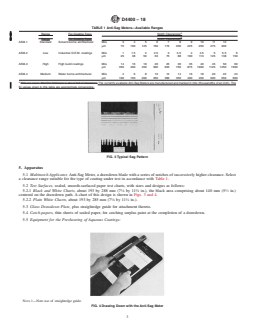
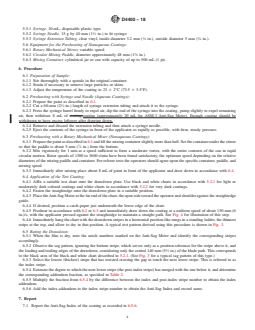
4.1 Evaluation of sag resistance is essential in quality control for both producers and purchasers of coatings. Practical application tests are poor in reproducibility, while viscometric methods, for example Test Methods D2196, are time-consuming and lack the convincing aspect of actual sagging. This method provides simple and rapid tests, whereby sag resistance is demonstrated by a visible sag pattern, and is rated objectively in terms of numerical values that correlate with brushout test observations.
SCOPE
1.1 This test method covers the laboratory determination of the sag resistance of aqueous and nonaqueous liquid coatings at any level of sag resistance.
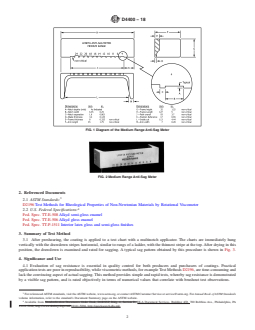
FIG. 1 Diagram of the Medium Range Anti-Sag Meter
FIG. 2 Medium Range Anti-Sag Meter
1.2 The values stated in either SI units or inch-pound units are to be regarded separately as standard. The values stated in each system may not be exact equivalents; therefore, each system shall be used independently of the other. Combining values from the two systems may result in non-conformance with the standard.
Note 1: Because the only manufacturer of the applicator know to the committee manufactures to inch-pound units, inch-pound units will be regarded as the standard when referring to the applicator.
1.3 This standard does not purport to address all of the safety concerns, if any, associated with its use. It is the responsibility of the user of this standard to establish appropriate safety, health, and environmental practices and determine the applicability of regulatory limitations prior to use.
1.4 This international standard was developed in accordance with internationally recognized principles on standardization established in the Decision on Principles for the Development of International Standards, Guides and Recommendations issued by the World Trade Organization Technical Barriers to Trade (TBT) Committee.
- Status
- Published
- Publication Date
- 14-Sep-2018
- Technical Committee
- D01 - Paint and Related Coatings, Materials, and Applications
- Drafting Committee
- D01.42 - Architectural Coatings
Buy Documents

ASTM D4400-18 - Standard Test Method for Sag Resistance of Paints Using a Multinotch Applicator
REDLINE ASTM D4400-18 - Standard Test Method for Sag Resistance of Paints Using a Multinotch Applicator
Overview
ASTM D4400-18 is the international standard that specifies a laboratory test method for determining the sag resistance of paints and other liquid coatings using a multinotch applicator, known as the Anti-Sag Meter. Developed and maintained by ASTM International, this method is essential for quality control during both production and purchasing of paint and coatings. Sag resistance is a key property for liquid coatings, as it measures the ability of a product to remain in place without flowing or sagging when applied to vertical or inclined surfaces.
Compared to other practical application tests, this standard delivers improved reproducibility and objective, numerical results that correlate well with real-world observations using brushout tests. ASTM D4400-18 applies to both aqueous and nonaqueous liquid coatings and is referenced in relevant U.S. Federal specifications for coating products.
Key Topics
- Sag Resistance Measurement: Uses a multinotch applicator (Anti-Sag Meter) to create coatings with varying thicknesses on a test chart. The applicator allows for a visible and measurable sag pattern, producing an Anti-Sag Index.
- Test Applicability: Suitable for all types of liquid coatings, including solvent-borne, water-borne, industrial, and high-build coatings.
- Objective Assessment: Results are given as a numerical Anti-Sag Index, which correlates closely with brushout observations but is simpler and more rapid than viscometric or brushout methods.
- Reproducibility and Precision: Provides repeatable and sensitive measurements, with demonstrated correlation coefficients up to 0.92 in interlaboratory studies.
- Standard Units: Test results can be reported in either SI units or inch-pound units, with inch-pound units being the standard for the Anti-Sag Meter itself.
- Safety and Compliance: The standard reminds users to consider safety, health, and environmental practices when conducting this test.
Applications
The ASTM D4400-18 standard test method is widely used in:
- Paint and Coatings Manufacturing: Ensuring that products meet defined sag resistance requirements before release to the market.
- Quality Control Laboratories: Monitoring batch-to-batch consistency during production.
- Procurement and Specification: Objective evaluation for purchasers of coatings, supporting compliance with contract specifications.
- Product Development: Evaluating and comparing the sag resistance performance of experimental coatings during R&D.
- Regulatory and Certification Contexts: Referenced in official U.S. Federal Specifications (e.g., TT-E-508, TT-E-506, TT-P-1511) as part of compliance and testing requirements for public projects or military applications.
Sag resistance testing is particularly critical for coatings applied to vertical or overhead surfaces, such as architectural walls, industrial structures, automotive components, and interior finishes, where flowing or dripping of paint can compromise both aesthetics and protective performance.
Related Standards
- ASTM D2196: Test Methods for Rheological Properties of Non-Newtonian Materials by Rotational Viscometer - provides complementary information on coating flow behavior.
- U.S. Federal Specifications:
- TT-E-508 (Alkyd semi-gloss enamel)
- TT-E-506 (Alkyd gloss enamel)
- TT-P-1511 (Interior latex gloss and semi-gloss finishes)
- ASTM D01 Committee Standards: Additional relevant standards for paint and related coatings, materials, and applications.
Keywords: ASTM D4400, sag resistance, paint testing, Anti-Sag Index, multinotch applicator, coatings quality control, rheological properties, anti-sag meter, standard test method, paint flow properties.
Relations
- Effective Date
- 15-Sep-2018
- Effective Date
- 01-Jun-2018
- Effective Date
- 01-Jul-2010
- Effective Date
- 01-Jul-2005
- Effective Date
- 10-Apr-1999
- Effective Date
- 15-Sep-2018
- Effective Date
- 15-Sep-2018
- Referred By
ASTM D6763-16(2022) - Standard Guide for Testing Exterior Wood Stains and Clear Water Repellents - Effective Date
- 15-Sep-2018
- Effective Date
- 15-Sep-2018
- Effective Date
- 15-Sep-2018
- Effective Date
- 15-Sep-2018
Buy Documents
ASTM D4400-18 - Standard Test Method for Sag Resistance of Paints Using a Multinotch Applicator
REDLINE ASTM D4400-18 - Standard Test Method for Sag Resistance of Paints Using a Multinotch Applicator
Frequently Asked Questions
ASTM D4400-18 is a standard published by ASTM International. Its full title is "Standard Test Method for Sag Resistance of Paints Using a Multinotch Applicator". This standard covers: SIGNIFICANCE AND USE 4.1 Evaluation of sag resistance is essential in quality control for both producers and purchasers of coatings. Practical application tests are poor in reproducibility, while viscometric methods, for example Test Methods D2196, are time-consuming and lack the convincing aspect of actual sagging. This method provides simple and rapid tests, whereby sag resistance is demonstrated by a visible sag pattern, and is rated objectively in terms of numerical values that correlate with brushout test observations. SCOPE 1.1 This test method covers the laboratory determination of the sag resistance of aqueous and nonaqueous liquid coatings at any level of sag resistance. FIG. 1 Diagram of the Medium Range Anti-Sag Meter FIG. 2 Medium Range Anti-Sag Meter 1.2 The values stated in either SI units or inch-pound units are to be regarded separately as standard. The values stated in each system may not be exact equivalents; therefore, each system shall be used independently of the other. Combining values from the two systems may result in non-conformance with the standard. Note 1: Because the only manufacturer of the applicator know to the committee manufactures to inch-pound units, inch-pound units will be regarded as the standard when referring to the applicator. 1.3 This standard does not purport to address all of the safety concerns, if any, associated with its use. It is the responsibility of the user of this standard to establish appropriate safety, health, and environmental practices and determine the applicability of regulatory limitations prior to use. 1.4 This international standard was developed in accordance with internationally recognized principles on standardization established in the Decision on Principles for the Development of International Standards, Guides and Recommendations issued by the World Trade Organization Technical Barriers to Trade (TBT) Committee.
SIGNIFICANCE AND USE 4.1 Evaluation of sag resistance is essential in quality control for both producers and purchasers of coatings. Practical application tests are poor in reproducibility, while viscometric methods, for example Test Methods D2196, are time-consuming and lack the convincing aspect of actual sagging. This method provides simple and rapid tests, whereby sag resistance is demonstrated by a visible sag pattern, and is rated objectively in terms of numerical values that correlate with brushout test observations. SCOPE 1.1 This test method covers the laboratory determination of the sag resistance of aqueous and nonaqueous liquid coatings at any level of sag resistance. FIG. 1 Diagram of the Medium Range Anti-Sag Meter FIG. 2 Medium Range Anti-Sag Meter 1.2 The values stated in either SI units or inch-pound units are to be regarded separately as standard. The values stated in each system may not be exact equivalents; therefore, each system shall be used independently of the other. Combining values from the two systems may result in non-conformance with the standard. Note 1: Because the only manufacturer of the applicator know to the committee manufactures to inch-pound units, inch-pound units will be regarded as the standard when referring to the applicator. 1.3 This standard does not purport to address all of the safety concerns, if any, associated with its use. It is the responsibility of the user of this standard to establish appropriate safety, health, and environmental practices and determine the applicability of regulatory limitations prior to use. 1.4 This international standard was developed in accordance with internationally recognized principles on standardization established in the Decision on Principles for the Development of International Standards, Guides and Recommendations issued by the World Trade Organization Technical Barriers to Trade (TBT) Committee.
ASTM D4400-18 is classified under the following ICS (International Classification for Standards) categories: 87.040 - Paints and varnishes. The ICS classification helps identify the subject area and facilitates finding related standards.
ASTM D4400-18 has the following relationships with other standards: It is inter standard links to ASTM D4400-99(2012)e1, ASTM D2196-18, ASTM D2196-10, ASTM D2196-05, ASTM D2196-99, ASTM D6577-15(2019), ASTM D7394-18(2023), ASTM D6763-16(2022), ASTM D3730-17(2022), ASTM D5146-10(2019), ASTM D5324-16(2022). Understanding these relationships helps ensure you are using the most current and applicable version of the standard.
ASTM D4400-18 is available in PDF format for immediate download after purchase. The document can be added to your cart and obtained through the secure checkout process. Digital delivery ensures instant access to the complete standard document.
Standards Content (Sample)
This international standard was developed in accordance with internationally recognized principles on standardization established in the Decision on Principles for the
Development of International Standards, Guides and Recommendations issued by the World Trade Organization Technical Barriers to Trade (TBT) Committee.
Designation: D4400 − 18
Standard Test Method for
Sag Resistance of Paints Using a Multinotch Applicator
This standard is issued under the fixed designation D4400; the number immediately following the designation indicates the year of
original adoption or, in the case of revision, the year of last revision. A number in parentheses indicates the year of last reapproval. A
superscript epsilon (´) indicates an editorial change since the last revision or reapproval.
This standard has been approved for use by agencies of the U.S. Department of Defense.
INTRODUCTION
The multinotch applicator used in this test method is a drawdown blade with a series of notches of
successively higher clearance, referred to as the Anti-Sag Meter. See Fig. 1 and Fig. 2 for a
representative diagram and photograph. The numerical value for sag resistance obtained with this
instrument is referred to as the Anti-Sag Index.
Anti-Sag Meters are made with several clearance ranges for different types of coatings (see 5.1 and
Table 1). In developing this standard the task group used an instrument with a range from 4 to 24 mils,
but the method is applicable to any clearance range, and results using instruments with overlapping
ranges correlate and have equal validity.
The basic method was developed in 1962 and is referenced in U.S. Federal specifications
TT-E-508, TT-E-506, and TT-P-1511.
Apreshear program is essential for a drawdown sag test to duplicate the breakdown in structure that
occurs when thixotropic paints are applied by brushout or other practical application methods. The
procedures therefore include the preshearing of paints just prior to making test applications.
1. Scope 1.4 This international standard was developed in accor-
dance with internationally recognized principles on standard-
1.1 This test method covers the laboratory determination of
ization established in the Decision on Principles for the
thesagresistanceofaqueousandnonaqueousliquidcoatingsat
Development of International Standards, Guides and Recom-
any level of sag resistance.
mendations issued by the World Trade Organization Technical
1.2 The values stated in either SI units or inch-pound units
Barriers to Trade (TBT) Committee.
are to be regarded separately as standard. The values stated in
each system may not be exact equivalents; therefore, each
2. Referenced Documents
system shall be used independently of the other. Combining
2.1 ASTM Standards:
values from the two systems may result in non-conformance
D2196 Test Methods for Rheological Properties of Non-
with the standard.
Newtonian Materials by Rotational Viscometer
NOTE 1—Because the only manufacturer of the applicator know to the
2.2 U.S. Federal Specifications:
committee manufactures to inch-pound units, inch-pound units will be
regarded as the standard when referring to the applicator. Fed. Spec. TT-E-508 Alkyd semi-gloss enamel
Fed. Spec. TT-E-506 Alkyd gloss enamel
1.3 This standard does not purport to address all of the
Fed. Spec. TT-P-1511 Interior latex gloss and semi-gloss
safety concerns, if any, associated with its use. It is the
finishes
responsibility of the user of this standard to establish appro-
priate safety, health, and environmental practices and deter-
3. Summary of Test Method
mine the applicability of regulatory limitations prior to use.
3.1 After preshearing, the coating is applied to a test chart
with a multinotch applicator. The charts are immediately hung
This test method is under the jurisdiction of ASTM Committee D01 on Paint
and Related Coatings, Materials, andApplications and is the direct responsibility of
Subcommittee D01.42 on Architectural Coatings. For referenced ASTM standards, visit the ASTM website, www.astm.org, or
Current edition approved Sept. 15, 2018. Published October 2018. Originally contact ASTM Customer Service at service@astm.org. For Annual Book of ASTM
ɛ1
approved in 1984. Last previous edition approved in 2012 as D4400 – 99 (2012) . Standards volume information, refer to the standard’s Document Summary page on
DOI: 10.1520/D4400-18. the ASTM website.
2 4
“Design of an Improved Sag Tester,” Offıcial Digest, Vol 34, No. 453, October Available from DLA Document Services, Building 4/D, 700 Robbins Ave.,
1962. Philadelphia, PA 19111-5094, http://quicksearch.dla.mil.
Copyright © ASTM International, 100 Barr Harbor Drive, PO Box C700, West Conshohocken, PA 19428-2959. United States
D4400 − 18
FIG. 1 Diagram of the Medium Range Anti-Sag Meter
5.2.1 Black and White Charts, about 193 by 288 mm (7 ⁄8
3 1
by 11 ⁄8 in.), the black area comprising about 140 mm (5 ⁄2 in.)
centered on the drawdown path.Achart of this design is shown
in Figs. 3 and 4.
5.2.2 Plain White Charts, about 193 by 285 mm (7 ⁄8 by
11 ⁄4 in.).
5.3 Glass Drawdown Plate, plus straightedge guide for
attachment thereto.
FIG. 2 Medium Range Anti-Sag Meter
5.4 Catch-papers, thin sheets of sealed paper, for catching
surplus paint at the completion of a drawdown.
vertically with the drawdown stripes horizontal, similar to
5.5 Equipment for the Preshearing of Aqueous Coatings:
rungs of a ladder, with the thinnest stripe at the top. After
5.5.1 Syringe, 10-mL, disposable plastic type.
dryinginthisposition,thedrawdownisexaminedandratedfor
5.5.2 Syringe Needle,15gby40mm(1 ⁄2 in.) to fit syringe.
sagging. A typical sag pattern obtained by this procedure is
5.5.3 Syringe Extension Tubing, clear vinyl, inside diameter
shown in Fig. 3.
1 3
3.2 mm ( ⁄8 in.), outside diameter 5 mm ( ⁄6 in.).
4. Significance and Use
5.6 Equipment for the Preshearing of Nonaqueous Coat-
4.1 Evaluation of sag resistance is essential in quality
ings:
controlforbothproducersandpurchasersofcoatings.Practical
5.6.1 Rotary Mechanical Stirrer, variable speed.
application tests are poor in reproducibility, while viscometric
5.6.2 Circular Mixing Paddle, diameter approximately 48
methods, for example Test Methods D2196, are time-
mm (1 ⁄8 in.).
consuming and lack the convincing aspect of actual sagging.
5.6.3 Mixing Container, cylindrical jar or can with capacity
This method provides simple and rapid tests, whereby sag
of up to 500 mL (1 pt).
resistance is demonstrated by a visible sag pattern, and is rated
objectively in terms of numerical values that correlate with
6. Procedure
brushout test observations.
6.1 Preparation of Sample:
5. Apparatus 6.1.1 Stirthoroughlywithaspatulaintheoriginalcontainer.
6.1.2 Strain if necessary to remove large particles or skins.
5.1 Multinotch Applicator, Anti-Sag Meter, a drawdown
6.1.3 Adjust the temperature of the coating to 23 6 2°C
blade with a series of notches of successively higher clearance.
(73.5 6 3.5°F).
Select a clearance range suitable for the type of coating under
test in accordance with Table 1.
6.2 Preshearing with Syringe and Needle (Aqueous Coat-
ings):
5.2 Test Surfaces, sealed, smooth-surfaced paper test charts,
with sizes and designs as follows: 6.2.1 Prepare the paint as described in 6.1.
D4400 − 18
TABLE 1 Anti-Sag Meters—Available Ranges
A
Range For Coating Type: Notch Clearances
ASM-1 Standard Solvent-borne architectural Mils 3456789 10 11 12
µm 75 100 125 150 175 200 225 250 275 300
ASM-2 Low Industrial O.E.M. coatings Mils 1 1.5 2 2.5 3 3.5 4 4.5 5 5.5 6
µm 25 38 50 63 75 88 100 113 125 138 150
ASM-3 High High build coatings Mils 14 16 18 20 25 30 35 40 45 50 60
µm 350 400 450 500 625 750 875 1000 1125 1250 1500
ASM-4 Medium Water borne architectural Mils 4 6 8 10 12 14 16 18 20 22 24
µm 10
...
This document is not an ASTM standard and is intended only to provide the user of an ASTM standard an indication of what changes have been made to the previous version. Because
it may not be technically possible to adequately depict all changes accurately, ASTM recommends that users consult prior editions as appropriate. In all cases only the current version
of the standard as published by ASTM is to be considered the official document.
´1
Designation: D4400 − 99 (Reapproved 2012) D4400 − 18
Standard Test Method for
Sag Resistance of Paints Using a Multinotch Applicator
This standard is issued under the fixed designation D4400; the number immediately following the designation indicates the year of
original adoption or, in the case of revision, the year of last revision. A number in parentheses indicates the year of last reapproval. A
superscript epsilon (´) indicates an editorial change since the last revision or reapproval.
This standard has been approved for use by agencies of the U.S. Department of Defense.
ε NOTE—Sole source of supply footnote was removed editorially and new footnote placed in Precision section in Novem-
ber 2012.
INTRODUCTION
The multinotch applicator used in this test method is a drawdown blade with a series of notches of
successively higher clearance, referred to as the Anti-Sag Meter. See Fig. 1 and Fig. 2 for a
representative diagram and photograph. The numerical value for sag resistance obtained with this
instrument is referred to as the Anti-Sag Index.
Anti-Sag Meters are made with several clearance ranges for different types of coatings (see 5.1 and
Table 1). In developing this standard the task group used an instrument with a range from 4 to 24 mils,
but the method is applicable to any clearance range, and results using instruments with overlapping
ranges correlate and have equal validity.
The basic method was developed in 1962 and is referenced in U.S. Federal specifications
TT-E-508, TT-E-506, and TT-P-1511.
A preshear program is essential for a drawdown sag test to duplicate the breakdown in structure that
occurs when thixotropic paints are applied by brushout or other practical application methods. The
procedures therefore include the preshearing of paints just prior to making test applications.
1. Scope
1.1 This test method covers the laboratory determination of the sag resistance of aqueous and nonaqueous liquid coatings at any
level of sag resistance.
1.2 The values stated in either SI units or inch-pound units are to be regarded separately as the standard. The values given in
parentheses are for information only.stated in each system may not be exact equivalents; therefore, each system shall be used
independently of the other. Combining values from the two systems may result in non-conformance with the standard.
NOTE 1—Because the only manufacturer of the applicator know to the committee manufactures to inch-pound units, inch-pound units will be regarded
as the standard when referring to the applicator.
1.3 This standard does not purport to address all of the safety concerns, if any, associated with its use. It is the responsibility
of the user of this standard to establish appropriate safety safety, health, and healthenvironmental practices and determine the
applicability of regulatory limitations prior to use.
1.4 This international standard was developed in accordance with internationally recognized principles on standardization
established in the Decision on Principles for the Development of International Standards, Guides and Recommendations issued
by the World Trade Organization Technical Barriers to Trade (TBT) Committee.
This test method is under the jurisdiction of ASTM Committee D01 on Paint and Related Coatings, Materials, and Applications and is the direct responsibility of
Subcommittee D01.42 on Architectural Coatings.
Current edition approved May 15, 2012Sept. 15, 2018. Published May 2012October 2018. Originally approved in 1984. Last previous edition approved in 20072012 as
ɛ1
D4400 – 99 (2007).(2012) . DOI: 10.1520/D4400-99R12E01.10.1520/D4400-18.
“Design of an Improved Sag Tester,” Offıcial Digest, Vol 34, No. 453, October 1962.
Copyright © ASTM International, 100 Barr Harbor Drive, PO Box C700, West Conshohocken, PA 19428-2959. United States
D4400 − 18
FIG. 1 Diagram of the Medium Range Anti-Sag Meter
FIG. 2 Medium Range Anti-Sag Meter
2. Referenced Documents
2.1 ASTM Standards:
D2196 Test Methods for Rheological Properties of Non-Newtonian Materials by Rotational Viscometer
2.2 U.S. Federal Specifications:
Fed. Spec. TT-E-508 Alkyd semi-gloss enamel
Fed. Spec. TT-E-506 Alkyd gloss enamel
Fed. Spec. TT-P-1511 Interior latex gloss and semi-gloss finishes
3. Summary of Test Method
3.1 After preshearing, the coating is applied to a test chart with a multinotch applicator. The charts are immediately hung
vertically with the drawdown stripes horizontal, similar to rungs of a ladder, with the thinnest stripe at the top. After drying in this
position, the drawdown is examined and rated for sagging. A typical sag pattern obtained by this procedure is shown in Fig. 3.
4. Significance and Use
4.1 Evaluation of sag resistance is essential in quality control for both producers and purchasers of coatings. Practical
application tests are poor in reproducibility, while viscometric methods, for example Test Methods D2196, are time-consuming and
lack the convincing aspect of actual sagging. This method provides simple and rapid tests, whereby sag resistance is demonstrated
by a visible sag pattern, and is rated objectively in terms of numerical values that correlate with brushout test observations.
For referenced ASTM standards, visit the ASTM website, www.astm.org, or contact ASTM Customer Service at service@astm.org. For Annual Book of ASTM Standards
volume information, refer to the standard’s Document Summary page on the ASTM website.
Available from Standardization Documents Order Desk, DODSSP, Bldg. 4, Section D, DLA Document Services, Building 4/D, 700 Robbins Ave., Philadelphia, PA
19111-5098, http://www.dodssp.daps.mil.19111-5094, http://quicksearch.dla.mil.
D4400 − 18
TABLE 1 Anti-Sag Meters—Available Ranges
A
Range For Coating Type: Notch Clearances
A
Range For Coating Type: Notch Clearances
ASM-1 Standard Solvent-borne architectural Mils 3 4 5 6 7 8 9 10 11 12
μm 75 100 125 150 175 200 225 250 275 300
ASM-2 Low Industrial O.E.M. coatings Mils 1 1.5 2 2.5 3 3.5 4 4.5 5 5.5 6
μm 25 38 50 63 75 88 100 113 125 138 150
ASM-3 High High build coatings Mils 14 16 18 20 25 30 35 40 45 50 60
μm 350 400 450 500 625 750 875 1000 1125 1250 1500
ASM-4 Medium Water borne architectural Mils 4 6 8 10 12 14 16 18 20 22 24
μm 100 150 200 250 300 350 400 450 500 550 600
A
Mils are exact. Wet film thickness is about half of clearance. The currently available Anti-Sag Meters are manufactured and marked in mils (thousandths of an inch). The
SI values given in this table are approximate conversions.
FIG. 3 Typical Sag Pattern
5. Apparatus
5.1 Multinotch Applicator, Anti-Sag Meter, a drawdown blade with a series of notches of successively higher clearance. Select
a clearance range suitable for the type of coating under test in accordance with Table 1.
5.2 Test Surfaces, sealed, smooth-surfaced paper test charts, with sizes and designs as follows:
5 3 1
5.2.1 Black and White Charts, about 193 by 288 mm (7 ⁄8 by 11 ⁄8 in.), the black area comprising about 140 mm (5 ⁄2 in.)
centered on the drawdown path. A chart of this design is shown in Figs. 3 and 4.
5 1
5.2.2 Plain White Charts, about 193 by 285 mm (7 ⁄8 by 11 ⁄4 in.).
5.3 Glass Drawdown Plate, plus straightedge guide for attachment thereto.
5.4 Catch-papers, thin sheets of sealed paper, for catching surplus paint at the completion of a drawdown.
5.5 Equipment for the Preshearing of Aqueous Coatings:
NOTE 1—Note use of straightedge guide.
FIG. 4 Drawing Down with the Anti-Sag Meter
D4400 − 18
5.5.1 Syringe, 10-mL, disposable plastic type.
5.5.2 Syringe Needle, 15 g by 40 mm (1 ⁄2 in.) to fit syringe.
1 3
5.5.3 Syringe Extension Tubing, clear vinyl, inside diameter 3.2 mm ( ⁄8 i
...