

ASTM F2388-21
(Specification)Standard Consumer Safety Specification for Baby Changing Products for Domestic Use
General Information
- Abstract
ABSTRACT
This consumer safety specification covers performance requirements, test methods, and labeling requirements to promote the safe use of baby changing tables and other changing surfaces such as contoured changing pads and add-on changing units that are sold separately for use on furniture products other than changing tables. The torque, tension, structural integrity, and stability shall be tested to meet the requirements prescribed. Each changing table and add-on changing unit or contoured changing pad, sold separately, and its retail package shall be marked or labeled clearly and legibly to indicate the following: name and place of business (city, state, and mailing address, including zip code) or telephone number of either the manufacturer, distributor, or seller; and code mark or other means that identifies the date (month and year as a minimum) of manufacture. Instructions shall be provided with or permanently attached or printed on the changing table, add-on changing unit, or contoured changing pad and shall be easy to read and understand. These instructions shall include information regarding assembly, maintenance, cleaning, and use of the product.
SCOPE
1.1 This consumer safety specification covers performance requirements, test methods, and labeling requirements to promote the safe use of baby changing products including changing tables, changing table accessories, contoured changing pads, and add-on changing units.
1.2 This specification covers products sold for domestic use for children up to a weight of 30 lb (13.6 kg).
1.3 Changing products shall meet all applicable performance and labeling requirements.
1.4 No changing product produced after the approval date of this specification shall, either by label or other means, indicate compliance with this specification unless it conforms to all applicable requirements contained herein, before, and after all testing.
1.5 The values stated in inch-pound units are to be regarded as standard. The values given in parentheses are mathematical conversions to SI units that are provided for information only and are not considered standard.
1.6 The following precautionary caveat pertains only to the test method portion in Section 7 of this specification. This standard does not purport to address all of the safety concerns, if any, associated with its use. It is the responsibility of the user of this standard to establish appropriate safety, health, and environmental practices and determine the applicability of regulatory requirements prior to use.
1.7 This international standard was developed in accordance with internationally recognized principles on standardization established in the Decision on Principles for the Development of International Standards, Guides and Recommendations issued by the World Trade Organization Technical Barriers to Trade (TBT) Committee.
- Status
- Published
- Publication Date
- 14-Nov-2021
- Technical Committee
- F15 - Consumer Products
Buy Documents
ASTM F2388-21 - Standard Consumer Safety Specification for Baby Changing Products for Domestic Use
REDLINE ASTM F2388-21 - Standard Consumer Safety Specification for Baby Changing Products for Domestic Use
Overview
ASTM F2388-21: Standard Consumer Safety Specification for Baby Changing Products for Domestic Use is a comprehensive safety standard developed by ASTM International to enhance safety and reduce injury risks associated with baby changing tables, contoured changing pads, and add-on units. This standard provides performance, testing, and labeling requirements for products intended for infants and children up to 30 lb (13.6 kg), ensuring that changing products sold for home use meet stringent quality and safety benchmarks.
The requirements in ASTM F2388-21 are designed to prevent falls, entrapment, suffocation, structural failures, and hazards caused by sharp points and small parts. Labeling and instructional requirements further promote safe use by caregivers. The standard also aligns with international best practices and references key U.S. federal regulations to guide manufacturers and retailers in the baby products market.
Key Topics
ASTM F2388-21 covers the following essential topics:
- Product Scope: Applies to baby changing tables, accessories, contoured changing pads, and add-on changing units intended for domestic use with children up to 30 lb (13.6 kg).
- Performance Requirements: Addresses product integrity, stability, safe barrier construction, entrapment risks, and surface coating regulations.
- Test Methods: Details testing procedures for torque, tension, structural integrity, stability, and protective component retention.
- Marking and Labeling: Requires clear, permanent labeling including manufacturer identification, date of manufacture, and maximum recommended weight.
- Warnings and Instructions: Products must feature explicit warnings regarding fall and suffocation hazards, as well as comprehensive instructions for assembly, use, maintenance, and cleaning.
- Attachment and Conversion: Sets criteria for add-on units or pads sold separately, including secure attachment methods and clear communication about compatible support surfaces.
- Referenced Documents: Relies on standards such as ASTM F963 (Toy Safety), F1169 (Full-Size Baby Cribs), and federal regulations like 16 CFR 1303 (Lead Paint Ban), among others.
Applications
ASTM F2388-21 holds practical significance for a range of stakeholders:
- Manufacturers: Ensures that baby changing products are designed, tested, and labeled to meet rigorous safety standards, reducing liability and market access barriers globally.
- Retailers and Distributors: Provides assurance that products comply with current safety laws, simplifying sourcing decisions and protecting brand reputation.
- Product Designers: Guides the creation of baby changing surfaces and accessories that minimize risk while maximizing usability and compliance.
- Consumers and Caregivers: Offers peace of mind, knowing that changing tables and pads meet recognized safety criteria and carry clear instructions and warnings.
- Compliance Officers: Serves as a benchmark for evaluating product conformity, especially for regulatory submissions and internal audits.
Related Standards
Several key standards and regulations are referenced or associated with ASTM F2388-21:
- ASTM F406: Consumer Safety Specification for Non-Full-Size Baby Cribs/Play Yards
- ASTM F963: Toy Safety Standard
- ASTM F1169: Full-Size Baby Cribs Safety Standard
- ASTM F2057: Safety Specification for Clothing Storage Units
- ANSI Z535.4 & Z535.6: Standards for product safety signs, labels, and information manuals
- 16 CFR 1303: US regulation on lead-containing paints and coatings
- Consumer Product Safety Improvement Act (CPSIA)
- 16 CFR 1500 & 1501: Regulations related to hazardous substances and small parts
By adhering to ASTM F2388-21, companies demonstrate a commitment to child safety and regulatory compliance, supporting safer nursery environments and helping prevent injuries during everyday diaper changes.
Keywords: ASTM F2388-21, baby changing table safety, changing pad standards, consumer product safety, domestic use, labeling requirements, performance testing, infant changing products, safety specification, ASTM standard.
Relations
- Effective Date
- 01-Aug-2023
- Effective Date
- 15-Mar-2019
- Effective Date
- 01-Dec-2017
- Effective Date
- 01-Oct-2017
- Effective Date
- 01-Aug-2016
- Effective Date
- 01-Nov-2015
- Effective Date
- 01-Oct-2014
- Effective Date
- 01-May-2013
- Effective Date
- 01-May-2013
- Refers
ASTM F406-12a - Standard Consumer Safety Specification for Non-Full-Size Baby Cribs/Play Yards - Effective Date
- 01-May-2012
- Effective Date
- 15-Jan-2012
- Effective Date
- 01-Dec-2011
- Effective Date
- 15-Aug-2011
- Refers
ASTM F406-11b - Standard Consumer Safety Specification for Non-Full-Size Baby Cribs/Play Yards - Effective Date
- 15-Aug-2011
- Refers
ASTM F406-11a - Standard Consumer Safety Specification for Non-Full-Size Baby Cribs/Play Yards - Effective Date
- 01-Jul-2011
Buy Documents
ASTM F2388-21 - Standard Consumer Safety Specification for Baby Changing Products for Domestic Use
REDLINE ASTM F2388-21 - Standard Consumer Safety Specification for Baby Changing Products for Domestic Use
Frequently Asked Questions
ASTM F2388-21 is a technical specification published by ASTM International. Its full title is "Standard Consumer Safety Specification for Baby Changing Products for Domestic Use". This standard covers: ABSTRACT This consumer safety specification covers performance requirements, test methods, and labeling requirements to promote the safe use of baby changing tables and other changing surfaces such as contoured changing pads and add-on changing units that are sold separately for use on furniture products other than changing tables. The torque, tension, structural integrity, and stability shall be tested to meet the requirements prescribed. Each changing table and add-on changing unit or contoured changing pad, sold separately, and its retail package shall be marked or labeled clearly and legibly to indicate the following: name and place of business (city, state, and mailing address, including zip code) or telephone number of either the manufacturer, distributor, or seller; and code mark or other means that identifies the date (month and year as a minimum) of manufacture. Instructions shall be provided with or permanently attached or printed on the changing table, add-on changing unit, or contoured changing pad and shall be easy to read and understand. These instructions shall include information regarding assembly, maintenance, cleaning, and use of the product. SCOPE 1.1 This consumer safety specification covers performance requirements, test methods, and labeling requirements to promote the safe use of baby changing products including changing tables, changing table accessories, contoured changing pads, and add-on changing units. 1.2 This specification covers products sold for domestic use for children up to a weight of 30 lb (13.6 kg). 1.3 Changing products shall meet all applicable performance and labeling requirements. 1.4 No changing product produced after the approval date of this specification shall, either by label or other means, indicate compliance with this specification unless it conforms to all applicable requirements contained herein, before, and after all testing. 1.5 The values stated in inch-pound units are to be regarded as standard. The values given in parentheses are mathematical conversions to SI units that are provided for information only and are not considered standard. 1.6 The following precautionary caveat pertains only to the test method portion in Section 7 of this specification. This standard does not purport to address all of the safety concerns, if any, associated with its use. It is the responsibility of the user of this standard to establish appropriate safety, health, and environmental practices and determine the applicability of regulatory requirements prior to use. 1.7 This international standard was developed in accordance with internationally recognized principles on standardization established in the Decision on Principles for the Development of International Standards, Guides and Recommendations issued by the World Trade Organization Technical Barriers to Trade (TBT) Committee.
ABSTRACT This consumer safety specification covers performance requirements, test methods, and labeling requirements to promote the safe use of baby changing tables and other changing surfaces such as contoured changing pads and add-on changing units that are sold separately for use on furniture products other than changing tables. The torque, tension, structural integrity, and stability shall be tested to meet the requirements prescribed. Each changing table and add-on changing unit or contoured changing pad, sold separately, and its retail package shall be marked or labeled clearly and legibly to indicate the following: name and place of business (city, state, and mailing address, including zip code) or telephone number of either the manufacturer, distributor, or seller; and code mark or other means that identifies the date (month and year as a minimum) of manufacture. Instructions shall be provided with or permanently attached or printed on the changing table, add-on changing unit, or contoured changing pad and shall be easy to read and understand. These instructions shall include information regarding assembly, maintenance, cleaning, and use of the product. SCOPE 1.1 This consumer safety specification covers performance requirements, test methods, and labeling requirements to promote the safe use of baby changing products including changing tables, changing table accessories, contoured changing pads, and add-on changing units. 1.2 This specification covers products sold for domestic use for children up to a weight of 30 lb (13.6 kg). 1.3 Changing products shall meet all applicable performance and labeling requirements. 1.4 No changing product produced after the approval date of this specification shall, either by label or other means, indicate compliance with this specification unless it conforms to all applicable requirements contained herein, before, and after all testing. 1.5 The values stated in inch-pound units are to be regarded as standard. The values given in parentheses are mathematical conversions to SI units that are provided for information only and are not considered standard. 1.6 The following precautionary caveat pertains only to the test method portion in Section 7 of this specification. This standard does not purport to address all of the safety concerns, if any, associated with its use. It is the responsibility of the user of this standard to establish appropriate safety, health, and environmental practices and determine the applicability of regulatory requirements prior to use. 1.7 This international standard was developed in accordance with internationally recognized principles on standardization established in the Decision on Principles for the Development of International Standards, Guides and Recommendations issued by the World Trade Organization Technical Barriers to Trade (TBT) Committee.
ASTM F2388-21 is classified under the following ICS (International Classification for Standards) categories: 97.190 - Equipment for children. The ICS classification helps identify the subject area and facilitates finding related standards.
ASTM F2388-21 has the following relationships with other standards: It is inter standard links to ASTM F963-23, ASTM F1169-19, ASTM F406-17, ASTM F2057-17, ASTM F963-16, ASTM F406-15, ASTM F2057-14, ASTM F1169-13, ASTM F406-13, ASTM F406-12a, ASTM F406-12, ASTM F963-11, ASTM F1169-11, ASTM F406-11b, ASTM F406-11a. Understanding these relationships helps ensure you are using the most current and applicable version of the standard.
ASTM F2388-21 is available in PDF format for immediate download after purchase. The document can be added to your cart and obtained through the secure checkout process. Digital delivery ensures instant access to the complete standard document.
Standards Content (Sample)
This international standard was developed in accordance with internationally recognized principles on standardization established in the Decision on Principles for the
Development of International Standards, Guides and Recommendations issued by the World Trade Organization Technical Barriers to Trade (TBT) Committee.
Designation:F2388 −21
Standard Consumer Safety Specification for
Baby Changing Products for Domestic Use
This standard is issued under the fixed designation F2388; the number immediately following the designation indicates the year of
original adoption or, in the case of revision, the year of last revision. A number in parentheses indicates the year of last reapproval. A
superscript epsilon (´) indicates an editorial change since the last revision or reapproval.
INTRODUCTION
This consumer safety specification addresses incidents associated with baby changing products
identified by the U.S. Consumer Product Safety Commission (CPSC). Incidents involved collapse,
falls from the table, and entrapment in structural members.
In response to incident data collected by CPSC, this consumer safety specification attempts to
minimize the risk of injury and death due to: (1) falls from changing tables, (2) failure of structural
or mechanical components, (3) instability and entrapment in openings in the table structure, and (4)
suffocation. This specification also contains requirements for warnings and instructional materials
directed to parents or caregivers.
1. Scope environmental practices and determine the applicability of
regulatory requirements prior to use.
1.1 This consumer safety specification covers performance
1.7 This international standard was developed in accor-
requirements, test methods, and labeling requirements to pro-
dance with internationally recognized principles on standard-
mote the safe use of baby changing products including chang-
ization established in the Decision on Principles for the
ing tables, changing table accessories, contoured changing
Development of International Standards, Guides and Recom-
pads, and add-on changing units.
mendations issued by the World Trade Organization Technical
1.2 This specification covers products sold for domestic use
Barriers to Trade (TBT) Committee.
for children up to a weight of 30 lb (13.6 kg).
2. Referenced Documents
1.3 Changing products shall meet all applicable perfor-
mance and labeling requirements.
2.1 ASTM Standards:
D3359 Test Methods for Rating Adhesion by Tape Test
1.4 Nochangingproductproducedaftertheapprovaldateof
F406 Consumer Safety Specification for Non-Full-Size
this specification shall, either by label or other means, indicate
Baby Cribs/Play Yards
compliance with this specification unless it conforms to all
F963 Consumer Safety Specification for Toy Safety
applicable requirements contained herein, before, and after all
F1169 Consumer Safety Specification for Full-Size Baby
testing.
Cribs
1.5 The values stated in inch-pound units are to be regarded
F2057 Safety Specification for Clothing Storage Units
as standard. The values given in parentheses are mathematical
2.2 Federal Regulations:
conversions to SI units that are provided for information only
16 CFR 1303 Ban of Lead-Containing Paint and Certain
and are not considered standard.
Consumer Products Bearing Lead-Containing Paint
1.6 The following precautionary caveat pertains only to the
16CFR1500 HazardousSubstancesActRegulationsinclud-
test method portion in Section 7 of this specification. This
ing sections:
standard does not purport to address all of the safety concerns,
16 CFR 1500.48 Technical Requirements for Determining a
if any, associated with its use. It is the responsibility of the user
Sharp Point in Toys or OtherArticles Intended for Use by
of this standard to establish appropriate safety, health, and
Children Under Eight Years of Age
This consumer safety specification is under the jurisdiction ofASTM Commit-
tee F15 on Consumer Products and is the direct responsibility of Subcommittee For referenced ASTM standards, visit the ASTM website, www.astm.org, or
F15.18 on Cribs, Toddler Beds, Play Yards, Bassinets, Cradles and Baby Changing contact ASTM Customer Service at service@astm.org. For Annual Book of ASTM
Products. Standards volume information, refer to the standard’s Document Summary page on
Current edition approved Nov. 15, 2021. Published January 2022. Originally the ASTM website.
approved in 2004. Last previous edition approved in 2018 as F2388 – 18. DOI: Available from U.S. Consumer Product Safety Commission (CPSC),
10.1520/F2388-21. Washington, D.C. 20207, website: www.cpsc.gov.
Copyright © ASTM International, 100 Barr Harbor Drive, PO Box C700, West Conshohocken, PA 19428-2959. United States
F2388−21
16 CFR 1500.49 Technical Requirements for Determining a 3.1.5 changing surface, n—the surface that is in direct
Sharp Metal or Glass Edge in Toys or Other Articles contact with the child when the changing product is in the
Intended for Use by Children Under Eight Years of Age manufacturer’s recommended use position.
16 CFR 1500.50-.52 Test Methods for Simulating Use and
3.1.6 changing table, n—an elevated, freestanding structure
Abuse of Toys and Other Articles Intended for Use by
generally designed to support and retain a child with a body
Children
weight of up to 30 lb (13.6 kg) in a horizontal position for the
16 CFR 1501 Method for Identifying Toys and Other Ar-
purpose of allowing a caregiver to change the child’s diaper.
ticles Intended for Use by Children Under Three Years of
Changing tables may convert from or to other items of
Age Which Present Choking, Aspiration or Ingestion
furniture, such as, but not limited to, a dresser, desk, hutch,
Hazards Because of Small Parts
bookshelf, or play yard, may have pull-out or drop-down
Consumer Product Safety Improvement Act
changing surfaces, and may provide storage for diapers and
2.3 ANSI Standards:
diaper products.
ANSI Z535.4 American National Standard for Product
3.1.7 changing table accessory—an accessory that attaches
Safety Signs and Labels
to a crib or play yard designed to convert the product into a
ANSI Z535.6 American National Standard: Product Safety
changingtabletypicallyhavingarigidframewithsoftfabricor
Information in Product Manuals, Instructions, and Other
mesh sides or bottom surface, or both.
Collateral Materials
3.1.8 conspicuous, adj—visible when the changing product
3. Terminology
is in any manufacturer’s recommended use position, to a
person in a position normally associated with the task of
3.1 Definitions of Terms Specific to This Standard:
changing a child’s diaper.
3.1.1 add-on changing unit, n—a rigid addition to or sepa-
rate product used in conjunction with an item of furniture that
3.1.9 contoured changing pad, n—a changing pad designed
provides barriers to prevent the infant from rolling off the
for use on an elevated surface which incorporates barriers to
product when a diaper is being changed.
prevent a child from rolling off the changing surface.
3.1.2 barrier, n—any component of the changing product
3.1.10 double action release system, n—a mechanism re-
intended to prevent a child from rolling or falling off the
quiring either two consecutive actions, the first of which must
changing surface.
be maintained while the second is carried out, or two separate
3.1.3 changing pad, n—a flat or contoured pad specifically
and independent simultaneous actions to fully release.
designed for the purpose of changing the diaper of a child with
3.1.11 key structural elements, n—side assemblies, end
a body weight of up to 30 lb (13.6 kg) on an elevated surface.
assemblies, base assemblies, leg assemblies, primary changing
The child is placed on the pad during the process of changing.
surface supports, or other components designed to support the
3.1.4 changing product—one of the following: changing
weight of the occupant, or a combination thereof (see Fig. 1).
table, changing table accessory, add-on changing unit, con-
3.1.12 manufacturer’s recommended use position(s), n—any
toured changing pad.
position that is presented as a normal, allowable, or acceptable
configuration for the use of the product as a diaper changer by
the manufacturer in any descriptive or instructional literature.
This specifically excludes positions that the manufacturer
Available from American National Standards Institute (ANSI), 25 W. 43rd St.,
4th Floor, New York, NY 10036, http://www.ansi.org.
FIG. 1Example of Secondary Support Component
F2388−21
shows in a like manner in its literature to be unacceptable, 5.5 Openings—Holes or slots that extend entirely through a
unsafe, or not recommended. wallsectionofanyrigidmateriallessthan0.375-in.(9.53-mm)
thick and admit a 0.210-in. (5.33-mm) diameter rod shall also
3.1.13 non-paper label, n—any label (material such as
admit a 0.375-in. (9.53-mm) diameter rod. Holes or slots that
plastic or metal) which either will not tear without the aid of
are between 0.210 in. (5.33 mm) and 0.375 in. (9.53 mm) and
tools, or tears leaving a sharp defined edge.
have a wall thickness less than 0.375 in. (9.53 mm) but are
3.1.14 paper label, n—any label material that tears without
limited in depth to 0.375-in. (9.53-mm) maximum by another
the aid of tools and leaves a fibrous edge.
rigidsurfaceshallbepermissible(seeFig.2).Theproductshall
3.1.15 protective component, n—any component used for
be evaluated in all manufacturer’s use positions.
protectionfromsharpedges,points,orentrapmentoffingersor
5.6 A changing table accessory, when attached in the
toes.
manufacturer’s recommended use position to a full-size crib or
3.1.15.1 Discussion—Examples of protective components
non-full-size crib/play yard, shall conform to the requirements
include caps, sleeves, and plugs.
of this specification and the applicable requirements of Con-
3.1.16 secondary support component, n—a strap, bar, rod,
sumer Safety Specification F1169 or F406, respectively.
or other component that is consumer installed and provides
5.7 Toys—Toy accessories attached to, removable from, or
added support, to the changing surface of the changing table.
sold with a changing product, as well as their means of
3.1.17 self-folding steps, n—steps which must be held open
attachment, must meet applicable requirements of Consumer
by an adult caregiver that, when released, fold away and latch
Safety Specification F963.
automatically into their normally closed position.
5.8 Threaded Fasteners:
3.1.18 support surface, n—a surface to which a changing
5.8.1 Wood Screws and Sheet Metal Screws:
pad, changing table accessory, or add-on changing unit may be
5.8.1.1 No changing table shall require consumer assembly
mounted according to manufacturer’s instructions.
of key structural elements using wood screws or sheet metal
3.1.19 threaded fastener, n—a discrete piece of hardware
fasteners directly into wood components. This shall not apply
that has internal or external screw threads which is used for the
to non-key structural elements such as drawers, secondary
assembly of multiple parts and facilitates disassembly.
support components, other storage components, accessory
items and the fasteners used for attaching contoured pads and
4. Calibration and Standardization
add-on changing units to other supporting furniture. This shall
4.1 All testing shall be conducted on a concrete floor, which
also not apply to the fasteners used for changing tables which
may be covered with ⁄8-in. (3-mm) thick vinyl flooring cover,
are also clothing storage units which fall under the scope of
unless test instructs differently.
Safety Specification F2057.
4.2 Unless otherwise noted, the product shall be completely
5.8.2 Metal inserts, with external wood screw threads for
assembled in accordance with the manufacturer’s instructions, screwing into a wood component and providing internal
including any pad supplied by the manufacturer or pad the
machine threads to accommodate a machine screw, that are
manufacturer requires, for product to be used as a changing used to secure key structural elements shall be glued or include
table.
other means to impede loosening or detaching.
5.8.3 Metal threaded fasteners, such as sheet metal screws
4.3 No testing shall be conducted within 48 h of manufac-
and machine screws, secured into metal components and used
turing.
to attach key structural elements shall have lock washers,
4.4 The product to be tested shall be placed in a room with
self-locking nuts, or other means to impede loosening as
ambient temperature of 73 6 9°F (23 6 5°C) for at least 1 h
defined in 6.1 or detachment during the testing required by this
prior to testing. Testing shall then be conducted within this
specification.
temperature range.
5.9 Protective Components—If the child can grasp protec-
4.5 All testing required by this specification shall be con-
tive components between the thumb and forefinger, or teeth, or
ducted on the same unit.
if there is at least a 0.04-in. (1.0-mm) gap between the
protective component and its adjacent parent component, such
5. General Requirements
component shall not be removed when tested in accordance
5.1 Sharp Points and Edges—There shall be no hazardous
with 7.1. All protective components that are accessible to a
sharp points or sharp edges as defined by 16 CFR 1500.48 and
child in/on the product or accessible to a child from any
16 CFR 1500.49 before and after testing to this specification.
position around the product shall be evaluated.
5.2 Small Parts—There shall be no small parts as defined by
5.10 Product must comply with the applicable requirements
16 CFR 1501 before testing or liberated as a result of testing to
of the Consumer Product Safety Improvement Act.
this specification.
5.11 Scissoring, Shearing, and Pinching—The product,
5.3 Surface Coatings—The paint or surface coating on the
wheninthemanufacturer’srecommendeduseposition(s),shall
product shall comply with 16 CFR 1303.
be designed and constructed to prevent injury to the occupant
5.4 Wood Parts—Prior to testing, any exposed wood parts from any scissoring, shearing, or pinching when members or
shall be smooth and free from splinters. components rotate about a common axis or fastening point,
F2388−21
FIG. 2Opening Examples
NOTE 1—Contoured changing pads and add-on changing units that are
slide, pivot, fold, or otherwise move relative to one another.
sold separately are exempt from this requirement.
Scissoring, shearing, or pinching that may cause injury exists
when the edges of the rigid parts admit a probe greater than 6.2 Stability—When tested in accordance with 7.3, the unit
0.210 in. (5.33 mm) and less than 0.375 in. (9.53 mm) in shall not tip over.
diameter at any accessible point throughout the range of
NOTE 2—Contoured changing pads and add-on changing units that are
motion of such parts.
sold separately are exempt from this requirement.
5.12 If the changing product can be converted into another
6.3 Barriers:
product for which a consumer safety specification exists, the
6.3.1 Each changing product shall include barriers as an
product shall comply with the applicable requirements of that
integral part of the product.
standard when in that use mode.
6.3.2 For changing products with a flat changing surface,
barriers shall be provided around all sides of the changing
6. Performance Requirements
surface.
6.1 Structural Integrity—When tested in accordance with 6.3.3 Contoured changing pads shall have barriers on the
7.2, there shall be no breakage of the unit, nor shall it fail to two opposing long sides.
conform with any other requirements in this specification 6.3.4 When tested in accordance with 7.4, barriers shall
before and after all testing. Threaded fasteners used for key preventthetestcylinderfromfallingfromthechangingsurface
structural elements shall not have separated by more than 0.04 and shall not break or fail to conform with the requirements of
in. (1 mm) upon completion of testing. Section 5.
F2388−21
6.3.4.4 Changing products using contoured changing pads
shall be tested per 7.4.4.
6.4 Retention of Contoured Changing Pads and Add-on
Changing Units:
6.4.1 When tested in accordance with 7.4, the contoured
changing pad or add-on changing unit shall not shift or slide
more than 1 in. (25 mm) in any direction from its original
position.
6.4.1.1 If tabs or straps are provided to secure the contoured
changingpad,whentestedinaccordancewith7.4,thepadshall
not shift or slide more than 1 in. (25 mm) in a direction
opposite from the edge containing attachment tabs or straps.
NOTE 3—Changing table accessory installed on non-full-size cribs/play
yards are exempt from this requirement, as they must comply with the
retention and opening/entrapment requirements specified in Consumer
Safety Specification F406, “Entrapment in Attachments” Section.
6.5 Entrapment in Enclosed Openings—When tested in
accordance with 7.5, there shall be no completely bounded
openings (openings surrounded by a boundary on all sides)
anywhere in the structure of a changing table that are acces-
sible to the occupant or a child around the base of the product
and that permit the free passage of the torso probe shown in
Fig. 6 unless they also permit the free passage of the 9.0-in.
(229-mm) diameter probe shown in Fig. 7. Exempt from this
requirement are self-folding steps when in their open position.
FIG. 3Tension Test Clamp
6.6 Entrapment by Shelves—When tested in accordance
with the procedure in 7.6, any shelf above 4.3 in. (109 mm)
from the floor that, because its movement may expose an
opening that could entrap a child’s head, shall not permit the
entire passage of the small head probe shown in Fig. 8 through
the exposed opening. Excluded from this requirement are
pulloutdrawersandshelvesenclosedwithinacabinetequipped
with a door(s).
6.7 Self-foldingSteps—Self-foldingstepsshallbesecuredin
their closed position by one of the following latching or
locking mechanisms:
6.7.1 The latching or locking mechanism must be a double
action release system, or
6.7.2 The latching or locking mechanism shall require a
minimum force of 10 lbf (45 N) to activate the single action
release mechanism when tested in accordance with 7.7.
6.8 Restraint System:
NOTE 4—A restraint system may be provided to restrict upward or
lateral movement of the occupant’s torso. Inclusion of a restraint system
is not mandatory.
FIG. 4Stability Test
6.8.1 If a restraint system is installed on the product or
available as an option, it shall meet the following:
6.8.1.1 A restraint system and its closing means (for
example, buckle) shall not break or separate when tested in
6.3.4.1 Changing tables, add-on changing units sold with
accordance with 7.8.
items of furniture and changing table accessories shall be
6.8.1.2 The anchorages shall not separate from the product
set-up for testing per 7.4.2.1.
when tested in accordance with 7.8.
6.3.4.2 Add-on changing units sold separately and con-
toured changing pads sold separately shall be set-up for testing 6.8.1.3 Restraints shall be capable of adjustment with a
per 7.4.2.2. positive, self-locking mechanism that is capable, when locked,
6.3.4.3 Changing products with a flat changing surface shall of withstanding the forces of tests in 7.8 without allowing
be tested per 7.4.3. restraint movement or slippage of more than 1 in. (25.4 mm).
F2388−21
FIG. 5Barrier Retention Test
FIG. 6Torso Probe
7. Test Methods rotation of 180° from the original position has been attained or
3lbf-in.(0.3N-m)hasbeenexceeded.Thetorqueormaximum
7.1 Removal of Protective Components—Protective compo-
rotation shall be maintained for an additional 10 s. The torque
nents shall be tested in accordance with each of the following
shall then be removed and the test components permitted to
methods in the sequence listed.
return to a relaxed condition. This procedure shall then be
7.1.1 Any protective component shall be tested in accor-
repeated in the counterclockwise direction.
dance with each of the following methods in the sequence
7.1.4 Tension Test:
listed.
7.1.2 Secure the product so that the product cannot move 7.1.4.1 Attach a force gage to the protective component by
during the performance of the following tests: means of any suitable device. For components that cannot
reasonably be expected to be grasped between thumb and
7.1.3 Torque Test—Gradually apply a torque of 3 lbf-in. (0.3
N-m) over a period of5sina clockwise direction until a forefinger, or teeth, on their outer diameter but have a gap of
F2388−21
FIG. 7Large Head Probe
0.04 in. (1.0 mm) or more between the rear surface of the (45.4 kg) weight onto the wood block within a period of 5 s.
component and the structural member of the product to which
Maintain the weight for an additional period of 60 s.
they are attached, a clamp such as the one shown in Fig. 3 may
7.3 Stability—Remove the changing pad if it is detachable.
be a suitable device.
Gradually apply a 45-lbf (200-N) vertically downward force to
7.1.4.2 Be sure that the attachment device does not com-
the edge of the support surface that is deemed most likely to
press or expand the component hindering any possible re-
cause tipping. The force shall be applied to the center of a load
moval.
distribution block (see Fig. 4) fabricated from a rigid material
7.1.4.3 Gradually apply a 15-lbf (67-N) over a period of 5 s
3 3
⁄4-in. (19-mm) wide by ⁄4-in. (19-mm) thick by 3-in. (80-mm)
in the direction t
...
This document is not an ASTM standard and is intended only to provide the user of an ASTM standard an indication of what changes have been made to the previous version. Because
it may not be technically possible to adequately depict all changes accurately, ASTM recommends that users consult prior editions as appropriate. In all cases only the current version
of the standard as published by ASTM is to be considered the official document.
Designation: F2388 − 18 F2388 − 21
Standard Consumer Safety Specification for
Baby Changing Products for Domestic Use
This standard is issued under the fixed designation F2388; the number immediately following the designation indicates the year of
original adoption or, in the case of revision, the year of last revision. A number in parentheses indicates the year of last reapproval. A
superscript epsilon (´) indicates an editorial change since the last revision or reapproval.
INTRODUCTION
This consumer safety specification addresses incidents associated with baby changing products
identified by the U.S. Consumer Product Safety Commission (CPSC). Incidents involved collapse,
falls from the table, and entrapment in structural members.
In response to incident data collected by CPSC, this consumer safety specification attempts to
minimize the risk of injury and death due to: (1) falls from changing tables, (2) failure of structural
or mechanical components, (3) instability and entrapment in openings in the table structure, and (4)
suffocation. This specification also contains requirements for warnings and instructional materials
directed to parents or caregivers.
1. Scope
1.1 This consumer safety specification covers performance requirements, test methods, and labeling requirements to promote the
safe use of baby changing products including changing tables, changing table accessories, contoured changing pads, and add-on
changing units.
1.2 This specification covers products sold for domestic use for children up to a weight of 30 lb (13.6 kg).
1.3 Changing products shall meet all applicable performance and labeling requirements.
1.4 No changing product produced after the approval date of this specification shall, either by label or other means, indicate
compliance with this specification unless it conforms to all applicable requirements contained herein, before, and after all testing.
1.5 The values stated in inch-pound units are to be regarded as standard. The values given in parentheses are mathematical
conversions to SI units that are provided for information only and are not considered standard.
1.6 The following precautionary caveat pertains only to the test method portion in Section 7 of this specification. This standard
does not purport to address all of the safety concerns, if any, associated with its use. It is the responsibility of the user of this
standard to establish appropriate safety, health, and environmental practices and determine the applicability of regulatory
requirements prior to use.
1.7 This international standard was developed in accordance with internationally recognized principles on standardization
established in the Decision on Principles for the Development of International Standards, Guides and Recommendations issued
by the World Trade Organization Technical Barriers to Trade (TBT) Committee.
This consumer safety specification is under the jurisdiction of ASTM Committee F15 on Consumer Products and is the direct responsibility of Subcommittee F15.18
on Cribs, Toddler Beds, Play Yards, Bassinets, Cradles and Baby Changing TablesProducts.
Current edition approved Feb. 15, 2018Nov. 15, 2021. Published March 2018January 2022. Originally approved in 2004. Last previous edition approved in 20172018 as
F2388 – 17a.F2388 – 18. DOI: 10.1520/F2388-18.10.1520/F2388-21.
Copyright © ASTM International, 100 Barr Harbor Drive, PO Box C700, West Conshohocken, PA 19428-2959. United States
F2388 − 21
2. Referenced Documents
2.1 ASTM Standards:
D3359 Test Methods for Rating Adhesion by Tape Test
F406 Consumer Safety Specification for Non-Full-Size Baby Cribs/Play Yards
F963 Consumer Safety Specification for Toy Safety
F1169 Consumer Safety Specification for Full-Size Baby Cribs
F2057 Safety Specification for Clothing Storage Units
2.2 Federal Regulations:
16 CFR 1303 Ban of Lead-Containing Paint and Certain Consumer Products Bearing Lead-Containing Paint
16 CFR 1500 Hazardous Substances Act Regulations including sections:
16 CFR 1500.48 Technical Requirements for Determining a Sharp Point in Toys or Other Articles Intended for Use by Children
Under Eight Years of Age
16 CFR 1500.49 Technical Requirements for Determining a Sharp Metal or Glass Edge in Toys or Other Articles Intended for
Use by Children Under Eight Years of Age
16 CFR 1500.50-.52 Test Methods for Simulating Use and Abuse of Toys and Other Articles Intended for Use by Children
16 CFR 1501 Method for Identifying Toys and Other Articles Intended for Use by Children Under Three Years of Age Which
Present Choking, Aspiration or Ingestion Hazards Because of Small Parts
Consumer Product Safety Improvement Act
2.3 ANSI Standards:
ANSI Z535.4 American National Standard for Product Safety Signs and Labels
ANSI Z535.6 American National Standard: Product Safety Information in Product Manuals, Instructions, and Other Collateral
Materials
3. Terminology
3.1 Definitions of Terms Specific to This Standard:
3.1.1 add-on changing unit, n—a rigid addition to or separate product used in conjunction with an item of furniture that provides
barriers to prevent the infant from rolling off the product when a diaper is being changed.
3.1.2 barrier, n—any component of the changing product intended to prevent a child from rolling or falling off the changing
surface.
3.1.3 changing pad, n—a flat or contoured pad specifically designed for the purpose of changing the diaper of a child with a body
weight of up to 30 lb (13.6 kg) on an elevated surface. The child is placed on the pad during the process of changing.
3.1.4 changing product—one of the following: changing table, changing table accessory, add-on changing unit, contoured
changing pad.
3.1.5 changing surface, n—the surface that is in direct contact with the child when the changing product is in the manufacturer’s
recommended use position.
3.1.6 changing table, n—an elevated, freestanding structure generally designed to support and retain a child with a body weight
of up to 30 lb (13.6 kg) in a horizontal position for the purpose of allowing a caregiver to change the child’s diaper. Changing tables
may convert from or to other items of furniture, such as, but not limited to, a dresser, desk, hutch, bookshelf, or play yard, may
have pull-out or drop-down changing surfaces, and may provide storage for diapers and diaper products.
3.1.7 changing table accessory—an accessory that attaches to a crib or play yard designed to convert the product into a changing
table typically having a rigid frame with soft fabric or mesh sides or bottom surface, or both.
3.1.8 conspicuous, adj—visible when the changing product is in any manufacturer’s recommended use position, to a person in a
position normally associated with the task of changing a child’s diaper.
For referenced ASTM standards, visit the ASTM website, www.astm.org, or contact ASTM Customer Service at service@astm.org. For Annual Book of ASTM Standards
volume information, refer to the standard’s Document Summary page on the ASTM website.
Available from U.S. Consumer Product Safety Commission (CPSC), Washington, D.C. 20207, website: www.cpsc.gov.
Available from American National Standards Institute (ANSI), 25 W. 43rd St., 4th Floor, New York, NY 10036, http://www.ansi.org.
F2388 − 21
3.1.9 contoured changing pad, n—a changing pad designed for use on an elevated surface which incorporates barriers to prevent
a child from rolling off the changing surface.
3.1.10 double action release system, n—a mechanism requiring either two consecutive actions, the first of which must be
maintained while the second is carried out, or two separate and independent simultaneous actions to fully release.
3.1.11 key structural elements, n—side assemblies, end assemblies, base assemblies, leg assemblies, primary changing surface
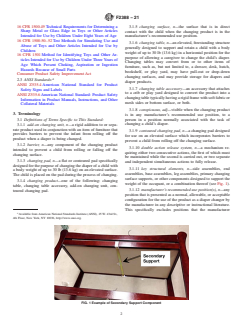
supports, or other components designed to support the weight of the occupant, or a combination thereof (see Fig. 1).
3.1.12 manufacturer’s recommended use position(s), n—any position that is presented as a normal, allowable, or acceptable
configuration for the use of the product as a diaper changer by the manufacturer in any descriptive or instructional literature. This
specifically excludes positions that the manufacturer shows in a like manner in its literature to be unacceptable, unsafe, or not
recommended.
3.1.13 non-paper label, n—any label (material such as plastic or metal) which either will not tear without the aid of tools, or tears
leaving a sharp defined edge.
3.1.14 paper label, n—any label material that tears without the aid of tools and leaves a fibrous edge.
3.1.15 protective component, n—any component used for protection from sharp edges, points, or entrapment of fingers or toes.
3.1.15.1 Discussion—
Examples of protective components include caps, sleeves, and plugs.
3.1.16 secondary support component, n—a strap, bar, rod, or other component that is consumer installed and provides added
support, to the changing surface of the changing table.
3.1.17 self-folding steps, n—steps which must be held open by an adult caregiver that, when released, fold away and latch
automatically into their normally closed position.
3.1.18 support surface, n—a surface to which a changing pad, changing table accessory, or add-on changing unit may be mounted
according to manufacturer’s instructions.
3.1.19 threaded fastener, n—a discrete piece of hardware that has internal or external screw threads which is used for the assembly
of multiple parts and facilitates disassembly.
FIG. 1 Example of Secondary Support Component
F2388 − 21
4. Calibration and Standardization
4.1 All testing shall be conducted on a concrete floor, which may be covered with ⁄8-in. (3-mm) thick vinyl flooring cover, unless
test instructs differently.
4.2 Unless otherwise noted, the product shall be completely assembled in accordance with the manufacturer’s instructions,
including any pad supplied by the manufacturer or pad the manufacturer requires, for product to be used as a changing table.
4.3 No testing shall be conducted within 48 h of manufacturing.
4.4 The product to be tested shall be placed in a room with ambient temperature of 73 6 9°F (23 6 5°C) for at least 1 h prior
to testing. Testing shall then be conducted within this temperature range.
4.5 All testing required by this specification shall be conducted on the same unit.
5. General Requirements
5.1 Sharp Points and Edges—There shall be no hazardous sharp points or sharp edges as defined by 16 CFR 1500.48 and 16 CFR
1500.49 before and after testing to this specification.
5.2 Small Parts—There shall be no small parts as defined by 16 CFR 1501 before testing or liberated as a result of testing to this
specification.
5.3 Surface Coatings—The paint or surface coating on the product shall comply with 16 CFR 1303.
5.4 Wood Parts—Prior to testing, any exposed wood parts shall be smooth and free from splinters.
5.5 Openings—Holes or slots that extend entirely through a wall section of any rigid material less than 0.375-in. (9.53-mm) thick
and admit a 0.210-in. (5.33-mm) diameter rod shall also admit a 0.375-in. (9.53-mm) diameter rod. Holes or slots that are between
0.210 in. (5.33 mm) and 0.375 in. (9.53 mm) and have a wall thickness less than 0.375 in. (9.53 mm) but are limited in depth to
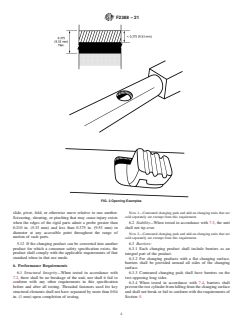
0.375-in. (9.53-mm) maximum by another rigid surface shall be permissible (see Fig. 2). The product shall be evaluated in all
manufacturer’s use positions.
5.6 A changing table accessory, when attached in the manufacturer’s recommended use position to a full-size crib or non-full-size
crib/play yard, shall conform to the requirements of this specification and the applicable requirements of Consumer Safety
Specification F1169 or F406, respectively.
5.7 Toys—Toy accessories attached to, removable from, or sold with a changing product, as well as their means of attachment,
must meet applicable requirements of Consumer Safety Specification F963.
5.8 Threaded Fasteners:
5.8.1 Wood Screws and Sheet Metal Screws:
5.8.1.1 No changing table shall require consumer assembly of key structural elements using wood screws or sheet metal fasteners
directly into wood components. This shall not apply to non-key structural elements such as drawers, secondary support
components, other storage components, accessory items and the fasteners used for attaching contoured pads and add-on changing
units to other supporting furniture. This shall also not apply to the fasteners used for changing tables which are also clothing storage
units which fall under the scope of Safety Specification F2057.
5.8.2 Metal inserts, with external wood screw threads for screwing into a wood component and providing internal machine threads
to accommodate a machine screw, that are used to secure key structural elements shall be glued or include other means to impede
loosening or detaching.
F2388 − 21
FIG. 2 Opening Examples
5.8.3 Metal threaded fasteners, such as sheet metal screws and machine screws, secured into metal components and used to attach
key structural elements shall have lock washers, self-locking nuts, or other means to impede loosening as defined in 6.1 or
detachment during the testing required by this specification.
5.9 Protective Components—If the child can grasp protective components between the thumb and forefinger, or teeth, or if there
is at least a 0.04-in. (1.0-mm) gap between the protective component and its adjacent parent component, such component shall not
be removed when tested in accordance with 7.1. All protective components that are accessible to a child in/on the product or
accessible to a child from any position around the product shall be evaluated.
5.10 Product must comply with the applicable requirements of the Consumer Product Safety Improvement Act.
5.11 Scissoring, Shearing, and Pinching—The product, when in the manufacturer’s recommended use position(s), shall be
designed and constructed to prevent injury to the occupant from any scissoring, shearing, or pinching when members or
components rotate about a common axis or fastening point, slide, pivot, fold, or otherwise move relative to one another. Scissoring,
shearing, or pinching that may cause injury exists when the edges of the rigid parts admit a probe greater than 0.210 in. (5.33 mm)
and less than 0.375 in. (9.53 mm) in diameter at any accessible point throughout the range of motion of such parts.
F2388 − 21
FIG. 3 Tension Test Clamp
FIG. 4 Stability Test
5.12 If the changing product can be converted into another product for which a consumer safety specification exists, the product
shall comply with the applicable requirements of that standard when in that use mode.
6. Performance Requirements
6.1 Structural Integrity—When tested in accordance with 7.2, there shall be no breakage of the unit, nor shall it fail to conform
F2388 − 21
FIG. 5 Barrier Retention Test
FIG. 6 Torso Probe
with any other requirements in this specification before and after all testing. Threaded fasteners used for key structural elements
shall not have separated by more than 0.04 in. (1 mm) upon completion of testing.
NOTE 1—Contoured changing pads and add-on changing units that are sold separately are exempt from this requirement.
6.2 Stability—When tested in accordance with 7.3, the unit shall not tip over.
NOTE 2—Contoured changing pads and add-on changing units that are sold separately are exempt from this requirement.
6.3 Barriers:
F2388 − 21
6.3.1 Each changing product shall include barriers as an integral part of the product.
6.3.2 For changing products with a flat changing surface, barriers shall be provided around all sides of the changing surface.
6.3.3 Contoured changing pads shall have barriers on the two opposing long sides.
6.3.4 When tested in accordance with 7.4, barriers shall prevent the test cylinder from falling from the changing surface and shall
not break or fail to conform with the requirements of Section 5.
6.3.4.1 Changing tables, add-on changing units sold with items of furniture and changing table accessories shall be set-up for
testing per 7.4.2.1.
6.3.4.2 Add-on changing units sold separately and contoured changing pads sold separately shall be set-up for testing per 7.4.2.2.
6.3.4.3 Changing products with a flat changing surface shall be tested per 7.4.3.
6.3.4.4 Changing products using contoured changing pads shall be tested per 7.4.4.
6.4 Retention of Contoured Changing Pads and Add-on Changing Units:
6.4.1 When tested in accordance with 7.4, the contoured changing pad or add-on changing unit shall not shift or slide more than
1 in. (25 mm) in any direction from its original position.
6.4.1.1 If tabs or straps are provided to secure the contoured changing pad, when tested in accordance with 7.4, the pad shall not
shift or slide more than 1 in. (25 mm) in a direction opposite from the edge containing attachment tabs or straps.
NOTE 3—Changing table accessory installed on non-full-size cribs/play yards are exempt from this requirement, as they must comply with the retention
and opening/entrapment requirements specified in Consumer Safety Specification F406, “Entrapment in Attachments” Section.
6.5 Entrapment in Enclosed Openings—When tested in accordance with 7.5, there shall be no completely bounded openings
(openings surrounded by a boundary on all sides) anywhere in the structure of a changing table that are accessible to the occupant
or a child around the base of the product and that permit the free passage of the torso probe shown in Fig. 6 unless they also permit
the free passage of the 9.0-in. (229-mm) diameter probe shown in Fig. 7. Exempt from this requirement are self-folding steps when
in their open position.
6.6 Entrapment by Shelves—When tested in accordance with the procedure in 7.6, any shelf above 4.3 in. (109 mm) from the floor
that, because its movement may expose an opening that could entrap a child’s head, shall not permit the entire passage of the small
head probe shown in Fig. 8 through the exposed opening. Excluded from this requirement are pullout drawers and shelves enclosed
within a cabinet equipped with a door(s).
6.7 Self-folding Steps—Self-folding steps shall be secured in their closed position by one of the following latching or locking
mechanisms:
6.7.1 The latching or locking mechanism must be a double action release system, or
6.7.2 The latching or locking mechanism shall require a minimum force of 10 lbf (45 N) to activate the single action release
mechanism when tested in accordance with 7.7.
6.8 Restraint System:
NOTE 4—A restraint system may be provided to restrict upward or lateral movement of the occupant’s torso. Inclusion of a restraint system is not
mandatory.
6.8.1 If a restraint system is installed on the product or available as an option, it shall meet the following:
F2388 − 21
FIG. 7 Large Head Probe
6.8.1.1 A restraint system and its closing means (for example, buckle) shall not break or separate when tested in accordance with
7.8.
6.8.1.2 The anchorages shall not separate from the product when tested in accordance with 7.8.
6.8.1.3 Restraints shall be capable of adjustment with a positive, self-locking mechanism that is capable, when locked, of
withstanding the forces of tests in 7.8 without allowing restraint movement or slippage of more than 1 in. (25.4 mm).
7. Test Methods
7.1 Removal of Protective Components—Protective components shall be tested in accordance with each of the following methods
in the sequence listed.
7.1.1 Any protective component shall be tested in accordance with each of the following methods in the sequence listed.
7.1.2 Secure the product so that the product cannot move during the performance of the following tests:
7.1.3 Torque Test—Gradually apply a torque of 3 lbf-in. (0.3 N-m) over a period of 5 s in a clockwise direction until a rotation
of 180° from the original position has been attained or 3 lbf-in. (0.3 N-m) has been exceeded. The torque or maximum rotation
F2388 − 21
FIG. 8 Small Head Probe
shall be maintained for an additional 10 s. The torque shall then be removed and the test components permitted to return to a
relaxed condition. This procedure shall then be repeated in the counterclockwise direction.
7.1.4 Tension Test:
7.1.4.1 Attach a force gage to the protective component by means of any suitable device. For components that cannot reasonably
be expected to be grasped between thumb and forefinger, or teeth, on their outer diameter but have a gap of 0.04 in. (1.0 mm) or
more between the rear surface of the component and the structural member of the product to which they are attached, a clamp such
as the one shown in Fig. 3 may be a suitable device.
7.1.4.2 Be sure that the attachment device does not compress or expand the component hindering any possible removal.
7.1.4.3 Gradually apply a 15-lbf (67-N) over a period of 5 s in the direction that would normally be associated with the removal
of the protective component. Hold for an additional 10 s.
7.2 Structural Integrity—Assemble the product in accordance with the manufacturer’s assembly instructions. If the product design
employs secondary support components beneath the changing surface that are not factory preassembled in their intended use
position, this test is to be conducted without the secondary support components installed. Place the product on the test floor, center
a 6
...