

EN 12310-1:2025
(Main)Flexible sheets for waterproofing - Determination of resistance to tearing (nail shank) - Part 1: Bitumen sheets for roof waterproofing
- Abstract
This document specifies a method for the determination of the resistance tearing (nail shank) of bitumen sheets for roofing.
- Status
- Published
- Publication Date
- 24-Jun-2025
- Technical Committee
- CEN/TC 254 - Flexible sheets for water proofing
- Drafting Committee
- CEN/TC 254/SC 1 - Bitumen sheets
- Current Stage
- 6060 - Definitive text made available (DAV) - Publishing
- Start Date
- 25-Jun-2025
- Due Date
- 01-Jul-2025
- Completion Date
- 25-Jun-2025
Overview
EN 12310-1:2025 is the European standard developed by CEN for testing the resistance to tearing (nail shank) of bitumen sheets used in roof waterproofing. It provides a standardized method for assessing how bitumen-based roofing membranes perform when subjected to forces likely encountered during installation, maintenance, or extreme weather. This standard ensures consistency and reliability in evaluating the mechanical durability of flexible waterproofing sheets, supporting safe and effective use across roofing applications.
Key Topics
- Scope: EN 12310-1:2025 is specifically designed for bitumen sheets used in roof waterproofing. The test evaluates the resistance to tearing when a nail shank is forced through the sheet, simulating conditions the material may face in real-world use.
- Test Principle: Measures the maximum tensile force required to tear a bitumen sheet specimen pierced by a nail shank, perpendicular to the axis of the nail.
- Sampling and Preparation: Due attention is given to sample selection and preparation, ensuring results are representative of the actual product delivered for roofing.
- Apparatus: Involves a tensile testing machine, a specific stirrup assembly, and standard size and conditioning of test specimens.
- Test Procedure: Details how to insert the specimen between the stirrup arms, pierce with a nail shank, and record the tearing force at a controlled speed and temperature.
- Results and Reporting: Requires recording the maximum force for each specimen, calculating the mean, detailing test conditions, and reporting any deviations.
Applications
- Product Characterization: This standard is essential for manufacturers and suppliers to demonstrate product quality, specifically the mechanical robustness of bitumen waterproofing sheets.
- Quality Assurance: By using the EN 12310-1:2025 test method, producers and third-party laboratories can confirm compliance with specified performance requirements for roofing membranes.
- Specification and Procurement: Architects, engineers, and procurement professionals can use the resistance to tearing results as a criterion when selecting bitumen roofing sheets for new build or refurbishment projects, ensuring suitability for challenging environments.
- Compliance and Certification: Adherence to EN 12310-1:2025 is often required for CE marking and other regulatory processes within the European market, supporting transparent and uniform product comparisons.
Related Standards
- EN 13416: Specifies methods for sampling bitumen, plastic, and rubber sheets for roof waterproofing.
- EN ISO 7500-1: Covers calibration and verification of static uniaxial testing machines, ensuring accurate tensile testing.
- EN 12311-1: Relates to determination of tensile properties for bitumen sheets.
- Product and System Standards: EN 12310-1:2025 is used in combination with European standards that define characteristics and requirements for reinforced and unreinforced bitumen roof membranes.
Practical Value
EN 12310-1:2025 provides a clear, repeatable method for evaluating the resistance to tearing in bitumen roof waterproofing sheets, directly addressing issues of durability and safety. Its implementation in the manufacturing, specification, and testing of roofing materials underpins quality assurance, regulatory compliance, and effective risk management for construction projects across Europe. Adhering to this standard supports the longevity and reliability of flat and pitched roof systems, protecting buildings from water ingress and the effects of mechanical damage.
Relations
- Effective Date
- 29-Mar-2023
- Effective Date
- 28-Jan-2026
- Effective Date
- 28-Jan-2026
- Effective Date
- 28-Jan-2026
- Effective Date
- 28-Jan-2026
- Effective Date
- 28-Jan-2026
- Effective Date
- 28-Jan-2026
- Effective Date
- 28-Jan-2026
- Effective Date
- 28-Jan-2026
- Effective Date
- 28-Jan-2026
- Effective Date
- 28-Jan-2026
- Effective Date
- 28-Jan-2026
- Effective Date
- 28-Jan-2026
- Effective Date
- 28-Jan-2026
- Effective Date
- 28-Jan-2026
Get Certified
Connect with accredited certification bodies for this standard

DIBt (Deutsches Institut für Bautechnik)
German Institute for Building Technology.
DIN CERTCO
DIN Group product certification.

Aboma Certification B.V.
Specialized in construction, metal, and transport sectors.
Sponsored listings
Frequently Asked Questions
EN 12310-1:2025 is a standard published by the European Committee for Standardization (CEN). Its full title is "Flexible sheets for waterproofing - Determination of resistance to tearing (nail shank) - Part 1: Bitumen sheets for roof waterproofing". This standard covers: This document specifies a method for the determination of the resistance tearing (nail shank) of bitumen sheets for roofing.
This document specifies a method for the determination of the resistance tearing (nail shank) of bitumen sheets for roofing.
EN 12310-1:2025 is classified under the following ICS (International Classification for Standards) categories: 91.100.50 - Binders. Sealing materials. The ICS classification helps identify the subject area and facilitates finding related standards.
EN 12310-1:2025 has the following relationships with other standards: It is inter standard links to EN 12310-1:1999, EN 13416:2023, EN ISO 7500-1:2018, EN 15382:2008, EN 13361:2004, EN 13969:2004, EN 13967:2012, EN 13361:2013, EN 13984:2013, EN 14967:2006, EN 13492:2013, EN 13707:2013, EN 14909:2012, EN 13362:2005, EN 13491:2004. Understanding these relationships helps ensure you are using the most current and applicable version of the standard.
EN 12310-1:2025 is associated with the following European legislation: EU Directives/Regulations: 305/2011; Standardization Mandates: M/102. When a standard is cited in the Official Journal of the European Union, products manufactured in conformity with it benefit from a presumption of conformity with the essential requirements of the corresponding EU directive or regulation.
EN 12310-1:2025 is available in PDF format for immediate download after purchase. The document can be added to your cart and obtained through the secure checkout process. Digital delivery ensures instant access to the complete standard document.
Standards Content (Sample)
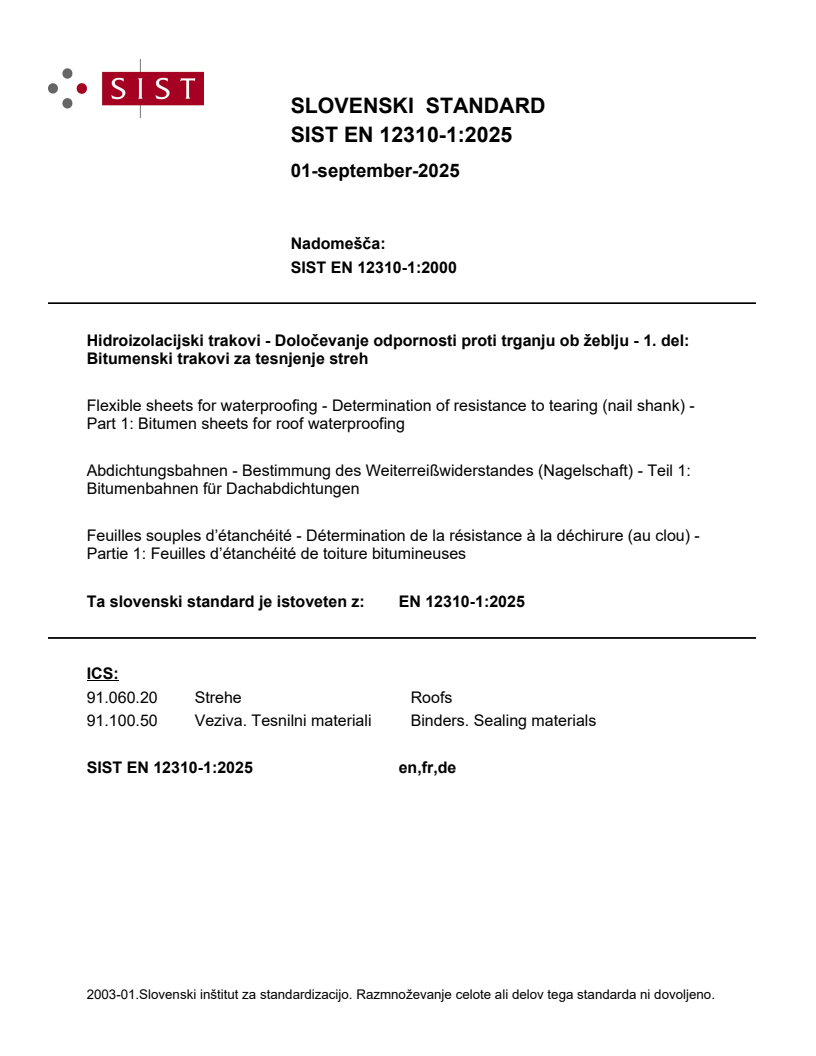
SLOVENSKI STANDARD
01-september-2025
Nadomešča:
SIST EN 12310-1:2000
Hidroizolacijski trakovi - Določevanje odpornosti proti trganju ob žeblju - 1. del:
Bitumenski trakovi za tesnjenje streh
Flexible sheets for waterproofing - Determination of resistance to tearing (nail shank) -
Part 1: Bitumen sheets for roof waterproofing
Abdichtungsbahnen - Bestimmung des Weiterreißwiderstandes (Nagelschaft) - Teil 1:
Bitumenbahnen für Dachabdichtungen
Feuilles souples d’étanchéité - Détermination de la résistance à la déchirure (au clou) -
Partie 1: Feuilles d’étanchéité de toiture bitumineuses
Ta slovenski standard je istoveten z: EN 12310-1:2025
ICS:
91.060.20 Strehe Roofs
91.100.50 Veziva. Tesnilni materiali Binders. Sealing materials
2003-01.Slovenski inštitut za standardizacijo. Razmnoževanje celote ali delov tega standarda ni dovoljeno.
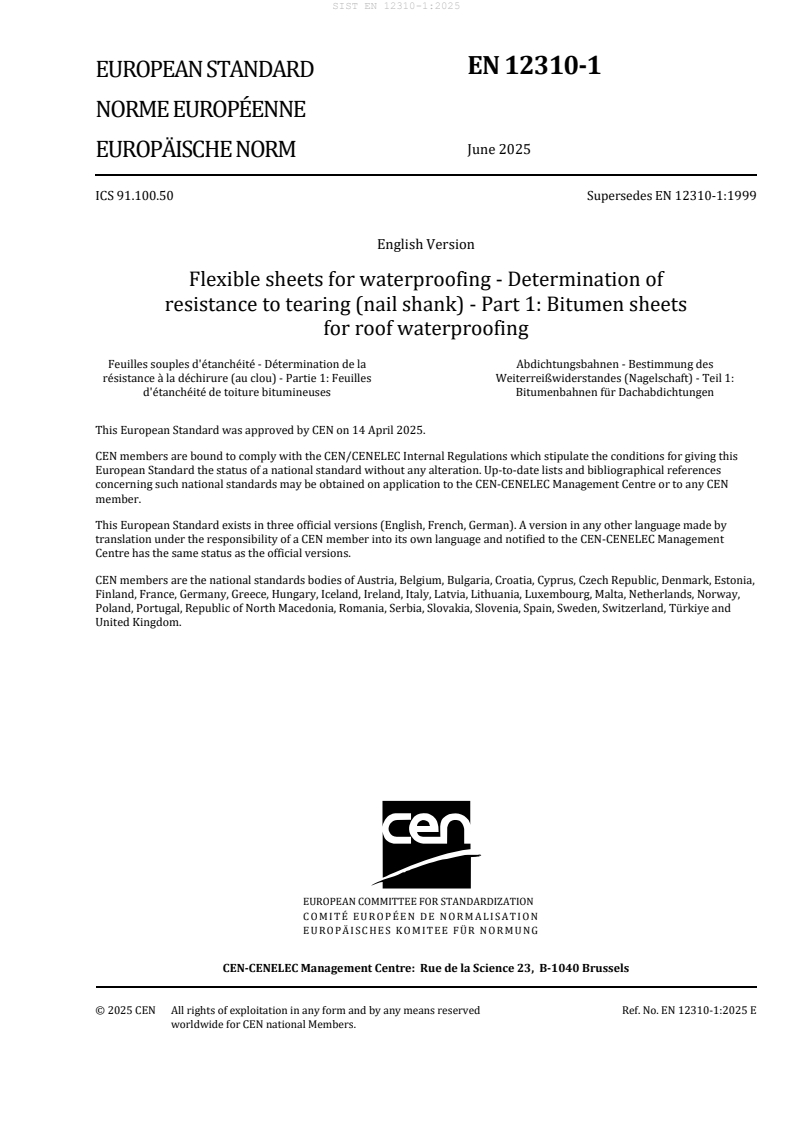
EN 12310-1
EUROPEAN STANDARD
NORME EUROPÉENNE
June 2025
EUROPÄISCHE NORM
ICS 91.100.50 Supersedes EN 12310-1:1999
English Version
Flexible sheets for waterproofing - Determination of
resistance to tearing (nail shank) - Part 1: Bitumen sheets
for roof waterproofing
Feuilles souples d'étanchéité - Détermination de la Abdichtungsbahnen - Bestimmung des
résistance à la déchirure (au clou) - Partie 1: Feuilles Weiterreißwiderstandes (Nagelschaft) - Teil 1:
d'étanchéité de toiture bitumineuses Bitumenbahnen für Dachabdichtungen
This European Standard was approved by CEN on 14 April 2025.
CEN members are bound to comply with the CEN/CENELEC Internal Regulations which stipulate the conditions for giving this
European Standard the status of a national standard without any alteration. Up-to-date lists and bibliographical references
concerning such national standards may be obtained on application to the CEN-CENELEC Management Centre or to any CEN
member.
This European Standard exists in three official versions (English, French, German). A version in any other language made by
translation under the responsibility of a CEN member into its own language and notified to the CEN-CENELEC Management
Centre has the same status as the official versions.
CEN members are the national standards bodies of Austria, Belgium, Bulgaria, Croatia, Cyprus, Czech Republic, Denmark, Estonia,
Finland, France, Germany, Greece, Hungary, Iceland, Ireland, Italy, Latvia, Lithuania, Luxembourg, Malta, Netherlands, Norway,
Poland, Portugal, Republic of North Macedonia, Romania, Serbia, Slovakia, Slovenia, Spain, Sweden, Switzerland, Türkiye and
United Kingdom.
EUROPEAN COMMITTEE FOR STANDARDIZATION
COMITÉ EUROPÉEN DE NORMALISATION
EUROPÄISCHES KOMITEE FÜR NORMUNG
CEN-CENELEC Management Centre: Rue de la Science 23, B-1040 Brussels
© 2025 CEN All rights of exploitation in any form and by any means reserved Ref. No. EN 12310-1:2025 E
worldwide for CEN national Members.
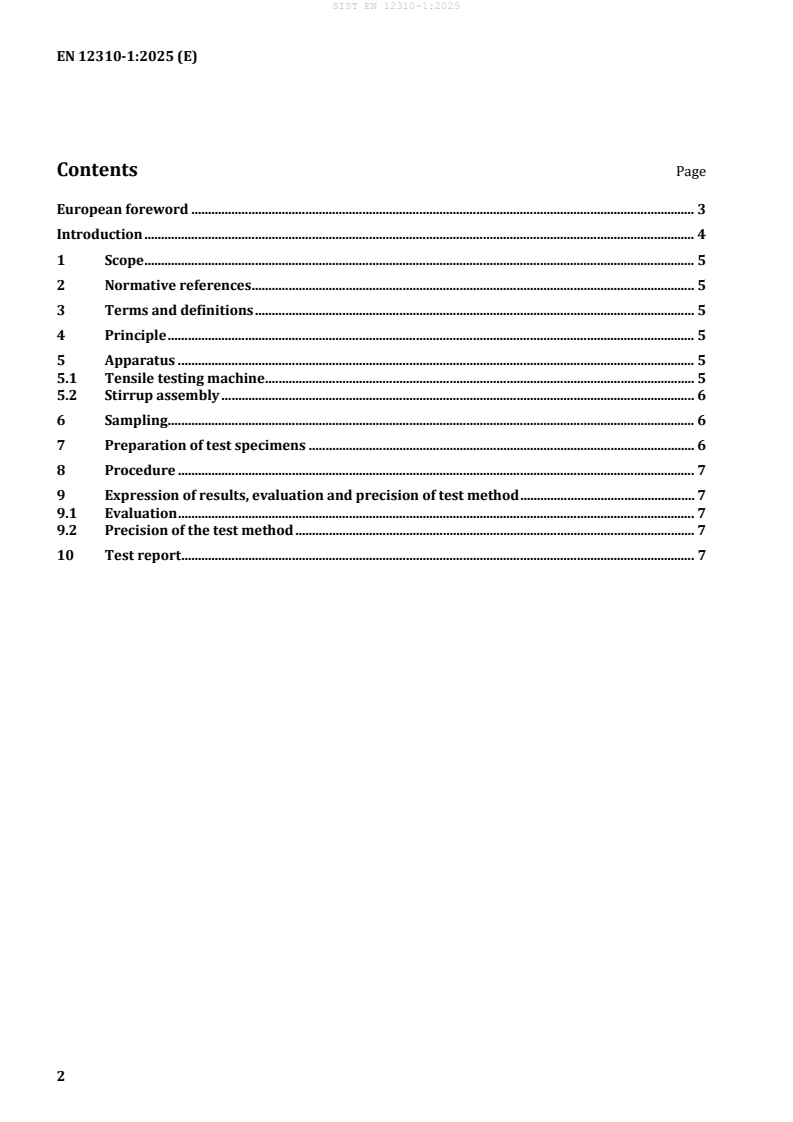
Contents Page
European foreword . 3
Introduction . 4
1 Scope . 5
2 Normative references . 5
3 Terms and definitions . 5
4 Principle . 5
5 Apparatus . 5
5.1 Tensile testing machine . 5
5.2 Stirrup assembly . 6
6 Sampling . 6
7 Preparation of test specimens . 6
8 Procedure . 7
9 Expression of results, evaluation and precision of test method . 7
9.1 Evaluation . 7
9.2 Precision of the test method . 7
10 Test report . 7
European foreword
This document (EN 12310-1:2025) has been prepared by Technical Committee CEN/TC 254 “Flexible
sheets for waterproofing”, the secretariat of which is held by NEN.
This European Standard shall be given the status of a national standard, either by publication of an
identical text or by endorsement, at the latest by November 2025, and conflicting national standards shall
be withdrawn at the latest by November 2025.
Attention is drawn to the possibility that some of the elements of this document may be the subject of
patent rights. CEN shall not be held responsible for identifying any or all such patent rights.
This document supersedes EN 12310-1:1999.
— the normative reference has been updated;
— Figure 1 has been amended;
— the “or” has been deleted in Clause 7, 1st paragraph, last sentence.
This document has been prepared under a standardization request addressed to CEN by the European
Commission. The Standing Committee of the EFTA States subsequently approves these requests for its
Member States.
Any feedback and questions on this document should be directed to the users’ national standards body.
A complete listing of these bodies can be found on the CEN websi
...