


FprEN 1993-2
(Main)Eurocode 3 - Design of steel structures - Part 2: Bridges
Eurocode 3 - Design of steel structures - Part 2: Bridges
1.1 Scope of FprEN 1993 2
(1) This document provides rules for the structural design of steel bridges and steel parts of steel-concrete composite bridges.
(2) This document is applicable to the resistance, serviceability and durability of steel bridge structures.
(3) The design of tension components and related parts is covered by EN 1993 1 11.
NOTE For the design of hangers for tied-arch bridges, additional provisions are given in Annex A.
(4) Supplementary requirements for seismic design are given in EN 1998 2.
1.2 Assumptions
(1) Unless specifically stated, EN 1990, EN 1991 (all parts), EN 1998 (all parts) and EN 1993 1 (all parts) apply.
(2) The design methods given in FprEN 1993 2 are applicable if:
- the execution quality is as specified in EN 1090 2 and EN 1090 4, and
- the construction materials and products used are as specified in the relevant parts of EN 1993, or in the relevant material and product specifications.
Eurocode 3 - Bemessung und Konstruktion von Stahlbauten - Teil 2: Brücken
1.1 Anwendungsbereich von FprEN 1993-2
(1) Dieses Dokument enthält Regeln für die Tragwerksbemessung von Stahlbrücken und Stahlbauteilen von Stahl-Beton-Verbundbrücken.
(2) Dieses Dokument ist anwendbar für die Bestimmung der Tragfähigkeit, Gebrauchstauglichkeit und Dauerhaftig¬keit der Tragwerke von Stahlbrücken.
(3) Die Bemessung von Zuggliedern und zugehörigen Bauteilen wird durch EN 1993‑1‑11 geregelt.
ANMERKUNG Für die Bemessung von Hängern bei Stabbogenbrücken sind zusätzliche Festlegungen in Anhang A enthalten.
(4) Ergänzende Anforderungen für die Erdbebenbemessung sind in EN 1998-2 angegeben.
1.2 Annahmen
(1) Sofern nicht spezifisch anders angegeben, gelten EN 1990, EN 1991 (alle Teile), EN 1998 (alle Teile) und EN 1993-1 (alle Teile).
(2) Die Bemessungsverfahren nach FprEN 1993 2 sind anwendbar, sofern:
- die Qualität der Ausführung den Festlegungen nach EN 1090-2 und EN 1090 4 entspricht; und
- die verwendeten Baustoffe und Bauprodukte den Festlegungen in den maßgebenden Teilen von EN 1993 oder den maßgebenden Baustoff- und Produktspezifikationen entsprechen.
Eurocode 3 - Calcul des structures en acier - Partie 2: Ponts
1.1 Domaine d'application de la FprEN 1993-2
(1) Le présent document fournit les règles de conception et de calcul pour les ponts métalliques et les parties en acier des ponts à ossature mixte acier-béton.
(2) Le présent document est applicable à la résistance, à l'aptitude au service et à la durabilité des structures de ponts en acier.
(3) Le calcul des éléments tendus et des pièces associées est couvert par l'EN 1993-1-11.
NOTE Pour le calcul des suspentes pour les ponts en arc à tirant, des dispositions supplémentaires sont données dans l'Annexe A.
(4) Les exigences supplémentaires applicables au calcul sismique sont données dans l'EN 1998-2.
1.2 Hypothèses
(1) Sauf indication contraire, l‘EN 1990, l’EN 1991 (toutes les parties), l’EN 1998 (toutes les parties) et l’EN 1993-1 (toutes les parties) s'appliquent.
(2) Les méthodes de calcul données dans la FprEN 1993-2 sont applicables si :
- la qualité de l'exécution est telle que spécifiée dans l'EN 1090-2 et l'EN 1090-4 ; et
- les matériaux et produits de construction sont tels que spécifiés dans les parties pertinentes de la norme EN 1993 ou dans les spécifications de matériaux et de produits appropriées.
Evrokod 3 - Projektiranje jeklenih konstrukcij - 2. del: Mostovi
General Information
Relations

Standards Content (Sample)
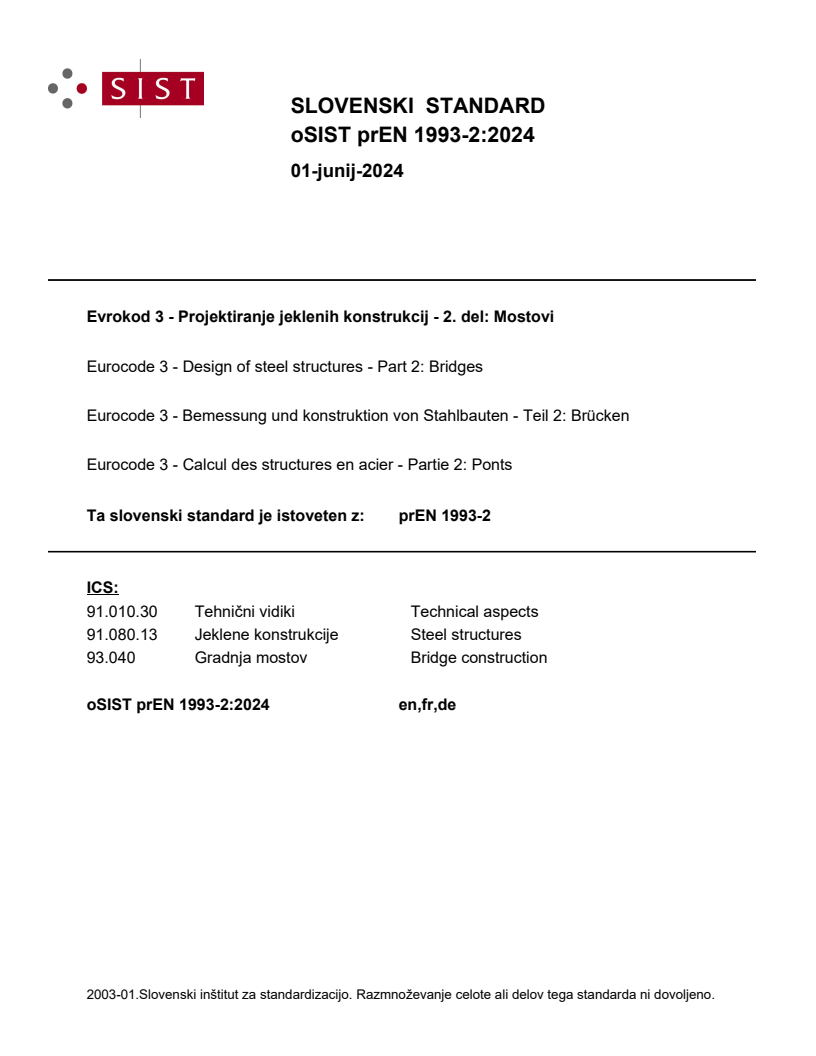
SLOVENSKI STANDARD
oSIST prEN 1993-2:2024
01-junij-2024
Evrokod 3 - Projektiranje jeklenih konstrukcij - 2. del: Mostovi
Eurocode 3 - Design of steel structures - Part 2: Bridges
Eurocode 3 - Bemessung und konstruktion von Stahlbauten - Teil 2: Brücken
Eurocode 3 - Calcul des structures en acier - Partie 2: Ponts
Ta slovenski standard je istoveten z: prEN 1993-2
ICS:
91.010.30 Tehnični vidiki Technical aspects
91.080.13 Jeklene konstrukcije Steel structures
93.040 Gradnja mostov Bridge construction
oSIST prEN 1993-2:2024 en,fr,de
2003-01.Slovenski inštitut za standardizacijo. Razmnoževanje celote ali delov tega standarda ni dovoljeno.
oSIST prEN 1993-2:2024
oSIST prEN 1993-2:2024
DRAFT
EUROPEAN STANDARD
prEN 1993-2
NORME EUROPÉENNE
EUROPÄISCHE NORM
March 2024
ICS 91.010.30; 91.080.13; 93.040 Will supersede EN 1993-2:2006
English Version
Eurocode 3 - Design of steel structures - Part 2: Bridges
Eurocode 3 - Calcul des structures en acier - Partie 2: Eurocode 3 - Bemessung und konstruktion von
Ponts Stahlbauten - Teil 2: Brücken
This draft European Standard is submitted to CEN members for enquiry. It has been drawn up by the Technical Committee
CEN/TC 250.
If this draft becomes a European Standard, CEN members are bound to comply with the CEN/CENELEC Internal Regulations
which stipulate the conditions for giving this European Standard the status of a national standard without any alteration.
This draft European Standard was established by CEN in three official versions (English, French, German). A version in any other
language made by translation under the responsibility of a CEN member into its own language and notified to the CEN-CENELEC
Management Centre has the same status as the official versions.
CEN members are the national standards bodies of Austria, Belgium, Bulgaria, Croatia, Cyprus, Czech Republic, Denmark, Estonia,
Finland, France, Germany, Greece, Hungary, Iceland, Ireland, Italy, Latvia, Lithuania, Luxembourg, Malta, Netherlands, Norway,
Poland, Portugal, Republic of North Macedonia, Romania, Serbia, Slovakia, Slovenia, Spain, Sweden, Switzerland, Türkiye and
United Kingdom.
Recipients of this draft are invited to submit, with their comments, notification of any relevant patent rights of which they are
aware and to provide supporting documentation.
Warning : This document is not a European Standard. It is distributed for review and comments. It is subject to change without
notice and shall not be referred to as a European Standard.
EUROPEAN COMMITTEE FOR STANDARDIZATION
COMITÉ EUROPÉEN DE NORMALISATION
EUROPÄISCHES KOMITEE FÜR NORMUNG
CEN-CENELEC Management Centre: Rue de la Science 23, B-1040 Brussels
© 2024 CEN All rights of exploitation in any form and by any means reserved Ref. No. prEN 1993-2:2024 E
worldwide for CEN national Members.
oSIST prEN 1993-2:2024
prEN 1993-2:2024 (E)
Contents
Page
European foreword . 7
Introduction . 8
0.1 Introduction to the Eurocodes . 8
0.2 Introduction to EN 1993 (all parts) . 8
0.3 Introduction to prEN 1993-2 . 9
0.4 Verbal forms used in the Eurocodes . 10
0.5 National annex for prEN 1993-2 . 10
1 Scope . 12
1.1 Scope of prEN 1993-2 . 12
1.2 Assumptions . 12
2 Normative references . 12
3 Terms, definitions and symbols . 13
3.1 Terms and definitions . 13
3.2 Symbols . 13
3.2.1 General. 13
3.2.2 Latin upper-case symbols . 13
3.2.3 Latin lower-case symbols . 15
3.2.4 Greek upper-case symbols . 17
3.2.5 Greek lower-case symbols . 18
4 Basis of design . 21
4.1 General rules . 21
4.1.1 Basic requirements . 21
4.1.2 Structural reliability . 21
4.1.3 Robustness . 21
4.1.4 Design service life for bridges . 21
4.1.5 Durability . 21
4.2 Basic variables . 21
4.2.1 Actions and environmental influences . 21
4.2.2 Material and product properties . 22
4.3 Verification by the partial factor method . 22
4.4 Partial factors for fatigue verifications . 23
4.5 Design assisted by testing . 24
5 Materials . 25
5.1 General. 25
5.2 Structural steel . 25
5.2.1 Material properties . 25
5.2.2 Ductility requirements . 25
5.2.3 Fracture toughness. 25
5.2.4 Through thickness properties. 25
5.2.5 Values of other material properties . 26
5.3 Connecting devices . 26
5.3.1 Fasteners . 26
5.3.2 Welding consumables . 26
oSIST prEN 1993-2:2024
prEN 1993-2:2024 (E)
5.4 Cables and other tension elements . 26
5.5 Bearings . 26
5.6 Dampers and lock-up devices . 27
5.7 Other bridge components . 27
6 Durability . 28
7 Structural analysis . 29
7.1 Structural modelling for analysis . 29
7.1.1 Basic assumptions . 29
7.1.2 Joint modelling . 29
7.2 Global analysis . 29
7.2.1 Consideration of second order effects . 29
7.2.2 Methods of analysis for ultimate limit state design checks . 29
7.3 Imperfections . 29
7.3.1 Basis. 29
7.3.2 Sway imperfections . 30
7.3.3 Equivalent bow imperfection for global and member analysis . 30
7.3.4 Combination of sway and equivalent bow imperfections . 30
7.3.5 Imperfections for analysis of bracing systems . 30
7.3.6 Imperfection based on elastic critical buckling modes . 30
7.4 Methods of analysis . 30
7.4.1 General . 30
7.4.2 Elastic global analysis . 30
7.5 Classification of cross-sections . 30
8 Ultimate limit states . 31
8.1 Partial factors . 31
8.2 Resistance of cross-sections . 31
8.2.1 General . 31
8.2.2 Section properties . 31
8.2.3 Tension . 32
8.2.4 Compression . 32
8.2.5 Bending . 32
8.2.6 Shear . 32
8.2.7 Torsion . 33
8.2.8 Combined bending and shear. 33
8.2.9 Combined bending and axial force . 33
8.2.10 Combined bending, shear and axial force . 33
8.2.11 Combined bending, shear, axial force and transverse loads . 34
8.3 Buckling resistance of members . 34
8.3.1 Uniform members in compression . 34
8.3.2 Uniform members in bending . 34
8.3.3 Uniform members in bending and axial compression . 34
8.3.4 General method for lateral and lateral torsional buckling of structural components . 34
8.3.5 Simplified method for lateral and lateral torsional buckling of structural
components . 35
8.3.6 Plate girders curved in plan . 37
8.4 Uniform built-up compression members . 38
8.5 Buckling of plates . 38
9 Serviceability limit states . 39
9.1 General . 39
9.2 Calculation models . 40
9.3 Limitations for stress . 40
oSIST prEN 1993-2:2024
prEN 1993-2:2024 (E)
9.4 Limitation of web breathing . 41
9.5 Limits for clearance gauges . 41
9.6 Limits for visual impression . 42
9.7 Performance criteria for railway bridges . 42
9.8 Performance criteria for road bridges . 42
9.8.1 General. 42
9.8.2 Deflection limits to avoid excessive impact from traffic . 42
9.8.3 Resonance effects . 42
9.9 Performance criteria for pedestrian bridges . 42
9.10 Performance criteria for the effect of wind . 43
9.11 Accessibility of joint details and surfaces . 43
9.12 Drainage . 43
10 Fatigue . 44
10.1 General. 44
10.1.1 Requirements for fatigue verification . 44
10.1.2 Design of road bridges for fatigue . 44
10.1.3 Design of railway bridges for fatigue . 44
10.2 Fatigue loading . 45
10.2.1 General. 45
10.2.2 Simplified fatigue load model for road bridges . 45
10.2.3 Simplified fatigue load model for railway bridges . 46
10.3 Fatigue stress range . 46
10.3.1 General. 46
10.3.2 Analysis for fatigue . 46
10.4 Fatigue verification procedures . 48
10.4.1 Fatigue verification . 48
10.4.2 Damage equivalent factors λ for road bridges . 49
10.4.3 Damage equivalent factors λ for railway bridges . 49
10.4.4 Combination of damage from local and global stress ranges . 53
10.5 Fatigue resistance . 53
10.6 Post weld treatment . 54
11 Fasteners, welds, connections and joints . 55
11.1 Connections using bolts, rivets or pins . 55
11.1.1 General. 55
11.1.2 Injection bolts . 55
11.1.3 Hybrid connections . 55
11.1.4 Connections with lug angles. 55
11.1.5 Bolts on threaded holes . 55
11.1.6 Angles connected by one leg . 55
11.1.7 Distribution of forces between fasteners at the ultimate limit state . 55
11.2 Welded connections . 55
11.2.1 General. 55
11.2.2 Intermittent fillet welds . 55
11.2.3 Plug welds . 55
11.2.4 Flare groove welds . 56
11.2.5 Distribution of forces. 56
11.2.6 Eccentrically loaded single fillet or single-sided partial penetration butt welds . 56
11.3 Structural joints connecting H- or I-sections . 56
11.4 Hollow section joints . 56
Annex A (normative) Design of hangers for tied-arch bridges . 57
A.1 Use of this Annex . 57
A.2 Scope and field of application . 57
oSIST prEN 1993-2:2024
prEN 1993-2:2024 (E)
A.3 Design principles . 57
A.3.1 Material and cross-sections for tension members . 57
A.3.2 Design recommendations for welded connections of round bar steel hangers . 58
A.3.3 Design recommendations for forged hangers . 61
A.3.4 Design recommendations for flat steel plate hangers . 62
A.3.5 Design recommendations for rope hangers . 63
A.3.6 Measures to reduce restraint forces from the main structure . 65
A.4 Design rules for round bar steel hangers . 65
A.4.1 Application limits . 65
A.4.2 Oscillations due to vortex shedding . 65
A.4.3 Rain-wind-induced oscillations . 66
A.4.4 Traffic-induced stresses . 68
A.4.5 Verification concepts . 68
A.5 Design of flat steel plate hangers . 69
A.5.1 Oscillations due to vortex shedding . 69
A.5.2 Galloping . 71
A.5.3 Traffic-induced stresses . 72
A.5.4 Verification concept . 72
A.6 Design rules for rope hangers . 72
Annex B (normative) Supplementary rules for the design of plate girders curved in plan
with rigid restraints to the compression flange . 74
B.1 Use of this annex . 74
B.2 Scope and field of application . 74
B.3 Bending resistance . 74
B.4 Shear resistance . 75
B.5 Interaction between shear force and bending moment . 77
B.6 Design of restraints to the compression flange . 77
Annex C (informative) Recommendations for the structural detailing of steel bridge decks . 78
C.1 Use of this annex . 78
C.2 Scope and field of application . 78
C.3 Road bridges . 78
C.3.1 General . 78
C.3.2 Deck plate . 80
C.3.3 Longitudinal stiffeners . 84
C.3.4 Crossbeams . 89
C.4 Railway bridges . 90
C.4.1 General . 90
C.4.2 Plate thickness and dimensions . 91
C.4.3 Design of stiffener to crossbeam connection . 92
C.4.4 Weld preparation and inspections . 93
C.4.5 Analyses . 93
C.4.6 Flame cut surfaces . 95
C.5 Tolerances for semi-finished products and fabrication . 95
C.5.1 Tolerances for semi-finished products . 95
C.5.2 Tolerances for fabrication . 95
C.5.3 Particular requirements for welded connections . 95
Annex D (normative) Equivalent geometrical imperfections for arched bridges . 109
D.1 Use of this annex . 109
D.2 Scope and field of application . 109
D.3 Definition of the equivalent geometrical imperfections . 109
oSIST prEN 1993-2:2024
prEN 1993-2:2024 (E)
Annex E (normative) Combination of effects from local wheel and tyre loads and from
global traffic loads on road bridges . 111
E.1 Use of this annex . 111
E.2 Scope and field of application . 111
E.3 Combination rule for global and local load effects . 111
E.4 Combination factor . 112
Annex F (informative) Damage equivalent factors λ for fatigue verification of road bridge
decks . 113
F.1 Use of this annex . 113
F.2 Set 1 of damage equivalent factors λ. 113
F2.1 Scope and field of application . 113
F2.2 Simplified fatigue load model . 113
F2.3 Damage equivalent factors λ . 113
F.3 Set 2 of damage equivalent factors λ. 116
F3.1 Scope and field of application . 116
F3.2 Simplified fatigue load model for road bridges . 116
F3.3 Damage equivalent factors λ . 117
Bibliography . 125
oSIST prEN 1993-2:2024
prEN 1993-2:2024 (E)
European foreword
This document (prEN 1993-2:2024) has been prepared by Technical Committee CEN/TC 250 “Structural
Eurocodes”, the secretariat of which is held by BSI. CEN/TC 250 is responsible for all Structural
Eurocodes and has been assigned responsibility for structural and geotechnical design matters by CEN.
This document is currently submitted to the CEN Enquiry.
This document will supersede EN 1993-2:2006.
The first generation of EN Eurocodes was published between 2002 and 2007. This document forms part
of the second generation of the Eurocodes, which have been prepared under Mandate M/515 issued to
CEN by the European Commission and the European Free Trade Association.
The Eurocodes have been drafted to be used in conjunction with relevant execution, material, product
and test standards, and to identify requirements for execution, materials, products and testing that are
relied upon by the Eurocodes.
The Eurocodes recognise the responsibility of each Member State and have safeguarded their right to
determine values related to regulatory safety matters at national level through the use of National
Annexes.
oSIST prEN 1993-2:2024
prEN 1993-2:2024 (E)
Introduction
0.1 Introduction to the Eurocodes
The Structural Eurocodes comprise the following standards generally consisting of a number of Parts:
— EN 1990, Eurocode — Basis of structural and geotechnical design
— EN 1991, Eurocode 1 — Actions on structures
— EN 1992, Eurocode 2 — Design of concrete structures
— EN 1993, Eurocode 3 — Design of steel structures
— EN 1994, Eurocode 4 — Design of composite steel and concrete structures
— EN 1995, Eurocode 5 — Design of timber structures
— EN 1996, Eurocode 6 — Design of masonry structures
— EN 1997, Eurocode 7 — Geotechnical design
— EN 1998, Eurocode 8 — Design of structures for earthquake resistance
— EN 1999, Eurocode 9 — Design of aluminium structures
— New parts are under development, e.g. Eurocode for design of structural glass
The Eurocodes are intended for use by designers, clients, manufacturers, constructors, relevant
authorities (in exercising their duties in accordance with national or international regulations),
educators, software developers, and committees drafting standards for related product, testing and
execution standards.
NOTE Some aspects of design are most appropriately specified by relevant authorities or, where not specified,
can be agreed on a project-specific basis between relevant parties such as designers and clients. The Eurocodes
identify such aspects making explicit reference to relevant authorities and relevant parties.
0.2 Introduction to EN 1993 (all parts)
EN 1993 applies to the design of buildings and civil engineering works in steel. It complies with the
principles and requirements for the safety and serviceability of structures, the basis of their design and
verification that are given in EN 1990 — Basis of structural and geotechnical design.
EN 1993 is concerned only with requirements for resistance, serviceability, durability and fire resistance
of steel structures. Other requirements, e.g. concerning thermal or sound insulation, are not covered.
EN 1993 is subdivided in various parts:
EN 1993-1, Design of Steel Structures — Part 1: General rules and rules for buildings;
EN 1993-2, Design of Steel Structures — Part 2: Bridges;
EN 1993-3, Design of Steel Structures — Part 3: Towers, masts and chimneys;
EN 1993-4, Design of Steel Structures — Part 4: Silos and tanks;
EN 1993-5, Design of Steel Structures — Part 5: Piling;
EN 1993-6, Design of Steel Structures — Part 6: Crane supporting structures;
oSIST prEN 1993-2:2024
prEN 1993-2:2024 (E)
EN 1993-7, Design of steel structures — Part 7: Sandwich panels.
(4) EN 1993-1 in itself does not exist as a physical document, but comprises the following 14 separate
parts, the basic part being EN 1993-1-1:
EN 1993-1-1, Design of Steel Structures — Part 1-1: General rules and rules for buildings;
EN 1993-1-2, Design of Steel Structures — Part 1-2: Structural fire design;
EN 1993-1-3, Design of Steel Structures — Part 1-3: Cold-formed members and sheeting;
NOTE Cold formed hollow sections supplied according to EN 10219 are covered in EN 1993-1-1.
EN 1993-1-4, Design of Steel Structures — Part 1-4: Stainless steel structures;
EN 1993-1-5, Design of Steel Structures — Part 1-5: Plated structural elements;
EN 1993-1-6, Design of Steel Structures — Part 1-6: Strength and stability of shell structures;
EN 1993-1-7, Design of Steel Structures — Part 1-7: Plate assemblies with elements under transverse loads;
EN 1993-1-8, Design of Steel Structures — Part 1-8: Joints;
EN 1993-1-9, Design of Steel Structures — Part 1-9: Fatigue;
EN 1993-1-10, Design of Steel Structures — Part 1-10: Material toughness and through-thickness
properties;
EN 1993-1-11, Design of Steel Structures — Part 1-11: Tension components;
EN 1993-1-12, Design of Steel Structures — Part 1-12: Additional rules for steel grades up to S960;
EN 1993-1-13, Design of Steel Structures — Part 1-13: Beams with large web openings;
EN 1993-1-14, Design of Steel Structures — Part 1-14: Design assisted by finite element analysis.
All subsequent parts EN 1993-1-2 to EN 1993-1-14 treat general topics that are independent from the
structural type like structural fire design, cold-formed members and sheeting, stainless steels, plated
structural elements, etc.
All subsequent parts numbered EN 1993-2 to EN 1993-7 treat topics relevant for a specific structural
type like steel bridges, towers, masts and chimneys, silos and tanks, piling, crane supporting structures,
etc. EN 1993-2 to EN 1993-7 refer to the generic rules in EN 1993-1 and supplement them.
0.3 Introduction to EN 1993-2
EN 1993-2 is the second part of EN 1993 — Design of Steel Structures and describes the principles and
application rules for the safety and serviceability and durability of steel structures for bridges.
EN 1993-2 gives design rules which are supplementary to the generic rules in EN 1993-1.
EN 1993-2 is intended to be used with Eurocodes EN 1990, EN 1991 (all parts) and the parts 2 of EN 1992
to EN 1998 when steel structures or steel components for bridges are referred to.
Matters that are already covered in those documents are not repeated.
oSIST prEN 1993-2:2024
prEN 1993-2:2024 (E)
EN 1993-2 is intended for use by
— committees drafting design related product, testing and execution standards,
— clients (e.g. for the formulation of their specific requirements),
— designers and constructors,
— relevant authorities.
Numerical values for partial factors and other reliability parameters are recommended as basic values
that provide an acceptable level of reliability. They have been selected assuming that an appropriate level
of workmanship and quality management applies.
0.4 Verbal forms used in the Eurocodes
The verb “shall” expresses a requirement strictly to be followed and from which no deviation is permitted
in order to comply with the Eurocodes.
The verb “should” expresses a highly recommended choice or course of action. Subject to national regu-
lation and/or any relevant contractual provisions, alternative approaches could be used/adopted where
technically justified.
The verb “may” expresses a course of action permissible within the limits of the Eurocodes.
The verb “can” expresses possibility and capability; it is used for statements of fact and clarification of
concepts.
0.5 National annex for prEN 1993-2
National choice is allowed in this standard where explicitly stated within notes. National choice includes
the selection of values for Nationally Determined Parameters (NDPs).
The national standard implementing prEN 1993-2 can have a National Annex containing all national
choices to be used for the design of buildings and civil engineering works to be constructed in the relevant
country.
When no national choice is given, the default choice given in this standard is to be used.
When no national choice is made and no default is given in this standard, the choice can be specified by a
relevant a
...
Questions, Comments and Discussion
Ask us and Technical Secretary will try to provide an answer. You can facilitate discussion about the standard in here.
Loading comments...