

FprCEN/TS 18271-3
(Main)Textiles - Circular economy for textile products - Minimum durability requirements and recommendations - Part 3: Bed, bath, kitchen and table textiles
- Abstract
This document specifies minimum physical durability requirements and recommendations for bed, bath, kitchen and table textiles for circular economy in the textiles chain, based upon their intended use. Only textiles for domestic use are considered.
Included in this document are the following textiles for domestic use: bedlinen, kitchen towels, teacloths, tablecloths, napkins, bedding articles (duvets, pillows, bed covers), blankets, bath robes, terries like towels, washcloths and bathmats.
Excluded from the document are textiles intended for contract use and other home textiles such as curtains, textile wallpaper, carpets, upholstery, bed frames covered with textiles, mattresses (including mattress ticking), ticking and children sleeping bags. Medical textiles and medical devices are also excluded from this document.
- Status
- Not Published
- Publication Date
- 17-Feb-2027
- Technical Committee
- CEN/TC 248 - Textiles and textile products
- Drafting Committee
- CEN/TC 248/WG 39 - Circular Textiles Chain - Requirements and categories
- Current Stage
- 5020 - Submission to Vote - Formal Approval
- Start Date
- 01-Oct-2026
- Due Date
- 20-Oct-2026
- Completion Date
- 01-Oct-2026

FprCEN/TS 18271-3 is a CEN final draft Technical Specification for minimum physical durability requirements and recommendations for bed, bath, kitchen and table textiles. It focuses on domestic-use textiles in the circular economy and links product groups to test methods and performance levels. Engineers, quality managers and buyers can use it to set durability targets, plan testing and compare products on the same basis.
What does FprCEN/TS 18271-3 specify?
FprCEN/TS 18271-3 specifies minimum durability requirements and recommendations for bed, bath, kitchen and table textiles intended for domestic use. The document is organized into Scope, Normative references, Terms and definitions, product-group descriptions, property descriptions, and separate requirement tables by product group.
- The scope covers domestic textiles such as bedlinen, kitchen towels, teacloths, tablecloths, napkins, bedding articles, blankets, bath robes, towels, washcloths and bathmats.
- The scope excludes contract-use textiles and other home textiles such as curtains, textile wallpaper, carpets, upholstery, bed frames covered with textiles, mattresses including mattress ticking, ticking and children sleeping bags.
- Medical textiles and medical devices are outside the document’s scope.
- Clause 4 groups the products by intended use, and Clause 6 gives the minimum requirements and recommendations for each group.
What are the key requirements of FprCEN/TS 18271-3?
FprCEN/TS 18271-3 is built around a use-based approach. Clause 6 says the tables marked as requirements shall be met, while the tables marked as recommendations should be targeted where relevant. For elastic fabrics, the minimum requirements are treated as recommendations.
General application rules
Clause 6 requires care instructions to be provided. If care symbols are used, EN ISO 3758 governs the testing conditions; if written care instructions are used, the test conditions should be as close as possible to EN ISO 3758. If dry cleaning is the only care option, the document switches to EN ISO 3175 and ISO 105 D01 instead of EN ISO 6330 and EN ISO 105 C06.
That matters in practice because durability has to be assessed against the care route the consumer will actually use. If no care instructions are provided, the product is not compliant with the document’s requirements and recommendations.
Clause 6 also notes that the tables use W and K markers to show whether a property applies to woven textiles, knitted textiles, or both. That helps a laboratory or buyer choose the right test path without mixing fabric types.
Kitchen towels, bath towels and washcloths
Kitchen towels have one required appearance check after five wash and dry cycles, with only slight change in appearance allowed. Recommended properties include tear force, abrasion resistance, dimensional stability and absorption after one wash cycle.
Bath towels and washcloths must meet tensile strength and bursting strength limits, with colour staining also controlled. Recommended checks add dimensional stability, colour fastness to light and absorption after one wash cycle. For products used at pools or the beach, the document recommends testing colour fastness to light and to chlorine.
Bathmats and bath robes
Bathmats have a required colour staining level, with dimensional stability and appearance after washing listed as recommendations. This is important because bathmats are exposed to moisture, floor contact and repeated home laundering.
Bath robes have a broader set of required properties: tensile strength, tear force, bursting strength, seam slippage resistance and colour staining. The recommendations add pilling propensity, dimensional stability, colour fastness to light and perspiration, and absorption. Clause 6 also recommends testing at various cycles so performance over repeated wear can be checked.
Bedlinen, blankets and table textiles
Bedlinen has required tensile strength, abrasion resistance, colour staining and dimensional stability for fitted sheets. Recommended checks include pilling, bursting strength, tear force, dimensional stability for the rest of the range, appearance after washing, and colour fastness to light and perspiration.
Blankets have a required colour staining level, with tensile strength, bursting strength, dimensional stability and colour fastness to light listed as recommendations. Tablecloths and napkins have a required dimensional stability limit, and recommended checks for tensile strength, pilling, appearance after washing and colour fastness to light.
Duvets and pillows
Duvets and pillows have a required down and feather proofness check for products with down and feather fillings. The recommendations add dimensional stability, colour fastness to perspiration, fibre filling proofness, fill power control and air permeability. In practice, this part of the document helps a buyer separate shell fabric performance from filling performance.
What terms does FprCEN/TS 18271-3 define?
FprCEN/TS 18271-3 uses a small set of product and test terms that matter when interpreting the tables.
- woven fabric - fabric made by interlacing warp and weft threads, usually at right angles.
- knitted fabrics - fabric made from intermeshed loops formed by at least one system of threads.
- domestic laundering - washing and finishing carried out on the scale of a single household.
- bedlinen - textile product used to dress a bed, such as sheets, pillowcases and duvet covers.
- bathmats - bathroom mats intended to reduce slipping, absorb water and protect against cold feet.
- fill power - the massic volume measure used for down and feather products.
- seam slippage resistance - the resistance of woven fabric thread systems to slipping at a sewn seam.
Who uses FprCEN/TS 18271-3?
FprCEN/TS 18271-3 is used by textile manufacturers, product developers, testing laboratories, quality managers, buyers and sustainability teams working with home textiles. It supports product specification, incoming inspection, test planning, supplier comparison and durability assessment for domestic-use items.
It is also relevant for stakeholders along the value chain who need to discuss materials, expected performance and maintenance behavior. The introduction specifically links the document to consumer enquiries, waste audits, complaints and returns as practical ways to understand textile life and total cost of ownership.
Which standards are used with FprCEN/TS 18271-3?
| Standard | Contribution in FprCEN/TS 18271-3 |
|---|---|
| CEN/TS 18272-1 | Shared terms and definitions for the series |
| EN 12132-1 | Down and feather proofness by rubbing |
| EN ISO 1421 | Tensile strength and elongation for coated fabrics |
| EN ISO 4674-2 | Tear resistance for coated fabrics |
| EN ISO 5077 | Dimensional change after washing and drying |
| EN ISO 5470 (all parts) | Abrasion resistance for coated fabrics |
| EN ISO 6330 | Domestic washing and drying procedures for textile testing |
| EN ISO 12947-2 | Martindale abrasion resistance for fabrics |
| EN ISO 13934-1 | Tensile properties of fabrics |
| EN ISO 13936-1 / EN ISO 13936-2 | Seam slippage resistance in woven fabrics |
| EN ISO 13937-1 | Tear force by ballistic pendulum method |
| EN ISO 13938-1 / EN ISO 13938-2 | Bursting strength and bursting distension |
| EN ISO 15487 | Appearance after domestic washing and drying |
| EN ISO 105 C06 | Colour fastness to washing |
| EN ISO 105 X12 | Colour fastness to rubbing |
| EN ISO 105 B02 | Colour fastness to artificial light |
| EN ISO 105 E04 | Colour fastness to perspiration |
| EN 14697 | Absorption properties and test methods for terry towels |
| EN 15586 | Fibre filling proofness |
| EN ISO 9237 | Air permeability of fabrics |
| EN 12130 | Fill power of processed plumage |
| EN ISO 3758 | Care symbols and care instructions used for testing conditions |
| EN ISO 3175 | Professional drycleaning and wetcleaning procedures |
| ISO 105 D01 | Colour fastness testing used when dry cleaning is the only care option |
What does the FprCEN/TS 18271-3 document contain?
FprCEN/TS 18271-3 contains a product-group classification in Clause 4 and a property-to-test-method mapping in Clause 5. Table 1 groups the textiles by intended function, while Table 2 links each durability property to the relevant standard and indicates whether it applies to woven, knitted or coated materials.
Clause 6 contains the core of the document: separate tables of minimum requirements and recommendations for kitchen towels, bath towels and washcloths, bathmats, bath robes, bedlinen, blankets, duvets and pillows, and tablecloths and napkins. The tables use alternative test methods where relevant, such as hydraulic or pneumatic bursting tests, and they point to the measurements used for appearance, colour fastness, absorption, abrasion, pilling, tear, tensile strength, seam slippage and filling performance.
Get Certified
Connect with accredited certification bodies for this standard

BSI Group
BSI (British Standards Institution) is the business standards company that helps organizations make excellence a habit.

Bureau Veritas
Bureau Veritas is a world leader in laboratory testing, inspection and certification services.

DNV
DNV is an independent assurance and risk management provider.
Sponsored listings
Frequently Asked Questions
FprCEN/TS 18271-3 is a draft published by the European Committee for Standardization (CEN). Its full title is "Textiles - Circular economy for textile products - Minimum durability requirements and recommendations - Part 3: Bed, bath, kitchen and table textiles". This standard covers: This document specifies minimum physical durability requirements and recommendations for bed, bath, kitchen and table textiles for circular economy in the textiles chain, based upon their intended use. Only textiles for domestic use are considered. Included in this document are the following textiles for domestic use: bedlinen, kitchen towels, teacloths, tablecloths, napkins, bedding articles (duvets, pillows, bed covers), blankets, bath robes, terries like towels, washcloths and bathmats. Excluded from the document are textiles intended for contract use and other home textiles such as curtains, textile wallpaper, carpets, upholstery, bed frames covered with textiles, mattresses (including mattress ticking), ticking and children sleeping bags. Medical textiles and medical devices are also excluded from this document.
This document specifies minimum physical durability requirements and recommendations for bed, bath, kitchen and table textiles for circular economy in the textiles chain, based upon their intended use. Only textiles for domestic use are considered. Included in this document are the following textiles for domestic use: bedlinen, kitchen towels, teacloths, tablecloths, napkins, bedding articles (duvets, pillows, bed covers), blankets, bath robes, terries like towels, washcloths and bathmats. Excluded from the document are textiles intended for contract use and other home textiles such as curtains, textile wallpaper, carpets, upholstery, bed frames covered with textiles, mattresses (including mattress ticking), ticking and children sleeping bags. Medical textiles and medical devices are also excluded from this document.
FprCEN/TS 18271-3 is classified under the following ICS (International Classification for Standards) categories: 13.020.20 - Environmental economics. Sustainability; 59.080.30 - Textile fabrics; 97.160 - Home textiles. Linen. The ICS classification helps identify the subject area and facilitates finding related standards.
FprCEN/TS 18271-3 is available in PDF format for immediate download after purchase. The document can be added to your cart and obtained through the secure checkout process. Digital delivery ensures instant access to the complete standard document.
Standards Content (Sample)
SLOVENSKI STANDARD
01-december-2026
Tekstilije - Krožno gospodarstvo za tekstilne izdelke - Minimalne zahteve za
trajnost in priporočila - 3. del: Posteljnina, kopalniške, kuhinjske in namizne
tekstilije
Textiles - Circular economy for textile products - Minimum durability requirements and
recommendations - Part 3: Bed, bath, kitchen and table textiles
Textilien - Circular Economy für textile Erzeugnisse - Mindestanforderungen und
Empfehlungen an die Funktionsbeständigkeit - Teil 3: Bett-, Bad-, Küchen- und
Tischwaren
Ta slovenski standard je istoveten z: FprCEN/TS 18271-3
ICS:
13.020.20 Okoljska ekonomija. Environmental economics.
Trajnostnost Sustainability
59.080.30 Tkanine Textile fabrics
97.160 Tekstilije za dom. Perilo Home textiles. Linen
2003-01.Slovenski inštitut za standardizacijo. Razmnoževanje celote ali delov tega standarda ni dovoljeno.
FINAL DRAFT
TECHNICAL SPECIFICATION
SPÉCIFICATION TECHNIQUE
TECHNISCHE SPEZIFIKATION
October 2026
ICS 13.020.20; 59.080.30; 97.160
English Version
Textiles - Circular economy for textile products - Minimum
durability requirements and recommendations - Part 3:
Bed, bath, kitchen and table textiles
Textilien - Circular Economy für textile Erzeugnisse -
Mindestanforderungen und Empfehlungen an die
Funktionsbeständigkeit - Teil 3: Bett-, Bad-, Küchen-
und Tischwaren
This draft Technical Specification is submitted to CEN members for Vote. It has been drawn up by the Technical Committee
CEN/TC 248.
CEN members are the national standards bodies of Austria, Belgium, Bulgaria, Croatia, Cyprus, Czech Republic, Denmark, Estonia,
Finland, France, Germany, Greece, Hungary, Iceland, Ireland, Italy, Latvia, Lithuania, Luxembourg, Malta, Netherlands, Norway,
Poland, Portugal, Republic of North Macedonia, Romania, Serbia, Slovakia, Slovenia, Spain, Sweden, Switzerland, Türkiye and
United Kingdom.
Recipients of this draft are invited to submit, with their comments, notification of any relevant patent rights of which they are
aware and to provide supporting documentation.
Warning : This document is not a Technical Specification. It is distributed for review and comments. It is subject to change
without notice and shall not be referred to as a Technical Specification.
EUROPEAN COMMITTEE FOR STANDARDIZATION
COMITÉ EUROPÉEN DE NORMALISATION
EUROPÄISCHES KOMITEE FÜR NORMUNG
CEN-CENELEC Management Centre: Rue de la Science 23, B-1040 Brussels
© 2026 CEN All rights of exploitation in any form and by any means reserved Ref. No. FprCEN/TS 18271-3:2026 E
worldwide for CEN national Members.
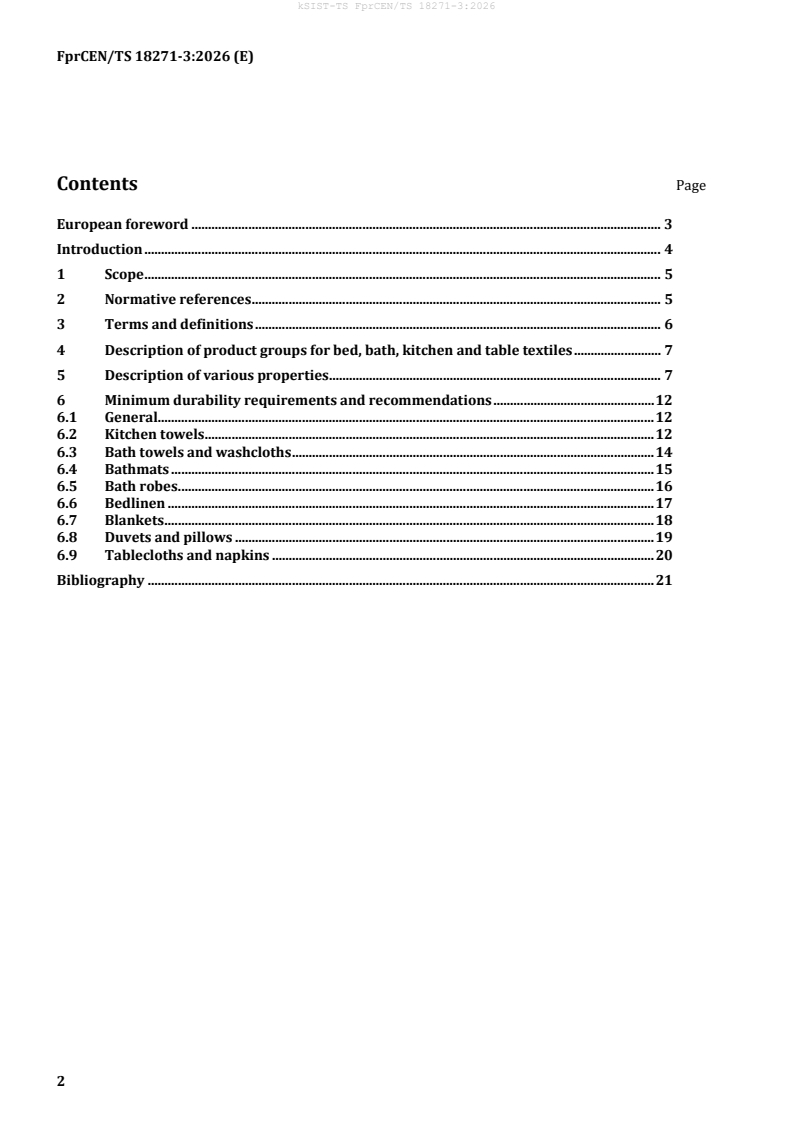
Contents Page
European foreword . 3
Introduction . 4
1 Scope . 5
2 Normative references . 5
3 Terms and definitions . 6
4 Description of product groups for bed, bath, kitchen and table textiles . 7
5 Description of various properties . 7
6 Minimum durability requirements and recommendations . 12
6.1 General. 12
6.2 Kitchen towels . 12
6.3 Bath towels and washcloths . 14
6.4 Bathmats . 15
6.5 Bath robes . 16
6.6 Bedlinen . 17
6.7 Blankets . 18
6.8 Duvets and pillows . 19
6.9 Tablecloths and napkins . 20
Bibliography . 21
European foreword
This document (FprCEN/TS 18271-3:2026) has been prepared by Technical Committee CEN/TC 248
“Textiles and textile products”, the secretariat of which is held by BSI.
This document is currently submitted to Vote on TS.
This document is part of the CEN/TS 18271 series under the general title Textiles — Circular economy
for textile products — Minimum durability requirements and recommendations. The series consists of
the following parts:
— Part 1: Clothing
— Part 2: Workwear
— Part 3: Bed, bath, kitchen and table textiles
Introduction
This document represents a first step towards a harmonized approach for assessing and improving
physical durability. It is expected that the methodologies and criteria described herein will evolve further
based on practical experience and future developments.
This document provides minimum requirements and recommendations for newly produced bed, bath,
kitchen and table textiles. It is intended to ensure a minimum durability performance of bed, bath, kitchen
and table textiles for domestic use and is intended to be maintained by domestic care.
The minimum requirements and recommendations in this document have been established with the
intended and foreseeable use, and care in mind, including subsequent uses. The ability of materials and
components to resist certain constraints are not detailed.
This document only addresses the intrinsic properties of the materials (knitted or woven fabrics) and
finished products (assembling) and not the extrinsic properties. Every step in the production chain, such
as fibre type, yarn type, type of fabric (sur)face, finishing, dying and coating, assembling techniques (use
of accessories) has an influence on the durability level. They are not considered in this document but can
be used to improve the durability level. This document does not contain information that allows the
minimum specifications to be related to the life and value of textiles in a typical domestic maintenance
procedure. Furthermore, these minimum specifications cannot be related to the lifetime of textiles
measured by multiple consumers in domestic maintenance and use trials. The actual domestic
maintenance applied by the user can differ from the standardized maintenance test and the use
consequences are very user specific. The use phase is tested via several standardized simulation tests
that each cover a different effect. These test methods are an abbreviated (accelerated) simulation of the
actual effect of certain factors that have no correlation to a particular use time. Therefore, this document
should not be used to produce claims on specific lifetime, lifespan nor use cycles. Spot cleaning is not
addressed in this document; if applied, it is recommended to carry it out on a non-visible area first.
It is strongly recommended that stakeholders along the value chain discuss the characteristics of
materials and their expected performance requirement to ensure the durability of bed, bath, kitchen and
table textiles. Both the used materials, the textile production as the assembly of the product are of
importance to ensure a good durability level.
High durability characteristics of the products can increase acquisition costs for both the value chain and
the consumer. To have a balanced durability level, it is therefore encouraged to carry out consumer
enquiries and waste audits, and monitor consumer complaints and returns, to better assess textile life
and total cost of ownership.
Clause 4 describes the different product groups on which this document applies. Clause 5 describes the
different properties and corresponding references to test methods used in this document. Clause 6
provides minimum durability requirements and additional recommendations on properties to ensure an
expected performance of different product groups.
1 Scope
This document specifies minimum physical durability requirements and recommendations for bed, bath,
kitchen and table textiles for circular economy in the textiles chain, based upon their intended use. Only
textiles for domestic use are considered.
Included in this document are the following textiles for domestic use: bedlinen, kitchen towels, teacloths,
tablecloths, napkins, bedding articles (duvets, pillows, bed covers), blankets, bath robes, terries like
towels, washcloths and bathmats.
Excluded from the document are textiles intended for contract use and other home textiles such as
curtains, textile wallpaper, carpets, upholstery, bed frames covered with textiles, mattresses (including
mattress ticking), ticking and children sleeping bags. Medical textiles and medical devices are also
excluded from this document.
2 Normative references
The following documents are referred to in the text in such a way that some or all of their content
constitutes requirements of this document. For dated references, only the edition cited applies. For
undated references, the latest edition of the referenced document (including any amendments) applies.
EN 12132-1, Feather and down — Methods of testing the down-proof properties of fabrics — Part 1:
Rubbing test
EN ISO 1421, Rubber- or plastics-coated fabrics — Determination of tensile strength and elongation at
break
EN ISO 4674-2, Rubber- or plastics-coated fabrics — Determination of tear resistance — Part 2: Ballistic
pendulum method
EN ISO 5077, Textiles — Determination of dimensional change in washing and drying
EN ISO 5470 (all parts), Rubber- or plastics-coated fabrics — Determination of abrasion resistance — Part
2: Martindale abrader
EN ISO 6330, Textiles — Domestic washing and drying procedures for textile testing
EN ISO 12947-2, Textiles — Determination of the abrasion resistance of fabrics by the Martindale method
— Part 2: Determination of specimen breakdown
EN ISO 13934-1, Textiles — Tensile properties of fabrics — Part 1: Determination of maximum force and
elongation at maximum force using the strip method
EN ISO 13936-1, Textiles — Determination of the slippage resistance of yarns at a seam in woven fabrics —
Part 1: Fixed seam opening method
EN ISO 13936-2, Textiles — Determination of the slippage resistance of yarns at a seam in woven fabrics —
Part 2: Fixed load method
EN ISO 13937-1, Textiles — Tear properties of fabrics — Part 1: Determination of tear force using ballistic
pendulum method (Elmendorf)
EN ISO 13938-1, Textiles — Bursting properties of fabrics — Part 1: Hydraulic method for determination
of bursting strength and bursting distension
EN ISO 13938-2, Textiles — Bursting properties of fabrics — Part 2: Pneumatic method for determination
of bursting strength and bursting distension
EN ISO 15487, Textiles — Method for assessing appearance of apparel and other textile end products after
domestic washing and drying
3 Terms and definitions
For the purposes of this document, the terms and definitions given in CEN/TS 18272-1 and the following
apply.
ISO and IEC maintain terminology databases for use in standardization at the following addresses:
— ISO Online browsing platform: available at https://www.iso.org/obp/
— IEC Electropedia: available at https://www.electropedia.org/
3.1
woven fabric
produced by interlacing (by weaving on a loom or weaving machine) a set of warp threads and a set of
weft threads normally at right angles to each other
[SOURCE: ISO 3572:1976, definition 2.1]
3.2
knitted fabrics
generic name applied to textile fabrics in which at least one system of threads is formed in to knitted
loops and the knitted loops are intermeshed into stitches
cf. ISO/4921: knitted loop; stitch
≠Knitting — Basic Concepts — Vocabulary ISO/4921 −1993≠Non-Woven Fabrics ISO/9092-1988
≠sew-knit (stitch-bonded) fabrics
≠knitted articles
≠knotted fabrics
≠lace machine fabrics
≠woven fabrics
≠tufted fabrics
≠needlefelt fabrics
[SOURCE: ISO 8388:2003, definition 3.0.1]
3.3
domestic laundering
washing/finishing of textiles according to size and volume needed by a single household
[SOURCE: ISO 15797:2017, definition 3.3, modified — Note 1 to entry has been deleted]
4 Description of product groups for bed, bath, kitchen and table textiles
This document classifies the requirements for the fabrics according to its use in the following product
groups (see Table 1).
Table 1 — description of various product groups
Product group Description and intended function Typical products include
Kitchen towels Towel mainly used to dry clean dishes. Dish cloths, teacloths
Bath towels and Towel mainly used to dry the body. Bath towels, washcloths
washcloths
Textile product used to clean the body.
Bathmats Mat to put in the bathroom to protect from Bathmats
slipping, to absorb water and protect against
a
cold feet.
Bath robes Bath robes typically worn in the spa, at Bath robes
swimming pools and beach environments. Its
main function is to cover the body and to stay
b
warm. It can also be used to dry the body.
Duvets and pillows Bedding article, for example to cover the human Duvets, comforters and
body or for laying your head on while you rest, sleeping pillows
c
consisting of a casing and a filling.
Blankets Textile product to cover the human body, Blankets
normally without filling.
Bedlinen Textile product to dress a bed. Sheets, pillowcases, duvet
covers, fitted sheets and
mattress covers
Tablecloths (also Textile product used to protect the table and Tablecloths
tablecloths) cover it for aesthetic reasons.
Napkins Textile product used to protect your clothes Napkins
from dirt, to clean your mouth and hands and
for aesthetic reasons to complement a
tablecloth.
a
This includes both woven and tufted bathmats.
b
This only includes terry bath robes and flat woven bath robes.
c
This only includes bedding articles intended to be used with a cover.
5 Description of various properties
The properties listed in Table 2 determine the durability of the bed, bath, kitchen and table textiles as
described in Clause 6. For each property Table 2 lists the appropriate test methods that are to be used.
Table 2 — Description of various properties
Properties Description (based on scopes) Test standard
Tensile strength This part of ISO 13934 specifies a procedure to EN ISO 13934-1
and elongation determine the maximum force and elongation at
maximum force of textile fabrics using a strip method.
Properties Description (based on scopes) Test standard
The method is mainly applicable to woven textile In case of coated
fabrics, including fabrics which exhibit stretch fabrics EN ISO 1421
characteristics imparted by the presence of an applies.
elastomeric fibre, mechanical, or chemical treatment. It
can be applicable to fabrics produced by other
techniques.
It is not normally applicable to geotextiles, nonwovens,
coated fabrics, textile-glass woven fabrics, and fabrics
made from carbon fibres or polyolefin tape yarns.
This International Standard specifies two methods for EN ISO 1421
the determination of the tensile strength of fabrics
coated with rubber or plastics.
— Method 1 — the strip test method, which is a method
for the determination of tensile strength and elongation
at break.
— Method 2 — the grab test method, which is a method
for the determination of tensile strength only.
The methods apply to test pieces in equilibrium with
specific standard atmospheres for testing and to wet
test pieces. Both methods require the use of a constant
rate of extension (CRE) tensile-testing machine.
Tear force This part of EN ISO 13937 describes a method known as EN ISO 13937-1
the ballistic pendulum (Elmendorf) method for the
In case of coated
determination of tear force of textile fabrics. The
fabrics EN ISO 4674-2
method describes the measurement of the tear force
applies.
required to propagate a single-rip tear of defined length
from a cut in a fabric when a sudden force is applied.
The test is mainly applicable to woven textile fabrics. It
may be applicable to fabrics produced by other
techniques, e.g. to nonwovens (with the same under-
mentioned restrictions as for the woven fabrics).
In general the test is not applicable to knitted fabrics
and woven elastic fabrics. It is not suitable for highly
anisotropic fabrics or loose fabrics where tear transfer
from one direction to another direction of the fabric
during the tear test is likely to occur.
This document specifies a method for the determination EN ISO 4674-2
of tear resistance based on the action of an active force
applied to a notched test piece. The test can be carried
out on:
— test pieces that have been conditioned in a standard
atmosphere; or
— test pieces that have undergone pre-treatment, e.g.
water immersion.
The results obtained by this method cannot be
compared with those obtained by methods involving
constant rate of tear.
Properties Description (based on scopes) Test standard
Abrasion This document specifies the procedure for the EN ISO 12947-2
resistance determination of specimen breakdown (end point of
In case of coated
test) by inspection at fixed intervals and is applicable to
fabrics EN ISO 5470
all textile fabrics including nonwovens apart from
(all parts) applies.
fabrics where the specifier indicates the end
performance as having a low abrasion wear life.
This document is not applicable to coated fabrics
(including laminated fabrics). If the abrasion behaviour
of the coated surface of a coated fabric is to be
determined, use the methods described in the various
parts of ISO 5470.
This document specifies two separate methods for EN ISO 5470 (all
determining the resistance of a material to wet and parts)
dry abrasion.
It is applicable to the coated surface or surfaces of
coated fabrics.
It does not apply to determining the abrasion behaviour
of an uncoated surface of a coated fabric, for which the
methods for uncoated textiles described in the
ISO 12947 series apply.
Pilling This document specifies a method for the determination EN ISO 12945-1
propensity of the resistance to pilling, fuzzing, and matting of textile
fabrics using a rotating pilling box apparatus.
This document specifies a method for determination of EN ISO 12945-2
the resistance to pilling, fuzzing, and matting of textile
a
fabrics using a modified Martindale method.
Bursting This doc
...