

EN 438-7:2005
(Main)High-pressure decorative laminates (HPL) - Sheets based on thermosetting resins (Usually called Laminates) - Part 7: Compact laminate and HPL composite panels for internal and external wall and ceiling finishes
- Abstract
This document specifies the health, safety and energy saving requirements for:
· Compact laminate panels/sidings for interior wall and ceiling finishes (including suspended ceilings);
· HPL composite panels/sidings for interior wall and ceiling finishes (including suspended ceilings);
· Compact laminate panels/sidings for exterior wall and ceiling finishes (including suspended ceilings);
· HPL composite panels/sidings for exterior wall and ceiling finishes (including suspended ceilings).
It also specifies methods for the evaluation of conformity of the product to the requirements, and includes requirements for marking. It covers only the HPL panels for non-structural applications, and does not cover fixing systems.
The products are intended for use as wall and ceiling finishes for internal and external applications according to the manufacturer's specifications.
The scope of this document does not cover:
a) overlaid or veneered wood-based panels where the overlay/veneer is not HPL;
b) HPL-surfaced wood-based panels intended for use as structural components. These products are covered by EN 13986 (wood-based panels for use in construction).
This document covers only characteristics related to health, safety and energy-saving. All other characteristics are covered in separate European Standards for HPL products (see aAnnex B).
b) HPL-surfaced wood-based panels intended for use as structural components. These products are covered by EN 13986 (wood-based panels for use in construction).
This European Standard covers only characteristics related to health, safety and energy-saving. All other characteristics are covered in separate European Standards for HPL products (see annex B).
- Status
- Published
- Publication Date
- 25-Jan-2005
- Withdrawal Date
- 30-Jul-2005
- Technical Committee
- CEN/TC 249 - Plastics
- Current Stage
- 6060 - Definitive text made available (DAV) - Publishing
- Start Date
- 26-Jan-2005
- Completion Date
- 26-Jan-2005
- Directive
- 305/2011 - Regulation (eu) No 305/2011 of the European Parliament and of the Council of 9 march 2011 laying down harmonised conditions for the marketing of construction products and repealing council directive 89/106/eecOJ Ref: C, C 259 OJ Date: 08-Aug-2014
89/106/EEC - Construction productsOJ Ref: C, C 139, C 319 OJ Date: 08-Jun-2005


Overview
EN 438-7:2005 is the CEN European standard for high‑pressure decorative laminates (HPL) used as non‑structural wall and ceiling finishes. It covers both compact laminate panels (≥ 2 mm) and HPL composite panels (HPL bonded to a substrate) for internal and external applications, including suspended ceilings. The standard focuses on health, safety and energy‑saving characteristics, specifies conformity assessment and marking requirements, and excludes fixing systems and structural wood‑based components.
Key topics and requirements
EN 438-7:2005 defines performance characteristics and test methods (references to EN 438‑1/2 and ISO standards) for HPL wall and ceiling products, including:
- Reaction to fire - classification according to EN 13501‑1 (SBI testing as per EN 13823; Annex B gives specimen mounting details). Some interior non‑flame‑retardant HPL products are Classified Without Further Testing (CWFT) under defined conditions.
- Fire resistance - where applicable, products are tested/classified to EN 13501‑2.
- Water vapour permeability - determined by EN ISO 12572 or taken from tabulated values (e.g., compact HPL at 1 350 kg/m3: wet cup µ = 110, dry cup µ = 250).
- Resistance to fixings - axial withdrawal (face screw‑holding) per ISO 13894‑1 or tabulated values for compact panels (example: 6 mm → 2 000 N; ≥10 mm → 4 000 N).
- Acoustic contribution - direct airborne sound insulation where applicable.
- Mechanical and thermal properties - bonding strength, flexural tensile strength, thermal resistance/conductivity.
- Release of dangerous substances and durability for intended use.
- Evaluation of conformity - type testing and Factory Production Control (FPC) requirements, plus marking and labelling obligations.
Applications and users
Who uses EN 438-7:2005:
- Manufacturers of compact HPL panels and HPL composite wall/ceiling panels for CE marking and conformity demonstration.
- Architects, specifiers and façade engineers assessing fire, hygrothermal and acoustic suitability for internal and external finishes.
- Installers and contractors verifying product performance and marking before installation (note: fixing systems are excluded by the standard).
- Regulators and certification bodies applying reaction‑to‑fire and building safety rules.
Practical uses:
- Specifying HPL panels for interior/exterior cladding, washroom walls, suspended ceilings and decorative façades where health, safety and energy concerns are critical.
Related standards
- EN 438‑1, EN 438‑2, EN 438‑3, EN 438‑4, EN 438‑6 (other HPL parts)
- EN 13501‑1 / EN 13501‑2 (fire classification)
- EN ISO 12572 (water vapour), ISO 13894‑1 (HPL composite test methods)
- EN 13986 (wood‑based panels - structural uses)
Keywords: EN 438-7:2005, HPL, high-pressure decorative laminates, compact laminate, HPL composite panels, wall finishes, ceiling finishes, reaction to fire, water vapour permeability, conformity, CEN.
Relations
- Effective Date
- 22-Dec-2008
- Effective Date
- 22-Dec-2008
- Refers
ISO 13894-1:2000 - High-pressure decorative laminates — Composite elements — Part 1: Test methods - Effective Date
- 25-Aug-2026
- Effective Date
- 28-Jan-2026
- Effective Date
- 28-Jan-2026
- Effective Date
- 28-Jan-2026
- Effective Date
- 28-Jan-2026
- Effective Date
- 28-Jan-2026
- Effective Date
- 28-Jan-2026
- Effective Date
- 28-Jan-2026
- Effective Date
- 28-Jan-2026
- Effective Date
- 28-Jan-2026
- Effective Date
- 28-Jan-2026
- Effective Date
- 28-Jan-2026
- Effective Date
- 28-Jan-2026
Get Certified
Connect with accredited certification bodies for this standard

DIN CERTCO
DIN Group product certification.

Smithers Quality Assessments
US management systems and product certification.
Sponsored listings
Frequently Asked Questions
EN 438-7:2005 is a standard published by the European Committee for Standardization (CEN). Its full title is "High-pressure decorative laminates (HPL) - Sheets based on thermosetting resins (Usually called Laminates) - Part 7: Compact laminate and HPL composite panels for internal and external wall and ceiling finishes". This standard covers: This document specifies the health, safety and energy saving requirements for: · Compact laminate panels/sidings for interior wall and ceiling finishes (including suspended ceilings); · HPL composite panels/sidings for interior wall and ceiling finishes (including suspended ceilings); · Compact laminate panels/sidings for exterior wall and ceiling finishes (including suspended ceilings); · HPL composite panels/sidings for exterior wall and ceiling finishes (including suspended ceilings). It also specifies methods for the evaluation of conformity of the product to the requirements, and includes requirements for marking. It covers only the HPL panels for non-structural applications, and does not cover fixing systems. The products are intended for use as wall and ceiling finishes for internal and external applications according to the manufacturer's specifications. The scope of this document does not cover: a) overlaid or veneered wood-based panels where the overlay/veneer is not HPL; b) HPL-surfaced wood-based panels intended for use as structural components. These products are covered by EN 13986 (wood-based panels for use in construction). This document covers only characteristics related to health, safety and energy-saving. All other characteristics are covered in separate European Standards for HPL products (see aAnnex B). b) HPL-surfaced wood-based panels intended for use as structural components. These products are covered by EN 13986 (wood-based panels for use in construction). This European Standard covers only characteristics related to health, safety and energy-saving. All other characteristics are covered in separate European Standards for HPL products (see annex B).
This document specifies the health, safety and energy saving requirements for: · Compact laminate panels/sidings for interior wall and ceiling finishes (including suspended ceilings); · HPL composite panels/sidings for interior wall and ceiling finishes (including suspended ceilings); · Compact laminate panels/sidings for exterior wall and ceiling finishes (including suspended ceilings); · HPL composite panels/sidings for exterior wall and ceiling finishes (including suspended ceilings). It also specifies methods for the evaluation of conformity of the product to the requirements, and includes requirements for marking. It covers only the HPL panels for non-structural applications, and does not cover fixing systems. The products are intended for use as wall and ceiling finishes for internal and external applications according to the manufacturer's specifications. The scope of this document does not cover: a) overlaid or veneered wood-based panels where the overlay/veneer is not HPL; b) HPL-surfaced wood-based panels intended for use as structural components. These products are covered by EN 13986 (wood-based panels for use in construction). This document covers only characteristics related to health, safety and energy-saving. All other characteristics are covered in separate European Standards for HPL products (see aAnnex B). b) HPL-surfaced wood-based panels intended for use as structural components. These products are covered by EN 13986 (wood-based panels for use in construction). This European Standard covers only characteristics related to health, safety and energy-saving. All other characteristics are covered in separate European Standards for HPL products (see annex B).
EN 438-7:2005 is classified under the following ICS (International Classification for Standards) categories: 83.140.20 - Laminated sheets. The ICS classification helps identify the subject area and facilitates finding related standards.
EN 438-7:2005 has the following relationships with other standards: It is inter standard links to EN 438-1:1991, EN 438-2:1991, ISO 13894-1:2000, EN 13501-2:2023, EN ISO 10140-5:2021, EN ISO 10140-2:2021, EN ISO 717-1:2020, EN ISO 12460-3:2023, EN ISO 12572:2016, EN 717-1:2004, EN ISO 178:2019, EN ISO 21533:2003, EN 438-6:2005, EN 438-1:2005, EN 438-4:2005. Understanding these relationships helps ensure you are using the most current and applicable version of the standard.
EN 438-7:2005 is associated with the following European legislation: EU Directives/Regulations: 305/2011, 89/106/EEC; Standardization Mandates: M/121. When a standard is cited in the Official Journal of the European Union, products manufactured in conformity with it benefit from a presumption of conformity with the essential requirements of the corresponding EU directive or regulation.
EN 438-7:2005 is available in PDF format for immediate download after purchase. The document can be added to your cart and obtained through the secure checkout process. Digital delivery ensures instant access to the complete standard document.
Standards Content (Sample)
2003-01.Slovenski inštitut za standardizacijo. Razmnoževanje celote ali delov tega standarda ni dovoljeno.High-pressure decorative laminates (HPL) - Sheets based on thermosetting resins (Usually called Laminates) - Part 7: Compact laminate and HPL composite panels for internal and external wall and ceiling finishesStratifiés décoratifs haute pression (HPL) - Plaques a base de résines thermodurcissables (communément appelées stratifiés) - Partie 7 : Panneaux stratifiés compacts et composites HPL pour finitions des murs et plafonds intérieurs et extérieursDekorative Hochdruck-Schichtpressstoffplatten (HPL) - Platten auf Basis härtbarer Harze (Schichtpressstoffe) - Teil 7: Kompaktplatten und HPL-Mehrschicht-Verbundplatten für Wand- und Deckenbekleidungen für Innen- und AußenanwendungTa slovenski standard je istoveten z:EN 438-7:2005SIST EN 438-7:2005en83.140.20ICS:SLOVENSKI
STANDARDSIST EN 438-7:200501-maj-2005
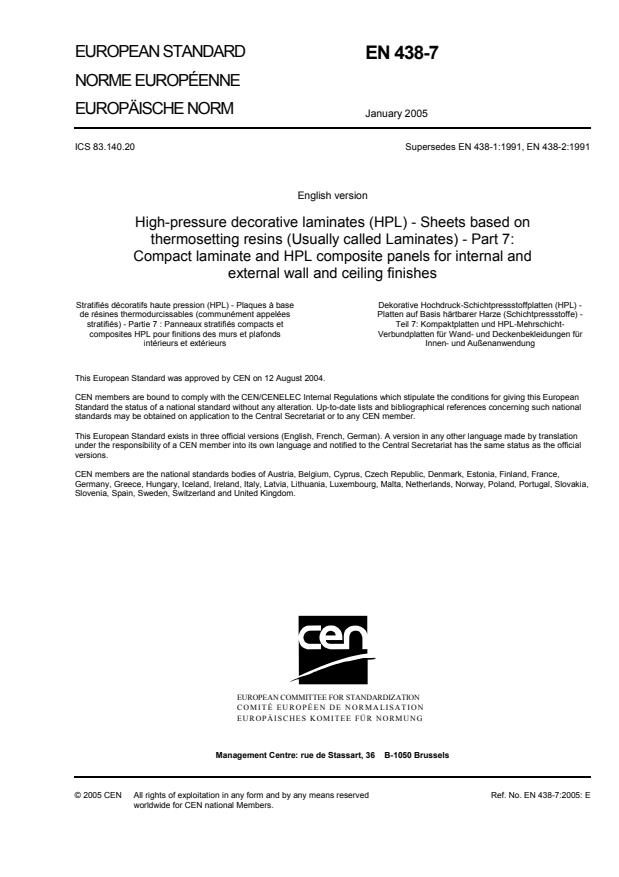
EUROPEAN STANDARD NORME EUROPÉENNE EUROPÄISCHE NORM
EN 438-7
January 2005 ICS 83.140.20 Supersedes EN 438-1:1991, EN 438-2:1991 English version
High-pressure decorative laminates (HPL) - Sheets based on thermosetting resins (Usually called Laminates) - Part 7: Compact laminate and HPL composite panels for internal and external wall and ceiling finishes
Stratifiés décoratifs haute pression (HPL) - Plaques à base de résines thermodurcissables (communément appelées stratifiés) - Partie 7 : Panneaux stratifiés compacts et composites HPL pour finitions des murs et plafonds intérieurs et extérieurs
Dekorative Hochdruck-Schichtpressstoffplatten (HPL) - Platten auf Basis härtbarer Harze (Schichtpressstoffe) - Teil 7: Kompaktplatten und HPL-Mehrschicht-Verbundplatten für Wand- und Deckenbekleidungen für Innen- und Außenanwendung This European Standard was approved by CEN on 12 August 2004.
CEN members are bound to comply with the CEN/CENELEC Internal Regulations which stipulate the conditions for giving this European Standard the status of a national standard without any alteration. Up-to-date lists and bibliographical references concerning such national standards may be obtained on application to the Central Secretariat or to any CEN member.
This European Standard exists in three official versions (English, French, German). A version in any other language made by translation under the responsibility of a CEN member into its own language and notified to the Central Secretariat has the same status as the official versions.
CEN members are the national standards bodies of Austria, Belgium, Cyprus, Czech Republic, Denmark, Estonia, Finland, France, Germany, Greece, Hungary, Iceland, Ireland, Italy, Latvia, Lithuania, Luxembourg, Malta, Netherlands, Norway, Poland, Portugal, Slovakia, Slovenia, Spain, Sweden, Switzerland and United Kingdom.
EUROPEAN COMMITTEE FOR STANDARDIZATION COMITÉ EUROPÉEN DE NORMALISATION EUROPÄISCHES KOMITEE FÜR NORMUNG
Management Centre: rue de Stassart, 36
B-1050 Brussels © 2005 CEN All rights of exploitation in any form and by any means reserved worldwide for CEN national Members. Ref. No. EN 438-7:2005: E
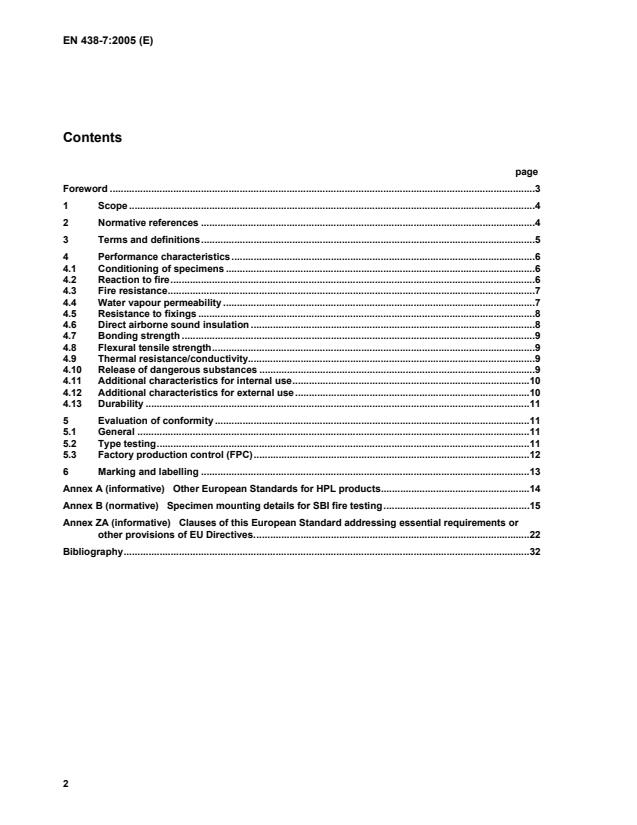
Other European Standards for HPL products.14 Annex B (normative)
Specimen mounting details for SBI fire testing.15 Annex ZA (informative)
Clauses of this European Standard addressing essential requirements or other provisions of EU Directives.22 Bibliography.32
Interior grade non-FR HPL composite panels with wood-based substrates c Composite panels comprising non-FR grade HPL meeting the requirements of EN 438-3, adhesively bonded to both sides of non-FR grade wood-based core of minimum thickness 12 mm complying with EN 13986, using PVAc or thermosetting adhesive at an application rate of 60 g/m2 to 120 g/m2.
Wood-based core minimum density 600. HPL minimum density 1 350.
12 mm wood-based core with HPL ≥ 0,5 mm bonded to both sides
D-s2,d0 a Either directly fixed (i.e. with no air gap) to a material having a reaction to fire class of A2-s1,d0 or better and a density of at least 600 kg/m3; or mounted on a timber or metal batten support frame, with a non-ventilated (i.e. void open only at the top) air gap of at least 30 mm, the reverse face of the cavity so formed having a reaction to fire classification of A2-s2,d0 or better. b Classes as provided for in Commission Decision 2000/147/EC Annex Table 1. c Complying with this standard.
4.3 Fire resistance 4.3.1 General Fire resistance applies only for panels intended for end-uses subject to resistance to fire regulations, and where the panel is intended to contribute to fire resistance. 4.3.2 Specimen preparation The product tested shall be mounted in a manner representative of the end-use conditions. 4.3.3 Requirement The product shall be tested and classified according to EN 13501-2, and the resulting class or classes with the corresponding end use(s) shall be declared. 4.4 Water vapour permeability 4.4.1 General Water vapour permeability applies only for panels intended for end uses on walls subject to water vapour permeability regulations, and where the panel is intended to contribute to water vapour resistance. 4.4.2 Requirement The water vapour permeability shall either be determined as water vapour resistance factor according to EN ISO 12572, or taken from Table 2.
HPL particleboard composite panel Substrate density 300 kg/m3 Substrate density 600 kg/m3 Substrate density 900 kg/m3 10 15 20 50 50 50
HPL fibreboard composite panel Substrate density 400 kg/m3 Substrate density 600 kg/m3 Substrate density 800 kg/m3 5 12 20 10 20 30 a Linear interpolation for intermediate density values is permitted.
4.5 Resistance to fixings Resistance to fixings shall be determined as resistance to axial withdrawal of wood screws from the panel face (face screw-holding) according to ISO 13894-1:2000, test method 15, or in the case of Compact panels taken from Table 3. When testing Compact panels a pilot hole, with a diameter 0,5 mm less than the nominal screw size, shall be pre-drilled before inserting the screw. Table 3 — Resistance to fixings – values for Compact panels Compact panel thickness (mm) Screw holding value (Newtons) 2 250 4 1 000 6 2 000 8 3 000 ≥ 10 4 000
4.6 Direct airborne sound insulation 4.6.1 General Direct airborne sound insulation applies for panels intended for uses in walls/ceilings subject to acoustic insulation regulations, and where the panel is intended to contribute to sound insulation. Compact panels/sidings and composite panels/sidings are used most of the time as a component of a building element. The acoustic performance is relevant for the building element of which the panel is a part.
EN 438-6:2005, Table 2 for exterior use, and shall be declared as pass results. 4.9 Thermal resistance/conductivity 4.9.1 General Thermal resistance/conductivity applies only for panels intended for end uses on walls/ceilings subject to thermal insulation regulations, and where the panel is intended to contribute to the thermal insulation. 4.9.2 Requirement The thermal conductivity shall be determined in accordance with EN 12664 and the result shall be declared, or it shall be calculated from data taken from EN 12524, where the conductivity of the HPL part of the product shall be taken to be 0,3 W/(m K). 4.10 Release of dangerous substances 4.10.1 Content of pentachlorophenol 4.10.1.1 General Content of pentachlorophenol applies only for wood-based HPL composite panels/sidings.
EN 717-1 requirement EN 717-2 requirement Class E1 ≤ 0,13 mg/m3 air ≤ 3,5 mg/m2 h Class E2 > 0,13 mg/m3 air > 3,5 to ≤ 8,0 mg/m2 h NOTE
For established products, initial type testing may also be done on the basis of existing data from tests carried out in accordance with EN 120 or EN 717-2, either from factory production control or from external inspection.
4.11.2 Sound absorption 4.11.2.1 General Sound absorption applies only for panels intended to be used for acoustical absorbent purposes, and where the panel is intended to contribute to sound absorption. Compact panels/sidings and composite panels/sidings are used most of the time as a component of building element. The acoustic performance is relevant for the building element of which the panel is a part. 4.11.2.2 Requirement If the building element including Compact or composite panels is to be tested for sound absorption, then it shall be tested in accordance with EN ISO 354 and rated in accordance with EN ISO 11654. 4.12 Additional characteristics for external use The thermal shock resistance shall be determined as resistance to climatic shock according to EN 438-2:2005, Test method 19. Compact laminate panels shall comply with the requirement specified for a ‘Pass’ result specified in EN 438-6.
...