

EN 12814-6:2026
(Main)Testing of welded joints of thermoplastics semi-finished products - Part 6: Low temperature tensile test
- Abstract
This document specifies the dimensions, the method of sampling and the preparation of the test specimens, also the conditions for performing the low temperature tensile test perpendicular to the weld in order to determine the low temperature tensile welding factor.
A low temperature tensile test can be used in conjunction with other tests (e.g. bend, tensile creep, macro) to assess the performance of welded assemblies, made from thermoplastics materials.
The low temperature tensile welding factor and the appearance of the fracture surface provide a guide regarding the ductility of the joint and the quality of the work.
This document is applicable to co-axial or co-planar welded assemblies made from thermoplastics materials filled or unfilled, but not reinforced, irrespective of the welding process used.
This document does not apply to co-axial welded assemblies of an external diameter less than 20 mm.
- Status
- Published
- Publication Date
- 08-Nov-2026
- Technical Committee
- CEN/TC 249 - Plastics
- Drafting Committee
- CEN/TC 249/WG 16 - Welding of thermoplastics
- Current Stage
- 6060 - Definitive text made available (DAV) - Publishing
- Start Date
- 16-Sep-2026
- Due Date
- 09-Nov-2026
- Completion Date
- 09-Nov-2026
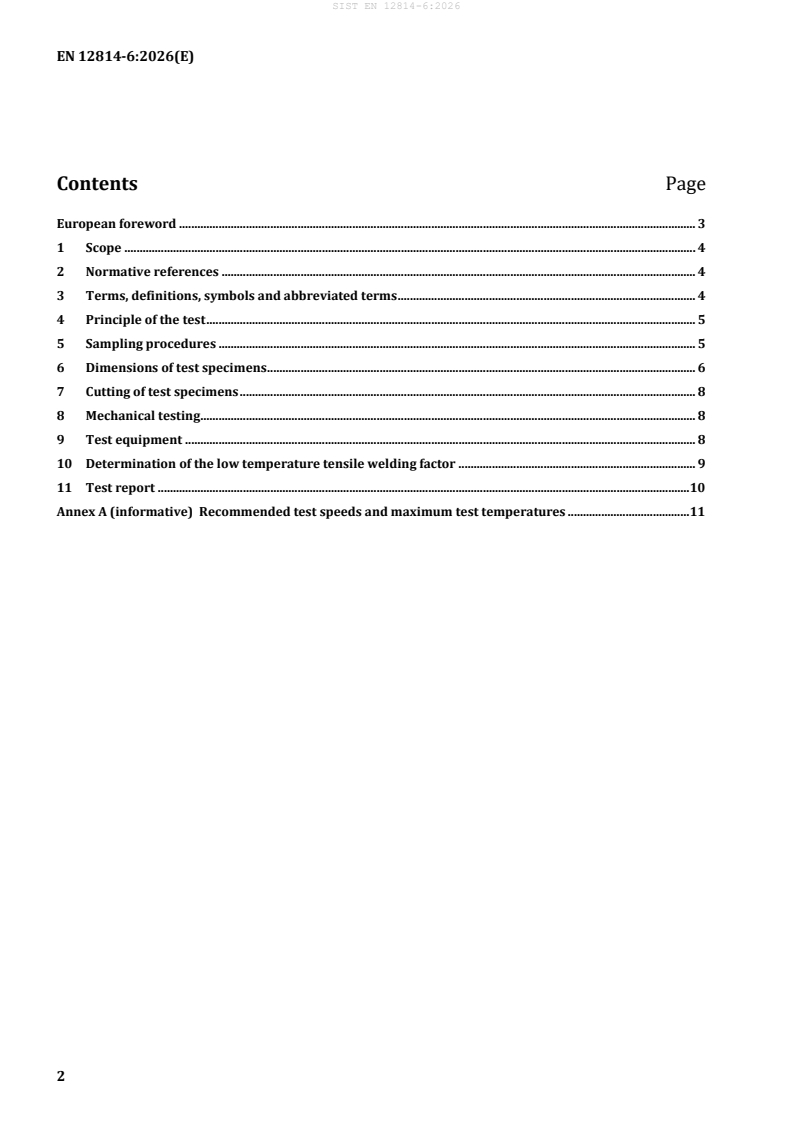
EN 12814-6:2026 is a CEN European Standard for the low temperature tensile test on welded joints of thermoplastics semi-finished products. It specifies how to sample, prepare and test welded and unwelded specimens perpendicular to the weld so the low temperature tensile welding factor can be determined. It applies to co-axial or co-planar welded assemblies made from filled or unfilled, non-reinforced thermoplastics, with a diameter limit for small co-axial assemblies.
What does EN 12814-6:2026 specify?
EN 12814-6:2026 specifies the test specimen dimensions, sampling method, specimen preparation and test conditions for a low temperature tensile test performed across the weld. The document is organized into clauses on scope, references, symbols, test principle, sampling, specimen dimensions, cutting, mechanical testing, equipment, calculation and reporting, plus an informative annex with recommended test settings.
The standard is intended for assessing welded assemblies in combination with other checks such as bend, tensile creep and macro examination. In practice, it is used to judge joint ductility and the quality of the welding work from the welding factor and the fracture surface.
What are the key requirements of EN 12814-6:2026?
EN 12814-6:2026 requires a low temperature tensile test to be carried out perpendicular to the weld until brittle fracture occurs. The welded and unwelded specimens used for comparison must come from the same test piece so the result reflects the weld rather than material variation.
Sampling and specimen preparation
Clause 5 requires welded and unwelded specimens to be cut from the same test piece, at least eight hours after welding, and marked so their original position can be traced. No heat treatment or mechanical straightening is allowed, which matters because those actions could change the weld area before testing.
Clause 6 and Figure 1 set the specimen geometry. Tables 1 and 2 give the dimensions for co-axial assemblies and plates, and the bead is kept or removed depending on how the product is used in service. This ensures the test piece matches the actual joint condition the user cares about.
Cutting and examination
Clause 7 requires parallel-sided specimens and minimization of heating during cutting. Cutting must not create notches, and the weld must then be visually examined in accordance with EN 13100-1 and recorded. That makes the test traceable and helps separate cutting damage from weld defects.
Test conditions and equipment
Clause 8 requires conditioning at the test temperature in line with EN ISO 291, with the test then run at the same temperature and with temperature variation within ± 5 °C. At least five welded and five unwelded specimens are tested at the same temperature and speed, and if a specimen yields, the whole set from that test piece is repeated at lower temperature and/or higher speed to obtain brittle fracture behavior.
Clause 9 requires test equipment that complies with ISO 5893. Annex A gives recommended test speeds and maximum test temperatures for some materials, which helps laboratories select conditions that are more likely to produce a meaningful brittle-fracture result.
Calculation and reporting
Clause 10 requires the low temperature tensile welding factor to be calculated from the mean fracture stresses of the welded and unwelded specimens. At least ten specimens in total are used, and specimens are not ignored unless failure occurs in the clamps. The fracture type and the appearance of the fracture surface must also be assessed and recorded.
Clause 11 defines the test report content. In practice, the report captures the specimen identification, dimensions, test temperature, speed, measured forces, calculated stresses, the welding factor, deviations, unusual observations and the laboratory identification.
What terms does EN 12814-6:2026 define?
EN 12814-6:2026 uses symbols and abbreviated terms for the specimen dimensions, test forces, stresses and calculated result.
- Low temperature tensile welding factor (f) - the calculated ratio used to compare the welded specimen result with the unwelded specimen result.
- Fw - the force value used for welded test specimens in the calculation of f.
- Fr - the force value used for unwelded test specimens in the calculation of f.
- σw - the fracture stress for each welded test specimen used in the calculation of f.
- σr - the fracture stress for each unwelded test specimen used in the calculation of f.
- De - the external diameter of the co-axial assembly.
- a - the minimum measured thickness of the test specimen within the waisted section.
- b - the minimum width of the test specimen within the waisted section.
Who uses EN 12814-6:2026?
EN 12814-6:2026 is used by laboratories, weld testers, manufacturers and quality personnel working with thermoplastics welded assemblies. It is relevant for acceptance testing, weld procedure assessment, quality control and failure analysis where a low temperature tensile result is needed. Buyers and inspectors can also use it to specify how welded joints are to be tested and reported.
What changed in EN 12814-6:2026 from the previous edition?
EN 12814-6:2026 supersedes EN 12814-6:2000. The foreword states one technical change: if one test specimen yields, all specimens from both the welded and unwelded test pieces may be tested at a temperature and speed that produce brittle fracture, not just one specimen.
Which standards are used with EN 12814-6:2026?
EN 12814-6:2026 refers to these standards for supporting conditions and methods:
- EN ISO 291 - standard atmospheres for conditioning and testing plastics specimens.
- EN 13100-1 - visual examination of welded joints of thermoplastics semi-finished products.
- ISO 5893 - requirements for tensile, flexural and compression test equipment with constant rate of traverse.
What does the EN 12814-6:2026 document contain?
EN 12814-6:2026 contains a specimen figure, two dimension tables for co-axial assemblies and plates, and a calculation section for the welding factor. It also includes the procedure for cutting, conditioning and testing specimens, and a report checklist covering identification, test conditions, forces, stresses and fracture appearance. Annex A provides recommended test speeds and maximum test temperatures for selected thermoplastics materials.
Relations
- Effective Date
- 07-Aug-2024
- Effective Date
- 17-Sep-2026
- Effective Date
- 17-Sep-2026
- Effective Date
- 17-Sep-2026
- Effective Date
- 17-Sep-2026
Get Certified
Connect with accredited certification bodies for this standard

DVS-ZERT GmbH
German welding certification society.

CARES (UK Certification Authority for Reinforcing Steels)
UK certification for reinforcing steels and construction.

EWF/IIW (European/International Welding Federation)
International welding personnel certification.
Sponsored listings
Frequently Asked Questions
EN 12814-6:2026 is a standard published by the European Committee for Standardization (CEN). Its full title is "Testing of welded joints of thermoplastics semi-finished products - Part 6: Low temperature tensile test". This standard covers: This document specifies the dimensions, the method of sampling and the preparation of the test specimens, also the conditions for performing the low temperature tensile test perpendicular to the weld in order to determine the low temperature tensile welding factor. A low temperature tensile test can be used in conjunction with other tests (e.g. bend, tensile creep, macro) to assess the performance of welded assemblies, made from thermoplastics materials. The low temperature tensile welding factor and the appearance of the fracture surface provide a guide regarding the ductility of the joint and the quality of the work. This document is applicable to co-axial or co-planar welded assemblies made from thermoplastics materials filled or unfilled, but not reinforced, irrespective of the welding process used. This document does not apply to co-axial welded assemblies of an external diameter less than 20 mm.
This document specifies the dimensions, the method of sampling and the preparation of the test specimens, also the conditions for performing the low temperature tensile test perpendicular to the weld in order to determine the low temperature tensile welding factor. A low temperature tensile test can be used in conjunction with other tests (e.g. bend, tensile creep, macro) to assess the performance of welded assemblies, made from thermoplastics materials. The low temperature tensile welding factor and the appearance of the fracture surface provide a guide regarding the ductility of the joint and the quality of the work. This document is applicable to co-axial or co-planar welded assemblies made from thermoplastics materials filled or unfilled, but not reinforced, irrespective of the welding process used. This document does not apply to co-axial welded assemblies of an external diameter less than 20 mm.
EN 12814-6:2026 is classified under the following ICS (International Classification for Standards) categories: 25.160.40 - Welded joints and welds. The ICS classification helps identify the subject area and facilitates finding related standards.
EN 12814-6:2026 has the following relationships with other standards: It is inter standard links to EN 12814-6:2000, EN 14879-4:2007, EN 12814-8:2024, EN 12814-8:2001, EN 12814-8:2021. Understanding these relationships helps ensure you are using the most current and applicable version of the standard.
EN 12814-6:2026 is available in PDF format for immediate download after purchase. The document can be added to your cart and obtained through the secure checkout process. Digital delivery ensures instant access to the complete standard document.
Standards Content (Sample)
Contents
- 1 Scope
- 2 Normative references
- 3 Terms, definitions, symbols and abbreviated terms
- 3.1 Terms and definitions
- 3.2 Symbols and abbreviated terms
- 4 Principle of the test
- 5 Sampling procedures
- 6 Dimensions of test specimens
- 7 Cutting of test specimens
- 8 Mechanical testing
- 9 Test equipment
- 10 Determination of the low temperature tensile welding factor
- 11 Test report
- Annex A
1 Scope
This document specifies the dimensions, the method of sampling and the preparation of the test specimens, also the conditions for performing the low temperature tensile test perpendicular to the weld in order to determine the low temperature tensile welding factor. A low temperature tensile test can be used in conjunction with other tests (e.g. bend, tensile creep, macro) to assess the performance of welded assemblies, made from thermoplastics materials. The low temperature tensile welding factor and the appearance of the fracture surface provide a guide regarding the ductility of the joint and the quality of the work. This document is applicable to co-axial or co-planar welded assemblies made from thermoplastics materials filled or unfilled, but not reinforced, irrespective of the welding process used. This document does not apply to co-axial welded assemblies of an external diameter less than 20 mm.
2 Normative references
The following documents are referred to in the text in such a way that some or all of their content constitutes requirements of this document. For dated references, only the edition cited applies. For undated references, the latest edition of the referenced document (including any amendments) applies. EN ISO 291, Plastics - Standard atmospheres for conditioning and testing (ISO 291) EN 13100-1, Non destructive testing of welded joints of thermoplastics semi-finished products - Part 1:
Visual examination ISO 5893, Rubber and plastics test equipment — Tensile, flexural and compression types (constant rate of traverse) — Specification
3 Terms, definitions, symbols and abbreviated terms
3.1 Terms and definitions
No terms and definitions are listed in this document.
ISO and IEC maintain terminology databases for use in standardization at the following addresses:
- ISO Online browsing platform: available at https://www.iso.org/obp/
- IEC Electropedia: available at https://www.electropedia.org/
SIST EN 12814-6:2026 EN 12814-6:2026(E)
3.2 Symbols and abbreviated terms
For the purposes of this document, the following symbols and abbreviations apply:
a minimum measured thickness of the test mm specimen within the waisted section a nominal thickness of the test piece mm n b minimum width of test specimen within the mm waisted section b width of shoulder of the test specimen mm
D external diameter of the co-axial assembly mm e f low temperature tensile welding factor None t F value of force of the unwelded test specimens N r taken from the same test piece, used in the calculation of f t F value of force of the welded test specimens used N w in the calculation of f t L total length of the test specimen mm L minimum distance between the clamping jaws mm j L maximum width of the weld bead of the test mm w specimen r radius of machining of the test specimen mm
σ value of stress at break of each unwelded test N/mm r specimen taken from the same test piece
average value of σ for all unwelded test N/mm σ r r specimens from the same test piece, used in the calculation of f t
σ value of stress at break of each welded test N/mm w specimen taken from the same test piece
...