


FprEN ISO 18243
(Main)Electrically propelled mopeds and motorcycles - Test specifications and safety requirements for lithium-ion battery systems (ISO/FDIS 18243:2025)
Electrically propelled mopeds and motorcycles - Test specifications and safety requirements for lithium-ion battery systems (ISO/FDIS 18243:2025)
ISO 18243:2017 specifies the test procedures for lithium-ion battery packs and systems used in electrically propelled mopeds and motorcycles.
The specified test procedures enable the user of this document to determine the essential characteristics on performance, safety and reliability of lithium-ion battery packs and systems. The user is also supported to compare the test results achieved for different battery packs or systems.
ISO 18243:2017 enables setting up a dedicated test plan for an individual battery pack or system subject to an agreement between customer and supplier. If required, the relevant test procedures and/or test conditions of lithium-ion battery packs and systems are selected from the standard tests provided in this document to configure a dedicated test plan.
NOTE 1 Electrically power-assisted cycles (EPAC) cannot be considered as mopeds. The definition of electrically power-assisted cycles can differ from country to country. An example of definition can be found in the EU Directive 2002/24/EC.
NOTE 2 Testing on cell level is specified in IEC 62660 (all parts).
Elektrisch angetriebene Mopeds und Motorräder - Prüfspezifikation und Sicherheitsanforderungen für Lithium-Ionen basierte Batteriesysteme (ISO/FDIS 18243:2025)
Dieses Dokument spezifiziert Prüfverfahren für Lithium-Ionen-Batteriepakete und systeme, die in elektrisch angetriebenen Kleinkrafträdern und Motorrädern verwendet werden.
Die spezifizierten Prüfverfahren ermöglichen dem Anwender dieses Dokuments die Bestimmung der wesentlichen Merkmale der Leistungsfähigkeit und Sicherheit von Lithium-Ionen-Batteriepaketen und -systemen. Zudem ist es möglich, die von verschiedenen Batteriepaketen oder -systemen erreichten Prüfergebnisse zu vergleichen.
Dieses Dokument ermöglicht die Erstellung eines speziellen Prüfplans für ein einzelnes Batteriepaket oder system, der einer Vereinbarung zwischen Kunde und Lieferant unterliegt. Bei Bedarf werden die relevanten Prüfverfahren und/oder Prüfbedingungen von Lithium-Ionen-Batteriepaketen und -systemen aus den in diesem Dokument enthaltenen Standardprüfungen ausgewählt, um einen eigenen Prüfplan zu erstellen.
ANMERKUNG 1 Fahrräder mit elektrischem Hilfsmotor (EPAC, Electrically Power-Assisted Cycles) können nicht als Kleinkrafträder angesehen werden. Die Definition von Fahrrädern mit elektrischem Hilfsmotor kann von Land zu Land unterschiedlich sein. Ein Beispiel einer Definition kann Literaturhinweis [7] entnommen werden.
ANMERKUNG 2 Prüfungen auf Zellenebene sind in der Normenreihe IEC 62660. spezifiziert.
Cyclomoteurs et motocycles à propulsion électrique - Spécifications d'essai et exigences de sécurité pour les systèmes de batterie au lithium-ion (ISO/FDIS 18243:2025)
ISO 18243:2017 spécifie des modes opératoires d'essai spécifiques pour les blocs et systèmes de batterie au lithium-ion utilisables dans les motocycles et cyclomoteurs à propulsion électrique.
Les modes opératoires d'essai spécifiés permettent à l'utilisateur du présent document de déterminer les caractéristiques essentielles de performance, de sécurité et de fiabilité des blocs et systèmes de batterie au lithium-ion. L'utilisateur peut également comparer les résultats d'essai obtenus pour différents blocs ou systèmes de batterie.
ISO 18243:2017 permet d'établir un plan d'essai dédié pour un bloc ou système de batterie individuel sous réserve d'un accord entre le client et le fournisseur. Si nécessaire, les modes opératoires et/ou conditions d'essai approprié(e)s des blocs et systèmes de batterie au lithium-ion sont choisis parmi les essais normalisés fournis dans le présent document pour configurer un plan d'essai dédié.
NOTE 1 Le vélo à assistance électrique (VAE) ne peut pas être considéré comme un cyclomoteur. La définition du vélo à assistance électrique peut différer selon les pays. Un exemple de définition est indiqué dans la Directive 2002/24/CE de l'UE.
NOTE 2 Des essais de performance des accumulateurs sont spécifiés dans l'IEC 62660 (toutes les parties).
Mopedi in motorna kolesa na električni pogon - Metode preskušanja in varnostne zahteve za sisteme z litij-ionskimi baterijami (ISO/FDIS 18243:2025)
General Information
Relations
Standards Content (Sample)
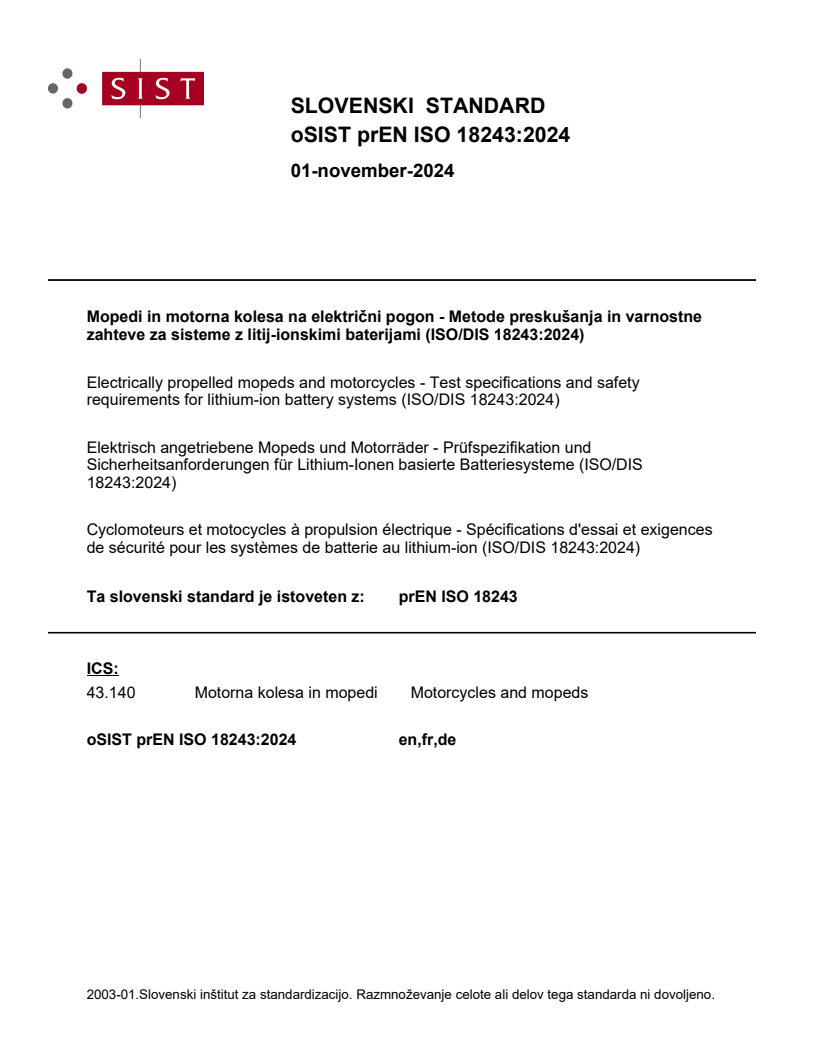
SLOVENSKI STANDARD
oSIST prEN ISO 18243:2024
01-november-2024
Mopedi in motorna kolesa na električni pogon - Metode preskušanja in varnostne
zahteve za sisteme z litij-ionskimi baterijami (ISO/DIS 18243:2024)
Electrically propelled mopeds and motorcycles - Test specifications and safety
requirements for lithium-ion battery systems (ISO/DIS 18243:2024)
Elektrisch angetriebene Mopeds und Motorräder - Prüfspezifikation und
Sicherheitsanforderungen für Lithium-Ionen basierte Batteriesysteme (ISO/DIS
18243:2024)
Cyclomoteurs et motocycles à propulsion électrique - Spécifications d'essai et exigences
de sécurité pour les systèmes de batterie au lithium-ion (ISO/DIS 18243:2024)
Ta slovenski standard je istoveten z: prEN ISO 18243
ICS:
43.140 Motorna kolesa in mopedi Motorcycles and mopeds
oSIST prEN ISO 18243:2024 en,fr,de
2003-01.Slovenski inštitut za standardizacijo. Razmnoževanje celote ali delov tega standarda ni dovoljeno.
oSIST prEN ISO 18243:2024
oSIST prEN ISO 18243:2024
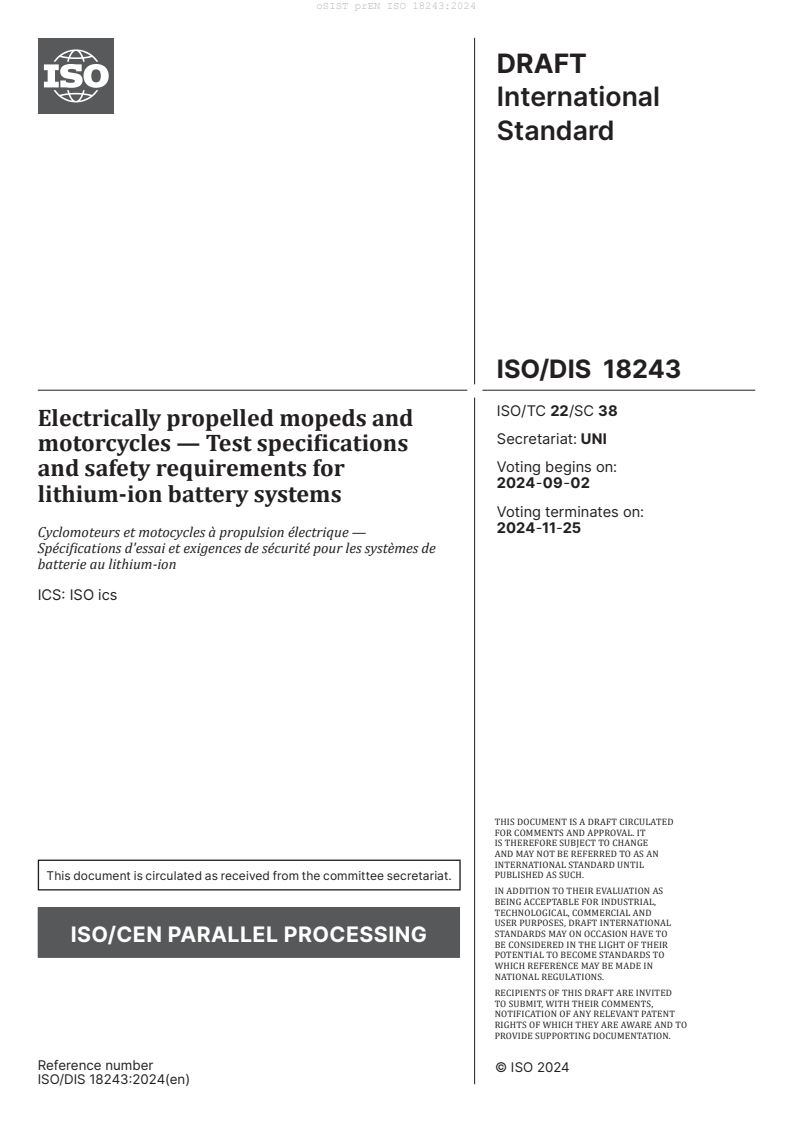
DRAFT
International
Standard
ISO/DIS 18243
ISO/TC 22/SC 38
Electrically propelled mopeds and
Secretariat: UNI
motorcycles — Test specifications
Voting begins on:
and safety requirements for
2024-09-02
lithium-ion battery systems
Voting terminates on:
2024-11-25
Cyclomoteurs et motocycles à propulsion électrique —
Spécifications d'essai et exigences de sécurité pour les systèmes de
batterie au lithium-ion
ICS: ISO ics
THIS DOCUMENT IS A DRAFT CIRCULATED
FOR COMMENTS AND APPROVAL. IT
IS THEREFORE SUBJECT TO CHANGE
AND MAY NOT BE REFERRED TO AS AN
INTERNATIONAL STANDARD UNTIL
PUBLISHED AS SUCH.
This document is circulated as received from the committee secretariat.
IN ADDITION TO THEIR EVALUATION AS
BEING ACCEPTABLE FOR INDUSTRIAL,
TECHNOLOGICAL, COMMERCIAL AND
USER PURPOSES, DRAFT INTERNATIONAL
STANDARDS MAY ON OCCASION HAVE TO
ISO/CEN PARALLEL PROCESSING
BE CONSIDERED IN THE LIGHT OF THEIR
POTENTIAL TO BECOME STANDARDS TO
WHICH REFERENCE MAY BE MADE IN
NATIONAL REGULATIONS.
RECIPIENTS OF THIS DRAFT ARE INVITED
TO SUBMIT, WITH THEIR COMMENTS,
NOTIFICATION OF ANY RELEVANT PATENT
RIGHTS OF WHICH THEY ARE AWARE AND TO
PROVIDE SUPPORTING DOCUMENTATION.
Reference number
ISO/DIS 18243:2024(en)
oSIST prEN ISO 18243:2024
DRAFT
ISO/DIS 18243:2024(en)
International
Standard
ISO/DIS 18243
ISO/TC 22/SC 38
Electrically propelled mopeds and
Secretariat: UNI
motorcycles — Test specifications
Voting begins on:
and safety requirements for
lithium-ion battery systems
Voting terminates on:
Cyclomoteurs et motocycles à propulsion électrique —
Spécifications d'essai et exigences de sécurité pour les systèmes de
batterie au lithium-ion
ICS: ISO ics
THIS DOCUMENT IS A DRAFT CIRCULATED
FOR COMMENTS AND APPROVAL. IT
IS THEREFORE SUBJECT TO CHANGE
AND MAY NOT BE REFERRED TO AS AN
INTERNATIONAL STANDARD UNTIL
PUBLISHED AS SUCH.
IN ADDITION TO THEIR EVALUATION AS
BEING ACCEPTABLE FOR INDUSTRIAL,
© ISO 2024
TECHNOLOGICAL, COMMERCIAL AND
USER PURPOSES, DRAFT INTERNATIONAL
All rights reserved. Unless otherwise specified, or required in the context of its implementation, no part of this publication may
STANDARDS MAY ON OCCASION HAVE TO
be reproduced or utilized otherwise in any form or by any means, electronic or mechanical, including photocopying, or posting on
This document is circulated as received from the committee secretariat. BE CONSIDERED IN THE LIGHT OF THEIR
the internet or an intranet, without prior written permission. Permission can be requested from either ISO at the address below
POTENTIAL TO BECOME STANDARDS TO
WHICH REFERENCE MAY BE MADE IN
or ISO’s member body in the country of the requester.
NATIONAL REGULATIONS.
ISO copyright office
RECIPIENTS OF THIS DRAFT ARE INVITED
CP 401 • Ch. de Blandonnet 8
TO SUBMIT, WITH THEIR COMMENTS,
CH-1214 Vernier, Geneva
NOTIFICATION OF ANY RELEVANT PATENT
Phone: +41 22 749 01 11
RIGHTS OF WHICH THEY ARE AWARE AND TO
PROVIDE SUPPORTING DOCUMENTATION.
Email: copyright@iso.org
Website: www.iso.org
Published in Switzerland Reference number
ISO/DIS 18243:2024(en)
ii
oSIST prEN ISO 18243:2024
ISO/DIS 18243:2024(en)
Contents Page
Foreword .vi
Introduction .vii
1 Scope . 1
2 Normative references . 1
3 Terms and definitions . 1
4 Symbols and abbreviated terms. 6
4.1 Symbols .6
4.2 Abbreviated terms .6
5 Technical requirements . 7
5.1 General safety requirements .7
5.2 Testing of general safety requirements.7
5.2.1 Evidence of leakage .7
5.2.2 Evidence of rupture .7
5.2.3 Evidence of fire .7
5.2.4 Evidence of explosion .7
5.2.5 Isolation resistance .7
5.3 Mechanical requirements .7
5.4 Climatic requirements .8
5.4.1 Thermal shock .8
5.4.2 Dewing . .8
5.4.3 Salt spray .8
5.5 Simulated accident requirements .8
5.5.1 Immersion into water .8
5.5.2 Exposure to fire .9
5.6 Electrical requirements.9
5.6.1 Isolation resistance .9
5.6.2 Short circuit protection .9
5.7 Functional requirements . .10
5.7.1 General .10
5.7.2 Overcharge protection .10
5.7.3 Overdischarge protection .10
5.7.4 Overcurrent protection .10
5.7.5 Protection against internal overheating .10
5.7.6 Low temperature protection .10
6 General test methods .11
6.1 General conditions .11
6.2 Measurement accuracy .11
6.3 DUT requirements and preparation of the DUT for testing . 12
6.3.1 DUT requirements . 12
6.3.2 Preparation of the battery subsystem and test bench . 12
6.3.3 Preparation of the battery pack or system and test bench . 12
6.4 Test sequence plan . 12
6.5 Tests . 12
6.6 Preconditioning cycles . 13
6.6.1 Purpose . 13
6.6.2 Test procedure.14
6.7 Standard cycle (SC).14
6.7.1 Purpose .14
6.7.2 Test procedure.14
7 Safety test procedures . 14
7.1 Mechanical tests .14
7.1.1 Vibration .14
iii
oSIST prEN ISO 18243:2024
ISO/DIS 18243:2024(en)
7.1.2 Mechanical shock . 15
7.1.3 Drop . 15
7.2 Climatic tests . 15
7.2.1 Thermal shock . 15
7.2.2 Dewing . . .16
7.2.3 Salt spray .17
7.3 Simulated accident tests .18
7.3.1 Immersion into water .18
7.3.2 Exposure to fire . .18
7.4 Electrical test .19
7.4.1 Short circuit protection .19
7.5 Functional tests . 20
7.5.1 General procedures . 20
7.5.2 Overcharge protection . 20
7.5.3 Over discharge protection . 20
7.5.4 Overcurrent protection .21
7.5.5 Protection against internal overheating . 22
8 Performance test methods .23
8.1 Energy and capacity at RT . 23
8.1.1 Purpose . 23
8.1.2 Test procedure. 23
8.1.3 Requirement . 23
8.2 Energy and capacity at different temperature and discharge rates .24
8.2.1 Purpose .24
8.2.2 Test procedure.24
8.2.3 Requirements . 26
8.3 Power and internal resistance . .27
8.3.1 Purpose .27
8.3.2 Pulse power characterization profile .27
8.3.3 Test procedure. 30
8.3.4 Requirements .32
8.4 No load SOC loss .32
8.4.1 Purpose .32
8.4.2 Test procedure.32
8.4.3 Test sequence. 33
8.4.4 Requirement . 34
8.5 SOC loss at storage . 34
8.5.1 Purpose . 34
8.5.2 Test procedure. 34
8.5.3 Test sequence. 35
8.5.4 Requirement . 35
8.6 Cycle life . 35
8.6.1 Purpose . 35
8.6.2 Preparation . 36
8.6.3 Test procedure. 36
8.6.4 Conditions.37
8.6.5 Monitoring and data logging .37
8.6.6 SOC determination.37
8.6.7 End of test criteria .37
8.6.8 Capacity fade .37
8.6.9 Self-discharging rates . 38
8.6.10 Requirements . 38
8.7 Cycle life specific test (optional) . 38
Annex A (informative) Battery pack and system .39
Annex B (informative) Description of the screen referenced in 7.3.2 .43
Annex C (informative) An example of the cycle life specific test .44
iv
oSIST prEN ISO 18243:2024
ISO/DIS 18243:2024(en)
Bibliography .45
v
oSIST prEN ISO 18243:2024
ISO/DIS 18243:2024(en)
Foreword
ISO (the International Organization for Standardization) is a worldwide federation of national standards
bodies (ISO member bodies). The work of preparing International Standards is normally carried out through
ISO technical committees. Each member body interested in a subject for which a technical committee
has been established has the right to be represented on that committee. International organizations,
governmental and non-governmental, in liaison with ISO, also take part in the work. ISO collaborates closely
with the International Electrotechnical Commission (IEC) on all matters of electrotechnical standardization.
The procedures used to develop this document and those intended for its further maintenance are described
in the ISO/IEC Directives, Part 1. In particular, the different approval criteria needed for the different types
of ISO documents should be noted. This document was drafted in accordance with the editorial rules of the
ISO/IEC Directives, Part 2 (see www.iso.org/directives).
ISO draws attention to the possibility that the implementation of this document may involve the use of (a)
patent(s). ISO takes no position concerning the evidence, validity or applicability of any claimed patent
rights in respect thereof. As of the date of publication of this document, ISO had not received notice of (a)
patent(s) which may be required to implement this document. However, implementers are cautioned that
this may not represent the latest information, which may be obtained from the patent database available at
www.iso.org/patents. ISO shall not be held responsible for identifying any or all such patent rights.
Any trade name used in this document is information given for the convenience of users and does not
constitute an endorsement.
For an explanation of the voluntary nature of standards, the meaning of ISO specific terms and expressions
related to conformity assessment, as well as information about ISO's adherence to the World Trade
Organization (WTO) principles in the Technical Barriers to Trade (TBT), see www.iso.org/iso/foreword.html.
This document was prepared by Technical Committee ISO/TC 22, Road vehicles, Subcommittee SC 38,
Motorcycles and mopeds.
This second edition cancels and replaces the first edition (ISO 18243:2017), which has been technically
revised.
The main changes are as follows:
— New safety requirement of undertemperature condition;
— New safety requirement of overcurrent protection;
— Alignment with ISO 6469-1 and ISO 12405-4;
Any feedback or questions on this document should be directed to the user’s national standards body. A
complete listing of these bodies can be found at www.iso.org/members.html.
vi
oSIST prEN ISO 18243:2024
ISO/DIS 18243:2024(en)
Introduction
Lithium-ion based battery systems are an efficient alternative energy storage system for electrically
propelled mopeds and motorcycles. The requirements for lithium-ion based battery systems to be used as
power source for the propulsion of electrically propelled mopeds and motorcycles are significantly different
to those batteries used for consumer electronics or stationary usage.
This document provides specific test procedures for lithium-ion battery packs and systems specifically
developed for propulsion of mopeds and motorcycles. This document specifies such tests and related
requirements to ensure that a battery pack or system is able to meet the specific needs of the mopeds and
motorcycles industry.
It enables mopeds and motorcycles manufacturers to choose test procedures to evaluate the characteristics
of a battery pack or system for their specific requirements.
vii
oSIST prEN ISO 18243:2024
oSIST prEN ISO 18243:2024
DRAFT International Standard ISO/DIS 18243:2024(en)
Electrically propelled mopeds and motorcycles — Test
specifications and safety requirements for lithium-ion
battery systems
1 Scope
This document specifies the test procedures for lithium-ion battery packs and systems used in electrically
propelled mopeds and motorcycles.
The specified test procedures enable the user of this document to determine the essential characteristics on
performance and safety of lithium-ion battery packs and systems. The user is also supported to compare the
test results achieved for different battery packs or systems.
This document enables setting up a dedicated test plan for an individual battery pack or system subject to an
agreement between customer and supplier. If required, the relevant test procedures and/or test conditions
of lithium-ion battery packs and systems are selected from the standard tests provided in this document to
configure a dedicated test plan.
NOTE 1 Electrically power-assisted cycles (EPAC) cannot be considered as mopeds. The definition of electrically
power-assisted cycles can differ from country to country. An example of definition can be found in the REGULATION
(EU) No 168/2013
NOTE 2 Testing on cell level is specified in IEC 62660 (all parts).
2 Normative references
The following documents are referred to in the text in such a way that some or all of their content constitutes
requirements of this document. For dated references, only the edition cited applies. For undated references,
the latest edition of the referenced document (including any amendments) applies.
ISO 13063-3, Electrically propelled mopeds and motorcycles — Safety specifications — Part 3: Electrical safety
ISO 16750-1, Road vehicles — Environmental conditions and testing for electrical and electronic equipment —
Part 1: General
ISO 20653, Road vehicles — Degrees of protection (IP code) — Protection of electrical equipment against foreign
objects, water and access
IEC 60068-2-30, Environmental testing — Part 2-30: Tests – Test Db: Damp heat, cyclic (12 h + 12 h cycle)
IEC 60068-2-47, Environmental testing — Part 2-47: Tests – Mounting of specimens for vibration, impact and
similar dynamic tests
IEC 60068-2-52, Environmental testing — Part 2-52: Tests – Test Kb: Salt mist, cyclic (sodium, chloride solution).
3 Terms and definitions
For the purposes of this document, the following terms and definitions apply.
ISO and IEC maintain terminology databases for use in standardization at the following addresses:
— ISO Online browsing platform: available at https:// www .iso .org/ obp
— IEC Electropedia: available at https:// www .electropedia .org/
oSIST prEN ISO 18243:2024
ISO/DIS 18243:2024(en)
3.1
battery control unit
BCU
electronic device that controls, manages, detects, or calculates electric and thermal functions of the battery
system and that provides communication between the battery system and other vehicle controllers
Note 1 to entry: See A.3.1 for further explanations.
[SOURCE: ISO 12405-4:2018, 3.1]
3.2
battery pack
energy storage device that includes cells or cell assemblies normally connected with cell electronics, high
voltage circuit and over current shut-off device including electrical interconnections, interfaces for external
systems (e.g. cooling, high voltage, auxiliary low voltage and communication)
Note 1 to entry: See A.2 for further explanation.
[SOURCE: ISO 12405-4:2018, 3.2]
3.3
battery pack subsystem
any assembly of components of the battery pack which stores energy
[SOURCE: ISO 6469-1:2019 3.24, modified — “RESS components” replaced by “components of the battery pack”]
3.4
battery system
energy storage device that includes cells or cell assemblies or battery pack(s) as well as electrical circuits
and electronics (e.g. BCU, contactors)
Note 1 to entry: See A.3.1 and A.3.2 for further explanation. Battery system components can also be distributed in
different devices within the vehicle.
[SOURCE: ISO 12405-4:2018, 3.3]
3.5
capacity
total number of ampere-hours that can be withdrawn from a fully charged battery under specified conditions
[SOURCE: ISO 12405-4:2018, 3.4]
3.6
cell electronics
electronic device that collects and possibly monitors thermal and electrical data of cells or cell assemblies
and contains electronic for cell balancing, if necessary
Note 1 to entry: The cell electronics can include a cell controller. The functionality of cell balancing can be controlled
by the cell electronics or it can be controlled by the BCU.
[SOURCE: ISO 12405-4:2018, 3.5]
3.7
conductive part
part which can carry electric current
[SOURCE: ISO 13063-3:2022 3.6]
3.8
customer
party interested in using the battery pack or system and, therefore, orders or performs the test
EXAMPLE vehicle manufacturer.
oSIST prEN ISO 18243:2024
ISO/DIS 18243:2024(en)
[SOURCE: ISO 6469-1:2019 3.6]
3.9
electric chassis
conductive parts of a vehicle that are electrically connected and whose potential is taken as reference
[SOURCE: ISO 13063-3:2022, 3.11]
3.10
energy round trip efficiency
ratio of the net DC energy (W·h discharge) delivered by a DUT during a discharge test to the total DC energy
(W·h charge) required to restore the initial SOC by a standard charge
[SOURCE: ISO 12405-4:2018, 3.11]
3.11
explosion
sudden release of energy sufficient to cause pressure waves and/or projectiles that may cause structural
and/or physical damage to the surrounding area
[SOURCE: ISO 6469-1:2019 3.10]
3.12
isolation resistance
resistance between live parts of voltage class B electric circuit and the electric chassis as well as the voltage
class A system
[SOURCE: ISO 13063-3:2022, 3.18]
3.13
leakage
escape of liquid or gas except for venting
[SOURCE: ISO 6469-1:2019 3.15]
3.14
live part
conductor or conductive part (3.4) intended to be energized in normal use, but by convention, not the
electric chassis
[SOURCE: ISO 13063-3:2022, 3.19]
3.15
maximum operating temperature
highest value of the temperature at which the systems/components can be operated continuously
[SOURCE: ISO 6469-1:2019, 3.17]
3.16
maximum working voltage
highest value of a.c. voltage (r.m.s.) or of d.c. voltage which may occur in an electrical system under any
normal operating conditions according to the manufacturer’s specifications, disregarding transients
[SOURCE: ISO 13063-3:2022, 3.20]
3.17
overcurrent protection
protection intended to operate when the current is in excess of a predetermined value
[SOURCE: ISO 6469-1:2019, 3.21]
oSIST prEN ISO 18243:2024
ISO/DIS 18243:2024(en)
3.18
passenger compartment
space for occupant accommodation, bounded by at least 4 of the following: the roof, floor, side walls, doors,
outside glazing, front bulkhead and rear bulkhead, or rear gate, as well as by the electrical protection barriers
and enclosures provided for protecting the occupants from direct contact with voltage class B live parts
Note 1 to entry: The same term and definition except replacing “high voltage” by “voltage class B” is described in
Regulation No 136 Amendment 1 of the Economic Commission for Europe of the United Nations (UN/ECE).
3.19
rated capacity
supplier’s specification of the total number of ampere-hours that can be withdrawn from a fully charged
battery pack or system for a specified set of test conditions such as discharge rate, temperature, discharge
cut-off voltage, etc.
[SOURCE: ISO 12405-4:2018, 3.16]
3.20
removable battery pack
battery pack that is designed to be taken out from the vehicle by the vehicle by the vehicle user
[SOURCE: ISO 13063-1:2022 3.14, modified — “RESS” replaced by “battery pack”, Note 1 deleted]
3.21
room temperature
RT
temperature of (25 ± 2) °C
[SOURCE: ISO 12405-4:2018, 3.17]
3.22
rupture
loss of mechanical integrity of the enclosure of the DUT resulting in openings that do not fulfil protection
degree IPXXB according to ISO 20653
Note 1 to entry: Predetermined openings for venting are not considered as rupture.
[SOURCE: ISO 6469-1:2019 3.25]
3.23
sign of battery current
discharge current is specified as positive and the charge current as negative
[SOURCE: ISO 12405-4:2018, 3.18]
3.24
state of charge
SOC
available capacity in a battery pack or system expressed as a percentage of rated capacity
[SOURCE: ISO 12405-4:2018, 3.20]
3.25
standard charge for top off
SCH
additional charge which eliminates possible SOC reduction after SCH at RT followed by thermal equilibration
at a different temperature
[SOURCE: ISO 12405-4:2018, 3.21]
oSIST prEN ISO 18243:2024
ISO/DIS 18243:2024(en)
3.26
supplier
party that provides battery systems and packs
EXAMPLE A battery manufacturer.
[SOURCE: ISO 6469-1:2019 3.27]
3.27
venting
release of excessive pressure intended by design
[SOURCE: ISO 6469-1:2019 3.28]
3.28
voltage class
classification of an electric component or circuit with a maximum working voltage of ≤30 V a.c. or ≤60 V d.c.,
respectively classification of an electric component or circuit according to its maximum working voltage
Note 1 to entry: The classification to the voltage classes A and B is according to ISO 13063-3:2022
[SOURCE: ISO 13063-3:2022, 3.36, modified — Note 1 to entry added.]
3.29
water depth
water depth level a vehicle is designed for operation according to the vehicle manufacturer’s specification
Note 1 to entry: The vehicle manufacturer may consider the local environmental conditions where the vehicle is placed
on the market.
[SOURCE: ISO 6469-1:2019, 3.30]
3.30
Power fade
Decrease over time and upon usage in the amount of power that a battery can deliver at the rated voltage.
Note 1 to entry: The same term and definition is described in REGULATION (EU) 2023/1542 OF THE EUROPEAN
PARLIAMENT AND OF THE COUNCIL of 12 July 2023
3.31
Internal resistance
Opposition to the flow of current within a cell or a battery under reference conditions, that is, the sum
of electronic resistance and ionic resistance to the contribution to total effective resistance including
inductive/capacitive properties.
Note 1 to entry: The same term and definition is described in REGULATION (EU) 2023/1542 OF THE EUROPEAN
PARLIAMENT AND OF THE COUNCIL of 12 July 2023
3.32
Energy round trip efficiency fade
Decrease of energy round trip efficiency as percentage with reference to initial and current energy round trip.
Note 1 to entry: The same term and definition is described in REGULATION (EU) 2023/1542 OF THE EUROPEAN
PARLIAMENT AND OF THE COUNCIL of 12 July 2023
oSIST prEN ISO 18243:2024
ISO/DIS 18243:2024(en)
4 Symbols and abbreviated terms
4.1 Symbols
C Capacity fade
fade
C Rated 1 C capacity at BOL
rt,t0
I maximum continuous charge current specified by the supplier for energy efficiency at fast
c,max
charging testing
I maximum continuous discharge current specified by the supplier for energy and capacity test-
d,max
ing
I maximum discharge pulse current specified by the supplier for power, internal resistance and
dp,max
energy efficiency testing
T maximum temperature
max
T minimum temperature
min
T time
w Water depth
4.2 Abbreviated terms
a.c. alternating current
BCU battery control unit
BOL beginning of life
C capacity, expressed in ampere-hours (A·h)
nC current rate equal to n times the 1 h discharge capacity expressed in ampere (e.g. 5C is equal to
five times the 1 h current discharge rate, expressed in A)
d.c. direct current
DUT device under test
EODV end of discharge voltage
IEC International Electrotechnical Commission
ISO International Organization for Standardization
Li lithium
Li-ion lithium-ion
OCV open circuit voltage
r.m.s. root mean square
RT room temperature (25 ± 2) °C
SC standard cycle
oSIST prEN ISO 18243:2024
ISO/DIS 18243:2024(en)
SCH standard charge
SDCH standard discharge
SOC state of charge
5 Technical requirements
5.1 General safety requirements
The following requirements are general safety requirements, which apply when cited.
— The DUT shall not exhibit any evidence of leakage.
— The DUT shall not exhibit continuous emission of flames for more than 1 s or explosion.
— The DUT shall not exhibit any evidence of rupture.
— The voltage class B DUT shall maintain an isolation resistance according to 5.6.1.
Compliance shall be tested in accordance with 5.2
5.2 Testing of general safety requirements
5.2.1 Evidence of leakage
The evidence of leakage shall be tested without disassembling any part of the DUT. Verification of electrolyte
may be determined by visual inspection, litmus paper testing, and/or chemical analysis of the fluid after the
observation period.
5.2.2 Evidence of rupture
The evidence of rupture shall be tested in accordance with ISO 20653 after the observation period.
5.2.3 Evidence of fire
The evidence of continuous emission of flames for more than 1 s shall be tested by visual inspection during
the test and during the observation period.
NOTE Sparks and arcing are not considered as flames.
5.2.4 Evidence of explosion
The evidence of explosion shall be tested by visual inspection or appropriate means for detection of
projectiles from the DUT during the test and during the observation period.
5.2.5 Isolation resistance
The isolation resistance shall be measured after the test and after the observation period. The measurement
shall be conducted according to the relevant test procedures in ISO 13063-3 but without preconditioning
and conditioning.
5.3 Mechanical requirements
The battery pack or system shall provide the safety performance as specified below under mechanical loads
due to vibration, mechanical shock and drop of the removable battery pack, which a battery pack or system
will likely experience during the normal operation of a vehicle over its lifetime.
oSIST prEN ISO 18243:2024
I
...
Questions, Comments and Discussion
Ask us and Technical Secretary will try to provide an answer. You can facilitate discussion about the standard in here.