

EN 12390-5:2019
(Main)Testing hardened concrete - Part 5: Flexural strength of test specimens
- Abstract
This document specifies a method for the determination of the flexural strength of specimens of hardened concrete.
- Status
- Published
- Publication Date
- 25-Jun-2019
- Withdrawal Date
- 30-Dec-2019
- Technical Committee
- CEN/TC 104 - Concrete ( performance, production, placing and compliance criteria )
- Drafting Committee
- CEN/TC 104/SC 1 - Revision of ENV 206
- Current Stage
- 9093 - Decision to confirm - Review Enquiry
- Start Date
- 24-Jun-2025
- Completion Date
- 14-Oct-2026
Buy Documents






Overview
EN 12390-5:2019 - "Testing hardened concrete - Part 5: Flexural strength of test specimens" (CEN) specifies a standardized method to determine the flexural strength of hardened concrete prism specimens. The document defines test arrangement, specimen preparation and conditioning, loading devices, test procedure, calculations and reporting requirements. The two-point loading (3-point span with two load points) is the reference method; a centred (single-point) loading arrangement is provided as a normative annex and typically produces higher results (~13% higher in round-robin trials).
Key Topics and Requirements
Specimen type and preparation
- Prism specimens complying with EN 12390-1; mould-cast or sawed specimens allowed.
- Orientation: loading direction must be perpendicular to the casting direction; note possible influence of casting direction on results.
- Non-conforming specimens can be trimmed or ground to meet dimensional tolerances.
Test equipment
- Use a test machine that meets EN 12390-4 requirements.
- Load application device: steel rolls (circular cross-section) with diameter 20–40 mm, at least 10 mm longer than specimen width.
- Support span l (distance between outer support rolls) = 3 × specimen width d; inner roll spacing = d; positional tolerance ±2.0 mm.
Loading and rates
- Apply load only after all rolls contact the specimen uniformly.
- Choose a constant stress increase rate between 0.04 MPa/s and 0.06 MPa/s.
- Initial preload must not exceed ~20% of expected breaking load; apply load smoothly to failure.
- Test environment: test frame temperature (20 ±5) °C or (25 ±5) °C in warm climates. Test specimens within 10 hours after removal from storage; protect specimens in the machine from moisture loss if stored >4 h.
Calculation and results
- Flexural strength (f) calculated from the recorded maximum load F using the formula: f = F · l / (2 · d1 · d2)
- Reported value rounded to 0.1 MPa.
- Record location of failure, maximum load, specimen dimensions and any deviations.
Reporting
- Mandatory items include reference to EN 12390-5:2019, specimen ID and dimensions, loading method (2‑point or centre), test date, max load, computed flexural strength, and any deviations from the standard. Optional items include specimen mass and bulk density (EN 12390-7).
Applications and Users
- Quality control and acceptance testing for concrete used in beams, pavements, slabs and precast elements where bending performance is critical.
- Typical users: materials and concrete testing laboratories, precast manufacturers, contractors, structural and pavement engineers, and product certification bodies.
- Useful for verifying mix design performance, production consistency, and for research into concrete fracture and toughness.
Related Standards
- EN 12390 series (relevant parts): EN 12390-1 (specimens), EN 12390-2 (casting and curing), EN 12390-4 (test machine requirements), EN 12390-7 (density).
- EN 12350-1 (fresh concrete sampling and apparatus) for casting references.
Keywords: EN 12390-5:2019, flexural strength, hardened concrete, flexural test, test specimens, 2-point loading, centre loading, concrete testing, prism specimens.
Relations
- Effective Date
- 03-Jul-2019
- Effective Date
- 28-Jan-2026
- Effective Date
- 28-Jan-2026
- Effective Date
- 28-Jan-2026
- Effective Date
- 28-Jan-2026
- Refers
EN 12390-2:2019 - Testing hardened concrete - Part 2: Making and curing specimens for strength tests - Effective Date
- 28-Jan-2026
- Effective Date
- 28-Jan-2026
- Effective Date
- 28-Jan-2026
- Effective Date
- 28-Jan-2026
- Effective Date
- 28-Jan-2026
- Effective Date
- 28-Jan-2026
- Referred By
EN 1926:2006 - Natural stone test methods - Determination of uniaxial compressive strength - Effective Date
- 28-Jan-2026
- Effective Date
- 28-Jan-2026
- Effective Date
- 28-Jan-2026
- Effective Date
- 28-Jan-2026
Buy Documents
Get Certified
Connect with accredited certification bodies for this standard

DIBt (Deutsches Institut für Bautechnik)
German Institute for Building Technology.
DIN CERTCO
DIN Group product certification.

Aboma Certification B.V.
Specialized in construction, metal, and transport sectors.
Sponsored listings
Frequently Asked Questions
EN 12390-5:2019 is a standard published by the European Committee for Standardization (CEN). Its full title is "Testing hardened concrete - Part 5: Flexural strength of test specimens". This standard covers: This document specifies a method for the determination of the flexural strength of specimens of hardened concrete.
This document specifies a method for the determination of the flexural strength of specimens of hardened concrete.
EN 12390-5:2019 is classified under the following ICS (International Classification for Standards) categories: 91.100.30 - Concrete and concrete products. The ICS classification helps identify the subject area and facilitates finding related standards.
EN 12390-5:2019 has the following relationships with other standards: It is inter standard links to EN 12390-5:2009, EN 12350-1:2019, EN 12390-7:2019, EN 12390-4:2025, EN 12390-1:2021, EN 12390-2:2019, EN 1992-1-1:2004, EN 13877-1:2004, EN 14487-1:2005, EN 12372:2006, EN 13877-1:2023, EN 1926:2006, EN 14474:2004, EN 13161:2008, EN 40-4:2005. Understanding these relationships helps ensure you are using the most current and applicable version of the standard.
EN 12390-5:2019 is associated with the following European legislation: EU Directives/Regulations: 305/2011. When a standard is cited in the Official Journal of the European Union, products manufactured in conformity with it benefit from a presumption of conformity with the essential requirements of the corresponding EU directive or regulation.
EN 12390-5:2019 is available in PDF format for immediate download after purchase. The document can be added to your cart and obtained through the secure checkout process. Digital delivery ensures instant access to the complete standard document.
Standards Content (Sample)
SLOVENSKI STANDARD
01-oktober-2019
Nadomešča:
SIST EN 12390-5:2009
Preskušanje strjenega betona - 5. del: Upogibna trdnost preskušancev
Testing hardened concrete - Part 5: Flexural strength of test specimens
Prüfung von Festbeton - Teil 5: Biegezugfestigkeit von Probekörpern
Essai pour béton durci - Partie 5 : Résistance à la flexion sur éprouvettes
Ta slovenski standard je istoveten z: EN 12390-5:2019
ICS:
91.100.30 Beton in betonski izdelki Concrete and concrete
products
2003-01.Slovenski inštitut za standardizacijo. Razmnoževanje celote ali delov tega standarda ni dovoljeno.
EN 12390-5
EUROPEAN STANDARD
NORME EUROPÉENNE
June 2019
EUROPÄISCHE NORM
ICS 91.100.30 Supersedes EN 12390-5:2009
English Version
Testing hardened concrete - Part 5: Flexural strength of
test specimens
Essai pour béton durci - Partie 5 : Résistance à la Prüfung von Festbeton - Teil 5: Biegezugfestigkeit von
flexion sur éprouvettes Probekörpern
This European Standard was approved by CEN on 29 April 2019.
CEN members are bound to comply with the CEN/CENELEC Internal Regulations which stipulate the conditions for giving this
European Standard the status of a national standard without any alteration. Up-to-date lists and bibliographical references
concerning such national standards may be obtained on application to the CEN-CENELEC Management Centre or to any CEN
member.
This European Standard exists in three official versions (English, French, German). A version in any other language made by
translation under the responsibility of a CEN member into its own language and notified to the CEN-CENELEC Management
Centre has the same status as the official versions.
CEN members are the national standards bodies of Austria, Belgium, Bulgaria, Croatia, Cyprus, Czech Republic, Denmark, Estonia,
Finland, France, Germany, Greece, Hungary, Iceland, Ireland, Italy, Latvia, Lithuania, Luxembourg, Malta, Netherlands, Norway,
Poland, Portugal, Republic of North Macedonia, Romania, Serbia, Slovakia, Slovenia, Spain, Sweden, Switzerland, Turkey and
United Kingdom.
EUROPEAN COMMITTEE FOR STANDARDIZATION
COMITÉ EUROPÉEN DE NORMALISATION
EUROPÄISCHES KOMITEE FÜR NORMUNG
CEN-CENELEC Management Centre: Rue de la Science 23, B-1040 Brussels
© 2019 CEN All rights of exploitation in any form and by any means reserved Ref. No. EN 12390-5:2019 E
worldwide for CEN national Members.
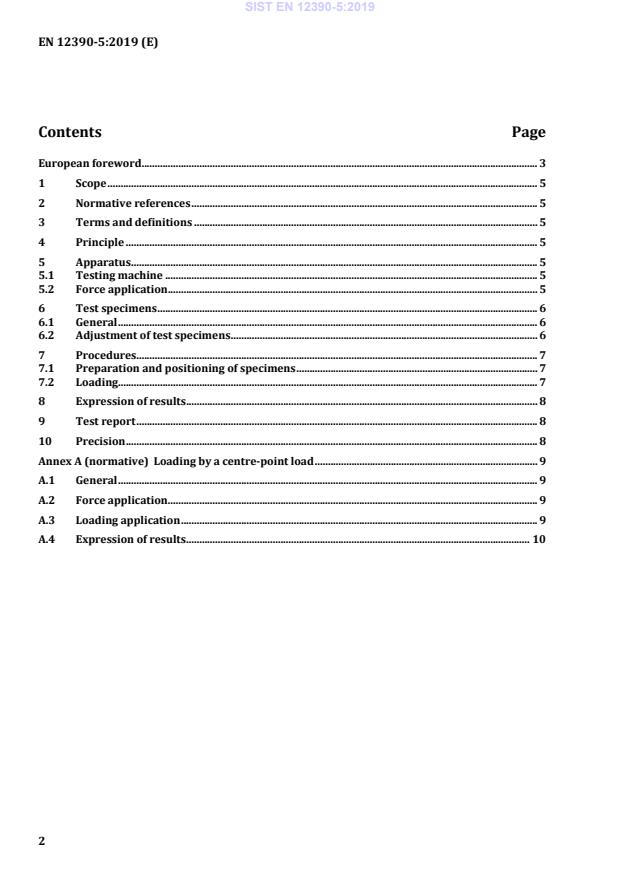
Contents Page
European foreword . 3
1 Scope . 5
2 Normative references . 5
3 Terms and definitions . 5
4 Principle . 5
5 Apparatus . 5
5.1 Testing machine . 5
5.2 Force application . 5
6 Test specimens . 6
6.1 General . 6
6.2 Adjustment of test specimens . 6
7 Procedures. 7
7.1 Preparation and positioning of specimens . 7
7.2 Loading. 7
8 Expression of results . 8
9 Test report . 8
10 Precision . 8
Annex A (normative) Loading by a centre-point load . 9
A.1 General . 9
A.2 Force application . 9
A.3 Loading application . 9
A.4 Expression of results . 10
European foreword
This document (EN 12390-5:2019) has been prepared by Technical Committee CEN/TC 104 “Concrete
and related products”, the secretariat of which is held by SN.
This European Standard shall be given the status of a national standard, either by publication of an
identical text or by endorsement, at the latest by December 2019, and conflicting national standards
shall be withdrawn at the latest by December 2019.
Attention is drawn to the possibility that some of the elements of this document may be the subject of
patent rights. CEN shall not be held responsible for identifying any or all such patent rights.
This document supersedes EN 12390-5:2009.
It is recognized as good practice to include measurement of density prior to the determination of
flexural strength, as a check on compaction of the concrete.
The two-point method of loading has been taken as the reference method, but the use of centre-point
loading has been included as a normative annex. An inter-comparison of the two-point and the centre-
point methods has been made as part of a test programme, part-funded by the EC under the
Measurement and Testing Programme, contract MAT I-CT-94-CO43. The centre-point method gave
results which were consistently 13 % higher than those from the two-point method.
This standard is one of a series on testing concrete.
EN 12390, Testing hardened concrete, consists of the following parts:
— Part 1: Shape, dimensions and other requirements of specimens and moulds;
— Part 2: Making and curing specimens for strength tests;
— Part 3: Compressive strength of test specimens;
— Part 4: Compressive strength – Specification for testing machines;
— Part 5: Flexural strength of test specimens;
— Part 6: Tensile splitting strength of test specimens;
— Part 7: Density of hardened concrete;
— Part 8: Depth of penetration of water under pressure;
— Part 11: Determination of the chloride resistance of concrete, unidirectional diffusion;
— Part 12: Determination of the potential carbonation resistance of concrete: Accelerated carbonation
method (in preparation);
— Part 13: Determination of secant modulus of elasticity in compression;
— Part 14: Semi-adiabatic method for the determination of heat released by concrete during its
hardening process;
— Part 15: Adiabatic method for the determination of heat released by concrete during its hardening
process;
— Part 16: Determination of the shrinkage of concrete (in preparation);
— Part 17: Determination of creep of concrete in compression (in preparation);
— Part 18: Determination of the chloride migration coefficient (in preparation).
This edition includes the following significant technical changes with respect to EN 12390 5:2009:
— editorial revision;
— technical corrections;
— curing procedure aligned with EN 12390-3.
According to the CEN-CENELEC Internal Regulations, the national standards organisations of the
following countries are bound to implement this European Standard: Austria, Belgium, Bulgaria,
Croatia, Cyprus, Czech Republic, Denmark, Estonia, Finland, Former Yugoslav Republic of Macedonia,
France, Germany, Greece, Hungary, Iceland, Ireland, Italy, Latvia, Lithuania, Luxembourg, Malta,
Netherlands, Norway, Poland, Portugal, Romania, Serbia, Slovakia, Slovenia, Spain, Sweden, Switzerland,
Turk
...
SLOVENSKI STANDARD
01-oktober-2019
Nadomešča:
SIST EN 12390-5:2009
Preskušanje strjenega betona - 5. del: Upogibna trdnost preskušancev
Testing hardened concrete - Part 5: Flexural strength of test specimens
Prüfung von Festbeton - Teil 5: Biegezugfestigkeit von Probekörpern
Essai pour béton durci - Partie 5 : Résistance à la flexion sur éprouvettes
Ta slovenski standard je istoveten z: EN 12390-5:2019
ICS:
91.100.30 Beton in betonski izdelki Concrete and concrete
products
2003-01.Slovenski inštitut za standardizacijo. Razmnoževanje celote ali delov tega standarda ni dovoljeno.
EN 12390-5
EUROPÄISCHE NORM
EUROPEAN STANDARD
Juni 2019
NORME EUROPÉENNE
ICS 91.100.30 Ersatz für EN 12390-5:2009
Deutsche Fassung
Prüfung von Festbeton - Teil 5: Biegezugfestigkeit von
Probekörpern
Testing hardened concrete - Part 5: Flexural strength of Essai pour béton durci - Partie 5 : Résistance à la flexion
test specimens sur éprouvettes
Diese Europäische Norm wurde vom CEN am 29. April 2019 angenommen.
Die CEN-Mitglieder sind gehalten, die CEN/CENELEC-Geschäftsordnung zu erfüllen, in der die Bedingungen festgelegt sind, unter
denen dieser Europäischen Norm ohne jede Änderung der Status einer nationalen Norm zu geben ist. Auf dem letzten Stand
befindliche Listen dieser nationalen Normen mit ihren bibliographischen Angaben sind beim CEN-CENELEC-Management-
Zentrum oder bei jedem CEN-Mitglied auf Anfrage erhältlich.
Diese Europäische Norm besteht in drei offiziellen Fassungen (Deutsch, Englisch, Französisch). Eine Fassung in einer anderen
Sprache, die von einem CEN-Mitglied in eigener Verantwortung durch Übersetzung in seine Landessprache gemacht und dem
Management-Zentrum mitgeteilt worden ist, hat den gleichen Status wie die offiziellen Fassungen.
CEN-Mitglieder sind die nationalen Normungsinstitute von Belgien, Bulgarien, Dänemark, Deutschland, Estland, Finnland,
Frankreich, Griechenland, Irland, Island, Italien, Kroatien, Lettland, Litauen, Luxemburg, Malta, den Niederlanden, Norwegen,
Österreich, Polen, Portugal, der Republik Nordmazedonien, Rumänien, Schweden, der Schweiz, Serbien, der Slowakei, Slowenien,
Spanien, der Tschechischen Republik, der Türkei, Ungarn, dem Vereinigten Königreich und Zypern.
EUROPÄISCHES KOMITEE FÜR NORMUNG
EUROPEAN COMMITTEE FOR STANDARDIZATION
COMITÉ EUROPÉEN DE NORMALISATION
CEN-CENELEC Management-Zentrum: Rue de la Science 23, B-1040 Brüssel
© 2019 CEN Alle Rechte der Verwertung, gleich in welcher Form und in welchem Ref. Nr. EN 12390-5:2019 D
Verfahren, sind weltweit den nationalen Mitgliedern von CEN
vorbehalten.
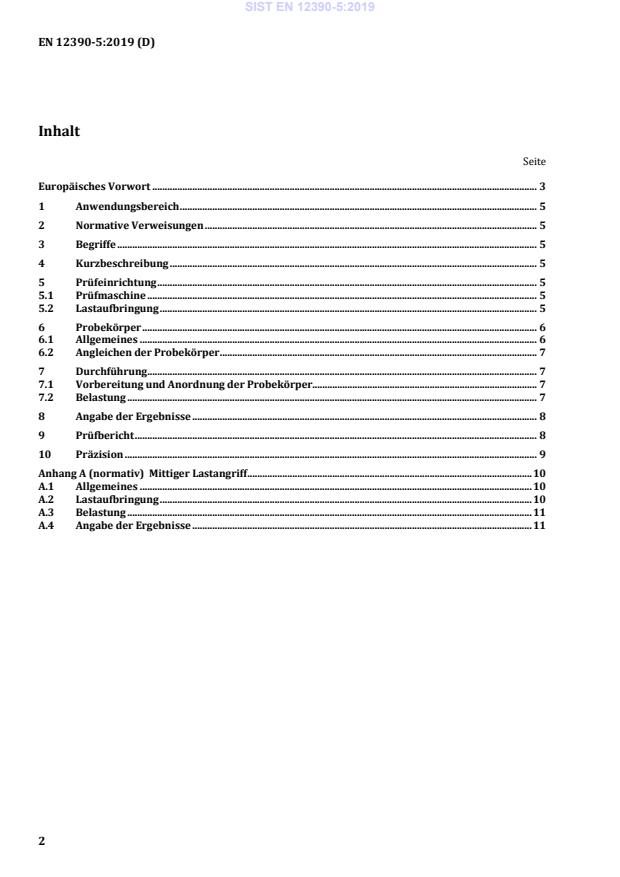
Inhalt
Seite
Europäisches Vorwort . 3
1 Anwendungsbereich . 5
2 Normative Verweisungen . 5
3 Begriffe . 5
4 Kurzbeschreibung . 5
5 Prüfeinrichtung . 5
5.1 Prüfmaschine . 5
5.2 Lastaufbringung . 5
6 Probekörper . 6
6.1 Allgemeines . 6
6.2 Angleichen der Probekörper . 7
7 Durchführung . 7
7.1 Vorbereitung und Anordnung der Probekörper. 7
7.2 Belastung . 7
8 Angabe der Ergebnisse . 8
9 Prüfbericht . 8
10 Präzision . 9
Anhang A (normativ) Mittiger Lastangriff . 10
A.1 Allgemeines . 10
A.2 Lastaufbringung . 10
A.3 Belastung . 11
A.4 Angabe der Ergebnisse . 11
Europäisches Vorwort
Dieses Dokument (EN 12390-5:2019) wurde vom Technischen Komitee CEN/TC 104 „Beton und zugehörige
Produkte“ erarbeitet, dessen Sekretariat von SN gehalten wird.
Diese Europäische Norm muss den Status einer nationalen Norm erhalten, entweder durch Veröffentlichung
eines identischen Textes oder durch Anerkennung bis Dezember 2019, und etwaige entgegenstehende
nationale Normen müssen bis Dezember 2019 zurückgezogen werden.
Es wird auf die Möglichkeit hingewiesen, dass einige Elemente dieses Dokuments Patentrechte berühren
können. CEN ist nicht dafür verantwortlich, einige oder alle diesbezüglichen Patentrechte zu identifizieren.
Dieses Dokument ersetzt EN 12390-5:2009.
Es ist allgemein üblich, dass vor der Prüfung der Biegezugfestigkeit eine Bestimmung der Rohdichte erfolgt,
um die Verdichtung des Betons zu überprüfen.
Die 2-Punkt-Lasteintragung gilt als Referenzverfahren; die Anwendung der mittigen Lasteintragung ist als
normativer Anhang angegeben. Ein Vergleich der Zweipunkt- und der mittigen Lasteintragung wurde im
Rahmen eines Prüfprogramms, das teilweise durch die EG im Mess- und Prüfprogramm gefördert wurde
(Vertrag MAT I-CT-94-CO43), durchgeführt. Der mittige Lasteintrag ergab durchweg 13 % höhere Prüfwerte
als der Zweipunkt-Lasteintrag.
Diese Norm ist Bestandteil einer Normenreihe für die Prüfung von Beton.
EN 12390, Prüfung von Festbeton, besteht aus den folgenden Teilen:
Teil 1: Form, Maße und andere Anforderungen für Probekörpern und Formen
Teil 2: Herstellung und Lagerung von Probekörpern für Festigkeitsprüfungen
Teil 3: Druckfestigkeit von Probekörpern
Teil 4: Bestimmung der Druckfestigkeit — Anforderungen an Prüfmaschinen
Teil 5: Biegezugfestigkeit von Probekörpern
Teil 6: Spaltzugfestigkeit von Probekörpern
Teil 7: Dichte von Festbeton
Teil 8: Wassereindringtiefe unter Druck
Teil 11: Bestimmung des Chloridwiderstandes von Beton — Einseitig gerichtete Diffusion
Teil 12: Bestimmung des Karbonatisierungswiderstandes von Beton — Beschleunigtes Karbonatisierungs-
verfahren (in Vorbereitung)
Teil 13: Bestimmung des Elastizitätsmoduls unter Druckbelastung (Sekantenmodul)
Teil 14: Teiladiabatisches Verfahren zur Bestimmung der Wärme, die während des Erhärtungsprozesses
von Beton freigesetzt wird
Teil 15: Adiabatisches Verfahren zur Bestimmung der Wärme, die während des Erhärtungsprozesses von
Beton freigesetzt wird
Teil 16: Bestimmung des Schwindens von Beton (in Vorbereitung)
Teil 17: Bestimmung des Kriechens von Beton unter Druckspannung (in Vorbereitung)
Teil 18: Bestimmung des Chloridmigrationskoeffizienten (in Vorbereitung)
Diese Fassung beinhaltet die folgenden wesentlichen technischen Änderungen gegenüber EN 12390-5:2009:
redaktionelle Überarbeitung;
technische Korrekturen;
Lagerungsverfahren an EN 12390-3 angeglichen.
Entsprechend der CEN-CENELEC-Geschäftsordnung sind die nationalen Normungsinstitute der folgenden
Länder gehalten, diese Europäische Norm zu übernehmen: Belgien, Bulgarien, Dänemark, Deutschland, die
ehemalige jugoslawische Republik Mazedonien, Estland, Finnland, Frankreich, Griechenland, Irland, Island,
Italien, Kroatien, Lettland, Litauen, Luxemburg, Malta, Niederlande, Norwegen, Österreich, Polen, Portugal,
Rumänien, Schweden, Schweiz, Serbien, Slowakei, Slowenien, Spanien, Tschechische Republik, Türkei,
Ungarn, Vereinigtes Königreich und Zypern.
1 Anwendungsbereich
Dieses Dokument legt ein Verfahren zur Bestimmung de
...