


FprEN 18190
(Main)Precast concrete products - Performance assessment and declaration
General Information
- Abstract
This document covers the following products regardless of if manufactured in factories or in temporary plants on site under the same conditions:
a) Precast concrete products intended to be used as structural elements:
— linear structural elements, including columns, beams and frame elements, made of concrete or lightweight concrete, reinforced or prestressed, including the use in contact with indoor air and the use in contact with soil or ground water, to the exclusion of products used as bridge elements and products of less than 4,5 m intended to be used as lintels in masonry wall;
— beams made of concrete or lightweight concrete, reinforced or prestressed, with or without clay shells, to be used in conjunction with blocks as beam-and-block system and intended to be used for floor and roofing systems, including the use in contact with indoor air and the use in contact with soil or ground water;
— foundation elements, including columns with integrated foundation elements, pocket foundation elements and sockets, made of reinforced concrete or lightweight concrete, including the use in contact with soil or ground water, to the exclusion of products using prestressing steel;
— foundation piles and segments of piles made of concrete or lightweight concrete, reinforced or prestressed, including the use in contact with soil or ground water;
— poles (also called masts), made of concrete or lightweight concrete, hollow or solid, reinforced or prestressed, in one piece or composed of elements and their inserts and connectors, including the use in contact with soil or ground water, to the exclusion of lighting columns for use in traffic circulation areas;
— bridge deck elements made of concrete, reinforced or prestressed, including the use in contact with soil or ground water, to the exclusion of abutments, barriers, bumpers, piers, guards and arches;
— floor plates made of concrete or lightweight concrete, reinforced or prestressed, intended to be used in floor systems in conjunction with cast-in-situ concrete, including the use in contact with indoor air and the use in contact with soil or ground water, to the exclusion of products used as bridge elements, and products with stiffening ribs taking a major part of the mechanical resistance, considered either as ribbed floor elements or hollow-core slabs;
— solid slabs made of concrete or lightweight concrete, reinforced or prestressed, without voids or void formers intended to be used as structural elements, such as floors, roofs, landings and balconies, which are self-supporting and can be installed without a structural topping but to which a structural topping can be added, and with a cross section which is rectangular but may present slopes for drainage, grooves for handling and shear keys, including the use in contact with indoor air and the use in contact with soil or ground water, to the exclusion of balustrades without structural behaviour and slabs manufactured using hollow core slabs manufacturing process;
— hollow core slabs and solid slabs manufactured in the same way but without hollow cores, made of concrete or lightweight concrete, reinforced or prestressed, with a maximum depth of 500 mm for prestressed elements and 300 mm for reinforced elements, to be used in conjunction with cast-in-situ concrete or without it, including the use in contact with indoor air and the use in contact with soil or ground water;
— ribbed floor elements made of concrete or lightweight concrete, reinforced or prestressed, intended to be used for floors and roofs, including the use in contact with indoor air and the use in contact with soil or ground water, to the exclusion of floor plates for floor systems;
- (...)
- Status
- Not Published
- Publication Date
- 25-Nov-2026
- Technical Committee
- CEN/TC 229 - Precast concrete products
- Drafting Committee
- CEN/TC 229 - Precast concrete products
- Current Stage
- 5020 - Submission to Vote - Formal Approval
- Start Date
- 06-Aug-2026
- Completion Date
- 06-Aug-2026

Overview
FprEN 18190: Precast Concrete Products - Performance Assessment and Declaration is a draft European Standard developed by CEN/TC 229. This standard specifies requirements for assessing and declaring the performance of precast concrete products, whether manufactured in a factory or temporary plant, under consistent production conditions. It covers a broad range of products, including both structural and non-structural precast concrete elements, and aims to harmonize the processes for performance evaluation and documentation across Europe.
FprEN 18190 consolidates and updates requirements from multiple preceding standards, providing a single reference for performance assessment and declaration. The scope of the document ensures comprehensive control over product qualities such as mechanical strength, durability, fire resistance, water and acoustic performance, and environmental sustainability.
Key Topics
- Product Scope and Classification: Covers linear structural elements (e.g., columns, beams), beams for beam-and-block systems, foundation elements, piles, poles, bridge deck elements, floor plates, solid slabs, ribbed floor elements, wall and roof elements, stairs, retaining walls, box culverts, junction boxes, garages, fence elements, shuttering blocks, and HVAC flue elements.
- Performance Characteristics: Addresses critical aspects of precast concrete products including:
- Concrete and lightweight concrete properties (compressive strength, density, shrinkage)
- Steel reinforcement and prestressing steel performance
- Mechanical strength and rigidity
- Fire performance (resistance, reaction, smouldering)
- Water, thermal, and acoustic properties
- Emissions and release of dangerous substances
- Environmental sustainability (life cycle, resource use, waste, carbon content)
- Assessment and Verification Processes: Details methods for:
- Testing, sampling, and assessment of product properties
- Factory production control (FPC) and continuous surveillance
- Verification of performance constancy and initial factory inspections
- Documentation and Declaration: Specifies requirements for supporting documentation, including test data and design calculations, to ensure transparency and traceability in the market.
Applications
FprEN 18190 is essential for stakeholders involved in the design, manufacturing, assessment, and certification of precast concrete products in construction projects. Its practical applications include:
- Structural and Non-structural Components: Applicable to elements for buildings, infrastructure, industrial facilities, agricultural buildings, and public works.
- Quality Assurance: Supports producers and certifying bodies in maintaining consistent quality and meeting regulatory requirements across manufacturing sites.
- Compliance with EU Legislation: Facilitates CE marking and market access within the European Economic Area by aligning with the requirements of the Construction Products Regulation (EU No. 305/2011).
- Sustainability Declarations: Enables companies to document environmental performance, including life cycle assessment and resource efficiency, supporting green building initiatives.
- Product Specification and Procurement: Provides architects, engineers, and clients with standardized criteria for specifying and comparing precast concrete products.
Related Standards
This standard partially supersedes and consolidates several existing European Standards for specific precast concrete products, including:
- EN 1168: Hollow core slabs
- EN 12839: Elements for fences
- EN 13225: Linear structural elements
- EN 13369: Common rules for precast concrete products
- EN 13747: Floor plates for floor systems
- EN 14844: Box culverts
- EN 12794: Foundation piles
- EN 12843: Masts and poles
- EN 14991/14992: Foundation and wall elements
- EN 15037 series: Beam-and-block floor systems
- EN 15435/15498: Shuttering blocks
By providing uniform guidelines for the performance assessment and declaration of precast concrete products, FprEN 18190 helps streamline manufacturing processes, supports regulatory compliance, and improves safety and sustainability in construction projects across Europe.
Relations
- Effective Date
- 05-Aug-2026
- Effective Date
- 05-Aug-2026
- Effective Date
- 05-Aug-2026
- Effective Date
- 05-Aug-2026
- Effective Date
- 05-Aug-2026
- Effective Date
- 05-Aug-2026
- Effective Date
- 05-Aug-2026
- Effective Date
- 05-Aug-2026
- Effective Date
- 05-Aug-2026
- Effective Date
- 05-Aug-2026
- Effective Date
- 05-Aug-2026
- Effective Date
- 05-Aug-2026
- Effective Date
- 05-Aug-2026
- Effective Date
- 05-Aug-2026
- Effective Date
- 05-Aug-2026
Get Certified
Connect with accredited certification bodies for this standard

ICC Evaluation Service
Building products evaluation and certification.

QAI Laboratories
Building and construction product testing and certification.

Aboma Certification B.V.
Specialized in construction, metal, and transport sectors.
Sponsored listings
Frequently Asked Questions
FprEN 18190 is a draft published by the European Committee for Standardization (CEN). Its full title is "Precast concrete products - Performance assessment and declaration". This standard covers: This document covers the following products regardless of if manufactured in factories or in temporary plants on site under the same conditions: a) Precast concrete products intended to be used as structural elements: — linear structural elements, including columns, beams and frame elements, made of concrete or lightweight concrete, reinforced or prestressed, including the use in contact with indoor air and the use in contact with soil or ground water, to the exclusion of products used as bridge elements and products of less than 4,5 m intended to be used as lintels in masonry wall; — beams made of concrete or lightweight concrete, reinforced or prestressed, with or without clay shells, to be used in conjunction with blocks as beam-and-block system and intended to be used for floor and roofing systems, including the use in contact with indoor air and the use in contact with soil or ground water; — foundation elements, including columns with integrated foundation elements, pocket foundation elements and sockets, made of reinforced concrete or lightweight concrete, including the use in contact with soil or ground water, to the exclusion of products using prestressing steel; — foundation piles and segments of piles made of concrete or lightweight concrete, reinforced or prestressed, including the use in contact with soil or ground water; — poles (also called masts), made of concrete or lightweight concrete, hollow or solid, reinforced or prestressed, in one piece or composed of elements and their inserts and connectors, including the use in contact with soil or ground water, to the exclusion of lighting columns for use in traffic circulation areas; — bridge deck elements made of concrete, reinforced or prestressed, including the use in contact with soil or ground water, to the exclusion of abutments, barriers, bumpers, piers, guards and arches; — floor plates made of concrete or lightweight concrete, reinforced or prestressed, intended to be used in floor systems in conjunction with cast-in-situ concrete, including the use in contact with indoor air and the use in contact with soil or ground water, to the exclusion of products used as bridge elements, and products with stiffening ribs taking a major part of the mechanical resistance, considered either as ribbed floor elements or hollow-core slabs; — solid slabs made of concrete or lightweight concrete, reinforced or prestressed, without voids or void formers intended to be used as structural elements, such as floors, roofs, landings and balconies, which are self-supporting and can be installed without a structural topping but to which a structural topping can be added, and with a cross section which is rectangular but may present slopes for drainage, grooves for handling and shear keys, including the use in contact with indoor air and the use in contact with soil or ground water, to the exclusion of balustrades without structural behaviour and slabs manufactured using hollow core slabs manufacturing process; — hollow core slabs and solid slabs manufactured in the same way but without hollow cores, made of concrete or lightweight concrete, reinforced or prestressed, with a maximum depth of 500 mm for prestressed elements and 300 mm for reinforced elements, to be used in conjunction with cast-in-situ concrete or without it, including the use in contact with indoor air and the use in contact with soil or ground water; — ribbed floor elements made of concrete or lightweight concrete, reinforced or prestressed, intended to be used for floors and roofs, including the use in contact with indoor air and the use in contact with soil or ground water, to the exclusion of floor plates for floor systems; - (...)
This document covers the following products regardless of if manufactured in factories or in temporary plants on site under the same conditions: a) Precast concrete products intended to be used as structural elements: — linear structural elements, including columns, beams and frame elements, made of concrete or lightweight concrete, reinforced or prestressed, including the use in contact with indoor air and the use in contact with soil or ground water, to the exclusion of products used as bridge elements and products of less than 4,5 m intended to be used as lintels in masonry wall; — beams made of concrete or lightweight concrete, reinforced or prestressed, with or without clay shells, to be used in conjunction with blocks as beam-and-block system and intended to be used for floor and roofing systems, including the use in contact with indoor air and the use in contact with soil or ground water; — foundation elements, including columns with integrated foundation elements, pocket foundation elements and sockets, made of reinforced concrete or lightweight concrete, including the use in contact with soil or ground water, to the exclusion of products using prestressing steel; — foundation piles and segments of piles made of concrete or lightweight concrete, reinforced or prestressed, including the use in contact with soil or ground water; — poles (also called masts), made of concrete or lightweight concrete, hollow or solid, reinforced or prestressed, in one piece or composed of elements and their inserts and connectors, including the use in contact with soil or ground water, to the exclusion of lighting columns for use in traffic circulation areas; — bridge deck elements made of concrete, reinforced or prestressed, including the use in contact with soil or ground water, to the exclusion of abutments, barriers, bumpers, piers, guards and arches; — floor plates made of concrete or lightweight concrete, reinforced or prestressed, intended to be used in floor systems in conjunction with cast-in-situ concrete, including the use in contact with indoor air and the use in contact with soil or ground water, to the exclusion of products used as bridge elements, and products with stiffening ribs taking a major part of the mechanical resistance, considered either as ribbed floor elements or hollow-core slabs; — solid slabs made of concrete or lightweight concrete, reinforced or prestressed, without voids or void formers intended to be used as structural elements, such as floors, roofs, landings and balconies, which are self-supporting and can be installed without a structural topping but to which a structural topping can be added, and with a cross section which is rectangular but may present slopes for drainage, grooves for handling and shear keys, including the use in contact with indoor air and the use in contact with soil or ground water, to the exclusion of balustrades without structural behaviour and slabs manufactured using hollow core slabs manufacturing process; — hollow core slabs and solid slabs manufactured in the same way but without hollow cores, made of concrete or lightweight concrete, reinforced or prestressed, with a maximum depth of 500 mm for prestressed elements and 300 mm for reinforced elements, to be used in conjunction with cast-in-situ concrete or without it, including the use in contact with indoor air and the use in contact with soil or ground water; — ribbed floor elements made of concrete or lightweight concrete, reinforced or prestressed, intended to be used for floors and roofs, including the use in contact with indoor air and the use in contact with soil or ground water, to the exclusion of floor plates for floor systems; - (...)
FprEN 18190 is classified under the following ICS (International Classification for Standards) categories: 91.100.30 - Concrete and concrete products. The ICS classification helps identify the subject area and facilitates finding related standards.
FprEN 18190 has the following relationships with other standards: It is inter standard links to EN 12737:2004+A1:2007, EN 13225:2013, EN 1168:2005+A3:2011, EN 13747:2005+A2:2010, EN 15498:2008, EN 12794:2005+A1:2007, EN 12794:2005+A1:2007/AC:2008, EN 13224:2011, EN 15435:2008, EN 14844:2006+A2:2011, EN 15037-4:2010+A1:2013, EN 14843:2007, EN 12839:2012, EN 15037-2:2009+A1:2011, EN 14992:2007+A1:2012. Understanding these relationships helps ensure you are using the most current and applicable version of the standard.
FprEN 18190 is associated with the following European legislation: EU Directives/Regulations: 305/2011; Standardization Mandates: M/100, M/609. When a standard is cited in the Official Journal of the European Union, products manufactured in conformity with it benefit from a presumption of conformity with the essential requirements of the corresponding EU directive or regulation.
FprEN 18190 is available in PDF format for immediate download after purchase. The document can be added to your cart and obtained through the secure checkout process. Digital delivery ensures instant access to the complete standard document.
Standards Content (Sample)
SLOVENSKI STANDARD
01-september-2025
Montažni betonski izdelki - Ocena in deklaracija lastnosti
Precast concrete products - Performance assessment and declaration
Betonfertigteile - Leistungsbeurteilung und -erklärung
Produit préfabriqué en béton - Évaluation des performances et déclaration
Ta slovenski standard je istoveten z: prEN 18190
ICS:
91.100.30 Beton in betonski izdelki Concrete and concrete
products
2003-01.Slovenski inštitut za standardizacijo. Razmnoževanje celote ali delov tega standarda ni dovoljeno.
DRAFT
EUROPEAN STANDARD
prEN 18190
NORME EUROPÉENNE
EUROPÄISCHE NORM
July 2025
ICS 91.100.30
English Version
Precast concrete products - Performance assessment and
declaration
Produit préfabriqué en béton - Évaluation des Betonfertigteile - Leistungsbeurteilung und -erklärung
performances et déclaration
This draft European Standard is submitted to CEN members for enquiry. It has been drawn up by the Technical Committee
CEN/TC 229.
If this draft becomes a European Standard, CEN members are bound to comply with the CEN/CENELEC Internal Regulations
which stipulate the conditions for giving this European Standard the status of a national standard without any alteration.
This draft European Standard was established by CEN in three official versions (English, French, German). A version in any other
language made by translation under the responsibility of a CEN member into its own language and notified to the CEN-CENELEC
Management Centre has the same status as the official versions.
CEN members are the national standards bodies of Austria, Belgium, Bulgaria, Croatia, Cyprus, Czech Republic, Denmark, Estonia,
Finland, France, Germany, Greece, Hungary, Iceland, Ireland, Italy, Latvia, Lithuania, Luxembourg, Malta, Netherlands, Norway,
Poland, Portugal, Republic of North Macedonia, Romania, Serbia, Slovakia, Slovenia, Spain, Sweden, Switzerland, Türkiye and
United Kingdom.
Recipients of this draft are invited to submit, with their comments, notification of any relevant patent rights of which they are
aware and to provide supporting documentation.
Warning : This document is not a European Standard. It is distributed for review and comments. It is subject to change without
notice and shall not be referred to as a European Standard.
EUROPEAN COMMITTEE FOR STANDARDIZATION
COMITÉ EUROPÉEN DE NORMALISATION
EUROPÄISCHES KOMITEE FÜR NORMUNG
CEN-CENELEC Management Centre: Rue de la Science 23, B-1040 Brussels
© 2025 CEN All rights of exploitation in any form and by any means reserved Ref. No. prEN 18190:2025 E
worldwide for CEN national Members.
prEN 18190:2025 (E)
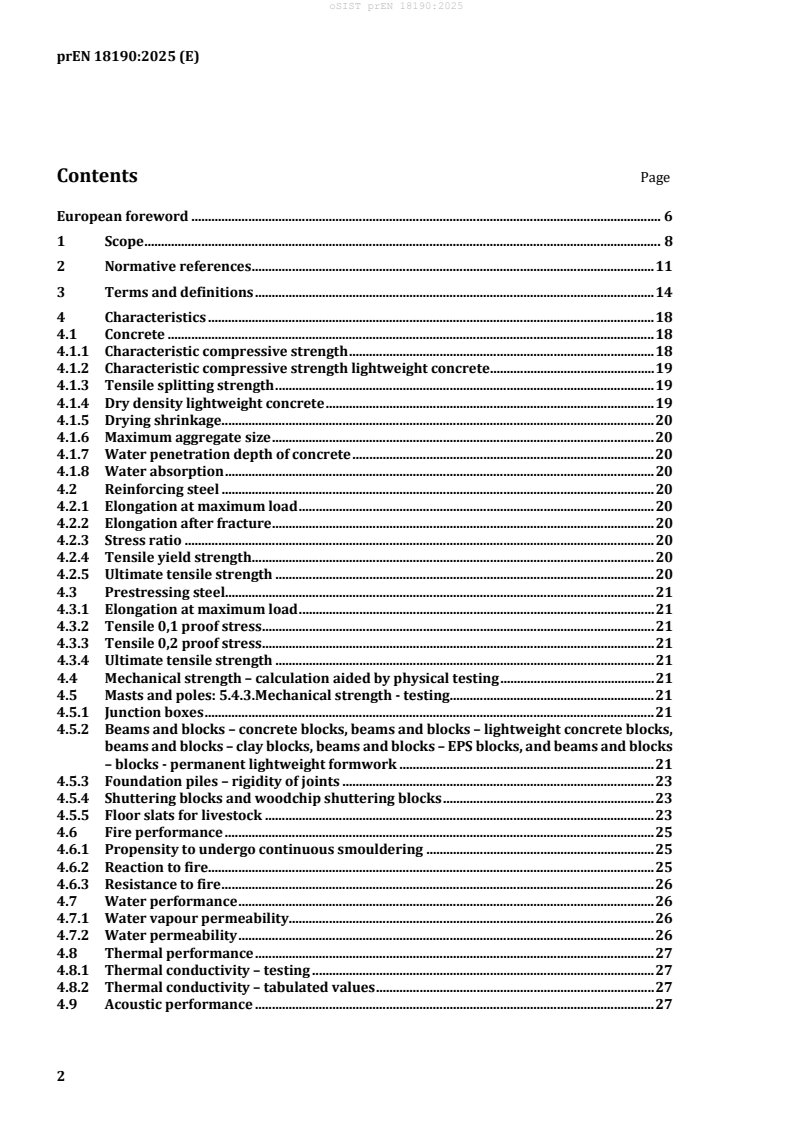
Contents Page
European foreword . 6
1 Scope . 8
2 Normative references . 11
3 Terms and definitions . 14
4 Characteristics . 18
4.1 Concrete . 18
4.1.1 Characteristic compressive strength . 18
4.1.2 Characteristic compressive strength lightweight concrete . 19
4.1.3 Tensile splitting strength . 19
4.1.4 Dry density lightweight concrete . 19
4.1.5 Drying shrinkage . 20
4.1.6 Maximum aggregate size . 20
4.1.7 Water penetration depth of concrete . 20
4.1.8 Water absorption . 20
4.2 Reinforcing steel . 20
4.2.1 Elongation at maximum load . 20
4.2.2 Elongation after fracture . 20
4.2.3 Stress ratio . 20
4.2.4 Tensile yield strength . 20
4.2.5 Ultimate tensile strength . 20
4.3 Prestressing steel . 21
4.3.1 Elongation at maximum load . 21
4.3.2 Tensile 0,1 proof stress. 21
4.3.3 Tensile 0,2 proof stress. 21
4.3.4 Ultimate tensile strength . 21
4.4 Mechanical strength – calculation aided by physical testing . 21
4.5 Masts and poles: 5.4.3.Mechanical strength - testing. 21
4.5.1 Junction boxes . 21
4.5.2 Beams and blocks – concrete blocks, beams and blocks – lightweight concrete blocks,
beams and blocks – clay blocks, beams and blocks – EPS blocks, and beams and blocks
– blocks - permanent lightweight formwork . 21
4.5.3 Foundation piles – rigidity of joints . 23
4.5.4 Shuttering blocks and woodchip shuttering blocks . 23
4.5.5 Floor slats for livestock . 23
4.6 Fire performance . 25
4.6.1 Propensity to undergo continuous smouldering . 25
4.6.2 Reaction to fire. 25
4.6.3 Resistance to fire . 26
4.7 Water performance . 26
4.7.1 Water vapour permeability. 26
4.7.2 Water permeability . 26
4.8 Thermal performance . 27
4.8.1 Thermal conductivity – testing . 27
4.8.2 Thermal conductivity – tabulated values . 27
4.9 Acoustic performance . 27
prEN 18190:2025 (E)
4.9.1 Airborne sound insulation index - calculation . 27
4.9.2 Airborne sound insulation index – testing . 27
4.9.3 Impact sound insulation - calculation . 27
4.9.4 Impact sound insulation – testing . 27
4.9.5 Sound absorption coefficient building elements . 27
4.10 Other performances . 27
4.10.1 Mass of the element . 27
4.10.2 Air tightness class - HVAC flue elements . 27
4.10.3 Mechanical resistance of rungs . 28
4.10.4 Moisture expansion . 28
4.11 Release of dangerous substances . 28
4.11.1 Release of dangerous substances to indoor air . 28
4.11.2 Release of dangerous substances to soil and ground water . 28
4.12 Environmental sustainability . 30
4.12.1 Reference service life . 30
4.12.2 Life cycle assessment environmental characteristics . 30
4.12.3 Resource use environmental characteristics . 30
4.12.4 Waste environmental characteristics . 31
4.12.5 Output flows environmental characteristics . 32
4.12.6 Biogenic carbon content environmental characteristics . 32
4.13 Performances in attached documentation of the product . 32
4.13.1 General . 32
4.13.2 Off-the-shelf products . 32
4.13.3 Custom-made products . 33
4.13.4 Set of drawings . 33
4.13.5 Calculations . 33
5 Testing, assessment and sampling methods . 34
5.1 Concrete . 34
5.1.1 Characteristic compressive strength . 34
5.1.2 Characteristic compressive strength lightweight concrete . 36
5.1.3 Tensile splitting strength . 36
5.1.4 Dry density lightweight concrete . 36
5.1.5 Drying shrinkage . 36
5.1.6 Maximum aggregate size . 36
5.1.7 Water penetration depth of concrete . 36
5.1.8 Water absorption . 36
5.2 Reinforcing steel . 37
5.2.1 Elongation at maximum load . 37
5.2.2 Elongation after fracture . 37
5.2.3 Stress ratio . 37
5.2.4 Tensile yield strength . 37
5.2.5 Ultimate tensile strength . 37
5.3 Prestressing steel . 37
5.3.1 Elongation at maximum load . 37
5.3.2 Tensile 0,1 proof stress . 37
5.3.3 Tensile 0,2 proof stress . 37
5.3.4 Ultimate tensile strength . 37
5.4 Mechanical strength - calculation aided by testing . 38
5.4.1 Box culverts . 38
5.4.2 Fence elements . 38
5.4.3 Masts and poles . 38
5.5 Mechanical strength – testing . 38
prEN 18190:2025 (E)
5.5.1 Junction boxes . 38
5.5.2 Beams and blocks – concrete blocks, beams and blocks – lightweight concrete blocks,
beams and blocks – clay blocks, beams and blocks – EPS blocks, and beams and blocks
– blocks - permanent lightweight formwork . 38
5.5.3 Foundation piles – rigidity of joints . 39
5.5.4 Shuttering blocks and woodchip shuttering blocks . 39
5.6 Reaction and resistance to fire . 39
5.6.1 Propensity to undergo continuous smouldering . 39
5.6.2 Reaction to fire. 39
5.6.3 Resistance to fire . 39
5.7 Water performance . 39
5.7.1 Water vapour permeability. 39
5.7.2 Water permeability . 40
5.8 Thermal performance . 40
5.8.1 Thermal conductivity – testing . 40
5.8.2 Thermal conductivity – tabulated values . 40
5.9 Acoustic performance . 40
5.9.1 Airborne sound insulation index - calculation . 40
5.9.2 Airborne sound insulation index – testing . 40
5.9.3 Impact sound insulation - calculation . 40
5.9.4 Impact sound insulation – testing . 40
5.9.5 Sound absorption coefficient building elements . 41
5.10 Other performances . 41
5.10.1 Mass of the element . 41
5.10.2 Air tightness class - HVAC flue elements . 41
5.10.3 Mechanical resistance of rungs . 41
5.10.4 Moisture expansion . 41
5.11 Release of dangerous substances . 41
5.11.1 Release of dangerous substances to indoor air . 41
5.11.2 Release of dangerous substances to soil and ground water . 42
5.12 Environmental sustainability . 42
5.12.1 Reference service life . 42
5.12.2 Life cycle assessment environmental characteristics . 43
5.12.3 Resource use environmental characteristics . 43
5.12.4 Waste environmental characteristics . 43
5.12.5 Output flows environmental characteristics . 43
5.12.6 Biogenic carbon environmental characteristics . 43
5.13 Performances in attached documentation of the product . 43
5.13.1 General. 43
5.13.2 Off-the-shelf products . 44
5.13.3 Custom-made products . 44
6 Assessment and verification of constancy of performance – AVCP . 44
6.1 General. 44
6.2 Assessment of performance . 45
6.2.1 General. 45
6.2.2 Test samples, testing and assessment criteria . 45
6.3 Verification of constancy of performance . 82
6.3.1 Factory production control (FPC) . 82
6.3.2 Initial inspection of factory and of FPC . 100
6.3.3 Initial inspection of factory to validate environmental sustainability company specific
data . 101
6.3.4 Continuous surveillance of FPC . 101
prEN 18190:2025 (E)
6.3.5 Environmental sustainability assessment validation . 102
Annex A (normative) Verification by calculation aided by physical testing of box culverts
................................................................................................................................................................ 103
Annex B (normative) Loadbearing capacity testing of fence elements . 108
Annex C (normative) Loadbearing capacity testing of masts and poles . 114
Annex D (normative) Reaction to fire test for thin blocks . 117
Annex E (normative) Measurement of dimensions . 122
Annex F (normative) Test of water absorption. 135
Annex G (normative) Test method for the verification of robustness and rigidity of pile joints
................................................................................................................................................................ 139
Annex H (normative) Loadbearing capacity testing of beams and blocks – concrete blocks,
beams and blocks - lightweight concrete blocks, beams and blocks – clay blocks,
beams and blocks - EPS blocks, and beams and blocks - blocks - permanent
lightweight formwork . 144
Annex I (normative) Determination of the mechanical strength of shuttering blocks and
woodchip shuttering blocks . 154
Annex J (normative) Mechanical strength of junction boxes . 162
Annex K (normative) Environmental impact indicators . 166
Annex ZA (informative) Relationship of this European Standard with Regulation (EU)
No.305/2011 . 169
Bibliography . 244
prEN 18190:2025 (E)
European foreword
This document (prEN 18190:2025) has been prepared by Technical Committee CEN/TC 229 “Precast
concrete products”, the secretariat of which is held by AFNOR.
This document is currently submitted to the CEN Enquiry.
This document will partially supersede:
EN 1168:2005+A3:2011, Precast concrete products – Hollow core slabs
EN 12839:2012, Precast concrete products — Elements for fences
EN 12737:2004+A1:2007, Precast concrete products – Floor slats for livestock
EN 12794:2005+A1:2007, Precast concrete products – Foundation piles
EN 12843:2004, Precast concrete products – Masts and poles
EN 13224:2011, Precast concrete products – Ribbed floor elements
EN 13225:2013, Precast concrete products – Linear structural elements
EN 13369:2023, Common rules for precast concrete products
EN 13693:2004+A1:2009, Precast concrete products – Special roof elements
EN 13747:2005+A2:2010, Precast concrete products – Floor plates for floor systems
EN 13978-1:2005, Precast concrete products – Precast concrete garages – Part 1: Requirements for
reinforced garages monolithic or consisting of single sections with room dimensions
EN 14843:2007, Precast concrete products – Stairs
EN 14844:2006+A2:2011, Precast concrete products – Box culverts
EN 14991:2007, Precast concrete products – Foundation elements
EN 14992:2007+A1:2012, Precast concrete products – Wall elements
EN 15037-1:2008, Precast concrete products – Beam-and-block floor systems – Part 1: Beams
EN 15037-2:2009+A1:2011, Precast concrete products – Beam-and-block floor systems – Part 2: Concrete
blocks
EN 15037-3:2009+A1:2011, Precast concrete products – Beam-and-block floor systems – Part 3: Clay
blocks
EN 15037-4:2010+A1:2013, Precast concrete products – Beam-and-block floor systems – Part 4: Expanded
polystyrene blocks
EN 15037-5:2013, Precast concrete products – Beam-and-block floor systems – Part 5: Lightweight blocks
for simple formwork
prEN 18190:2025 (E)
EN 15050:2007+A1:2012, Precast concrete products – Bridge elements
EN 15258:2008, Precast concrete products – Retaining wall elements
EN 15435:2008, Precast concrete products — Normal weight and lightweight concrete shuttering blocks
— Product properties and performance
EN 15498:2008, Precast concrete products — Wood-chip concrete shuttering blocks — Product properties
and performance
This document has been prepared under a standardization request addressed to CEN by the European
Commission. The Standing Committee of the EFTA States subsequently approves these requests for its
Member States.
For the relationship with EU Legislation, see informative Annex ZA, which is an integral part of this
document.
prEN 18190:2025 includes the following significant technical changes with respect to the standards listed
above:
— merging of the documents;
— removal of every clause not related to the assessment and verification of the constancy of
performance in answer to the Standardisation Request;
— addition of the necessary clauses to answer new essential characteristics as listed in the
Standardisation Request;
— replacement of the references to EN 206 with the corresponding technical content;
— removal of the references to Eurocode standards;
— updating of the Annex ZA considering the standardization request addressed to CEN by the European
Commission.
This document also includes in its scope the following other precast concrete products:
— solid slabs;
— junction boxes;
— heating, ventilation and air conditioning (HVAC) flue elements.
prEN 18190:2025 (E)
1 Scope
This document covers the following products regardless of if manufactured in factories or in temporary
plants on site under the same conditions:
a) Precast concrete products intended to be used as structural elements:
— linear structural elements, including columns, beams and frame elements, made of concrete or
lightweight concrete, reinforced or prestressed, including the use in contact with indoor air and
the use in contact with soil or ground water, to the exclusion of products used as bridge elements
and products of less than 4,5 m intended to be used as lintels in masonry wall;
— beams made of concrete or lightweight concrete, reinforced or prestressed, with or without clay
shells, to be used in conjunction with blocks as beam-and-block system and intended to be used
for floor and roofing systems, including the use in contact with indoor air and the use in contact
with soil or ground water;
— foundation elements, including columns with integrated foundation elements, pocket foundation
elements and sockets, made of reinforced concrete or lightweight concrete, including the use in
contact with soil or ground water, to the exclusion of products using prestressing steel;
— foundation piles and segments of piles made of concrete or lightweight concrete, reinforced or
prestressed, including the use in contact with soil or ground water;
— poles (also called masts), made of concrete or lightweight concrete, hollow or solid, reinforced
or prestressed, in one piece or composed of elements and their inserts and connectors, including
the use in contact with soil or ground water, to the exclusion of lighting columns for use in traffic
circulation areas;
— bridge deck elements made of concrete, reinforced or prestressed, including the use in contact
with soil or ground water, to the exclusion of abutments, barriers, bumpers, piers, guards and
arches;
— floor plates made of concrete or lightweight concrete, reinforced or prestressed, intended to be
used in floor systems in conjunction with cast-in-situ concrete, including the use in contact with
indoor air and the use in contact with soil or ground water, to the exclusion of products used as
bridge elements, and products with stiffening ribs taking a major part of the mechanical
resistance, considered either as ribbed floor elements or hollow-core slabs;
— solid slabs made of concrete or lightweight concrete, reinforced or prestressed, without voids or
void formers intended to be used as self-supporting structural elements, such as floors, roofs,
landings and balconies, which can be installed without a structural topping but to which a
structural topping can be added, and with a cross section which is rectangular but may present
slopes for drainage, grooves for handling and shear keys, including the use in contact with indoor
air and the use in contact with soil or ground water, to the exclusion of balustrades without
structural behaviour and slabs manufactured using hollow core slabs manufacturing process;
— hollow core slabs and solid slabs manufactured in the same way but without hollow cores, made
of concrete or lightweight concrete, reinforced or prestressed, with a maximum depth of 500
mm for prestressed elements and 300 mm for reinforced elements, to be used in conjunction
with cast-in-situ concrete or without it, including the use in contact with indoor air and the use
in contact with soil or ground water;
prEN 18190:2025 (E)
— ribbed floor elements made of concrete or lightweight concrete, reinforced or prestressed,
intended to be used for floors and roofs, including the use in contact with indoor air and the use
in contact with soil or ground water, to the exclusion of floor plates for floor systems;
— floor slats for livestock made of concrete or lightweight concrete, reinforced or prestressed,
intended to be used for the housing of livestock, including the use in contact with indoor air and
the use in contact with soil or ground water, to the exclusion of products used as load bearing
elements other than stock and stockmen, and of prestressed single slat beams;
— hollow core, multilayer and composite loadbearing wall elements, made of concrete or
lightweight concrete, reinforced or prestressed, including the use in contact with indoor air and
the use in contact with soil or ground water, to the exclusion of retaining walls;
— cladding elements, made of concrete or lightweight concrete, reinforced or prestressed, intended
to be used as non-loadbearing elements, including the use in contact with indoor air and the use
in contact with soil or ground water, to the exclusion of non-reinforced cladding elements with
a maximum size of 2,25 m , a maximum length of 1,5 m and a thickness smaller than 80 mm,
which are considered non-structural;
— solid, hollow, multilayer and special roof elements, made of concrete or lightweight concrete,
reinforced or prestressed, including the use in contact with indoor air and the use in contact with
soil or ground water, to the exclusion of ribbed floor elements and floor slabs elements;
— stairs (monolithic) made of concrete or lightweight concrete, reinforced or prestressed, and kits
of stairs constructed from individual steps, including the use in contact with indoor air and the
use in contact with soil or ground water;
— retaining walls, made of concrete or lightweight concrete, reinforced or prestressed, including
the use in contact with soil or ground water, to the exclusion of retaining walls intended to retain
tanks or reservoirs of liquid and precast diaphragm walls (concrete sheet piling);
— rectangular cross-section box culverts, made of reinforced concrete or lightweight concrete,
intended to be used as continuous elements for the creation of voids below ground, cable tunnels
and subways, including the use in contact with soil or ground water, to the exclusion of box
culverts having both internal cross-sectional dimensions less than or equal to 1 250 mm which
are considered non-structural, of products using prestressing steel, and of non-monolithic
products;
— rectangular prismatic junction boxes, made of concrete or lightweight concrete, including the
use in contact with soil or ground water, to the exclusion of products using prestressing steel;
— garages as monolithic unit or as kits of single or double sections, made of reinforced concrete or
lightweight concrete, including the use in contact with indoor air and the use in contact with soil
or ground water, to the exclusion of products used as supporting upper structures and products
using prestressing steel.
b) Precast concrete products not intended to be used as structural elements:
— fence elements, made of concrete or lightweight concrete, reinforced or prestressed, including
posts, panels, rails and base panels, intended to be used as light-structural or non-structural
elements, including the use in contact with soil or ground water;
— hollow core shuttering blocks, made of concrete or lightweight concrete, to be used for form
walls and partitions intended to be used as loadbearing and non-loadbearing elements, including
prEN 18190:2025 (E)
the use in contact with indoor air and the use in contact with soil or ground water, to the
exclusion of masonry units;
— wood-chip hollow core shuttering blocks, to be used for form walls and partitions intended to be
used as loadbearing and non-loadbearing elements in conjunction with concrete infill, including
the use in contact with indoor air and the use in contact with soil or ground water, to the
exclusion of products intended to be used unfilled;
— composite wall elements made of concrete or lightweight concrete, reinforced or prestressed,
intended to be used as non-loadbearing element, including the use in contact with indoor air and
the use in contact with soil or ground water;
— cladding elements, made of concrete or lightweight concrete, non-reinforced, with a maximum
size of 2,25 m , a maximum length of 1,5 m and a thickness smaller than 80 mm, intended to be
used as non-loadbearing elements, including the use in contact with indoor air and the use in
contact with soil or ground water;
— rectangular cross-section box culverts, made of reinforced concrete or lightweight concrete,
having both internal cross-sectional dimensions less than or equal to 1 250 mm (small box
culverts), intended to be used as light structural or non-structural continuous elements, for the
creation of voids below ground, cable tunnels and subways, including the use in contact with soil
or ground water, to the exclusion of products using prestressing steel and non-monolithic
products;
— heating, ventilation and air conditioning (HVAC) flue elements, made of concrete or lightweight
concrete, intended to be used to convey heating, ventilation, and air conditioning gases, including
the use in contact with indoor air and the use in contact with soil or ground water, to the
exclusion of products intended to be used to convey smoke from a furnace, boiler or combustion
chamber, products intended to be used to convey, control or limit smoke and fire propagation,
and products using prestressing steel.
c) Blocks intended to be used as structural elements in conjunction with beams as beam-and-block
system:
— precast concrete blocks made of concrete, including the use in contact with indoor air and the
use in contact with soil or ground water;
— precast concrete blocks made of lightweight concrete, including the use in contact with indoor
air and the use in contact with soil or ground water;
— blocks made of clay, with or without clay shells, to be used for floor and roofing systems,
including the use in contact with indoor air and the use in contact with soil or ground water;
— blocks fully made of EPS or combined with different materials, and permanent formworks made
of EPS, including the use in contact with indoor air;
— lightweight permanent formworks made of wood, plastic, cardboard, glass reinforced plastic,
agglomerated stone, metal or a combination of them to be used as permanent formwork,
including the use in contact with indoor air, to the exclusion of lightweight permanent
formworks made of EPS.
This document does not cover:
— masonry and ancillary products;
prEN 18190:2025 (E)
— roof covering products for discontinuous laying;
— chimney components;
— products for wastewater treatment;
— paving units and kerbs;
— road equipment;
— prefabricated reinforced components of autoclaved aerated concrete or light-weight aggregate
concrete with open structure;
— the design, production, handling, installation of the elements and the water tightness of joints
between elements.
2 Normative references
The following documents are referred to in the text in such a way that some or all of their content
constitutes requirements of this document. For dated references, only the edition cited applies. For
undated references, the latest edition of the referenced document (including any amendments) applies.
CEN/TS 15117:2005, Guidance on direct and extended application
EN 772-1:2011+A1:2015, Methods of test for masonry units - Part 1: Determination of compressive strength
EN 772-13:2000, Methods of test for masonry units – Part 13: Determination of net and gross dry density of
masonry units (except for natural stone)
EN 772-19:2000, Methods of test for masonry units - Part 19: Determination of moisture expansion of large
horizontally perforated clay masonry units
EN ISO 29469:2022, Thermal insulating products for building applications - Determination of compression
behaviour (ISO 29469:2022)
EN 933-1:2012, Tests for geometrical properties of aggregates - Part 1: Determination of particle size
distribution - Sieving method
EN 1008:2002, Mixing water for concrete - Specification for sampling, testing and assessing the suitability
of water, including water recovered from processes in the concrete industry, as mixing water for concrete
EN 1365-1:2012, Fire resistance tests for loadbearing elements - Part 1: Walls
EN 1365-2:2014, Fire resistance tests for loadbearing elements - Part 2: Floors and roofs
EN 1365-3:1999, Fire resistance tests for loadbearing elements - Part 3: Beams
EN 1365-4:1999, Fire resistance tests for loadbearing elements - Part 4: Columns
EN 1365-5:2004, Fire resistance tests for loadbearing elements - Part 5: Balconies and walkways
EN 1365-6:2004, Fire resistance tests for loadbearing elements - Part 6: Stairs
EN 1507:2006, Ventilation for buildings - Sheet metal air ducts with rectangular section - Requirements for
strength and leakage
prEN 18190:2025 (E)
EN 1745:2020, Masonry and masonry products — Methods for determining thermal properties
EN 12350-7:2019 , Testing fresh concrete - Part 7: Air content - Pressure methods
EN 12390-1:2021, Testing hardened concrete - Part 1: Shape, dimensions and other requirements for
specimens and moulds
EN 12390-2:2019, Testing hardened concrete - Part 2: Making and curing specimens for strength tests
EN 12390-3:2019, Testing hardened concrete - Part 3: Compressive strength of test specimens
EN 12390-4:2025, Testing hardened concrete - Part 4: Compressive strength - Specification for testing
machines
EN 12390-5:2019, Testing hardened concrete - Part 5: Flexural strength of test specimens
EN 12390-6:2023, Testing hardened concrete - Part 6: Tensile splitting strength of test specimens
EN 12390-7:2019 , Testing hardened concrete - Part 7: Density of hardened concrete
EN 12390-8:2019, Testing hardened concrete - Part 8: Depth of penetration of water under pressure
EN 12390-16:2019, Testing hardened concrete - Part 16: Determination of the shrinkage of concrete
EN 12504-1:2019, Testing concrete in stru
...