

EN 13224:2011
(Main)Precast concrete products - Ribbed floor elements
- Abstract
This document identifies the requirements, the basic performance criteria and evaluation of conformity for precast ribbed elements made of reinforced or prestressed normal weight concrete, used in floors or roofs. The elements consist of a top and/or bottom slab and one or more (usually two) ribs; transverse ribs may also be present.
Some examples of precast elements considered in this document are shown in Annex A.
Specific requirements for minor floor elements are listed in Annex B.
This document covers terminology, performance criteria, tolerances, relevant physical properties, test methods and aspects of transport and erection.
This document does not cover load-bearing capacity determined by testing.
- Status
- Published
- Publication Date
- 08-Nov-2011
- Withdrawal Date
- 30-Aug-2013
- Technical Committee
- CEN/TC 229 - Precast concrete products
- Current Stage
- 9092 - Decision on results of review/2YR ENQ - revise - Review Enquiry
- Start Date
- 22-Dec-2021
- Completion Date
- 07-Oct-2026
- Directive
- 305/2011 - Regulation (eu) No 305/2011 of the European Parliament and of the Council of 9 march 2011 laying down harmonised conditions for the marketing of construction products and repealing council directive 89/106/eecOJ Ref: C, C 259 OJ Date: 08-Aug-2014
89/106/EEC - Construction productsOJ Ref: C, C 176 OJ Date: 19-Jun-2012


Overview
EN 13224:2011 - Precast concrete products - Ribbed floor elements (CEN) defines requirements, performance criteria and conformity evaluation for precast ribbed elements made of reinforced or prestressed normal-weight concrete, used as floors or roofs. The elements comprise a top and/or bottom slab plus one or more longitudinal ribs (transverse ribs may be present). The standard covers terminology, tolerances, relevant physical properties, test methods, and aspects of transport and erection. It does not cover load-bearing capacity determined by testing.
Key topics and requirements
- Scope and definitions: Applies to precast ribbed floor elements and includes specific rules for minor floor elements (Annex B) and examples of elements (Annex A).
- Material and production: References EN 13369 (common rules for precast products) and EN 206‑1 for concrete constituents; addresses reinforcing/prestressing steel, inserts and connectors.
- Finished product requirements:
- Geometrical tolerances (complementary to EN 13369): skewness ±15 mm, lateral bow ±10 mm or L/1000 (whichever greater), angular deviation of ribs ±15 mm (prestressed elements: lateral/ angular tolerances may be increased by 50%); length tolerance for minor elements ±25 mm.
- Surface characteristics, mechanical resistance, fire reaction/resistance, acoustic and thermal properties, durability (requirements and test methods are specified).
- Longitudinal connections and concrete cover: minimum joint widths, groove requirements, tie bar anchorage guidance and welding connection considerations.
- Test methods and conformity: Describes tests on concrete, dimensional measurement methods, type testing, factory production control and finished product checks.
- Transport and erection: Specific considerations for handling, lifting and on-site assembly.
- CE marking and legal aspects: Annex ZA explains how EN 13224 supports the EU Construction Products Directive and presents procedures for attestation of conformity and CE marking (declaration methods for product properties and design specifications).
Applications
- Use for design, production and quality control of precast ribbed floor and roof elements in residential, commercial and industrial buildings.
- Guidance for detailing longitudinal joints, connections and on-site erection to ensure durability and performance.
- Basis for factory production control and supplier declarations required for CE marking and procurement.
Who uses this standard
- Precast concrete manufacturers and plant quality managers
- Structural engineers and designers using Eurocode-based design (EN 1992‑1‑1 / EN 1992‑1‑2)
- Contractors and erectors handling transport and installation
- Specifiers and clients requiring compliant precast ribbed elements
Related standards
- EN 13369 - Common rules for precast products
- EN 1992‑1‑1 / EN 1992‑1‑2 - Eurocode 2 (design and fire design)
- EN 13670 - Execution of concrete structures
Keywords: EN 13224, ribbed floor elements, precast concrete, CEN, tolerances, conformity, CE marking, Eurocode.
Relations
- Effective Date
- 12-Nov-2011
- Effective Date
- 28-Jan-2026
- Effective Date
- 28-Jan-2026
- Effective Date
- 28-Jan-2026
- Effective Date
- 28-Jan-2026
- Effective Date
- 28-Jan-2026
- Effective Date
- 05-Aug-2026
- Effective Date
- 15-Jul-2020
- Effective Date
- 15-Jul-2020
Get Certified
Connect with accredited certification bodies for this standard

DIBt (Deutsches Institut für Bautechnik)
German Institute for Building Technology.
DIN CERTCO
DIN Group product certification.

Aboma Certification B.V.
Specialized in construction, metal, and transport sectors.
Sponsored listings
Frequently Asked Questions
EN 13224:2011 is a standard published by the European Committee for Standardization (CEN). Its full title is "Precast concrete products - Ribbed floor elements". This standard covers: This document identifies the requirements, the basic performance criteria and evaluation of conformity for precast ribbed elements made of reinforced or prestressed normal weight concrete, used in floors or roofs. The elements consist of a top and/or bottom slab and one or more (usually two) ribs; transverse ribs may also be present. Some examples of precast elements considered in this document are shown in Annex A. Specific requirements for minor floor elements are listed in Annex B. This document covers terminology, performance criteria, tolerances, relevant physical properties, test methods and aspects of transport and erection. This document does not cover load-bearing capacity determined by testing.
This document identifies the requirements, the basic performance criteria and evaluation of conformity for precast ribbed elements made of reinforced or prestressed normal weight concrete, used in floors or roofs. The elements consist of a top and/or bottom slab and one or more (usually two) ribs; transverse ribs may also be present. Some examples of precast elements considered in this document are shown in Annex A. Specific requirements for minor floor elements are listed in Annex B. This document covers terminology, performance criteria, tolerances, relevant physical properties, test methods and aspects of transport and erection. This document does not cover load-bearing capacity determined by testing.
EN 13224:2011 is classified under the following ICS (International Classification for Standards) categories: 91.100.30 - Concrete and concrete products. The ICS classification helps identify the subject area and facilitates finding related standards.
EN 13224:2011 has the following relationships with other standards: It is inter standard links to EN 13224:2004+A1:2007, EN 1992-1-1:2004, EN 1992-1-2:2004, EN 1990:2002, EN 1991-1-6:2005, EN 13369:2004, EN 18190:2026, prEN 13224-1, prEN 13224-2. Understanding these relationships helps ensure you are using the most current and applicable version of the standard.
EN 13224:2011 is associated with the following European legislation: EU Directives/Regulations: 305/2011, 89/106/EEC; Standardization Mandates: M/100. When a standard is cited in the Official Journal of the European Union, products manufactured in conformity with it benefit from a presumption of conformity with the essential requirements of the corresponding EU directive or regulation.
EN 13224:2011 is available in PDF format for immediate download after purchase. The document can be added to your cart and obtained through the secure checkout process. Digital delivery ensures instant access to the complete standard document.
Standards Content (Sample)
2003-01.Slovenski inštitut za standardizacijo. Razmnoževanje celote ali delov tega standarda ni dovoljeno.Betonfertigteile - Deckenplatten mit StegenProduits préfabriqués en béton - Eléments de plancher nervurésPrecast concrete products - Ribbed floor elements91.100.30Beton in betonski izdelkiConcrete and concrete productsICS:Ta slovenski standard je istoveten z:EN 13224:2011SIST EN 13224:2012en,fr,de01-februar-2012SIST EN 13224:2012SLOVENSKI
STANDARDSIST EN 13224:2004+A1:20071DGRPHãþD
EUROPEAN STANDARD NORME EUROPÉENNE EUROPÄISCHE NORM
EN 13224
November 2011 ICS 91.100.30 Supersedes EN 13224:2004+A1:2007English Version
Precast concrete products - Ribbed floor elements
Produits préfabriqués en béton - Eléments de plancher nervurés
Betonfertigteile - Deckenplatten mit Stegen This European Standard was approved by CEN on 1 October 2011.
CEN members are bound to comply with the CEN/CENELEC Internal Regulations which stipulate the conditions for giving this European Standard the status of a national standard without any alteration. Up-to-date lists and bibliographical references concerning such national standards may be obtained on application to the CEN-CENELEC Management Centre or to any CEN member.
This European Standard exists in three official versions (English, French, German). A version in any other language made by translation under the responsibility of a CEN member into its own language and notified to the CEN-CENELEC Management Centre has the same status as the official versions.
CEN members are the national standards bodies of Austria, Belgium, Bulgaria, Croatia, Cyprus, Czech Republic, Denmark, Estonia, Finland, France, Germany, Greece, Hungary, Iceland, Ireland, Italy, Latvia, Lithuania, Luxembourg, Malta, Netherlands, Norway, Poland, Portugal, Romania, Slovakia, Slovenia, Spain, Sweden, Switzerland and United Kingdom.
EUROPEAN COMMITTEE FOR STANDARDIZATION
COMITÉ EUROPÉEN DE NORMALISATION EUROPÄISCHES KOMITEE FÜR NORMUNG
Management Centre:
Avenue Marnix 17,
B-1000 Brussels © 2011 CEN All rights of exploitation in any form and by any means reserved worldwide for CEN national Members. Ref. No. EN 13224:2011: ESIST EN 13224:2012
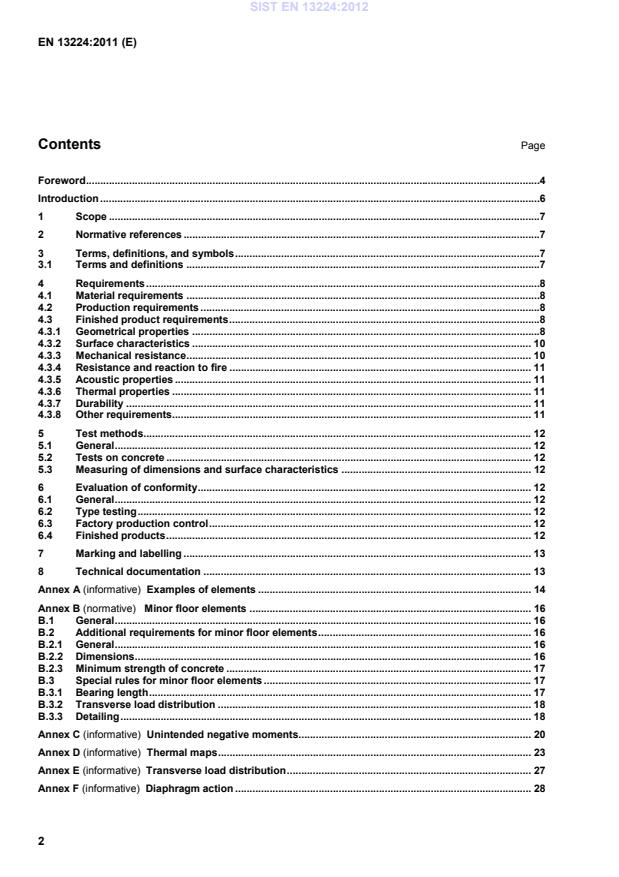
Examples of elements . 14Annex B (normative)
Minor floor elements . 16B.1 General . 16B.2 Additional requirements for minor floor elements . 16B.2.1 General . 16B.2.2 Dimensions . 16B.2.3 Minimum strength of concrete . 17B.3 Special rules for minor floor elements . 17B.3.1 Bearing length . 17B.3.2 Transverse load distribution . 18B.3.3 Detailing . 18Annex C (informative)
Unintended negative moments . 20Annex D (informative)
Thermal maps . 23Annex E (informative)
Transverse load distribution . 27Annex F (informative)
Diaphragm action . 28SIST EN 13224:2012
Clauses of this European Standard addressing the provisions of the EU Construction Products Directive . 29ZA.1 Scope and relevant characteristics . 29ZA.2 Procedure for attestation of conformity of precast ribbed floor elements . 31ZA.2.1 System of attestation of conformity . 31ZA.2.2 EC Certificate and Declaration of conformity . 32ZA.3 CE marking and labelling. 33ZA.3.1 General . 33ZA.3.2 Declaration of geometrical data and material properties (method 1) . 35ZA.3.3 Declaration of product properties (method 2) . 37ZA.3.4 Declaration of compliance with a given design specification provided by the client (method 3a) . 39ZA.3.5 Declaration of compliance with a given design specification provided by the manufacturer according to the client's order (method 3b) . 41Bibliography . 43 SIST EN 13224:2012
1-2: General rules — Structural fire design EN 13369:2004, Common rules for precast concrete products 3 Terms, definitions, and symbols 3.1 Terms and definitions For the purposes of this document, the terms and definitions given in EN 1992-1-1:2004 and EN 13369:2004 and the following apply. 3.1.1 ribbed precast concrete element precast unit consisting in a slab stiffened by one or more ribs 3.1.2 minor floor element ribbed precast floor elements having limited dimensions, which are in compliance with Annex B SIST EN 13224:2012
Figure 1 — Reference points for standard check of tolerances DIMENSION PERMITTED DEVIATION (mm) Skewness (θ) ± 15 Lateral bow (ε ) ± 10 or L/1 000 (whichever is greater) Angular deviation of ribs (δ) ± 15 Methods of measurements are given in 5.3. For prestressed elements the values of tolerance in lateral bow (ε) and angular deviation of ribs (δ) can be increased by 50 %; this includes the effect of prestressing tolerances. For minor floor elements according to Annex B, the permitted deviation on length is ± 25 mm. 4.3.1.2 Minimum dimensions EN 13369:2004, 4.3.1.2 shall apply. 4.3.1.3 Longitudinal connections If the precast units are connected along their longitudinal edges by means of a cast in situ mortar or concrete joint, the minimum joint width shall be at least 30 mm at the top to allow satisfactory casting. The joint face shall be provided with at least one groove. The size shall be appropriate with regard to the shear resistance of the grout. If tie bars are to be anchored within the joint, the joint width at the tie bar level shall be at least three times the diameter of the bar to enable a satisfactory bond and a complete encasing of the bar. If welded connections are used, the connection devices should be designed in order to allow an easy compensation of camber and erection deviations and welding execution. SIST EN 13224:2012
EN 13369:2004, 4.2.3.2.4 Only if release is not gradual Surface appearance
Visual inspection In case of doubt, check according to EN 13369:2004, J.4 Conformity with specified tolerances Every element 7 Marking and labelling EN 13369:2004, Clause 7 shall apply. NOTE For CE marking see Annex ZA. 8 Technical documentation The detailing of the element, with respect to geometrical data and complementary properties of materials and inserts, shall be given in technical documentation, which includes the construction data, such as the dimensions, the tolerances, the layout of reinforcement, the concrete cover, the surface characteristics (when relevant), the expected transient and final support conditions and lifting conditions. The composition of technical documentation is given in Clause 8 of EN 13369:2004.’ SIST EN 13224:2012
Examples of elements Some examples of cross-sections of precast elements considered in this document are shown in Figure A.1. The elements can be simply supported, or connected longitudinally on or with the supports, achieving total or partial continuity. They can also be designed with half joints at the ends, in order to reduce the total thickness. According to the different situations, the elements can be: placed on site without transversal connections, eventually supporting secondary elements between them (isolated members); provided with steel plates at their lateral edges to be connected together at their top flanges by welded shear connectors; shaped in form of shear keys at their lateral edges to be connected together by cast in situ shear joints, and/or be provided with steel plates for welded connections on site; provided with a cast in situ reinforced concrete topping. Such topping, if effectively restrained to the precast elements by bond, with or without steel reinforcement projecting from the elements, may be taken into account in the resistant section. Combinations of the preceding cases are also possible. According to the different arrangement of connections, the elements can be: able to act as a diaphragm in order to transfer horizontal forces to the bracing elements (cases b), c), d) and a) if the secondary elements are adequately connected); able to transfer vertical shear from heavier loaded elements to the surrounding ones (cases c), d) and b) if the welded connection is arranged in an appropriate way). SIST EN 13224:2012
a)
b)
c)
d)
e)
f)
g) Figure A.1 — Examples of some forms of ribbed floor elements SIST EN 13224:2012
Minor floor elements B.1 General In view of their use as specified in B.2.1, minor floor elements may be designed in the lower consequences class of EN 1990:2002, B.3.1. In this case, they shall be in compliance with the additional requirements and special rules of this annex. Design, production and application of minor floor elements, according to these special rules, is only allowed if manufacturing takes place under strict production control. B.2 Additional requirements for minor floor elements B.2.1 General Minor floor elements are ribbed precast floor elements with limited dimensions, used only for a suspended floor with a maximum below air space of 1 000 mm between the floor and the ground, which are in compliance with the additional requirements of B.2.2 and B.2.3. NOTE According to consequences classes stated in 1990:2002, B.3.1, taking into account the use stated above, some special design rules are given for these products. Examples of some forms of minor floor elements are given in Figure B.1.
Figure B.1 — Possible forms of minor floor elements B.2.2 Dimensions Minor floor elements shall comply with the following dimensions (referred to the concrete-element, without thermal insulation): span of the elements ≤ 8 000 mm; height of the elements ≤ 400 mm; width of the ribs ≥ 60 mm; spacing between ribs ≤ 1 200 mm; SIST EN 13224:2012
Figure B.2 — Notations B.2.3 Minimum strength of concrete The strength class of minor floor elements shall be not be less than C30/37 for reinforced elements and C40/50 for prestressed elements. B.3 Special rules for minor floor elements B.3.1 Bearing length It may be assumed that the requirements of the bearing length are fulfilled if the minimum values of Table B.1 are adopted: Table B.1 — Minimum bearing length for minor floor elements support prestressed elements reinforced elements masonry 90 mm 100 mm concrete 80 mm 80 mm steel 70 mm 70 mm SIST EN 13224:2012
Figure B.3 — Joint shapes
Figure B.4 — Transverse load distribution B.3.3 Detailing B.3.3.1 Shear reinforcement In ribs having width not exceeding 125 mm the shear reinforcement, when required, may be shaped in one leg only, placed in the middle plane of the rib and properly anchored at each end. B.3.3.2 Prestressed elements Transversal reinforcement in the ribs can be omitted in the zone of anchorage of the prestressing tendons if it is not required by the resistance verification. SIST EN 13224:2012
...