

FprEN 16263
(Main)Pyrotechnic articles - Other pyrotechnic articles
- Abstract
This document specifies requirements for the construction, performances, minimum labelling and mandatory instructions for use of other pyrotechnic articles of the following generic types:
- flares;
- flash devices;
- gas generators;
- heaters;
- other cartridges;
- pyromechanical devices;
- pyrotechnic actuated dispersers;
- rockets and rocket motors;
- semi-finished pyrotechnic articles;
- smoke/aerosol generators;
- sound emitters.
This document does not apply to pyrotechnic articles for vehicles, ignition devices and cartridges for powder actuated tools (PAT).
The following standards apply to the excluded articles:
- EN ISO 14451 1, Pyrotechnic articles - Pyrotechnic articles for vehicles - Part 1: Terminology (Under preparation)
- EN ISO 14451 2, Pyrotechnic articles - Pyrotechnic articles for vehicles - Part 2: Test methods (Under preparation)
- EN ISO 14451 3, Pyrotechnic articles - Pyrotechnic articles for vehicles - Part 3: Labelling (Under preparation)
- EN ISO 14451 4, Pyrotechnic articles - Pyrotechnic articles for vehicles - Part 4: Requirements and categorization for micro gas generators (Under preparation)
- EN ISO 14451 5, Pyrotechnic articles for vehicles – Part 5: Requirements and categorization for airbag gas generators (Under preparation)
- EN ISO 14451 6, Pyrotechnic articles – Pyrotechnic articles for vehicles – Part 6: Requirements and categorization for airbag modules (Under preparation)
- EN ISO 14451 7, Pyrotechnic articles – Pyrotechnic articles for vehicles – Part 7: Requirements and categorization for seatbelt pretensioners (Under preparation)
- EN ISO 14451 8, Pyrotechnic articles – Pyrotechnic articles for vehicles – Part 8: Requirements and categorization for igniters (Under preparation)
- EN ISO 14451 9, Pyrotechnic articles – Pyrotechnic articles for vehicles – Part 9: Requirements and categorization for actuators (Under preparation)
- EN ISO 14451 10, Pyrotechnic articles – Pyrotechnic articles for vehicles – Part 10: Requirements and categorization for semi-finished products (preparation)
- EN 16264, Pyrotechnic articles – Other pyrotechnic articles – Cartridges for powder actuated tools (Under preparation)
- EN 16265, Pyrotechnic articles – Other pyrotechnic articles – Ignition devices (Under preparation)
- Status
- Not Published
- Publication Date
- 17-Mar-2027
- Technical Committee
- CEN/TC 212 - Fireworks
- Drafting Committee
- CEN/TC 212/WG 5 - Other pyrotechnic articles, category P1 and P2
- Current Stage
- 4599 - Dispatch of FV draft to CMC - Finalization for Vote
- Start Date
- 01-Oct-2026
- Completion Date
- 01-Oct-2026

FprEN 16263 is a draft European Standard from CEN for other pyrotechnic articles. It specifies construction, performance, minimum labelling and mandatory instructions for use for defined generic types such as flares, gas generators, rocket motors, smoke/aerosol generators and sound emitters.
FprEN 16263 is aimed at manufacturers, importers, test laboratories and conformity assessment teams that need to classify, test, mark and document these articles. It is written around the two hazard categories P1 and P2 and shows how to decide which one applies.
What does FprEN 16263 specify?
FprEN 16263 covers other pyrotechnic articles within the listed generic types and sets out how they are classified, built, tested and labelled. The standard is organized into clauses for scope, references, terms, generic types, subtypes, categorization, safety and performance requirements, special requirements for semi-finished articles and rocket motors, primary packs, type testing, batch testing, test methods and minimum labelling.
It does not apply to pyrotechnic articles for vehicles, ignition devices or cartridges for powder actuated tools (PAT). Those excluded product families are handled by the named EN ISO 14451 parts, EN 16265 and EN 16264.
| Annex | What it covers |
|---|---|
| Annex A | Flow chart for categorization |
| Annex B | Drag coefficient values |
| Annex C | Thermal dose calculation |
| Annex D | Mechanical conditioning shock apparatus |
| Annex E | Drop test apparatus |
| Annex F | Procedures for calculating heights |
| Annex G | Accelerated ageing to demonstrate correct functioning at the 'use by' date |
| Annex H | Apparatus for testing sensitivity of pyrotechnic composition to electrostatic discharge |
| Annex ZA | Relationship with Directive 2013/29/EU |
What are the key requirements of FprEN 16263?
FprEN 16263 combines product safety rules, performance checks and labelling obligations. In practice, the document tells a manufacturer what the article must not contain, how it must behave under test, what information must appear on the label and how conformity is checked in type testing and batch testing.
Categorization into P1 and P2
Clause 6 places every covered article into Category P1 or P2. FprEN 16263 uses general criteria and specific criteria to judge hazard in normal and foreseeable use, and Annex A gives the flow chart that supports the decision.
This matters because the category drives the required safety distances, instructions and acceptance criteria. Annex C is part of that decision chain for thermal effect, so the designer has to know the article's effect profile before finalizing the technical specification.
Construction, substances and ignition safety
Clause 7 requires articles to avoid incompatible substances unless they are effectively segregated, stabilized or shown to be safe in the technical documentation. The clause also lists forbidden substances, sets rules for safe disposal, requires protection against accidental initiation and calls for safety features matched to the mode of initiation.
For ignition devices, FprEN 16263 points to EN 16265:- when the device has not already been successfully tested. In practice, a manufacturer has to show that the ignition system, leading wires or optical fibre, all-fire and no-fire levels, electrical characteristics and ESD resistance are under control.
Limits on detonative explosives
Clause 7.6 restricts detonative explosives in P1 and P2 articles. Black powder and flash composition are treated as exceptions in the clause, but other detonative explosives are only permitted when the article cannot be extracted easily and, depending on the category, cannot function in a detonative way or initiate secondary explosives.
This is important for product design and for technical files. The manufacturer must be able to justify the internal construction and, where required, verify the behaviour by test.
Performance and integrity after use
Clause 8 requires each article to function completely and to achieve the performance stated in its technical specification. It also covers design verification, verification of labelling and instructions, resistance to mechanical impact, resistance to moisture, resistance to high and low temperatures and integrity after functioning.
In practice, this means the article has to survive the relevant conditioning steps and still operate safely. Clause 8 also deals with loose pyrotechnic composition after conditioning, which is a practical check on whether the article sheds hazardous material.
Special treatment for semi-finished articles and rocket motors
Clause 9 gives a simplified rule for semi-finished pyrotechnic articles: only design verification applies. For rocket motors, the document requires thrust measurement and comparison with the technical specification.
That matters because these products are not judged only by visual appearance or labels. Their intended performance has to be demonstrated in a measurable way.
Type testing, batch testing and sampling
Clauses 11 and 12 split conformity assessment into type testing for a new article and batch testing for production lots. Type testing covers the full requirement set for a new item during EU-type examination, while batch testing checks serial production against the approved type.
Batch testing uses ISO 2859-1:2026 sampling rules, with special sampling rules for smaller batches. The standard also classifies nonconformities as critical, major or minor, which helps decide whether a batch is accepted or rejected.
Labelling and instructions for use
Clause 14 sets the minimum label content and the instructions for use. The label or pack has to identify the manufacturer or importer, the article type, category, registration number, intended use, age limits, safe firing distance where applicable, NEC, means of ignition, safe/arm status, direction of effect and any 'use by' date.
The instructions for use have to explain safe handling, firing, storage, disposal and any special ancillary equipment. For P2 articles, the instructions must also give the user data needed to calculate or determine the hazard zone and safe firing distance.
What terms does FprEN 16263 define?
FprEN 16263 defines the main product families and the vocabulary used to classify them and test them.
- Generic type - the broad family of articles with a common design feature or common effect, such as flare or gas generator.
- Subtype - a more specific set within a generic type, such as hand-held flare or pyrotechnic fire-fighting device.
- Type - a representative sample of the production that is intended.
- Category P1 - pyrotechnic articles other than fireworks and theatrical pyrotechnic articles that present a low hazard.
- Category P2 - pyrotechnic articles other than fireworks and theatrical pyrotechnic articles intended for handling or use only by persons with specialist knowledge.
- Net explosive content (NEC) - the total mass of pyrotechnic compositions in an article.
- Acceptance quality limit (AQL) - the worst tolerable process average in acceptance sampling.
- Electrostatic discharge (ESD) - a sudden electric current between objects at different electrical potentials.
Who uses FprEN 16263?
FprEN 16263 is used by manufacturers and importers of flares, gas generators, heaters, pyromechanical devices, rocket motors, smoke/aerosol generators and sound emitters. It is also used by notified bodies, test laboratories and quality teams that carry out EU-type examination, batch testing, design verification and label checks.
Regulatory and product safety staff use it to decide whether a product belongs in P1 or P2, what evidence has to go into the technical documentation and what user information must be supplied. Buyers and specifiers use it to check that a product is in the right standard family before they compare offers.
What changed in FprEN 16263 from the previous edition?
FprEN 16263 supersedes EN 16263-1:2015, EN 16263-2:2015, EN 16263-3:2015, EN 16263-4:2015 and EN 16263-5:2015. The foreword states two changes: the five parts have been merged, and Annex ZA has been updated.
Which standards are used with FprEN 16263?
FprEN 16263 relies on several external standards for test methods, sampling, symbols and measuring equipment.
| Standard | What it contributes |
|---|---|
| EN 16265:- | Requirements for ignition devices and related checks in Clause 7 |
| EN 13631-3:2025 | Friction sensitivity test for pyrotechnic composition |
| EN 13631-4:2025 | Impact sensitivity test for pyrotechnic composition |
| EN 13763-1:2025 | Reference detonators for the secondary explosive detonation test |
| EN 61672-1:2013 | Sound level meters for acoustic measurements |
| EN ISO 13385-1:2019 | Calipers for dimensional measurement |
| EN ISO 13385-2:2020 | Calliper depth gauges for dimensional measurement |
| EN ISO 7010:2020 | Registered safety signs used in warnings and instructions |
| ISO 565:1990 | Test sieve for ESD sample preparation |
| ISO 2859-1:2026 | Sampling plans for batch testing |
| ISO 3864-1:2011 | Design principles for safety signs and markings |
| ISO 6344-3:2021 | Grain size distribution for coated abrasives |
| ISO 7000:2019 | Registered symbols for equipment marking |
The scope also names the related excluded-product standards EN ISO 14451-1 to EN ISO 14451-10, EN 16264 and EN 16265, which helps readers find the correct document when an article falls outside FprEN 16263.
What does the FprEN 16263 document contain?
FprEN 16263 contains the full test and compliance structure behind the requirements. Clause 13 gives the apparatus and procedures for construction checks, design verification, effect height, sound pressure, timing, mechanical conditioning, drop testing, thermal conditioning, thrust measurement, abrasive ignition, ESD sensitivity, water immersion and visual examination.
The annexes add the supporting tools for practical work. In particular, Annex C provides the thermal dose calculation used for categorization, Annex G gives the accelerated ageing logic for a 'use by' date, and Annex H describes the ESD test cell, conditioning and reporting format.
The document also contains the flow chart used to classify articles, the drag coefficient table used in calculations, and the geometry procedures for measuring aerial effects. These parts are mainly used by designers, test houses and notified bodies when they need a repeatable way to measure and record product behaviour.
Get Certified
Connect with accredited certification bodies for this standard

ECOCERT
Organic and sustainability certification.

Eurofins Food Testing Global
Global leader in food, environment, and pharmaceutical product testing.

Intertek Bangladesh
Intertek certification and testing services in Bangladesh.
Sponsored listings
Frequently Asked Questions
FprEN 16263 is a draft published by the European Committee for Standardization (CEN). Its full title is "Pyrotechnic articles - Other pyrotechnic articles". This standard covers: This document specifies requirements for the construction, performances, minimum labelling and mandatory instructions for use of other pyrotechnic articles of the following generic types: - flares; - flash devices; - gas generators; - heaters; - other cartridges; - pyromechanical devices; - pyrotechnic actuated dispersers; - rockets and rocket motors; - semi-finished pyrotechnic articles; - smoke/aerosol generators; - sound emitters. This document does not apply to pyrotechnic articles for vehicles, ignition devices and cartridges for powder actuated tools (PAT). The following standards apply to the excluded articles: - EN ISO 14451 1, Pyrotechnic articles - Pyrotechnic articles for vehicles - Part 1: Terminology (Under preparation) - EN ISO 14451 2, Pyrotechnic articles - Pyrotechnic articles for vehicles - Part 2: Test methods (Under preparation) - EN ISO 14451 3, Pyrotechnic articles - Pyrotechnic articles for vehicles - Part 3: Labelling (Under preparation) - EN ISO 14451 4, Pyrotechnic articles - Pyrotechnic articles for vehicles - Part 4: Requirements and categorization for micro gas generators (Under preparation) - EN ISO 14451 5, Pyrotechnic articles for vehicles – Part 5: Requirements and categorization for airbag gas generators (Under preparation) - EN ISO 14451 6, Pyrotechnic articles – Pyrotechnic articles for vehicles – Part 6: Requirements and categorization for airbag modules (Under preparation) - EN ISO 14451 7, Pyrotechnic articles – Pyrotechnic articles for vehicles – Part 7: Requirements and categorization for seatbelt pretensioners (Under preparation) - EN ISO 14451 8, Pyrotechnic articles – Pyrotechnic articles for vehicles – Part 8: Requirements and categorization for igniters (Under preparation) - EN ISO 14451 9, Pyrotechnic articles – Pyrotechnic articles for vehicles – Part 9: Requirements and categorization for actuators (Under preparation) - EN ISO 14451 10, Pyrotechnic articles – Pyrotechnic articles for vehicles – Part 10: Requirements and categorization for semi-finished products (preparation) - EN 16264, Pyrotechnic articles – Other pyrotechnic articles – Cartridges for powder actuated tools (Under preparation) - EN 16265, Pyrotechnic articles – Other pyrotechnic articles – Ignition devices (Under preparation)
This document specifies requirements for the construction, performances, minimum labelling and mandatory instructions for use of other pyrotechnic articles of the following generic types: - flares; - flash devices; - gas generators; - heaters; - other cartridges; - pyromechanical devices; - pyrotechnic actuated dispersers; - rockets and rocket motors; - semi-finished pyrotechnic articles; - smoke/aerosol generators; - sound emitters. This document does not apply to pyrotechnic articles for vehicles, ignition devices and cartridges for powder actuated tools (PAT). The following standards apply to the excluded articles: - EN ISO 14451 1, Pyrotechnic articles - Pyrotechnic articles for vehicles - Part 1: Terminology (Under preparation) - EN ISO 14451 2, Pyrotechnic articles - Pyrotechnic articles for vehicles - Part 2: Test methods (Under preparation) - EN ISO 14451 3, Pyrotechnic articles - Pyrotechnic articles for vehicles - Part 3: Labelling (Under preparation) - EN ISO 14451 4, Pyrotechnic articles - Pyrotechnic articles for vehicles - Part 4: Requirements and categorization for micro gas generators (Under preparation) - EN ISO 14451 5, Pyrotechnic articles for vehicles – Part 5: Requirements and categorization for airbag gas generators (Under preparation) - EN ISO 14451 6, Pyrotechnic articles – Pyrotechnic articles for vehicles – Part 6: Requirements and categorization for airbag modules (Under preparation) - EN ISO 14451 7, Pyrotechnic articles – Pyrotechnic articles for vehicles – Part 7: Requirements and categorization for seatbelt pretensioners (Under preparation) - EN ISO 14451 8, Pyrotechnic articles – Pyrotechnic articles for vehicles – Part 8: Requirements and categorization for igniters (Under preparation) - EN ISO 14451 9, Pyrotechnic articles – Pyrotechnic articles for vehicles – Part 9: Requirements and categorization for actuators (Under preparation) - EN ISO 14451 10, Pyrotechnic articles – Pyrotechnic articles for vehicles – Part 10: Requirements and categorization for semi-finished products (preparation) - EN 16264, Pyrotechnic articles – Other pyrotechnic articles – Cartridges for powder actuated tools (Under preparation) - EN 16265, Pyrotechnic articles – Other pyrotechnic articles – Ignition devices (Under preparation)
FprEN 16263 is classified under the following ICS (International Classification for Standards) categories: 71.100.30 - Explosives. Pyrotechnics and fireworks. The ICS classification helps identify the subject area and facilitates finding related standards.
FprEN 16263 is associated with the following European legislation: EU Directives/Regulations: 2013/29/EU; Standardization Mandates: M/583. When a standard is cited in the Official Journal of the European Union, products manufactured in conformity with it benefit from a presumption of conformity with the essential requirements of the corresponding EU directive or regulation.
FprEN 16263 is available in PDF format for immediate download after purchase. The document can be added to your cart and obtained through the secure checkout process. Digital delivery ensures instant access to the complete standard document.
Standards Content (Sample)
SLOVENSKI STANDARD
01-junij-2026
Pirotehnični izdelki - Drugi pirotehnični izdelki
Pyrotechnic articles - Other pyrotechnic articles
Pyrotechnische Gegenstände - Sonstige pyrotechnische Gegenstände
Articles pyrotechniques - Autres articles pyrotechniques
Ta slovenski standard je istoveten z: prEN 16263
ICS:
71.100.30 Eksplozivi. Pirotehnika in Explosives. Pyrotechnics and
ognjemeti fireworks
2003-01.Slovenski inštitut za standardizacijo. Razmnoževanje celote ali delov tega standarda ni dovoljeno.
DRAFT
EUROPEAN STANDARD
prEN 16263
NORME EUROPÉENNE
EUROPÄISCHE NORM
April 2026
ICS 71.100.30
English Version
Pyrotechnic articles - Other pyrotechnic articles
Articles pyrotechniques - Autres articles Pyrotechnische Gegenstände - Sonstige pyrotechnische
pyrotechniques Gegenstände
This draft European Standard is submitted to CEN members for enquiry. It has been drawn up by the Technical Committee
CEN/TC 212.
If this draft becomes a European Standard, CEN members are bound to comply with the CEN/CENELEC Internal Regulations
which stipulate the conditions for giving this European Standard the status of a national standard without any alteration.
This draft European Standard was established by CEN in three official versions (English, French, German). A version in any other
language made by translation under the responsibility of a CEN member into its own language and notified to the CEN-CENELEC
Management Centre has the same status as the official versions.
CEN members are the national standards bodies of Austria, Belgium, Bulgaria, Croatia, Cyprus, Czech Republic, Denmark, Estonia,
Finland, France, Germany, Greece, Hungary, Iceland, Ireland, Italy, Latvia, Lithuania, Luxembourg, Malta, Netherlands, Norway,
Poland, Portugal, Republic of North Macedonia, Romania, Serbia, Slovakia, Slovenia, Spain, Sweden, Switzerland, Türkiye and
United Kingdom.
Recipients of this draft are invited to submit, with their comments, notification of any relevant patent rights of which they are
aware and to provide supporting documentation.
Warning : This document is not a European Standard. It is distributed for review and comments. It is subject to change without
notice and shall not be referred to as a European Standard.
EUROPEAN COMMITTEE FOR STANDARDIZATION
COMITÉ EUROPÉEN DE NORMALISATION
EUROPÄISCHES KOMITEE FÜR NORMUNG
CEN-CENELEC Management Centre: Rue de la Science 23, B-1040 Brussels
© 2026 CEN All rights of exploitation in any form and by any means reserved Ref. No. prEN 16263:2026 E
worldwide for CEN national Members.
prEN 16263:2026 (E)
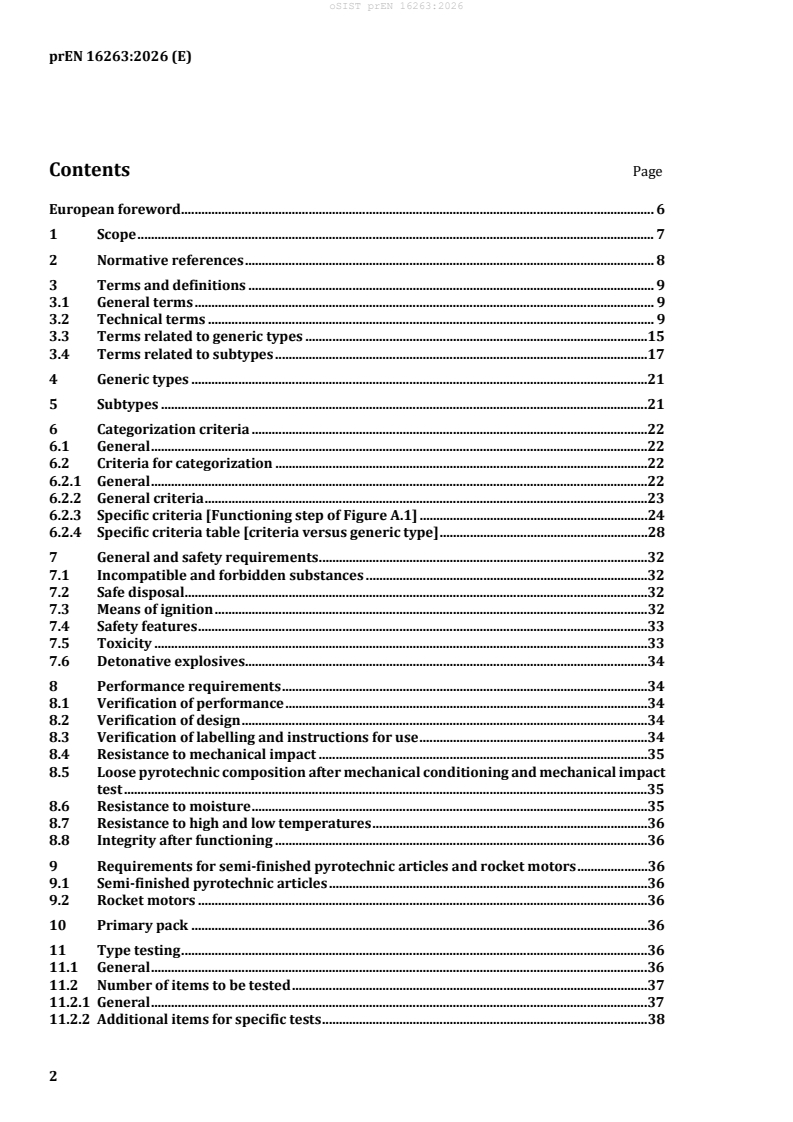
Contents Page
European foreword . 6
1 Scope . 7
2 Normative references . 8
3 Terms and definitions . 9
3.1 General terms . 9
3.2 Technical terms . 9
3.3 Terms related to generic types .15
3.4 Terms related to subtypes .17
4 Generic types .21
5 Subtypes .21
6 Categorization criteria .22
6.1 General .22
6.2 Criteria for categorization .22
6.2.1 General .22
6.2.2 General criteria .23
6.2.3 Specific criteria [Functioning step of Figure A.1] .24
6.2.4 Specific criteria table [criteria versus generic type] .28
7 General and safety requirements .32
7.1 Incompatible and forbidden substances .32
7.2 Safe disposal .32
7.3 Means of ignition .32
7.4 Safety features .33
7.5 Toxicity .33
7.6 Detonative explosives .34
8 Performance requirements .34
8.1 Verification of performance .34
8.2 Verification of design .34
8.3 Verification of labelling and instructions for use .34
8.4 Resistance to mechanical impact .35
8.5 Loose pyrotechnic composition after mechanical conditioning and mechanical impact
test .35
8.6 Resistance to moisture .35
8.7 Resistance to high and low temperatures .36
8.8 Integrity after functioning .36
9 Requirements for semi-finished pyrotechnic articles and rocket motors .36
9.1 Semi-finished pyrotechnic articles .36
9.2 Rocket motors .36
10 Primary pack .36
11 Type testing .36
11.1 General .36
11.2 Number of items to be tested .37
11.2.1 General .37
11.2.2 Additional items for specific tests .38
prEN 16263:2026 (E)
11.3 Number of primary packs to be examined . 38
11.4 Test report . 39
12 Batch testing . 39
12.1 General . 39
12.2 Sampling plans. 39
12.3 Unit of product . 40
12.4 Nonconformities . 40
12.5 Labelling . 42
12.6 Test report . 42
12.7 Acceptance or rejection of a batch . 42
12.7.1 Nonconforming units . 42
12.7.2 Critical nonconforming units . 42
12.7.3 Major nonconforming units . 42
12.7.4 Minor nonconforming units . 43
12.7.5 Pyrotechnic articles supplied in primary packs. 43
13 Test methods . 43
13.1 Apparatus . 43
13.1.1 General . 43
13.1.2 Test area . 43
13.1.3 Timing device . 43
13.1.4 Calliper . 43
13.1.5 Ruler . 44
13.1.6 Measuring tape . 44
13.1.7 Wind speed meter . 44
13.1.8 Balance . 44
13.1.9 Temperature chamber . 44
13.1.10 Sound level meter . 44
13.1.11 Shock apparatus . 44
13.1.12 Drop-test apparatus . 44
13.1.13 Goniometer . 45
13.1.14 Devices for measuring of effect height . 45
13.1.15 Devices for measuring thrust . 45
13.1.16 Abrasive sheet . 45
13.1.17 Witness screen . 45
13.1.18 Transparent type size sheet . 46
13.1.19 High speed video equipment . 47
13.1.20 Magnifying equipment . 47
13.1.21 Further test apparatus . 47
13.2 Test procedures . 47
13.2.1 General . 47
13.2.2 Construction . 47
13.2.3 Design verification . 47
13.2.4 Angle of ascent and height of effects . 48
13.2.5 Measurement of sound pressure level . 49
13.2.6 Timing measurement . 49
13.2.7 Mechanical conditioning . 50
13.2.8 Mechanical impact test (Drop test) . 50
13.2.9 Thermal conditioning . 51
13.2.10 Function test. 51
13.2.11 Measurement of thrust . 53
13.2.12 Resistance to ignition by an abrasive surface . 53
13.2.13 Further tests . 54
prEN 16263:2026 (E)
13.2.14 Measuring of labelling .57
13.2.15 Measuring of the hazard level of fragments .57
13.2.16 Water immersion test .59
13.2.17 Use of detonative explosives .59
13.2.18 Visual examination .63
14 Minimum labelling requirements .64
14.1 General .64
14.2 Information on manufacturer or importer .64
14.3 Type of article, category, registration number and intended use .64
14.3.1 Type of article .64
14.3.2 Name of article .64
14.3.3 Category and registration number .64
14.3.4 Marking and identification number of the notified body .65
14.3.5 Product, batch or serial number .65
14.3.6 Intended use .65
14.4 Age limits .65
14.5 Instructions for use .65
14.6 Safe firing distance and hazard zone .67
14.7 Net explosive content .67
14.8 Means of ignition .67
14.9 Safe/arm device .67
14.10 Direction of effect .67
14.11 ‘Use by’ date .67
14.12 Printing .68
14.13 Marking of very small items .68
Annex A (normative) Flow chart .69
Annex B (normative) Value of the drag coefficient .76
Annex C (normative) Calculation of the thermal dose .77
C.1 Method of calculation .77
C.2 Typical values of the enthalpy of combustion .78
C.3 Radiation part of the thermal flux .78
C.4 Alternative criterion when q(t) is constant or can be approximated by a constant law
of time .78
Annex D (informative) Mechanical conditioning (Shock apparatus) .80
Annex E (informative) Drop test (Mechanical impact test) .83
Annex F (informative) Procedures for calculation of heights .84
Annex G (informative) Determination of the duration of accelerated ageing test to
demonstrate the correct functioning at the 'use by' date .88
Annex H (normative) Apparatus for the testing of sensitiveness of the pyrotechnic
composition to electrostatic discharge .91
H.1 Electrostatic energy supply .91
H.2 Test cell assembly .92
H.3 Preparation of the test sample .92
H.4 Conditioning of the test sample and test conditions .92
H.5 Evaluation of spark gap energy .93
prEN 16263:2026 (E)
H.6 Reporting of results . 93
H.7 Test report . 93
Annex ZA (informative) Relationship between this European Standard and the essential
safety requirements of Directive 2013/29/EU aimed to be covered . 94
Bibliography . 96
prEN 16263:2026 (E)
European foreword
This document (prEN 16263:2026) has been prepared by Technical Committee CEN/TC 212
“Pyrotechnic articles”, the secretariat of which is held by NEN.
This document is currently submitted to the CEN Enquiry.
This document will supersede EN 16263-1:2015, EN 16263-2:2015, EN 16263-3:2015,
EN 16263-4:2015 and EN 16263-5:2015.
prEN 16263:2026 includes the following changes with respect to EN 16263-1:2015, EN 16263-2:2015,
EN 16263-3:2015, EN 16263-4:2015 and EN 16263-5:2015:
— the 5 parts have been merged;
— the Annex ZA has been updated.
NOTE Words in italics (apart from document titles) are defined in Clause 3 (Terms and definitions)
This document has been prepared under a standardization request addressed to CEN by the European
Commission. The Standing Committee of the EFTA States subsequently approves these requests for its
Member States.
For the relationship with EU Legislation, see informative Annex ZA, which is an integral part of this
document.
prEN 16263:2026 (E)
1 Scope
This document specifies requirements for the construction, performances, minimum labelling and
mandatory instructions for use of other pyrotechnic articles of the following generic types:
— flares;
— flash devices;
— gas generators;
— heaters;
— other cartridges;
— pyromechanical devices;
— pyrotechnic actuated dispersers;
— rockets and rocket motors;
— semi-finished pyrotechnic articles;
— smoke/aerosol generators;
— sound emitters.
This document does not apply to pyrotechnic articles for vehicles, ignition devices and cartridges for
powder actuated tools (PAT).
The following standards apply to the excluded articles:
— EN ISO 14451-1, Pyrotechnic articles – Pyrotechnic articles for vehicles – Part 1: Terminology
(Under preparation)
— EN ISO 14451-2, Pyrotechnic articles – Pyrotechnic articles for vehicles – Part 2: Test methods
(Under preparation)
— EN ISO 14451-3, Pyrotechnic articles – Pyrotechnic articles for vehicles – Part 3: Labelling (Under
preparation)
— EN ISO 14451-4, Pyrotechnic articles – Pyrotechnic articles for vehicles – Part 4: Requirements and
categorization for micro gas generators (Under preparation)
— EN ISO 14451-5, Pyrotechnic articles for vehicles – Part 5: Requirements and categorization for
airbag gas generators (Under preparation)
— EN ISO 14451-6, Pyrotechnic articles – Pyrotechnic articles for vehicles – Part 6: Requirements and
categorization for airbag modules (Under preparation)
— EN ISO 14451-7, Pyrotechnic articles – Pyrotechnic articles for vehicles – Part 7: Requirements and
categorization for seatbelt pretensioners (Under preparation)
— EN ISO 14451-8, Pyrotechnic articles – Pyrotechnic articles for vehicles – Part 8: Requirements and
categorization for igniters (Under preparation)
prEN 16263:2026 (E)
— EN ISO 14451-9, Pyrotechnic articles – Pyrotechnic articles for vehicles – Part 9: Requirements and
categorization for actuators (Under preparation)
— EN ISO 14451-10, Pyrotechnic articles – Pyrotechnic articles for vehicles – Part 10: Requirements
and categorization for semi-finished products (preparation)
— EN 16264, Pyrotechnic articles – Other pyrotechnic articles – Cartridges for powder actuated tools
(Under preparation)
— EN 16265, Pyrotechnic articles – Other pyrotechnic articles – Ignition devices (Under preparation)
2 Normative references
The following documents are referred to in the text in such a way that some or all of their content
constitutes requirements of this document. For dated references, only the edition cited applies. For
undated references, the latest edition of the referenced document (including any amendments) applies.
EN 13631-3:2025, Explosives for civil uses - Explosives for blasting, boosters and explosive substances —
Part 3: Verification of the insensitiveness to friction of explosives for blasting and explosive substances
EN 13631-4:2025, Explosives for civil uses — Explosives for blasting, boosters and explosive substances —
Part 4: Verification of the insensitiveness to impact of explosives for blasting and explosive substances
EN 13763-1:2025, Explosives for civil uses — Detonators and detonating cord relays - Part 1: Requirements
EN 16265:—, Pyrotechnic articles — Other pyrotechnic articles — Ignition devices
EN 61672-1:2013, Electroacoustics — Sound level meters — Part 1: Specifications (IEC 61672 1:2013)
EN ISO 13385-1:2019, Geometrical product specifications (GPS) — Dimensional measuring equipment —
Part 1: Design and metrological characteristics of callipers (ISO 13385-1:2019)
EN ISO 13385-2:2020, Geometrical product specifications (GPS) — Dimensional measuring equipment —
Part 2: Design and metrological characteristics of calliper depth gauges (ISO 13385-2:2020)
EN ISO 7010:2020, Graphical symbols — Safety colours and safety signs — Registered safety signs
(ISO 7010:2019, Corrected version 2020-06)
ISO 565:1990, Test sieves — Metal wire cloth, perforated metal plate and electroformed sheet — Nominal
sizes of openings
ISO 2859-1:2026, Sampling procedures for inspection by attributes — Part 1: Sampling schemes indexed by
acceptance quality limit (AQL) for lot-by-lot inspection
ISO 3864-1:2011, Graphical symbols — Safety colours and safety signs — Part 1: Design principles for safety
signs and safety markings
ISO 6344-3:2021, Coated abrasives — Determination and designation of grain size distribution — Part 3:
Microgrit sizes P240 to P5000
Under preparation, current stage: prEN 16265:2025.
As impacted by EN ISO 7010:2020/A1:2020; EN ISO 7010:2020/A2:2022; EN ISO 7010:2020/A3:2022; EN ISO
7010:2020/A4:2023; EN ISO 7010:2020/A5:2023; EN ISO 7010:2020/A6:2023; EN ISO 7010:2020/A7:2024;
EN ISO 7010:2020/A8:2024.
prEN 16263:2026 (E)
ISO 7000:2019, Graphical symbols for use on equipment — Registered symbols
ISO 21948:2001, Coated abrasives — Plain sheets
3 Terms and definitions
For the purposes of this document, the following terms and definitions apply.
3.1 General terms
3.1.1
generic type
set of articles with a common, very general, design feature and/or with a common characteristic effect
3.1.2
subtype
set of articles within a generic type with specific design features
3.1.3
technical documentation provided with the article
technical information about the article to be provided for EU-type examination
3.1.4
trade name
designation of an individual item from a particular supplier
3.1.5
type
sample representative of the production envisaged
3.2 Technical terms
3.2.1
acceptance quality limit
AQL
quality level that is the worst tolerable process average when a continuing series of lots is submitted for
acceptance sampling
3.2.2
all-fire level
minimum level of the initiation input, needed to ensure that an igniter or an ignition device initiates
within a given time frame
Note 1 to entry: All fire level is a characteristic given in the instructions for use of every igniter. It is generally
associated with a probability level (generally 99,9 % at 95 % confidence level) within a specified time frame
(e.g. 50 ms).
Note 2 to entry: Examples of initiation input are: an electrical current in Amperes, a mechanical force in Newtons
and an optical energy in Watts.
3.2.3
ancillary equipment
device which does not form part of a pyrotechnic article, but which is supplied with it and is required in
order that the article functions safely and correctly when used according to the instructions for use
prEN 16263:2026 (E)
3.2.4
batch test
test performed on a sample of products taken at random from a production batch to check compliance
with Clause 12
3.2.5
black powder
intimate mixture of charcoal and sodium nitrate or potassium nitrate with or without sulphur
3.2.6
burning rate
mass of consumed pyrotechnic composition of the effect charge in grams divided by the effect time in
seconds
3.2.7
combustive behaviour
self-sustained chemical reaction that propagates at a velocity lower than the sound velocity of the
reacting effect charge
3.2.8
critical nonconformity
nonconformity that judgement and experience indicate is likely to result in hazardous or unsafe
conditions
Note 1 to entry: This type of nonconformity is referred to as ‘class A nonconformity’ in ISO 2859-1:2026.
3.2.9
critical nonconforming unit
nonconforming unit with one or more critical nonconformities, with or without major or minor
nonconformities
3.2.10
debris
rigid or resilient part of a pyrotechnic article which remains after it has ceased to function
3.2.11
delay element
pyrotechnic device designed in such a manner that it generates a delay in the transmission of fire in a
pyrotechnic train
Note 1 to entry: Delay fuses are specific examples of such pyrotechnic delays.
3.2.12
detonation
reaction which propagates through an explosive at supersonic velocity in the reacting explosive
3.2.13
detonative explosive
substance or mixture of substances which can undergo a fast-internal decomposition reaction leading to
a detonation in normal use
prEN 16263:2026 (E)
3.2.14
disposal
destroying the article or the pyrotechnic substances it contains or otherwise rendering the article
harmless and, for end users, includes arranging the safe return of the article to the competent body
specified in the instructions for use
3.2.15
effect charge
pyrotechnic composition which, upon functioning, will burn or explode to produce the principal effects of
a pyrotechnic article
3.2.16
effect time
total duration of effect from its emergence until it entirely vanishes
3.2.17
electrostatic discharge
ESD
sudden and momentary electric current that flows between two objects at different electrical potentials
3.2.18
external effect
effect that develops outside the article when functioning
Note 1 to entry: External effect does not include the external surface temperature of the article.
3.2.19
flash composition
inherent mixture of a metal and an oxidizer
Note 1 to entry: This is usually perchlorate or nitrate metal based.
3.2.20
friction head
ignition head designed to be ignited by friction
3.2.21
gross mass
total mass of a pyrotechnic article not including any ancillary equipment
3.2.22
hazard zone
space where persons or property could suffer significant harm from the intended or likely unintended
effects of the article
prEN 16263:2026 (E)
3.2.23
igniter
article containing pyrotechnic composition(s) used to initiate combustion or deflagration, as defined in
EN 16265:—
Note 1 to entry: It may be actuated by chemical, electrical, optical or mechanical means.
3.2.24
ignition device
pyrotechnic device which is used to start and/or transmit ignition of/to pyrotechnic compositions, as
defined in EN 16265:—
3.2.25
ignition head
initial fuse consisting of pyrotechnic composition only
3.2.26
incompatible substances
substances or materials that react together resulting in unsafe conditions
3.2.27
intended fragmentation
intended production of fragments by the explosive reaction of the pyrotechnic compositions included in a
pyrotechnic article
3.2.28
leading wires
electrical wires attached to the igniter to lead the electric firing current to it
3.2.29
leading optical fibre
optical fibre attached to the igniter to lead the optical firing energy to it
3.2.30
life saving device
pyrotechnic article that is intended to protect human life in distress situations and exposure to harmful
conditions and/or give support to rescue operations
Note 1 to entry: Such articles may include different generic types as defined in Clauses 3.3 and 3.4 (e.g. flares,
actuators, pyrotechnic actuated dispenser…).
3.2.31
major nonconformity
nonconformity, other than a critical nonconformity, which is likely to result in failure, to reduce materially
the usability of the pyrotechnic article, or to increase the potential hazard
Note 1 to entry: This type of nonconformity is referred to as ‘class B nonconformity’ in ISO 2859-1:2026.
3.2.32
major nonconforming unit
nonconforming unit with one or more major nonconformities, with or without minor nonconformities,
but with no critical nonconformities
prEN 16263:2026 (E)
3.2.33
minor nonconformity
nonconformity that is not likely to reduce materially the usability of the pyrotechnic article
Note 1 to entry: This type of nonconformity is referred to as ‘class C nonconformity’ in ISO 2859-1:2026.
3.2.34
minor nonconforming unit
nonconforming unit with one or more minor nonconformities, but with no critical or major
nonconformities
3.2.35
misfire
incomplete functioning or no functioning of a pyrotechnic article after application of initiation stimulus
3.2.36
net explosive content
NEC
total mass of pyrotechnic compositions in a pyrotechnic article
3.2.37
no-fire level
maximum level of the initiation input that can be applied without causing an igniter to function within a
specified time period
Note 1 to entry: No fire level can be an electrical current in Amperes, a mechanical force in Newton or an optical
energy in Watts.
Note 2 to entry: No-fire level is a characteristic given in the instructions for use of every igniter. It is generally
associated with a probability level (generally 99,9 % at 95 % confidence level) within a specified time frame
(e.g. 50 ms).
3.2.38
nonconforming unit
pyrotechnic article with one or more nonconformities
3.2.39
nonconformity
non-fulfilment of a requirement
[SOURCE: EN ISO 9000:2015, 3.6.9 [1] Note 1 to entry has been deleted.]
3.2.40
packaging
wrapping in which an item is presented for transport, storage and/or sale
3.2.41
powder actuated tool
PAT
tool with a piston powered by the hot combustion gases from a cartridge and comprising powder
actuated fixing and hard marking tools
[SOURCE: EN 15895:2025, 3.1 [2]]
prEN 16263:2026 (E)
3.2.42
primary pack
smallest package of one or more pyrotechnic articles with the same registration number, offered for retail
sale as a single unit
3.2.43
principal effect
main effect a pyrotechnic article is designed to produce, as defined by its technical specification
3.2.44
projected fragment
debris projected while functioning
3.2.45
projected frontal area
two-dimensional area of a fragment or part of an article obtained by geometrically projecting its shape
on to a plane that is perpendicular to the direction of its motion
Note 1 to entry: In ordinary terms, it can be considered as the “shadow” of such a fragment or part perpendicularly
to the direction of its motion.
3.2.46
personal protective equipment
equipment that has to be worn by exposed people in the hazard zone
3.247
pyrotechnic component
component of a pyrotechnic article which contains one or more pyrotechnic compositions
3.2.48
pyrotechnic composition
explosive substance or mixture of explosive substances which is designed, on ignition or initiation, to
produce heat, light, sound, gas or smoke or a combination of such effects through self-sustained
exothermic chemical reactions
3.2.49
pyrotechnic operation
operation which leads to the intentional direct application of a mechanical, thermal and/or chemical
stress on the pyrotechnic composition without intending to ignite or initiate the article at the time the
stress is applied
3.2.50
pyrotechnic train
set of pyrotechnic components which are functionally linked and, after an initial input of energy, function
in a designed sequence to transmit, enhance and/or distribute ignition to one or more other pyrotechnic
components
3.2.51
remote effect
effect obtained by propulsion or projection beyond the safe firing distance and generating hazards by the
functioning of the article
Note 1 to entry: Examples of articles that are propelled are hand-held rockets and propelled signals. Examples of
articles that project are signal cartridges and simulation devices.
prEN 16263:2026 (E)
3.2.52
safe/arm device
mechanical device which is intended to interrupt the propagation of the firing signal within the article
when it is in its “safe” position and to allow the propagation when in “arm” position
3.2.53
safe firing distance
minimum distance between the user and the place where the pyrotechnic article is set and fired
3.2.54
secondary effect
effect other than the principal effect
3.2.55
secondary explosive
detonative explosive that can only be initiated by a detonation and not by flames, sparks or, more
generally, means that produce heat
3.2.56
type test
test performed on a sample of products, representative of the production envisaged,
Note 1 to entry: The definition is in line with Directive 2013/29/EU [8] in order to demonstrate their compliance
with the Essential Safety Requirements of Annex I and its relevant provisions.
Note 2 to entry: The successful submission to type tests leads to the attribution of an EU-type examination
certificate.
3.2.57
‘use by’ date
latest date by which an article may be used if it is to safely exhibit the performance characteristics
described in its technical specifications
3.3 Terms related to generic types
3.3.1
flare
article consisting of a light and/or radiated heat producing pyrotechnic composition, with or without a
casing, with or without means of ignition
Note 1 to entry: Such article exhibits a combustive behaviour.
3.3.2
flash device
article consisting of a casing and flash powder all assembled in one piece, with or without a means of
ignition
Note 1 to entry: Flash powder is not submitted to 7.6 and 13.2.17.
3.3.3
gas generator
article consisting of a pyrotechnic composition designed to generate gases, with or without a casing, with
or without an ignition device
prEN 16263:2026 (E)
Note 1 to entry: Such article exhibits a combustive behaviour when the duration of gas generation is higher than
15 ms.
3.3.4
heater
article containing a pyrotechnic composition designed to generate heat
Note 1 to entry: Such article exhibits a combustive behaviour.
3.3.5
other cartridge
article comprising a cup containing means of ignition, with or without projecting charge and effect to be
projected, and designed to be fired from a device having the means of holding the cartridge and providing
the stimulus to function the means of ignition
Note 1 to entry: Such article exhibits a combustive behaviour when the duration of its principal effect is higher
than 15 ms.
Note 2 to entry: Such article excludes flash device.
3.3.6
pyromechanical device
article consisting of mechanically mobile parts which are driven by the reaction of a pyrotechnic
composition, with no or limited effect outside the device
Note 1 to entry: Such article exhibits a combustive behaviour.
3.3.7
pyrotechnic actuated disperser
article containing a charge of pyrotechnic composition or unit which ejects or disperses a liquid, gel or
solid particles without forming aerosol as its principal effect
Note 1 to entry: Such article exhibits a combustive behaviour when the duration of its principal effect is higher
than 15 ms.
3.3.8
rocket and rocket motor
respectively, article which is propelled by one or more rocket motors and which delivers a given rising
height without exhibiting a random trajectory, and article delivering a given thrust and consisting of a
pyrotechnic composition, generally a solid propellant, either contained or not in a casing fitted with one
or more nozzles
Note 1 to entry: Such article exhibits a combustive behaviour, except when the duration of its propelled effect is
smaller than 15
...