

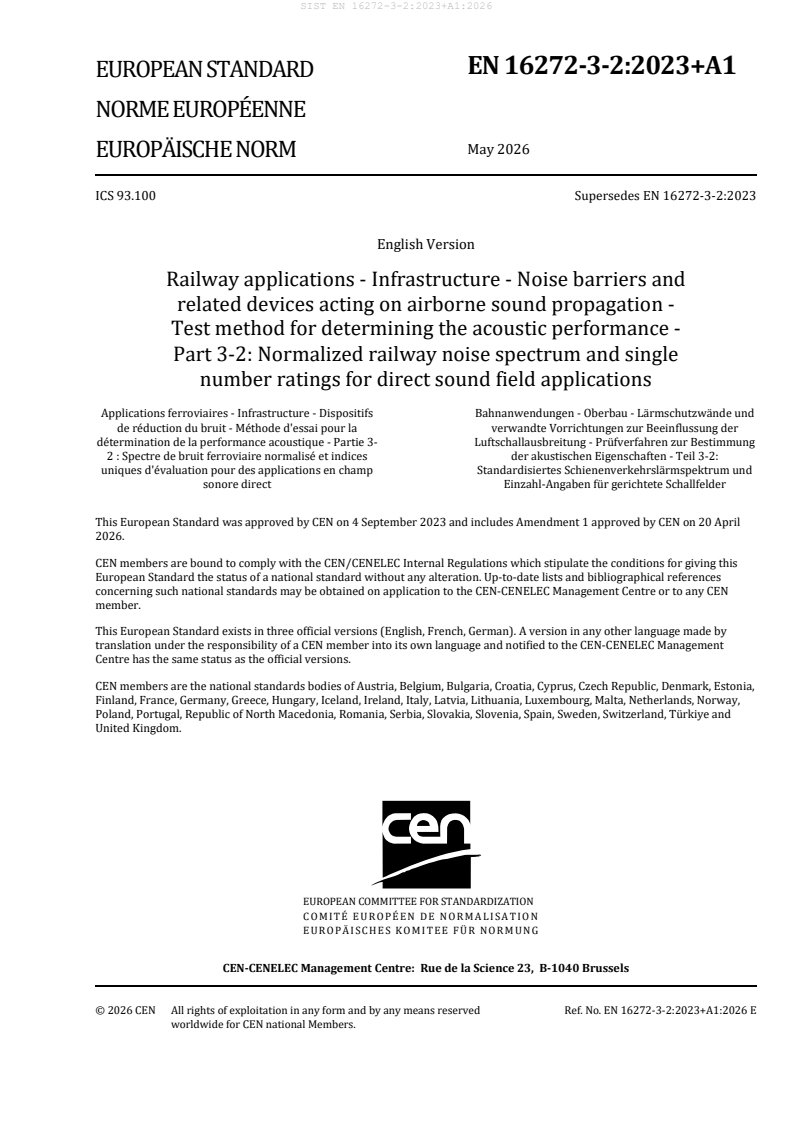
EN 16272-3-2:2023+A1:2026
(Main + Amendment)Railway applications - Infrastructure - Noise barriers and related devices acting on airborne sound propagation - Test method for determining the acoustic performance - Part 3-2: Normalized railway noise spectrum and single number ratings for direct sound field applications
- Abstract
This document specifies a normalized railway noise spectrum for the evaluation and assessment of the acoustic performance of devices designed to reduce airborne railway noise near railways.
All noise reducing devices different from noise barriers and related devices acting on airborne sound propagation, e.g. devices for attenuation of ground borne vibration and on board devices are outside of the scope of this document.
- Status
- Published
- Publication Date
- 27-Jul-2026
- Technical Committee
- CEN/TC 256 - Railway applications
- Drafting Committee
- CEN/TC 256/SC 1/WG 40 - Noise barriers
- Current Stage
- 6060 - Definitive text made available (DAV) - Publishing
- Start Date
- 20-May-2026
- Due Date
- 28-Jul-2026
- Completion Date
- 28-Jul-2026

EN 16272-3-2:2023+A1:2026 is a CEN European Standard for railway applications. It specifies a normalized railway noise spectrum and the single-number ratings used to assess sound reflection, airborne sound insulation and diffraction index difference for noise barriers and related devices acting on airborne sound propagation in direct sound field applications near railways.
Engineers, test laboratories, manufacturers and infrastructure buyers use EN 16272-3-2:2023+A1:2026 to turn frequency-dependent acoustic measurements into comparable one-number results. The document is meant to be read with the linked measurement parts of the EN 16272 series.
What does EN 16272-3-2:2023+A1:2026 specify?
EN 16272-3-2:2023+A1:2026 specifies the normalized railway noise spectrum used to evaluate the acoustic performance of devices that reduce airborne railway noise near railways. It applies to noise barriers and related devices acting on airborne sound propagation in direct sound field conditions.
The scope excludes other noise-reducing devices such as products for ground-borne vibration attenuation and on-board devices. In practice, that means the document is for barrier-type and related trackside products, not for rolling stock equipment or vibration control systems.
The document is organized into:
- Clause 1 Scope
- Clause 2 Normative references
- Clause 3 Terms, definitions, symbols and abbreviated terms
- Clause 4 Normalized railway noise spectrum for direct sound field applications
- Clause 5 Single-number rating of sound reflection index DL
- Clause 6 Single-number rating of sound insulation index DL
- Clause 7 Single-number ratings of diffraction index difference DL
- Clause 8 Uncertainty of single-number ratings
- Clause 9 Expression of results
- Annexes A to D, all informative
| Annex | What it covers |
|---|---|
| Annex A | Guidance on using the single-number rating of sound reflection index DL |
| Annex B | Guidance on using the single-number rating of sound insulation index DL |
| Annex C | Guidance on using the single-number rating of diffraction index difference DL |
| Annex D | Measurement uncertainty of the single-number ratings |
What are the key requirements of EN 16272-3-2:2023+A1:2026?
EN 16272-3-2:2023+A1:2026 sets one reference railway noise spectrum and then uses it to weight frequency-band measurement results into single-number ratings. That is the core idea: take band-by-band acoustic data from the related test parts, apply the same railway spectrum, and report a single result that can be compared between products.
Reference spectrum
Clause 4 requires use of the normalized railway noise spectrum in Table 2 for direct sound field applications near railways. The spectrum covers one-third octave bands from 100 Hz to 5 kHz.
In practice, this spectrum is the reference weighting for every rating in the document. It makes different products comparable under the same assumed railway-noise conditions.
Sound reflection rating
Clause 5 defines the single-number rating of sound reflection index DL from the frequency-dependent reflection index values measured according to EN 16272-5. The rating is calculated by weighting each band with the normalized railway noise spectrum.
For qualification work, the rating is calculated for samples of minimum dimensions conforming to EN 16272-5. For other uses, the document says the result shall be reported with the frequency range used for the calculation. The rating is rounded to one decimal digit, and the calculation limits the ratio in the formula to 0.99 when needed.
Sound insulation ratings
Clause 6 defines single-number ratings for sound insulation index in three forms: one for acoustic elements, one for posts, and one global rating. The frequency-band values come from EN 16272-6 and are weighted with the same normalized railway noise spectrum.
For acoustic elements and posts, the document requires minimum sample dimensions conforming to EN 16272-6. If a post rating cannot be derived, the global rating is equal to the acoustic-element rating. The reported values are rounded to one decimal digit and should be accompanied by the relevant frequency range when used outside qualification.
Diffraction index difference ratings
Clause 7 covers added devices mounted on a reflective reference wall, an absorptive reference wall, or an in situ test construction. The frequency-band diffraction index difference values are weighted with the normalized railway noise spectrum to produce single-number ratings.
For these ratings, the samples must conform to the minimum dimensions of EN 16272-4:2016. The document also requires reporting to one decimal digit and gives separate formulas for the three mounting conditions.
Uncertainty and reporting
Clause 8 allows reproducibility data to be used as an estimate of combined standard uncertainty when no analytical uncertainty budget is available. Clause 9 then ties the rating to the relevant test report from EN 16272-4, EN 16272-5 or EN 16272-6.
In practice, this means the final report should not just give a number. For reflection and insulation ratings, it should also state the expanded uncertainty. For diffraction index difference ratings, the document requires the rounded single-number result in the test report.
What terms does EN 16272-3-2:2023+A1:2026 define?
EN 16272-3-2:2023+A1:2026 defines a small set of terms and symbols that drive the calculations.
- normalized railway noise spectrum - the reference spectrum used to calculate acoustic performance near railways in terms of single-number ratings.
- one-third octave bands level - the relative A-weighted sound pressure level used for one band of the normalized railway noise spectrum.
- RI - the sound reflection index in a one-third octave band, which feeds the reflection rating.
- SI - the sound insulation index in a one-third octave band, which feeds the insulation ratings.
- ΔDI,refl - the diffraction index difference for an added device mounted on a reflective reference wall.
- ΔDI,abs - the diffraction index difference for an added device mounted on an absorptive reference wall.
- ΔDI,situ - the diffraction index difference for an added device mounted on an in situ test construction.
- m - the lowest reliable one-third octave frequency band used in a calculation.
Who uses EN 16272-3-2:2023+A1:2026?
EN 16272-3-2:2023+A1:2026 is used by people who test, specify, compare or buy railway noise barriers and related devices. Typical users include acoustic test laboratories, manufacturers, consultants, railway infrastructure managers, quality teams and procurement teams.
They use it to convert banded acoustic measurements into single-number ratings, compare products on the same railway-noise basis, and state results in test reports with the required frequency range and uncertainty information.
What changed in EN 16272-3-2:2023+A1:2026 from the previous edition?
EN 16272-3-2:2023+A1:2026 supersedes EN 16272-3-2:2023 and includes Amendment 1 approved by CEN on 20 April 2026. The foreword lists these main changes:
- the terms, definitions, symbols and abbreviations clause was updated
- an annex on reproducibility and repeatability values was added so measurement uncertainty and the related confidence level can be declared
- the bibliography chapter was added
- Formula (4) for DL was changed
- all single-number ratings are reported after rounding to the first decimal digit
Which standards are used with EN 16272-3-2:2023+A1:2026?
EN 16272-3-2:2023+A1:2026 depends on three normative references:
- EN 16272-4:2016 - provides the measurement basis for diffraction index difference
- EN 16272-5 - provides the sound reflection index measurement and the direct sound field basis used for DL
- EN 16272-6 - provides the airborne sound insulation measurement and the direct sound field basis used for DL
The foreword also places the document in the EN 16272 series, alongside parts 1, 2, 3-1, 4, 5, 6 and CEN/TS 16272-7. Together, those parts cover diffuse sound field, direct sound field, intrinsic characteristics and in situ insertion loss for noise barriers and related devices.
What does the EN 16272-3-2:2023+A1:2026 document contain?
The document contains the normalized railway noise spectrum used in the calculations, the symbol and abbreviation table, the equations for DL and the diffraction index difference ratings, and the rules for reporting the results. It also contains guidance annexes that explain how to use the reflection, insulation and diffraction ratings in practice.
Annex D discusses measurement uncertainty and how reproducibility data can be used when a full uncertainty budget is not available. The bibliography includes an interlaboratory study on repeatability and reproducibility and ISO/IEC Guide 98-3 for uncertainty of measurement.
Relations
- Effective Date
- 25-Mar-2026
- Effective Date
- 25-Mar-2026
- Effective Date
- 25-Mar-2026
- Effective Date
- 25-Mar-2026
- Effective Date
- 25-Mar-2026
Get Certified
Connect with accredited certification bodies for this standard

Zavod za gradbeništvo Slovenije (ZAG) - Inšpekcija
ZAG inspection body for construction products, structures, and materials.
Sponsored listings
Frequently Asked Questions
EN 16272-3-2:2023+A1:2026 is a standard published by the European Committee for Standardization (CEN). Its full title is "Railway applications - Infrastructure - Noise barriers and related devices acting on airborne sound propagation - Test method for determining the acoustic performance - Part 3-2: Normalized railway noise spectrum and single number ratings for direct sound field applications". This standard covers: This document specifies a normalized railway noise spectrum for the evaluation and assessment of the acoustic performance of devices designed to reduce airborne railway noise near railways. All noise reducing devices different from noise barriers and related devices acting on airborne sound propagation, e.g. devices for attenuation of ground borne vibration and on board devices are outside of the scope of this document.
This document specifies a normalized railway noise spectrum for the evaluation and assessment of the acoustic performance of devices designed to reduce airborne railway noise near railways. All noise reducing devices different from noise barriers and related devices acting on airborne sound propagation, e.g. devices for attenuation of ground borne vibration and on board devices are outside of the scope of this document.
EN 16272-3-2:2023+A1:2026 is classified under the following ICS (International Classification for Standards) categories: 93.100 - Construction of railways. The ICS classification helps identify the subject area and facilitates finding related standards.
EN 16272-3-2:2023+A1:2026 has the following relationships with other standards: It is inter standard links to EN 16272-3-2:2023, EN 16272-5:2023, EN 16272-6:2014, EN 16272-6:2023, EN 16272-4:2016. Understanding these relationships helps ensure you are using the most current and applicable version of the standard.
EN 16272-3-2:2023+A1:2026 is available in PDF format for immediate download after purchase. The document can be added to your cart and obtained through the secure checkout process. Digital delivery ensures instant access to the complete standard document.
Standards Content (Sample)
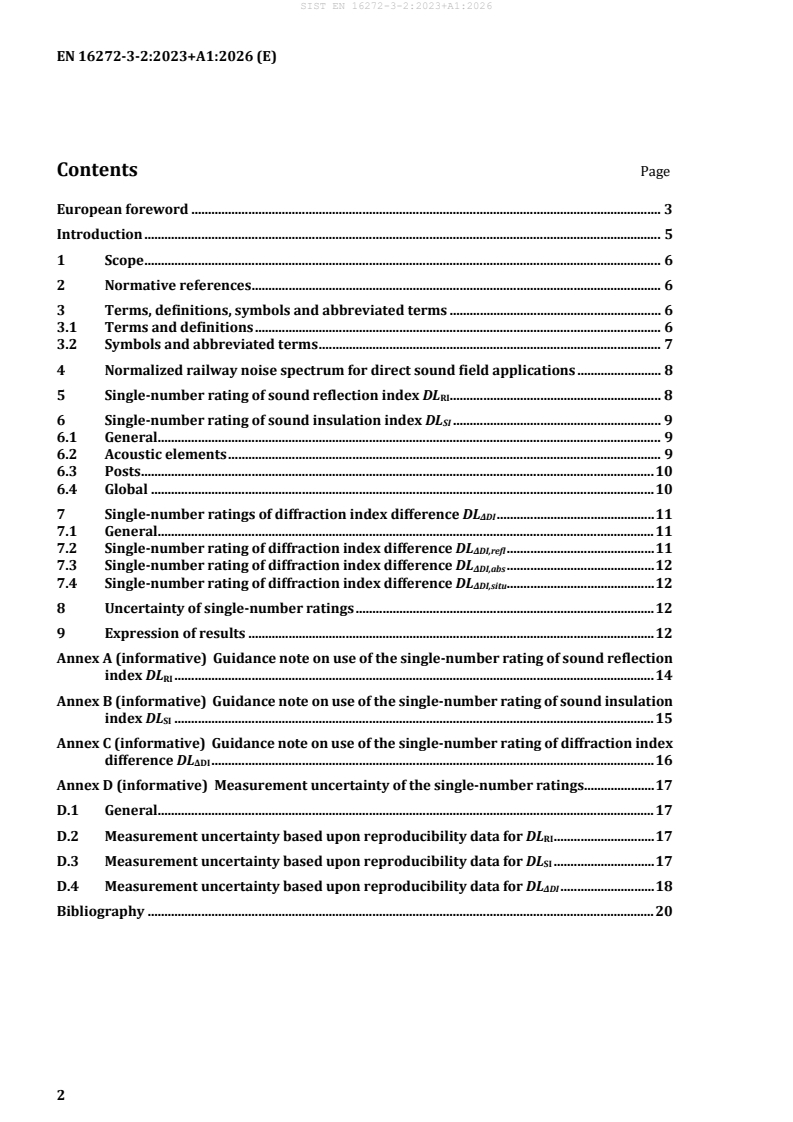
Contents
- Introduction
- 1 Scope
- 2 Normative references
- 3 Terms, definitions, symbols and abbreviated terms
- 3.1 Terms and definitions
- 3.1.1 normalized railway noise spectrum
- 3.1.2 one-third octave bands level
- 3.2 Symbols and abbreviated terms
- 4 Normalized railway noise spectrum for direct sound field applications
- 5 Single-number rating of sound reflection index DL
- 6 Single-number rating of sound insulation index DL
- 6.1 General
- 6.2 Acoustic elements
- 6.3 Posts
- 6.4 Global
- 7 Single-number ratings of diffraction index difference DL
- 7.1 General
- 7.2 Single-number rating of diffraction index difference DLΔDI,refl
- 7.3 Single-number rating of diffraction index difference DLΔDI,abs
- 7.4 Single-number rating of diffraction index difference DL
- 8 Uncertainty of single-number ratings
- 9 Expression of results
- Annex A
- Annex B
- Annex C
- Annex D
- Bibliography
Introduction
1 2 This document is to be read in conjunction with EN 16272-5 and EN 16272-6 and is applied only to situations as described in those documents (direct sound field conditions). As the two main intrinsic acoustic characteristics of noise barriers and related devices acting on airborne sound propagation in a direct sound field, the sound reflection index and the sound insulation index, are frequency dependent, there is a need to define a reference railway noise spectrum for test purposes. Also, the diffraction index difference, the main intrinsic acoustic characteristic of added devices, i.e. products to be added on the top of noise barriers and intended to contribute to sound attenuation acting primarily on the diffracted sound field, is frequency dependent and there is an analogous need to define a reference railway noise spectrum for test purposes.
This document defines the basic properties of railway noise measured at the rail track side in terms of a characteristic normalized railway noise spectrum, which is needed to evaluate single-number ratings of noise barriers and related devices acting on airborne sound propagation, except those used in reverberant conditions, e.g. inside tunnels or deep trenches.
Under preparation. Stage at the time of publication: FprEN 16272-5:2023.
Under preparation. Stage at the time of publication: FprEN 16272-6:2023.
SIST EN 16272-3-2:2023+A1:2026 EN 16272-3-2:2023+A1:2026 (E)
1 Scope
This document specifies a normalized railway noise spectrum for the evaluation and assessment of the acoustic performance of devices designed to reduce airborne railway noise near railways. All noise reducing devices different from noise barriers and related devices acting on airborne sound propagation, e.g. devices for attenuation of ground borne vibration and on board devices are outside of the scope of this document.
2 Normative references
The following documents are referred to in the text in such a way that some or all of their content constitutes requirements of this document. For dated references, only the edition cited applies. For undated references, the latest edition of the referenced document (including any amendments) applies. EN 16272-4:2016, Railway applications - Track - Noise barriers and related devices acting on airborne sound propagation - Test method for determining the acoustic performance - Part 4: Intrinsic characteristics - In situ values of sound diffraction under direct sound field
EN 16272-5 , Railway applications - Infrastructure - Noise barriers and related devices acting on airborne sound propagation - Test method for determining the acoustic performance - Part 5: Intrinsic characteristics - Sound absorption under direct sound field conditions
EN 16272-6 , Railway applications - Infrastructure - Noise barriers and related devices acting on airborne sound propagation - Test method for determining the acoustic performance - Part 6: Intrinsic characteristics - In situ values of airborne sound insulation under direct sound field conditions
3 Terms, definitions, symbols and abbreviated terms
3.1 Terms and definitions
For the purposes of this document, the following terms and definitions apply. ISO and IEC maintain terminology databases for use in standardization at the following addresses:
- IEC Electropedia: available at https://www.electropedia.org/ - ISO Online browsing platform: available at https://www.iso.org/obp NOTE For the purpose of this document, the following definitions take precedence over other definitions from the above websites.
3.1.1 normalized railway noise spectrum
spectrum that is used for the calculation of the acoustic performance of noise barriers and related devices acting on airborne sound propagation near railways, in terms of !single-number ratings of sound absorption, airborne sound insulation and diffraction index difference" Note 1 to entry: The spectrum is expressed in terms of relative A-weighted sound pressure levels in decibels, for one-third octave bands, Li, in the frequency range from 100 Hz to 5 kHz.
3.1.2 one-third octave bands level
L
relative A-weighted sound pressure level in decibels, of a normalized railway noise spectrum for onethird octave band with centre frequency f
SIST EN 16272-3-2:2023+A1:2026 EN 16272-3-2:2023+A1:2026 (E)
3.2 Symbols and abbreviated terms
For the purposes of this document, the following symbols apply. Table 1 — Symbols and abbreviations Symbol or Designation Unit abbreviation DL Single-number rating of sound reflection index in a direct sound field dB RI expressed as a difference of A weighted sound pressure levels DL Single-number rating of sound insulation index in a direct sound field dB SI expressed as a difference of A-weighted sound pressure levels DL Single-number rating of diffraction index difference of an added device dB ΔDI,refl mounted on a reflective reference wall in a direct sound field expressed as a difference of A-weighted sound pressure levels DL Single-number rating of diffraction index difference of an added device dB ΔDI,abs mounted on an absorptive reference wall in a direct sound field expressed as a difference of A-weighted sound pressure levels DL Single-number rating of diffraction index difference of an added device dB ΔDI,situ mounted on an in situ test construction in a direct sound field expressed as a difference of A-weighted sound pressure levels f Nominal centre frequency of the i-th one-third octave band Hz
i Index of the i-th one-third octave frequency band, between 100 Hz and - 5 kHz L Relative A-weighted sound pressure level, in decibels, of the normalized dB
traffic noise spectrum in the i-th one-third octave band L !Total length of an acoustic element before installation" m E m number of the lowest reliable one-third octave frequency band according
1 2 to EN 16272-5 (for RI) or EN 16272-6 (for SI) RI Sound reflection index in the i-th one-third octave band -
SI Sound insulation index in the i-th one-third octave band dB
Standard deviation of reproducibility of the single-number rating for - s R,DL SI,E “elements” Standard deviation of reproducibility of the single-number rating for - s R,DL SI,P “posts” Standard deviation of reproducibility of the single-number rating for -
s R,DL SI,G “global” w Weight for the single-number rating for acoustic elements - E w Weight for the single-number rating across posts - P ΔDI Sound diffraction index difference of an added device mounted on a dB refl reflective reference wall ΔDIabs Sound diffraction index difference of an added device mounted on an dB absorptive reference wall ΔDI Sound diffraction index difference of an added device mounted on an in dB situ situ test construction
SIST EN 16272-3-2:2023+A1:2026 EN 16272-3-2:2023+A1:2026 (E)
4 Normalized railway noise spectrum for direct sound field applications
The normalized railway noise spectrum shown in Table 2 shall be used to assess the acoustic performance of noise barriers and related devices acting on airborne sound propagation for direct sound field applications near railways.
Table 2 — Normalized traffic noise spectrum for direct sound field applications f L railways i i Hz dB 100 −27 125 −25 160 −23 200 −21 250 −19 315 −17 400 −15 500 −13 630 −12 800 −11 1000 −10 1250 −9 1600 −9 2000 −9 2500 −9 3150 −10 4000 −13 5000 −17
5 Single-number rating of sound reflection index DL
RI A single-number rating shall be derived from frequency dependent data to indicate the performance of the product.
The individual sound reflection index values obtained according to EN 16272-5 shall be weighted according to the normalized railway noise spectrum defined in Table 2. The single-number rating of sound reflection index DL , in decibels, is given by:
RI
01, L
RI ⋅ 10
∑ i im= DL =−⋅10 lg (1) RI
01, L
im=
SIST EN 16272-3-2:2023+A1:2026 EN 16272-3-2:2023+A1:2026 (E)
where:
m is the number of the lowest reliable one-third octave frequency band according to
EN 16272-5 ; m ≥ 3; RI is the sound reflection index in the i-th one-third octave band, measured according to
EN 16272-5 ; L is the normalized A-weighted sound pressure level, in decibels, of railway noise in the i-
th one-third octave band as defined in Table 2.
For qualification purposes, the single-number rating of sound absorption under a direct sound field DL RI
shall be calculated for samples of minimum dimensions conforming to EN 16272-5 . For other purposes, single number ratings shall be informative and explicitly reported with the frequency range, in one-third octave bands, over which they are calculated. For example, for a noise barrier of 3,5 m height the single number rating of sound absorption under a direct sound field is DL , RI(250 - 5 000 Hz) because 250 Hz is the lowest reliable frequency.
...