

EN 15594:2026
(Main)Railway applications - Infrastructure - Restoration of rails by electric arc welding
- Abstract
This document specifies restoration by electric arc welding and is limited to the head of the rails only.
This document describes the approval systems for consumables and procedures used in manual metal arc and flux cored metal deposit rail repair welding. This document includes the quality-related tasks and responsibilities of personnel involved in the electric arc repair welding of rails. This document applies to plain rail and switches and crossings manufactured from new Vignole railway rails R200, R220, R260, R260Mn, and R350HT grades rails of 27 kg/m and above as contained in EN 13674-1, EN 13674-2 and EN 13674-4.
The permitted welding processes are limited to Electric Arc (EA) in accordance with EN ISO 4063 and are by description Process No 111: SMAW (Shielded Metal Arc Welding) and Process No 114: FCAW (Flux Cored Arc Welding).
This document can be applied in situ, at line side or at out of track locations. The flash welded leg ends of austenitic manganese steel crossings are included in this document, except when located within 500 mm of manganese crossings. Where repairs are required within 500 mm, refer to EN 16725.
- Status
- Not Published
- Publication Date
- 20-Oct-2026
- Technical Committee
- CEN/TC 256 - Railway applications
- Drafting Committee
- CEN/TC 256/SC 1/WG 4 - Rails
- Current Stage
- 6055 - CEN Ratification completed (DOR) - Publishing
- Start Date
- 03-Aug-2026
- Due Date
- 16-Aug-2024
- Completion Date
- 03-Aug-2026

EN 15594:2026 is a CEN standard for railway applications covering restoration of rail heads by electric arc welding. It specifies how consumables, welding procedures, contractors, welders, and track trials are approved for repair welding on listed Vignole rail grades. In practice, it tells railway authorities and contractors what must be checked before a rail repair weld is accepted for service.
What does EN 15594:2026 specify?
EN 15594:2026 applies to restoration by electric arc welding of the rail head only. It covers approval systems for consumables and procedures used in manual metal arc welding and flux cored arc welding, and it can be used in situ, at line side, or off track. The scope also includes the flash welded leg ends of austenitic manganese steel crossings, except where repairs are within 500 mm of manganese crossings, where EN 16725 applies.
The document is organized into clauses on scope, normative references, terms, consumable and WPS approval, contractor approval, personnel and qualification requirements, and repair applications.
| Annex | What it covers |
|---|---|
| Annex A | Supplementary information for track trials |
| Annex B | Example Welding Procedure Specification (WPS) |
| Annex C | Example diploma in electric arc restoration welding of rails |
| Annex D | Permit to restore rail by electric arc welding |
| Annex E | Track component names |
| Annex ZA | Relationship with EU Directive (EU) 2016/797 |
What are the key requirements of EN 15594:2026?
EN 15594:2026 is built around four controls: approval of consumables and WPS, approval of contractors, qualification of people, and limits on the repairs that may be carried out. The practical point is that a repair weld is only acceptable when the process, the materials, the people, and the site conditions are all under RA control.
Consumable and WPS approval
Clause 4 requires consumable and WPS approval to follow EN ISO 15613, using a pre-production test approach. The approving RA issues the approval certificate after a successful track trial, and it may require extra tests for special operating conditions. That means the consumable and the procedure are not just selected from a catalogue - they must be proven on rail.
Clause 4 also requires laboratory and track trial checks on single bead, single layer, and multi-layer deposits. These checks cover bead shape, spatter, cratering, porosity, cracks, hardness, weld integrity, and welding parameters, with MT or PT inspection and, for some samples, macro and micro examination. In practice, the standard is checking whether a consumable can make sound rail deposits before it is used in service.
Acceptance of weld deposits
EN 15594:2026 sets acceptance criteria by rail grade and deposit type. Table 1 gives separate hardness limits for R200, R220, R260, R260Mn, and R350HT, and multi-layer deposits also have a sub-surface hardness limit. Table 2 rejects cracks, lack of fusion, shrinkage, linear porosity, elongated cavities or wormholes, and un-tempered martensite at the specified magnification.
This matters because rail welding failures are service-critical and cyclic loading is severe. If the deposit does not meet the hardness and defect limits, it is not suitable for track use.
Track trials
Clause 4.7 and Annex A require track trials under RA requirements, using the approved WPS. The trials check surface cracking, flatness over 1 m, rail head profile compliance with EN 13674-1 or EN 13674-4, and weld integrity, with visual, MT or PT, straightedge or electronic straightedge, and UT methods as specified. Trials run for 12 months with inspections after 1 day, 1 month, 6 months, and 12 months.
For a user, this means the process must work not only in the workshop but also in real track conditions. The approving RA records the site, welds, conditions, and inspection results before deciding whether the consumable and WPS are accepted.
Contractor control and site practice
Clause 5 requires a quality management system in accordance with EN ISO 3834-2. It also requires compatible equipment, approved subcontracting arrangements, controlled storage and handling of consumables, protection of the infrastructure, traceability for each weld, audits, training, and documentation. Clause 4.1 also requires welding fumes to be removed by local exhaust ventilation, or, if that is not possible, approved respiratory protective equipment.
In practice, the contractor must be able to show who did the work, with what equipment, under which WPS, and with what records. That is what supports traceability when a weld later has to be investigated.
Personnel, diploma, and permit
Clause 6 requires training and qualification in a training establishment approved by the RA, and welder approval follows EN ISO 9606-1. A welder first receives a Diploma in Electric Arc Welding of Rails, then applies for a Permit to restore rails by electric arc welding; the permit can have a maximum validity of 4 years. The RA controls issue, renewal, withdrawal, and the approved processes, line categories, and components.
Repair applications
Clause 7 applies the standard to repair welding for wheel burns, squats, headwear, sidewear, welding-zone defects, and rail damage, on plain rail and switch and crossing components. The RA defines the permitted repair types, excavation limits, repair dimensions, and special conditions. That means the standard gives the method, while the railway authority sets the local repair policy.
What terms does EN 15594:2026 define?
- RA - the railway authority, meaning the regulator, the infrastructure owner, or a custodian with delegated responsibility.
- Contractor - a company approved by the RA to carry out rail restoration by electric arc welding.
- SMAW - shielded metal arc welding, one of the permitted Electric Arc processes.
- FCAW - flux cored arc welding, the other permitted Electric Arc process.
- Pwps - a preliminary welding procedure specification, used for trial welding before approval.
- WPS - a welding procedure specification approved to European standards and agreed by the RA.
- Training establishment - an RA-approved training organization or centre for welders.
Who uses EN 15594:2026?
Railway authorities use EN 15594:2026 to approve processes, set repair limits, and issue or withdraw permits. Contractors and welding supervisors use it to prepare WPSs, organize work, control consumables, and keep weld traceability. Welders, training establishments, inspection bodies, and quality managers use it for qualification, testing, records, and acceptance of repair welds in track.
What changed in EN 15594:2026 from the previous edition?
EN 15594:2026 supersedes EN 15594:2009. The stated technical changes are updated normative references, inclusion of additional rail steel grades, updated microstructure and macrostructure requirements, and the addition of Annex ZA.
Which standards are used with EN 15594:2026?
| Standard | What it contributes |
|---|---|
| EN 13674-1 | Rail grades and profile requirements for 46 kg/m and above |
| EN 13674-2 | Switch and crossing rails used with Vignole railway rails |
| EN 13674-4 | Rail grades from 27 kg/m to below 46 kg/m |
| EN ISO 4063 | Process numbering for Electric Arc welding, including 111 and 114 |
| EN ISO 15613 | Procedure approval by pre-production welding test |
| EN ISO 15607 / EN ISO 15609-1 | General rules and WPS content for welding procedures |
| EN ISO 3834-2 | Quality management requirements for fusion welding |
| EN ISO 9606-1 | Welder qualification testing for steels |
| EN ISO 17638 / EN ISO 3452-1 | Magnetic particle testing and penetrant testing |
| EN ISO 6506-1 / EN ISO 6507-1 | Brinell and Vickers hardness testing |
| EN ISO 544 | Delivery, marking, and handling of filler materials and fluxes |
| EN ISO 3580 / EN 14700 / EN ISO 18276 | Consumable classification references |
| EN 16725 | Restoration and repair of manganese crossings near the 500 mm limit |
What does the EN 15594:2026 document contain?
EN 15594:2026 contains laboratory test methods for single bead, single layer, and multi-layer rail deposits, including sample geometry, excavation dimensions, preheat positions, MT or PT examination, hardness testing, and macro/micro preparation. It also contains track trial methods, inspection timing, and reporting requirements for approving RA decisions.
The document includes Figure 1 to Figure 4 for sample size, excavation, sectioning, and hardness locations. Table 1 and Table 2 set hardness and defect acceptance criteria. Annex B gives a WPS template, Annex C gives a diploma specimen, and Annex D gives a permit specimen for rail welding control.
Relations
- Effective Date
- 28-Jan-2026
- Effective Date
- 22-Jul-2020
Get Certified
Connect with accredited certification bodies for this standard

DVS-ZERT GmbH
German welding certification society.
CARES (UK Certification Authority for Reinforcing Steels)
UK certification for reinforcing steels and construction.
EWF/IIW (European/International Welding Federation)
International welding personnel certification.
Sponsored listings
Frequently Asked Questions
EN 15594:2026 is a draft published by the European Committee for Standardization (CEN). Its full title is "Railway applications - Infrastructure - Restoration of rails by electric arc welding". This standard covers: This document specifies restoration by electric arc welding and is limited to the head of the rails only. This document describes the approval systems for consumables and procedures used in manual metal arc and flux cored metal deposit rail repair welding. This document includes the quality-related tasks and responsibilities of personnel involved in the electric arc repair welding of rails. This document applies to plain rail and switches and crossings manufactured from new Vignole railway rails R200, R220, R260, R260Mn, and R350HT grades rails of 27 kg/m and above as contained in EN 13674-1, EN 13674-2 and EN 13674-4. The permitted welding processes are limited to Electric Arc (EA) in accordance with EN ISO 4063 and are by description Process No 111: SMAW (Shielded Metal Arc Welding) and Process No 114: FCAW (Flux Cored Arc Welding). This document can be applied in situ, at line side or at out of track locations. The flash welded leg ends of austenitic manganese steel crossings are included in this document, except when located within 500 mm of manganese crossings. Where repairs are required within 500 mm, refer to EN 16725.
This document specifies restoration by electric arc welding and is limited to the head of the rails only. This document describes the approval systems for consumables and procedures used in manual metal arc and flux cored metal deposit rail repair welding. This document includes the quality-related tasks and responsibilities of personnel involved in the electric arc repair welding of rails. This document applies to plain rail and switches and crossings manufactured from new Vignole railway rails R200, R220, R260, R260Mn, and R350HT grades rails of 27 kg/m and above as contained in EN 13674-1, EN 13674-2 and EN 13674-4. The permitted welding processes are limited to Electric Arc (EA) in accordance with EN ISO 4063 and are by description Process No 111: SMAW (Shielded Metal Arc Welding) and Process No 114: FCAW (Flux Cored Arc Welding). This document can be applied in situ, at line side or at out of track locations. The flash welded leg ends of austenitic manganese steel crossings are included in this document, except when located within 500 mm of manganese crossings. Where repairs are required within 500 mm, refer to EN 16725.
EN 15594:2026 is classified under the following ICS (International Classification for Standards) categories: 25.160.10 - Welding processes; 93.100 - Construction of railways. The ICS classification helps identify the subject area and facilitates finding related standards.
EN 15594:2026 has the following relationships with other standards: It is inter standard links to EN ISO/IEC 30111:2020, EN 15594:2009. Understanding these relationships helps ensure you are using the most current and applicable version of the standard.
EN 15594:2026 is associated with the following European legislation: EU Directives/Regulations: 2016/797/EU, 2016/797/EU, 2016/797/EU, 2016/797/EU, 2016/797/EU, 2016/797/EU, 2016/797/EU, 2016/797/EU, 2016/797/EU, 2016/797/EU, 2016/797/EU, 2016/797/EU, 2016/797/EU; Standardization Mandates: M/483, M/591. When a standard is cited in the Official Journal of the European Union, products manufactured in conformity with it benefit from a presumption of conformity with the essential requirements of the corresponding EU directive or regulation.
EN 15594:2026 is available in PDF format for immediate download after purchase. The document can be added to your cart and obtained through the secure checkout process. Digital delivery ensures instant access to the complete standard document.
Standards Content (Sample)
SLOVENSKI STANDARD
oSIST prEN 15594:2025
01-april-2025
Železniške naprave - Infrastruktura - Obnova tirnic z električnim obločnim
varjenjem
Railway applications - Infrastructure - Restoration of rails by electric arc welding
Bahnanwendungen - Infrastruktur - Aufarbeitung von Schienen durch elektrisches
Lichtbogenschweißen
Applications ferroviaires - Infrastructure - Réparation des rails par soudage à l’arc
électrique
Ta slovenski standard je istoveten z: prEN 15594
ICS:
25.160.10 Varilni postopki in varjenje Welding processes
93.100 Gradnja železnic Construction of railways
oSIST prEN 15594:2025 en,fr,de
2003-01.Slovenski inštitut za standardizacijo. Razmnoževanje celote ali delov tega standarda ni dovoljeno.
oSIST prEN 15594:2025
oSIST prEN 15594:2025
DRAFT
EUROPEAN STANDARD
prEN 15594
NORME EUROPÉENNE
EUROPÄISCHE NORM
February 2025
ICS 25.160.10; 93.100 Will supersede EN 15594:2009
English Version
Railway applications - Infrastructure - Restoration of rails
by electric arc welding
Applications ferroviaires - Infrastructure - Réparation Bahnanwendungen - Infrastruktur - Aufarbeitung von
des rails par soudage à l'arc électrique Schienen durch elektrisches Lichtbogenschweißen
This draft European Standard is submitted to CEN members for enquiry. It has been drawn up by the Technical Committee
CEN/TC 256.
If this draft becomes a European Standard, CEN members are bound to comply with the CEN/CENELEC Internal Regulations
which stipulate the conditions for giving this European Standard the status of a national standard without any alteration.
This draft European Standard was established by CEN in three official versions (English, French, German). A version in any other
language made by translation under the responsibility of a CEN member into its own language and notified to the CEN-CENELEC
Management Centre has the same status as the official versions.
CEN members are the national standards bodies of Austria, Belgium, Bulgaria, Croatia, Cyprus, Czech Republic, Denmark, Estonia,
Finland, France, Germany, Greece, Hungary, Iceland, Ireland, Italy, Latvia, Lithuania, Luxembourg, Malta, Netherlands, Norway,
Poland, Portugal, Republic of North Macedonia, Romania, Serbia, Slovakia, Slovenia, Spain, Sweden, Switzerland, Türkiye and
United Kingdom.
Recipients of this draft are invited to submit, with their comments, notification of any relevant patent rights of which they are
aware and to provide supporting documentation.
Warning : This document is not a European Standard. It is distributed for review and comments. It is subject to change without
notice and shall not be referred to as a European Standard.
EUROPEAN COMMITTEE FOR STANDARDIZATION
COMITÉ EUROPÉEN DE NORMALISATION
EUROPÄISCHES KOMITEE FÜR NORMUNG
CEN-CENELEC Management Centre: Rue de la Science 23, B-1040 Brussels
© 2025 CEN All rights of exploitation in any form and by any means reserved Ref. No. prEN 15594:2025 E
worldwide for CEN national Members.
oSIST prEN 15594:2025
prEN 15594:2025 (E)
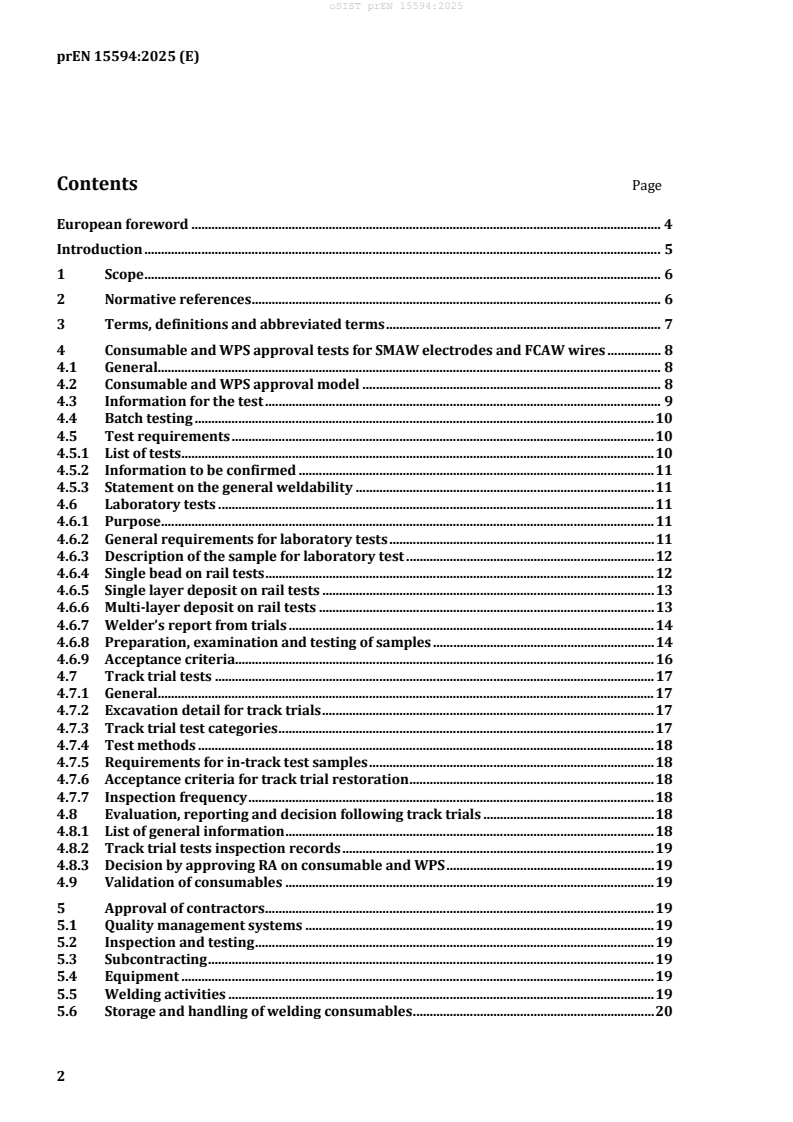
Contents Page
European foreword . 4
Introduction . 5
1 Scope . 6
2 Normative references . 6
3 Terms, definitions and abbreviated terms . 7
4 Consumable and WPS approval tests for SMAW electrodes and FCAW wires . 8
4.1 General. 8
4.2 Consumable and WPS approval model . 8
4.3 Information for the test . 9
4.4 Batch testing . 10
4.5 Test requirements . 10
4.5.1 List of tests . 10
4.5.2 Information to be confirmed . 11
4.5.3 Statement on the general weldability . 11
4.6 Laboratory tests . 11
4.6.1 Purpose . 11
4.6.2 General requirements for laboratory tests . 11
4.6.3 Description of the sample for laboratory test . 12
4.6.4 Single bead on rail tests . 12
4.6.5 Single layer deposit on rail tests . 13
4.6.6 Multi-layer deposit on rail tests . 13
4.6.7 Welder’s report from trials . 14
4.6.8 Preparation, examination and testing of samples . 14
4.6.9 Acceptance criteria. 16
4.7 Track trial tests . 17
4.7.1 General. 17
4.7.2 Excavation detail for track trials . 17
4.7.3 Track trial test categories . 17
4.7.4 Test methods . 18
4.7.5 Requirements for in-track test samples . 18
4.7.6 Acceptance criteria for track trial restoration . 18
4.7.7 Inspection frequency . 18
4.8 Evaluation, reporting and decision following track trials . 18
4.8.1 List of general information . 18
4.8.2 Track trial tests inspection records . 19
4.8.3 Decision by approving RA on consumable and WPS . 19
4.9 Validation of consumables . 19
5 Approval of contractors . 19
5.1 Quality management systems . 19
5.2 Inspection and testing . 19
5.3 Subcontracting . 19
5.4 Equipment . 19
5.5 Welding activities . 19
5.6 Storage and handling of welding consumables . 20
oSIST prEN 15594:2025
prEN 15594:2025 (E)
5.7 Care of the infrastructure . 20
5.8 Welding procedure specifications . 20
5.9 Pre-heating of rails . 20
5.10 Welders . 20
5.11 Welder records . 20
5.12 Supervision . 20
5.13 Traceability . 21
5.14 Audits . 21
5.15 Training . 21
5.16 Documentation . 21
6 Personnel and qualification requirements . 21
6.1 Training and qualification requirements . 21
6.2 Diploma in electric arc welding of rails . 22
6.3 Permit to restore rails by electric arc welding . 22
6.3.1 RA requirements for permit application . 22
6.3.2 Mandatory information required . 23
6.3.3 Change or withdrawal of the permit . 23
7 Repair applications . 24
Annex A (normative) Track trials supplementary information . 25
Annex B (informative) Welding Procedure Specification (WPS) . 26
Annex C (informative) Diploma in electric arc restoration welding of rails . 28
Annex D (normative) Permit to restore rail by electric arc welding . 29
Annex E (informative) Track components. 30
Annex ZA (informative) Relationship between this European Standard and the essential
requirements of EU Directive (EU) 2016/797 aimed to be covered . 31
Bibliography . 32
oSIST prEN 15594:2025
prEN 15594:2025 (E)
European foreword
This document (prEN 15594:2025) has been prepared by Technical Committee CEN/TC 256 “Railway
applications”, the secretariat of which is held by DIN.
This document is currently submitted to the CEN Enquiry.
This document will supersede EN 15594:2009.
prEN 15594:2025 includes the following significant technical changes with respect to EN 15594:2009:
— normative references have been updated;
— additional rail steel grades have been included;
— microstructure and macrostructure requirements have been updated;
— an Annex ZA has been included.
The purpose of this document is to unify the restoration of rail electric arc welding across Europe. The
document provides control systems for the approval and qualification of welding processes, welding
procedures, welding consumables, contractors and welders for the successful delivery of welds into track.
This document has been prepared under a standardization request addressed to CEN by the European
Commission. The Standing Committee of the EFTA States subsequently approves these requests for its
Member States.
For the relationship with EU Legislation, see informative Annex ZA, which is an integral part of this
document.
oSIST prEN 15594:2025
prEN 15594:2025 (E)
Introduction
Restoration of rails by electric arc welding is a special process requiring the co-ordination of welding and
grinding activities to establish confidence and reliability of the weld deposit and safety of the line.
Controls must be in place from the design phase through to inspection. Incorrect selection of materials,
consumables or procedure can result in serious track welding failure.
It is important to strictly adhere to the correct application of the approved processes and the types of
repairs permitted to be carried out on various rail components. Only consumables approved by the
method described in this document should be used. The tasks and responsibilities of personnel involved
in restoration, e.g. planning, executing, supervising and inspection should be clearly defined.
oSIST prEN 15594:2025
prEN 15594:2025 (E)
1 Scope
This document specifies restoration by electric arc welding and is limited to the head of the rails only.
This document describes the approval systems for consumables and procedures used in manual metal
arc and flux cored metal deposit rail repair welding. This document includes the quality-related tasks and
responsibilities of personnel involved in the electric arc repair welding of rails. This document applies to
plain rail and switches and crossings manufactured from new Vignole railway rails R200, R220, R260,
R260Mn, and R350HT grades rails of 27 kg/m and above as contained in EN 13674-1, EN 13674-2 and
EN 13674-4.
The permitted welding processes are limited to Electric Arc (EA) in accordance with EN ISO 4063 and are
by description Process No 111: SMAW (Shielded Metal Arc Welding) and Process No 114: FCAW (Flux
Cored Arc Welding).
This document can be applied in situ, at line side or at out of track locations. The flash welded leg ends of
austenitic manganese steel crossings are included in this document, except when located within 500 mm
of manganese crossings. Where repairs are required within 500 mm, refer to EN 16725.
2 Normative references
The following documents are referred to in the text in such a way that some or all of their content
constitutes requirements of this document. For dated references, only the edition cited applies. For
undated references, the latest edition of the referenced document (including any amendments) applies.
EN 13674-1:2011+A1:2017, Railway applications — Track — Rail — Part 1: Vignole railway rails 46 kg/m
and above
EN 13674-4:2019, Railway applications — Track — Rail — Part 4: Vignole railway rails from 27 kg/m to,
but excluding 46 kg/m
EN 14700:2022, Welding consumables — Welding consumables for hard-facing
EN 17343:2023, Railway applications — General terms and definitions
EN ISO 544:2024, Welding consumables — Technical delivery conditions for filler materials and fluxes —
Type of product, dimensions, tolerances and markings (ISO 544:2024)
EN ISO 3452-1:2021, Non-destructive testing — Penetrant testing — Part 1: General principles (ISO 3452-
1:2021)
EN ISO 3580:2017, Welding consumables — Covered electrodes for manual metal arc welding of creep-
resisting steels — Classification (ISO 3580:2017)
EN ISO 3834-2:2021, Quality requirements for fusion welding of metallic materials — Part 2:
Comprehensive quality requirements (ISO 3834-2:2021)
EN ISO 6506-1:2014, Metallic materials — Brinell hardness test — Part 1: Test method (ISO 6506-1:2014)
EN ISO 6507-1:2023, Metallic materials — Vickers hardness test — Part 1: Test method (ISO 6507-1:2023)
EN ISO 9606-1:2017, Qualification testing of welders — Fusion welding — Part 1: Steels (ISO 9606-1:2012
including Cor 1:2012 and Cor 2:2013)
EN ISO 15607:2019, Specification and qualification of welding procedures for metallic materials — General
rules (ISO 15607:2019)
oSIST prEN 15594:2025
prEN 15594:2025 (E)
EN ISO 15609-1:2019, Specification and qualification of welding procedures for metallic materials —
Welding procedure specification — Part 1: Arc welding (ISO 15609-1:2019)
EN ISO 15613:2004, Specification and qualification of welding procedures for metallic materials —
Qualification based on pre-production welding test (ISO 15613:2004)
EN ISO 17638:2016, Non-destructive testing of welds — Magnetic particle testing (ISO 17638:2016)
EN ISO 18276:2024, Welding consumables — Tubular cored electrodes for gas-shielded and non-gas-
shielded metal arc welding of high strength steels — Classification (ISO 18276:2024)
3 Terms, definitions and abbreviated terms
For the purposes of this document, the terms and definitions given in EN 17343:2023 and the following
apply.
ISO and IEC maintain terminology databases for use in standardization at the following addresses:
— ISO Online browsing platform: available at https://www.iso.org/obp
— IEC Electropedia: available at https://www.electropedia.org/
3.1
railway authority
RA
either the railway regulator or the owner of a railway infrastructure or the custodian with a delegated
responsibility for a railway infrastructure
3.2
contractor
company approved by a railway authority to carry out the restoration of rails by electric arc welding on
that infrastructure
3.3
FCAW
flux cored arc welding
3.4
SMAW
shielded metal arc welding
3.5
preliminary welding procedure specification
Pwps
tentative welding procedure specification, which is assumed to be adequate by the manufacturer, but
which has not been approved
Note 1 to entry: Welding of test pieces needed for approval of a welding procedure specification shall be carried
out based on a preliminary welding procedure specification.
3.6
weld procedure specification
WPS
procedure approved to European standards and agreed by the RA for use on the railway infrastructure
oSIST prEN 15594:2025
prEN 15594:2025 (E)
3.7
training establishment
welder training organisation or centre approved by the railway authority or alternatively a welder
training organisation or centre approved by and belonging to a railway authority
4 Consumable and WPS approval tests for SMAW electrodes and FCAW wires
4.1 General
The approval of consumables and the related WPS shall follow the requirements of EN ISO 15613:2004.
Welding fume shall be removed from the welding environment by the means of local exhaust ventilation,
where this is not possible approved respiratory protective equipment shall be used.
4.2 Consumable and WPS approval model
The following flow chart describes how a consumable and its related WPS shall be approved. WPS
approval shall follow the principle of EN ISO 15613:2004 approval by a pre-production test.
oSIST prEN 15594:2025
prEN 15594:2025 (E)
NOTE These track trials are undertaken by the approving RA.
The approving RA shall issue an approval certificate upon successful outcome of track trial.
Other railway authorities may require further tests to verify suitability for special service/operational
conditions or deposition techniques.
4.3 Information for the test
— toxicity threshold levels;
— SMAW electrode classification in accordance with EN ISO 3580:2017;
— wire electrodes classification in accordance with EN 14700:2022;
oSIST prEN 15594:2025
prEN 15594:2025 (E)
— tubular covered electrodes in accordance with EN ISO 18276:2024;
— chemical analysis and batch analysis;
— storage requirements with manufacturers recommendations;
— current range/voltage range/polarity;
— availability of vacuum sealed SMAW electrodes;
— dimensions, length and diameter;
— FCAW spool size/weight availability;
— drying requirements;
— description of marking system;
— optimum deposition technique.
4.4 Batch testing
The batch testing criteria are:
— concentricity and dimensions;
— chemical composition;
— consumable performance, e.g. wire behaviour.
4.5 Test requirements
4.5.1 List of tests
— mechanical tests;
— chemical analysis of undiluted weld metal with batch verification;
— hardness;
— weld integrity (laboratory conditions);
— crack free;
— defect level;
oSIST prEN 15594:2025
prEN 15594:2025 (E)
— porosity;
— craters;
— Open Circuit Voltage (OCV) requirements;
— welding parameters.
4.5.2 Information to be confirmed
Marking/branding shall be carried out before and after drying.
4.5.3 Statement on the general weldability
the statement on the general weldability shall include the following information:
— bead shape;
— cratering;
— spatter;
— slag characteristics;
— strike and re-strike capability;
— other relevant information.
These checks are carried out on one bead, one layer and five layers.
The one bead test checks for cracking after grinding.
The single layer test checks the behaviour of weld deposit on rail steel.
The five-layer test checks the behaviour of weld metal on weld metal.
In single and five-layer deposits macro, micro and hardness HV tests are employed.
The five-layer test is finish ground and ultrasonic testing applied.
4.6 Laboratory tests
4.6.1 Purpose
The purpose of the laboratory tests is to prove the suitability of the consumable to successfully repair
appropriate grades of rail steel.
4.6.2 General requirements for laboratory tests
The following deposits are required for laboratory tests.
— single bead on rail: one sample required;
— single layer on rail: one sample required;
— multi-layers on rail: one sample required.
oSIST prEN 15594:2025
prEN 15594:2025 (E)
Deposits shall be subjected to magnetic particle inspection (MT) in accordance with EN ISO 17638:2016
or dye penetrant inspection (PT) in accordance with EN ISO 3452-1:2021.
4.6.3 Description of the sample for laboratory test
Figures 1 and 2 describe the requirements of sample size, excavation details and preheat measurement
positions.
Pre-heat point A shall be 75 mm from the end of the excavation on the running surface.
Pre-heat point B shall be at the full railhead flange height.
Length of the sample C shall be 600 mm minimum.
Figure 1 — Position of preheat measurement and sample size.
The transverse excavation for trials shall be 100 % of the railhead width.
Key
D depth of excavation
S slope (S ≥ 5D)
L length (L + 2S ≥ 200 mm)
The dimension D shall be such that the surface of the final layer is level with the surface of the parent rail.
Figure 2 — Excavation dimensions
4.6.4 Single bead on rail tests
4.6.4.1 Purpose
This test is used to demonstrate the consumable’s compatibility with welding of rail steel before carrying
out further detailed tests. This deposition is without any excavation and provides information regarding
the bead shape, slag detachability, spatter, strike and re-strike capability.
oSIST prEN 15594:2025
prEN 15594:2025 (E)
4.6.4.2 Description
The sample shall be a minimum length of 600 mm in an appropriate grade of rail steel. The sample shall
be lightly ground on the running surface to give a clean oxide-free finish. The sample shall be preheated
in accordance with the Pwps and the position of pre-heat measurement in accordance with §4.6.3. For
SMAW only the deposit shall be made to maximum electrode recovery using the manufacturer’s
parameters.
4.6.4.3 Deposit examination and assessment
The deposit shall be cleaned removing all slag and spatter. Initially, the deposit shall be examined visually
in the as-welded condition.
Following visual examination, the bead shall be ground until 0,5 mm - 0,8 mm remains above the rail
surface. Following grinding the deposit shall be examined using visual and MT or PT methods. The deposit
shall be assessed in accordance with §4.6.9.
If the weld deposit fails, MT or PT examination the test shall be terminated. The approval of this
consumable for welding this grade shall be declined.
4.6.5 Single layer deposit on rail tests
4.6.
...