

EN 15721:2026
(Main)Ethanol as a blending component for petrol - Determination of higher alcohols, methanol and other impurities - Gas chromatographic method
- Abstract
This document specifies a gas chromatographic method for ethanol, in which higher alcohols (propan-1-ol, butan-1-ol, butan-2-ol, 2-methylpropan-1-ol (iso-butanol), 2-methylbutan-1-ol, and 3-methylbutan-1-ol) from (0,1 up to 2,5) mass percentage, methanol from (0,1 up to 3) mass percentage and other impurities, in the range from (0,1 up to 2) mass percentage are determined.
NOTE 1 The European ethanol blending component specification [1] sets a limit for the combined result of ethanol + higher alcohols, not the ethanol content itself.
The method is developed for non-denatured ethanol samples. With sufficient attention to correct separation of the higher alcohols and other components, determination of hydrocarbons in ethanol that contains denaturants as per EN 15376 [1] is possible.
NOTE 2 For the purposes of this document, the term “% (m/m)” is used to represent the mass percentage or mass fraction (ω).
- Status
- Published
- Publication Date
- 14-Jul-2026
- Technical Committee
- CEN/TC 19 - Petroleum products, lubricants and related products
- Drafting Committee
- CEN/TC 19/WG 9 - Chromatographic test methods
- Current Stage
- 6060 - Definitive text made available (DAV) - Publishing
- Start Date
- 15-Jul-2026
- Due Date
- 19-May-2027
- Completion Date
- 15-Jul-2026

Overview
EN 15721:2026 is a European standard developed by CEN that specifies a gas chromatographic method for the determination of higher alcohols, methanol, and other impurities in ethanol intended as a blending component for petrol. This standard is designed to support compliance with European ethanol blending component specifications, particularly EN 15376, by providing procedures to accurately quantify impurities present in ethanol samples. The methodology outlined applies to mass percentages relevant for fuel quality control, ensuring ethanol used in petrol blends meets stringent requirements for purity and performance.
Key Topics
- Scope of Assessment: The standard outlines procedures for quantifying:
- Higher alcohols (propan-1-ol, butan-1-ol, butan-2-ol, 2-methylpropan-1-ol (iso-butanol), 2-methylbutan-1-ol, 3-methylbutan-1-ol) in the range of 0.1 to 2.5% (m/m)
- Methanol in the range of 0.1 to 3% (m/m)
- Impurities (other volatile compounds) in the range of 0.1 to 2% (m/m)
- Sample Applicability: The method is developed for non-denatured ethanol; with suitable separation, it can also be applied to denatured ethanol as per EN 15376.
- Analysis Principle: Utilizes direct injection (Procedure A) or water dilution (Procedure B) of the ethanol sample into a gas chromatograph with a flame ionization detector (FID) to identify and quantify target compounds.
- Precision and Reliability: Validated through multilaboratory studies, both method variants offer reproducible and repeatable results aligned with industry expectations for fuel analysis.
Applications
- Fuel Quality Control: Enables fuel producers, refiners, and analytical laboratories to ensure that ethanol blended into petrol is compliant with European requirements for composition and quality-critical for engine performance, emissions, and regulatory adherence.
- Laboratory Analysis: Provides detailed protocols for sample preparation, calibration, chromatographic separation, and calculation of results to yield accurate quantification of higher alcohols, methanol, and other impurities.
- Support for Regulatory Compliance: The data derived using this method support declarations of ethanol content, higher alcohols, and impurity levels required by EN 15376 and related automotive fuel standards.
- Adaptability: Suitable for continuous quality assurance and research applications in ethanol production and distribution chains, including monitoring during production, storage, blending, and transportation.
- Flexibility in Method Variant Use: Laboratories can select direct injection or dilution based on sample characteristics, potential contamination, or specific analytical needs.
Related Standards
- EN 15376: Automotive fuels - Ethanol as a blending component for petrol - Requirements and test methods. Specifies the quality, specification limits, and test methods for ethanol used in fuel blending.
- EN ISO 3170: Petroleum liquids - Manual sampling. Provides sampling procedures for reliable laboratory analysis.
- EN ISO 3696: Water for analytical laboratory use. Ensures reagent water quality used in preparation and analysis.
- EN ISO 4259: Petroleum products - Determination and application of precision data in relation to methods of test. Supports determination of repeatability and reproducibility for analytical methods.
Practical Value
- Ensures Consistent Fuel Quality: By applying EN 15721:2026, stakeholders in the fuel supply chain can maintain consistent ethanol quality, leading to improved engine compatibility and reduced risk of operational issues.
- Mitigates Impurity Risks: Accurate analysis of higher alcohols and methanol prevents excess impurity levels, which can impact fuel quality and vehicle emissions.
- Contributes to Harmonization: Facilitates uniform testing practices across the European fuel industry, supporting market fairness and legal enforcement of fuel quality standards.
- Supports Industry and Regulatory Needs: Ideal for use within fuel manufacturing, governmental inspection laboratories, and any context where ethanol-based fuel blends are managed or regulated.
For further guidance and technical details, refer to EN 15376 and the accompanying chromatographic methods specified in related international standards. By implementing EN 15721:2026, organizations ensure robust, precise, and trusted assessments of ethanol purity for petrol blending.
Relations
- Effective Date
- 19-Mar-2025
- Effective Date
- 12-Aug-2026
- Effective Date
- 12-Aug-2026
Get Certified
Connect with accredited certification bodies for this standard

ECOCERT
Organic and sustainability certification.

Element Materials Technology
Materials testing and product certification.

ABS Group Brazil
ABS Group certification services in Brazil.
Sponsored listings
Frequently Asked Questions
EN 15721:2026 is a standard published by the European Committee for Standardization (CEN). Its full title is "Ethanol as a blending component for petrol - Determination of higher alcohols, methanol and other impurities - Gas chromatographic method". This standard covers: This document specifies a gas chromatographic method for ethanol, in which higher alcohols (propan-1-ol, butan-1-ol, butan-2-ol, 2-methylpropan-1-ol (iso-butanol), 2-methylbutan-1-ol, and 3-methylbutan-1-ol) from (0,1 up to 2,5) mass percentage, methanol from (0,1 up to 3) mass percentage and other impurities, in the range from (0,1 up to 2) mass percentage are determined. NOTE 1 The European ethanol blending component specification [1] sets a limit for the combined result of ethanol + higher alcohols, not the ethanol content itself. The method is developed for non-denatured ethanol samples. With sufficient attention to correct separation of the higher alcohols and other components, determination of hydrocarbons in ethanol that contains denaturants as per EN 15376 [1] is possible. NOTE 2 For the purposes of this document, the term “% (m/m)” is used to represent the mass percentage or mass fraction (ω).
This document specifies a gas chromatographic method for ethanol, in which higher alcohols (propan-1-ol, butan-1-ol, butan-2-ol, 2-methylpropan-1-ol (iso-butanol), 2-methylbutan-1-ol, and 3-methylbutan-1-ol) from (0,1 up to 2,5) mass percentage, methanol from (0,1 up to 3) mass percentage and other impurities, in the range from (0,1 up to 2) mass percentage are determined. NOTE 1 The European ethanol blending component specification [1] sets a limit for the combined result of ethanol + higher alcohols, not the ethanol content itself. The method is developed for non-denatured ethanol samples. With sufficient attention to correct separation of the higher alcohols and other components, determination of hydrocarbons in ethanol that contains denaturants as per EN 15376 [1] is possible. NOTE 2 For the purposes of this document, the term “% (m/m)” is used to represent the mass percentage or mass fraction (ω).
EN 15721:2026 is classified under the following ICS (International Classification for Standards) categories: 71.080.60 - Alcohols. Ethers; 75.160.20 - Liquid fuels. The ICS classification helps identify the subject area and facilitates finding related standards.
EN 15721:2026 has the following relationships with other standards: It is inter standard links to EN 15721:2013, EN ISO 3170:2025, EN ISO 3696:1995. Understanding these relationships helps ensure you are using the most current and applicable version of the standard.
EN 15721:2026 is available in PDF format for immediate download after purchase. The document can be added to your cart and obtained through the secure checkout process. Digital delivery ensures instant access to the complete standard document.
Standards Content (Sample)
SLOVENSKI STANDARD
01-julij-2026
Nadomešča:
SIST EN 15721:2013
Etanol kot komponenta za dodajanje motornemu bencinu - Določanje višjih
alkoholov, metanola ter drugih nečistoč - Metoda plinske kromatografije
Ethanol as a blending component for petrol — Determination of higher alcohols,
methanol and other impurities - Gas chromatographic method
Ethanol zur Verwendung als Blendkomponente in Ottokraftstoff - Bestimmung von
höheren Alkoholen, Methanol und andere Verunreinigungen - Gaschromatographisches
Verfahren
Ethanol comme base de mélange à l'essence — Détermination de la teneur des alcools
supérieurs, méthanol et autres impuretés — Méthode par chromatographie en phase
gazeuse
Ta slovenski standard je istoveten z: EN 15721:2026
ICS:
71.040.50 Fizikalnokemijske analitske Physicochemical methods of
metode analysis
71.080.60 Alkoholi. Etri Alcohols. Ethers
75.160.20 Tekoča goriva Liquid fuels
2003-01.Slovenski inštitut za standardizacijo. Razmnoževanje celote ali delov tega standarda ni dovoljeno.
EN 15721
EUROPEAN STANDARD
NORME EUROPÉENNE
July 2026
EUROPÄISCHE NORM
ICS 75.160.20 Supersedes EN 15721:2013
English Version
Ethanol as a blending component for petrol -
Determination of higher alcohols, methanol and other
impurities - Gas chromatographic method
Éthanol comme base de mélange à l'essence - Ethanol zur Verwendung als Blendkomponente in
Détermination de la teneur en alcools supérieurs, Ottokraftstoff - Bestimmung von höheren Alkoholen,
méthanol et autres impuretés - Méthode par Methanol und andere Verunreinigungen -
chromatographie en phase gazeuse Gaschromatographisches Verfahren
This European Standard was approved by CEN on 17 May 2026.
CEN members are bound to comply with the CEN/CENELEC Internal Regulations which stipulate the conditions for giving this
European Standard the status of a national standard without any alteration. Up-to-date lists and bibliographical references
concerning such national standards may be obtained on application to the CEN-CENELEC Management Centre or to any CEN
member.
This European Standard exists in three official versions (English, French, German). A version in any other language made by
translation under the responsibility of a CEN member into its own language and notified to the CEN-CENELEC Management
Centre has the same status as the official versions.
CEN members are the national standards bodies of Austria, Belgium, Bulgaria, Croatia, Cyprus, Czech Republic, Denmark, Estonia,
Finland, France, Germany, Greece, Hungary, Iceland, Ireland, Italy, Latvia, Lithuania, Luxembourg, Malta, Netherlands, Norway,
Poland, Portugal, Republic of North Macedonia, Romania, Serbia, Slovakia, Slovenia, Spain, Sweden, Switzerland, Türkiye and
United Kingdom.
EUROPEAN COMMITTEE FOR STANDARDIZATION
COMITÉ EUROPÉEN DE NORMALISATION
EUROPÄISCHES KOMITEE FÜR NORMUNG
CEN-CENELEC Management Centre: Rue de la Science 23, B-1040 Brussels
© 2026 CEN All rights of exploitation in any form and by any means reserved Ref. No. EN 15721:2026 E
worldwide for CEN national Members.
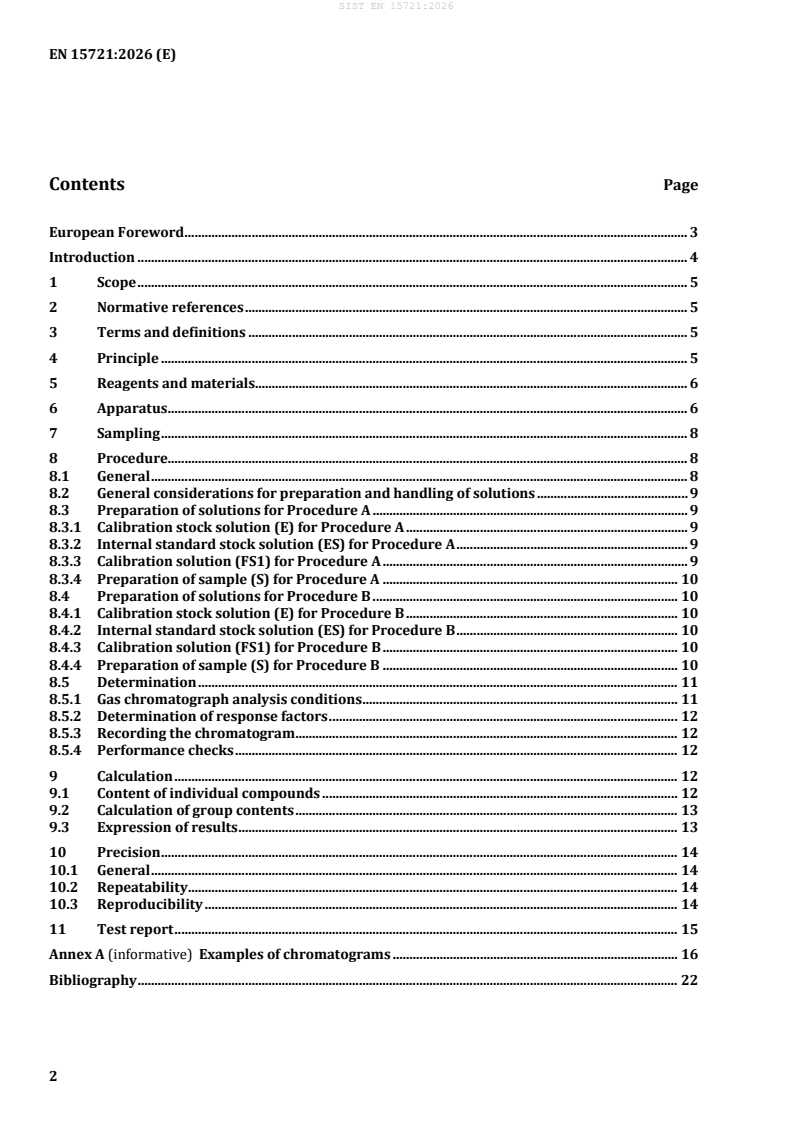
Contents Page
European Foreword . 3
Introduction . 4
1 Scope . 5
2 Normative references . 5
3 Terms and definitions . 5
4 Principle . 5
5 Reagents and materials . 6
6 Apparatus . 6
7 Sampling . 8
8 Procedure. 8
8.1 General . 8
8.2 General considerations for preparation and handling of solutions . 9
8.3 Preparation of solutions for Procedure A . 9
8.3.1 Calibration stock solution (E) for Procedure A . 9
8.3.2 Internal standard stock solution (ES) for Procedure A . 9
8.3.3 Calibration solution (FS1) for Procedure A . 9
8.3.4 Preparation of sample (S) for Procedure A . 10
8.4 Preparation of solutions for Procedure B . 10
8.4.1 Calibration stock solution (E) for Procedure B . 10
8.4.2 Internal standard stock solution (ES) for Procedure B . 10
8.4.3 Calibration solution (FS1) for Procedure B . 10
8.4.4 Preparation of sample (S) for Procedure B . 10
8.5 Determination . 11
8.5.1 Gas chromatograph analysis conditions . 11
8.5.2 Determination of response factors . 12
8.5.3 Recording the chromatogram . 12
8.5.4 Performance checks . 12
9 Calculation . 12
9.1 Content of individual compounds . 12
9.2 Calculation of group contents . 13
9.3 Expression of results . 13
10 Precision . 14
10.1 General . 14
10.2 Repeatability . 14
10.3 Reproducibility . 14
11 Test report . 15
Annex A (informative) Examples of chromatograms . 16
Bibliography . 22
European foreword
This document (EN 15721:2026) has been prepared by Technical Committee CEN/TC 19 “Gaseous and
liquid fuels, lubricants and related products of petroleum, synthetic and biological origin”, the secretariat
of which is held by NEN.
This European Standard shall be given the status of a national standard, either by publication of an
identical text or by endorsement, at the latest by January 2027, and conflicting national standards shall
be withdrawn at the latest by January 2027.
Attention is drawn to the possibility that some of the elements of this document may be the subject of
patent rights. CEN shall not be held responsible for identifying any or all such patent rights.
This document will supersede EN 15721:2013, and includes the following significant technical changes
with respect to that edition:
— the requirement to use self-determined response factors in the calculation (9.1) for all components,
whereas recommendations are given for the commonly used denaturants;
— the need for a good separation, to prevent peak overlap between ethanol and petrol components, is
underlined (8.5.3).
Any feedback and questions on this document should be directed to the users’ national standards body.
A complete listing of these bodies can be found on the CEN website.
According to the CEN-CENELEC Internal Regulations, the national standards organisations of the
following countries are bound to implement this European Standard: Austria, Belgium, Bulgaria, Croatia,
Cyprus, Czech Republic, Denmark, Estonia, Finland, France, Germany, Greece, Hungary, Iceland, Ireland,
Italy, Latvia, Lithuania, Luxembourg, Malta, Netherlands, Norway, Poland, Portugal, Republic of North
Macedonia, Romania, Serbia, Slovakia, Slovenia, Spain, Sweden, Switzerland, Türkiye and the United
Kingdom.
Introduction
This document specifies a gas chromatographic (GC) test method for the determination of a number of
compounds present in ethanol for use as a blending component in petrol according to the CEN ethanol
blending component specification EN 15376 [1]. The test method comprises of GC identification and
analysis of a number of molecules, which are then attributed to several classes (“impurities”, “methanol”,
“higher alcohols”), which are needed for calculation of the specified values as required in EN 15376.
The method described in this document was prepared by CEN/TC 19’s Working Group 9 and is based on
two methods ([2] and [3]) published from a European Regulation on wine and on other internationally
published analytical methods on spirits [4]. The method was modified for determinations in non-
denatured ethanol for automotive applications. When ethanol blending in petrol became more common
outside the refinery, it appeared to be necessary to generalize the test method more towards denatured
ethanol.
1 Scope
This document specifies a gas chromatographic method for ethanol, in which higher alcohols (propan-1-
ol, butan-1-ol, butan-2-ol, 2-methylpropan-1-ol (iso-butanol), 2-methylbutan-1-ol, and 3-methylbutan-1-
ol) from (0,1 up to 2,5) mass percentage, methanol from (0,1 up to 3) mass percentage and other
impurities, in the range from (0,1 up to 2) mass percentage are determined.
NOTE 1 The European ethanol blending component specification [1] sets a limit for the combined result of
ethanol + higher alcohols, not the ethanol content itself.
The method is developed for non-denatured ethanol samples. With sufficient attention to correct
separation of the higher alcohols and other components, determination of hydrocarbons in ethanol that
contains denaturants as per EN 15376 [1] is possible.
NOTE 2 For the purposes of this document, the term “% (m/m)” is used to represent the mass percentage or
mass fraction (ω).
2 Normative references
The following documents are referred to in the text in such a way that some or all of their content
constitutes requirements of this document. For dated references, only the edition cited applies. For
undated references, the latest edition of the referenced document (including any amendments) applies.
EN ISO 3170, Hydrocarbon liquids — Manual sampling (ISO 3170)
EN ISO 3696, Water for analytical laboratory use — Specification and test methods (ISO 3696)
3 Terms and definitions
For the purposes of this document, the following terms and definitions apply.
ISO and IEC maintain terminology databases for use in standardization at the following addresses:
— ISO Online browsing platform: available at https://www.iso.org/obp
— IEC Electropedia: available at https://www.electropedia.org/
3.1
impurities
compounds not attributed to the groups of higher alcohols or methanol
4 Principle
The compounds specified in the scope are determined by direct injection of a test portion into a gas
chromatograph (GC) system. An internal standard is added to the sample prior to the injection. The
compounds are separated with suitable GC equipment using temperature programming with the option
to also use flow programming on a suitable column. They are detected using a flame ionization detector
(FID). The concentration of each compound is determined from response factors with respect to the
internal standard.
Water, if present in the sample, is not included in this analysis, because a signal for water is not visible in
the chromatogram.
The response factors are obtained during calibration using the same chromatographic conditions as those
for the analysis of the ethanol samples.
Two procedures (“Procedure A” and “Procedure B”) are specified which differ mainly in the optional use
of a water dilution step prior to the analysis. Both variants have been validated to produce identical
results and precision in extensive Round Robin tests.
5 Reagents and materials
All reagents shall be of recognized analytical grade (minimum 99 %) or of higher purity, if commercially
available. They shall be stored in closed dark glass bottles. Other internal standards may also be used
when there is sufficient proof that their GC signal does not interfere with the other signals in the
chromatogram.
5.1 Water which, for analytical laboratory use, shall conform to grade 2 of EN ISO 3696.
5.2 Compounds
The compounds used for calibration and peak identification are listed in Table 1.
Table 1 — Compounds for calibration, used as solvents and other related information
Compound Attributed to group
Calibration compounds
Methanol Methanol
Propan-1-ol Higher Alcohols
Butan-1-ol Higher Alcohols
Butan-2-ol Higher Alcohols
2-Methylpropan-1-ol Higher Alcohols
2-Methylbutan-1-ol Higher Alcohols
3-Methylbutan-1-ol Higher Alcohols
Internal standards
Pentan-3-ol Internal standard for Procedure A
4-Methylpentan-2-ol Internal standard for Procedure B
Solvent
a
Ethanol Solvent
a
Ethanol is needed in Procedure “A” and “B” as a solvent for the calibration
solutions. The purity of the ethanol should be considered when preparing
the mixtures. It should not contain any impurities that may interfere with
the analysis and the results shall be corrected for the purity of the ethanol.
5.3 Carrier gas, helium for use with flame ionization detectors (FIDs).
Use of hydrogen or nitrogen is allowed, however can result in slightly different retention times, relative
retention times (RRT) and peak resolutions. Precision in this document (see Clause 10) is acquired using
only helium as carrier gas.
CAUTION — Helium and nitrogen are compressed gases under high pressure. Hydrogen is an extremely
flammable gas under high pressure. The use of a hydrogen sensor in the gas chromatography oven is
strongly recommended to shut off the hydrogen source in case of a high concentration build-up of
hydrogen that exceeds the explosive limit.
6 Apparatus
6.1 Gas chromatograph, equipped with a Flame Ionization Detector (FID), a split injector and
connected to a PC or other system permitting the recording of chromatograms and execution of
quantitative calculations.
6.2 Gas chromatographic column
6.2.1 General
Bonded capillary column with a suited phase, permitting the complete separation of all requested
compounds for the analysis, except for 2-methylbutan-1-ol and 3-methylbutan-1-ol, for which a
minimum peak resolution of 1,0 (see 6.2.2) is required. The internal standard shall be perfectly separated
from all other compounds. Additional detail, including sample chromatograms, is given in Annex A.
6.2.2 Chromatographic resolution
The column resolution (as measured for 2-methylbutan-1-ol and 3-methylbutan-1-ol) shall be at least
1,0. Determine the column resolution, C , with the calibration solutions (8.3) or (8.4) for the 2-
R
methylbutan-1-ol and 3-methylbutan-1-ol peaks using the following Formula (1):
2 tt−
( )
2 1
(1)
C =
R
1,699 W + W
( )
1 2
where
t is the retention time, in seconds, for the 2-methylbutan-1-ol peak;
t is the retention time, in seconds, for the 3-methylbutan-1-ol peak;
W is the width, in seconds, at half-height of 2-methylbutan-1-ol peak;
W is the width, in seconds, at half-height of 3-methylbutan-1-ol peak.
Figure 1 presents further clarification on the calculation of column resolution, C , of 2-methylbutan-1-ol
R
and 3-methylbutan-1-ol according to procedure “B” (example: C = 1,30).
R
Key
1 pentan-3-ol (retention time 12,292 min) X retention time (min)
2 2-methylbutan-1-ol (retention time 13,741 min) Y FID signal
3 3-methylbutan-1-ol (retention time 13,820 min)
Figure 1 — Typical chromatogram for calculation of column resolution
6.3 Analytical balance, capable of weighing to the nearest 0,1 mg.
6.4 Vials, having seals and used for test portions and calibration solutions.
7 Sampling
Unless otherwise specified, laboratory samples shall be obtained by the procedures specified in
EN ISO 3170.
Glass bottles shall be used for taking samples. The glass bottles shall be meticulously cleaned and dried,
rinsed at least twice with the product to be sampled. Special care shall be taken during all further
manipulations with the samples to avoid any risk of further contamination, e.g. with water.
8 Procedure
8.1 General
Two method variants are defined in this document:
a
...