

prEN ISO 11461
(Main)Soil quality - Determination of soil water content as a volume fraction using coring sleeves - Gravimetric method (ISO/DIS 11461:2026)
- Status
- Not Published
- Publication Date
- 06-Feb-2028
- Technical Committee
- CEN/TC 444 - Environmental characterization
- Drafting Committee
- CEN/TC 444/WG 5 - Physical tests
- Current Stage
- 4020 - Submission to enquiry - Enquiry
- Start Date
- 20-Aug-2026
- Completion Date
- 20-Aug-2026
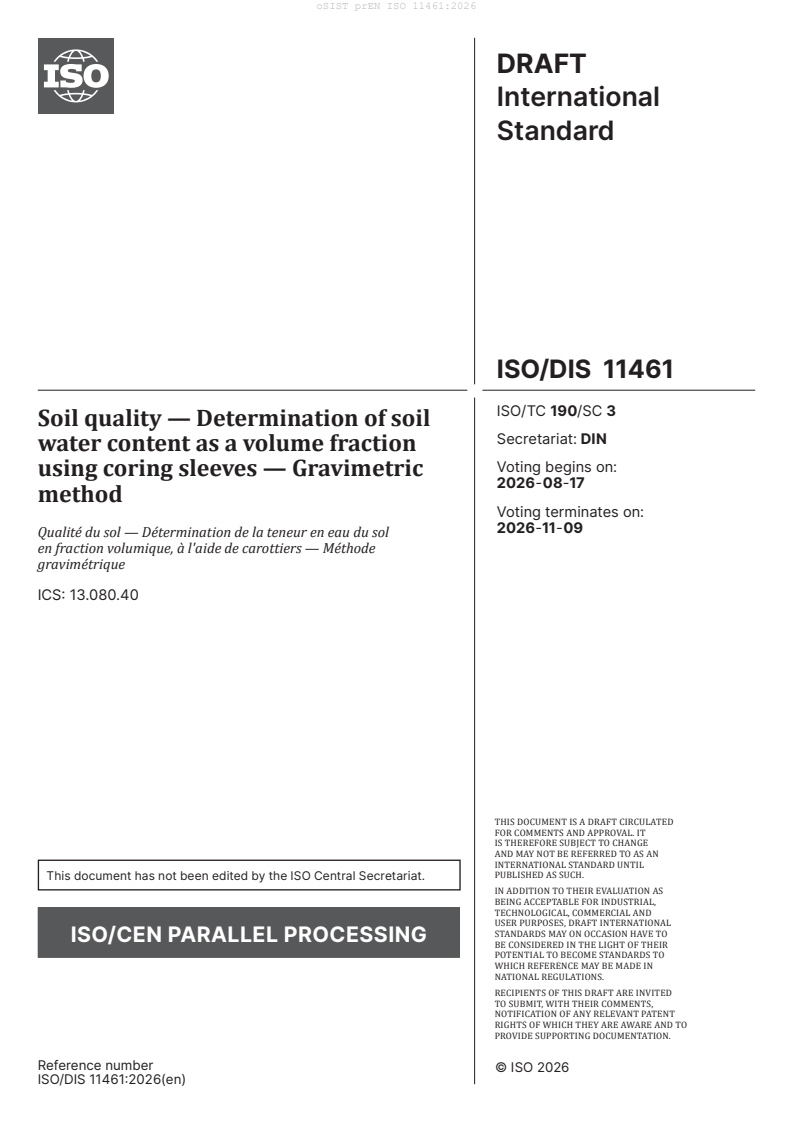

prEN ISO 11461 is a draft CEN/ISO standard on soil quality. It specifies a gravimetric method for determining soil water content as a volume fraction using coring sleeves, so a known-volume soil core is collected, dried, and weighed to calculate the water content. The method is meant for field samplers and laboratory users, especially where the result will be used as a reference value, for example to calibrate indirect moisture methods.
What does prEN ISO 11461 specify?
prEN ISO 11461 specifies how to determine soil water content as a volume fraction by the gravimetric method. The document covers the whole workflow from field sampling to calculation and reporting, and it is organized into clauses on scope, normative references, terms and definitions, symbols, principle, apparatus, field sampling, procedure, calculation, accuracy and reproducibility, and test report.
The method applies to non-swelling and non-shrinking soils where coring sleeves can be used to collect intact samples. It is not intended for soils where stones, tough roots, or similar conditions prevent the collection of soil cores. The document also notes that it is used as a reference method, for example for calibration of indirect methods.
What are the key requirements of prEN ISO 11461?
prEN ISO 11461 requires a known-volume soil core, proper drying, careful weighing, and an uncertainty-aware calculation. In practice, the standard is about preserving the sample state in the field and then converting mass loss to a volumetric result in the laboratory.
Sampling and sample integrity
Clause 7 requires coring sleeves for direct determination of volumetric water content, because the sample volume must be known. The sleeve size and the number of samples depend on the aim of the investigation and the variability of the soil, which matters because a single core may not represent a heterogeneous site well.
Samples have to be collected, transported, and stored so that their water content does not change after sampling. Protruding soil is trimmed, compacted or incomplete cores are discarded, and the sleeves are sealed with water- and vapour-tight caps or placed in an airtight bag if the seal is not reliable.
Drying and weighing
Clause 5 and Clause 8 require drying the sample at 105 °C ± 5 °C to constant mass. The first wet mass should be taken as soon as possible after sampling, because evaporation begins immediately and would bias the result.
The drying cycle continues with a 4 h re-dry and re-weigh sequence until two successive weighings differ by no more than 0.1 % of the last dry mass. This matters in practice because the result is only stable when the sample has genuinely reached constant mass.
Apparatus
Clause 6 specifies a thermostatically controlled oven with forced air ventilation, a desiccator with an active drying agent, a balance accurate to within 0.1 % of the dried sample mass, and coring sleeves of known volume. The sleeves need sharp cutting edges, water- and vapour-tight caps of known mass, and a volume greater than 20 cm³.
Calculation and corrections
Clause 9 defines the calculation of volumetric water content from the mass of water lost and the known sample volume. It also requires separate tare masses for wet and dry weighings when the accessories differ, such as caps during wet weighing and a dish during dry weighing.
The clause also explains that the density of water may need to be corrected for laboratory temperature and in-situ temperature. That matters when the temperature difference is significant, because the conversion is to a volume fraction, not just a mass fraction.
Accuracy, uncertainty, and reporting
Clause 10 separates sampling errors from laboratory measurement uncertainty and requires them to be treated distinctly. It also calls for Gaussian error propagation for the laboratory part and notes that repeatability is used in the ISO 5725 sense.
Clause 11 lists what the report has to identify: the sample, the standard reference, sampling location and depth, field and laboratory dates, sample mass, calculated water content, deviations, unusual features, and any optional or non-specified operations. That gives traceability for audits, quality control, and later re-use of the data.
What terms does prEN ISO 11461 define?
- Volumetric soil water content, θ - The volume of water released from the soil on drying to constant mass at 105 °C, divided by the original bulk volume of the soil.
- Constant mass - The drying endpoint reached when two successive weighings, 4 h apart, differ by no more than 0.1 % of the last mass.
- m - The mass term used in the calculation of water content.
- V - The known volume of the soil sample in the coring sleeve.
- ρw - The density of water used in the conversion to volumetric water content.
- Tare mass - The mass of caps, dishes, or other accessories that must be accounted for separately in wet and dry weighings.
Who uses prEN ISO 11461?
prEN ISO 11461 is used by soil testing laboratories, field samplers, researchers, and technical staff working in soil quality, hydrology, environmental testing, and agriculture. It is also relevant to quality managers and buyers who need a reference method for checking or calibrating indirect soil moisture methods.
In practice, users apply it when they need a reproducible way to collect cores, dry them under defined conditions, calculate water content as a volume fraction, and document the result for comparison or calibration.
What changed in prEN ISO 11461 from the previous edition?
prEN ISO 11461 replaces ISO 11461:2001. The foreword states that this second edition is technically revised, and the main change listed is an editorial revision.
Which standards are used with prEN ISO 11461?
prEN ISO 11461 refers to ISO 11465 for determination of soil water content as a mass fraction. It also cites ISO 5725 when discussing repeatability and the meaning of repeatability under identical conditions.
What does the prEN ISO 11461 document contain?
prEN ISO 11461 contains the full test method, including the principle, equipment, field sampling steps, laboratory drying and weighing sequence, and the calculation approach for volumetric water content. It also includes a dedicated clause on accuracy and reproducibility that separates sampling effects from laboratory uncertainty.
The document gives the information needed to run the method in practice: how to handle coring sleeves, when to discard a core, how long to dry, when to stop drying, and what to record in the test report. It also explains the uncertainty sources that matter most when the result is used as a reference value.
Relations
- Effective Date
- 22-Oct-2025
Get Certified
Connect with accredited certification bodies for this standard

CIS Institut d.o.o.
Personal Protective Equipment (PPE) certification body. Notified Body NB-2890 for EU Regulation 2016/425 PPE.

Kiwa BDA Testing
Building and construction product certification.
Kmetijski inštitut Slovenije
Agricultural Institute of Slovenia. Soil testing, plant health, agricultural product analysis.
Sponsored listings
Frequently Asked Questions
prEN ISO 11461 is a draft published by the European Committee for Standardization (CEN). Its full title is "Soil quality - Determination of soil water content as a volume fraction using coring sleeves - Gravimetric method (ISO/DIS 11461:2026)". This standard covers: La présente Norme internationale spécifie une méthode de détermination gravimétrique de la teneur en eau du sol en fraction volumique. Cette méthode s'applique à tous les types de sols non gonflant et sans retrait pour lesquels des carottiers peuvent être utilisés pour l'échantillonnage. Elle ne s'applique pas aux sols où des pierres, des grosses racines ou d'autres facteurs empêchent de prélever des carottes. Elle est utilisée comme méthode de référence (par exemple étalonnage de méthodes indirectes pour la détermination de la teneur en eau).
La présente Norme internationale spécifie une méthode de détermination gravimétrique de la teneur en eau du sol en fraction volumique. Cette méthode s'applique à tous les types de sols non gonflant et sans retrait pour lesquels des carottiers peuvent être utilisés pour l'échantillonnage. Elle ne s'applique pas aux sols où des pierres, des grosses racines ou d'autres facteurs empêchent de prélever des carottes. Elle est utilisée comme méthode de référence (par exemple étalonnage de méthodes indirectes pour la détermination de la teneur en eau).
prEN ISO 11461 is classified under the following ICS (International Classification for Standards) categories: 13.080.40 - Hydrological properties of soils. The ICS classification helps identify the subject area and facilitates finding related standards.
prEN ISO 11461 has the following relationships with other standards: It is inter standard links to EN ISO 11461:2014. Understanding these relationships helps ensure you are using the most current and applicable version of the standard.
prEN ISO 11461 is available in PDF format for immediate download after purchase. The document can be added to your cart and obtained through the secure checkout process. Digital delivery ensures instant access to the complete standard document.
Standards Content (Sample)
SLOVENSKI STANDARD
01-oktober-2026
Kakovost tal - Določanje količine vode kot prostorninskega deleža z uporabo
cilindrov - Gravimetrijska metoda (ISO/DIS 11461:2026)
Soil quality - Determination of soil water content as a volume fraction using coring
sleeves - Gravimetric method (ISO/DIS 11461:2026)
Bodenqualität - Bestimmung des Wassergehalts des Bodens als Volumenanteil mit Hilfe
von Bohrhülsen - Gravimetrisches Verfahren (ISO/DIS 11461:2026)
Qualité du sol - Détermination de la teneur en eau du sol en fraction volumique, à l'aide
de carottiers - Méthode gravimétrique (ISO/DIS 11461:2026)
Ta slovenski standard je istoveten z: prEN ISO 11461
ICS:
13.080.40 Hidrološke lastnosti tal Hydrological properties of
soils
2003-01.Slovenski inštitut za standardizacijo. Razmnoževanje celote ali delov tega standarda ni dovoljeno.
DRAFT
International
Standard
ISO/DIS 11461
ISO/TC 190/SC 3
Soil quality — Determination of soil
Secretariat: DIN
water content as a volume fraction
Voting begins on:
using coring sleeves — Gravimetric
2026-08-17
method
Voting terminates on:
2026-11-09
Qualité du sol — Détermination de la teneur en eau du sol
en fraction volumique, à l'aide de carottiers — Méthode
gravimétrique
ICS: 13.080.40
THIS DOCUMENT IS A DRAFT CIRCULATED
FOR COMMENTS AND APPROVAL. IT
IS THEREFORE SUBJECT TO CHANGE
AND MAY NOT BE REFERRED TO AS AN
INTERNATIONAL STANDARD UNTIL
PUBLISHED AS SUCH.
This document has not been edited by the ISO Central Secretariat.
IN ADDITION TO THEIR EVALUATION AS
BEING ACCEPTABLE FOR INDUSTRIAL,
TECHNOLOGICAL, COMMERCIAL AND
USER PURPOSES, DRAFT INTERNATIONAL
STANDARDS MAY ON OCCASION HAVE TO
ISO/CEN PARALLEL PROCESSING
BE CONSIDERED IN THE LIGHT OF THEIR
POTENTIAL TO BECOME STANDARDS TO
WHICH REFERENCE MAY BE MADE IN
NATIONAL REGULATIONS.
RECIPIENTS OF THIS DRAFT ARE INVITED
TO SUBMIT, WITH THEIR COMMENTS,
NOTIFICATION OF ANY RELEVANT PATENT
RIGHTS OF WHICH THEY ARE AWARE AND TO
PROVIDE SUPPORTING DOCUMENTATION.
Reference number
ISO/DIS 11461:2026(en)
DRAFT
ISO/DIS 11461:2026(en)
International
Standard
ISO/DIS 11461
ISO/TC 190/SC 3
Soil quality — Determination of soil
Secretariat: DIN
water content as a volume fraction
Voting begins on:
using coring sleeves — Gravimetric
method
Voting terminates on:
Qualité du sol — Détermination de la teneur en eau du sol
en fraction volumique, à l'aide de carottiers — Méthode
gravimétrique
ICS: 13.080.40
THIS DOCUMENT IS A DRAFT CIRCULATED
FOR COMMENTS AND APPROVAL. IT
IS THEREFORE SUBJECT TO CHANGE
AND MAY NOT BE REFERRED TO AS AN
INTERNATIONAL STANDARD UNTIL
PUBLISHED AS SUCH.
This document has not been edited by the ISO Central Secretariat.
IN ADDITION TO THEIR EVALUATION AS
BEING ACCEPTABLE FOR INDUSTRIAL,
© ISO 2026
TECHNOLOGICAL, COMMERCIAL AND
USER PURPOSES, DRAFT INTERNATIONAL
All rights reserved. Unless otherwise specified, or required in the context of its implementation, no part of this publication may
STANDARDS MAY ON OCCASION HAVE TO
ISO/CEN PARALLEL PROCESSING
be reproduced or utilized otherwise in any form or by any means, electronic or mechanical, including photocopying, or posting on
BE CONSIDERED IN THE LIGHT OF THEIR
the internet or an intranet, without prior written permission. Permission can be requested from either ISO at the address below
POTENTIAL TO BECOME STANDARDS TO
WHICH REFERENCE MAY BE MADE IN
or ISO’s member body in the country of the requester.
NATIONAL REGULATIONS.
ISO copyright office
RECIPIENTS OF THIS DRAFT ARE INVITED
CP 401 • Ch. de Blandonnet 8
TO SUBMIT, WITH THEIR COMMENTS,
CH-1214 Vernier, Geneva
NOTIFICATION OF ANY RELEVANT PATENT
Phone: +41 22 749 01 11
RIGHTS OF WHICH THEY ARE AWARE AND TO
PROVIDE SUPPORTING DOCUMENTATION.
Email: copyright@iso.org
Website: www.iso.org
Published in Switzerland Reference number
ISO/DIS 11461:2026(en)
ii
ISO/DIS 11461:2026(en)
Contents Page
Foreword .iv
1 Scope . 1
2 Normative references . 1
3 Terms and definitions . 1
4 Symbols . 1
5 Principle . 2
6 Apparatus . 2
7 Field sampling . 2
7.1 General .2
7.2 Sampling procedure .2
8 Procedure . 3
9 Calculation of volumetric water content . 3
10 Accuracy and reproducibility . 4
10.1 Scope of the error assessment .4
10.2 Errors due to sampling and sample preparation .4
10.2.1 General .4
10.2.2 Random sampling errors .4
10.2.3 Systematic sampling errors .4
10.3 Measurement uncertainty of the laboratory determination .4
10.3.1 General .4
10.3.2 Random measurement errors .5
10.3.3 Systematic errors of the laboratory determination .5
10.4 Temperature dependence of water density .5
10.5 Overall uncertainty .6
11 Test report . 6
iii
ISO/DIS 11461:2026(en)
Foreword
ISO (the International Organization for Standardization) is a worldwide federation of national standards
bodies (ISO member bodies). The work of preparing International Standards is normally carried out through
ISO technical committees. Each member body interested in a subject for which a technical committee
has been established has the right to be represented on that committee. International organizations,
governmental and non-governmental, in liaison with ISO, also take part in the work. ISO collaborates closely
with the International Electrotechnical Commission (IEC) on all matters of electrotechnical standardization.
The procedures used to develop this document and those intended for its further maintenance are described
in the ISO/IEC Directives, Part 1. In particular, the different approval criteria needed for the different types
of ISO document should be noted. This document was drafted in accordance with the editorial rules of the
ISO/IEC Directives, Part 2 (see www.iso.org/directives).
ISO draws attention to the possibility that the implementation of this document may involve the use of (a)
patent(s). ISO takes no position concerning the evidence, validity or applicability of any claimed patent
rights in respect thereof. As of the date of publication of this document, ISO [had/had not] received notice of
(a) patent(s) which may be required to implement this document. However, implementers are cautioned that
this may not represent the latest information, which may be obtained from the patent database available at
www.iso.org/patents. ISO shall not be held responsible for identifying any or all such patent rights.
Any trade name used in this document is information given for the convenience of users and does not
constitute an endorsement.
For an explanation of the voluntary nature of standards, the meaning of ISO specific terms and expressions
related to conformity assessment, as well as information about ISO's adherence to the World Trade
Organization (WTO) principles in the Technical Barriers to Trade (TBT), see www.iso.org/iso/foreword.html.
This document was prepared by Technical Committee ISO/TC 190, Soil quality, Subcommittee SC 3, Chemical
and physical characterization.
This second edition cancels and replaces the first edition (ISO 11461:2001), which has been technically
revised.
The main changes are as follows:
— document editorial revised.
Any feedback or questions on this document should be directed to the user’s national standards body. A
complete listing of these bodies can be found at www.iso.org/members.html.
iv
DRAFT International Standard ISO/DIS 11461:2026(en)
Soil quality — Determination of soil water content as a
volume fraction using coring sleeves — Gravimetric method
1 Scope
This document specifies a method for the gravimetric determination of soil water content as a volume
fraction.
The method is applicable to all types of non-swelling or non-shrinking soils where coring sleeves can be
used for sampling. It is not applicable to soils where stones, tough roots or other factors prevent collection
of soil cores. It is used as a reference method (e.g. the calibration of indirect methods for determination of
water content).
NOTE The determination of water content as a mass fraction is described in ISO 11465.
2 Normative references
There are no normative references in this document.
3 Terms and definitions
For the purposes of this document, the following terms and definitions apply.
ISO and IEC maintain terminological databases for use in standardization at the following addresses:
— IEC Electropedia: available at http:// www .electropedia .org/
— ISO Online browsing platform: available at http:// www .iso .org/ obp
3.1
volumetri
...