

prEN 15182-3
(Main)Portable equipment for projecting extinguishing agents and firefighting support operations — Hand-held branchpipes for fire service use — Part 3: Smooth bore and/or one fixed spray jet angle branchpipes PN 16
- Abstract
In addition to the common requirements given in EN 15182-1, this document specifies the specific safety and performance requirements and the corresponding test methods, applicale to hand-held branchpipes with smooth bore and/or one fixed spray jet angle with a nominal pressure of 16 bar (1,6 MPa) PN 16, with a maximum flow rate up to 1 000 l/min at a reference pressure of 6 bar (0,6 MPa).
NOTE 1 These branchpipes offer no or inadequate protection for firefighters when the spray jet angle is less than 30 ° and therefore are not adapted in high risk firefighting situations such as internal attack.
NOTE 2 These branchpipes are not adapted when fighting fires in or near electrical installations when the spray jet angle is less than 30° without written authorization in the manual (safety distances included).
- Status
- Not Published
- Publication Date
- 05-Jun-2028
- Technical Committee
- CEN/TC 192 - Fire service equipment
- Drafting Committee
- CEN/TC 192/WG 8 - Hand-held branchpipes for fire service use
- Current Stage
- 4020 - Submission to enquiry - Enquiry
- Start Date
- 01-Oct-2026
- Due Date
- 23-Feb-2027
- Completion Date
- 01-Oct-2026

prEN 15182-3 is a CEN draft European Standard for hand-held branchpipes used by fire services. It specifies the additional safety and performance requirements, together with the test methods used to verify them, for smooth bore and/or one fixed spray jet angle branchpipes PN 16. The standard is aimed at manufacturers, test laboratories, and fire service users who need to select, verify, or document these branchpipes.
What does prEN 15182-3 specify?
prEN 15182-3 covers hand-held branchpipes with a nominal pressure of PN 16 and a maximum flow rate up to 1 000 l/min at the reference pressure used in the tests. It builds on the common requirements in EN 15182-1 and adds the branchpipe-specific safety, performance, and verification rules.
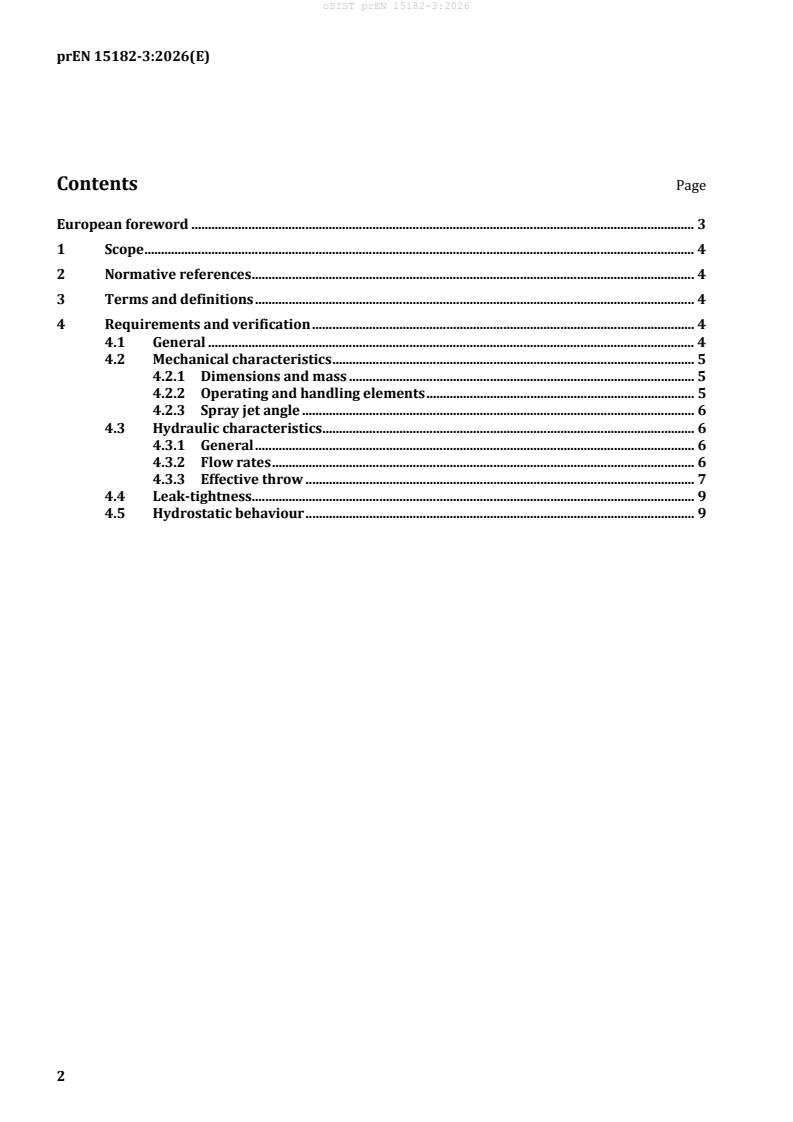
The document is organized into scope, normative references, terms and definitions, and requirements and verification. Clause 4 then groups the technical requirements into general rules, mechanical characteristics, hydraulic characteristics, leak-tightness, and hydrostatic behaviour.
The scope notes also warn about use in practice: branchpipes with a low spray jet angle are not intended to protect firefighters adequately in high-risk situations such as internal attack, and they are not intended for use near electrical installations unless the manual gives written authorization and safety distances.
What are the key requirements of prEN 15182-3?
prEN 15182-3 sets the main product checks in Clause 4 and makes all the tests in this document type tests. In practice, that means manufacturers and test bodies use the standard for design validation and product approval, not just for routine inspection.
General compliance and classification
Clause 4.1 requires compliance with EN 15182-1, and branchpipe classification follows Annex A of EN 15182-1. The document also states the pressures used for the hydraulic checks and warns that PN 16 branchpipes shall not be used above their rated pressure. This matters because the branchpipe must be judged against the base standard as well as this part’s extra requirements.
Dimensions, mass, and handling
Clause 4.2.1 limits dimensions and mass according to flow-rate category, so larger-capacity branchpipes are checked against the appropriate size and weight class. Clause 4.2.2 then limits the effort needed to move the operating elements, and it also covers rotating elements with detents and the identification of the closed position. In practice, this protects usability with gloves, reduces operator strain, and helps prevent incorrect operation under fireground conditions.
Spray jet angle and marking
Clause 4.2.3 requires jet positions, where applicable, to be clearly marked, and it requires a minimum spray jet angle for branchpipes that include a spray jet. The angle is measured with an angle-measuring device. This helps users confirm the setting quickly and makes the branchpipe’s spray mode measurable during testing.
Flow rate and effective throw
Clause 4.3.2 requires all indicated flow rates to be measured at straight jet and/or spray jet, with allowable deviations depending on the flow setting. Clause 4.3.3 requires effective throw to be demonstrated for each flow-rate position above the lower threshold when set to straight jet. In practice, this tells buyers and fire services what water delivery performance to expect and how far the jet should reach under the defined test conditions.
Leak-tightness and hydrostatic resistance
Clause 4.4 requires the branchpipe to remain leak-tight in both closed and open conditions during the specified pressure checks. Clause 4.5 requires the branchpipe to withstand a hydrostatic test intended to represent water hammer effects without rupturing. These checks matter because leaks and pressure damage directly affect safety, reliability, and service life.
What terms does prEN 15182-3 define?
- Smooth bore - a device that provides a solid water stream.
- Test pressure - the static pressure used for leakage tests.
- Reference pressure - the pressure used as the basis for the flow-rate and throw measurements.
- Nominal pressure (PN 16) - the rated pressure class used for this branchpipe category.
- Burst pressure - the pressure level used for the hydrostatic resistance check.
- Branchpipe - the hand-held fire service nozzle covered by this part of EN 15182.
Who uses prEN 15182-3?
prEN 15182-3 is used by branchpipe manufacturers, fire service equipment suppliers, and test laboratories that verify product performance. It is also used by quality managers, procurement teams, and fire and rescue services when comparing products, defining acceptance checks, and writing technical specifications. Training and instruction-document authors use it to describe operating positions, flow settings, and safe use limits.
What changed in prEN 15182-3 from the previous edition?
prEN 15182-3:2026 is intended to supersede EN 15182-3:2019. The foreword states these changes compared with the previous edition:
- the first part of the title was changed;
- the wording “smooth bore jet” and “smooth bore branchpipe” was replaced by “smooth bore”;
- the scope was rewritten;
- definition 3.2, test pressure, was added;
- Clause 4.1 was updated;
- editorial wording was improved.
Which standards are used with prEN 15182-3?
- EN 15182-1:2026 - provides the common requirements for hand-held branchpipes, and Annex A of that part is used for classification.
What does the prEN 15182-3 document contain?
prEN 15182-3 includes the test and verification material that supports product design and type testing. It contains Table 1 for dimensions and mass, Table 2 for operating-element torques, and Table 3 for flow-rate deviation limits. It also includes Figure 1 for effective throw and Figure 2 for the measurement set-up for that test.
The document’s procedures cover measurement of size and weight, operating forces, spray jet angle, flow rates, throw, leak-tightness, and hydrostatic behaviour. These are the checks a manufacturer or test laboratory uses to show that a branchpipe matches the PN 16 performance expectations for fire service use.
Relations
- Effective Date
- 01-Apr-2026
Get Certified
Connect with accredited certification bodies for this standard

CIS Institut d.o.o.
Personal Protective Equipment (PPE) certification body. Notified Body NB-2890 for EU Regulation 2016/425 PPE.

Kiwa BDA Testing
Building and construction product certification.
Kmetijski inštitut Slovenije
Agricultural Institute of Slovenia. Soil testing, plant health, agricultural product analysis.
Sponsored listings
Frequently Asked Questions
prEN 15182-3 is a draft published by the European Committee for Standardization (CEN). Its full title is "Portable equipment for projecting extinguishing agents and firefighting support operations — Hand-held branchpipes for fire service use — Part 3: Smooth bore and/or one fixed spray jet angle branchpipes PN 16". This standard covers: In addition to the common requirements given in EN 15182-1, this document specifies the specific safety and performance requirements and the corresponding test methods, applicale to hand-held branchpipes with smooth bore and/or one fixed spray jet angle with a nominal pressure of 16 bar (1,6 MPa) PN 16, with a maximum flow rate up to 1 000 l/min at a reference pressure of 6 bar (0,6 MPa). NOTE 1 These branchpipes offer no or inadequate protection for firefighters when the spray jet angle is less than 30 ° and therefore are not adapted in high risk firefighting situations such as internal attack. NOTE 2 These branchpipes are not adapted when fighting fires in or near electrical installations when the spray jet angle is less than 30° without written authorization in the manual (safety distances included).
In addition to the common requirements given in EN 15182-1, this document specifies the specific safety and performance requirements and the corresponding test methods, applicale to hand-held branchpipes with smooth bore and/or one fixed spray jet angle with a nominal pressure of 16 bar (1,6 MPa) PN 16, with a maximum flow rate up to 1 000 l/min at a reference pressure of 6 bar (0,6 MPa). NOTE 1 These branchpipes offer no or inadequate protection for firefighters when the spray jet angle is less than 30 ° and therefore are not adapted in high risk firefighting situations such as internal attack. NOTE 2 These branchpipes are not adapted when fighting fires in or near electrical installations when the spray jet angle is less than 30° without written authorization in the manual (safety distances included).
prEN 15182-3 is classified under the following ICS (International Classification for Standards) categories: 13.220.10 - Fire-fighting. The ICS classification helps identify the subject area and facilitates finding related standards.
prEN 15182-3 has the following relationships with other standards: It is inter standard links to EN 15182-3:2019. Understanding these relationships helps ensure you are using the most current and applicable version of the standard.
prEN 15182-3 is available in PDF format for immediate download after purchase. The document can be added to your cart and obtained through the secure checkout process. Digital delivery ensures instant access to the complete standard document.
Standards Content (Sample)
SLOVENSKI STANDARD
01-december-2026
Prenosna oprema za črpanje in uporabo gasilnega sredstva in podporne operacije
gašenja požarov - Gasilski ročniki - 3. del: Ročniki PN 16 s polnim curkom in/ali z
razpršenim curkom pod določenim fiksnim kotom
Portable equipment for projecting extinguishing agents and firefighting support
operations — Hand-held branchpipes for fire service use — Part 3: Smooth bore and/or
one fixed spray jet angle branchpipes PN 16
Brandbekämpfung - Strahlrohre für die Brandbekämpfung - Teil 3: Strahlrohre mit
Vollstrahl und/oder einem unveränderlichem Sprühstrahlwinkel PN 16
Equipement portable de projection d’agents d’extinction et les opérations de soutien à la
lutte contre les incendies — Lances à main destinées aux services d'incendie et de
secours — Partie 3 : Lances à jet plein et/ou à diffusion à angle fixe PN 16
Ta slovenski standard je istoveten z: prEN 15182-3
ICS:
13.220.10 Gašenje požara Fire-fighting
2003-01.Slovenski inštitut za standardizacijo. Razmnoževanje celote ali delov tega standarda ni dovoljeno.
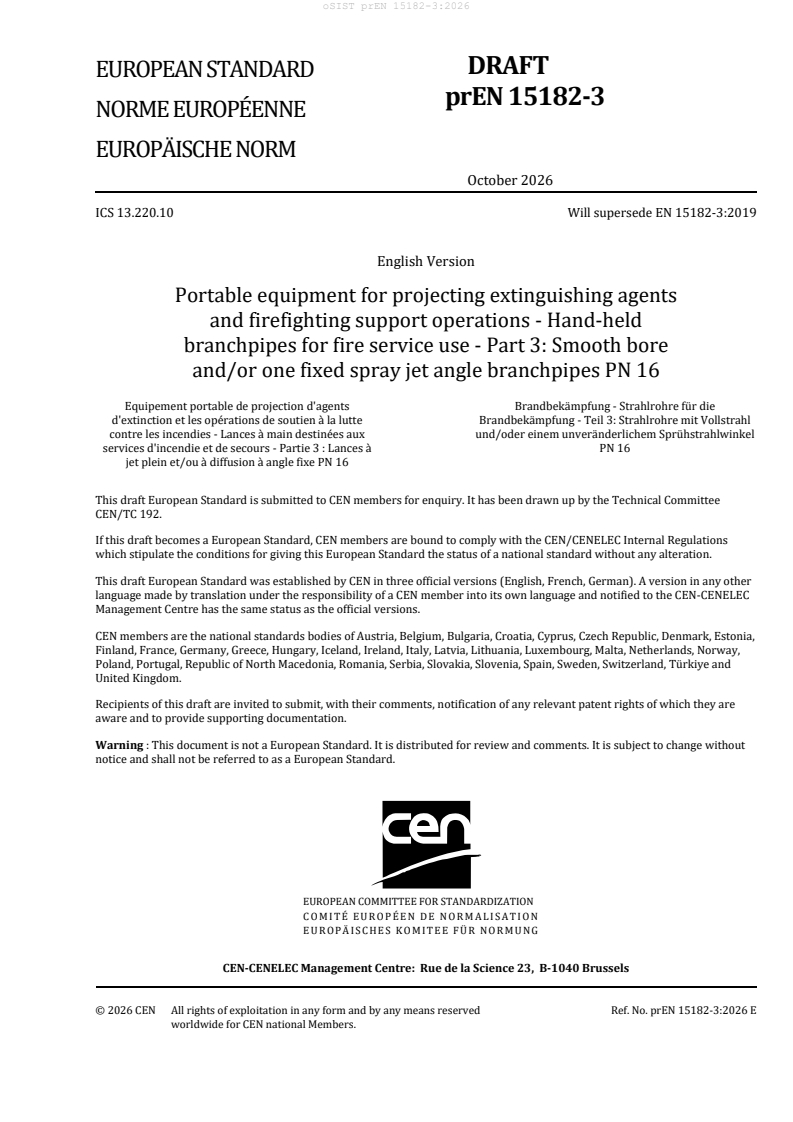
DRAFT
EUROPEAN STANDARD
NORME EUROPÉENNE
EUROPÄISCHE NORM
October 2026
ICS 13.220.10 Will supersede EN 15182-3:2019
English Version
Portable equipment for projecting extinguishing agents
and firefighting support operations - Hand-held
branchpipes for fire service use - Part 3: Smooth bore
and/or one fixed spray jet angle branchpipes PN 16
Equipement portable de projection d'agents Brandbekämpfung - Strahlrohre für die
d'extinction et les opérations de soutien à la lutte Brandbekämpfung - Teil 3: Strahlrohre mit Vollstrahl
contre les incendies - Lances à main destinées aux und/oder einem unveränderlichem Sprühstrahlwinkel
services d'incendie et de secours - Partie 3 : Lances à PN 16
jet plein et/ou à diffusion à angle fixe PN 16
This draft European Standard is submitted to CEN members for enquiry. It has been drawn up by the Technical Committee
CEN/TC 192.
If this draft becomes a European Standard, CEN members are bound to comply with the CEN/CENELEC Internal Regulations
which stipulate the conditions for giving this European Standard the status of a national standard without any alteration.
This draft European Standard was established by CEN in three official versions (English, French, German). A version in any other
language made by translation under the responsibility of a CEN member into its own language and notified to the CEN-CENELEC
Management Centre has the same status as the official versions.
CEN members are the national standards bodies of Austria, Belgium, Bulgaria, Croatia, Cyprus, Czech Republic, Denmark, Estonia,
Finland, France, Germany, Greece, Hungary, Iceland, Ireland, Italy, Latvia, Lithuania, Luxembourg, Malta, Netherlands, Norway,
Poland, Portugal, Republic of North Macedonia, Romania, Serbia, Slovakia, Slovenia, Spain, Sweden, Switzerland, Türkiye and
United Kingdom.
Recipients of this draft are invited to submit, with their comments, notification of any relevant patent rights of which they are
aware and to provide supporting documentation.
Warning : This document is not a European Standard. It is distributed for review and comments. It is subject to change without
notice and shall not be referred to as a European Standard.
EUROPEAN COMMITTEE FOR STANDARDIZATION
COMITÉ EUROPÉEN DE NORMALISATION
EUROPÄISCHES KOMITEE FÜR NORMUNG
CEN-CENELEC Management Centre: Rue de la Science 23, B-1040 Brussels
© 2026 CEN All rights of exploitation in any form and by any means reserved Ref. No. prEN 15182-3:2026 E
worldwide for CEN national Members.
Contents Page
European foreword . 3
1 Scope . 4
2 Normative references . 4
3 Terms and definitions . 4
4 Requirements and verification . 4
4.1 General . 4
4.2 Mechanical characteristics . 5
4.2.1 Dimensions and mass . 5
4.2.2 Operating and handling elements . 5
4.2.3 Spray jet angle . 6
4.3 Hydraulic characteristics . 6
4.3.1 General . 6
4.3.2 Flow rates . 6
4.3.3 Effective throw . 7
4.4 Leak-tightness. 9
4.5 Hydrostatic behaviour . 9
European foreword
This document (prEN 15182-3:2026) has been prepared by Technical Committee CEN/TC 192 “Fire and
rescue service equipment”, the secretariat of which is held by BSI.
This document is currently submitted to the CEN Enquiry.
This document will supersede EN 15182-3:2019.
EN 15182-3:2019:
— the first part of the title of the standard has been changed;
— in the document “smooth bore jet” and “smooth bore branchpipe” have been replaced by “smooth
bore”;
— scope: new wording;
— definition 3.2 (test pressure) has been added;
— 4.1 has been updated;
— improvement of the wording/editorial changes.
1 Scope
In addition to the common requirements given in EN 15182-1:2026 this document specifies the
specific safety and performance requirements and the corresponding test methods, applicable to hand-
held branchpipes with smooth bore and/or one fixed spray jet angle with a nominal pressure of 16 bar
(1,6 MPa) PN 16, with a maximum flow rate up to 1 000 l/min at a reference pressure of 6 bar
(0,6 MPa).
NOTE 1 These branchpipes offer no or inadequate protection for
...