


EN ISO 13590:2023
(Main)Small craft - Personal watercraft - Construction and system installation requirements (ISO 13590:2022)
General Information
- Abstract
This document specifies construction and system installation requirements for personal watercraft. It addresses the builder’s plate, watercraft identification, permanently installed petrol fuel systems, electrical systems, steering systems, ventilation, hull structure and floatation, stability, mooring and towing, flooding, off-throttle steering and the owner’s manual.
This document does not apply to outboard powered personal watercraft and jet powered surfboards.
- Status
- Published
- Publication Date
- 14-Mar-2023
- Withdrawal Date
- 22-Jan-2023
- Technical Committee
- CEN/TC 464 - Small Craft
- Drafting Committee
- CEN/TC 464 - Small Craft
- Current Stage
- 6060 - Definitive text made available (DAV) - Publishing
- Start Date
- 15-Mar-2023
- Completion Date
- 15-Mar-2023



Overview
EN ISO 13590:2023 (identical to ISO 13590:2022) specifies construction and system installation requirements for personal watercraft (PWC). It provides manufacturers, designers and conformity assessors with normative guidance on safe design and installation of fuel, electrical, steering and flotation systems for jet‑propelled personal watercraft. The standard supersedes EN ISO 13590:2018 and supports conformity with EU Directive 2013/53/EU for small craft. It does not apply to outboard‑powered personal watercraft or jet‑powered surfboards.
Key topics and technical requirements
EN ISO 13590:2023 covers a broad range of technical areas relevant to PWC safety and installation, including:
- Builder’s plate and watercraft identification - requirements for marking and unique identification.
- Fuel system - materials, tank design and installation, fill/vent openings, static‑pressure and shock testing, pumps, stop valves, filters, metallic fuel lines, fittings and grounding. Includes detailed fuel‑hose performance tests (tensile, burst, cold flexibility, oil/ozone/fuel resistance).
- Electrical system - conductor type, sizing and identification, support/protection, overcurrent protection, external ignition protection, terminations, batteries and ignition secondary circuits.
- Steering and controls - installation requirements, off‑throttle steering considerations and related safety features.
- Ventilation - ventilation of compartments and safe management of fuel/vapour.
- Hull structure, stability and flotation - structural integrity testing, swamped‑condition flotation and buoyancy criteria.
- Mooring, towing and anchoring - rated attachment points and load considerations for towing/mooring.
- Flooding and reboarding - provisions for managing flooding and means of reboarding after falling overboard.
- Owner’s manual - required information for safe operation, maintenance and emergency procedures.
Where applicable, EN ISO 13590 references other normative standards for hoses, fuel components and materials.
Practical applications and users
This standard is essential for:
- PWC manufacturers and OEMs - to design and install compliant fuel, electrical and steering systems.
- Naval architects and system integrators - to ensure hull, flotation and stability meet safety tests.
- Compliance officers and notified bodies - for conformity assessment against Directive 2013/53/EU.
- Service technicians and installers - for correct replacement of hoses, fittings, batteries and wiring.
- Distributors and fleet operators - to verify builder’s plate data and required owner’s manual content.
Using EN ISO 13590:2023 helps reduce fire, flooding and electrical hazards, supports certification, and improves operational safety of personal watercraft.
Related standards
Normative references include standards for fuel hoses and material testing such as ISO 1817, ISO 7326, ISO 7840 and ISO 8469, which are cited to ensure compatible test methods and material performance.
Relations
- Effective Date
- 19-Jan-2023
- Effective Date
- 20-May-2026
- Effective Date
- 20-May-2026
- Effective Date
- 20-May-2026
- Refers
ISO 7326:2016 - Rubber and plastics hoses — Assessment of ozone resistance under static conditions - Effective Date
- 20-May-2026
- Effective Date
- 28-Jan-2026
- Effective Date
- 28-Jan-2026
- Consolidated By
ISO 13590:2022 - Small craft — Personal watercraft — Construction and system installation requirements - Effective Date
- 12-Feb-2026
Get Certified
Connect with accredited certification bodies for this standard

DNV
DNV is an independent assurance and risk management provider.

Lloyd's Register
Lloyd's Register is a global professional services organisation specialising in engineering and technology.

FSC International
Forest Stewardship Council certification.
Sponsored listings
Frequently Asked Questions
EN ISO 13590:2023 is a standard published by the European Committee for Standardization (CEN). Its full title is "Small craft - Personal watercraft - Construction and system installation requirements (ISO 13590:2022)". This standard covers: This document specifies construction and system installation requirements for personal watercraft. It addresses the builder’s plate, watercraft identification, permanently installed petrol fuel systems, electrical systems, steering systems, ventilation, hull structure and floatation, stability, mooring and towing, flooding, off-throttle steering and the owner’s manual. This document does not apply to outboard powered personal watercraft and jet powered surfboards.
This document specifies construction and system installation requirements for personal watercraft. It addresses the builder’s plate, watercraft identification, permanently installed petrol fuel systems, electrical systems, steering systems, ventilation, hull structure and floatation, stability, mooring and towing, flooding, off-throttle steering and the owner’s manual. This document does not apply to outboard powered personal watercraft and jet powered surfboards.
EN ISO 13590:2023 is classified under the following ICS (International Classification for Standards) categories: 47.080 - Small craft. The ICS classification helps identify the subject area and facilitates finding related standards.
EN ISO 13590:2023 has the following relationships with other standards: It is inter standard links to EN ISO 13590:2018, ISO 7840:2021, ISO 1817:2022, ISO 8469:2021, ISO 7326:2016, EN 73:2020+A1:2024, CEN/TR 17474:2020, ISO 13590:2022. Understanding these relationships helps ensure you are using the most current and applicable version of the standard.
EN ISO 13590:2023 is associated with the following European legislation: EU Directives/Regulations: 2013/53/EU; Standardization Mandates: M/542. When a standard is cited in the Official Journal of the European Union, products manufactured in conformity with it benefit from a presumption of conformity with the essential requirements of the corresponding EU directive or regulation.
EN ISO 13590:2023 is available in PDF format for immediate download after purchase. The document can be added to your cart and obtained through the secure checkout process. Digital delivery ensures instant access to the complete standard document.
Standards Content (Sample)
SLOVENSKI STANDARD
01-maj-2023
Mala plovila - Osebna plovila - Zahteve za konstrukcijo in inštalacijo sistema (ISO
13590:2022)
Small craft - Personal watercraft - Construction and system installation requirements
(ISO 13590:2022)
Kleine Wasserfahrzeuge - Wassermotorräder - Anforderungen an Konstruktion und
Einbau von Systemen (ISO 13590:2022)
Petits navires - Véhicules nautiques à moteur - Exigences de construction et
d'installation des systèmes (ISO 13590:2022)
Ta slovenski standard je istoveten z: EN ISO 13590:2023
ICS:
47.080 Čolni Small craft
2003-01.Slovenski inštitut za standardizacijo. Razmnoževanje celote ali delov tega standarda ni dovoljeno.
EN ISO 13590
EUROPEAN STANDARD
NORME EUROPÉENNE
March 2023
EUROPÄISCHE NORM
ICS 47.080 Supersedes EN ISO 13590:2018
English Version
Small craft - Personal watercraft - Construction and system
installation requirements (ISO 13590:2022)
Petits navires - Véhicules nautiques à moteur - Kleine Wasserfahrzeuge - Wassermotorräder -
Exigences de construction et d'installation des Anforderungen an Konstruktion und Einbau von
systèmes (ISO 13590:2022) Systemen (ISO 13590:2022)
This European Standard was approved by CEN on 22 May 2022.
CEN members are bound to comply with the CEN/CENELEC Internal Regulations which stipulate the conditions for giving this
European Standard the status of a national standard without any alteration. Up-to-date lists and bibliographical references
concerning such national standards may be obtained on application to the CEN-CENELEC Management Centre or to any CEN
member.
This European Standard exists in three official versions (English, French, German). A version in any other language made by
translation under the responsibility of a CEN member into its own language and notified to the CEN-CENELEC Management
Centre has the same status as the official versions.
CEN members are the national standards bodies of Austria, Belgium, Bulgaria, Croatia, Cyprus, Czech Republic, Denmark, Estonia,
Finland, France, Germany, Greece, Hungary, Iceland, Ireland, Italy, Latvia, Lithuania, Luxembourg, Malta, Netherlands, Norway,
Poland, Portugal, Republic of North Macedonia, Romania, Serbia, Slovakia, Slovenia, Spain, Sweden, Switzerland, Türkiye and
United Kingdom.
EUROPEAN COMMITTEE FOR STANDARDIZATION
COMITÉ EUROPÉEN DE NORMALISATION
EUROPÄISCHES KOMITEE FÜR NORMUNG
CEN-CENELEC Management Centre: Rue de la Science 23, B-1040 Brussels
© 2023 CEN All rights of exploitation in any form and by any means reserved Ref. No. EN ISO 13590:2023 E
worldwide for CEN national Members.
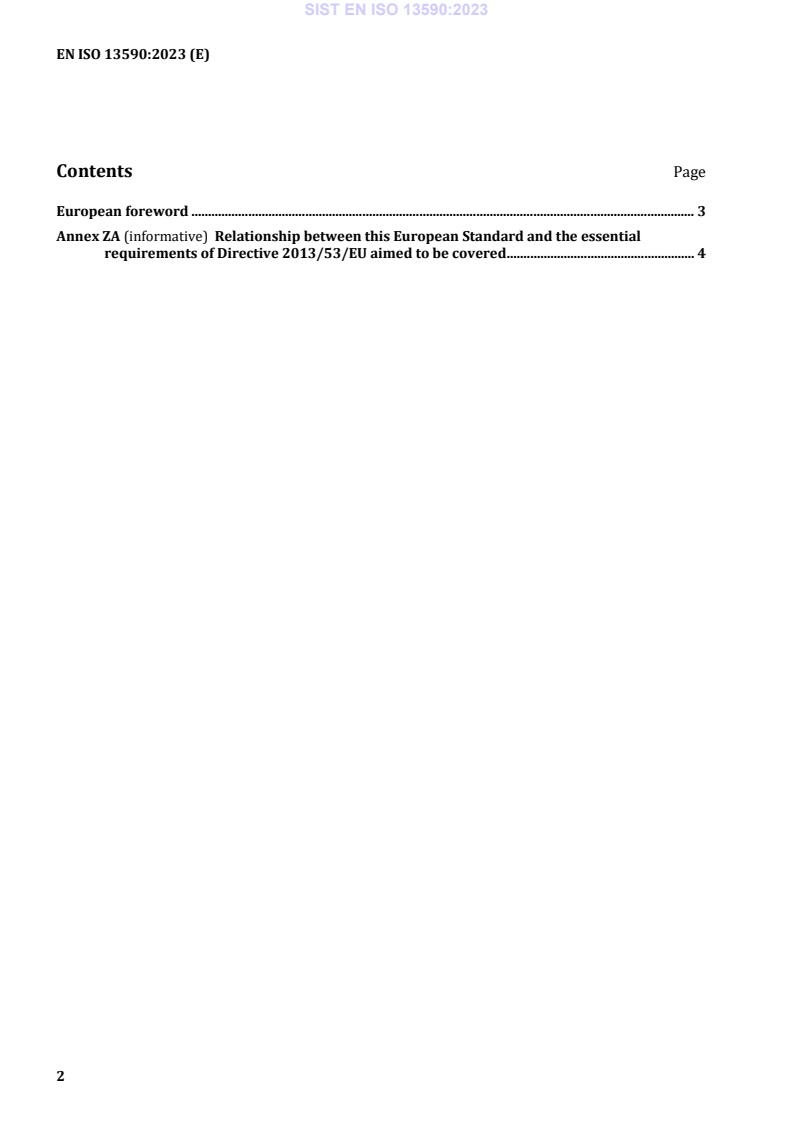
Contents Page
European foreword . 3
Annex ZA (informative) Relationship between this European Standard and the essential
requirements of Directive 2013/53/EU aimed to be covered . 4
European foreword
This document (EN ISO 13590:2023) has been prepared by Technical Committee ISO/TC 188 "Small
craft" in collaboration with Technical Committee CEN/TC 464 “Small Craft” the secretariat of which is
held by SIS.
This European Standard shall be given the status of a national standard, either by publication of an
identical text or by endorsement, at the latest by September 2023, and conflicting national standards shall
be withdrawn at the latest by March 2024.
Attention is drawn to the possibility that some of the elements of this document may be the subject of
patent rights. CEN shall not be held responsible for identifying any or all such patent rights.
This document supersedes EN ISO 13590:2018.
This document has been prepared under a Standardization Request given to CEN by the European
Commission and the European Free Trade Association, and supports essential requirements of EU
Directive(s) / Regulation(s).
For the relationship with EU Directive(s) / Regulation(s), see informative Annex ZA, which is an integral
part of this document.
Any feedback and questions on this document should be directed to the users’ national standards
body/national committee. A complete listing of these bodies can be found on the CEN website.
According to the CEN-CENELEC Internal Regulations, the national standards organizations of the
following countries are bound to implement this European Standard: Austria, Belgium, Bulgaria, Croatia,
Cyprus, Czech Republic, Denmark, Estonia, Finland, France, Germany, Greece, Hungary, Iceland, Ireland,
Italy, Latvia, Lithuania, Luxembourg, Malta, Netherlands, Norway, Poland, Portugal, Republic of North
Macedonia, Romania, Serbia, Slovakia, Slovenia, Spain, Sweden, Switzerland, Türkiye and the United
Kingdom.
Endorsement notice
The text of ISO 13590:2022 has been approved by CEN as EN ISO 13590:2023 without any modification.
Annex ZA
(informative)
Relationship between this European Standard and the essential
requirements of Directive 2013/53/EU aimed to be covered
This European Standard has been prepared under a Commission’s standardization request
M/542/C(2015) 8736 final to provide one voluntary means of conforming to essential requirements of
Directive 2013/53/EU.
Once this standard is cited in the Official Journal of the European Union under that Directive, compliance
with the normative clauses of this standard given in Table ZA.1 confers, within the limits of the scope of
this standard, a presumption of conformity with the corresponding essential requirements of that
Directive, and associated EFTA regulations.
Table ZA.1 — Correspondence between this European Standard and Annex I and II of Directive
2013/53/EU
Essential Requirements of Clause(s)/sub-clause(s) Remarks/Notes
Directive 2013/53/EU of this EN
Annex I, Part A, 5.2 - Fuel system 6
Annex I, Part A, 5.3 – Electrical 7
system
Annex I, Part A, 5.1.2 - 8 The ingress of water into the
Ventilation. engine compartment is
not dealt with in this standard; the
personal watercraft
must pass the floatation test when
swamped.
Annex I, Part A, 3.1 - Structure 9 Clause 9 specifies testing to
ensure that there are no
structural failures
Annex I, Part A, 3.2 – Stability and 12 The document does not address
Freeboard freeboard requirements.
Annex I, Part A, 3.3 – Buoyancy 10 In respect of means of floatation in
and floatation the swamped condition only.
Annex I, Part A, 5.4.1 – Steering 10 Document does not address
system; general emergency steering arrangements
Annex I, Part A, 5.1.5 – Personal 13 Automatic devices to provide
watercraft running without reduced speed, circular, forward
driver movement when the driver
dismounts
deliberately or falls overboard are
not addressed by this
document
Annex I, Part A, 2.3 – Protection 14 In respect of means of reboarding
from falling overboard an d only.
means of reboarding
Annex I, Part A, 3.9 – Anchoring, 15 Clause 15 only specifies point for
mooring and towing accepting towing
loading.
Annex I, Part A, 2.5 – Owner’s 18
manual
Table ZA.2 — Applicable Standards to confer presumption of conformity as described in this
Annex ZA
Column 4
Column 1 Column 2
Column 3
Reference in International
Corresponding European
Title
Clause 2 Standard Edition
Standard Edition
Rubber, vulcanized or
thermoplastic — For applicable standard edition
ISO 1817:2015 ISO 1817:2015
Determination of the effect of see column 2
liquids
Rubber and plastics hoses —
Assessment of ozone
ISO 7326:2016 ISO 7326:2016 EN ISO 7326:2016
resistance under static
conditions
Small craft — Fire-resistant
ISO 7840:2021 ISO 7840:2021
EN ISO 7840:2021
fuel hoses
ISO 8469:2021 ISO 8469:2021 Small craft — Non-fire- EN ISO 8469:2021
resistant fuel hoses
The documents listed in the Column 1 of Table ZA.2, in whole or in part, are normatively referenced in
this document, i.e. are indispensable for its application. The achievement of the presumption of
conformity is subject to the application of the edition of Standards as listed in Column 4 or, if no European
Standard Edition exists, the International Standard Edition given in Column 2 of Table ZA.2.
WARNING 1 — Presumption of conformity stays valid only as long as a reference to this European
Standard is maintained in the list published in the Official Journal of the European Union. Users of this
standard should consult frequently the latest list published in the Official Journal of the European Union.
WARNING 2 — Other Union legislation may be applicable to the product(s) falling within the scope of
this standard.
INTERNATIONAL ISO
STANDARD 13590
Third edition
2022-06
Small craft — Personal watercraft —
Construction and system installation
requirements
Petits navires — Véhicules nautiques à moteur — Exigences de
construction et d'installation des systèmes
Reference number
ISO 13590:2022(E)
ISO 13590:2022(E)
© ISO 2022
All rights reserved. Unless otherwise specified, or required in the context of its implementation, no part of this publication may
be reproduced or utilized otherwise in any form or by any means, electronic or mechanical, including photocopying, or posting on
the internet or an intranet, without prior written permission. Permission can be requested from either ISO at the address below
or ISO’s member body in the country of the requester.
ISO copyright office
CP 401 • Ch. de Blandonnet 8
CH-1214 Vernier, Geneva
Phone: +41 22 749 01 11
Email: copyright@iso.org
Website: www.iso.org
Published in Switzerland
ii
ISO 13590:2022(E)
Contents Page
Foreword .v
1 Scope . 1
2 Normative references . 1
3 Terms and definitions . 1
4 Builder’s plate . 4
5 Watercraft identification . 4
6 Fuel system . 4
6.1 General . 4
6.2 Fuel tanks . 4
6.2.1 Materials prohibited for fuel tanks . 4
6.2.2 Fuel level indication . 4
6.2.3 Tank pressure limitation . . 5
6.2.4 Fill and vent openings . 5
6.2.5 Fuel tank static-pressure test . 5
6.2.6 Fuel tank shock test . 5
6.3 Fuel tank installations . 6
6.3.1 Non-encased metallic fuel tanks . 6
6.4 Fuel tank filling system . 6
6.5 Fuel pumps . 6
6.6 Fuel stop valves . 6
6.7 Fuel filters and strainers . 6
6.8 Spud, pipe and hose fitting . . 6
6.9 Clips, straps and hose clamps . 6
6.10 Metallic fuel line . 7
6.11 Plugs and fittings . 7
6.12 Vent and fuel distribution hoses and connections . 7
6.13 Fuel fill system grounding . 7
6.14 Fire test . 7
6.15 Fuel-hose specifications . 8
6.15.1 General . 8
6.15.2 Tensile strength and elongation . 8
6.15.3 Dry heat resistance . 8
6.15.4 Ozone resistance . 8
6.15.5 Oil resistance . 8
6.15.6 Burst test . 9
6.15.7 Vacuum collapse test . 9
6.15.8 Cold flexibility . 9
6.15.9 Adhesion test (reinforced hose with cover) . 9
6.15.10 Fuel resistance . 9
7 Electrical system . .10
7.1 Exemptions . 10
7.2 Conductor type, size and identification . 10
7.3 Conductor support and protection .12
7.4 External ignition protection. 12
7.5 Overcurrent protection .12
7.6 Conductor terminations . 13
7.7 Batteries . 14
7.8 Secondary circuits of ignition systems . 15
8 Ventilation .15
9 Hull structure test .16
9.1 Drop test . 16
iii
ISO 13590:2022(E)
9.2 Testing . 16
9.3 Passing or failing the test . 16
10 Floatation test .16
10.1 General . 16
10.2 Test conditions . 16
10.3 Test procedure . 16
10.4 Acceptance level . 16
10.5 Floatation material . 17
10.5.1 Introduction . 17
10.5.2 Vapour test . 17
10.5.3 Petrol test lasting 24 h . 17
10.5.4 Petrol test lasting 30 days. 17
10.5.5 Oil test lasting 24 h . 17
10.5.6 Oil test lasting 30 days . 17
10.5.7 Bilge cleaner test lasting 24 h . 17
10.5.8 Bilge cleaner test lasting 30 days . 18
11 Steering-system test.18
11.1 General . 18
11.2 Axial force test . 18
11.3 Tangential force test . 18
11.4 Fatigue test. 18
11.5 Impact test . 18
11.5.1 Impact test 1 . 18
11.5.2 Impact test 2 . 18
12 Stability .19
13 Propulsion engine cut-off device .20
13.1 General . 20
13.2 Cut-off device requirements .20
13.3 Mechanical devices employing a physical attachment to the operator .20
13.4 Testing . 20
14 Means of reboarding .21
15 Towing . .22
16 Off throttle steering when underway .22
17 Flooding — Detection and removal of water .22
18 Owner’s manual .22
Annex A (normative) Test conditions, procedures and performance requirements for
evaluating the off throttle steering capabilities of personal watercraft .23
Bibliography .28
iv
ISO 13590:2022(E)
Foreword
ISO (the International Organization for Standardization) is a worldwide federation of national standards
bodies (ISO member bodies). The work of preparing International Standards is normally carried out
through ISO technical committees. Each member body interested in a subject for which a technical
committee has been established has the right to be represented on that committee. International
organizations, governmental and non-governmental, in liaison with ISO, also take part in the work.
ISO collaborates closely with the International Electrotechnical Commission (IEC) on all matters of
electrotechnical standardization.
The procedures used to develop this document and those intended for its further maintenance are
described in the ISO/IEC Directives, Part 1. In particular, the different approval criteria needed for the
different types of ISO documents should be noted. This document was drafted in accordance with the
editorial rules of the ISO/IEC Directives, Part 2 (see www.iso.org/directives).
Attention is drawn to the possibility that some of the elements of this document may be the subject of
patent rights. ISO shall not be held responsible for identifying any or all such patent rights. Details of
any patent rights identified during the development of the document will be in the Introduction and/or
on the ISO list of patent declarations received (see www.iso.org/patents).
Any trade name used in this document is information given for the convenience of users and does not
constitute an endorsement.
For an explanation of the voluntary nature of standards, the meaning of ISO specific terms and
expressions related to conformity assessment, as well as information about ISO’s adherence to
the World Trade Organization (WTO) principles in the Technical Barriers to Trade (TBT), see
www.iso.org/iso/foreword.html.
This document was prepared by Technical Committee ISO/TC 188, Small craft, in collaboration with
the European Committee for Standardization (CEN) Technical Committee CEN/TC 464, Small craft, in
accordance with the Agreement on technical cooperation between ISO and CEN (Vienna Agreement).
This third edition cancels and replaces the second edition (ISO 13590:2003), which has been technically
revised.
The main changes are as follows:
— in Clause 1, it has been clarified that outboard powered personal watercraft and jet powered
surfboards are outside the scope of this document;
— comparing all values to SAE and industry standards;
— using the single term “craft’s ground” for both “earthed” and “ground”;
— requirements for watercraft identification have been added in new Clause 5;
— requirements for cellular plastic used to encase metallic fuel tanks have been removed (former 5.2.2);
— requirements for plastic-encased metallic fuel tanks have been removed (former 5.3.2);
— requirements for carburettors have been removed (former 5.6);
— the fuel fill system grounding value in 6.13 has been corrected;
— requirements for propulsion engine cut-off device have been added in new Clause 13;
— requirements for off throttle steering when underway have been added in Clause 16;
— requirements for the owner’s manual have been added in Clause 18;
— off-throttle steering testing methods have been added in new Annex A.
v
ISO 13590:2022(E)
Any feedback or questions on this document should be directed to the user’s national standards body. A
complete listing of these bodies can be found at www.iso.org/members.html.
vi
INTERNATIONAL STANDARD ISO 13590:2022(E)
Small craft — Personal watercraft — Construction and
system installation requirements
1 Scope
This document specifies construction and system installation requirements for personal watercraft.
It addresses the builder’s plate, watercraft identification, permanently installed petrol fuel systems,
electrical systems, steering systems, ventilation, hull structure and floatation, stability, mooring and
towing, flooding, off-throttle steering and the owner’s manual.
This document does not apply to outboard powered personal watercraft and jet powered surfboards.
2 Normative references
The following documents are referred to in the text in such a way that some or all of their content
constitutes requirements of this document. For dated references, only the edition cited applies. For
undated references, the latest edition of the referenced document (including any amendments) applies.
ISO 1817:2022, Rubber, vulcanized or thermoplastic — Determination of the effect of liquids
ISO 7326:2016, Rubber and plastics hoses — Assessment of ozone resistance under static conditions
ISO 7840:2021, Small craft — Fire-resistant fuel hoses
ISO 8469:2021, Small craft — Non-fire-resistant fuel hoses
3 Terms and definitions
For the purposes of this document, the following terms and definitions apply.
ISO and IEC maintain terminology databases for use in standardization at the following addresses:
— ISO Online browsing platform: available at https:// www .iso .org/ obp
— IEC Electropedia: available at https:// www .electropedia .org/
3.1
personal watercraft
watercraft intended for sports and leisure purposes, of less than 4 m in hull length, which uses a
propulsion engine having a water jet pump as its primary source of propulsion and is designed to be
operated by a person or persons sitting, standing, or kneeling on, rather than within the confines of a
hull
Note 1 to entry: The measurement methodology for the length of hull is defined in ISO 8666.
3.2
fuel system
entire assembly of the fuel fill, vent, tank and distribution components, including but not limited to
pumps, valves, strainers, and filters
3.3
static floating position
condition in which a personal watercraft floats in calm water, with each fuel tank filled to its rated
capacity, but with no person or items of portable equipment on board
ISO 13590:2022(E)
3.4
conduit
any type of rigid plastic or metal piping or tubing that supports the conductors contained within
3.5
sheath
material used as a continuous protective covering, such as electrical tape, moulded rubber, moulded
plastic or flexible tubing, around one or more insulated conductors
3.6
open to the atmosphere
space or compartment that has at least 0,34 m of open area directly exposed to the atmosphere for
each cubic metre of net compartment volume
3.7
engine compartment
space where the engine is permanently installed
3.8
bilge
area, excluding engine compartments (3.7), in the personal watercraft, below a height of 100 mm
measured from the lowest point in the personal watercraft, where liquid can collect when the personal
watercraft is in its static floating position (3.3)
3.9
engine compartment bilge
space in the engine compartment (3.7) or a connected compartment, below a height of 300 mm measured
from the lowest point, where liquid can collect when the personal watercraft is in its static floating
position (3.3)
3.10
builder’s plate
label or plate to display basic user information related to the personal watercraft
3.11
handlebar
mechanical means for applying manual steering effort into the connected helm (3.12), normally a
horizontal configuration with hand grips at each end
3.12
helm
mechanism, exclusive of handlebars (3.11) or other means for manual application of a controlling force,
by which the controlling force is fed into a personal watercraft steering system
3.13
craft’s ground
ground that is established by a conducting connection (intended or accidental) with the common
ground (potential of the earth’s surface), including any conductive part of the wetted surface of the hull
Note 1 to entry: “Ground” is also known as “earth”.
1)
[SOURCE: ISO 10088:— , 3.12]
1) Under preparation. Stage at the time of publication: ISO/FDIS 10088:2021.
ISO 13590:2022(E)
3.14
normal accumulation of bilge water
minor amounts of water collecting in the bilge (3.8) from spray, rain seepage and spillage that can be
removed by bilge pumps
Note 1 to entry: The height of the normal accumulation of bilge water is below the lowest part of the engine, or
measured at the top of the bilge pump inlet or the bilge pump automatic float switch.
3.15
accessible
capable of being reached for inspection, removal or maintenance without removal of permanent craft
structure
3.16
readily accessible
capable of being reached for use, inspection, removal or maintenance without the use of tools
3.17
propulsion engine cut-off device
switch or other system that, when activated in an emergency, provides the means to shut off the
mechanical propulsion system
3.18 Terms related to the off-throttle testing (see Annex A)
3.18.1
advance
distance travelled along an extension of a previous straight line course measured from the completion
of steer input
3.18.2
apex marker
test triangle (3.18.7) marker closest to the turn markers (3.18.9)
3.18.3
entrance chute
area of the test course between the gate markers (3.18.4) and the turn markers (3.18.9)
3.18.4
gate marker
marker at the beginning of the entrance chute (3.18.3)
3.18.5
off throttle condition
condition where the forward thrust throttle is completely released by the operator and the engine
returns to idle
3.18.6
off throttle steering
any means provided with the personal watercraft that allows manoeuvring of the craft in an off throttle
condition (3.18.5)
3.18.7
test triangle
area, outlined by markers, that the personal watercraft is not meant to enter during the test
3.18.8
transfer
perpendicular distance from an extension of a previously straight line course
ISO 13590:2022(E)
3.18.9
turn marker
marker at the end of the entrance chute (3.18.3)
4 Builder’s plate
Personal watercraft shall display a permanently installed builder’s plate.
NOTE Requirements for builder’s plate are found in ISO 14945.
5 Watercraft identification
Personal watercraft shall display a permanent identification number.
NOTE 1 The identification number is subject to certain international as well as national regulations.
NOTE 2 Requirements for the identification number are found in ISO 10087.
6 Fuel system
6.1 General
6.1.1 Each fuel system fitting, joint and connection shall be accessible.
6.1.2 The fuel system shall be designed not to leak liquid fuel into the personal watercraft when
a) the personal watercraft is overturned through 180° of roll in either direction, or
b) the personal watercraft is overturned through 90° of pitch in either direction.
6.1.3 The fuel system shall be designed not to leak liquid fuel into the personal watercraft when
subjected to the greater of the following two values: 20 kPa or 1,5 times the highest hydrostatic
pressure to which the component can be subjected in service.
6.1.4 The fuel system shall be designed to supply fuel to the engine within 10 s of the engine being
energized and automatically stop the supply of fuel within 10 s of the engine being de-energized.
6.2 Fuel tanks
6.2.1 Materials prohibited for fuel tanks
6.2.1.1 A fuel tank shall not be constructed of terneplate.
6.2.1.2 Unless it has an inorganic sacrificial galvanic coating on the inside and outside of the tank, a
fuel tank shall not be constructed of black iron or steel.
6.2.1.3 A metallic fuel tank encased in cellular plastic or in fibre-reinforced plastic shall not be
constructed from a ferrous alloy.
6.2.2 Fuel level indication
A means shall be provided to check the fuel level, or a reserve fuel supply shall be provided.
ISO 13590:2022(E)
6.2.3 Tank pressure limitation
With the personal watercraft in its static floating position, a fuel tank, when filled, shall have an air-
expansion volume or be equipped with a system that prevents pressure in the tank from exceeding
80 % of the fuel tank design pressure.
6.2.4 Fill and vent openings
Fill and vent openings shall be at or above the liquid level when the tank is filled to its rated capacity
with the personal watercraft in its static floating position.
The vent-line termination or a gooseneck in the vent-line routing shall be arranged at sufficient height
to prevent spillage of fuel through the vent line during filling under normal operating conditions of the
personal watercraft.
6.2.5 Fuel tank static-pressure test
6.2.5.1 A representative fuel tank shall not leak if tested using the procedures specified in 6.2.5.2 and
6.2.5.3.
6.2.5.2 Fill the tank with air or inert gas to exceed 80 % of the maximum test pressure of 21 kPa.
6.2.5.3 Tank fittings and seams shall be checked for leaks using a method other than the pressure
drop test.
NOTE Soapy test solutions must be non-corrosive and non-toxic. Ammonia, present in some soaps and
detergents, creates a condition that attacks brass fittings like those used in fuel systems. Damage can be
undetectable at first, and these fittings can develop cracks in a matter of months creating a very hazardous
situation.
6.2.6 Fuel tank shock test
6.2.6.1 A representative fuel tank shall not leak when shock tested using the procedures specified in
6.2.6.2 to 6.2.6.7.
6.2.6.2 Confirm that the tank does not leak when pressure tested according to 6.2.5.
6.2.6.3 If the tank is non-metallic, precondition the tank by filling it to capacity with petrol that has
at least a 50 % aromatic content. Keep the fuel in the tank at 21 °C or higher for at least 30 days prior to
testing.
6.2.6.4 Mount the empty shock test tank on an impact-test machine platform in a manner similar to
how the tank is installed in the personal watercraft.
6.2.6.5 Fill the tank to capacity with water.
6.2.6.6 Apply 1 000 cycles of vertical accelerations of 245 m/s at a rate of 80 cycles or less per minute.
Apply the accelerations within 76 mm of the centre of the horizontal mounting surface of the tank.
The duration of each vertical acceleration cycle measured from the base of the shock envelope shall be
between 6 ms and 14 ms.
6.2.6.7 Check the tank for leaks using the procedure specified in 6.2.5.
ISO 13590:2022(E)
6.3 Fuel tank installations
6.3.1 Non-encased metallic fuel tanks
6.3.1.1 Each fuel tank shall not support a deck, bulkhead or other structural component.
6.3.1.2 Fuel tanks shall not be integral with the hull or engine.
6.3.1.3 Each metallic fuel tank installed shall allow water to drain from the top surface when the
personal watercraft is in its static floating position.
6.3.1.4 Each fuel tank support, chock or strap that is not integral with a metallic fuel tank shall be
separated from the tank surface by a material that does not absorb moisture.
6.3.1.5 Cellular plastic shall not be the sole support for a metallic fuel tank.
6.4 Fuel tank filling system
6.4.1 Each fuel fill opening shall be located so that, when the personal watercraft is in its static floating
position, a fuel overflow of up to 19 l/min for at least 5 s does not enter the enclosed compartments of
the personal watercraft when all compartment openings are closed.
6.4.2 Each hose in the tank filling system shall be secured to a pipe, spud or hose fitting by a method
that prevents leaks and prevents the hose from becoming disconnected.
6.5 Fuel pumps
6.5.1 Each fuel pump with a diaphragm shall not leak fuel into the personal watercraft if the primary
diaphragm fails.
6.6 Fuel stop valves
Each electrically operated fuel stop valve in a fuel line between the fuel tank and the engine shall open
only when the ignition switch is on.
6.7 Fuel filters and strainers
Each fuel filter and strainer shall be supported on the engine or watercraft structure independent from
its fuel-line connections, unless the fuel filter or strainer is inside a fuel-system component.
6.8 Spud, pipe and hose fitting
Except when used for a tank filling line, each spud, pipe or hose fitting used with hose clamps shall have
a bead, flare or a series of annular grooves or serration no less than 0,4 mm in depth.
6.9 Clips, straps and hose clamps
6.9.1 Clips, straps and hose clamps shall be of a corrosion resistant material
...