

EN ISO 14877:2002
(Main)Protective clothing for abrasive blasting operations using granular abrasives (ISO 14877:2002)
- Abstract
This European Standard specifies minimum requirements and test methods for protective clothing for abrasive
blasting operations and for hand protection, for the treatment of surfaces with granular abrasives propelled by
compressed air or by mechanical means. The protection against substances that develop during the blasting
operation as well as connections between the protective clothing and the respiratory protective device are also
covered.
This European Standard does not apply to steam blasting, jet blasting and flame blasting operations.
- Status
- Published
- Publication Date
- 14-Oct-2002
- Technical Committee
- CEN/TC 162 - Protective clothing including hand and arm protection and lifejackets
- Drafting Committee
- CEN/TC 162/WG 5 - Resistance to mechanical impact of protective clothing
- Current Stage
- 9093 - Decision to confirm - Review Enquiry
- Start Date
- 22-Sep-2006
- Completion Date
- 22-Sep-2006
- Directive
- 2016/425 - Regulation (EU) 2016/425 of the European Parliament and of the Council of 9 March 2016 on personal protective equipment and repealing Council Directive 89/686/EECOJ Ref: C, C 113 OJ Date: 27-Mar-2018
89/686/EEC - Personal protective equipment (PPE)OJ Ref: C 203, C 24, C 247, C 306, C 46, C 91 OJ Date: 28-Aug-2003

Overview
EN ISO 14877:2002 - Protective clothing for abrasive blasting operations using granular abrasives - is a CEN-adopted ISO standard that specifies minimum requirements and test methods for clothing and hand protection used when treating surfaces with granular abrasives propelled by compressed air or mechanical means. The standard addresses protection against rebounding abrasives, dust and other substances generated during blasting, and covers interfaces between clothing and respiratory protective devices. It does not apply to steam, jet or flame blasting operations.
Key topics and technical requirements
- Scope and definitions: Terms such as “abrasive blasting operation”, “abrasives” and “abrasive blasting combination” are defined to clarify application.
- Types of clothing:
- Type 1: Body protection independent of respiratory equipment.
- Type 2: Body protection designed to be used with respiratory protective devices.
- Type 3: Dust-tight whole‑body protection used with respiratory devices.
- Protective gloves:
- Compliance with EN 420 general glove requirements.
- Minimum performance levels per EN 388: abrasion resistance level 3 (≈2 000 cycles), blade cut level 1, tear resistance level 3 (≈50 N), puncture resistance level 3 (≈100 N).
- Minimum dexterity: pin diameter 11 mm (EN 420 level 1).
- Minimum glove lengths specified by hand size (e.g., size 7 = 295 mm up to size 11 = 350 mm).
- Material and construction tests:
- Dimensional change (EN 340), breaking strength (≥450 N unless elongation >50 %), seam strength (≥200 N), puncture resistance (≥30 N), tear resistance, and resistance against abrasive wear.
- Additional tests for Type 3 (dust-tight) garments and flammability/abrasion evaluations.
- Marking & information: Requirements for manufacturer marking and user information, including compatibility with respiratory protective equipment.
Practical applications and who uses this standard
- Intended for PPE manufacturers designing protective suits and gloves for abrasive blasting.
- Used by safety managers, specifiers, procurement teams and occupational health professionals to select compliant protective clothing.
- Valuable to abrasive blasting contractors, surface treatment plants, and respiratory equipment suppliers to ensure integrated protection (clothing + respirator).
- Supports regulatory compliance and purchasing specifications for operations that use compressed-air or mechanically propelled granular abrasives.
Related standards
- EN 340 (Protective clothing - General requirements)
- EN 388 / EN 420 (Protective gloves - mechanical risks / general)
- EN 466, EN 270, EN 271 (connections to respiratory protective devices)
- ISO 4674, EN ISO 13934, EN ISO 13937 series (material test methods)
Keywords: EN ISO 14877:2002, protective clothing, abrasive blasting, granular abrasives, protective gloves, dust-tight, respiratory protective device, PPE standard.
Relations
- Effective Date
- 25-Aug-2026
- Effective Date
- 25-Aug-2026
- Effective Date
- 25-Aug-2026
- Effective Date
- 25-Aug-2026
- Effective Date
- 09-Feb-2026
- Effective Date
- 28-Jan-2026
- Effective Date
- 28-Jan-2026
- Effective Date
- 28-Jan-2026
- Effective Date
- 28-Jan-2026
- Effective Date
- 28-Jan-2026
- Effective Date
- 28-Jan-2026
- Effective Date
- 28-Jan-2026
- Effective Date
- 28-Jan-2026
- Effective Date
- 28-Jan-2026
- Effective Date
- 28-Jan-2026
Get Certified
Connect with accredited certification bodies for this standard

CIS Institut d.o.o.
Personal Protective Equipment (PPE) certification body. Notified Body NB-2890 for EU Regulation 2016/425 PPE.

Kiwa BDA Testing
Building and construction product certification.
Kmetijski inštitut Slovenije
Agricultural Institute of Slovenia. Soil testing, plant health, agricultural product analysis.
Sponsored listings
Frequently Asked Questions
EN ISO 14877:2002 is a standard published by the European Committee for Standardization (CEN). Its full title is "Protective clothing for abrasive blasting operations using granular abrasives (ISO 14877:2002)". This standard covers: This European Standard specifies minimum requirements and test methods for protective clothing for abrasive blasting operations and for hand protection, for the treatment of surfaces with granular abrasives propelled by compressed air or by mechanical means. The protection against substances that develop during the blasting operation as well as connections between the protective clothing and the respiratory protective device are also covered. This European Standard does not apply to steam blasting, jet blasting and flame blasting operations.
This European Standard specifies minimum requirements and test methods for protective clothing for abrasive blasting operations and for hand protection, for the treatment of surfaces with granular abrasives propelled by compressed air or by mechanical means. The protection against substances that develop during the blasting operation as well as connections between the protective clothing and the respiratory protective device are also covered. This European Standard does not apply to steam blasting, jet blasting and flame blasting operations.
EN ISO 14877:2002 is classified under the following ICS (International Classification for Standards) categories: 13.340.10 - Protective clothing. The ICS classification helps identify the subject area and facilitates finding related standards.
EN ISO 14877:2002 has the following relationships with other standards: It is inter standard links to ISO 4674:1977, ISO 6330:2000, ISO 1421:1998, ISO 3758:2005, ISO 3175-2:2010, EN 270:1994, EN ISO 10642:2004, EN 530:2010, EN ISO 13937-2:2000, EN ISO 13934-2:2014, EN 340:1993, EN 420:1994, EN 388:1994, EN ISO 14253-3:2011, EN 1463-2:2000. Understanding these relationships helps ensure you are using the most current and applicable version of the standard.
EN ISO 14877:2002 is associated with the following European legislation: EU Directives/Regulations: 2016/425, 89/686/EEC, 93/68/EEC, 93/95/EEC, 96/58/EC; Standardization Mandates: M/031. When a standard is cited in the Official Journal of the European Union, products manufactured in conformity with it benefit from a presumption of conformity with the essential requirements of the corresponding EU directive or regulation.
EN ISO 14877:2002 is available in PDF format for immediate download after purchase. The document can be added to your cart and obtained through the secure checkout process. Digital delivery ensures instant access to the complete standard document.
Standards Content (Sample)
SLOVENSKI STANDARD
01-januar-2003
Varovalna obleka pri peskanju, kjer se uporabljajo abrazivna sredstva v obliki
granul (ISO 14877:2002)
Protective clothing for abrasive blasting operations using granular abrasives (ISO
14877:2002)
Schutzkleidung für Strahlarbeiten mit körnigen Strahlmitteln (ISO 14877:2002)
Vetements de protection utilisés lors des opérations de projection d'abrasifs en grains
(ISO 14877:2002)
Ta slovenski standard je istoveten z: EN ISO 14877:2002
ICS:
13.340.10 Varovalna obleka Protective clothing
2003-01.Slovenski inštitut za standardizacijo. Razmnoževanje celote ali delov tega standarda ni dovoljeno.
EUROPEAN STANDARD
EN ISO 14877
NORME EUROPÉENNE
EUROPÄISCHE NORM
October 2002
ICS 13.340.10
English version
Protective clothing for abrasive blasting operations using
granular abrasives (ISO 14877:2002)
Vêtements de protection utilisés lors des opérations de Schutzkleidung für Strahlarbeiten mit körnigen Strahlmitteln
projection d'abrasifs en grains (ISO 14877:2002) (ISO 14877:2002)
This European Standard was approved by CEN on 23 November 2001.
CEN members are bound to comply with the CEN/CENELEC Internal Regulations which stipulate the conditions for giving this European
Standard the status of a national standard without any alteration. Up-to-date lists and bibliographical references concerning such national
standards may be obtained on application to the Management Centre or to any CEN member.
This European Standard exists in three official versions (English, French, German). A version in any other language made by translation
under the responsibility of a CEN member into its own language and notified to the Management Centre has the same status as the official
versions.
CEN members are the national standards bodies of Austria, Belgium, Czech Republic, Denmark, Finland, France, Germany, Greece,
Iceland, Ireland, Italy, Luxembourg, Malta, Netherlands, Norway, Portugal, Spain, Sweden, Switzerland and United Kingdom.
EUROPEAN COMMITTEE FOR STANDARDIZATION
COMITÉ EUROPÉEN DE NORMALISATION
EUROPÄISCHES KOMITEE FÜR NORMUNG
Management Centre: rue de Stassart, 36 B-1050 Brussels
© 2002 CEN All rights of exploitation in any form and by any means reserved Ref. No. EN ISO 14877:2002 E
worldwide for CEN national Members.
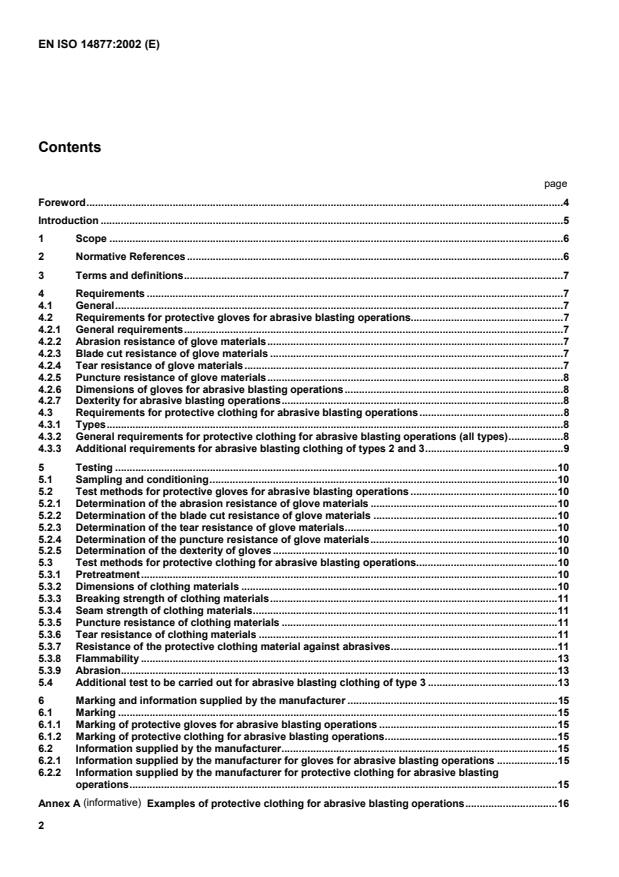
Contents
page
Foreword.4
Introduction .5
1 Scope .6
2 Normative References .6
3 Terms and definitions.7
4 Requirements .7
4.1 General.7
4.2 Requirements for protective gloves for abrasive blasting operations.7
4.2.1 General requirements.7
4.2.2 Abrasion resistance of glove materials.7
4.2.3 Blade cut resistance of glove materials .7
4.2.4 Tear resistance of glove materials.7
4.2.5 Puncture resistance of glove materials.8
4.2.6 Dimensions of gloves for abrasive blasting operations.8
4.2.7 Dexterity for abrasive blasting operations.8
4.3 Requirements for protective clothing for abrasive blasting operations.8
4.3.1 Types.8
4.3.2 General requirements for protective clothing for abrasive blasting operations (all types).8
4.3.3 Additional requirements for abrasive blasting clothing of types 2 and 3.9
5 Testing .10
5.1 Sampling and conditioning.10
5.2 Test methods for protective gloves for abrasive blasting operations .10
5.2.1 Determination of the abrasion resistance of glove materials .10
5.2.2 Determination of the blade cut resistance of glove materials .10
5.2.3 Determination of the tear resistance of glove materials.10
5.2.4 Determination of the puncture resistance of glove materials.10
5.2.5 Determination of the dexterity of gloves .10
5.3 Test methods for protective clothing for abrasive blasting operations.10
5.3.1 Pretreatment.10
5.3.2 Dimensions of clothing materials .10
5.3.3 Breaking strength of clothing materials.11
5.3.4 Seam strength of clothing materials.11
5.3.5 Puncture resistance of clothing materials .11
5.3.6 Tear resistance of clothing materials .11
5.3.7 Resistance of the protective clothing material against abrasives.11
5.3.8 Flammability .13
5.3.9 Abrasion.13
5.4 Additional test to be carried out for abrasive blasting clothing of type 3 .13
6 Marking and information supplied by the manufacturer .15
6.1 Marking .15
6.1.1 Marking of protective gloves for abrasive blasting operations .15
6.1.2 Marking of protective clothing for abrasive blasting operations.15
6.2 Information supplied by the manufacturer.15
6.2.1 Information supplied by the manufacturer for gloves for abrasive blasting operations .15
6.2.2 Information supplied by the manufacturer for protective clothing for abrasive blasting
operations.15
Annex A (informative) Examples of protective clothing for abrasive blasting operations.16
Annex ZA (informative) Clauses of this European Standard addressing essential requirements or other
provisions of EU Directives .18
Bibliography .20
Foreword
The text of EN ISO 14877:2002 has been prepared by Technical Committee CEN/TC 162 “Protective clothing
including hand and arm protection and lifejackets”, the secretariat of which is held by DIN, in collaboration with
Technical Committee ISO/TC 94 "Personal safety - Protective clothing and equipment".
This European Standard shall be given the status of a national standard, either by publication of an identical text or
by endorsement, at the latest by October 2002, and conflicting national standards shall be withdrawn at the latest
by October 2002.
This document has been prepared under a mandate given to CEN by the European Commission and the European
Free Trade Association, and supports essential requirements of EU Directive(s).
For relationship with EU Directive(s), see informative annex ZA, which is an integral part of this document.
Annex A is informative.
According to the CEN/CENELEC Internal Regulations, the national standards organizations of the following
countries are bound to implement this European Standard: Austria, Belgium, Czech Republic, Denmark, Finland,
France, Germany, Greece, Iceland, Ireland, Italy, Luxembourg, Malta, Netherlands, Norway, Portugal, Spain,
Sweden, Switzerland and the United Kingdom.
Introduction
In abrasive blasting, the worker is exposed to hazards caused by the abrasive (direct projection and rebounding
abrasives) and substances produced during the abrasive blasting operation. Depending on the working conditions,
the protection against these hazards requires suitable protective clothing as well as suitable respiratory protective
equipment. For clothing connected to respiratory protective devices, this standard takes into account the
specifications regarding respiratory protective equipment (CEN/TC 79).
1 Scope
This European Standard specifies minimum requirements and test methods for protective clothing for abrasive
blasting operations and for hand protection, for the treatment of surfaces with granular abrasives propelled by
compressed air or by mechanical means. The protection against substances that develop during the blasting
operation as well as connections between the protective clothing and the respiratory protective device are also
covered.
This European Standard does not apply to steam blasting, jet blasting and flame blasting operations.
2 Normative References
This European Standard incorporates by dated or undated reference, provisions from other publications. These
normative references are cited at the appropriate places in the text, and the publications are listed hereafter. For
dated references, subsequent amendments to or revisions of any of these publications apply to this European
Standard only when incorporated in it by amendment or revision. For undated references the latest edition of the
publication referred to applies (including amendments).
EN 270:1994, Respiratory protective devices - Compressed air line breathing apparatus incorporating a hood -
Requirement, testing, marking.
EN 271, Respiratory protective devices - Compressed air line or powered fresh air hose breathing apparatus
incorporating a hood for use in abrasive blasting operations - Requirements, testing, marking.
EN 340:1993, Protective clothing - General requirements.
EN 388:1994, Protective gloves against mechanical risks.
EN 420:1994, General requirements for gloves.
EN 466:1995/A1, Protective clothing - Protection against liquid chemicals - Performance requirements for chemical
protective clothing with liquid-tight connections between different parts of the clothing (Type 3 Equipment).
EN 530, Abrasion resistance of protective clothing material - Test methods.
EN 863, Protective clothing - Mechanical properties - Test method: Puncture resistance.
ISO 1421, Fabrics coated with rubber of plastics - Determination of breaking strength and elongation at break.
ISO 3175-2, Textiles - Dry cleaning and finishing - Part 2: Procedures for tetrachloroethene.
ISO 3758, Textiles - Care labelling code using symbols.
ISO 4674, Fabrics coated with rubber or plastics - Determination of tear resistance.
ISO 6330, Textiles - Domestic washing and drying procedures for textile testing.
EN ISO 13934-1, Textiles - Tensile properties of fabrics - Part 1: Determination of maximum force and elongation at
maximum force - Strip method.
EN ISO 13934-2, Textiles - Tensile properties of fabrics - Part 2: Determination of maximum force - Grab method.
EN ISO 13937-2, Textiles - Tearing properties of fabrics - Part 2: Trouser method.
3 Terms and definitions
For the purposes of this European Standard, the terms and definitions of EN 340 and EN 420 and the following
terms and definitions apply.
3.1
abrasive blasting operation
method for the treatment of surfaces by directing propelled abrasives onto the surface. During the blasting
operation the abrasive blasting operator and the blasted material are in a confined room or outdoors. The abrasive
blasting operator is directly exposed to the abrasive rebounding from the blasted material, the carrier medium and
developing dusts
3.2
abrasives
granular materials that are directed onto the surface of the blasted material at a high speed for surface treatment
3.3
abrasive blasting combination
combination of protective clothing protecting against the risks arising in abrasive blasting operations and suitable
respiratory protective equipment
4 Requirements
4.1 General
Materials that may come into direct contact with the wearer's skin shall not be known to be likely to cause skin
irritation or any other adverse effect to health.
The finish of any part of the equipment likely to be in contact with the wearer shall be free from sharp edges and
burrs.
4.2 Requirements for protective gloves for abrasive blasting operations
4.2.1 General requirements
Protective gloves for abrasive blasting operations shall comply with the requirements specified in EN 420:1994, 4.1,
4.2, 4.4, and 4.5.
The protective performance of the gloves shall be ensured evenly for all parts of the hand.
4.2.2 Abrasion resistance of glove materials
When tested in accordance with 5.2.1, the abrasion resistance of the glove material shall meet at least
performance level 3 in accordance with EN 388:1994, clause 4. This corresponds to an abrasion resistance of
2 000 cycles.
4.2.3 Blade cut resistance of glove materials
When tested in accordance with 5.2.2, the blade cut resistance of the glove material shall meet at least
performance level 1 in accordance with EN 388:1994, clause 4. This corresponds to a blade cut resistance of
index 1,2.
4.2.4 Tear resistance of glove materials
When tested in accordance with 5.2.3, the tear resistance of the glove material shall meet at least performance
level 3 in accordance with EN 388:1994, clause 4.
...