


EN ISO 7328:2008
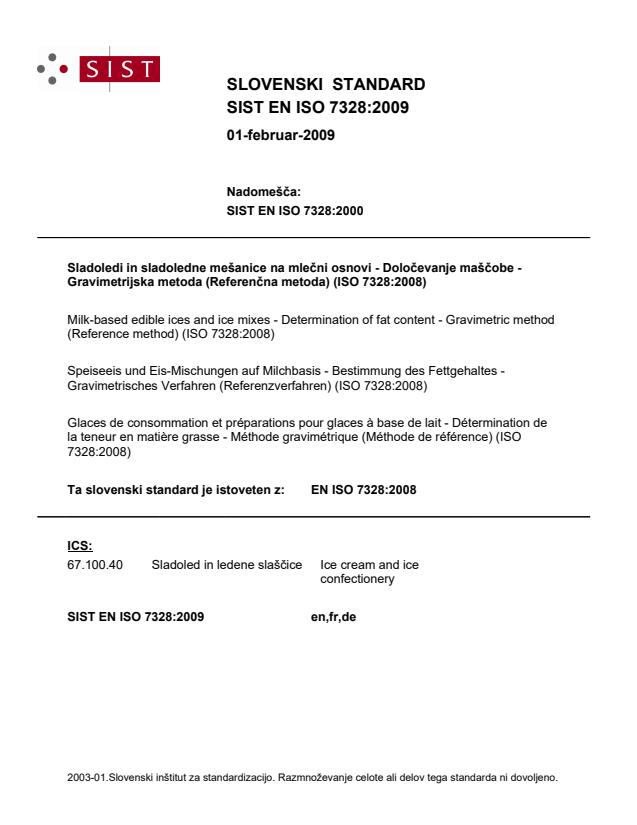
(Main)Milk-based edible ices and ice mixes - Determination of fat content - Gravimetric method (Reference method) (ISO 7328:2008)
Milk-based edible ices and ice mixes - Determination of fat content - Gravimetric method (Reference method) (ISO 7328:2008)
ISO 7328¦IDF 116:2008 specifies the reference method for the determination of the fat content of most milk-based edible ices and ice mixes.
The method is also applicable to concentrated and dried ice mixes.
The method is not applicable to some milk-based edible ices and ice mixes, in which the level of emulsifier, stabilizer or thickening agent or of egg yolk or of fruits, or of combinations of these constituents makes the Roese-Gottlieb method unsuitable.
Speiseeis und Eis-Mischungen auf Milchbasis - Bestimmung des Fettgehaltes - Gravimetrisches Verfahren (Referenzverfahren) (ISO 7328:2008)
Diese Internationale Norm legt das Referenzverfahren für die Bestimmung des Fettgehaltes der meisten Speiseeissorten und Eis-Mischungen zur Herstellung von Speiseeis auf Milchbasis fest.
Dieses Verfahren gilt auch für konzentrierte und getrocknete Eis-Mischungen (Eis-Mix-Pulver) auf Milchbasis.
Das Verfahren gilt nicht für einige Speiseeissorten und Eis-Mischungen zur Herstellung von Speiseeis auf Milchbasis für die das Röse-Gottlieb-Verfahren aufgrund des Gehalts an Emulgatoren, Stabilisatoren, Ver-dickungsmitteln, Eigelb oder Früchten oder einer Kombination dieser Bestandteile ungeeignet ist.
ANMERKUNG Bei derartigen Produkten ist ein Verfahren geeignet, das nach dem Weibull-Berntrop-Prinzip arbeitet (siehe ISO 8262-2|IDF 124-2 [3]).
Glaces de consommation et préparations pour glaces à base de lait - Détermination de la teneur en matière grasse - Méthode gravimétrique (Méthode de référence) (ISO 7328:2008)
L'ISO 7328|FIL 116:2008 spécifie la méthode de référence pour la détermination de la teneur en matière grasse dans la plupart des glaces de consommation et préparations pour glaces à base de lait.
La méthode est également applicable aux préparations pour glaces concentrées et en poudre.
La méthode n'est pas applicable à certaines glaces de consommation et préparations pour glaces à base de lait, dont le taux d'agents émulsifiant, stabilisant, épaississant ou de jaune d'œuf ou de fruits, ou des combinaisons de ces constituants, rend la méthode Röse-Gottlieb inutilisable.
Sladoledi in sladoledne mešanice na mlečni osnovi - Določevanje maščobe - Gravimetrijska metoda (Referenčna metoda) (ISO 7328:2008)
General Information
Relations

Standards Content (Sample)
2003-01.Slovenski inštitut za standardizacijo. Razmnoževanje celote ali delov tega standarda ni dovoljeno.Speiseeis und Eis-Mischungen auf Milchbasis - Bestimmung des Fettgehaltes - Gravimetrisches Verfahren (Referenzverfahren) (ISO 7328:2008)Glaces de consommation et préparations pour glaces à base de lait - Détermination de la teneur en matière grasse - Méthode gravimétrique (Méthode de référence) (ISO 7328:2008)Milk-based edible ices and ice mixes - Determination of fat content - Gravimetric method (Reference method) (ISO 7328:2008)67.100.40Ice cream and ice confectioneryICS:Ta slovenski standard je istoveten z:EN ISO 7328:2008SIST EN ISO 7328:2009en,fr,de01-februar-2009SIST EN ISO 7328:2009SLOVENSKI
STANDARDSIST EN ISO 7328:20001DGRPHãþD
EUROPEAN STANDARDNORME EUROPÉENNEEUROPÄISCHE NORMEN ISO 7328October 2008ICS 67.100.40Supersedes EN ISO 7328:1999
English VersionMilk-based edible ices and ice mixes - Determination of fatcontent - Gravimetric method (Reference method) (ISO7328:2008)Glaces de consommation et préparations pour glaces àbase de lait - Détermination de la teneur en matière grasse- Méthode gravimétrique (Méthode de référence) (ISO7328:2008)Speiseeis und Eis-Mischungen auf Milchbasis -Bestimmung des Fettgehaltes - Gravimetrisches Verfahren(Referenzverfahren) (ISO 7328:2008)This European Standard was approved by CEN on 14 October 2008.CEN members are bound to comply with the CEN/CENELEC Internal Regulations which stipulate the conditions for giving this EuropeanStandard the status of a national standard without any alteration. Up-to-date lists and bibliographical references concerning such nationalstandards may be obtained on application to the CEN Management Centre or to any CEN member.This European Standard exists in three official versions (English, French, German). A version in any other language made by translationunder the responsibility of a CEN member into its own language and notified to the CEN Management Centre has the same status as theofficial versions.CEN members are the national standards bodies of Austria, Belgium, Bulgaria, Cyprus, Czech Republic, Denmark, Estonia, Finland,France, Germany, Greece, Hungary, Iceland, Ireland, Italy, Latvia, Lithuania, Luxembourg, Malta, Netherlands, Norway, Poland, Portugal,Romania, Slovakia, Slovenia, Spain, Sweden, Switzerland and United Kingdom.EUROPEAN COMMITTEE FOR STANDARDIZATIONCOMITÉ EUROPÉEN DE NORMALISATIONEUROPÄISCHES KOMITEE FÜR NORMUNGManagement Centre: rue de Stassart, 36
B-1050 Brussels© 2008 CENAll rights of exploitation in any form and by any means reservedworldwide for CEN national Members.Ref. No. EN ISO 7328:2008: ESIST EN ISO 7328:2009
Reference numbersISO 7328:2008(E)IDF 116:2008(E)© ISO and IDF 2008
INTERNATIONAL STANDARD ISO7328IDF116Third edition2008-10-15Milk-based edible ices and ice mixes — Determination of fat content — Gravimetric method (Reference method) Glaces de consommation et préparations pour glaces à base de lait — Détermination de la teneur en matière grasse — Méthode gravimétrique (Méthode de référence)
ISO 7328:2008(E) IDF 116:2008(E) PDF disclaimer This PDF file may contain embedded typefaces. In accordance with Adobe's licensing policy, this file may be printed or viewed but shall not be edited unless the typefaces which are embedded are licensed to and installed on the computer performing the editing. In downloading this file, parties accept therein the responsibility of not infringing Adobe's licensing policy. Neither the ISO Central Secretariat nor the IDF accepts any liability in this area. Adobe is a trademark of Adobe Systems Incorporated. Details of the software products used to create this PDF file can be found in the General Info relative to the file; the PDF-creation parameters were optimized for printing. Every care has been taken to ensure that the file is suitable for use by ISO member bodies and IDF national committees. In the unlikely event that a problem relating to it is found, please inform the ISO Central Secretariat at the address given below.
©
ISO and IDF 2008 All rights reserved. Unless otherwise specified, no part of this publication may be reproduced or utilized in any form or by any means, electronic or mechanical, including photocopying and microfilm, without permission in writing from either ISO or IDF at the respective address below. ISO copyright office International Dairy Federation Case postale 56 • CH-1211 Geneva 20 Diamant Building • Boulevard Auguste Reyers 80 • B-1030 Brussels Tel.
+ 41 22 749 01 11 Tel.
+ 32 2 733 98 88 Fax
+ 41 22 749 09 47 Fax
+ 32 2 733 04 13 E-mail
copyright@iso.org E-mail
info@fil-idf.org Web
www.iso.org Web
www.fil-idf.org Published in Switzerland ii © ISO and IDF 2008 – All rights reserved
ISO 7328:2008(E) IDF 116:2008(E) © ISO and IDF 2008 – All rights reserved iiiContents Page Foreword.iv Foreword.v 1 Scope.1 2 Normative references.1 3 Terms and definitions.1 4 Principle.2 5 Reagents.2 6 Apparatus.2 7 Sampling.4 8 Preparation of test sample.4 8.1 Edible ices, ice mixes and concentrated ice mixes.4 8.2 Dried ice mixes.4 9 Procedure.4 9.1 Test portion.4 9.2 Blank tests.5 9.3 Preparation of fat-collecting vessel.5 9.4 Determination.5 10 Calculation and expression of results.8 10.1 Calculation.8 10.2 Expression of results.8 11 Precision.8 11.1 Interlaboratory test.8 11.2 Repeatability.8 11.3 Reproducibility.9 12 Test report.9 Annex A (informative)
Notes on procedures.10 Annex B (informative)
Alternative procedure using fat-extraction tubes with siphon or wash-bottle fittings.12 Bibliography.15 SIST EN ISO 7328:2009
ISO 7328:2008(E) IDF 116:2008(E) iv © ISO and IDF 2008 – All rights reserved Foreword ISO (the International Organization for Standardization) is a worldwide federation of national standards bodies (ISO member bodies). The work of preparing International Standards is normally carried out through ISO technical committees. Each member body interested in a subject for which a technical committee has been established has the right to be represented on that committee. International organizations, governmental and non-governmental, in liaison with ISO, also take part in the work. ISO collaborates closely with the International Electrotechnical Commission (IEC) on all matters of electrotechnical standardization. International Standards are drafted in accordance with the rules given in the ISO/IEC Directives, Part 2. The main task of technical committees is to prepare International Standards. Draft International Standards adopted by the technical committees are circulated to the member bodies for voting. Publication as an International Standard requires approval by at least 75 % of the member bodies casting a vote. Attention is drawn to the possibility that some of the elements of this document may be the subject of patent rights. ISO shall not be held responsible for identifying any or all such patent rights. ISO 7328⎪IDF 116 was prepared by Technical Committee ISO/TC 34, Food products, Subcommittee SC 5, Milk and milk products, and the International Dairy Federation (IDF). It is being published jointly by ISO and IDF. This third edition of ISO 7328⎪IDF 116 cancels and replaces the second edition (ISO 7328:1999), of which it constitutes a minor revision. SIST EN ISO 7328:2009
ISO 7328:2008(E) IDF 116:2008(E) © ISO and IDF 2008 – All rights reserved vForeword IDF (the International Dairy Federation) is a non-profit organization representing the dairy sector worldwide. IDF membership comprises National Committees in every member country as well as regional dairy associations having signed a formal agreement on cooperation with IDF. All members of IDF have the right to be represented at the IDF Standing Committees carrying out the technical work. IDF collaborates with ISO in the development of standard methods of analysis and sampling for milk and milk products. Draft International Standards adopted by the Action Teams and Standing Committees are circulated to the National Committees for voting. Publication as an International Standard requires approval by at least 50 % of the IDF National Committees casting a vote. Attention is drawn to the possibility that some of the elements of this document may be the subject of patent rights. IDF shall not be held responsible for identifying any or all such patent rights. ISO 7328⎪IDF 116 was prepared by the International Dairy Federation (IDF) and Technical Committee ISO/TC 34, Food products, Subcommittee SC 5, Milk and milk products. It is being published jointly by IDF and ISO. All work was carried out by the Joint ISO-IDF Action Team Fat of the Standing Committee on Main components in milk under the aegis of its project leader, Mr G.J. Beutick (NL). This edition of ISO 7328⎪IDF 116 cancels and replaces IDF 116:1987, of which it constitutes a minor revision. SIST EN ISO 7328:2009
INTERNATIONAL STANDARD ISO 7328:2008(E)IDF 116:2008(E) © ISO and IDF 2008 – All rights reserved 1Milk-based edible ices and ice mixes — Determination of fat content — Gravimetric method (Reference method) WARNING — The use of this International Standard may involve hazardous materials, operations and equipment. This International Standard does not purport to address all the safety problems associated with its use. It is the responsibility of the user of this International Standard to establish safety and health practices and determine the applicability of regulatory limitations prior to use. 1 Scope This International Standard specifies the reference method for the determination of the fat content of most milk-based edible ices and ice mixes. The method is also applicable to concentrated and dried ice mixes. The method is not applicable to some milk-based edible ices and ice mixes, in which the level of emulsifier, stabilizer or thickening agent or of egg yolk or of fruits, or of combinations of these constituents makes the Röse-Gottlieb method unsuitable. NOTE With such products, a method utilizing the Weibull-Berntrop principle (see ISO 8262-2⎪IDF 124-2[3]) is suitable. 2 Normative references The following referenced documents are indispensable for the application of this document. For dated references, only the edition cited applies. For undated references, the latest edition of the referenced document (including any amendments) applies. ISO 835, Laboratory glassware — Graduated pipettes ISO 1042, Laboratory glassware — One-mark volumetric flasks ISO 3889⎪IDF 219, Milk and milk products — Specification of Mojonnier-type fat extraction flasks ISO 4788, Laboratory glassware — Graduated measuring cylinders 3 Terms and definitions For the purposes of this document, the following terms and definitions apply. 3.1 fat content of milk-based edible ices and ice mixes mass fraction of substances determined by the procedure specified in this International Standard NOTE The fat content is expressed as a percentage mass fraction. SIST EN ISO 7328:2009
ISO 7328:2008(E) IDF 116:2008(E) 2 © ISO and IDF 2008 – All rights reserved 4 Principle An ammoniacal ethanolic solution of a test portion is extracted with diethyl ether and light petroleum. The solvents are removed by distillation or evaporation. The mass of the substances extracted is determined. NOTE This is usually known as the Röse-Gottlieb principle. 5 Reagents Use only reagents of recognized analytical grade, unless otherwise specified, and only distilled or demineralized water or water of equivalent purity. The reagents shall leave no appreciable residue when the determination is carried out by the method specified (see 9.2.2). 5.1 Ammonia solution, containing a mass fraction of NH3 of approximately 25 % (ρ20 = 910 g/l). NOTE If ammonia solution of this concentration is not available, a more concentrated solution of known concentration may be used (see 9.4.2). 5.2 Ethanol (C2H5OH), or ethanol denatured by methanol, containing a volume fraction of ethanol of at least 94 %. (See Clause A.5.) 5.3 Congo red solution Dissolve 1 g of Congo red (C32H22N6Na2O6S2) in water in a 100 ml one-mark volumetric flask (6.16). Make up to the mark with water. NOTE The use of this solution, which allows the interface between the solvent and aqueous layers to be seen more clearly, is optional (see 9.4.4). Other aqueous indicator solutions can be used provided that they do not affect the result of the determination. 5.4 Diethyl ether (C2H5OC2H5), free from peroxides (see Clause A.3), containing no more than 2 mg/kg of antioxidants, and complying with the requirements for the blank test (see 9.2.2, Clauses A.1 and A.4). WARNING — The use of diethyl ether can lead to hazardous situations. Observe current safety precautions for handling, use, and disposal. 5.5 Light petroleum, with any boiling range between 30 °C and 60 °C or, as equivalent, pentane (CH3[CH2]3CH3) with a boiling point of 36 °C and complying with the requirements for the blank test (see 9.2.2, Clauses A.1 and A.4). The use of pentane is recommended because of its higher purity and consistent quality. 5.6 Mixed solvent Shortly before use, mix equal volumes of diethyl ether (5.4) and light petroleum (5.5). 6 Apparatus WARNING — Since the determination involves the use of volatile flammable solvents, all electrical apparatus employed shall comply with legislation relating to the hazards in using such solvents. Usual laboratory equipment and, in particular, the following. 6.1 Analytical balance, capable of weighing to the nearest 1 mg, with a readability of 0,1 mg. SIST EN ISO 7328:2009
ISO 7328:2008(E) IDF 116:2008(E) © ISO and IDF 2008 – All rights reserved 36.2 Centrifuge, capable of holding the fat-extraction flasks or tubes (6.6) and capable of spinning at a rotational frequency of 500 min−1 to 600 min−1 to produce a radial acceleration of 80g to 90g at the outer end of the flasks or tubes. The use of the centrifuge is optional but recommended (see 9.4.7). 6.3 Distillation or evaporation apparatus, for distilling the solvents and ethanol from the boiling or conical flasks, or evaporating from beakers and dishes (see 9.4.14) at a temperature not exceeding 100 °C. 6.4 Drying oven, electrically heated, with ventilation port(s) fully open, capable of being maintained at a temperature of 102 °C ± 2 °C throughout its working space. The oven shall be fitted with a suitable thermometer. 6.5 Water bath, capable of being maintained at a temperature of 65 °C ± 2 °C. 6.6 Mojonnier-type fat-extraction flasks, as specified in ISO 3889⎪IDF 219. NOTE It is also possible to use fat-extraction tubes, with siphon or wash-bottle fittings, but then the procedure is different. The alternative procedure is given in Annex B.
The fat-extraction flasks shall be provided with good quality cork bungs or stoppers of other material (e.g. silicone rubber or polytetrafluoroethylene) unaffected by the reagents used. Cork bungs shall be extracted with the diethyl ether (5.4), kept in water at a temperature of 60 °C or more for at least 15 min, and shall then be allowed to cool in the water so that they are saturated when used. 6.7 Rack, for holding the fat-extraction flasks (or tubes) (6.6). 6.8 Wash bottle, suitable for use with the mixed solvent (5.6). A plastics wash bottle shall not be used. 6.9 Fat-collecting vessels, such as boiling flasks (flat-bottomed), of capacities 125 ml to 250 ml, conical flasks, of capacity 250 ml, or metal dishes. If metal dishes are used, they shall be of stainless steel, flat-bottomed with a diameter of 80 mm to 100 mm and a height of approximately 50 mm. 6.10 Boiling aids, fat-free, of non-porous porcelain or silicon carbide (optional when metal dishes are used). 6.11 Measuring cylinders, of capacities 5 ml and 25 ml, complying with the requirements of ISO 4788, class A, or any other apparatus suitable for the product concerned. 6.12 Pipettes, graduated, of capacity 10 ml, complying with the requirements of ISO 835, class A. 6.13 Tongs, made of metal, for holding flasks, beakers or dishes. 6.14 Pipette, with a wide tip, capable of delivering a liquid test portion. NOTE The use of this pipette is optional (see 9.1). 6.15 High-speed blender, with a blender jar of capacity 1 l fitted with lid, or other suitable apparatus for the preparation of the test sample. 6.16 Volumetric flask, one-mark, of capacity 100 ml, complying with the requirements of ISO 1042, class A. SIST EN ISO 7328:2009
ISO 7328:2008(E) IDF 116:2008(E) 4 © ISO and IDF 2008 – All rights reserved 7 Sampling A representative sample should have been sent to the laboratory. It should not have been damaged or changed during transport or storage. Sampling is not part of the method specified in this International Standard. A recommended sampling method is given in ISO 707⎪IDF 50[1]. Store laboratory samples, except dried ice mixes, at a temperature of not more than −18 °C from the time of sampling to the time of commencing the procedure. 8 Preparation of test sample 8.1 Edible ices, ice mixes and concentrated ice mixes 8.1.1 Do not allow the temperature to exceed 12 °C at any time during the preparation of the (ice) pieces. Remove any coating of non-ice character from the test sample. 8.1.2 If possible, separate the layers of multilayer products, in which the layers possibly have different fat contents, while the product is still frozen. Prepare individual test samples from each layer in the manner specified in 8.1.3. 8.1.3 Cut the test sample into pieces. Select several pieces at random to give a total mass of approximately 100 g, if possible. Place the pieces in a blender jar. Cover the jar with its lid and allow the pieces to soften at room temperature. Mix plain test samples for 2 min, and test samples containing particulate matter (e.g. nuts, hard candy chips) for not more than 7 min, to obtain a homogeneous mixture. If fat separates or “churning” occurs, discard the mixture and repeat the preparation process using a shorter mixing time. Immediately transfer the mixed test sample to a suitable airtight container and proceed with the determination within 1 h. 8.2 Dried ice mixes Mix thoroughly by rotating and inverting the sample container. If necessary, transfer the test sample to a suitable airtight container of adequate capacity to allow mixing. If the test sample still contains lumps or pieces of ingredients, homogenize it in an appropriate blender (6.15). 9 Procedure NOTE 1 If it is required to check whether the repeatability limit (11.2) is met, carry out two single determinations in accordance with 9.1 to 9.4. NOTE 2 An alternative procedure using fat-extraction tubes with siphon or wash-bottle fittings (see Note to 6.6) is given in Annex B. 9.1 Test portion Mix the test sample (Clause 8) by gently inverting the bottle three or four times. Immediately weigh, to the nearest 1 mg, directly or by difference, one of the following test portions in a fat-extraction flask (6.6): a) edible ices and ice mixes: 4,000 g to 5,000 g; b) concentrated ice mixes: 2,000 g to 2,500 g; c) dried ice mixes: 0,900 g to 1,100 g. Transfer the test portion as completely as possible into the lower (small) bulb of the fat-extraction flasks. Use a pipette (6.14), if appropriate. SIST EN ISO 7328:2009
ISO 7328:2008(E) IDF 116:2008(E) © ISO a
...
Questions, Comments and Discussion
Ask us and Technical Secretary will try to provide an answer. You can facilitate discussion about the standard in here.
Loading comments...