

EN 16907-4:2018
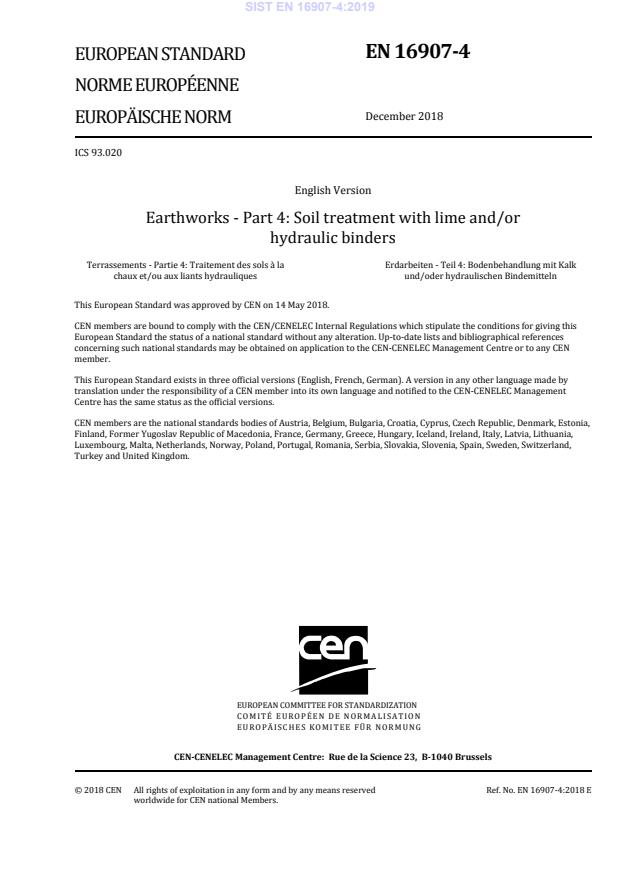
(Main)Earthworks - Part 4: Soil treatment with lime and/or hydraulic binders
- Abstract
This European Standard applies to the treatment with binders of natural soils, weak rocks, intermediate rocks, chalk, recycled materials and artificial materials for the execution of earthworks during the construction and maintenance of roads, railways, airfields, platforms, dykes, ponds and any other types of earth structure.
It relates only to the treatment in layers, produced for earthworks in situ or from a mixing plant, as opposed to the treatment by columns for example.
The standard specifies the requirements for the constituents of the mixtures, the preliminary laboratory testing methodology, the laboratory performance classification, the execution and control.
NOTE 1 The informative annexes also give example of good practices for execution and control.
The laboratory performance classification specified in this European Standard covers the two types of treatment: improvement and stabilization.
For improvement, the classification relates to the short term performance.
For stabilization, the classification relates to the medium to long term performance.
NOTE 2 FprEN 16907-4 prepared by CEN/TC 396 “Earthworks” is for improvement and stabilization in earthworks applications. EN 14227-15 prepared by CEN/TC 227 “Road materials“ is for stabilization only in pavement applications.
NOTE 3 For stabilization, the performance classification specified in FprEN 16907-4 uses generally the same laboratory performance classification specified in EN 14227-15, except for the performance classification diagram according to “Rt and E” specific to pavements in EN 14227-15, which has been replaced in FprEN 16904-4 by a performance classification diagram according to “Rt and E” specific to earthworks (Figure 1).
- Status
- Published
- Publication Date
- 04-Dec-2018
- Withdrawal Date
- 29-Jun-2019
- Technical Committee
- CEN/TC 396 - Earthworks
- Drafting Committee
- CEN/TC 396/WG 3 - Construction procedures
- Current Stage
- 9092 - Decision on results of review/2YR ENQ - revise - Review Enquiry
- Start Date
- 18-Sep-2025
- Completion Date
- 21-Oct-2026


Overview
EN 16907-4:2018 - Earthworks - Part 4: Soil treatment with lime and/or hydraulic binders - is a European standard that defines how to treat soils, weak/intermediate rocks, chalk, recycled and artificial materials using lime and hydraulic binders for earthworks. It covers treatment produced in layers - either in situ or from a mixing plant - for construction and maintenance of roads, railways, airfields, platforms, dykes, ponds and other earth structures. The standard specifies required constituents, laboratory testing methodology, performance classification (improvement vs stabilization), execution and quality control. Informative annexes give examples of good practice.
Key topics and technical requirements
- Scope of materials: natural soils, processed aggregates, low/intermediate/high strength rocks, chalk, recycled and artificial materials.
- Binders covered: cement, fly ash, slag, hydraulic road binders, lime and blended products.
- Mixture design: proportioning rules for treated mixtures intended for layers produced on-site or in plant.
- Laboratory methodology:
- Identification tests for materials and binders
- Feasibility of treatment and workability period
- Specimen production, compaction procedures and curing regimes
- Mechanical tests: resistance to water, frost, strength for construction trafficking, swelling
- Performance classification:
- Improvement - short-term performance criteria (e.g., immediate bearing indices, moisture condition)
- Stabilization - medium to long-term mechanical performance classification and durability
- Execution and control:
- Site investigation and identification of deleterious materials (sulfides, sulfates, organic matter)
- Plant and in situ mixing practices, binder spreading, compaction and protection of treated layers
- Compliance testing, records and completion reporting
- Quality guidance: informative annexes with specimen production and best-practice execution details.
Practical applications
- Design and specification of soil stabilization and soil improvement works for infrastructure projects: highways, rail embankments, airfields, flood defenses and industrial platforms.
- Use in mixed or recycled-material earthworks where lime or hydraulic binders are needed to improve load-bearing capacity or long-term durability.
- Provides a harmonized framework for laboratory-based validation of treatment schemes and on-site quality control.
Who should use this standard?
- Geotechnical and pavement engineers
- Contractors and site supervisors performing in situ mixing or plant mixing
- Materials and testing laboratories
- Infrastructure owners, specifiers and consultants preparing technical requirements and compliance criteria
Related standards
- EN 14227-15 (road materials) - covers stabilization for pavements; EN 16907-4 aligns broadly but uses an earthworks-specific performance classification diagram.
- CEN/TC 396 (Earthworks) is the technical committee responsible for this standard.
Keywords: EN 16907-4, soil treatment, lime stabilization, hydraulic binders, earthworks standard, soil improvement, laboratory testing, in situ mixing, mixing plant, performance classification.
Relations
- Effective Date
- 28-Jan-2026
- Effective Date
- 28-Jan-2026
- Effective Date
- 28-Jan-2026
- Effective Date
- 28-Jan-2026
- Effective Date
- 28-Jan-2026
- Effective Date
- 28-Jan-2026
- Effective Date
- 28-Jan-2026
- Effective Date
- 28-Jan-2026
- Effective Date
- 28-Jan-2026
- Effective Date
- 28-Jan-2026
- Effective Date
- 28-Jan-2026
- Effective Date
- 28-Jan-2026
- Effective Date
- 28-Jan-2026
- Effective Date
- 28-Jan-2026
- Effective Date
- 28-Jan-2026
Get Certified
Connect with accredited certification bodies for this standard

Zavod za gradbeništvo Slovenije (ZAG) - Inšpekcija
ZAG inspection body for construction products, structures, and materials.
Sponsored listings
Frequently Asked Questions
EN 16907-4:2018 is a standard published by the European Committee for Standardization (CEN). Its full title is "Earthworks - Part 4: Soil treatment with lime and/or hydraulic binders". This standard covers: This European Standard applies to the treatment with binders of natural soils, weak rocks, intermediate rocks, chalk, recycled materials and artificial materials for the execution of earthworks during the construction and maintenance of roads, railways, airfields, platforms, dykes, ponds and any other types of earth structure. It relates only to the treatment in layers, produced for earthworks in situ or from a mixing plant, as opposed to the treatment by columns for example. The standard specifies the requirements for the constituents of the mixtures, the preliminary laboratory testing methodology, the laboratory performance classification, the execution and control. NOTE 1 The informative annexes also give example of good practices for execution and control. The laboratory performance classification specified in this European Standard covers the two types of treatment: improvement and stabilization. For improvement, the classification relates to the short term performance. For stabilization, the classification relates to the medium to long term performance. NOTE 2 FprEN 16907-4 prepared by CEN/TC 396 “Earthworks” is for improvement and stabilization in earthworks applications. EN 14227-15 prepared by CEN/TC 227 “Road materials“ is for stabilization only in pavement applications. NOTE 3 For stabilization, the performance classification specified in FprEN 16907-4 uses generally the same laboratory performance classification specified in EN 14227-15, except for the performance classification diagram according to “Rt and E” specific to pavements in EN 14227-15, which has been replaced in FprEN 16904-4 by a performance classification diagram according to “Rt and E” specific to earthworks (Figure 1).
This European Standard applies to the treatment with binders of natural soils, weak rocks, intermediate rocks, chalk, recycled materials and artificial materials for the execution of earthworks during the construction and maintenance of roads, railways, airfields, platforms, dykes, ponds and any other types of earth structure. It relates only to the treatment in layers, produced for earthworks in situ or from a mixing plant, as opposed to the treatment by columns for example. The standard specifies the requirements for the constituents of the mixtures, the preliminary laboratory testing methodology, the laboratory performance classification, the execution and control. NOTE 1 The informative annexes also give example of good practices for execution and control. The laboratory performance classification specified in this European Standard covers the two types of treatment: improvement and stabilization. For improvement, the classification relates to the short term performance. For stabilization, the classification relates to the medium to long term performance. NOTE 2 FprEN 16907-4 prepared by CEN/TC 396 “Earthworks” is for improvement and stabilization in earthworks applications. EN 14227-15 prepared by CEN/TC 227 “Road materials“ is for stabilization only in pavement applications. NOTE 3 For stabilization, the performance classification specified in FprEN 16907-4 uses generally the same laboratory performance classification specified in EN 14227-15, except for the performance classification diagram according to “Rt and E” specific to pavements in EN 14227-15, which has been replaced in FprEN 16904-4 by a performance classification diagram according to “Rt and E” specific to earthworks (Figure 1).
EN 16907-4:2018 is classified under the following ICS (International Classification for Standards) categories: 93.020 - Earthworks. Excavations. Foundation construction. Underground works. The ICS classification helps identify the subject area and facilitates finding related standards.
EN 16907-4:2018 has the following relationships with other standards: It is inter standard links to EN 13286-47:2021, EN 13286-40:2003, EN 13282-2:2015, EN 13286-49:2004, EN 13286-43:2003, EN 13286-5:2003, EN 13286-48:2005, EN 13286-42:2003, EN 14227-4:2013, EN 459-1:2015, EN 13286-45:2003, EN 13286-50:2004, EN 13286-4:2021, EN 13286-46:2003, EN 13286-2:2010. Understanding these relationships helps ensure you are using the most current and applicable version of the standard.
EN 16907-4:2018 is available in PDF format for immediate download after purchase. The document can be added to your cart and obtained through the secure checkout process. Digital delivery ensures instant access to the complete standard document.
Standards Content (Sample)
2003-01.Slovenski inštitut za standardizacijo. Razmnoževanje celote ali delov tega standarda ni dovoljeno.Erdarbeiten - Teil 4: Bodenbehandlung mit Kalk und/oder hydraulischen BindemittelnTerrassements - Partie 4: Traitement des sols à la chaux et/ou aux liants hydrauliquesEarthworks - Part 4: Soil treatment with lime and/or hydraulic binders93.020Zemeljska dela. Izkopavanja. Gradnja temeljev. Dela pod zemljoEarthworks. Excavations. Foundation construction. Underground worksICS:Ta slovenski standard je istoveten z:EN 16907-4:2018SIST EN 16907-4:2019en,fr,de01-april-2019SIST EN 16907-4:2019SLOVENSKI
STANDARD
EUROPEAN STANDARD NORME EUROPÉENNE EUROPÄISCHE NORM
EN 16907-4
December
t r s z ICS
{ uä r t r English Version
Earthworks æ Part
vã Soil thydraulic binders Terrassements æ Partie
vã Traitement des sols à la
Erdarbeiten æ Teil
vã Bodenbehandlung mit Kalk This European Standard was approved by CEN on
s v May
t r s zä
egulations which stipulate the conditions for giving this European Standard the status of a national standard without any alterationä Upætoædate lists and bibliographical references concerning such national standards may be obtained on application to the CENæCENELEC Management Centre or to any CEN memberä
translation under the responsibility of a CEN member into its own language and notified to the CENæCENELEC Management Centre has the same status as the official versionsä
CEN members are the national standards bodies of Austriaá Belgiumá Bulgariaá Croatiaá Cyprusá Czech Republicá Denmarká Estoniaá Finlandá Former Yugoslav Republic of Macedoniaá Franceá Germanyá Greeceá Hungaryá Icelandá Irelandá Italyá Latviaá Lithuaniaá Luxembourgá Maltaá Netherlandsá Norwayá Polandá Portugalá Romaniaá Serbiaá Slovakiaá Sloveniaá Spainá Swedená Switzerlandá Turkey and United Kingdomä
EUROPEAN COMMITTEE FOR STANDARDIZATION COMITÉ EUROPÉEN DE NORMALISATION EUROPÄISCHES KOMITEE FÜR NORMUNG
CEN-CENELEC Management Centre:
Rue de la Science 23,
B-1040 Brussels
t r s z CEN All rights of exploitation in any form and by any means reserved worldwide for CEN national Membersä Refä Noä EN
s x { r yæ vã t r s z ESIST EN 16907-4:2019
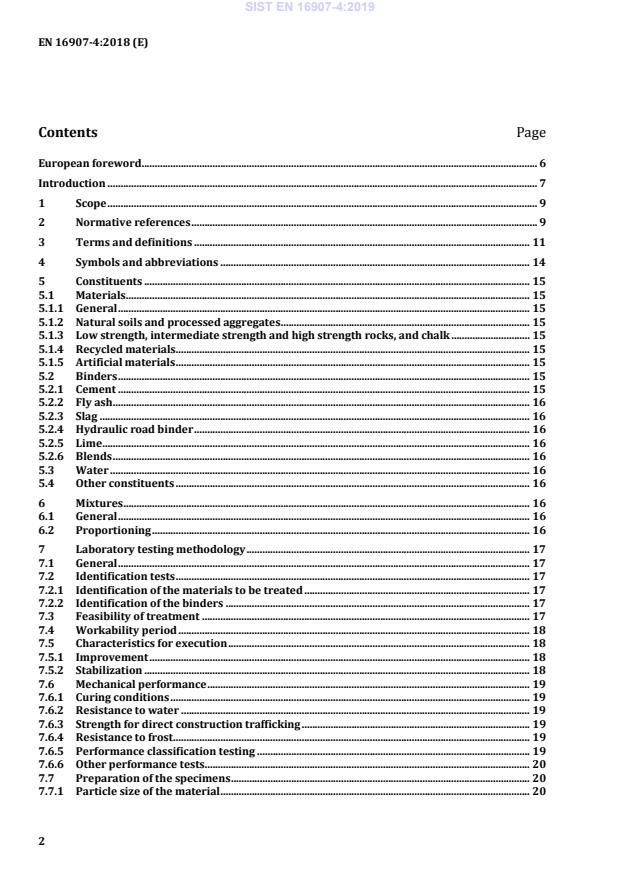
Production of test specimens for treated materials . 47 A.1 Introduction . 47 A.2 Sampling . 47 A.3 Water content . 47 A.4 Maximum size of the particles . 47 A.5 Treatment . 48 A.6 Mellowing and compaction of the treated material in the specimen mould . 49 A.7 Curing and storage . 49 A.8 Removing sample from the mould . 50 A.9 Reporting . 51 Annex B (informative)
Loading speed for the strength and modulus tests . 52 Annex C (informative)
Non destructive seismic test method for mechanical performance . 54 C.1 Introduction . 54 C.2 Scope . 54 C.3 Test apparatus. 54 C.4 Definitions and theoretical approach . 55 C.5 Principle of test method . 56 C.6 Significance and use . 56 C.7 Measurement . 57 C.8 References . 59 Annex D (informative)
Example of evaluation of performance variability of treated soil as a result of variation during implementation
Binder percentage adjustment and method for compensating it . 60 Annex E (informative)
Examples of age of classification and curing regimes for mechanical performance of treated materials for earthworks . 62 Annex F (informative)
Other performance characteristics for treated materials. 63 Annex G (informative)
Field and laboratory identifications of common sulfide and sulfate minerals . 64 G.1 Field Identification . 64 G.2 Laboratory Identification . 64 G.3 References . 65 Annex H (informative)
Soil Treatment Plant Types . 66 SIST EN 16907-4:2019
Treatment sequence and processes . 72 Annex J (informative)
Other applications for stabilized materials . 78 J.1 General . 78 J.2 Filling in narrow places . 78 J.3 Construction of lower layers in high embankments built with water sensitive soils or evolutive rocks which may be subject to occasional flooding. . 79 J.4 Steepened slopes of embankment . 79 J.5 Slope repairs. 80 J.6 Reinforced slopes . 80 J.7 Foundations . 80 J.8 Load transfer platforms . 80 J.9 Water retaining structures . 81 J.10 Contaminated soils . 81 Annex K (informative)
Site Stabilization checklist . 82 Annex L (informative)
Safety considerations . 85 L.1 General . 85 L.2 Specific protective equipment . 85 Annex M (informative)
Climatic and practical considerations . 86 M.1 General . 86 M.2 Weather . 86 M.3 Binder dust emission. 87 M.4 Run off and leachate . 88 Annex N (informative)
Method and charts to determine the quantity of lime needed to reach a targeted IPI value . 89
For stabilization, the classification relates to the medium to long term performance. NOTE 2 EN 16907-4 prepared by CEN/TC 396 “Earthworks” is for improvement and stabilization in earthworks applications. EN 14227-15 prepared by CEN/TC 227 “Road materials“ is for stabilization only in pavement applications. NOTE 3 For stabilization, the performance classification specified in EN 16907-4 uses generally the same laboratory performance classification specified in EN 14227-15, except for the performance classification diagram according to “Rt and E” specific to pavements in EN 14227-15, which has been replaced in EN 16907-4 by a performance classification diagram according to “Rt and E” specific to earthworks (Figure 1). 2 Normative references The following documents are referred to in the text in such a way that some or all of their content constitutes requirements of this document. For dated references, only the edition cited applies. For undated references, the latest edition of the referenced document (including any amendments) applies. EN 197-1, Cement - Part 1: Composition, specifications and conformity criteria for common cements EN 450-1, Fly ash for concrete - Part 1: Definition, specifications and conformity criteria EN 459-1, Building lime - Part 1: Definitions, specifications and conformity criteria EN 13282-1, Hydraulic road binders - Part 1: Rapid hardening hydraulic road binders - Composition, specifications and conformity criteria EN 13282-2, Hydraulic road binders - Part 2: Normal hardening hydraulic road binders - Composition, specifications and conformity criteria
EN 13286-2, Unbound and hydraulically bound mixtures - Part 2: Test methods for laboratory reference density and water content - Proctor compaction EN 13286-3, Unbound and hydraulically bound mixtures - Part 3: Test methods for laboratory reference density and water content - Vibrocompression with controlled parameters EN 13286-4, Unbound and hydraulically bound mixtures - Part 4: Test methods for laboratory reference density and water content - Vibrating hammer SIST EN 16907-4:2019
IEC Electropedia: available at http://www.electropedia.org/
ISO Online browsing platform: available at http://www.iso.org/obp 3.1 air lime lime which combines and hardens with carbon dioxide present in air 3.2 binder product or combination of products which, when mixed with a material, provides either a short term or a long term enhancement of the properties of the material Note 1 to entry: The binders covered by this standard are limited to the following standardized products: cement, fly ash, blast furnace slag, hydraulic road binder and building lime. 3.3 binder spreading unit equipment used to distribute the binder uniformly on the soil to be treated
Note 1 to entry: These include spreaders that are capable of applying binders under the form of powder or suspension into water. 3.4 cement hydraulic binder, i.e. a finely ground inorganic material which, when mixed with water, forms a paste which sets and hardens by means of hydration reactions and processes and which, after hardening, retains its strength and stability even under water 3.5 curing period period of time during which a treated mixture is left undisturbed after final compaction, in prescribed conditions to limit evaporation, to allow stabilization processes to continue 3.6 in situ soil mixing plant equipment used to thoroughly mix the binders with the soil Note 1 to entry: This equipment comes in various sizes and includes mainly two types of plants: stationary tool mixers (plough) and moving tool mixers (rotovators, soil pulverisers, etc.). 3.7 fly ash fine powder produced by the combustion of pulverized coal or lignite with or without co-combustion materials in energy generating plants and captured by mechanical or electrostatic precipitators Note 1 to entry: Fly ash may be: — siliceous, where the essential chemical components are silicates, aluminates and iron oxides; — calcareous, where the essential chemical components are silicates, aluminates, calcium oxide and sulphates. SIST EN 16907-4:2019
Note 1 to entry: They can be mobile or fixed. SIST EN 16907-4:2019
...