

EN 15344:2025
(Main)Plastics - Recycled plastics - Characterization of Polyethylene (PE) recyclates
- Abstract
This document specifies the main characteristics and associated test methods for assessing of polyethylene (PE) recyclates intended for use in the production of semi-finished or finished products.
It is intended to support parties involved in the use of PE recyclates to agree on specifications for specific and generic applications.
This document does not cover the characterization of plastics wastes, which is covered by the EN 15347 series, neither traceability topics which are covered by EN 15343.
- Status
- Published
- Publication Date
- 24-Jun-2025
- Technical Committee
- CEN/TC 249 - Plastics
- Drafting Committee
- CEN/TC 249/WG 11 - Plastics recycling
- Current Stage
- 6060 - Definitive text made available (DAV) - Publishing
- Start Date
- 25-Jun-2025
- Due Date
- 16-May-2025
- Completion Date
- 25-Jun-2025

Overview
EN 15344:2025 - Plastics: Recycled plastics - Characterization of Polyethylene (PE) recyclates is a CEN standard that specifies the main characteristics and associated test methods for assessing polyethylene (PE) recyclates intended for use in semi‑finished or finished products. The standard helps suppliers and users agree on batch specifications, supports quality assurance and reporting (Certificate of Analysis, CoA), and clarifies what is and is not covered (it excludes characterization of plastic wastes - see EN 15347 - and traceability topics - see EN 15343).
Key topics and requirements
- Scope and purpose: Defines required and optional characteristics to be reported for each homogeneous batch of PE recyclate.
- Batch-based assessment: Every batch must have homogeneous characteristics within specified tolerances and be accompanied by test results (CoA) on request.
- Characterization parameters: Includes general information (product name, colour, origin, form), physical properties (density, particle size distribution, bulk density, pellet size), and rheological properties (Melt Mass‑Flow Rate, MFR).
- Contaminant analysis: Annex A provides methods and procedures for determination of contaminants in recyclates.
- Bulk density testing: Annex B gives a normative test method for bulk density measurement.
- Test methods referenced: EN 15344:2025 refers to international and European test standards such as EN ISO 1133‑1 (MFR), EN ISO 1183‑1 (density), EN ISO 3451‑1 (ash), EN ISO 17855‑2 and others - the CoA should specify the exact test method used.
- Quality assurance: Clause 6 clarifies QA expectations and supplier responsibilities for reproducible, traceable test data.
- Documentation: Where multiple methods exist for a parameter, the CoA must state which method was used.
Applications and users
EN 15344:2025 is practical for:
- Converters and compounders selecting r‑PE for extrusion, injection moulding or compounding.
- Recyclers and suppliers preparing batch documentation and CoA for customers.
- Product designers and spec writers who need defined recyclate properties for component design.
- Procurement and quality teams specifying acceptance criteria in contracts.
- Regulators and compliance officers verifying conformity with recycled content and material quality frameworks.
Common application areas include packaging, agriculture, construction, household goods and technical parts where verified PE recyclate properties affect processability and end‑use performance.
Related standards
- EN 15343 (traceability & recycled content)
- EN 15347 (sorted plastics wastes)
- EN 15342 / EN 15345 / EN 15346 / EN 15348 / EN 18064 / EN 18065 / EN 18067
- CEN/TR 15353 (guidance on recycled plastics standard development)
Keywords: EN 15344:2025, PE recyclates characterization, polyethylene recyclates, recycled plastics test methods, Certificate of Analysis (CoA), bulk density test, contaminants analysis.
Relations
- Replaces
EN 15344:2021 - Plastics - Recycled plastics - Characterization of Polyethylene (PE) recyclates - Effective Date
- 08-Feb-2023
- Refers
EN ISO 3451-1:2026 - Plastics - Determination of ash - Part 1: General methods (ISO 3451-1:2026) - Effective Date
- 10-Jun-2026
- Refers
EN ISO 3451-1:2019 - Plastics - Determination of ash - Part 1: General methods (ISO 3451-1:2019) - Effective Date
- 28-Jan-2026
- Effective Date
- 28-Jan-2026
- Effective Date
- 28-Jan-2026
- Effective Date
- 28-Jan-2026
- Effective Date
- 28-Jan-2026
- Effective Date
- 28-Jan-2026
- Effective Date
- 28-Jan-2026
- Effective Date
- 28-Jan-2026
- Effective Date
- 27-May-2026
- Effective Date
- 28-Jan-2026
- Effective Date
- 28-Jan-2026
- Effective Date
- 28-Jan-2026
- Effective Date
- 28-Jan-2026
Get Certified
Connect with accredited certification bodies for this standard

DIN CERTCO
DIN Group product certification.
CIS Institut d.o.o.
Personal Protective Equipment (PPE) certification body. Notified Body NB-2890 for EU Regulation 2016/425 PPE.

Kiwa BDA Testing
Building and construction product certification.
Sponsored listings
Frequently Asked Questions
EN 15344:2025 is a standard published by the European Committee for Standardization (CEN). Its full title is "Plastics - Recycled plastics - Characterization of Polyethylene (PE) recyclates". This standard covers: This document specifies the main characteristics and associated test methods for assessing of polyethylene (PE) recyclates intended for use in the production of semi-finished or finished products. It is intended to support parties involved in the use of PE recyclates to agree on specifications for specific and generic applications. This document does not cover the characterization of plastics wastes, which is covered by the EN 15347 series, neither traceability topics which are covered by EN 15343.
This document specifies the main characteristics and associated test methods for assessing of polyethylene (PE) recyclates intended for use in the production of semi-finished or finished products. It is intended to support parties involved in the use of PE recyclates to agree on specifications for specific and generic applications. This document does not cover the characterization of plastics wastes, which is covered by the EN 15347 series, neither traceability topics which are covered by EN 15343.
EN 15344:2025 is classified under the following ICS (International Classification for Standards) categories: 13.030.50 - Recycling; 83.080.20 - Thermoplastic materials. The ICS classification helps identify the subject area and facilitates finding related standards.
EN 15344:2025 has the following relationships with other standards: It is inter standard links to EN 15344:2021, EN ISO 3451-1:2026, EN ISO 3451-1:2019, EN 17615:2022, EN ISO 1043-1:2011, EN ISO 17855-2:2024, EN ISO 472:2013, EN ISO 1133-1:2022, EN ISO 1183-1:2025, CEN/TR 15353:2007, EN 18120-10:2026, EN 15343:2007, EN 18109:2025, EN 18064-2:2025, CEN/TS 14541:2007. Understanding these relationships helps ensure you are using the most current and applicable version of the standard.
EN 15344:2025 is associated with the following European legislation: Standardization Mandates: M/584. When a standard is cited in the Official Journal of the European Union, products manufactured in conformity with it benefit from a presumption of conformity with the essential requirements of the corresponding EU directive or regulation.
EN 15344:2025 is available in PDF format for immediate download after purchase. The document can be added to your cart and obtained through the secure checkout process. Digital delivery ensures instant access to the complete standard document.
Standards Content (Sample)
SLOVENSKI STANDARD
01-september-2025
Polimerni materiali - Reciklirani polimerni materiali - Karakterizacija recikliranega
polietilena (PE)
Plastics - Recycled plastics - Characterization of Polyethylene (PE) recyclates
Kunststoffe - Kunststoff-Rezyklate - Charakterisierung von Polyethylen(PE)-Rezyklaten
Plastiques - Plastiques recyclés - Caractérisation des recyclats de polyéthylène (PE)
Ta slovenski standard je istoveten z: EN 15344:2025
ICS:
13.030.50 Recikliranje Recycling
83.080.20 Plastomeri Thermoplastic materials
2003-01.Slovenski inštitut za standardizacijo. Razmnoževanje celote ali delov tega standarda ni dovoljeno.
EN 15344
EUROPEAN STANDARD
NORME EUROPÉENNE
June 2025
EUROPÄISCHE NORM
ICS 13.030.50; 83.080.20 Supersedes EN 15344:2021
English Version
Plastics - Recycled plastics - Characterization of
Polyethylene (PE) recyclates
Plastiques - Plastiques recyclés - Caractérisation des Kunststoffe - Kunststoff-Rezyklate - Charakterisierung
recyclats de polyéthylène (PE) von Polyethylen(PE)-Rezyklaten
This European Standard was approved by CEN on 28 April 2025.
CEN members are bound to comply with the CEN/CENELEC Internal Regulations which stipulate the conditions for giving this
European Standard the status of a national standard without any alteration. Up-to-date lists and bibliographical references
concerning such national standards may be obtained on application to the CEN-CENELEC Management Centre or to any CEN
member.
This European Standard exists in three official versions (English, French, German). A version in any other language made by
translation under the responsibility of a CEN member into its own language and notified to the CEN-CENELEC Management
Centre has the same status as the official versions.
CEN members are the national standards bodies of Austria, Belgium, Bulgaria, Croatia, Cyprus, Czech Republic, Denmark, Estonia,
Finland, France, Germany, Greece, Hungary, Iceland, Ireland, Italy, Latvia, Lithuania, Luxembourg, Malta, Netherlands, Norway,
Poland, Portugal, Republic of North Macedonia, Romania, Serbia, Slovakia, Slovenia, Spain, Sweden, Switzerland, Türkiye and
United Kingdom.
EUROPEAN COMMITTEE FOR STANDARDIZATION
COMITÉ EUROPÉEN DE NORMALISATION
EUROPÄISCHES KOMITEE FÜR NORMUNG
CEN-CENELEC Management Centre: Rue de la Science 23, B-1040 Brussels
© 2025 CEN All rights of exploitation in any form and by any means reserved Ref. No. EN 15344:2025 E
worldwide for CEN national Members.
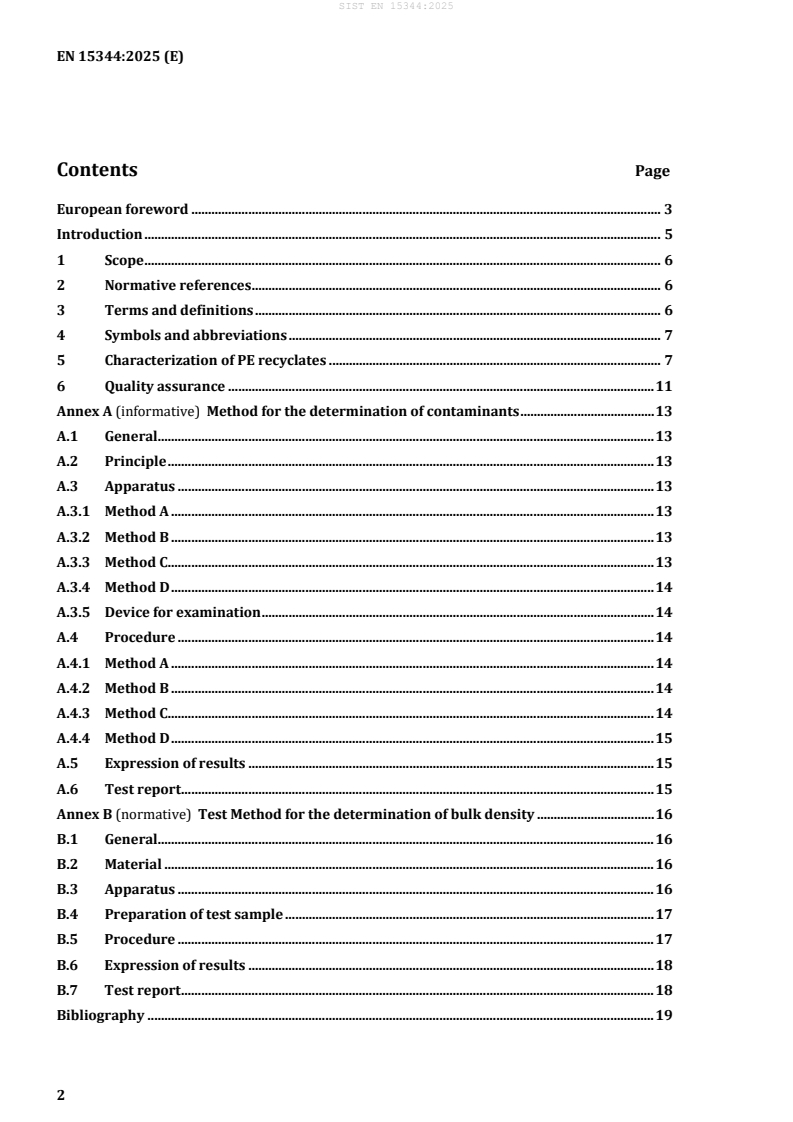
Contents Page
European foreword . 3
Introduction . 5
1 Scope . 6
2 Normative references . 6
3 Terms and definitions . 6
4 Symbols and abbreviations . 7
5 Characterization of PE recyclates . 7
6 Quality assurance . 11
Annex A (informative) Method for the determination of contaminants . 13
A.1 General. 13
A.2 Principle . 13
A.3 Apparatus . 13
A.3.1 Method A . 13
A.3.2 Method B . 13
A.3.3 Method C . 13
A.3.4 Method D . 14
A.3.5 Device for examination . 14
A.4 Procedure . 14
A.4.1 Method A . 14
A.4.2 Method B . 14
A.4.3 Method C . 14
A.4.4 Method D . 15
A.5 Expression of results . 15
A.6 Test report . 15
Annex B (normative) Test Method for the determination of bulk density . 16
B.1 General. 16
B.2 Material . 16
B.3 Apparatus . 16
B.4 Preparation of test sample . 17
B.5 Procedure . 17
B.6 Expression of results . 18
B.7 Test report . 18
Bibliography . 19
European foreword
This document (EN 15344:2025) has been prepared by Technical Committee CEN/TC 249 “Plastics”, the
secretariat of which is held by SIS.
This European Standard shall be given the status of a national standard, either by publication of an
identical text or by endorsement, at the latest by December 2025, and conflicting national standards shall
be withdrawn at the latest by December 2025.
Attention is drawn to the possibility that some of the elements of this document may be the subject of
patent rights. CEN shall not be held responsible for identifying any or all such patent rights.
This document supersedes EN 15344:2021.
This document includes the following significant changes with respect to EN 15344:2021:
— Scope has been clarified;
— Clause 2 “Normative references” was updated;
— Clause 3 “Terms and definitions” was updated;
— Clause 5, including Table 1 “Characterization of PE recyclates” was revised;
— Clause 6 has been clarified;
— Annex A was revised (apparatus and procedures);
— Bibliography was updated.
This document is part of CEN publications on plastics recycling, listed as follows:
— EN 15342, Plastics — Recycled plastics — Characterization of polystyrene (PS) recyclates
— EN 15343, Plastics — Recycled Plastics — Plastics recycling traceability and assessment of conformity
and recycled content
— EN 15344, Plastics — Recycled plastics — Characterization of Polyethylene (PE) recyclates
— EN 15345, Plastics — Recycled plastics — Characterization of Polypropylene (PP) recyclates
— EN 15346, Plastics — Recycled plastics — Characterization of poly(vinyl chloride) (PVC) recyclates
— EN 15347 (all parts), Plastics — Sorted plastics wastes
— EN 15348, Plastics — Recycled plastics — Characterization of poly(ethylene terephthalate) (PET)
recyclates
— EN 18064 (all parts), Plastics — Quality recommendations and basis for specifications for application
of plastic recyclates in products
— EN 18065, Plastics — Recycled plastics — Classification of recycled plastics based on Data Quality
Levels for use and (digital) trading
— EN 18067, Plastics — Recycled plastics — Characterization of Acrylonitrile-Butadiene-Styrene (ABS)
recyclates
— CEN/TR 15353, Plastics — Recycled plastics — Guidelines for the development of standards for
recycled plastics
— CEN/TR 00249A5G , Plastics recycling — Classification of plastic recyclates as postconsumer
recyclates (PCR) and postindustrial recyclates (PIR)
This document has been prepared under a standardization request addressed to CEN and CENELEC by
the European Commission. The Standing Committee of the EFTA States subsequently approves these
requests for its Member States.
Any feedback and questions on this document should be directed to the users’ national standards body.
A complete listing of these bodies can be found on the CEN website.
According to the CEN-CENELEC Internal Regulations, the national standards organisations of the
following countries are bound to implement this European Standard: Austria, Belgium, Bulgaria, Croatia,
Cyprus, Czech Republic, Denmark, Estonia, Finland, France, Germany, Greece, Hungary, Iceland, Ireland,
Italy, Latvia, Lithuania, Luxembourg, Malta, Netherlands, Norway, Poland, Portugal, Republic of North
Macedonia, Romania, Serbia, Slovakia, Slovenia, Spain, Sweden, Switzerland, Türkiye and the United
Kingdom.
Under preparation.
Introduction
Recycling of plastics waste is one type of material recovery process intended to save resources (virgin
raw materials, water, and energy), while minimizing harmful emissions into air, water and soil. The
environmental impact of recycling is assessed over the whole life cycle of the recycling system (from the
waste generation point to the disposal of final residues). To ensure that recycling constitutes the best
environmental option for treating the available waste, some prerequisites should preferably be met:
— recycling scheme being contemplated should generate lower environmental impacts than alternative
recovery options;
— existing or potential market outlets should be identified that will secure a sustainable industrial
recycling operation;
— collection and sorting schemes should be properly designed to deliver recyclable plastics waste
fractions fitting reasonably well with the available recycling technologies and with the (changing)
needs of the identified market outlets, preferably at minimum costs to society.
This document has been produced in accordance with the guidance produced by CEN on Environmental
Aspects and in accordance with CEN/TR 15353.
NOTE CEN/TR 15353 considers the general environmental aspects which are specific to the recycling process.
During their use phase, products are temporarily out of industrial control. Consequently, at the end user
stage, it is often impossible to trace back each individual product and whether it has been used correctly
through its life cycle.
1 Scope
This document specifies the main characteristics and associated test methods for assessing of
polyethylene (PE) recyclates intended for use in the production of semi-finished or finished products.
It is intended to support parties involved in the use of PE recyclates to agree on specifications for specific
and generic applications.
This document does not cover the characterization of plastics wastes, which is covered by the
EN 15347 series, neither traceability topics which are covered by EN 15343.
2 Normative references
The following documents are referred to in the text in such a way that some or all of their content
constitutes requirements of this document. For dated references, only the edition cited applies. For
undated references, the latest edition of the referenced document (including any amendments) applies.
CEN/TR 15353, Plastics — Recycled plastics — Guidelines for the development of standards for recycled
plastics
EN 15343, Plastics — Recycled Plastics — Plastics recycling traceability and assessment of conformity and
recycled content
EN 17615, Plastics — Environmental Aspects — Vocabulary
EN ISO 472, Plastics — Vocabulary (ISO 472)
EN ISO 1043-1, Plastics — Symbols and abbreviated terms — Part 1: Basic polymers and their special
characteristics (ISO 1043-1)
EN ISO 1133-1, Plastics — Determination of the melt mass-flow rate (MFR) and melt volume-flow rate
(MVR) of thermoplastics — Part 1: Standard method (ISO 1133-1)
EN ISO 1183-1, Plastics — Methods for determining the density of non-cellular plastics — Part 1: Immersion
method, liquid pycnometer method and titration method (ISO 1183-1)
EN ISO 3451-1, Plastics — Determination of ash — Part 1: General methods (ISO 3451-1)
EN ISO 17855-2, Plastics — Polyethylene (PE) moulding and extrusion materials — Part 2: Preparation of
test specimens and determination of properties (ISO 17855-2)
3 Terms and definitions
For the purposes of this document, the terms and definitions given in EN ISO 472, EN 17615 and
CEN/TR 15353 apply.
ISO and IEC maintain terminology databases for use in standardization at the following addresses:
— ISO Online browsing platform: available at https://www.iso.org/obp
— IEC Electropedia: available at https://www.electropedia.org/
4 Symbols and abbreviations
For the purposes of this document, the symbols and abbreviations related to recyclates given in
EN ISO 1043-1 apply.
NOTE Additionally to the abbreviation “r-PE”, “PER” or “R-PE” or “PE(REC) are used.
5 Characterization of PE recyclates
A single batch is the quantity of PE recyclates that has homogeneous characteristics within the specified
tolerances.
PE recyclates (see EN ISO 1043-1) may be composed of:
— polymeric matrix, consisting of polyethylene (PE content);
— other polymers, compatible with the polymeric matrix;
— fillers, pigments and other additives.
— impurities or contamination in a quantity which do not compromise the workability characteristics
of PE recyclates.
The characteristics of PE recyclates, which shall be determined for every batch (see ISO 3534-2) of
recyclate, are given in Table 1, and are divided into two types:
a) required characteristics, needed to define PE recyclates in general, and required for all recyclates;
b) optional characteristics needed to define PE recyclates according to customer specifications and
applications.
NOTE Polyethylene plastics waste originates from different types or grades of PE containing additives to
modify characteristics. Polyethylene is generally classified as PE-HD (high density polyethylene), PE-LD (low
density polyethylene), PE-LLD (linear low-density polyethylene) and others of less common use. The properties and
performance of recyclates derived from such wastes can depend on the type or relative proportions of blends of PE,
but it is not in the scope of this document to investigate such relations.
These characteristics shall be assessed by using the test methods given in Table 1.
A certificate of analysis (CoA) giving the test results for each batch of recyclate shall be provided by the
supplier to the customer upon request.
Other tests may be carried out by agreement between the customer and the supplier and results reported.
The customer may require some additional information on recyclate composition from the recycler in
order to facilitate the legally compliant use of the recyclate.
Where several methods are listed in Table 1, the Certificate of Analysis (CoA) should specify the method
used for each measured parameter.
Table 1 — Characterization of PE recyclates
a b
Characteristics Unit Test methods Comments
LDPE HDPE
General information
Indicate product name
Product name — — M M
and/or reference.
Colour by visual For example, unicolour,
— Visual inspection M M
inspection transparent, mixed.
Indicate the type of
products which are
composing the incoming
material and the source:
Agriculture, Building &
Origin of material — supplier to declare O O Construction, Packaging
– Household, Packaging -
Transport & Industry,
“Housewares, Leisure,
Sports etc”, Others
(specify).
Typical forms are pellets,
�lakes, regrinds, powders
Form — Visual inspection M M and agglomerates
preferably specifying the
maximum particle size.
Density and particle size
EN ISO 1183-1
Density M M —
g/cm
EN ISO 17855-2
EN 15346:2024,
Any additional sieve may
Annex D
be added (e.g. sieve of
EN 15348:2024,
Particle size 0,5 mm) may be added
g, % O O
Annex A
distribution upon common approval
with the customer
ISO 22498
through a speci�ication.
ASTM D1921
EN ISO 60 for PE-LD
Any alternative method
EN ISO 60 for PE-HD
may be used upon
as pellet
Bulk density O O common approval with
g/cm
ASTM D1895, method
the customer through a
C, or Annex B for PE-
speci�ication.
HD as �lakes
Weight of 100 pellets
g or
Pellet size or number of pellets in O O —
number
1 g
a b
Characteristics Unit Test methods Comments
LDPE HDPE
Viscosity
Melt Mass-Flow EN ISO 1133-1
In case MFR goes below
g/ 10 min M M
0,1 g/10 min, provide I5.
Rate (MFR) EN ISO 17855-2
Colour
Pellets or injection
Colorimeter according
Measure of
moulded �lat piece.
to
Colour by colorimetry L*a* b* O O
EN ISO/CIE 11664-4, Observer: 10°
values
DIN 53236
Illuminant: D65
The test may be
performed on a plate
with a thickness of
200 μm, made by fusion
pressing of granules.
Transparency % EN ISO 13468-1 O —
After agreement with the
customer through a
speci�ication, any
alternative method may
be used.
Composition
EN ISO 11357-3
DSC analysis °C or J/g O O —
EN ISO 17855-2
With this method, any
% (mass
Ash content EN ISO 3451-1 O M organic pigments are
fraction)
destroyed.
An alternative method
Annex A (method
...