

EN 1366-3:2021/FprA1
(Amendment)Fire resistance tests for service installations - Part 3: Penetration seals
- Abstract
This part of the EN 1366 series specifies a method of test and criteria for the evaluation (including field of direct application rules) of the ability of a penetration seal to maintain the fire resistance of a separating element at the position at which it has been penetrated by a service or services. Penetration seals used to seal gaps around chimneys, air ventilation systems, fire rated ventilation ducts, fire rated service ducts, shafts and smoke extraction ducts as well as combined penetration seals are excluded from this part of the EN 1366 series.
NOTE EN 15882-5 [6] deals with penetration seals including ducts and dampers.
Supporting constructions are used in this part of the EN 1366 series to represent separating elements such as walls or floors. These simulate the interaction between the test specimen and the separating element into which the sealing system is to be installed in practice.
This part of the EN 1366 series is intended to be used in conjunction with EN 1363 1.
The purpose of a test described in this part of the EN 1366 series is to assess the integrity and insulation performance of the penetration seal, of the penetrating service or services and of the separating element in the surrounding area of the penetration seal.
No information can be implied by the test concerning the influence of the inclusion of such penetrations and penetration seals on the loadbearing capacity of the separating element.
It is assumed that in each case the lintel above a penetration seal in the wall is designed in hot and cold state in a way that it does not apply any additional vertical load on the penetration seal.
It is not the intention of this test to provide quantitative information on the rate of leakage of smoke and/or hot gases or on the transmission or generation of fumes. Such phenomena are only noted in the test report in describing the general behaviour of test specimens during the test.
Tests in accordance with this part of the EN 1366 series are not intended to supply any information on the ability of the penetration seal to withstand stress caused by movements or displacements of the penetrating services.
The risk of spread of fire downwards caused by burning material, which drips e.g. through a pipe downwards to floors below, is at present excluded from this document.
Tests in accordance with this part of the EN 1366 series do not address any risks associated with leakage of dangerous liquids or gases caused by failure of pipes in case of fire.
Tests in accordance with this part of the EN 1366 series of pipe penetration seals for pipes of pneumatic dispatch systems, pressurized air systems, etc. simulate a situation where the systems are shut off in case of fire.
Explanatory notes to this test method are given in Annex H.
All values given without tolerances in this document are nominal ones unless otherwise specified.
All pipe diameters are outside diameters unless otherwise specified.
- Status
- Not Published
- Publication Date
- 20-Nov-2024
- Technical Committee
- CEN/TC 127 - Fire safety in buildings
- Drafting Committee
- CEN/TC 127/WG 2 - Services
- Current Stage
- 5060 - Closure of Vote - Formal Approval
- Start Date
- 26-Sep-2024
- Due Date
- 08-Jul-2025
- Completion Date
- 26-Sep-2024


Overview
EN 1366-3:2021/FprA1 is a European standard published by CEN under the series EN 1366, focusing specifically on fire resistance tests for service installations, with Part 3 dedicated to penetration seals. This standard outlines testing methods and performance criteria used to evaluate the ability of penetration seals to maintain the fire resistance integrity of separating elements such as walls and floors that have been penetrated by services (e.g., cables, pipes).
The latest amendment (FprA1) provides updates on testing protocols, orientation applicability, and technical specifications to enhance accuracy and relevance in assessing fire resistance of penetration seals. The standard excludes penetration seals around chimneys, ventilation systems, fire-rated ducts, and shafts, which are covered by other standards like EN 15882-5.
Key Topics
Fire Resistance Testing Methodology: EN 1366-3:2021/FprA1 specifies standardized test setups using supporting constructions to simulate real-life separating elements. It assesses the integrity and insulation performance of penetration seals during fire exposure.
Scope of Services Covered: The standard applies to penetration seals sealing gaps around services such as cables and pipes but excludes specific ducts and chimney penetrations.
Evaluation Criteria: Testing ensures seals prevent fire and heat transmission through service penetrations, maintaining the fire resistance rating of the tested separating element. It does not test loadbearing capacity or resistance to mechanical stresses caused by movement.
Orientation and Installation: Test results apply to walls or floors only in the orientation tested, subject to any deviating rules specified. Installation assumptions include lintel design ensuring no additional vertical loads impact the penetration seal.
Limitations: The test does not measure smoke or gas leakage rates, or risks from dripping burning material or hazardous liquid/gas leaks from failed pipes during fire.
Related Test References: EN 1363-1 is used in conjunction for overarching fire resistance testing. Notes and explanatory details are provided in Annex H of the standard.
Recent Amendments: Updates include clarifications on orientation rules, modifications to cable and pipe configurations, and enhanced definitions for service arrangements and test procedures.
Applications
EN 1366-3:2021/FprA1 is essential for manufacturers, installers, fire safety engineers, and regulators involved in:
Fire safety assessment of building service installations: Ensuring penetration seals used around electrical conduits, plumbing, and other technical installations maintain fire compartmentation.
Certification and Product Testing: Guiding labs and certification bodies to perform consistent, reliable fire resistance tests on penetration sealing systems.
Design and Construction Compliance: Assisting architects and engineers in selecting tested penetration sealing products that comply with regional fire safety regulations.
Quality Control: Enabling manufacturers to verify seal performance during product development and production phases.
Risk Mitigation: Supporting building code adherence to reduce fire spread risks via service penetrations in walls and floors.
Related Standards
EN 1366-1 & EN 1366-2: Cover fire resistance tests for ducts and fire dampers, complementing the focus on service penetrations.
EN 15882-5: Addresses penetration seals including ducts and dampers, excluded from EN 1366-3 scope.
EN 1363-1: Provides general fire resistance test methods applicable to EN 1366 series.
National Standards: Many European countries adopt EN 1366-3 with national amendments or supplements.
Other Fire Safety Standards: EN 13501 series for fire classification of construction products and elements, integrated with EN 1366-3 testing outcomes.
By adhering to EN 1366-3:2021/FprA1, professionals ensure that penetration seals reliably maintain fire compartment integrity, improving building fire safety and compliance with European fire protection legislations. The standard’s comprehensive testing framework supports robust evaluation of penetration seal system effectiveness under realistic fire conditions.
Relations
- Merged Into
EN 1366-3:2021+A1:2024 - Fire resistance tests for service installations - Part 3: Penetration seals - Effective Date
- 05-Oct-2024
- Effective Date
- 28-Sep-2022
Get Certified
Connect with accredited certification bodies for this standard

CIS Institut d.o.o.
Personal Protective Equipment (PPE) certification body. Notified Body NB-2890 for EU Regulation 2016/425 PPE.

Kiwa BDA Testing
Building and construction product certification.
Kmetijski inštitut Slovenije
Agricultural Institute of Slovenia. Soil testing, plant health, agricultural product analysis.
Sponsored listings
Frequently Asked Questions
EN 1366-3:2021/FprA1 is a draft published by the European Committee for Standardization (CEN). Its full title is "Fire resistance tests for service installations - Part 3: Penetration seals". This standard covers: This part of the EN 1366 series specifies a method of test and criteria for the evaluation (including field of direct application rules) of the ability of a penetration seal to maintain the fire resistance of a separating element at the position at which it has been penetrated by a service or services. Penetration seals used to seal gaps around chimneys, air ventilation systems, fire rated ventilation ducts, fire rated service ducts, shafts and smoke extraction ducts as well as combined penetration seals are excluded from this part of the EN 1366 series. NOTE EN 15882-5 [6] deals with penetration seals including ducts and dampers. Supporting constructions are used in this part of the EN 1366 series to represent separating elements such as walls or floors. These simulate the interaction between the test specimen and the separating element into which the sealing system is to be installed in practice. This part of the EN 1366 series is intended to be used in conjunction with EN 1363 1. The purpose of a test described in this part of the EN 1366 series is to assess the integrity and insulation performance of the penetration seal, of the penetrating service or services and of the separating element in the surrounding area of the penetration seal. No information can be implied by the test concerning the influence of the inclusion of such penetrations and penetration seals on the loadbearing capacity of the separating element. It is assumed that in each case the lintel above a penetration seal in the wall is designed in hot and cold state in a way that it does not apply any additional vertical load on the penetration seal. It is not the intention of this test to provide quantitative information on the rate of leakage of smoke and/or hot gases or on the transmission or generation of fumes. Such phenomena are only noted in the test report in describing the general behaviour of test specimens during the test. Tests in accordance with this part of the EN 1366 series are not intended to supply any information on the ability of the penetration seal to withstand stress caused by movements or displacements of the penetrating services. The risk of spread of fire downwards caused by burning material, which drips e.g. through a pipe downwards to floors below, is at present excluded from this document. Tests in accordance with this part of the EN 1366 series do not address any risks associated with leakage of dangerous liquids or gases caused by failure of pipes in case of fire. Tests in accordance with this part of the EN 1366 series of pipe penetration seals for pipes of pneumatic dispatch systems, pressurized air systems, etc. simulate a situation where the systems are shut off in case of fire. Explanatory notes to this test method are given in Annex H. All values given without tolerances in this document are nominal ones unless otherwise specified. All pipe diameters are outside diameters unless otherwise specified.
This part of the EN 1366 series specifies a method of test and criteria for the evaluation (including field of direct application rules) of the ability of a penetration seal to maintain the fire resistance of a separating element at the position at which it has been penetrated by a service or services. Penetration seals used to seal gaps around chimneys, air ventilation systems, fire rated ventilation ducts, fire rated service ducts, shafts and smoke extraction ducts as well as combined penetration seals are excluded from this part of the EN 1366 series. NOTE EN 15882-5 [6] deals with penetration seals including ducts and dampers. Supporting constructions are used in this part of the EN 1366 series to represent separating elements such as walls or floors. These simulate the interaction between the test specimen and the separating element into which the sealing system is to be installed in practice. This part of the EN 1366 series is intended to be used in conjunction with EN 1363 1. The purpose of a test described in this part of the EN 1366 series is to assess the integrity and insulation performance of the penetration seal, of the penetrating service or services and of the separating element in the surrounding area of the penetration seal. No information can be implied by the test concerning the influence of the inclusion of such penetrations and penetration seals on the loadbearing capacity of the separating element. It is assumed that in each case the lintel above a penetration seal in the wall is designed in hot and cold state in a way that it does not apply any additional vertical load on the penetration seal. It is not the intention of this test to provide quantitative information on the rate of leakage of smoke and/or hot gases or on the transmission or generation of fumes. Such phenomena are only noted in the test report in describing the general behaviour of test specimens during the test. Tests in accordance with this part of the EN 1366 series are not intended to supply any information on the ability of the penetration seal to withstand stress caused by movements or displacements of the penetrating services. The risk of spread of fire downwards caused by burning material, which drips e.g. through a pipe downwards to floors below, is at present excluded from this document. Tests in accordance with this part of the EN 1366 series do not address any risks associated with leakage of dangerous liquids or gases caused by failure of pipes in case of fire. Tests in accordance with this part of the EN 1366 series of pipe penetration seals for pipes of pneumatic dispatch systems, pressurized air systems, etc. simulate a situation where the systems are shut off in case of fire. Explanatory notes to this test method are given in Annex H. All values given without tolerances in this document are nominal ones unless otherwise specified. All pipe diameters are outside diameters unless otherwise specified.
EN 1366-3:2021/FprA1 is classified under the following ICS (International Classification for Standards) categories: 13.220.50 - Fire-resistance of building materials and elements. The ICS classification helps identify the subject area and facilitates finding related standards.
EN 1366-3:2021/FprA1 has the following relationships with other standards: It is inter standard links to EN 1366-3:2021+A1:2024, EN 1366-3:2021. Understanding these relationships helps ensure you are using the most current and applicable version of the standard.
EN 1366-3:2021/FprA1 is associated with the following European legislation: EU Directives/Regulations: 305/2011; Standardization Mandates: M/117. When a standard is cited in the Official Journal of the European Union, products manufactured in conformity with it benefit from a presumption of conformity with the essential requirements of the corresponding EU directive or regulation.
EN 1366-3:2021/FprA1 is available in PDF format for immediate download after purchase. The document can be added to your cart and obtained through the secure checkout process. Digital delivery ensures instant access to the complete standard document.
Standards Content (Sample)
SLOVENSKI STANDARD
SIST EN 1366-3:2022/oprA1:2024
01-marec-2024
Preskusi požarne odpornosti servisnih inštalacij - 3. del: Tesnitve prebojev -
Dopolnilo A1
Fire resistance tests for service installations - Part 3: Penetration seals
Feuerwiderstandsprüfungen für Installationen - Teil 3: Abschottungen
Essais de résistance au feu des installations techniques - Partie 3: Calfeutrement des
trémies
Ta slovenski standard je istoveten z: EN 1366-3:2021/prA1
ICS:
13.220.50 Požarna odpornost Fire-resistance of building
gradbenih materialov in materials and elements
elementov
SIST EN 1366-3:2022/oprA1:2024 en,fr,de
2003-01.Slovenski inštitut za standardizacijo. Razmnoževanje celote ali delov tega standarda ni dovoljeno.
SIST EN 1366-3:2022/oprA1:2024
SIST EN 1366-3:2022/oprA1:2024
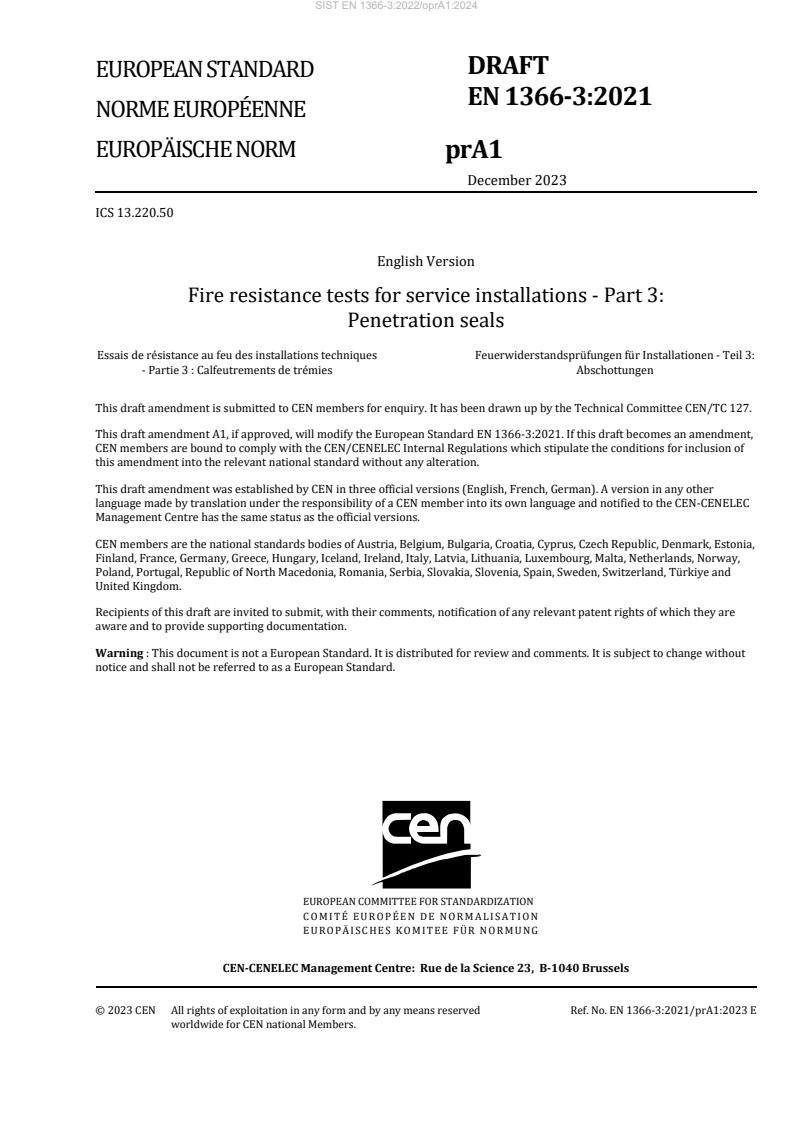
DRAFT
EUROPEAN STANDARD
EN 1366-3:2021
NORME EUROPÉENNE
EUROPÄISCHE NORM
prA1
December 2023
ICS 13.220.50
English Version
Fire resistance tests for service installations - Part 3:
Penetration seals
Essais de résistance au feu des installations techniques Feuerwiderstandsprüfungen für Installationen - Teil 3:
- Partie 3 : Calfeutrements de trémies Abschottungen
This draft amendment is submitted to CEN members for enquiry. It has been drawn up by the Technical Committee CEN/TC 127.
This draft amendment A1, if approved, will modify the European Standard EN 1366-3:2021. If this draft becomes an amendment,
CEN members are bound to comply with the CEN/CENELEC Internal Regulations which stipulate the conditions for inclusion of
this amendment into the relevant national standard without any alteration.
This draft amendment was established by CEN in three official versions (English, French, German). A version in any other
language made by translation under the responsibility of a CEN member into its own language and notified to the CEN-CENELEC
Management Centre has the same status as the official versions.
CEN members are the national standards bodies of Austria, Belgium, Bulgaria, Croatia, Cyprus, Czech Republic, Denmark, Estonia,
Finland, France, Germany, Greece, Hungary, Iceland, Ireland, Italy, Latvia, Lithuania, Luxembourg, Malta, Netherlands, Norway,
Poland, Portugal, Republic of North Macedonia, Romania, Serbia, Slovakia, Slovenia, Spain, Sweden, Switzerland, Türkiye and
United Kingdom.
Recipients of this draft are invited to submit, with their comments, notification of any relevant patent rights of which they are
aware and to provide supporting documentation.
Warning : This document is not a European Standard. It is distributed for review and comments. It is subject to change without
notice and shall not be referred to as a European Standard.
EUROPEAN COMMITTEE FOR STANDARDIZATION
COMITÉ EUROPÉEN DE NORMALISATION
EUROPÄISCHES KOMITEE FÜR NORMUNG
CEN-CENELEC Management Centre: Rue de la Science 23, B-1040 Brussels
© 2023 CEN All rights of exploitation in any form and by any means reserved Ref. No. EN 1366-3:2021/prA1:2023 E
worldwide for CEN national Members.
SIST EN 1366-3:2022/oprA1:2024
EN 1366-3:2021/prA1:2023 (E)
European foreword
This document (EN 1366-3:2021/prA1:2023) has been prepared by Technical Committee
CEN/TC 127 “Fire Safety in Buildings”, the secretariat of which is held by BSI.
This document is currently submitted to the CEN Enquiry.
This document will amend EN 1366-3:2021.
------
...