

prEN 17625
(Main)Roof-top units
General Information
- Abstract
This document specifies the terms and definitions, the test conditions and the test methods of air-sourced and water-cooled roof-top units, driven by electric compressor(s), which may be equipped with a supplementary heater using electrical resistance or combustion of fossil fuel.
This document covers roof-top units with 2, 3 or 4 dampers, including several features as the free-cooling, mixing air flows (on both sides) and heat recovery.
This document deals with roof-top units providing space heating and/or cooling for comfort application. Process applications are not covered by this document.
This document provides the part load conditions and the calculation methods taking into account roof-top units features for the determination of seasonal energy efficiency SEER and SEERon, seasonal space cooling energy efficiency ηs,c, seasonal coefficient of performance SCOP, SCOPon and SCOPnet, seasonal space heating energy efficiency ηs,h and the overall annual efficiency.
Such calculation methods may be based on calculated or measured values.
In case of measured values, this document covers the test methods for determination of capacities, EER and COP values during active mode at part load conditions. It also covers test methods for the determination of power input during thermostat-off mode, standby mode, off-mode and crankcase heater mode.
A roof-top unit that is not using at least the thermodynamic cycle for space heating is considered as a cooling only unit.
Roof-top units equipped with additional air heating and/or cooling heat exchangers will be rated without operation of these heat exchangers.
- Status
- Not Published
- Publication Date
- 06-Jun-2022
- Withdrawal Date
- 06-Dec-2022
- Technical Committee
- CEN/TC 113 - Heat pumps and air conditioning units
- Drafting Committee
- CEN/TC 113/WG 15 - Roof-top units
- Current Stage
- 4098 - Decision to abandon - Enquiry
- Start Date
- 15-Sep-2022
- Completion Date
- 23-Sep-2026
- Ref Project
oSIST prEN 17625:2020 - Roof-top units



Overview
The European Standard prEN 17625 defines comprehensive guidelines for testing and evaluating roof-top units (RTUs) used in HVAC systems. Developed by CEN/TC 113, this standard specifies terms, definitions, test conditions, and methods for air-sourced and water-cooled RTUs featuring electric compressors. It includes details on units equipped with supplementary heaters using electrical resistance or fossil fuel combustion. The scope covers roof-top units with 2 to 4 dampers, incorporating features such as free-cooling, air mixing on both sides, and heat recovery functionalities.
prEN 17625 specifically targets RTUs designed for space heating and cooling to provide indoor comfort. It excludes process applications and evaluates seasonal energy performance metrics, including SEER, SCOP, and overall annual efficiency. Testing protocols address part load conditions and auxiliary modes like standby and off mode power consumption, ensuring accurate energy efficiency assessments.
Key Topics
Terms and Definitions
Clear standard terminology related to roof-top units, compressors, dampers, and HVAC components ensures consistent understanding across applications.Test Conditions and Methods
Detailed procedures for testing cooling and heating capacities at standard and part load conditions. Includes test setups for air flow measurement, power input, and thermal output.Unit Configurations
Covers RTUs with 2, 3, or 4 dampers, supporting various airflow arrangements and heat recovery options.Energy Efficiency Calculations
Methods for calculating Seasonal Energy Efficiency Ratio (SEER), Seasonal Coefficient of Performance (SCOP), and related part load efficiency metrics based on measured or calculated data.Auxiliary Modes Measurement
Protocols for measuring power consumption during thermostat-off, standby, crankcase heater, and off modes to define comprehensive energy profiles.Marking and Documentation
Guidelines on reporting test results, unit identification, and ensuring transparency in energy efficiency labeling.
Applications
prEN 17625 applies primarily to roof-top HVAC units installed on building rooftops that provide heating and/or cooling for comfort applications in commercial, institutional, and residential buildings. The standard supports:
- Performance assessment for manufacturers seeking to prove compliance with European energy regulations.
- Energy labeling and certification for roof-top units to inform end-users about expected seasonal performance.
- Design optimization by providing test methods to validate new RTU features such as free-cooling or advanced heat recovery.
- Installation and commissioning processes by standardizing test parameters and measurement points.
- Energy efficiency benchmarking to promote sustainable HVAC solutions with reduced environmental impact.
This standard is indispensable for manufacturers, testing laboratories, HVAC engineers, facility managers, and regulatory bodies involved in roof-top unit specification and compliance.
Related Standards
prEN 17625 aligns with other HVAC and energy performance standards to ensure comprehensive evaluation of air conditioning and ventilation solutions:
- EN 14511 – Testing and rating air conditioners and heat pumps.
- EN 14825 – Seasonal energy efficiency of heat pumps and air conditioners.
- EN 13779 – Ventilation for non-residential buildings standards for indoor air quality and energy performance.
- ISO 16890 – Air filter testing and classification relevant to RTU filtration components.
- EN 50564 – Measurement of standby power, complementing auxiliary mode testing.
Compliance with prEN 17625 supports integration with broader European energy policy frameworks, accelerating adoption of high-performance, energy-efficient HVAC rooftop units.
By adhering to prEN 17625, stakeholders can ensure roof-top units meet rigorous quality and energy efficiency benchmarks, fostering environmentally responsible climate control infrastructure across Europe and beyond.
Relations
- Referred By
EN IEC 63365:2022 - Industrial process measurement, control and automation - Digital nameplate - Effective Date
- 09-Feb-2026
- Effective Date
- 28-Jan-2026
- Effective Date
- 28-Jan-2026
Get Certified
Connect with accredited certification bodies for this standard

DIBt (Deutsches Institut für Bautechnik)
German Institute for Building Technology.
DIN CERTCO
DIN Group product certification.

Aboma Certification B.V.
Specialized in construction, metal, and transport sectors.
Sponsored listings
Frequently Asked Questions
prEN 17625 is a draft published by the European Committee for Standardization (CEN). Its full title is "Roof-top units". This standard covers: This document specifies the terms and definitions, the test conditions and the test methods of air-sourced and water-cooled roof-top units, driven by electric compressor(s), which may be equipped with a supplementary heater using electrical resistance or combustion of fossil fuel. This document covers roof-top units with 2, 3 or 4 dampers, including several features as the free-cooling, mixing air flows (on both sides) and heat recovery. This document deals with roof-top units providing space heating and/or cooling for comfort application. Process applications are not covered by this document. This document provides the part load conditions and the calculation methods taking into account roof-top units features for the determination of seasonal energy efficiency SEER and SEERon, seasonal space cooling energy efficiency ηs,c, seasonal coefficient of performance SCOP, SCOPon and SCOPnet, seasonal space heating energy efficiency ηs,h and the overall annual efficiency. Such calculation methods may be based on calculated or measured values. In case of measured values, this document covers the test methods for determination of capacities, EER and COP values during active mode at part load conditions. It also covers test methods for the determination of power input during thermostat-off mode, standby mode, off-mode and crankcase heater mode. A roof-top unit that is not using at least the thermodynamic cycle for space heating is considered as a cooling only unit. Roof-top units equipped with additional air heating and/or cooling heat exchangers will be rated without operation of these heat exchangers.
This document specifies the terms and definitions, the test conditions and the test methods of air-sourced and water-cooled roof-top units, driven by electric compressor(s), which may be equipped with a supplementary heater using electrical resistance or combustion of fossil fuel. This document covers roof-top units with 2, 3 or 4 dampers, including several features as the free-cooling, mixing air flows (on both sides) and heat recovery. This document deals with roof-top units providing space heating and/or cooling for comfort application. Process applications are not covered by this document. This document provides the part load conditions and the calculation methods taking into account roof-top units features for the determination of seasonal energy efficiency SEER and SEERon, seasonal space cooling energy efficiency ηs,c, seasonal coefficient of performance SCOP, SCOPon and SCOPnet, seasonal space heating energy efficiency ηs,h and the overall annual efficiency. Such calculation methods may be based on calculated or measured values. In case of measured values, this document covers the test methods for determination of capacities, EER and COP values during active mode at part load conditions. It also covers test methods for the determination of power input during thermostat-off mode, standby mode, off-mode and crankcase heater mode. A roof-top unit that is not using at least the thermodynamic cycle for space heating is considered as a cooling only unit. Roof-top units equipped with additional air heating and/or cooling heat exchangers will be rated without operation of these heat exchangers.
prEN 17625 is classified under the following ICS (International Classification for Standards) categories: 91.140.30 - Ventilation and air-conditioning systems. The ICS classification helps identify the subject area and facilitates finding related standards.
prEN 17625 has the following relationships with other standards: It is inter standard links to EN IEC 63365:2022, CEN/TS 16794-2:2017, CEN/TS 16794-1:2017. Understanding these relationships helps ensure you are using the most current and applicable version of the standard.
prEN 17625 is associated with the following European legislation: EU Directives/Regulations: 2016/2281. When a standard is cited in the Official Journal of the European Union, products manufactured in conformity with it benefit from a presumption of conformity with the essential requirements of the corresponding EU directive or regulation.
prEN 17625 is available in PDF format for immediate download after purchase. The document can be added to your cart and obtained through the secure checkout process. Digital delivery ensures instant access to the complete standard document.
Standards Content (Sample)
SLOVENSKI STANDARD
01-december-2020
Klimatske strešne enote
Roof-top units
Dachgeräte
Unités de toiture
Ta slovenski standard je istoveten z: prEN 17625
ICS:
91.140.30 Prezračevalni in klimatski Ventilation and air-
sistemi conditioning systems
2003-01.Slovenski inštitut za standardizacijo. Razmnoževanje celote ali delov tega standarda ni dovoljeno.
DRAFT
EUROPEAN STANDARD
NORME EUROPÉENNE
EUROPÄISCHE NORM
December 2020
ICS 91.140.30
English Version
Roof-top units
Unités de toiture Dachgeräte
This draft European Standard is submitted to CEN members for enquiry. It has been drawn up by the Technical Committee
CEN/TC 113.
If this draft becomes a European Standard, CEN members are bound to comply with the CEN/CENELEC Internal Regulations
which stipulate the conditions for giving this European Standard the status of a national standard without any alteration.
This draft European Standard was established by CEN in three official versions (English, French, German). A version in any other
language made by translation under the responsibility of a CEN member into its own language and notified to the CEN-CENELEC
Management Centre has the same status as the official versions.
CEN members are the national standards bodies of Austria, Belgium, Bulgaria, Croatia, Cyprus, Czech Republic, Denmark, Estonia,
Finland, France, Germany, Greece, Hungary, Iceland, Ireland, Italy, Latvia, Lithuania, Luxembourg, Malta, Netherlands, Norway,
Poland, Portugal, Republic of North Macedonia, Romania, Serbia, Slovakia, Slovenia, Spain, Sweden, Switzerland, Turkey and
United Kingdom.
Recipients of this draft are invited to submit, with their comments, notification of any relevant patent rights of which they are
aware and to provide supporting documentation.
Warning : This document is not a European Standard. It is distributed for review and comments. It is subject to change without
notice and shall not be referred to as a European Standard.
EUROPEAN COMMITTEE FOR STANDARDIZATION
COMITÉ EUROPÉEN DE NORMALISATION
EUROPÄISCHES KOMITEE FÜR NORMUNG
CEN-CENELEC Management Centre: Rue de la Science 23, B-1040 Brussels
© 2020 CEN All rights of exploitation in any form and by any means reserved Ref. No. prEN 17625:2020 E
worldwide for CEN national Members.
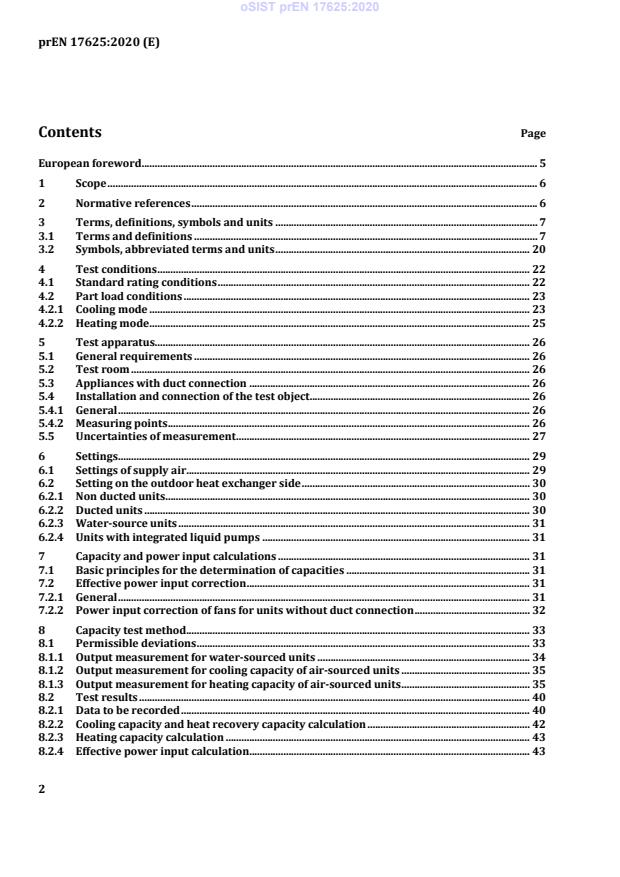
Contents Page
European foreword . 5
1 Scope . 6
2 Normative references . 6
3 Terms, definitions, symbols and units . 7
3.1 Terms and definitions . 7
3.2 Symbols, abbreviated terms and units . 20
4 Test conditions . 22
4.1 Standard rating conditions . 22
4.2 Part load conditions . 23
4.2.1 Cooling mode . 23
4.2.2 Heating mode . 25
5 Test apparatus. 26
5.1 General requirements . 26
5.2 Test room . 26
5.3 Appliances with duct connection . 26
5.4 Installation and connection of the test object. 26
5.4.1 General . 26
5.4.2 Measuring points . 26
5.5 Uncertainties of measurement . 27
6 Settings . 29
6.1 Settings of supply air . 29
6.2 Setting on the outdoor heat exchanger side . 30
6.2.1 Non ducted units . 30
6.2.2 Ducted units . 30
6.2.3 Water-source units . 31
6.2.4 Units with integrated liquid pumps . 31
7 Capacity and power input calculations . 31
7.1 Basic principles for the determination of capacities . 31
7.2 Effective power input correction . 31
7.2.1 General . 31
7.2.2 Power input correction of fans for units without duct connection . 32
8 Capacity test method . 33
8.1 Permissible deviations . 33
8.1.1 Output measurement for water-sourced units . 34
8.1.2 Output measurement for cooling capacity of air-sourced units . 35
8.1.3 Output measurement for heating capacity of air-sourced units . 35
8.2 Test results . 40
8.2.1 Data to be recorded . 40
8.2.2 Cooling capacity and heat recovery capacity calculation . 42
8.2.3 Heating capacity calculation . 43
8.2.4 Effective power input calculation. 43
9 Auxiliary modes . 43
9.1 Uncertainties of measurement . 43
9.2 Measurement of electric power input during thermostat-off mode . 44
9.3 Measurement of the electric power input during standby mode . 44
9.4 Measurement of the electric power input during crankcase heater mode . 44
9.5 Measurement of the electric power input during off mode . 45
10 Seasonal performance . 45
10.1 Calculation of SEER and SEER . 45
on
10.1.1 General formula for calculation of SEER . 45
10.1.2 Calculation of the reference annual cooling demand Q . 45
C
10.1.3 Calculation of the reference annual energy consumption for cooling Q . 45
CE
10.1.4 Calculation of SEER . 46
on
10.1.5 Calculation procedure for determination of EER values at part load conditions . 47
bin
10.2 Calculation of SCOP, SCOP and SCOP . 48
on net
10.2.1 General formula for calculation of SCOP . 48
10.2.2 Calculation of the reference annual heating demand Q . 48
H
10.2.3 Calculation of the annual energy consumption for heating Q . 48
HE
10.2.4 Calculation of SCOP and SCOP . 49
on net
10.2.5 Calculation procedure for determination of COP values at part load conditions . 51
bin
10.3 Determination of the degradation coefficient Cd . 52
10.3.1 General . 52
10.3.2 Air-to-air units – Cooling mode. 53
10.3.3 Air-to-air units – Heating mode . 53
10.3.4 Water(brine)-to-air units – Cooling mode . 53
10.3.5 Water(brine)-to-air units – Heating mode . 53
11 Test methods for electric power input during thermostat-off mode, standby mode
and crankcase heater mode and off mode . 54
11.1 Measurement of the electric power input during crankcase heater mode . 54
12 Test report . 54
12.1 General information . 54
12.2 Additional information . 55
12.3 Rating test results . 55
12.3.1 General . 55
12.3.2 Seasonal test results . 55
12.4 Specific information of the unit . 55
13 Marking . 56
Annex A (informative) Illustration of rooftop unit configurations. 57
A.1 General . 57
A.2 2-damper rooftop unit . 57
A.3 3-damper rooftop unit . 58
A.4 4-damper rooftop unit . 60
Annex B (normative) Indoor air enthalpy test method . 62
B.1 General . 62
B.2 Determination of the air flow rate . 62
B.3 Calculations-cooling capacities . 62
B.4 Calculations-heating capacities . 63
Annex C (informative) Symbols used in Annexes . 64
Annex D (normative) Determination of the liquid pump efficiency . 66
D.1 General . 66
D.2 Hydraulic power of the liquid pump . 66
D.2.1 The liquid pump is an integral part of the unit . 66
D.2.2 The liquid pump is not an integral part of the unit . 66
D.3 Efficiency of integrated pumps . 67
D.3.1 Glandless circulators . 67
D.3.2 Dry motor pumps . 67
D.4 Efficiency of non-integrated pumps . 69
Annex E (normative) Air flow rate measurement . 70
E.1 General . 70
E.2 Test installation . 70
E.3 Test conditions . 70
E.4 Air flow measurement . 70
Annex F (informative) Climate bins and hours . 71
F.1 Bin limit temperature . 71
F.2 Cooling. 71
F.3 Heating . 72
F.4 Hours for active, thermostat-off, standby and off modes . 73
F.4.1 Cooling. 73
F.4.2 Heating . 74
F.5 Hours used for crankcase heater mode . 74
F.5.1 Cooling. 74
F.5.2 Heating . 74
Bibliography . 75
European foreword
This document (prEN 17625:2020) has been prepared by Technical Committee CEN/TC 113 “Heat
pumps and air conditioning units”, the secretariat of which is held by UNE.
This document is currently submitted to the CEN Enquiry.
1 Scope
This document specifies the terms and definitions, the test conditions and the test methods of rooftop
units with electrically driven compressor(s), which may be equipped with a supplementary heater using
electrical resistance or combustion of fossil fuel.
This document covers air-to-air units with integrated indoor and outdoor fans as well as water(brine)-
to-air units with integrated indoor fan(s) and integrated or not liquid pump.
This document covers rooftop units with 2, 3 or 4 dampers, including several features as the free-cooling,
mixing air flows (on both sides) and heat recovery.
This document deals with rooftop units providing space heating and/or cooling for comfort application.
Process applications are not covered by this document.
This document provides the part load conditions and the calculation methods taking into account rooftop
units features for the determination of seasonal energy efficiency SEER and SEER , seasonal space
on
cooling energy efficiency η , seasonal coefficient of performance SCOP, SCOP and SCOP , seasonal
s,c on net
space heating energy efficiency η and the overall annual efficiency.
s,h
Such calculation methods may be based on calculated or measured values.
In case of measured values, this document covers the test methods for determination of capacities, EER
and COP values during active mode at part load conditions. It also covers test methods for the
determination of power input during thermostat-off mode, standby mode, off-mode and crankcase heater
mode.
A rooftop unit that is not using at least the thermodynamic cycle for space heating is considered as a
cooling only unit.
For the purpose of this document, rooftop units equipped with additional air heating and/or cooling heat
exchangers are rated without operation of these heat exchangers.
2 Normative references
The following documents are referred to in the text in such a way that some or all of their content
constitutes requirements of this document. For dated references, only the edition cited applies. For
undated references, the latest edition of the referenced document (including any amendments) applies.
EN 14511-1:2018, Air conditioners, liquid chilling packages and heat pumps for space heating and cooling
and process chillers, with electrically driven compressors - Part 1: Terms and definitions
EN 14511-2:2018, Air conditioners, liquid chilling packages and heat pumps for space heating and cooling
and process chillers, with electrically driven compressors - Part 2: Test conditions
EN 14511-3:2018, Air conditioners, liquid chilling packages and heat pumps for space heating and cooling
and process chillers, with electrically driven compressors - Part 3: Test methods
3 Terms, definitions, symbols and units
3.1 Terms and definitions
For the purposes of this document, the following terms and definitions apply.
ISO and IEC maintain terminological databases for use in standardization at the following addresses:
— IEC Electropedia: available at http://www.electropedia.org/
— ISO Online browsing platform: available at https://www.iso.org/obp
3.1.1
exhaust air
air from the air conditioned space entering the outdoor heat exchanger
3.1.2
recycled air
air from the air conditioned space entering the indoor heat exchanger
3.1.3
extracted air
air removed from the conditioned space and rejected outdoors without entering the indoor nor outdoor
heat exchanger
Note 1 to entry: The extracted air may be entering a heat recovery device to enhance the efficiency of the unit.
3.1.4
outdoor air
air from the outdoor environment
3.1.5
supply air
air leaving the indoor heat exchanger for entering the space that is to be air conditioned
3.1.6
rooftop
unit capable of space cooling or heating, or both, using a vapour compression cycle driven by electric
compressor(s), a mixture of outdoor air and recycled air on the indoor heat exchanger, and/or a mixture
of outdoor air and exhaust air on the outdoor heat exchanger, that may be equipped with a heat recovery
device and supplementary heaters
Note 1 to entry: Air mixtures ratio can vary from 0 to 100 %.
Note 2 to entry: It can have means for cleaning and dehumidifying the air.
3.1.7
single-package rooftop
factory-made assembly constituting a unique functional unit provided by the manufacturer, that can be
provided on one or two separate frames
3.1.8
2-damper rooftop
rooftop including indoor fan(s) for air supply, one damper on the recycled air circuit and one damper on
the outdoor air circuit that allows to vary the ratio of outdoor air into the indoor heat exchanger from 0
to 100%
Note 1 to entry: See Figures A.1.
3.1.9
3-damper rooftop
rooftop including fan(s) for air supply and fan(s) for air extraction, one damper on the recycled air circuit,
one damper on the outdoor air circuit and a third damper on the extract air circuit ahead of the air
extraction fan, with both fans functioning simultaneously that allows to vary the ratio of outdoor air into
the indoor heat exchanger from 0 to 100%
Note 1 to entry: The extracted air can be mixed with outdoor air before entering the outdoor heat exchanger.
Note 2 to entry: See Figures A.2 and A.3.
3.1.10
4-damper rooftop
rooftop equipped with four dampers for providing mixtures of outdoor air and exhaust air at the inlet of
both outdoor heat exchanger and indoor heat exchanger that allows to vary independently the ratio of
outdoor air entering both heat exchangers from 0 to 100%
Note 1 to entry: See Figures A.4 and A.5.
3.1.11
space heating mode
operation of the rooftop providing space heating by means of the thermodynamic cycle and/or
supplementary heater, where relevant
3.1.12
space cooling mode
operation of the rooftop providing space cooling by means of the active cooling and/or free cooling
modes, where relevant
3.1.13
active cooling mode
operation mode of the rooftop in which the cooling capacity, partially or totally, is only provided by the
use of thermodynamic cycle
3.1.14
free cooling mode
operating mode of the rooftop in which cooling is provided by direct supply of outdoor air or of a mixture
of outdoor air/recycled air to air conditioned space without using the thermodynamic cycle
Note 1 to entry: If free cooling cannot provide the total cooling capacity, the active cooling mode can be activated
to compensate for the missing cooling capacity.
3.1.15
free space cooling mode
operation of the rooftop when the outdoor air or a mixture of outdoor air/recycled air is directly entering
the space to be air conditioned, without any thermodynamic cycle in use
3.1.16
supplementary heater
any hot water coil, electrical, or fossil fuel heater that is used to provide the missing heating capacity of
the thermodynamic cycle and considered in the calculation of seasonal performance regardless whether
it is integrated in the rooftop or not
3.1.17
heat recovery device
any device capable to recover an amount of energy from the extracted air for the purpose of improving
the overall rooftop efficiency
3.1.18
free cooling temperature
T
free
highest outdoor temperature that allows to switch the thermodynamic cycle to fulfil the room
temperature requirements
3.1.19
active mode
mode corresponding to the hours with a space cooling or heating load of the building and whereby the
cooling or heating function of the unit is activated
Note 1 to entry: This condition may involve on/off-cycling of the unit in order to reach or maintain a required
indoor air temperature.
3.1.20
active mode seasonal coefficient of performance
SCOP
on
average coefficient of performance of the unit in active mode for the designated heating season,
determined from the part load, supplementary heating capacity (where required) and bin-specific
coefficients of performance (COP (T )) and weighted by the bin hours where the bin condition occurs
bin j
Note 1 to entry: For calculation of SCOPon, the energy consumption during thermostat-off mode, standby mode,
off mode and crankcase heater mode is excluded. The energy consumption of a supplementary heater is added for
the part load conditions where the declared capacity of the unit is lower than the heating load, regardless whether
this supplementary heater is included in the unit or not included in the unit.
Note 2 to entry: Expressed in kWh/kWh.
3.1.21
active mode seasonal energy efficiency ratio
SEER
on
average energy efficiency ratio of the unit in active mode for the space cooling function, determined from
part load and bin-specific energy efficiency ratios (EER (T )) and weighted by the bin hours where the
bin j
bin condition occurs
Note 1 to entry: For calculation of SEERon, energy consumption during thermostat-off mode, standby mode, off
mode and that of the crankcase heater is excluded.
Note 2 to entry: Expressed in kWh/kWh.
3.1.22
annual energy consumption for space cooling
Q
CE
energy consumption required to meet the reference annual space cooling demand and calculated as the
reference annual space cooling demand divided by the active mode seasonal energy efficiency ratio
(SEER ) and the energy consumption of the unit for thermostat-off-, standby-, off- and crankcase heater
on
mode during the cooling season
Note 1 to entry: Expressed in kWh.
3.1.23
annual energy consumption for heating
Q
HE
energy consumption required to meet the reference annual heating demand for a designated heating
season and calculated as the reference annual heating demand divided by the active mode seasonal
coefficient of performance (SCOP ) and the energy consumption of the unit for thermostat-off-, standby-
on
, off- and crankcase heater mode during the heating season
Note 1 to entry: Expressed in kWh.
3.1.24
average climate conditions
temperature conditions characteristic for the city of Strasbourg for the heating season
3.1.25
bin
outdoor temperature interval of 1 K
3.1.26
bin hours
h
j
hours per season for which an outdoor temperature occurs for each bin j
3.1.27
bin limit temperature
temperature in the bin for which no more heating or cooling is required
Note 1 to entry: The bin limit temperature equals 16 °C for all climates in space cooling and space heating
applications.
3.1.28
conversion coefficient
CC
coefficient for electricity generation efficiency
Note 1 to entry: The CC value of 2,5 is reflecting the estimated 40 % average EU power generation efficiency
referred to in Directive 2012/27/EU of the European Parliament and of the Council.
3.1.29
bin-specific coefficient of performance
COP (T )
bin j
coefficient of performance specific for every bin j with outdoor temperature T in a season
j
3.1.30
bin-specific energy efficiency ratio
EER (T )
bin j
energy efficiency ratio specific for every bin j with outdoor temperature T in a season
j
3.1.31
bin temperature
T
j
outdoor air dry bulb temperature
Note 1 to entry: Expressed in °C.
Note 2 to entry: The relative humidity may be indicated by a corresponding wet bulb temperature.
3.1.32
bivalent temperature
T
biv
lowest outdoor temperature point at which the unit is declared to have a capacity able to meet 100 % of
the heating load without supplementary heater, whether it is integrated in the unit or not
Note 1 to entry: Below this point, the unit may still provide capacity, but additional supplementary heating is
necessary to fulfil the full heating load.
3.1.33
capacity control
ability of the unit to change its capacity by changing the volumetric flow rate of the refrigerant
Note 1 to entry: Units are indicated as ‘fixed’ if the unit cannot change its volumetric flow rate, 'staged' if the
volumetric flow rate is changed or varied in series of not more than two steps, or 'variable' if the volumetric flow
rate is changed or varied in series of three or more steps.
3.1.34
capacity ratio
CR
cooling (or heating) part load or full load divided by the declared cooling (or heating) capacity of the unit
at the same temperature conditions
3.1.35
climate conditions
temperature conditions (dry bulb) characteristic for a specific location
3.1.36
coefficient of performance at declared capacity
COP
d
declared heating capacity of the unit divided by the effective power input of the unit at specific
temperature conditions, A, B, C, D, E, F and G, where applicable
Note 1 to entry: Expressed in kW/kW.
3.1.37
coefficient of performance at part load
COP
bin
coefficient of performance at the declared capacity, corrected with the degradation coefficient, where
applicable
Note 1 to entry: When the declared capacity of the unit is higher than the heating load, the COPbin includes
degradation losses. When the declared capacity of the unit is lower than the heating load (i.e. below the bivalent
temperature condition), the COP is equal to the COP of the declared capacity.
bin
Note 2 to entry: Expressed in kW/kW.
3.1.38
colder climate conditions
temperature conditions characteristic for the city of Helsinki for the heating season
3.1.39
compressor-off state
compressor is not running while the unit is operating in active mode
Note 1 to entry: This is the “off” phase in on/off cycling.
3.1.40
crankcase heater mode operating hours
H
CK
annual number of hours the unit is considered to be in crankcase heater mode, the value of which depends
on the designated season and type of unit and operating mode(s)
Note 1 to entry: Expressed in h.
3.1.41
crankcase heater mode power input
P
CK
power input of the unit due to crankcase heater operation mode
Note 1 to entry: Expressed in W.
3.1.42
crankcase heater (operation) mode
condition where the unit has activated a heating device to avoid the refrigerant migrating to the
compressor in order to limit the refrigerant concentration in oil at compressor start
3.1.43
cycling interval capacity for cooling
P
cycc
(time-weighted) average cooling capacity output over the cycling interval test
Note 1 to entry: Expressed in kW.
3.1.44
cycling interval capacity for heating
P
cych
(time-weighted) average heating capacity output over the cycling interval test
Note 1 to entry: Expressed in kW.
3.1.45
cycling interval efficiency for cooling
EER
cyc
average energy efficiency ratio over the cycling interval test (compressor switching on and off)
Note 1 to entry: The cycling interval efficiency for cooling is calculated as the integrated cooling capacity over the
interval divided by the integrated power input over that same interval.
Note 2 to entry: Expressed in kWh/kWh.
3.1.46
cycling interval efficiency for heating
COP
cyc
average coefficient of performance over the cycling interval test (compressor switching on and off)
Note 1 to entry: The cycling interval efficiency for heating calculated as the integrated heating capacity over the
interval divided by the integrated power input over that same interval.
Note 2 to entry: Expressed in kWh/kWh.
3.1.47
declared capacity
cooling (Pdc) or heating (Pdh) capacity a unit can provide at any temperature condition A, B, C, C', D, E1,
E2, E, F or G, as declared by the manufacturer
Note 1 to entry: This is the capacity provided by the refrigerant cycle and the necessary circulation means (e.g.
fans) of the unit without supplementary heaters, even if those are integrated in the unit.
3.1.48
degradation coefficient
Cd
measure of efficiency loss due to the cycling
Note 1 to entry: If Cd is not determined by measurement then the default degradation coefficient is 0,25.
3.1.49
effective power input during compressor-off state
P
Coff
total power input of the unit when the compressor is switched off in active mode, used for the
determination of the degradation coefficient Cd
Note 1 to entry: Expressed in kW.
3.1.50
effective power input with declared capacity
P
Con
total power input when the unit is operating at part load condition, used for the determination of the
degradation coefficient Cd
Note 1 to entry: Expressed in kW.
3.1.51
electric supplementary heater
real or assumed electric supplementary heater, with a COP of 1, considered in the calculation of SCOP and
SCOP
on
3.1.52
electric supplementary heater capacity
elbu(T )
j
heating capacity of a real or assumed electric supplementary heater supplementing the declared capacity
for heating when the capacity of the unit is lower than the heat load for a specific bin temperature T
j
Note 1 to entry: Expressed in kW.
3.1.53
energy efficiency ratio at declared capacity
EER
d
declared cooling capacity of the unit divided by the effective power input of a unit at specific temperature
conditions A, B, C or C', D, E1 and E2 where applicable
Note 1 to entry: Expressed in kW/kW.
3.1.54
energy efficiency ratio at part load
EER
bin
energy efficiency ratio at the declared capacity, corrected with the degradation coefficient, where
applicable
Note 1 to entry: The EERbin includes degradation losses when the declared capacity of the unit is higher than the
cooling load.
Note 2 to entry: Expressed in kW/kW.
3.1.55
equivalent active mode hours for cooling
H
CE
assumed annual number of hours while the unit is assumed to operate at the design load for space cooling
(P ) in order to satisfy the reference annual space cooling demand
designc
Note 1 to entry: Expressed in h.
3.1.56
equivalent active mode hours for heating
H
HE
assumed annual number of hours while the unit is assumed to operate at the design load for heating
(P ) in order to satisfy the reference annual heating demand
designh
Note 1 to entry: Expressed in h.
3.1.57
fossil fuel supplementary heater
fossil fuel supplementary heater supplied together with the unit and considered in the calculation of SCOP
and SCOP
on
3.1.58
fossil fuel heater efficiency
η
ssup
seasonal space heating energy efficiency of a supplementary fossil fuel heater
Note 1 to entry: Expressed in %.
3.1.59
design load
P
design
space cooling (P ) or space heating (P ) load declared by the manufacturer at T or T
designc designh designc designh
conditions respectively
Note 1 to entry: It is possible to calculate the SEER/SEERon or SCOP/SCOPon/SCOPnet of a unit for more than one
P value.
design
Note 2 to entry: Expressed in kW.
3.1.60
information or status display
continuous function providing information or indicating the status of the equipment on a display,
including clocks
3.1.61
net seasonal coefficient of performance
SCOP
net
seasonal coefficient of performance of a unit in active heating mode without supplementary heaters
which is determined from mandatory conditions given in this document
Note 1 to entry: For calculation of SCOPnet, the energy consumption during active mode is used. This excludes the
energy consumption during thermostat-off mode, standby mode, off mode or that of the crankcase heater. For the
part load conditions where the declared capacity of the unit is lower than the heating load, the energy consumption
of a supplementary heater is not included.
Note 2 to entry: Expressed in kWh/kWh.
3.1.62
off mode
mode wherein the unit is completely switched off and cannot be reactivated by control device, external
signal or by a timer
Note 1 to entry: Off mode means a condition in which the equipment is connected to the mains and is not
providing any function. The following will also be considered as off mode: conditions providing only an indication
of off mode condition; conditions providing only functionalities intended to ensure electromagnetic compatibility.
3.1.63
off mode operating hours
H
OFF
annual number of hours the unit is considered to be in off mode, the value of which depends on the
designated season and type of unit and operating mode(s)
Note 1 to entry: Expressed in h.
3.1.64
off mode power input
P
OFF
power input of the unit while in off mode
Note 1 to entry: Expressed in W.
3.1.65
operation limit temperature
TOL
outdoor temperature below which the declared capacity is equal to zero
Note 1 to entry: Expressed in °C.
3.1.66
part load for cooling
P (T )
c j
cooling load at a specific bin temperature Tj, calculated as the design load multiplied by the part load ratio
Note 1 to entry: Expressed in kW.
3.1.67
part load for heating
P (T )
h j
heating load at a specific bin temperature T , calculated as the design load multiplied by the part load ratio
j
Note 1 to entry: Expressed in kW.
3.1.68
part load ratio for space cooling
pl(T )
j
bin temperature minus 16 °C divided by the reference design temperature minus 16 °C
3.1.69
reactivation function
function facilitating the activation of other modes, including active mode, by remote switch including
remote control, internal sensor, timer to a condition providing additional functions, including the main
function, but excluding thermostats
3.1.70
reference annual cooling demand
Q
C
reference cooling demand to be used as basis for calculation of SEER and calculated as the product of the
design load for cooling (P ) and the equivalent active mode hours for cooling (H )
designc CE
Note 1 to entry: Expressed in kWh
3.1.71
reference annual heating demand(s)
Q
H
reference heating demand for a designated heating season, to be used as basis for calculation of SCOP and
calculated as the product of the design load for heating (P )and the equivalent active mode hours for
designh
heating (H )
HE
Note 1 to entry: There are three reference heating demands: “A” average, “C” colder and “W” warmer,
corresponding to the three reference heating seasons.
Note 2 to entry: Expressed in kWh.
3.1.72
reference cooling season
set of operating conditions describing per bin the combination of outdoor temperatures and the number
of hours these temperatures occur for cooling and for which the unit is declared fit for purpose
3.1.73
reference design conditions for space cooling
T
designc
temperature conditions at 35 °C dry bulb (24 °C wet bulb) outdoor temperature and 27 °C dry bulb (19 °C
wet bulb) indoor temperature
3.1.74
reference design conditions for space heating
T
designh
temperature conditions for average, colder and warmer climates
3.1.75
reference heating season(s)
set of operating conditions describing per bin the combination of outdoor temperatures and the number
of hours these temperatures occur for heating and for which the unit is declared fit for purpose
Note 1 to entry: There are three reference heating seasons: “A” average, “C” colder and “W” warmer.
3.1.76
seasonal coefficient of performance
SCOP
overall coefficient of performance of the unit, representative for the whole designated heating season
Note 1 to entry: The value of SCOP pertains to a designated heating season. SCOP is calculated as the reference
annual heating demand divided by the annual energy consumption for heating QHE.
Note 2 to entry: Expressed in kWh/kWh.
3.1.77
seasonal energy efficiency ratio
SEER
overall energy efficiency ratio of the unit, representative for the whole cooling season
Note 1 to entry: The seasonal energy efficiency ratio is calculated as the reference annual cooling demand divided
by the annual energy consumption for coo
...