

EN 13063-3:2007
(Main)Chimneys - System chimneys with clay/ceramic flue liners - Part 3: Requirements and test methods for air flue system chimneys
- Abstract
This product standard specifies the requirements and test methods for dry (designated D) and/or wet (designated W) air flue system chimneys, including terminals in which the products of combustion are conveyed to the atmosphere through clay/ceramic flue liners and combustion air is conveyed to suitable room-sealed appliances through an air duct or an air gap.
It also specifies the requirements for marking, manufacturer's instructions, product information and evaluation of conformity.
This standard does not apply to structurally independent (free standing or self supporting) system chimneys.
An air flue system chimney is made of the following components where appropriate:
- clay/ceramic flue liners;
- insulation layer;
- outer walls;
- mortar for jointing flue liners;
- acid resistant mortar or elastomeric sealant for jointing flue liners;
- mortar for jointing outer walls;
- terminal;
- chimney base;
- pressure equalising opening;
- air duct;
- air gap;
- cladding;
- opening section;
- cleaning and inspection door;
- distance piece;
- reinforcement.
The air- flue system chimney covers a combination of compatible chimney components obtained or specified from one manufacturing source, with product responsibility for the whole chimney.
- Status
- Published
- Publication Date
- 17-Jul-2007
- Technical Committee
- CEN/TC 166 - Chimneys
- Drafting Committee
- CEN/TC 166/WG 6 - Clay/Ceramic and Concrete chimneys components
- Current Stage
- 9020 - Submission to 2 Year Review Enquiry - Review Enquiry
- Start Date
- 15-Jul-2026
- Completion Date
- 15-Jul-2026
- Directive
- 305/2011 - Regulation (eu) No 305/2011 of the European Parliament and of the Council of 9 march 2011 laying down harmonised conditions for the marketing of construction products and repealing council directive 89/106/eecOJ Ref: C, C 259 OJ Date: 08-Aug-2014
89/106/EEC - Construction productsOJ Ref: C, C 290 OJ Date: 04-Dec-2007

Overview
EN 13063-3:2007 is a CEN product standard for air flue system chimneys with clay/ceramic flue liners. It defines requirements and test methods for dry (D) and/or wet (W) air-flue systems that convey combustion products through clay/ceramic liners while supplying combustion air to room‑sealed appliances via an air duct or air gap. The standard covers component combinations from a single manufacturer (product responsibility for the whole chimney) and specifies marking, manufacturer’s instructions, product information and procedures for evaluation of conformity. It does not apply to structurally independent (free‑standing) chimneys.
Key topics and requirements
- Scope & configurations: Applies to concentric (air duct around the flue) and side‑by‑side air‑flue chimneys; covers terminals and pressure‑equalising openings.
- Component list: Clay/ceramic flue liners, insulation, outer walls, mortars and sealants, terminals, chimney base, pressure‑equalising openings, air ducts/air gaps, cladding, inspection doors, reinforcement, etc.
- Material and performance:
- Designations D (dry) and W (wet) with associated material requirements (references to EN 13063-1 and EN 13063-2).
- For W systems, flue liners must have a water vapour resistance ≤ 10 g/h·m2 (EN 1457 test method).
- Thermal resistance of flue ducts (verification at inner surface temperature 200 °C) and air ducts (verification at 20 °C) must be declared and verified by test or calculation.
- Mechanical & aerodynamic tests:
- Minimum compressive strength for pressure‑equalising opening sections (tested per Annex A).
- Aerodynamic behaviour of terminals under wind conditions, including flow resistance and recirculation percentage (Annex A).
- Safety, marking & conformity: Requirements for safety in use, product information, marking/labeling, and factory production control; procedures for initial type testing and conformity assessment (CE marking guidance in Annex ZA).
Applications and users
This standard is intended for:
- Chimney and component manufacturers (design, product responsibility, labeling)
- HVAC and combustion appliance manufacturers (specifying compatible chimney systems)
- Test laboratories and certification bodies (type testing, aerodynamic and compressive tests)
- Architects, building services engineers and specifiers (selecting compliant air‑flue systems)
- Regulatory authorities and installers (ensuring conformity, safe installation and CE marking)
Related standards
Relevant referenced standards include:
- EN 13063-1:2005 (soot‑fire resistance)
- EN 13063-2:2005 (wet conditions)
- EN 1443:2003, EN 1457:1999, EN 13216-1, EN 12446, EN 13069
EN 13063-3:2007 provides the technical and testing framework needed to design, certify and install safe, compliant air flue system chimneys with clay/ceramic liners. Keywords: EN 13063-3:2007, air flue system chimneys, clay/ceramic flue liners, test methods, thermal resistance, pressure-equalising opening, terminals, conformity.
Relations
- Effective Date
- 22-Jul-2026
- Effective Date
- 28-Jan-2026
- Effective Date
- 28-Jan-2026
- Effective Date
- 28-Jan-2026
- Effective Date
- 28-Jan-2026
- Effective Date
- 28-Jan-2026
- Effective Date
- 28-Jan-2026
- Effective Date
- 28-Jan-2026
- Effective Date
- 28-Jan-2026
- Effective Date
- 28-Jan-2026
- Effective Date
- 28-Jan-2026
- Effective Date
- 28-Jan-2026
- Effective Date
- 28-Jan-2026
- Effective Date
- 28-Jan-2026
- Effective Date
- 28-Jan-2026
Get Certified
Connect with accredited certification bodies for this standard

DIBt (Deutsches Institut für Bautechnik)
German Institute for Building Technology.
DIN CERTCO
DIN Group product certification.

Aboma Certification B.V.
Specialized in construction, metal, and transport sectors.
Sponsored listings
Frequently Asked Questions
EN 13063-3:2007 is a standard published by the European Committee for Standardization (CEN). Its full title is "Chimneys - System chimneys with clay/ceramic flue liners - Part 3: Requirements and test methods for air flue system chimneys". This standard covers: This product standard specifies the requirements and test methods for dry (designated D) and/or wet (designated W) air flue system chimneys, including terminals in which the products of combustion are conveyed to the atmosphere through clay/ceramic flue liners and combustion air is conveyed to suitable room-sealed appliances through an air duct or an air gap. It also specifies the requirements for marking, manufacturer's instructions, product information and evaluation of conformity. This standard does not apply to structurally independent (free standing or self supporting) system chimneys. An air flue system chimney is made of the following components where appropriate: - clay/ceramic flue liners; - insulation layer; - outer walls; - mortar for jointing flue liners; - acid resistant mortar or elastomeric sealant for jointing flue liners; - mortar for jointing outer walls; - terminal; - chimney base; - pressure equalising opening; - air duct; - air gap; - cladding; - opening section; - cleaning and inspection door; - distance piece; - reinforcement. The air- flue system chimney covers a combination of compatible chimney components obtained or specified from one manufacturing source, with product responsibility for the whole chimney.
This product standard specifies the requirements and test methods for dry (designated D) and/or wet (designated W) air flue system chimneys, including terminals in which the products of combustion are conveyed to the atmosphere through clay/ceramic flue liners and combustion air is conveyed to suitable room-sealed appliances through an air duct or an air gap. It also specifies the requirements for marking, manufacturer's instructions, product information and evaluation of conformity. This standard does not apply to structurally independent (free standing or self supporting) system chimneys. An air flue system chimney is made of the following components where appropriate: - clay/ceramic flue liners; - insulation layer; - outer walls; - mortar for jointing flue liners; - acid resistant mortar or elastomeric sealant for jointing flue liners; - mortar for jointing outer walls; - terminal; - chimney base; - pressure equalising opening; - air duct; - air gap; - cladding; - opening section; - cleaning and inspection door; - distance piece; - reinforcement. The air- flue system chimney covers a combination of compatible chimney components obtained or specified from one manufacturing source, with product responsibility for the whole chimney.
EN 13063-3:2007 is classified under the following ICS (International Classification for Standards) categories: 91.060.40 - Chimneys, shafts, ducts. The ICS classification helps identify the subject area and facilitates finding related standards.
EN 13063-3:2007 has the following relationships with other standards: It is inter standard links to ISO 2859-1:1999, EN 1457:1999, EN 13069:2005, EN 13384-1:2015+A1:2019, EN 13063-1:2005, EN 196-1:1994, EN 1443:2003, EN 13063-2:2005, EN 13162:2012+A1:2015, EN 12446:2011, EN 13216-1:2004, EN 15287-2:2008, EN 1366-13:2019, EN 15287-1:2007+A1:2010, EN 15287-2:2023. Understanding these relationships helps ensure you are using the most current and applicable version of the standard.
EN 13063-3:2007 is associated with the following European legislation: EU Directives/Regulations: 305/2011, 89/106/EEC; Standardization Mandates: M/105. When a standard is cited in the Official Journal of the European Union, products manufactured in conformity with it benefit from a presumption of conformity with the essential requirements of the corresponding EU directive or regulation.
EN 13063-3:2007 is available in PDF format for immediate download after purchase. The document can be added to your cart and obtained through the secure checkout process. Digital delivery ensures instant access to the complete standard document.
Standards Content (Sample)
2003-01.Slovenski inštitut za standardizacijo. Razmnoževanje celote ali delov tega standarda ni dovoljeno.Chimneys — System chimneys with clay/ceramic flue liners — Part 3: Requirements and test methods for air flue system chimneysConduits de fumées - Conduits-systemes avec conduit intérieur en terre cuite/céramique - Partie 3 : Exigences et méthodes d'essai pour conduits-systemes a brassage d'airAbgasanlagen - System-Abgasanlagen mit Keramik-Innenrohren - Teil 3: Anforderungen und Prüfungen für Luft-AbgasleitungenTa slovenski standard je istoveten z:EN 13063-3:2007SIST EN 13063-3:2008en,fr91.060.40ICS:SLOVENSKI
STANDARDSIST EN 13063-3:200801-marec-2008
EUROPEAN STANDARDNORME EUROPÉENNEEUROPÄISCHE NORMEN 13063-3July 2007ICS 91.060.40 English VersionChimneys - System chimneys with clay/ceramic flue liners - Part3: Requirements and test methods for air flue system chimneysConduits de fumées - Conduits-systèmes avec conduitintérieur en terre cuite/céramique - Partie 3 : Exigences etméthodes d'essai pour conduits-systèmes à brassage d'airAbgasanlagen - System-Abgasanlagen mit Keramik-Innenrohren - Teil 3: Anforderungen und Prüfungen für Luft-AbgasleitungenThis European Standard was approved by CEN on 9 June 2007.CEN members are bound to comply with the CEN/CENELEC Internal Regulations which stipulate the conditions for giving this EuropeanStandard the status of a national standard without any alteration. Up-to-date lists and bibliographical references concerning such nationalstandards may be obtained on application to the CEN Management Centre or to any CEN member.This European Standard exists in three official versions (English, French, German). A version in any other language made by translationunder the responsibility of a CEN member into its own language and notified to the CEN Management Centre has the same status as theofficial versions.CEN members are the national standards bodies of Austria, Belgium, Bulgaria, Cyprus, Czech Republic, Denmark, Estonia, Finland,France, Germany, Greece, Hungary, Iceland, Ireland, Italy, Latvia, Lithuania, Luxembourg, Malta, Netherlands, Norway, Poland, Portugal,Romania, Slovakia, Slovenia, Spain, Sweden, Switzerland and United Kingdom.EUROPEAN COMMITTEE FOR STANDARDIZATIONCOMITÉ EUROPÉEN DE NORMALISATIONEUROPÄISCHES KOMITEE FÜR NORMUNGManagement Centre: rue de Stassart, 36
B-1050 Brussels© 2007 CENAll rights of exploitation in any form and by any means reservedworldwide for CEN national Members.Ref. No. EN 13063-3:2007: E
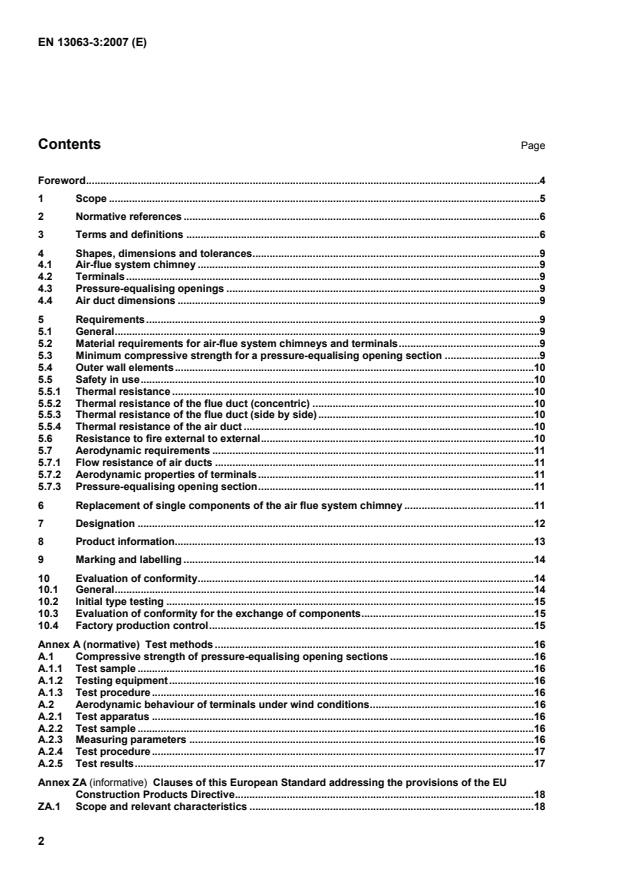
Test methods.16 A.1 Compressive strength of pressure-equalising opening sections.16 A.1.1 Test sample.16 A.1.2 Testing equipment.16 A.1.3 Test procedure.16 A.2 Aerodynamic behaviour of terminals under wind conditions.16 A.2.1 Test apparatus.16 A.2.2 Test sample.16 A.2.3 Measuring parameters.16 A.2.4 Test procedure.17 A.2.5 Test results.17 Annex ZA (informative)
Clauses of this European Standard addressing the provisions of the EU Construction Products Directive.18 ZA.1 Scope and relevant characteristics.18
CE marking and labelling.23 Bibliography.27
This document has been prepared under a mandate given to CEN by the European Commission and the European Free Trade Association, and supports essential requirements of EU Directive 89/106.
For relationship with EU Directive(s), see informative Annex ZA, which is an integral part of this document.
According to the CEN/CENELEC Internal Regulations, the national standards organizations of the following countries are bound to implement this European Standard: Austria, Belgium, Bulgaria, Cyprus, Czech Republic, Denmark, Estonia, Finland, France, Germany, Greece, Hungary, Iceland, Ireland, Italy, Latvia, Lithuania, Luxembourg, Malta, Netherlands, Norway, Poland, Portugal, Romania, Slovakia, Slovenia, Spain, Sweden, Switzerland and United Kingdom.
Key 1 Flue duct 2 Insulation layer 3 Outer wall 4 Cavities for structural reinforcement 5 Air gap Figure 1 — Examples of cross sections of concentric air flue system chimneys
Key 1 Flue duct 2 Insulation layer or air gap 3 Outer wall 4 Cavities for structural reinforcement 5 Air duct
6 Back ventilation Figure 2 — Examples of cross sections of side-by-side air flue system chimneys
3.4 terminal element consisting of an air inlet and a flue outlet which is situated at the top of the air flue–system chimney 3.5 pressure-equalising opening opening that directly connects the air duct/air gap with the flue which is situated at the base of the air flue–system chimney 3.6 air duct/air gap part of the air flue–system chimney which conveyscombustion air to room-sealed appliances 3.7 recirculation percentage ratio between the amount of flue gases leaking through the flue opening into the air duct opening of the terminal and the total amount of flue gases produced 3.8 wind pressure angle angle related to horizontal at which the wind impinges upon the air/flue terminal
EN 13063-2. 5.2 Material requirements for air-flue system chimneys and terminals All air flue system chimneys designated D, excluding terminals, shall be in accordance with the material requirements of EN 13063-1:2005, clause 5. Concentric air flue system chimneys designated W, excluding terminals, shall be in accordance with the material requirements of EN 13063-2:2005, clause 5. In addition the flue liner shall have a water vapour resistance less than or equal to 10 (g/h m2) measured according to EN 1457:1999, 16.13. Side-by-side air flue system chimneys designated W shall be in accordance with the material requirements of EN 13063-2:2005, clause 5. Material requirements for terminals shall be specified according to the appropriate European standard or, in the absence of European standards, according to the manufacturer's specification. 5.3 Minimum compressive strength for a pressure-equalising opening section The minimum compressive strength for a pressure-equalising opening section shall be in accordance with the requirements for opening sections of EN 13063-1:2005, 5.1.3 when testing in accordance with Annex A. NOTE The limiting factor of the maximum height of system chimneys is the compressive strength of the opening section or pressure-equalising opening section (inner liner or outer wall).
5.5 Safety in use 5.5.1 Thermal resistance For air flue system chimneys the thermal resistance of the flue duct and the thermal resistance of the air duct shall be declared by the manufacturer. 5.5.2 Thermal resistance of the flue duct (concentric) The thermal resistance value of the flue duct (inner liner with or without insulation) shall be declared by the manufacturer and shall be verified by testing according to the test method of EN 13216-1:2004, clause 5.8 (reference test method) or calculation in accordance with EN 13063-1:2005, Annex C, both with inner surface temperature of the flue liner at 200°C. 5.5.3 Thermal resistance of the flue duct (side by side) The thermal resistance value of the flue duct (inner liner with or without insulation and outer wall) shall be declared by the manufacturer and shall be verified by testing according to the test method of
EN 13216-1:2004 clause 5.8 (reference test method) or calculating in accordance with EN 13063-1:2005, Annex C, both with an inner flue liner surface temperature of 200 °C. 5.5.4 Thermal resistance of the air duct The thermal resistance value of the air duct declared by the manufacturer shall be verified by testing according to the test method of EN 13216-1 (reference test method) or calculation in accordance with EN 13063-1:2005, Annex C, related to 20 °C. NOTE In the absence of a European test method, the outer surface temperature of the air duct/air gap should not be less than the dew point temperature of the ambient air if calculated or measured according to national methods and boundary values. 5.6 Resistance to fire external to external Until a European test method is available,resistance to fire, external to external, shall be evaluated and declared according to national regulations. Examples of European classification are given in Table 1. Table 1 – Examples of European
fire resistance performance classes Fire resistance performance classes Duration in minutesEI 000 0 ≤ EI 000 < 30 EI 030 30 ≤ EI 030 < 60 EI 060 60 ≤ EI 060 < 90 EI 090 90 ≤ EI 090 < 120 EI 120 120 ≤ EI 120
Air – flue system chimney terminals shall be tested in accordance with A.2 and the pressure characteristics shall be declared. 5.7.3 Pressure-equalising opening section For multi-inlet air flue system chimneys the manufacturer shall declare the size of the pressure-equalising opening. The cross section of the pressure-equalising opening shall be at least 15 % of the cross section of the flue liner. Multi-inlet air flue system chimneys working under positive pressure shall not have a pressure-equalising opening. NOTE No pressure-equalising opening is necessary for air flue system chimneys with only one appliance. 6 Replacement of single components of the air flue system chimney If the manufacturer changes a part of the system, it is possible to replace single components as appropriate as described in the relevant EN 13063-1 for the designated D system or EN 13063-2 for the designated W system. Terminals and pressure equalizing openings shall meet the requirements of 5.3. Terminals shall comply with 5.7.1.3 and 5.7.3. Pressure equalizing opening section shall comply with 5.3 and 5.7.1.2.
Typical example for a soot fire resistant air flue system chimney
Air-flue system chimney EN 13063 –3 T400 N1 D 3 G50
Denomination
Standard number
Temperature class
Pressure class
Resistance to condensate class
Corrosion resistance class
Soot fire resistance class followed by the distance to combustible materials
8 Product information The installation instructions shall be available in the language of the country in which the product is sold and shall meet the criteria, if stated, in the national building regulations. The following information shall be included: manufacturer's identification; product designation with explanation;
fire resistance external to external; installation drawing typical of the application; method of jointing the components; method of installing sections or fittings and accessories; minimum distance to combustibles; limitations of height and location of the exposed section of the chimney;
thermal resistance of the flue duct; thermal resistance of the air duct; friction coefficient ζ of the pressure-equalising opening; friction coefficient ζ of the terminal air inlet; friction coefficient ζ of the terminal flue gas outlet; friction coefficient ζ of the air duct; roughness of the inner liner; coefficient of the flow resistance due to a directional change in the flue. 9 Marking and labelling The manufacturer shall make available a chimney plate made of a durable material that shall include the following information: name or trademark of the manufacturer, engraved or indelibly marked; nominal size; date of manufacturing or batch number; space for installer data and date of installation. NOTE For CE marking and labelling see ZA.3 in Annex ZA. 10 Evaluation of conformity 10.1 General The evaluation of conformity shall be demons
...