

EN 13508-2:2003+A1:2011
(Main)Investigation and assessment of drain and sewer systems outside buildings - Part 2: Visual inspection coding system
- Abstract
This European Standard is applicable to the establishment of the condition of sewers, drains, manholes and inspection chambers by inspection, status codification and consideration of external factors and other information. It is applicable to drain and sewer systems, which operate essentially under gravity, from the point where the sewage leaves a building or roof drainage system, or enters a road gully, to the point where it is discharged into a treatment works or receiving water.
- Status
- Published
- Publication Date
- 17-May-2011
- Technical Committee
- CEN/TC 165 - Waste water engineering
- Drafting Committee
- CEN/TC 165/WG 22 - Drainage outside buildings
- Current Stage
- 9093 - Decision to confirm - Review Enquiry
- Start Date
- 13-Jun-2024
- Completion Date
- 14-Oct-2026

Overview
EN 13508-2:2003+A1:2011 - "Investigation and assessment of drain and sewer systems outside buildings - Part 2: Visual inspection coding system" is a European standard that defines a structured coding system for visual inspection of drains, sewers, manholes and inspection chambers. It applies to gravity-operated external sewage systems from the point sewage leaves a building or road gully to discharge at treatment works or receiving waters. The standard supports consistent condition assessment, reporting and electronic data exchange across organisations.
Key topics and technical requirements
- Structured coding system for drains, sewers, manholes and inspection chambers, covering:
- Main codes, characterisation and quantification of defects and conditions
- Circumferential, longitudinal and vertical location references
- Observation-at-joint codes and inventory codes (materials, fittings, connections)
- Photograph and video reference fields for visual evidence
- Header information requirements: mandatory and optional metadata to identify inspection location, inspection details and pipeline/manhole attributes.
- Data transfer formats: recommended electronic formats for interoperability (character-separated formats and XML) to enable standardised exchange of inspection data.
- Annexes and guidance: examples, sample coding sheets, illustrative photographs and national equivalent coding considerations to aid implementation.
- Scope limitations: applies to gravity-operated external systems; national equivalents and amendments are acknowledged.
Practical applications and who uses this standard
SIST EN 13508-2 is used by:
- Municipal and regional water/wastewater utilities for routine CCTV inspection and condition surveys
- Asset managers and engineers for condition assessment, prioritising maintenance and rehabilitation
- CCTV inspection contractors and field operatives to record defects consistently
- Consultants and designers integrating inspection data into rehabilitation plans
- Regulators and data aggregators who require standardised reporting and cross-border compatibility
Typical uses:
- Consistent defect coding during CCTV inspections to feed asset management systems
- Creating inspection reports with photograph/video references and standardised defect descriptions
- Sharing inspection datasets between organisations using recommended electronic formats (CSV-like or XML)
- Comparing condition trends over time and informing lifecycle planning and funding decisions
Related standards and interoperability
- Part 2 is one element of the EN 13508 series (investigation and assessment of external sewer systems). The standard references national equivalent systems and provides annexes to assist data exchange and harmonisation across different countries and software platforms.
Keywords: EN 13508-2:2003+A1:2011, visual inspection coding system, sewer inspection, drain and sewer systems, manhole inspection, CCTV inspection, condition assessment, coding system, data transfer, sewer asset management.
Relations
- Effective Date
- 05-Mar-2011
- Effective Date
- 05-Mar-2011
- Effective Date
- 25-Aug-2026
- Effective Date
- 28-Jan-2026
- Effective Date
- 28-Jan-2026
- Effective Date
- 28-Jan-2026
- Effective Date
- 28-Jan-2026
- Effective Date
- 28-Jan-2026
- Effective Date
- 28-Jan-2026
- Effective Date
- 28-Jan-2026
Get Certified
Connect with accredited certification bodies for this standard

Zavod za gradbeništvo Slovenije (ZAG) - Inšpekcija
ZAG inspection body for construction products, structures, and materials.
Sponsored listings
Frequently Asked Questions
EN 13508-2:2003+A1:2011 is a standard published by the European Committee for Standardization (CEN). Its full title is "Investigation and assessment of drain and sewer systems outside buildings - Part 2: Visual inspection coding system". This standard covers: This European Standard is applicable to the establishment of the condition of sewers, drains, manholes and inspection chambers by inspection, status codification and consideration of external factors and other information. It is applicable to drain and sewer systems, which operate essentially under gravity, from the point where the sewage leaves a building or roof drainage system, or enters a road gully, to the point where it is discharged into a treatment works or receiving water.
This European Standard is applicable to the establishment of the condition of sewers, drains, manholes and inspection chambers by inspection, status codification and consideration of external factors and other information. It is applicable to drain and sewer systems, which operate essentially under gravity, from the point where the sewage leaves a building or roof drainage system, or enters a road gully, to the point where it is discharged into a treatment works or receiving water.
EN 13508-2:2003+A1:2011 is classified under the following ICS (International Classification for Standards) categories: 93.030 - External sewage systems. The ICS classification helps identify the subject area and facilitates finding related standards.
EN 13508-2:2003+A1:2011 has the following relationships with other standards: It is inter standard links to EN 13508-2:2003, EN 13508-2:2003/AC:2007, ISO 8601:2004, EN 1085:2007, EN 1090-5:2017, EN 476:1997, EN 13508-1:2012, EN ISO 11296-1:2011, EN 14654-4:2021, EN 752:2008. Understanding these relationships helps ensure you are using the most current and applicable version of the standard.
EN 13508-2:2003+A1:2011 is associated with the following European legislation: EU Directives/Regulations: 305/2011, 89/106/EEC. When a standard is cited in the Official Journal of the European Union, products manufactured in conformity with it benefit from a presumption of conformity with the essential requirements of the corresponding EU directive or regulation.
EN 13508-2:2003+A1:2011 is available in PDF format for immediate download after purchase. The document can be added to your cart and obtained through the secure checkout process. Digital delivery ensures instant access to the complete standard document.
Standards Content (Sample)
2003-01.Slovenski inštitut za standardizacijo. Razmnoževanje celote ali delov tega standarda ni dovoljeno.Ugotavljanje in ocenjevanje stanja drenažnih in kanalizacijskih sistemov zunaj stavb - 2. del: Sistem za vizualni nadzor in kodiranjeUntersuchung und Beurteilung Zustand von Entwässerungssystemen außerhalb von Gebäuden - Teil 2: Kodiersystem für die optische InspektionInvestigation et évaluation des réseaux d'assainissement à l'extérieur des bâtiments - Partie 2: Système de codage de l'inspection visuelleInvestigation and assessment of drain and sewer systems outside buildings - Part 2: Visual inspection coding system93.030Zunanji sistemi za odpadno vodoExternal sewage systemsICS:Ta slovenski standard je istoveten z:EN 13508-2:2003+A1:2011SIST EN 13508-2:2003+A1:2011en,de01-september-2011SIST EN 13508-2:2003+A1:2011SLOVENSKI
STANDARD
EUROPEAN STANDARD NORME EUROPÉENNE EUROPÄISCHE NORM
EN 13508-2:2003+A1
May 2011 ICS 93.030 Supersedes EN 13508-2:2003English Version
Investigation and assessment of drain and sewer systems outside buildings - Part 2: Visual inspection coding system
Investigation et évaluation des réseaux d'assainissement à l'extérieur des bâtiments - Partie 2: Système de codage de l'inspection visuelle
Untersuchung und Beurteilung Zustand von Entwässerungssystemen außerhalb von Gebäuden - Teil 2: Kodiersystem für die optische Inspektion This European Standard was approved by CEN on 4 November 2002 and includes Corrigendum 1 issued by CEN on 21 March 2007 and Amendment 1 approved by CEN on 17 March 2011.
CEN members are bound to comply with the CEN/CENELEC Internal Regulations which stipulate the conditions for giving this European Standard the status of a national standard without any alteration. Up-to-date lists and bibliographical references concerning such national standards may be obtained on application to the CEN-CENELEC Management Centre or to any CEN member.
This European Standard exists in three official versions (English, French, German). A version in any other language made by translation under the responsibility of a CEN member into its own language and notified to the CEN-CENELEC Management Centre has the same status as the official versions.
CEN members are the national standards bodies of Austria, Belgium, Bulgaria, Croatia, Cyprus, Czech Republic, Denmark, Estonia, Finland, France, Germany, Greece, Hungary, Iceland, Ireland, Italy, Latvia, Lithuania, Luxembourg, Malta, Netherlands, Norway, Poland, Portugal, Romania, Slovakia, Slovenia, Spain, Sweden, Switzerland and United Kingdom.
EUROPEAN COMMITTEE FOR STANDARDIZATION
COMITÉ EUROPÉEN DE NORMALISATION EUROPÄISCHES KOMITEE FÜR NORMUNG
Management Centre:
Avenue Marnix 17,
B-1000 Brussels © 2011 CEN All rights of exploitation in any form and by any means reserved worldwide for CEN national Members. Ref. No. EN 13508-2:2003+A1:2011: ESIST EN 13508-2:2003+A1:2011
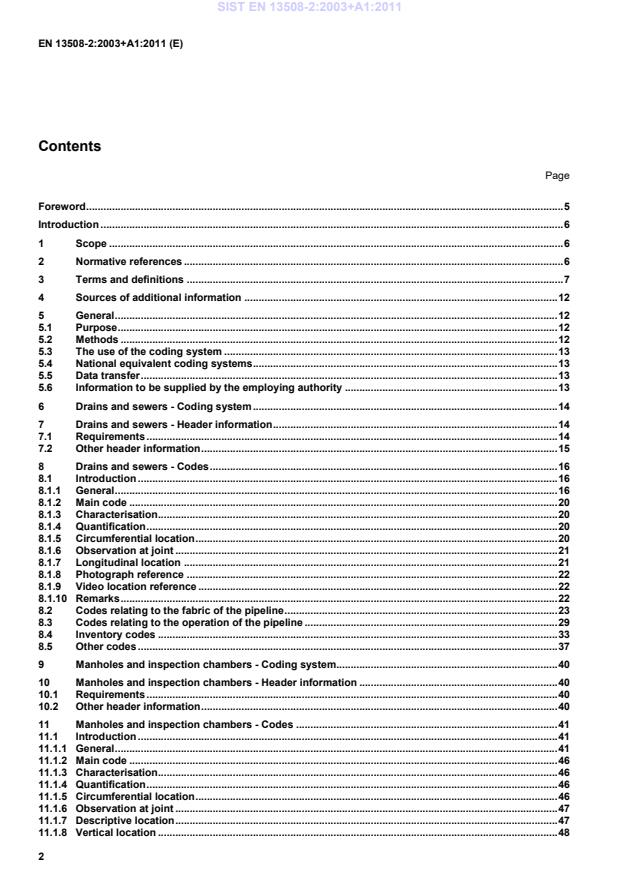
National equivalent coding systems . 68 A.1 Header information . 68 A.2 Codes . 68 Annex B (informative)
Format for electronic transfer of coded data . 69 B.1 Introduction . 69 !B.2 Character Separated format" . 69 B.2.1 General. 69 B.2.2 File header information . 69 B.2.3 Inspection header information . 71 B.2.4 Inspection data . 72 B.2.5 Examples . 73 B.3 Extensible Mark-up Language Format . 74 B.3.1 General. 74 B.3.2 File header information . 75 B.3.3 Inspection header information . 75 B.3.4 Inspection data . 75 B.3.5 Example . 75 Annex C (informative)
Recommended system for coding of header information for drains and sewers . 79 C.1 Introduction . 79 C.2 Location of the inspection . 79 C.3 Inspection details . 82 C.4 Pipeline details . 86 C.5 Other information . 89 C.6 Changes to header information . 89 C.7 Other information required by the employing authority . 91 Annex D (informative)
Recommended system for coding of header information for manholes and inspection chambers . 92 D.1 Introduction . 92 D.2 Location of the inspection . 92 D.3 Inspection details . 94 D.4 Manhole or inspection chamber details . 98 D.5 Other information . 100 D.6 Changes to header information . 101 D.7 Other information required by the employing authority . 102 Annex E (informative)
Sample coding sheet . 103 Annex F (informative)
Photographs illustrating the coding system for drains and sewers . 105 Annex G (informative)
Photographs illustrating the coding system for manholes and inspection chambers . 134 Annex H (informative)
Sources of additional information . 145 H.1 International Standards. 145 H.2 Austria. 145 H.2.1 Austrian Water and Waste Management Association – Rules of Practice (ÖWAV - Österreichischer Wasser- und Abfallwirtschaftsverband - Regelblätter) . 145 H.2.2 Other guidelines . 145 H.3 Denmark . 146 H.4 Finland . 146 H.5 France . 147 H.6 Germany . 147 H.7 Italy . 148 H.8 Netherlands . 148 SIST EN 13508-2:2003+A1:2011
!". The modifications of the related CEN Corrigendum have been implemented at the appropriate places in the text and are indicated by the tags ˜ ™. The Standard series EN 13508 " Condition of drain and sewer systems outside buildings " contains the following parts
Part 1:
General requirements
Part 2:
Visual inspection coding system
Other parts, dealing with other methods of inspection, can be added later. In drafting this part of this European Standard account has been taken of other available standards, in particular EN To2=―arain=and=sewer=systems=outside=buiädings‖= To allow for the alteration of existing data and coding system software in accordance with this standard and training of inspection personnel, a transition period is granted until (DAV + 36 month) for the withdrawal of conflicting national standards and the application of this standard. Where there are existing inspection programmes to meet legal requirements commenced before the publication of this standard, it is permitted to complete such programmes using the original coding system. According to the CEN/CENELEC Internal Regulations, the national standards organizations of the following countries are bound to implement this European Standard: Austria, Belgium, Bulgaria, Croatia, Cyprus, Czech Republic, Denmark, Estonia, Finland, France, Germany, Greece, Hungary, Iceland, Ireland, Italy, Latvia, Lithuania, Luxembourg, Malta, Netherlands, Norway, Poland, Portugal, Romania, Slovakia, Slovenia, Spain, Sweden, Switzerland and United Kingdom.
Before the standard can be fully applied, extensive retraining of operators and modification of software will be necessary.
1 Scope !This European Standard is applicable to the investigation and assessment of drain and sewer systems outside buildings." !It is applicable to drain and sewer systems, which operate essentially under gravity, from the point where the wastewater leaves a building or roof drainage system, or enters a road gully, to the point where it is discharged into a treatment works or receiving water." Drains and sewers below buildings are included provided that they do not form part of the drainage system of the building. This part of the European Standard specifies a coding system for the description of the internal condition of drains, sewers, manholes and inspection chambers identified through visual inspection. Where appropriate, it can also be used for pressure and vacuum systems in accordance with the requirements of the employing authority. !Visual inspection of drain and sewer systems can be carried out as part of the investigation in order to undertake the assessment." This part of the European Standard does not generally specify requirements for carrying out inspections.
2 Normative references !The following referenced documents are indispensable for the application of this document. For dated references, only the edition cited applies. For undated references, the latest edition of the referenced document (including any amendments) applies." EN 476:1997, General requirements for components used in discharge pipes, drains and sewers for gravity systems !EN 752:2008, Drain and sewer systems outside buildings" !EN 1085:2007, Wastewater treatment — Vocabulary" ISO 8601, Data elements and interchange formats — Information interchange — Representation of dates and times SIST EN 13508-2:2003+A1:2011
working space above the channel 3.5 chamber unit component part of a manhole or inspection chamber manufactured as a single entity and intended to be joined with other chamber units 3.6 combined system !drain and sewer system designed to carry both foul wastewater and surface water in the same pipeline(s)" ![EN 752:2008, Term 3.12, EN 1085:2007, Term 2110]" 3.7 connection general term used for the location at which one pipeline joins another pipeline or a manhole or inspection chamber 3.8 drain pipeline, usually underground, designed to carry wastewater and/or surface water from a source to a sewer.
![EN 752:2008, Term 3.19, EN 1085:2007, Term 2250]" 3.9 drain system network of pipelines and ancillary works that conveys wastewater and/or surface water to a cesspool, sewer system or other place of disposal !deleted text" 3.10 employing authority organisation which owns or is responsible for the !management" of a drain or sewer system 3.11 exfiltration !escape of wastewater from a drain or sewer system into surrounding ground" ![EN 752:2008, Term 3.24, EN 1085:2007, Term 2230]" SIST EN 13508-2:2003+A1:2011
!deleted text" 3.13 gravity system !drain or sewer system where flow is caused by the force of gravity and where the pipeline is designed usually to operate partially full" ![EN 752:2008, Term 3.30, EN 1085:2007, Term 2260]" 3.14 groundwater water present in the sub-surface strata
!deleted text" 3.15 infiltration ! unwanted flow resulting from an ingress of groundwater into a drain or sewer system" ![EN 752:2008, Term 3.33, EN 1085:2007, Term 2220]" 3.16 inspection chamber !chamber with a removable cover constructed on a drain or sewer that permits the introduction of cleaning and inspection equipment from surface level, but does not provide access for personnel" ![EN 752:2008, Term 3.34]" 3.17 invert lowest point of the internal surface of the barrel of a pipe or channel at any cross section [EN 476:1997] 3.18 joint location at which the ends of two adjacent pipe units are joined together longitudinally
3.19 junction connection made using a prefabricated junction pipe unit 3.20 landing intermediate rest platform used to limit the height of a run of steps in a manhole 3.21 manhole chamber with a removable cover constructed on a drain or sewer to permit entry by personnel ![EN 752:2008, Term 3.41]" 3.22 node manhole, inspection chamber, outfall, rodding eye or other significant intermediate point 3.23 outfall !structure or point from which wastewater is discharged to a wastewater treatment plant or receiving water" ![EN 752:2008, Term 3.42, EN 1085:2007, Term 1280]" 3.24 pipe unit component part of a drain or sewer manufactured as a single entity and intended to be joined with other pipe units
3.26 pipeline length continuous section of drain or sewer between two adjacent nodes 3.27 pipe unit length length of a manufactured pipe unit used in the construction of a pipeline
3.28 ramp manhole manhole with a steeply inclined pipe or channel from a drain or sewer at a higher level ![EN 752:2008, Term 3.47]" 3.29 receiving water !any type of water body where water or wastewater is discharged"
![EN 752:2008, Term 3.49, EN 1085:2007, Term 1100]" 3.30 rehabilitation !measures for restoring or upgrading the performance of existing drain and sewer systems" ![EN 752:2008, Term 3.50]" 3.31 repair rectification of local damage ![EN 752:2008, Term 3.53]" 3.32 rising main !pipe through which wastewater is pumped" ![EN 752:2008, Term 3.56, EN 1085:2007, Term 2170]" !deleted text" !3.33" sewer !pipeline or other construction, usually underground, designed to carry wastewater from more than one source" ![EN 752:2008, Term 3.65, EN 1085:2007, Term 2270]" !3.34" sewer system !network of pipelines and ancillary works which conveys wastewater from drains to a treatment works or other place of disposal" ![EN 752:2008, Term 3.66, EN 1085:2007, Term 2180]" !3.35" shaft upper part of a manhole or inspection chamber between the adjusting construction and the chamber
!3.36" surface water water from precipitation, which has not seeped into the ground and which is discharged to the drain or sewer system directly from the ground or from exterior building surfaces ![EN 752:2008, Term 3.73, EN 1085:2007, Term 2070]"
!3.38" wastewater !water composed of any combination of water discharged from domestic, industrial or commercial premises, surface run-off and accidentally any sewer infiltration water" ![EN 752:2008, Term 3.80, EN 1085:2007, Term 1010]" SIST EN 13508-2:2003+A1:2011
Key 1 channel 7 manhole top (cover and frame) h
depth to invert 2 benching 8 step ha depth of adjusting construction 3 invert 9 sealing material hs depth of shaft 4 chamber unit 10 adjusting construction hd depth of chamber 5 taper 11 cover level da access diameter/size 6 reducing slab 12 manhole wall ds shaft diameter/size
dc chamber diameter/size"
Figure 1 — Illustration of terms relating to manholes SIST EN 13508-2:2003+A1:2011
The documents listed in annex H contain details, which can be used in the framework of this part.
5 General 5.1 Purpose !EN 752 requires the use of a uniform standard coding system complying with this European Standard to ensure that results from visual inspections can be compared. This part of this standard specifies a system, which can be used to objectively record the visual information from the inspection. It does not include methods for assessing the condition of the drain or sewer as this requires subjective judgements and the use of additional information. The coded information can be used for one or more of the following purposes:
to assess the performance deficiencies as part of the development of a rehabilitation plan (see EN 752:2008, Clause 6);
to provide information for use in the planning of maintenance activities, e.g. sewer cleaning programmes (see EN 752:2008, Clause 6);
to investigate specific maintenance or operational problems (see EN 752:2008, Clause 11);
the recording of inventory data (see EN 752:2008, Clause 6)." 5.2 Methods The visual inspection can be carried out in one of the following ways:
inspection of the pipeline from within the pipeline;
inspection of the pipeline from within the manhole or inspection chamber;
inspection of the manhole or inspection chamber from within the manhole or inspection chamber;
inspection of the manhole or inspection chamber from the surface. Several inspection techniques can be used such as:
remotely controlled CCTV camera;
man entry;
mirrors;
photographic camera. The personnel involved in inspection work shall be adequately trained in the inspection methods and in the coding system. The inspection shall be carried out sufficiently slowly to enable all features to be observed. Where a closed circuit television camera is used, the camera should only be moved along the pipe when the lens is pointing forward in the direction of the axis of the sewer. SIST EN 13508-2:2003+A1:2011
The defects, features and the general condition shall be coded in accordance with this standard and should be supported either with photographs or by a video recording.
5.4 National equivalent coding systems
The codes used in this standard are independent of any language. In order to make the codes more memorable or more compatible with existing systems, a list of national equivalent codes may be produced. Where these are produced, a table of equivalence should be included in a national annex to this standard. Only the language independent codes specified in this standard can be used with the electronic data transfer format described in annex B. Rules for national equivalent coding systems are given in annex A. 5.5 Data transfer The coded information is frequently transferred between databases. A recommended format for data transfer, using this coding system, is included in annex B. 5.6 Information to be supplied by the employing authority The coding systems are intended to provide a comprehensive choice of codes to allow the inspector to describe the drains, sewers, manholes or inspection chambers as required by the employing authority. The codes are only to be used as directed by the employing authority who may decide which features are to be recorded.
The employing authority should specify the following from the options available in this standard: a) Header information i) The coding system to be used for recording header information (e.g. national equivalent system or annex C or D) ii) Which of the optional header information items is to be recorded (see 7.2 and 10.2)
iii) The reference points to be used for the longitudinal location in inspections of drains and sewers (see 8.1.7) and the vertical and circumferential location in manholes and inspection chambers (see 11.1.5 and 11.1.8). b) The information about the individual observations. i) Whether the coding system to be used is the system described in clause 8 or clause 11 of this standard or a specified national equivalent system in accordance with 5.4. SIST EN 13508-2:2003+A1:2011
whether quantification information, longitudinal, vertical, circumferential location information, or whether the fact that the observation is associated with a joint, is to be recorded;
whether quantification information is to be recorded as a single value or as a band;
if bands are to be used, the ranges of values be included in each band;
the tolerances to be used for estimation and/or measurement of values.
6 Drains and sewers - Coding system The coding system for drains and sewers comprises a series of codes which shall be used to describe the defects and features found in the drain or sewer. !A separate inspection report shall be prepared for each pipeline length." !If an additional node is found during the inspection then separate inspection reports shall be prepared for each of the two pipeline lengths. Where an inspection is abandoned and reinspected either in the same direction or from the other direction, then separate inspection reports shall be prepared for each inspection." !NOTE Where the inspection of a sewer length is carried out by more than one separate inspection, the documentation prepared in accordance with the requirements of the employing authority (see Clause 12) can include consolidated information from all the inspection reports of that pipeline length."
Header information - relating to the pipeline as a whole. This is described in clause 7 and annex C. All codes for these start with the letter A.
Information about individual observations within the drain or sewer. This is described in clause 8. All codes for these start with the letter B. 7 Drains and sewers - Header information 7.1 Requirements Header information is entered at the start of the inspection. The following information shall be recorded. ! a) The pipeline length identification, by: 1) pipeline reference and/or the two node references.
2) alternatively, where the pipeline length is a lateral connected to another pipeline without a chamber, the pipeline may be identified by: i) the node at the junction with the main pipeline may be defined using the reference of the main pipeline as in (1) above and the longitudinal location and clockface reference; and,
ii) the pipeline reference of the lateral or the node reference of the node at the other end of the lateral." b) The direction of the inspection. c) A textual description of the location. SIST EN 13508-2:2003+A1:2011
type of location;
name of employing authority;
name of town, village, district or sewer system;
land ownership;
original coding system (where older data is converted);
time of inspection;
name of inspector;
job reference;
video storage details;
photograph storage details;
purpose of inspection;
cross section;
material;
lining details;
pipe unit length;
depth to invert of upstream and downstream nodes;
type of drain or sewer (e.g. gravity sewer or rising main);
type of effluent (e.g. wastewater or surface water);
year of construction;
strategic importance;
precipitation;
temperature; SIST EN 13508-2:2003+A1:2011
flow control measures;
atmosphere within the pipeline. Any changes to header information identified during the course of the inspection shall be recorded.
A recommended coding system for the header information is given in annex C.
If the header information is coded in accordance with annex C, the recommended data transfer format described in annex B can be used.
8 Drains and sewers - Codes 8.1 Introduction 8.1.1 General !Each observation shall be recorded using a main code or combination of main codes (see 8.1.2) that broadly describe the feature, together with the following additional information where required."
Characterisation - up to two codes which describes the feature in more detail. (see 8.1.3)
Quantification - up to two values which quantify the feature (see 8.1.4).
Circumferential location - up to two clockface references which locate the position of the observation around the circumference (see 8.1.5).
Joint - identifies when the observation is associated with a joint (see 8.1.6).
Longitudinal location - the distance from the stated reference point including a method of recording observations which continue over a significant length (see 8.1.7).
Photograph reference (see 8.1.8).
Video reference (see 8.1.9).
Remarks - text which describes aspects of the observation which cannot be described any other way. (see 8.1.10)
The employing authority may specify which observations are to be recorded and the amount of detail that is recorded for each observation (see 5.6). An example of the record for a longitudinal crack at the top of the pipe 10.5 metres from the start point is shown in Table 1 (see 8.2). SIST EN 13508-2:2003+A1:2011
BAB B A
00:10:30
BCA E A 100
00:12:20
16.5
BAG
00:12:20
The main codes which are used to describe the observations are listed in 8.2 to 8.5 together with a description of the observation and the use of the code. No observation shall be recorded without using one of these codes.
For clarity these codes have been grouped under 4 headings and the second letter indicates the respective group:
Codes relating to the fabric of the pipeline (codes BA.),
Codes relating to the operation of the pipeline (codes BB.),
Inventory codes (codes BC.),
Other Codes (codes BD.). This is entirely for editorial purposes and the headings should not be used to interpret or otherwise restrict the meaning of the codes.
8.1.3 Characterisation Codes are given to further describe the observation. Up to two types of characterisation are given for each observation type. They shall be recorded in the order in which they are given.
When required by the employing authority, and where an observation cannot be observed (for example, if it is not possible to see corrosion in an uncleaned sewer) the code YY shall be used as a first characterisation code.
Only characterisation codes listed in this standard may be used.
8.1.4 Quantification Up to two values shall be recorded as specified in 8.2 to 8.5.
Unless these clauses specify the use of the two quantification values differently, the two values may be used to record a band, by specifying the lower and upper limits (e.g. 10% to 15%).
8.1.5 Circumferential location Where specified in 8.2 to 8.5, the position of the observation shall be recorded using the clockface reference. The clockface is determined from the angle subtended at the centre of the cross section (the point defined by half the height and half the width (see Figure 2) between the observation and the soffit of the pipeline.
Figure 2 — Examples of definition of the centre of the cross section SIST EN 13508-2:2003+A1:2011
EN
...