

prEN 12451
(Main)Copper and copper alloys - Seamless, round tubes for heat exchangers
- Abstract
This document specifies the composition, property requirements and tolerances on dimensions and form for seamless round drawn copper and copper alloy tubes for heat exchangers, condensers, evaporators and desalination equipment. It is applicable to copper and copper alloy tubes supplied in the size range from 6 mm up to and including 76 mm outside diameter and from 0,5 mm up to and including 3 mm wall thickness.
The sampling procedures and the methods of test for verification of conformity to the requirements of this document are also specified.
- Status
- Not Published
- Publication Date
- 07-Nov-2027
- Technical Committee
- CEN/TC 133 - Copper and copper alloys
- Drafting Committee
- CEN/TC 133/WG 3 - Copper tubes (installation and industrial)
- Current Stage
- 4020 - Submission to enquiry - Enquiry
- Start Date
- 27-Aug-2026
- Due Date
- 27-Jul-2026
- Completion Date
- 27-Aug-2026

prEN 12451 is a CEN draft European Standard for seamless, round drawn copper and copper alloy tubes used in heat exchangers, condensers, evaporators and desalination equipment. It specifies the tube composition, mechanical and technological property requirements, and the dimensional and form tolerances that make the product suitable for these heat-transfer duties. It also sets out the sampling, test, conformity documentation and marking information that manufacturers, purchasers and inspectors use to check compliance.
What does prEN 12451 specify?
prEN 12451 specifies requirements for seamless round copper and copper alloy tubes in the size range from 6 mm to 76 mm outside diameter and from 0.5 mm to 3 mm wall thickness. It covers product requirements and the procedures used to verify them.
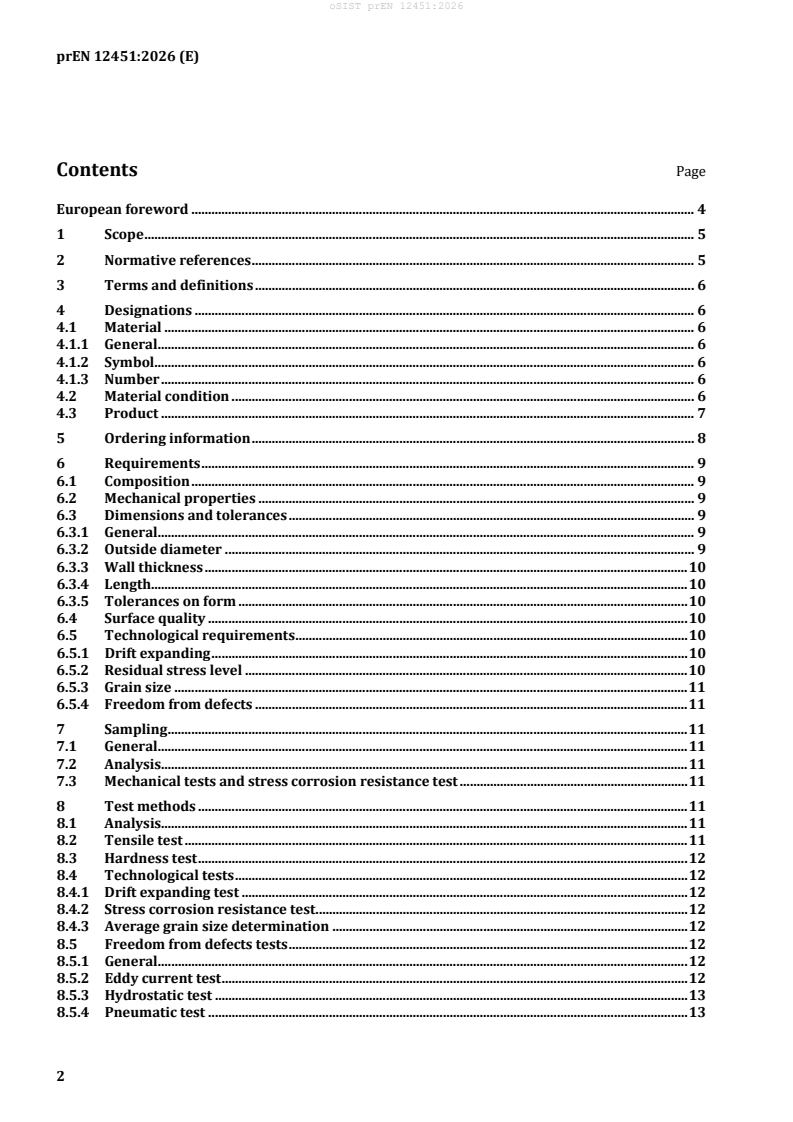
The document is organized into clauses for scope, normative references, terms and definitions, designations, ordering information, requirements, sampling, test methods, confirmation of conformity, and marking, packaging and labelling. It also has two annexes.
| Annex | What it covers |
|---|---|
| Annex A | U-bend seamless copper and copper alloy heat exchanger tubes |
| Annex ZA | Relationship with Directive 2014/68/EU (Pressure Equipment Directive) |
Annex ZA is informative and links the standard to pressure equipment legislation. That matters for users who need evidence of conformity for pressure equipment applications.
What are the key requirements of prEN 12451?
prEN 12451 combines material, performance and inspection requirements. The most important points are the alloy composition, the mechanical property condition, the dimensional tolerances, the surface quality and the tests used to show conformity.
Composition and designation
Clause 6.1 requires the composition to match Table 1 for the selected material. The table covers copper and several copper alloys, including Cu-DHP, CuAl5As, CuNi10Fe1Mn, CuNi30Fe2Mn2, CuNi30Mn1Fe, CuZn20Al2As, CuZn28Sn1As and CuZn30As. In practice, buyers need to state the exact symbol or number designation so the right alloy is supplied.
Clause 4 sets out material designation by symbol or number and defines the material conditions R..., H... and S. R... is based on tensile strength, H... on hardness, and S means stress relieved. This matters because the ordering information and the acceptance tests depend on the chosen condition.
Mechanical properties
Clause 6.2 requires the selected material condition to meet the mechanical property limits in Table 2, and the tests are carried out by tensile test or hardness test. Products in stress relieved condition still have to meet the same mechanical property requirements as non-stress-relieved material. For procurement, that means stress relief does not replace the need to meet the stated strength or hardness level.
Dimensions and form
Clause 6.3 requires the tube to meet the specified outside diameter, wall thickness and length tolerances. The standard also controls straightness and squareness of cut, and it treats deviation from circular form as part of the diameter tolerance for straight lengths.
Clause 6.3.3 gives two wall-thickness approaches: the general wall-thickness tolerance and, where requested, a minimum wall-thickness requirement. This is important when the tube is used in service conditions where local thinning matters, such as pressure-bearing heat exchanger circuits.
Surface quality
Clause 6.4 requires clean, smooth internal and external surfaces. A light drawing lubricant film is allowed, and annealed or thermally stress-relieved tubes may show a dull iridescent oxide film if it is securely adherent. Special cleaning or finishing, such as pickling or degreasing, has to be agreed at the time of order.
Technological requirements
Clause 6.5 includes drift expanding, residual stress level, grain size and freedom from defects. Tubes in annealed or end-annealed condition must pass drift expanding without visible cracking, and stress-relieved tubes may be checked for residual stress resistance when requested. Tubes in annealed condition must also meet the stated average grain-size range.
Sampling, tests and retests
Clause 7 requires random sampling at a rate of at least one sampling unit per 3 000 kg or per production batch, whichever is smaller. The document allows earlier analysis results if material identity is maintained, which can reduce duplicate testing in controlled production systems.
Clause 8 gives the test methods: chemical analysis, tensile testing, Vickers hardness, drift expanding, stress corrosion resistance, average grain size, and freedom-from-defects tests. For freedom from defects, each tube is tested by eddy current, hydrostatic pressure or pneumatic pressure, with eddy current used unless otherwise agreed.
If a test fails, Clause 8.6 provides retest rules. This gives a controlled path for deciding whether one lot can still be accepted after a nonconforming result.
Conformity documents and marking
Clauses 9 and 10 cover confirmation of conformity, inspection documentation, and any agreed marking, packaging or labelling. For pressure equipment applications, the buyer or manufacturer has to request the appropriate inspection documentation.
What terms does prEN 12451 define?
Seamless round tube - A hollow circular tube with uniform wall thickness and a continuous periphery through all stages of production.
Mean wall thickness - The arithmetic mean of the maximum and minimum wall thickness measured at the same cross-section.
Deviation from circular form - The difference between the maximum and minimum outside diameters at one cross-section.
R... - A material condition identified by the minimum tensile strength requirement.
H... - A material condition identified by the minimum hardness requirement.
S - A suffix that identifies a stress-relieved product.
Product designation - The standardized order of tube, standard number, material designation, material condition and nominal dimensions used to identify the product clearly.
Who uses prEN 12451?
prEN 12451 is used by tube manufacturers, heat exchanger makers, and buyers who specify copper or copper alloy tubing for thermal equipment. It is also used by quality managers, test laboratories and inspection bodies that verify composition, mechanical properties and defect freedom.
The standard is relevant to industries making condensers, evaporators, desalination equipment and, through Annex ZA, pressure equipment. It is especially useful where tube condition, residual stress, grain size and defect detection affect service reliability.
What changed in prEN 12451 from the previous edition?
prEN 12451 supersedes EN 12451:2012. The foreword states these significant changes:
- normative references were updated
- Directive 97/23/EC was replaced by Directive 2014/68/EU
- EN 1655 was replaced by EN ISO/IEC 17050-1:2010 and EN ISO/IEC 17050-2:2004
- in 7.1, the sampling rate was modified and the billet inward stage was included for analysis
- Table 6 “Sampling rate” was deleted
Which standards are used with prEN 12451?
The normative references give the test and documentation methods used by prEN 12451:
- EN 764-5:2014 - inspection documentation for metallic materials in pressure equipment
- EN 1971-1:2019 - eddy current testing with an encircling coil on the outer surface
- EN 1971-2:2019 - eddy current testing with an internal probe on the inner surface
- EN 10204:2004 - types of inspection documents
- EN 16090:2019 - average grain size estimation by ultrasound
- EN ISO 196:1995 - mercury(I) nitrate test for residual stress detection
- EN ISO 2624:1995 - average grain size estimation
- EN ISO 6507-1:2023 - Vickers hardness test method
- EN ISO 6892-1:2019 - tensile testing at room temperature
- EN ISO 8493:2004 - drift-expanding test
- EN ISO/IEC 17050-1:2010 - supplier’s declaration of conformity, general requirements
- EN ISO/IEC 17050-2:2004 - supporting documentation for supplier’s declaration
- ISO 6957:1988 - ammonia test for stress corrosion resistance
The foreword also places prEN 12451 in the same copper tube family as EN 1057, EN 12449, EN 12450, EN 12452, EN 12735-1, EN 12735-2, EN 13348, EN 13349 and EN 13600. Those standards cover other tube forms and applications, so they help users select the right product standard for the intended service.
What does the prEN 12451 document contain?
prEN 12451 contains composition tables, mechanical property tables, and dimensional tolerance tables for diameter, length and squareness of cut. It also includes a table of drill sizes for reference standard tubes used in eddy current testing.
The body of the document gives the ordering information, sampling rules, test methods and retest rules needed for production control and acceptance testing. Annex A adds U-bend requirements, including bend-radius related limits, wall-thickness checks and leg-spacing requirements for heat exchanger tubes formed after manufacture.
The document also includes the pressure-pressure-equipment linkage in Annex ZA, which maps selected clauses to Directive 2014/68/EU. That makes the standard useful not only for product specification, but also for technical documentation in regulated pressure equipment supply chains.
Relations
- Effective Date
- 11-Jun-2025
Get Certified
Connect with accredited certification bodies for this standard

Element Materials Technology
Materials testing and product certification.

Inštitut za kovinske materiale in tehnologije
Institute of Metals and Technology. Materials testing, metallurgical analysis, NDT.
Institut za varilstvo d.o.o. (Welding Institute)
Slovenia's leading welding institute since 1952. ISO 3834, EN 1090, pressure equipment certification, NDT personnel, welder qualification. Only IIW Au
Sponsored listings
Frequently Asked Questions
prEN 12451 is a draft published by the European Committee for Standardization (CEN). Its full title is "Copper and copper alloys - Seamless, round tubes for heat exchangers". This standard covers: This document specifies the composition, property requirements and tolerances on dimensions and form for seamless round drawn copper and copper alloy tubes for heat exchangers, condensers, evaporators and desalination equipment. It is applicable to copper and copper alloy tubes supplied in the size range from 6 mm up to and including 76 mm outside diameter and from 0,5 mm up to and including 3 mm wall thickness. The sampling procedures and the methods of test for verification of conformity to the requirements of this document are also specified.
This document specifies the composition, property requirements and tolerances on dimensions and form for seamless round drawn copper and copper alloy tubes for heat exchangers, condensers, evaporators and desalination equipment. It is applicable to copper and copper alloy tubes supplied in the size range from 6 mm up to and including 76 mm outside diameter and from 0,5 mm up to and including 3 mm wall thickness. The sampling procedures and the methods of test for verification of conformity to the requirements of this document are also specified.
prEN 12451 is classified under the following ICS (International Classification for Standards) categories: 23.040.15 - Non-ferrous metal pipes; 77.150.30 - Copper products. The ICS classification helps identify the subject area and facilitates finding related standards.
prEN 12451 has the following relationships with other standards: It is inter standard links to EN 12451:2012. Understanding these relationships helps ensure you are using the most current and applicable version of the standard.
prEN 12451 is associated with the following European legislation: EU Directives/Regulations: 2014/68/EU; Standardization Mandates: M/071, M/601. When a standard is cited in the Official Journal of the European Union, products manufactured in conformity with it benefit from a presumption of conformity with the essential requirements of the corresponding EU directive or regulation.
prEN 12451 is available in PDF format for immediate download after purchase. The document can be added to your cart and obtained through the secure checkout process. Digital delivery ensures instant access to the complete standard document.
Standards Content (Sample)
SLOVENSKI STANDARD
01-november-2026
Baker in bakrove zlitine - Nevarjene cevi z okroglim prerezom za toplotne
izmenjevalnike
Copper and copper alloys - Seamless, round tubes for heat exchangers
Kupfer und Kupferlegierungen - Nahtlose Rundrohre für Wärmeaustauscher
Cuivre et alliages de cuivre - Tubes ronds sans soudure pour échangeurs thermiques
Ta slovenski standard je istoveten z: prEN 12451
ICS:
23.040.15 Cevi iz neželeznih kovin Non-ferrous metal pipes
77.150.30 Bakreni izdelki Copper products
2003-01.Slovenski inštitut za standardizacijo. Razmnoževanje celote ali delov tega standarda ni dovoljeno.
DRAFT
EUROPEAN STANDARD
NORME EUROPÉENNE
EUROPÄISCHE NORM
August 2026
ICS 23.040.15; 77.150.30 Will supersede EN 12451:2012
English Version
Copper and copper alloys - Seamless, round tubes for heat
exchangers
Cuivre et alliages de cuivre - Tubes ronds sans soudure Kupfer und Kupferlegierungen - Nahtlose Rundrohre
pour échangeurs thermiques für Wärmeaustauscher
This draft European Standard is submitted to CEN members for enquiry. It has been drawn up by the Technical Committee
CEN/TC 133.
If this draft becomes a European Standard, CEN members are bound to comply with the CEN/CENELEC Internal Regulations
which stipulate the conditions for giving this European Standard the status of a national standard without any alteration.
This draft European Standard was established by CEN in three official versions (English, French, German). A version in any other
language made by translation under the responsibility of a CEN member into its own language and notified to the CEN-CENELEC
Management Centre has the same status as the official versions.
CEN members are the national standards bodies of Austria, Belgium, Bulgaria, Croatia, Cyprus, Czech Republic, Denmark, Estonia,
Finland, France, Germany, Greece, Hungary, Iceland, Ireland, Italy, Latvia, Lithuania, Luxembourg, Malta, Netherlands, Norway,
Poland, Portugal, Republic of North Macedonia, Romania, Serbia, Slovakia, Slovenia, Spain, Sweden, Switzerland, Türkiye and
United Kingdom.
Recipients of this draft are invited to submit, with their comments, notification of any relevant patent rights of which they are
aware and to provide supporting documentation.
Warning : This document is not a European Standard. It is distributed for review and comments. It is subject to change without
notice and shall not be referred to as a European Standard.
EUROPEAN COMMITTEE FOR STANDARDIZATION
COMITÉ EUROPÉEN DE NORMALISATION
EUROPÄISCHES KOMITEE FÜR NORMUNG
CEN-CENELEC Management Centre: Rue de la Science 23, B-1040 Brussels
© 2026 CEN All rights of exploitation in any form and by any means reserved Ref. No. prEN 12451:2026 E
worldwide for CEN national Members.
Contents Page
European foreword . 4
1 Scope . 5
2 Normative references . 5
3 Terms and definitions . 6
4 Designations . 6
4.1 Material . 6
4.1.1 General . 6
4.1.2 Symbol. 6
4.1.3 Number . 6
4.2 Material condition . 6
4.3 Product . 7
5 Ordering information . 8
6 Requirements . 9
6.1 Composition . 9
6.2 Mechanical properties . 9
6.3 Dimensions and tolerances . 9
6.3.1 General . 9
6.3.2 Outside diameter . 9
6.3.3 Wall thickness . 10
6.3.4 Length . 10
6.3.5 Tolerances on form . 10
6.4 Surface quality . 10
6.5 Technological requirements . 10
6.5.1 Drift expanding . 10
6.5.2 Residual stress level . 10
6.5.3 Grain size . 11
6.5.4 Freedom from defects . 11
7 Sampling . 11
7.1 General . 11
7.2 Analysis. 11
7.3 Mechanical tests and stress corrosion resistance test . 11
8 Test methods . 11
8.1 Analysis. 11
8.2 Tensile test . 11
8.3 Hardness test . 12
8.4 Technological tests . 12
8.4.1 Drift expanding test . 12
8.4.2 Stress corrosion resistance test . 12
8.4.3 Average grain size determination . 12
8.5 Freedom from defects tests . 12
8.5.1 General . 12
8.5.2 Eddy current test . 12
8.5.3 Hydrostatic test . 13
8.5.4 Pneumatic test . 13
8.6 Retests . 13
8.6.1 Analysis, tensile, hardness, drift expanding and grain size tests . 13
8.6.2 Stress corrosion resistance test . 13
8.7 Rounding of results . 14
9 Confirmation of conformity and inspection documentation . 14
9.1 Confirmation of conformity . 14
9.2 Inspection documentation . 14
10 Marking, packaging, labelling . 14
Annex A (normative) U-bend seamless copper and copper alloy heat exchanger tubes . 19
Annex ZA (informative) Relationship between this European Standard and the essential
requirements of Directive 2014/68/EU (Pressure Equipment Directive) aimed to be
covered . 21
Bibliography . 22
European foreword
This document (prEN 12451:2026) has been prepared by Technical Committee CEN/TC 133 “Copper and
copper alloys”, the secretariat of which is held by DIN.
This document is currently submitted to the CEN Enquiry.
This document will supersede EN 12451:2012.
This document includes the following significant technical changes with respect to EN 12451:2012:
— normative references updated;
— Directive 97/23/EC replaced by 2014/68/EU;
— EN 1655 replaced by EN ISO/IEC 17050-1:2010 and EN ISO/IEC 17050-2:2004;
— in 7.1 the sampling rate modified and the billet inward stage included for carrying out analysis;
— Table 6 “Sampling rate” deleted.
This document has been prepared under a standardization request addressed to CEN by the European
Commission. The Standing Committee of the EFTA States subsequently approves these requests for its
Member States.
For the relationship with EU Legislation, see informative Annex ZA, which is an integral part of this
document.
This is one of a series of European Standards for copper and copper alloy tubes. Other products are
specified as follows:
— EN 1057, Copper and copper alloys — Seamless, round copper tubes for water and gas in sanitary and
heating applications
— EN 12449, Copper and copper alloys — Seamless, round tubes for general purposes
— EN 12450, Copper and copper alloys — Seamless, round copper capillary tubes
— EN 12452, Copper and copper alloys — Rolled, finned, seamless tubes for heat exchangers
— EN 12735-1, Copper and copper alloys — Seamless, round copper tubes for air conditioning and
refrigeration — Part 1: Tubes for piping systems
— EN 12735-2, Copper and copper alloys — Seamless, round copper tubes for air conditioning and
refrigeration — Part 2: Tubes for equipment
— EN 13348, Copper and copper alloys — Seamless, round copper tubes for medical gases or vacuum
— EN 13349, Copper and copper alloys — Pre-insulated copper tubes with solid covering
— EN 13600, Copper and copper alloys — Seamless copper tubes for electrical purposes
1 Scope
This document specifies the composition, property requirements and tolerances on dimensions and form
for seamless round drawn copper and copper alloy tubes for heat exchangers, condensers, evaporators
and desalination equipment. It is applicable to copper and copper alloy tubes supplied in the size range
from 6 mm up to and including 76 mm outside diameter and from 0,5 mm up to and including 3 mm wall
thickness.
The sampling procedures and the methods of test for verification of conformity to the requirements of
this document are also specified.
2 Normative references
The following documents are referred to in the text in such a way that some or all of their content
constitutes requirements of this document. For dated references, only the edition cited applies. For
undated references, the latest edition of the referenced document (including any amendments) applies.
EN 764-5:2014, Pressure equipment — Part 5: Inspection documentation of metallic materials and
compliance with the material specification
EN 1971-1:2019, Copper and copper alloys — Eddy current test for measuring defects on seamless round
copper and copper alloy tubes — Part 1: Test with an encircling test coil on the outer surface
EN 1971-2:2019, Copper and copper alloys — Eddy current test for measuring defects on seamless round
copper and copper alloy tubes — Part 2: Test with an internal probe on the inner surface
EN 10204:2004, Metallic products — Types of inspection documents
EN 16090:2019, Copper and copper alloys — Estimation of average grain size by ultrasound
EN ISO 196:1995, Wrought copper and copper alloys — Detection of residual stress — Mercury (I) nitrate
test (ISO 196:1978)
EN ISO 2624:1995, Copper and copper alloys — Estimation of average grain size (ISO 2624:1990)
EN ISO 6507-1:2023, Metallic materials — Vickers hardness test — Part 1: Test method (ISO 6507-1:2023)
EN ISO 6892-1:2019, Metallic materials — Tensile testing — Part 1: Method of test at room temperature
(ISO 6892-1:2019)
EN ISO 8493:2004, Metallic materials — Tube — Drift-expanding test (ISO 8493:1998)
EN ISO/IEC 17050-1:2010, Conformity assessment — Supplier’s declaration of conformity — Part 1:
General requirements (ISO/IEC 17050-1:2004, corrected version 2007-06-15)
EN ISO/IEC 17050-2:2004, Conformity assessment — Supplier’s declaration of conformity — Part 2:
Supporting documentation (ISO/IEC 17050-2:2004)
ISO 6957:1988, Copper alloys — Ammonia test for stress corrosion resistance
3 Terms and definitions
For the purposes of this document, the following terms and definitions apply.
ISO and IEC maintain terminology databases for use in standardization at the following addresses:
— ISO Online browsing platform: available at https://www.iso.org/obp
— IEC Electropedia: available at https://www.electropedia.org/
3.1
seamless round tube
hollow semi-finished product, circular in cross-section, having a uniform wall thickness, which at all
stages of production has a continuous periphery
3.2
mean wall thickness
arithmetical mean of the maximum and minimum wall thicknesses at the same cross-section of the tube
3.3
deviation from circular form
difference between the maximum and minimum outside diameters measured at any one cross-section of
the tube
[SOURCE: EN 1057:2006+A1:2010, 3.6]
4 Designations
4.1 Material
4.1.1 General
The material is designated either by symbol or by number (see Table 1).
4.1.2 Symbol
The material symbol designation is based on the designation system given in ISO 1190-1:1982.
NOTE Although material symbol designations used in this document might be the same as those in other
standards using the designation system given in ISO 1190-1:1982, the detailed composition requirements are not
necessarily the same.
4.1.3 Number
The material number designation is in accordance with the system given in EN 1412:2016.
4.2 Material condition
For the purposes of this document, the following designations, which are in accordance with the system
given in EN 1173:2008, apply for the material condition:
R. Material condition designated by the minimum value of tensile strength requirement for
the product with mandatory tensile property requirements.
H. Material condition designated by the minimum value of hardness requirement for the
product with mandatory hardness requirements.
S (suffix) Material condition for a product which is stress relieved.
NOTE 1 Products in the H. condition can be specified to Vickers or Brinell hardness. The condition designation
H. is the same for both hardness test methods.
NOTE 2 Products in the R. or H. condition can be specially processed (i.e. mechanically or thermally stress
relieved) in order to lower the residual stress level to improve the resistance to stress corrosion (see 6.5.2).
Exact conversion between material conditions designated R. and H. is not possible.
Except when the suffix S is used, the material condition is designated by only one of the above
designations.
4.3 Product
The product designation provides a standardized pattern of designation from which a rapid and
unequivocal description of a product can be conveyed in communication. It provides mutual
comprehension at the international level with regard to products which meet the requirements of the
relevant document.
The product designation is no substitute for the full content of the standard.
The product designation for products to this document shall consist of:
— denomination (tube);
— number of this document (EN 12451);
— material designation, either symbol or number (see Table 1);
— material condition designation (see Table 2);
— nominal cross-sectional dimensions (outside diameter × wall thickness).
The derivation of a product designation is shown in the following example.
EXAMPLE Tube conforming to this document, in material designated either CuNi10Fe1Mn or CW352H, in
material condition H075, with nominal outside diameter 22 mm and nominal wall thickness 2,0 mm, will be
designated as follows:
5 Ordering information
To facilitate the enquiry, order and confirmation of order procedures, the following information shall be
specified:
NOTE 1 Heat exchanger tube can also be supplied as U-bend tube. For specific product and ordering information,
see Annex A.
a) quantity of product required (number of pieces, length or mass);
b) denomination (tube);
c) number of this document (EN 12451);
d) material designation (see Table 1);
e) material condition designation (see 4.2 and Table 2);
f) nominal cross-sectional dimensions (outside diameter × wall thickness);
g) nominal length (see 6.3.4).
NOTE 2 It is advised that the product designation, as described in 4.3, is used for items b) to f).
In addition, the enquiry and order shall contain the following, if required:
h) whether minimum wall thickness is required (see 6.3.3.2);
i) whether the tubes in alloy CuNi10Fe1Mn (CW352H) are for sea water application (see Table 1), and
if so, the composition limits required;
j) whether the tubes are required to pass a stress corrosion resistance test (see 6.5.2);
k) whether the tubes in hard condition are required with annealed ends;
l) whether the tubes are required to pass freedom from defects tests (see 6.5.4), and if so, which test
method is to be used (see 8.5);
m) whether the tubes are for subsequent welding applications (see Table 1);
n) whether special surface quality is required (see 6.4);
o) whether a confirmation of conformity is required (see 9.1);
p) whether an inspection document is required, and if so, which
...