

EN 15437-2:2012
(Main)Railway applications - Axlebox condition monitoring - Interface and design requirements - Part 2: Performance and design requirements of on-board systems for temperature monitoring
- Abstract
This European Standard defines the minimum performance requirements of on-board monitoring systems for axlebox condition monitoring by means of temperature measurements.
This European Standard refers to temperature monitoring of the axlebox. However, the design may be such that the rolling bearing itself is monitored directly.
The requirements of this European Standard are intended to apply equally to basic monitoring systems for monitoring the axlebox temperature through to more technically complex systems that may employ a combination of mechatronics.
To ensure the compatibility of monitoring systems and the effective monitoring functions, this European Standard defines the requirements in the following areas:
- equipment and characteristics;
- monitoring performance;
- operation & Interface.
This part of EN 15437 does not include:
- systems that do not give an indication to the driver;
- how an on-board monitoring system is structured and how it measures the temperature and identifies axlebox position. This is considered part of equipment design and not part of the functional requirements set out in this standard;
- operational requirements for acting on the information reported by the on-board monitoring system;
- operational requirements for conflict of information between trackside monitoring systems and on-board monitoring systems;
- maintenance requirements for on-board temperature monitoring system.
- Status
- Withdrawn
- Publication Date
- 18-Sep-2012
- Withdrawal Date
- 06-Oct-2026
- Technical Committee
- CEN/TC 256 - Railway applications
- Drafting Committee
- CEN/TC 256/SC 2/WG 35 - Hot box detection
- Current Stage
- 9960 - Withdrawal effective - Withdrawal
- Start Date
- 03-Sep-2023
- Completion Date
- 07-Oct-2026

Relations
- Effective Date
- 18-Jan-2023
- Effective Date
- 25-Aug-2026
- Effective Date
- 19-May-2026
- Effective Date
- 12-May-2026
- Effective Date
- 09-Feb-2026
- Effective Date
- 09-Feb-2026
- Effective Date
- 09-Feb-2026
- Effective Date
- 09-Feb-2026
- Effective Date
- 09-Feb-2026
- Effective Date
- 09-Feb-2026
- Effective Date
- 09-Feb-2026
- Effective Date
- 09-Feb-2026
- Effective Date
- 09-Feb-2026
- Effective Date
- 09-Feb-2026
- Effective Date
- 09-Feb-2026
Get Certified
Connect with accredited certification bodies for this standard

IRIS Certification (UNIFE)
International Railway Industry Standard certification.

TÜV SÜD Rail GmbH
TÜV SÜD railway certification services.

Bureau Veritas Railway Certification
Railway and transportation certification.
Sponsored listings
Frequently Asked Questions
EN 15437-2:2012 is a standard published by the European Committee for Standardization (CEN). Its full title is "Railway applications - Axlebox condition monitoring - Interface and design requirements - Part 2: Performance and design requirements of on-board systems for temperature monitoring". This standard covers: This European Standard defines the minimum performance requirements of on-board monitoring systems for axlebox condition monitoring by means of temperature measurements. This European Standard refers to temperature monitoring of the axlebox. However, the design may be such that the rolling bearing itself is monitored directly. The requirements of this European Standard are intended to apply equally to basic monitoring systems for monitoring the axlebox temperature through to more technically complex systems that may employ a combination of mechatronics. To ensure the compatibility of monitoring systems and the effective monitoring functions, this European Standard defines the requirements in the following areas: - equipment and characteristics; - monitoring performance; - operation & Interface. This part of EN 15437 does not include: - systems that do not give an indication to the driver; - how an on-board monitoring system is structured and how it measures the temperature and identifies axlebox position. This is considered part of equipment design and not part of the functional requirements set out in this standard; - operational requirements for acting on the information reported by the on-board monitoring system; - operational requirements for conflict of information between trackside monitoring systems and on-board monitoring systems; - maintenance requirements for on-board temperature monitoring system.
This European Standard defines the minimum performance requirements of on-board monitoring systems for axlebox condition monitoring by means of temperature measurements. This European Standard refers to temperature monitoring of the axlebox. However, the design may be such that the rolling bearing itself is monitored directly. The requirements of this European Standard are intended to apply equally to basic monitoring systems for monitoring the axlebox temperature through to more technically complex systems that may employ a combination of mechatronics. To ensure the compatibility of monitoring systems and the effective monitoring functions, this European Standard defines the requirements in the following areas: - equipment and characteristics; - monitoring performance; - operation & Interface. This part of EN 15437 does not include: - systems that do not give an indication to the driver; - how an on-board monitoring system is structured and how it measures the temperature and identifies axlebox position. This is considered part of equipment design and not part of the functional requirements set out in this standard; - operational requirements for acting on the information reported by the on-board monitoring system; - operational requirements for conflict of information between trackside monitoring systems and on-board monitoring systems; - maintenance requirements for on-board temperature monitoring system.
EN 15437-2:2012 is classified under the following ICS (International Classification for Standards) categories: 45.060.01 - Railway rolling stock in general. The ICS classification helps identify the subject area and facilitates finding related standards.
EN 15437-2:2012 has the following relationships with other standards: It is inter standard links to EN 15437-2:2012+A1:2022, ISO 8028:1999, EN 50129:2026, EN 50155:2026, EN 50125-1:2014, EN 61508-3:2010, EN 61508-2:2010, EN 61508-5:2010, EN 61508-6:2010, EN 61508-1:2010, EN 50155:2021, EN 61508-7:2010, EN 50129:2018, EN 50155:1995, EN 61508-4:2010. Understanding these relationships helps ensure you are using the most current and applicable version of the standard.
EN 15437-2:2012 is associated with the following European legislation: EU Directives/Regulations: 2001/16/EC, 2008/57/EC, 96/48/EC; Standardization Mandates: M/275, M/334, M/483. When a standard is cited in the Official Journal of the European Union, products manufactured in conformity with it benefit from a presumption of conformity with the essential requirements of the corresponding EU directive or regulation.
EN 15437-2:2012 is available in PDF format for immediate download after purchase. The document can be added to your cart and obtained through the secure checkout process. Digital delivery ensures instant access to the complete standard document.
Standards Content (Sample)
2003-01.Slovenski inštitut za standardizacijo. Razmnoževanje celote ali delov tega standarda ni dovoljeno.WHPSHUDWXUHBahnanwendungen - Zustandsüberwachung von Radsatzlagern - Leistungsanforderungen - Teil 2: Fahrzeugbasierte Systeme für TemperaturüberwachungApplications ferroviaires - Surveillance des boîtes d'essieux - Exigences - Partie 2: Systèmes embarqués pour surveillance de températureRailway applications - Axlebox condition monitoring - Interface and design requirements - Part 2: Performance and design requirements of on-board systems for temperature monitoring45.060.01Železniška vozila na splošnoRailway rolling stock in generalICS:Ta slovenski standard je istoveten z:EN 15437-2:2012SIST EN 15437-2:2014en,fr,de01-april-2014SIST EN 15437-2:2014SLOVENSKI
STANDARD
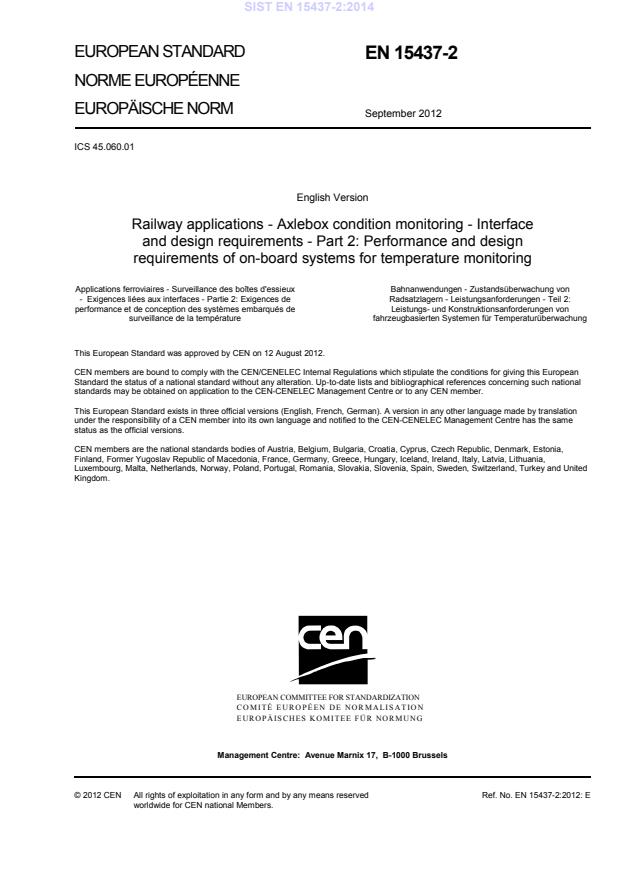
EUROPEAN STANDARD NORME EUROPÉENNE EUROPÄISCHE NORM
EN 15437-2
September 2012 ICS 45.060.01 English Version
Railway applications - Axlebox condition monitoring - Interface and design requirements - Part 2: Performance and design requirements of on-board systems for temperature monitoring
Applications ferroviaires - Surveillance des boîtes d'essieux -
Exigences liées aux interfaces - Partie 2: Exigences de performance et de conception des systèmes embarqués de surveillance de la température
Bahnanwendungen - Zustandsüberwachung von Radsatzlagern - Leistungsanforderungen - Teil 2: Leistungs- und Konstruktionsanforderungen von fahrzeugbasierten Systemen für TemperaturüberwachungThis European Standard was approved by CEN on 12 August 2012.
CEN members are bound to comply with the CEN/CENELEC Internal Regulations which stipulate the conditions for giving this European Standard the status of a national standard without any alteration. Up-to-date lists and bibliographical references concerning such national standards may be obtained on application to the CEN-CENELEC Management Centre or to any CEN member.
This European Standard exists in three official versions (English, French, German). A version in any other language made by translation under the responsibility of a CEN member into its own language and notified to the CEN-CENELEC Management Centre has the same status as the official versions.
CEN members are the national standards bodies of Austria, Belgium, Bulgaria, Croatia, Cyprus, Czech Republic, Denmark, Estonia, Finland, Former Yugoslav Republic of Macedonia, France, Germany, Greece, Hungary, Iceland, Ireland, Italy, Latvia, Lithuania, Luxembourg, Malta, Netherlands, Norway, Poland, Portugal, Romania, Slovakia, Slovenia, Spain, Sweden, Switzerland, Turkey and United Kingdom.
EUROPEAN COMMITTEE FOR STANDARDIZATION
COMITÉ EUROPÉEN DE NORMALISATION EUROPÄISCHES KOMITEE FÜR NORMUNG
Management Centre:
Avenue Marnix 17,
B-1000 Brussels © 2012 CEN All rights of exploitation in any form and by any means reserved worldwide for CEN national Members. Ref. No. EN 15437-2:2012: ESIST EN 15437-2:2014
Relationship between this European Standard and the Essential Requirements of EU Directive 2008/57/EC . 12Bibliography . 15 SIST EN 15437-2:2014
Standards. SIST EN 15437-2:2014
This European Standard refers to temperature monitoring of the axlebox. However, the design may be such that the rolling bearing itself is monitored directly. The requirements of this European Standard are intended to apply equally to basic monitoring systems for monitoring the axlebox temperature through to more technically complex systems that may employ a combination of mechatronics. To ensure the compatibility of monitoring systems and the effective monitoring functions, this European Standard defines the requirements in the following areas:
equipment and characteristics; monitoring performance; operation and interface. This part of EN 15437 does not include: systems that do not give an indication to the driver;
how an on-board monitoring system is structured and how it measures the temperature and identifies axlebox position. This is considered part of equipment design and not part of the functional requirements set out in this standard; operational requirements for acting on the information reported by the on-board monitoring system; operational requirements for conflict of information between trackside monitoring systems and on-board monitoring systems;
maintenance requirements for on-board temperature monitoring systems. 2 Normative references The following documents, in whole or in part, are normatively referenced in this document and are indispensable for its application. For dated references, only the edition cited applies. For undated references, the latest edition of the referenced document (including any amendments) applies. EN 50121-2, Railway applications — Electromagnetic compatibility — Part 2: Emission of the whole railway system to the outside world EN 50125-1, Railway applications — Environmental conditions for equipment — Part 1: Equipment on board rolling stock EN 50126-1, Railway applications — The specification and demonstration of Reliability, Availability, Maintainability and Safety (RAMS) — Part 1: Basic requirements and generic process EN 50128, Railway applications — Communications, signalling and processing systems — Software for railway control and protection systems SIST EN 15437-2:2014
axlebox assembly of box housing, rolling bearings, sealing and grease
3.2
bearing axle journal bearing or bearing assembly on a rail vehicle axle that transmits a proportion of the weight of the rail vehicle directly to the wheel set 3.3 rolling bearing bearing operating with rolling motion between the parts, supporting load and moving in relation to each other
3.4 on-board monitoring system system that is capable of detecting a temperature of an axlebox that is indicative of the health of that axlebox and indicates when acceptable temperature conditions have been exceeded 3.5 Safety Integrity Level (SIL) one of a number of defined discrete levels to specify the safety integrity requirements of the safety functions to be allocated to the safety related systems
Note 1 to entry: The Safety Integrity Level with the highest figure has the highest level of safety integrity.
4 Equipment and characteristics 4.1 Design requirements The equipment shall respect the applicable requirements regarding the environmental conditions for equipment on-board rolling stock as set out in EN 50125-1. In particular, vibration design of electrical and electronic equipment, as well as their fixing, associated with the measurements on the bearing unit or on the axle box shall respect the requirements set out in EN 61373.
The equipment shall respect the applicable requirements regarding electronic equipment as set out in EN 50155.
On-board monitoring systems shall not interfere or influence the behaviour of trackside equipment or other train-borne equipment.
NOTE This document does not set out the architecture of the environment in which an on-board temperature monitoring system may be installed. The range of architectures may differ significantly (from a freight wagon to a high SIST EN 15437-2:2014
4.3 Description of alarm levels
Temperature limits shall be determined for alarm levels depending on the bearing properties, sensor arrangement, vehicle type, network characteristics, etc. as follows: Alarm level 1 (“ho
...