


EN 10088-1:2023
(Main)Stainless steels - Part 1: List of stainless steels
General Information
- Abstract
This document lists the chemical composition of stainless steels, which are subdivided in accordance with their main properties into corrosion resistant steels, heat resistant steels and creep resistant steels (see Annex C) and specified in the European Standards given in Table 1.
Table 1 — Overview of material standards for stainless steels
(...)
Reference data on some physical properties are given in Annex E, Tables E.1 to E.8.
Empirical formulae for steel grade microstructure classification and pitting resistance ranking are given in Annex D.
NOTE 1 A matrix that shows which steels are included in which standard is given in Annex B.
NOTE 2 Valve steels are specified in EN 10090.
NOTE 3 Steel castings are specified in various European Standards (see Bibliography).
NOTE 4 Tool steels are specified in EN ISO 4957.
NOTE 5 Welding consumables are specified in various European Standards (see Bibliography).
- Status
- Published
- Publication Date
- 19-Dec-2023
- Technical Committee
- SC 13 - Stainless steels
- Drafting Committee
- CEN/TC 459/SC 5/WG 2 - Stainless steels
- Current Stage
- 6060 - Definitive text made available (DAV) - Publishing
- Start Date
- 20-Dec-2023
- Due Date
- 31-Jan-2023
- Completion Date
- 20-Dec-2023
Overview
EN 10088-1:2023 - Stainless steels - Part 1: List of stainless steels is the Slovenian adoption of EN 10088-1:2023. This part of the EN 10088 series provides a comprehensive list of stainless steel grades and the chemical composition ranges for each grade. Grades are grouped by primary performance: corrosion resistant, heat resistant, and creep resistant steels. The standard references material standards (Table 1) and includes informative annexes with designation cross‑references, classification rules, empirical formulae and guidance data on physical properties.
Key technical topics and requirements
- Chemical composition tables: Detailed cast/analysis composition ranges are given in Tables 2–9 for:
- Austenitic corrosion resistant steels
- Austenitic‑ferritic (duplex) corrosion resistant steels
- Ferritic corrosion resistant steels
- Martensitic and precipitation‑hardening corrosion resistant steels
- Austenitic and austenitic‑ferritic heat resistant steels
- Ferritic heat resistant steels
- Austenitic creep resistant steels
- Martensitic creep resistant steels
- Microstructure & pitting resistance: Annex D provides empirical formulae for microstructure classification and pitting resistance ranking - useful for material selection against localized corrosion.
- Physical property guidance: Annex E contains reference data (Tables E.1–E.8) on selected physical properties relevant to design and engineering.
- Cross‑reference & designation: Annex A lists ISO and comparable designations; Annex B presents a matrix mapping which steels are covered by which European material standards.
- Normative scope and notes: The document clarifies that valve steels, castings, tool steels and welding consumables are covered by other standards (e.g., EN 10090, EN ISO 4957) and flags that a small number of grades are subject to patent claims.
Practical applications and users
This standard is essential for:
- Material engineers and metallurgists selecting stainless steel grades for corrosion, temperature and creep performance
- Product designers and structural engineers specifying materials for equipment, piping, pressure vessels and heat‑exposed components
- Procurement and quality managers ensuring purchased materials meet European grade definitions
- Manufacturers, fabricators and testing laboratories verifying chemical composition and conformity to European material standards
- Standards bodies and spec writers mapping international designations to European grade numbers
Related standards
- EN 10088 series (Parts 2–5) - technical delivery conditions for sheet, plate, bars and semi‑finished products
- EN 10090 (valve steels), EN ISO 4957 (tool steels)
- EN 10095, EN 10269, EN 10302 (nickel/cobalt alloys referenced in Annex F)
- Various material standards listed in Table 1 of the standard
Keywords: EN 10088-1:2023, stainless steels, chemical composition, corrosion resistant steels, heat resistant steels, creep resistant steels, stainless steel grades, microstructure classification, pitting resistance, European standard.
Relations
- Effective Date
- 28-Oct-2020
- Effective Date
- 28-Jan-2026
- Effective Date
- 08-Jul-2026
- Effective Date
- 10-Feb-2026
- Effective Date
- 28-Jan-2026
- Effective Date
- 28-Jan-2026
- Effective Date
- 28-Jan-2026
- Effective Date
- 28-Jan-2026
- Effective Date
- 28-Jan-2026
- Effective Date
- 28-Jan-2026
- Referred By
EN 845-2:2013+A1:2016 - Specification for ancillary components for masonry - Part 2: Lintels - Effective Date
- 28-Jan-2026
- Effective Date
- 28-Jan-2026
- Effective Date
- 28-Jan-2026
- Effective Date
- 28-Jan-2026
- Effective Date
- 28-Jan-2026
Get Certified
Connect with accredited certification bodies for this standard

Element Materials Technology
Materials testing and product certification.

Inštitut za kovinske materiale in tehnologije
Institute of Metals and Technology. Materials testing, metallurgical analysis, NDT.
Sponsored listings
Frequently Asked Questions
EN 10088-1:2023 is a standard published by the European Committee for Standardization (CEN). Its full title is "Stainless steels - Part 1: List of stainless steels". This standard covers: This document lists the chemical composition of stainless steels, which are subdivided in accordance with their main properties into corrosion resistant steels, heat resistant steels and creep resistant steels (see Annex C) and specified in the European Standards given in Table 1. Table 1 — Overview of material standards for stainless steels (...) Reference data on some physical properties are given in Annex E, Tables E.1 to E.8. Empirical formulae for steel grade microstructure classification and pitting resistance ranking are given in Annex D. NOTE 1 A matrix that shows which steels are included in which standard is given in Annex B. NOTE 2 Valve steels are specified in EN 10090. NOTE 3 Steel castings are specified in various European Standards (see Bibliography). NOTE 4 Tool steels are specified in EN ISO 4957. NOTE 5 Welding consumables are specified in various European Standards (see Bibliography).
This document lists the chemical composition of stainless steels, which are subdivided in accordance with their main properties into corrosion resistant steels, heat resistant steels and creep resistant steels (see Annex C) and specified in the European Standards given in Table 1. Table 1 — Overview of material standards for stainless steels (...) Reference data on some physical properties are given in Annex E, Tables E.1 to E.8. Empirical formulae for steel grade microstructure classification and pitting resistance ranking are given in Annex D. NOTE 1 A matrix that shows which steels are included in which standard is given in Annex B. NOTE 2 Valve steels are specified in EN 10090. NOTE 3 Steel castings are specified in various European Standards (see Bibliography). NOTE 4 Tool steels are specified in EN ISO 4957. NOTE 5 Welding consumables are specified in various European Standards (see Bibliography).
EN 10088-1:2023 is classified under the following ICS (International Classification for Standards) categories: 77.140.20 - Stainless steels. The ICS classification helps identify the subject area and facilitates finding related standards.
EN 10088-1:2023 has the following relationships with other standards: It is inter standard links to EN 10088-1:2014, EN 10079:2007, EN 16282-7:2026, EN 50465:2015, EN 14423:2013+A2:2019, EN 845-3:2003+A1:2008, EN 14783:2006, EN 502:2013, EN ISO 28706-4:2016, EN 14424:2004, EN 845-2:2013+A1:2016, EN 16282-8:2017, EN 1186-11:2002, EN 10058:2018, EN ISO 15874-3:2013. Understanding these relationships helps ensure you are using the most current and applicable version of the standard.
EN 10088-1:2023 is available in PDF format for immediate download after purchase. The document can be added to your cart and obtained through the secure checkout process. Digital delivery ensures instant access to the complete standard document.
Standards Content (Sample)
SLOVENSKI STANDARD
01-februar-2024
Nerjavna jekla - 1. del: Seznam nerjavnih jekel
Stainless steels - Part 1: List of stainless steels
Nichtrostende Stähle - Teil 1: Verzeichnis der nichtrostenden Stähle
Aciers inoxydables - Partie 1: Liste des aciers inoxydable
Ta slovenski standard je istoveten z: EN 10088-1:2023
ICS:
77.140.20 Visokokakovostna jekla Stainless steels
2003-01.Slovenski inštitut za standardizacijo. Razmnoževanje celote ali delov tega standarda ni dovoljeno.
EN 10088-1
EUROPEAN STANDARD
NORME EUROPÉENNE
December 2023
EUROPÄISCHE NORM
ICS 77.140.20 Supersedes EN 10088-1:2014
English Version
Stainless steels - Part 1: List of stainless steels
Aciers inoxydables - Partie 1 : Liste des aciers Nichtrostende Stähle - Teil 1: Verzeichnis der
inoxydables nichtrostenden Stähle
This European Standard was approved by CEN on 6 November 2023.
CEN members are bound to comply with the CEN/CENELEC Internal Regulations which stipulate the conditions for giving this
European Standard the status of a national standard without any alteration. Up-to-date lists and bibliographical references
concerning such national standards may be obtained on application to the CEN-CENELEC Management Centre or to any CEN
member.
This European Standard exists in three official versions (English, French, German). A version in any other language made by
translation under the responsibility of a CEN member into its own language and notified to the CEN-CENELEC Management
Centre has the same status as the official versions.
CEN members are the national standards bodies of Austria, Belgium, Bulgaria, Croatia, Cyprus, Czech Republic, Denmark, Estonia,
Finland, France, Germany, Greece, Hungary, Iceland, Ireland, Italy, Latvia, Lithuania, Luxembourg, Malta, Netherlands, Norway,
Poland, Portugal, Republic of North Macedonia, Romania, Serbia, Slovakia, Slovenia, Spain, Sweden, Switzerland, Türkiye and
United Kingdom.
EUROPEAN COMMITTEE FOR STANDARDIZATION
COMITÉ EUROPÉEN DE NORMALISATION
EUROPÄISCHES KOMITEE FÜR NORMUNG
CEN-CENELEC Management Centre: Rue de la Science 23, B-1040 Brussels
© 2023 CEN All rights of exploitation in any form and by any means reserved Ref. No. EN 10088-1:2023 E
worldwide for CEN national Members.
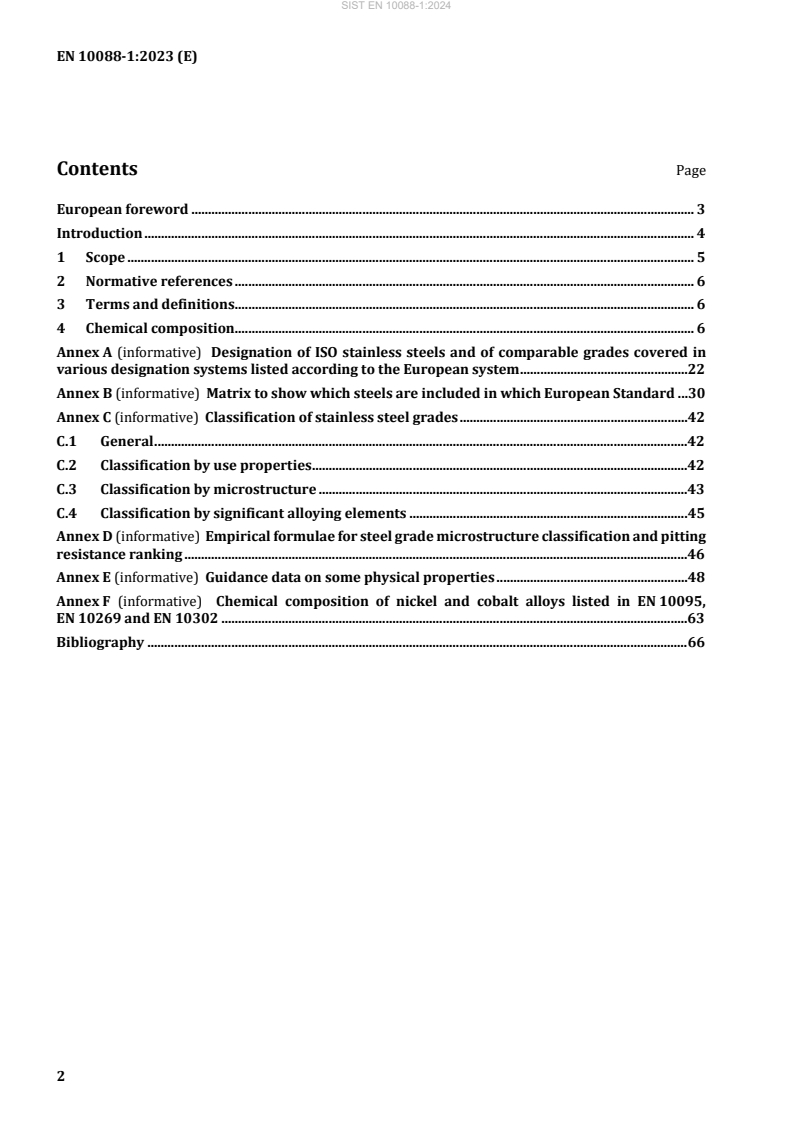
Contents Page
European foreword . 3
Introduction . 4
1 Scope . 5
2 Normative references . 6
3 Terms and definitions . 6
4 Chemical composition . 6
Annex A (informative) Designation of ISO stainless steels and of comparable grades covered in
various designation systems listed according to the European system .22
Annex B (informative) Matrix to show which steels are included in which European Standard .30
Annex C (informative) Classification of stainless steel grades .42
C.1 General .42
C.2 Classification by use properties .42
C.3 Classification by microstructure .43
C.4 Classification by significant alloying elements .45
Annex D (informative) Empirical formulae for steel grade microstructure classification and pitting
resistance ranking .46
Annex E (informative) Guidance data on some physical properties .48
Annex F (informative) Chemical composition of nickel and cobalt alloys listed in EN 10095,
EN 10269 and EN 10302 .63
Bibliography .66
European foreword
This document (EN 10088-1:2023) has been prepared by Technical Committee CEN/TC 459 “ECISS -
European Committee for Iron and Steel Standardization ”, the secretariat of which is held by AFNOR.
This European Standard shall be given the status of a national standard, either by publication of an
identical text or by endorsement, at the latest by June 2024, and conflicting national standards shall be
withdrawn at the latest by June 2024.
This document supersedes EN 10088-1:2014.
In comparison with the previous edition, the following technical modifications have been made:
a) addition of austenitic grades 1.4420 (also part 2), 1.4678 (2), 1.4681 (3), 1.4391 (3), 1.4382 (2),
1.4682 (2), austenitic-ferritic (duplex) grades 1.4637 (2), 1.4670 (3), ferritic grades 1.4622 (2),
1.4106 (3), 1.4114 (3), 1.4045 (3), martensitic grade 1.4060 (2), 1.4037 (3);
b) change in chemical composition: austenitic grades 1.4310 (2, 3), 1.4404 (2, 3), 1.4529 (2, 3), ferritic
grade 1.4003 (2, 3), 1.4521(2), martensitic grades 1.4028 (2, 3), 1.4116 (2, 3);
c) removal: austenitic grades 1.4319 (2, 3), 1.4537 (2, 3), austenitic-ferritic (duplex) grade 1.4655 (2).
EN 10088, under the general title Stainless steels, consists of the following parts:
— Part 1: List of stainless steels;
— Part 2: Technical delivery conditions for sheet/plate and strip of corrosion resistant steels for general
purposes;
— Part 3: Technical delivery conditions for semi-finished products, bars, rods, wire, sections and bright
products of corrosion steels for general purposes;
— Part 4: Technical delivery conditions for sheet/plate and strip of corrosion steels for construction
purposes;
— Part 5: Technical delivery conditions for bars, rods, wire, sections and bright products of corrosion steels
for construction purposes.
Any feedback and questions on this document should be directed to the users’ national standards body.
A complete listing of these bodies can be found on the CEN website.
According to the CEN-CENELEC Internal Regulations, the national standards organisations of the
following countries are bound to implement this European Standard: Austria, Belgium, Bulgaria, Croatia,
Cyprus, Czech Republic, Denmark, Estonia, Finland, France, Germany, Greece, Hungary, Iceland, Ireland,
Italy, Latvia, Lithuania, Luxembourg, Malta, Netherlands, Norway, Poland, Portugal, Republic of North
Macedonia, Romania, Serbia, Slovakia, Slovenia, Spain, Sweden, Switzerland, Türkiye and the United
Kingdom.
Through its sub-committee SC 5 “Steels for heat treatment, alloy steels, free-cutting steels and stainless steels”,
(secretariat: DIN).
Introduction
The European Committee for Standardization (CEN) draws attention to the fact that it is claimed that
compliance with this document may involve the use of patents concerning ten steel grades, given in
Clause 4, Annex A, Annex B and Annex E and which is claimed to be relevant for the following clause(s)
of this document:
Clauses: Clause 4, Annex A, Annex B and Annex E
CEN takes no position concerning the evidence, validity and scope of these patent rights. The holders of
these patents right have assured CEN that they are willing to negotiate licences, under reasonable and
non-discriminatory terms and conditions, with applicants throughout the world. In this respect, the
statements of the holders of these patent rights are registered with CEN.
Information may be obtained from:
Grade 1.4662, 1.4637
Outokumpu Stainless AB
SE-77480 Avesta, Sweden
Grade 1.4420, 1.4622
Outokumpu Oyj
FI-00180, Helsinki, Salmisaarenranta 11, Finland
Grade 1.4062, 1.4669, 1.4670
Ugitech
F-73403 Ugine Cedex, France
Grade 1.4062, 1.4669
Industeel
F-71200 Creusot, 56 Rue Clemenceau, France
Grade 1.4646, 1.4611, 1.4613
Acciai Speciali Terni
I-05100 Terni, Italy
Attention is drawn to the possibility that some of the elements of this document may be the subject of
patent rights other than those identified above. CEN shall not be held responsible for identifying any or
all such patent rights.
1 Scope
This document lists the chemical composition of stainless steels, which are subdivided in accordance with
their main properties into corrosion resistant steels, heat resistant steels and creep resistant steels (see
Annex C) and specified in the European Standards given in Table 1.
Table 1 — Overview of material standards for stainless steels
Stainless steels
Corrosion resistant Creep resistant
Heat resistant steels
steels steels
EN 10028-7 EN 10028-7
EN 10088-2
EN 10088-3
EN 10088-4
EN 10088-5
EN 10095
EN 10151
EN 10216-5 EN 10216-5
EN 10217-7
EN 10222-5 EN 10222-5
EN 10250-4
EN 10263-5
EN 10264-4 EN 10264-4
EN 10269 EN 10269
EN ISO 6931-1
EN 10272
EN 10296-2
EN 10297-2
EN 10302
EN 10312
Reference data on some physical properties are given in Annex E, Tables E.1 to E.8.
Empirical formulae for steel grade microstructure classification and pitting resistance ranking are given
in Annex D.
NOTE 1 A matrix that shows which steels are included in which standard is given in Annex B.
NOTE 2 Valve steels are specified in EN 10090.
NOTE 3 Steel castings are specified in various European Standards (see Bibliography).
NOTE 4 Tool steels are specified in EN ISO 4957.
NOTE 5 Welding consumables are specified in various European Standards (see Bibliography).
2 Normative references
The following documents are referred to in the text in such a way that some or all of their content
constitutes requirements of this document. For dated references, only the edition cited applies. For
undated references, the latest edition of the referenced document (including any amendments) applies.
EN 10079, Definition of steel products
3 Terms and definitions
For the purposes of this document, the terms and definitions given in EN 10079 and the following apply.
ISO and IEC maintain terminology databases for use in standardization at the following addresses:
— ISO Online browsing platform: available at https://www.iso.org/obp
— IEC Electropedia: available at https://www.electropedia.org/
3.1
stainless steels
steels with at least 10,5 % of chromium and maximum 1,20 % of carbon
[SOURCE: EN 10020:2000, 3.2.2]
Note 1 to entry: Stainless steels are further subdivided in accordance with their main property into corrosion
resistant steels, heat-resistant steels and creep resistant steels.
Note 2 to entry: One type of steel in Table 7 and five types of steel in Table 9 contain less chromium than the
minimum defined for stainless steels, but are included in the heat-resistant and creep-resistant steels standards
respectively, because they form a part of these two families of steels.
4 Chemical composition
The chemical composition of stainless steels is given:
— in Table 2 for austenitic corrosion resistant steels;
— in Table 3 for austenitic-ferritic corrosion resistant steels;
— in Table 4 for ferritic corrosion resistant steels;
— in Table 5 for martensitic and precipitation hardening corrosion resistant steels;
— in Table 6 for austenitic and austenitic-ferritic heat resistant steels;
— in Table 7 for ferritic heat resistant steels;
— in Table 8 for austenitic creep resistant steels;
— in Table 9 for martensitic creep resistant steels.
NOTE 1 The chemical composition of nickel and cobalt alloys listed in EN 10095, EN 10269 and EN 10302 is
given in Annex F, Tables F.1 and F.2.
NOTE 2 Steels in this document and in EN 10088-2 and EN 10088-3 are listed according to a line number (see
Annex A).
NOTE 3 The order of the elements listed in the tables of chemical composition is according to ISO 6306.
Table 2 — Chemical composition (cast analysis) of austenitic corrosion resistant steels
a
Steel designation % by mass
c
Name Number C Si Mn P S Cr Mo Ni N
Cu Others
Austenitic steels
X2CrNiN18-7 1.4318 0,030 1,00 2,00 0,045 0,015 16,5 to 18,5 - 6,0 to 8,0 0,10 to 0,20 - -
0,50 to
X4CrNiCu18-7 1.4382 0,05 1,00 2,00 0,045 0,015 17,0 to 19,0 - 6,0 to 8,0 0,05 to 0,15 -
2,00
0,030 to
X10CrNi18-8 1.4310 2,00 2,00 0,045 0,015 16,0 to 19,0 0,80 6,0 to 9,5 0,10 - -
0,15
b
X2CrNi18-9 1.4307 0,030 1,00 2,00 0,045 17,5 to 19,5 - 8,0 to 10,5 0,10 - -
0,015
0,030 to
X9CrNi18-9 1.4325 1,00 2,00 0,045 0,030 17,0 to 19,0 - 8,0 to 10,0 - - -
0,15
e e
0,10 1,00 2,00 0,045 0,15 to 0,35 17,0 to 19,0 - 8,0 to 10,0 0,10 1,00 -
X8CrNiS18-9 1.4305
1,40 to
e e
0,08 1,00 2,00 0,045 0,15 to 0,35 17,0 to 19,0 0,60 8,0 to 10,0 0,10 -
X6CrNiCuS18-9-2 1.4570
1,80
b
X3CrNiCu18-9-4 1.4567 0,04 1,00 2,00 0,045 0,015 17,0 to 19,0 - 8,5 to 10,5 0,10 3,00 to 4,0 -
X5CrNiN19-9 1.4315 0,06 1,00 2,00 0,045 0,015 18,0 to 20,0 - 8,0 to 11,0 0,12 to 0,22 - -
1,50 to 1,50 to
X3CrNiCu19-9-2 1.4560 0,035 1,00 0,045 0,015 18,0 to 19,0 - 8,0 to 9,0 0,10 -
2,00 2,00
0,030 to 0,030 to 1,30 to
X5CrNiCu19-6-2 1.4640 0,50 1,50 to 4,0 0,045 0,015 18,0 to 19,0 - 5,5 to 6,9 -
0,08 0,11 2,00
b
X2CrNiN18-10 1.4311 0,030 1,00 2,00 0,045 0,015 17,5 to 19,5 - 8,5 to 11,5 0,12 to 0,22 - -
b
X5CrNi18-10 1.4301 0,07 1,00 2,00 0,045 17,5 to 19,5 - 8,0 to 10,5 0,10 - -
0,015
X2CrNiSi18-10 1.4682 0,03 0,80 to 2,0 2,00 0,045 0,015 17,5 to 19,5 0,40 to 0,80 9,0 to 11,0 0,10 - -
b d
X6CrNiTi18-10 1.4541 0,08 1,00 2,00 0,045 0,015 17,0 to 19,0 - 9,0 to 12,0 - - Ti: 5 × C to 0,70
d
X6CrNiNb18-10 1.4550 0,08 1,00 2,00 0,045 0,015 17,0 to 19,0 - - - Nb: 10 × C to 1,00
9,0 to 12,0
X2CrNiCu19-10 1.4650 0,030 1,00 2,00 0,045 0,015 18,5 to 20,0 - 9,0 to 10,0 0,08 1,00 -
10,0 to 12,0
b
X2CrNi19-11 1.4306 0,030 1,00 2,00 0,045 0,015 18,0 to 20,0 - 0,10 - -
d
b
X4CrNi18-12 1.4303 0,06 1,00 2,00 0,045 17,0 to 19,0 - 11,0 to 13,0 0,10 - -
0,015
a
Steel designation
% by mass
c
Name Number C Si Mn P S Cr Mo Ni N Cu Others
X1CrNiSi18-15-4 1.4361 0,015 3,7 to 4,5 2,00 0,025 0,010 16,5 to 18,5 0,20 14,0 to 16,0 0,10 - -
X8CrMnCuN17-8-3 1.4597 0,10 2,00 6,5 to 9,0 0,040 0,030 15,0 to 18,0 1,00 3,00 0,10 to 0,30 2,00 to 3,5 -
X8CrMnNi19-6-3 1.4376 0,10 1,00 5,0 to 8,0 0,045 0,015 17,0 to 20,5 2,00 to 4,5 0,30 - -
X3CrMnNiCu15-8-5-3 1.4615 0,030 1,00 7,0 to 9,0 0,040 0,010 14,0 to 16,0 0,80 4,5 to 6,0 0,02 to 0,06 2,0 to 4,0 -
f
X12CrMnNiN17-7-5 1.4372 1,00 5,5 to 7,5 0,045 0,015 16,0 to 18,0 - 3,5 to 5,5 0,05 to 0,25 - -
0,15
X2CrMnNiN17-7-5 1.4371 0,030 1,00 6,0 to 8,0 0,045 0,015 16,0 to 17,5 - 3,5 to 5,5 0,15 to 0,25 1,00 -
1,00 to
X9CrMnNiCu17-8-5-2 1.4618 0,10 1,00 5,5 to 9,5 0,070 0,010 16,5 to 18,5 - 4,5 to 5,5 0,15 -
2,50
0,20 to 14,0 to
X30MnCrN16-14 1.4678 1,00 0,045 0,015 12,0 to 16,0 - - 0,20 to 0,40 2,00 -
0,40 18,0
X12CrMnNiN18-9-5 1.4373 0,15 1,00 7,5 to 10,5 0,045 0,015 17,0 to 19,0 - 4,0 to 6,0 0,05 to 0,25 - -
0,05 to
X8CrMnNiN18-9-5 1.4374 0,30 to 0,60 9,0 to 10,0 0,035 0,030 17,5 to 18,5 0,50 5,0 to 6,0 0,25 to 0,32 0,40 -
0,10
0,07 to
X11CrNiMnN19-8-6 1.4369 0,50 to 1,00 5,0 to 7,5 0,030 0,015 17,5 to 19,5 - 6,5 to 8,5 0,20 to 0,30 - -
0,15
11,0 to
X13CrMnNiN18-13-2 1.4020 0,15 1,00 0,045 0,030 16,5 to 19,0 - 0,5 to 2,5 0,20 to 0,45 - -
14.0
11,5 to
X6CrMnNiN18-13-3 1.4378 0,08 1,00 0,060 0,030 17,0 to 19,0 - 2,3 to 3,7 0,20 to 0,40 - -
14,5
0,02 to 10,5 to 1,50 to
X6CrMnNiCuN18-12-4-2 * 1.4646 * 1,00 0,050 0,015 17,0 to 19,0 0,50 3,5 to 4,5 0,20 to 0,30 -
0,10 12,5 3,00
X3CrMnNiN20-9-6 1.4391 0,040 1,00 8,0-10,0 0,045 0,030 19,0 to 21,5 0,75 5,5 to 7,5 0,15 to 0,40 - -
X1CrNi25-21 1.4335 0,020 0,25 2,00 0,025 0,010 24,0 to 26,0 0,20 20,0 to 22,0 0,10 - -
Austenitic steels with Mo
1,30 to
e e
X2CrNiMoCuS17-10-2 1.4598 0,030 1,00 2,00 0,045 0,10 to 0,20 16,5 to 18,5 2,00 to 2,50 10,0 to 13,0 0,10 -
1,80
X3CrNiCuMo17-11-3-2 1.4578 0,04 1,00 2,00 0,045 0,015 16,5 to 17,5 2,00 to 2,50 10,0 to 11,0 0,10 3,0 to 3,5 -
10,0 to 12,5
b
X2CrNiMoN17-11-2 1.4406 0,030 1,00 2,00 0,045 0,015 16,5 to 18,5 2,00 to 2,50 0,12 to 0,22 - -
d
a
Steel designation
% by mass
c
Name Number C Si Mn P S Cr Mo Ni N Cu Others
10,0 to 13,0
b
X2CrNiMo17-12-2 1.4404 0,030 1,00 2,00 0,045 0,015 16,5 to 18,5 2,00 to 3,0 0,10 - -
d
b
X5CrNiMo17-12-2 1.4401 0,07 1,00 2,00 0,045 0,015 16,5 to 18,5 2,00 to 2,50 10,0 to 13,0 0,10 - -
10,5 to 13,5
b
X6CrNiMoTi17-12-2 1.4571 0,08 1,00 2,00 0,045 16,5 to 18,5 2,00 to 2,50 - - Ti: 5 × C to 0,70
0,015
d
X6CrNiMoNb17-12-2 1.4580 0,08 1,00 2,00 0,045 0,015 16,5 to 18,5 2,00 to 2,50 10,5 to 13,5 - - Nb: 10 × C to 1,00
0,045
e e
0,030 1,00 2,00 0,015 19,5 to 21,5 0,50 to 1,50 8,0 to 9,5 0,14 to 0,25 1,00 -
X2CrNiMoN21-9-1 * 1.4420 *
g
b
X2CrNiMo17-12-3 1.4432 0,030 1,00 2,00 0,045 16,5 to 18,5 2,50 to 3,00 10,5 to 13,0 0,10 - -
0,015
10,5 to 13,0
b
X3CrNiMo17-12-3 1.4436 0,05 1,00 2,00 0,045 16,5 to 18,5 2,50 to 3,00 0,10 - -
0,015
d
X3CrNiMo18-12-3 1.4449 0,035 1,00 2,00 0,045 0,015 17,0 to 18,2 2,25 to 2,75 11,5 to 12,5 0,08 1,00 -
11,0 to 14,0
X2CrNiMoN17-13-3 1.4429 0,030 1,00 2,00 0,045 0,015 16,5 to 18,5 2,50 to 3,00 0,12 to 0,22 - -
d
10,5 to 14,0
X2CrNiMoN18-12-4 1.4434 0,030 1,00 2,00 0,045 0,015 16,5 to 19,5 3,00 to 4,0 0,10 to 0,20 - -
d
b
X2CrNiMo18-14-3 1.4435 0,030 1,00 2,00 0,045 17,0 to 19,0 2,50 to 3,00 12,5 to 15,0 0,10 - -
0,015
X2CrNiMoN17-13-5 1.4439 0,030 1,00 2,00 0,045 0,015 16,5 to 18,5 4,0 to 5,0 12,5 to 14,5 0,12 to 0,22 - -
13,0 to 16,0
b
X2CrNiMo18-15-4 1.4438 0,030 1,00 2,00 0,045 0,015 17,5 to 19,5 3,00 to 4,0 0,10 - -
d
X5CrNiMnMoNNbV22-12- Nb: 0,10 to 0,30
1.4681 0,060 1,00 4,0 to 6,0 0,045 0,030 20,5 to 23,5 1,5 to 3,0 11,5 to 13,5 0,20 to 0,40 -
5-2 V: 0,10 to 0,30
0,50 to
X1CrNiMoCuN20-18-7 1.4547 0,020 0,70 1,00 0,030 0,010 19,5 to 20,5 6,0 to 7,0 17,5 to 18,5 0,18 to 0,25 -
1,00
X1CrNiMoN25-22-2 1.4466 0,020 0,70 2,00 0,025 0,010 24,0 to 26,0 2,00 to 2,50 21,0 to 23,0 0,10 to 0,16 - -
1,00 to
X1CrNiMoCuNW24-22-6 1.4659 0,020 0,70 2,00 to 4,0 0,030 0,010 23,0 to 25,0 5,5 to 6,5 21,0 to 23,0 0,35 to 0,50 W: 1,50 to 2,50
2,00
0,30 to
X1CrNiMoCuN24-22-8 1.4652 0,020 0,50 2,00 to 4,0 0,030 0,005 23,0 to 25,0 7,0 to 8,0 21,0 to 23,0 0,45 to 0,55 -
0,60
X2CrNiMnMoN25-18-6-5 1.4565 0,030 1,00 5,0 to 7,0 0,030 0,015 24,0 to 26,0 4,0 to 5,0 16,0 to 19,0 0,30 to 0,60 - Nb: 0,15
a
Steel designation
% by mass
c
Name Number C Si Mn P S Cr Mo Ni N Cu Others
Austenitic steels with Ni as main alloying element
1,20 to
X1NiCrMoCu25-20-5 1.4539 0,020 0,70 2,00 0,030 0,010 19,0 to 21,0 4,0 to 5,0 24,0 to 26,0 0,15 -
2,00
0,50 to
X1NiCrMoCuN25-20-7 1.4529 0,020 0,75 2,00 0,030 0,010 19,0 to 21,0 6,0 to 7,0 24,0 to 26,0 0,15 to 0,25 -
1,50
Al: 0,15 to 0,45
X2NiCrAlTi32-20 1.4558 0,030 0,70 1,00 0,020 0,015 20,0 to 23,0 - 32,0 to 35,0 - -
Ti: [8 × (C + N)] to
0,60
0,70 to
X1NiCrMoCu31-27-4 1.4563 0,020 0,70 2,00 0,030 0,010 26,0 to 28,0 3,00 to 4,0 30,0 to 32,0 0,10 -
1,50
Elements not quoted (“-”) or not listed in this table shall not be intentionally added to the steel without the agreement of the purchaser except for finishing the cast. All appropriate precautions
shall be taken to avoid the addition of such elements from scrap and other materials used in production which would impair mechanical properties and the suitability of the steel.
a
Maximum values unless indicated otherwise.
b
For bars, rods, wire, sections, bright products and the relevant semi-finished products, a maximum content of 0,030 % S applies. Particular ranges of sulfur content may provide
improvement of particular properties. For machinability a controlled sulfur content of 0,015 % to 0,030 % is recommended and permitted. For weldability, a controlled sulfur content of
0,0080 % to 0,030 % is recommended and permitted. For polishability, a controlled sulfur content of 0,015 % max. is recommended.
c
For austenitic steel grades intended for cold heading and cold extruding, a Cu-content of max. 1,00 % is permitted.
d
Where for special reasons, e.g. hot workability for the fabrication of seamless tubes where it is necessary to minimize the delta ferrite content, or with the aim of low magnetic permeability,
the maximum Ni content may be increased by the following amounts:
- 0,50 % (m/m): 1.4571;
- 1,00 % (m/m): 1.4306, 1.4406, 1.4429, 1.4434, 1.4436, 1.4438, 1.4541, 1.4550;
- 1,50 % (m/m): 1.4404.
e
Parts made of high sulfur free cutting austenitic steels may not comply with European Directive 94/27 regarding articles in contact with human skin.
f
For pressure purposes a carbon limit of C ≤ 0,07 % is allowed.
g
For application according to Pressure Equipment Directive (PED) 2014/68/EU the phosphorus content is restricted to max 0,035 %.
* Patented steel grade.
Table 3 — Chemical composition (cast analysis) of austenitic-ferritic corrosion resistant steels
a
Steel designation % by mass
Name Number C Si Mn P S Cr Mo Ni N Cu Others
X2CrNiN22-2 * 1.4062 * 0,030 1,00 2,00 0,040 0,010 21,5 to 24,0 0,45 1,00 to 2,90 0,16 to 0,28 - -
X2CrCuNiN23-2-2 * 1.4669 * 0,045 1,00 1,00 to 3,00 0,040 0,030 21,5 to 24,0 0,50 1,00 to 3,00 0,12 to 0,20 1,60 to 3,00 -
e e
X2CrMnNiSiN20-5-4-2 1.4670 0,030 1,50 to 3,00 4,0 to 6,0 0,040 0,010 18,0 to 21,0 0,60 3,00 to 5,5 0,10 to 0,20 1,00 -
Austenitic-ferritic steels with Mo
X2CrNiMoSi18-5-3 1.4424 0,030 1,40 to 2,00 1,20 to 2,00 0,035 0,015 18,0 to 19,0 2,50 to 3,00 4,5 to 5,2 0,05 to 0,10 - -
0,015 to
X2CrNiMnMoCuN21-3-1-1 * 1.4637 * 0,30 to 0,50 1,05 to 1,30 0,035 0,05 19,9 to 20,3 1,15 to 1,30 2,65 to 3,00 0,18 to 0,21 0,30 to 0,50 -
0,030
X2CrNiN23-4 1.4362 0,030 1,00 2,00 0,035 0,015 22,0 to 24,5 0,10 to 0,60 3,5 to 5,5 0,05 to 0,20 0,10 to 0,60 -
X2CrMnNiN21-5-1 1.4162 0,04 1,00 4,0 to 6,0 0,040 0,015 21,0 to 22,0 0,10 to 0,80 1,35 to 1,90 0,20 to 0,25 0,10 to 0,80 -
X2CrMnNiMoN21-5-3 1.4482 0,030 1,00 4,0 to 6,0 0,035 0,030 19,5 to 21,5 0,10 to 0,60 1,50 to 3,50 0,05 to 0,20 1,00 -
c c
X2CrNiMoN22-5-3 1.4462 0,030 1,00 2,00 0,035 0,015 21,0 to 23,0 2,50 to 3,5 4,5 to 6,5 0,10 to 0,22 - -
X2CrNiMnMoCuN24-4-3-2 * 1.4662 * 0,030 0,70 2,50 to 4,0 0,035 0,005 23,0 to 25,0 1,00 to 2,00 3,00 to 4,5 0,20 to 0,30 0,10 to 0,80 -
X2CrNiMoCuN25-6-3 1.4507 0,030 0,70 2,00 0,035 0,015 24,0 to 26,0 3,00 to 4,0 6,0 to 8,0 0,20 to 0,30 1,00 to 2,50 -
b
X3CrNiMoN27-5-2 1.4460 0,05 1,00 2,00 0,035 0,015 25,0 to 28,0 1,30 to 2,00 4,5 to 6,5 0,05 to 0,20 - -
X2CrNiMoN25-7-4 1.4410 0,030 1,00 2,00 0,035 0,015 24,0 to 26,0 3,00 to 4,5 6,0 to 8,0 0,24 to 0,35 - -
W: 0,50 to
X2CrNiMoCuWN25-7-4 1.4501 0,030 1,00 1,00 0,035 0,015 24,0 to 26,0 3,00 to 4,0 6,0 to 8,0 0,20 to 0,30 0,50 to 1,00
1,00
X2CrNiMoN29-7-2 1.4477 0,030 0,50 0,80 to 1,50 0,030 0,015 28,0 to 30,0 1,50 to 2,60 5,8 to 7,5 0,30 to 0,40 0,80 -
Co: 0,50 to
X2CrNiMoCoN28-8-5-1 1.4658 0,030 0,50 1,50 0,035 0,010 26,0 to 29,0 4,0 to 5,0 5,5 to 9,5 0,30 to 0,50 1,00
2,00
Elements not quoted in this table shall not be intentionally added to the steel without the agreement of the purchaser except for finishing the cast. All appropriate precautions shall be taken to
avoid the addition of such elements from scrap and other materials used in production which would impair mechanical properties and the suitability of the steel.
a
Maximum values unless indicated otherwise.
b
For bars, rods, wire, sections, bright products and the relevant semi-finished products, a maximum content of 0,030 % S applies. Particular ranges of sulfur content may provide
improvement of particular properties. For machinability a controlled sulfur content of 0,015 % to 0,030 % is recommended and permitted. For weldability, a controlled sulfur content of
0,008 % to 0,030 % is recommended and permitted. For polishability, a controlled sulfur content of 0,015 % max. is recommended.
c
Minimum value of the Pitting Resistance Equivalent (PRE = Cr + 3,3 Mo + 16 N) can be agreed upon at the time of enquiry and order.
* Patented steel grade.
Table 4 — Chemical composition (cast analysis) of ferritic corrosion resistant steels
a
Steel designation % by mass
Name Number C Si Mn P S Cr Mo Ni N Nb Ti Others
0,15 to 11.0 to
X3CrS12 1.4045 0,060 2,00 1,50 0,040 1.00
0.35 13.0
10,5 to 0,30 to
b
X2CrNi12 1.4003 0,030 1,00 2,00 0,040 - 0,030 - - -
0,015
12,5 1,00
10,5 to
c
X2CrTi12 1.4512 0,030 1,00 1,00 0,040 0,015 - - - - -
[6 × (C + N)] to 0,65
12,5
10,5 to 0,50 to
X6CrNiTi12 1.4516 0,08 0,70 1,50 0,040 0,015 - - - 0,05 to 0,35 -
12,5 1,50
12,0 to
b
X6Cr13 1.4000 0,08 1,00 1,00 0,040 0,015 - - - - - -
14,0
12,0 to
b
X6CrAl13 1.4002 0,08 1,00 1,00 0,040 0,015 - - - - - Al: 0,10 to 0,30
14,0
X2CrMnNiTi1 1,00 to 11,0 to 0,30 to
1.4600 0,030 1,00 0,040 0,015 - 0,025 - 6 × C to 0,35 -
2 2,50 13,0 1,00
0,20
[4 × (C + N) + 0,15] to
13,0 to Al: 1,50
X2CrSiTi15 1.4630 0,030 to 1,00 0,050 0,050 0,50 0,50 - 0,50
c
16,0 Cu: 0,50
0,80
1,50
14,0 to
X1CrNb15 1.4595 0,020 1,00 1,00 0,025 0,015 - - 0,020 0,20 to 0,60 - -
16,0
16,0 to
b
X6Cr17 1.4016 0,08 1,00 1,00 0,040 0,015 - - - - -
18,0
[4 × (C + N) + 0,15] to
16,0 to
X2CrTi17 1.4520 0,025 0,50 0,50 0,040 0,015 - - 0,015 - -
c
18,0
0,80
[4 × (C + N) + 0,15] to
16,0 to
b
X3CrTi17 1.4510 0,05 1,00 1,00 0,040 - - - - -
0,015
c
18,0
0,80
16,0 to
b
X3CrNb17 1.4511 0,05 1,00 1,00 0,040 - - - 12 × C to 1,00 - -
0,015
18,0
16,0 to Zr ≥ 7× (C + N)
X2CrNbZr17 1.4590 0,030 1,00 1,00 0,040 0,015 - - 0,35 to 0,55 -
17,5 + 0,15
a
Steel designation % by mass
Name Number C Si Mn P S Cr Mo Ni N Nb Ti Others
16,0 to 1,20 to
X6CrNi17-1 1.4017 0,08 1,00 1,00 0,040 0,015 - - - - -
18,0 1,60
17,5 to [3 × C + 0,30] to
b
X2CrTiNb18 1.4509 0,030 1,00 1,00 0,040 - - 0,10 to 0,60 -
0,015
18,5 1,00
0,20
X2CrAlSiNb1 17,5 to [3 × C + 0,30] to Al: 0,20 to 1,50
1.4634 0,030 to 1,00 0,050 0,050 0,50 0,50 - -
c
8 18,5 1,00 Cu: 0,50
1,50
[4 × (C + N) + 0,15] to
18,5 to
X2CrNbTi20 1.4607 0,030 1,00 1,00 0,040 0,015 - 0,030 1,00 -
c
20,5 0,80
[4 × (C + N) + 0,20] to
19,0 to Cu: 0,50,
X2CrTi21 * 1.4611 * 0,030 1,00 1,00 0,050 0,050 0,50 0,50 - -
c
22,0 Al: 0,05
1,00
20,0 to
X2CrNbCu21 1.4621 0,030 1,00 1,00 0,040 0,015 - - 0,030 0,20 to 1,00 - Cu: 0,10 to 1,00
21,5
V: 0,03 to 0,50
X2CrCuNbTiV 1.4622 20,0 to
0,030 1,00 0,80 0,040 0,015 - - 0.030 0,10 to 0,70 0,10 to 0,70
22-1 *d *d 24,0
Cu: 0,30 to 0,80
[4 × (C + N) + 0,20] to
22,0 to Cu: 0,50,
X2CrTi24 * 1.4613 * 0,030 1,00 1,00 0,050 0,050 0,50 0,50 - -
c
25,0 Al: 0,05
1,00
Ferritic steels with Mo
X5CrNiMoTi1 13,5 to 1,00 to
1.4589 0,08 1,00 1,00 0,040 0,015 0,20 to 1,20 - - 0,30 to 0,50 -
5-2 15,5 2,50
0,15 to 16,0 to
X6CrMoS17 1.4105 0,08 1,50 1,50 0,040 0,20 to 0,60 - - - - -
0,35 18,0
16,0 to
b
X6CrMo17-1 1.4113 0,08 1,00 1,00 0,040 0,90 to 1,40 - - - - -
0,015
18,0
X2CrMoTi17- 16,0 to [4 × (C + N) + 0,15] to
1.4513 0,025 1,00 1,00 0,040 0,015 0,80 to 1,40 - 0,020 - -
c
1 18,0
0,80
X6CrMoNb17 16,0 to [7 × (C+N)+0,10] to
1.4526 0,08 1,00 1,00 0,040 0,015 0,80 to 1,40 - 0,040 - -
-1 18,0 1,00
X2CrMoTi18- 17,0 to [4 × (C + N) + 0,15] to
1.4521 0,025 1,00 1,00 0,040 0,015 1,75 to 2,50 - 0,030 - -
c
2 20,0 0,80
a
Steel designation % by mass
Name Number C Si Mn P S Cr Mo Ni N Nb Ti Others
[4 × (C + N) + 0,15] to
X2CrMoTiS18 0,15 to 17,5 to
1.4523 0,030 1,00 0,50 0,040 2,00 to 2,50 - - - (C + N) ≤ 0,040
c
-2 0,35 19,0
0,80
X2CrMoSiS18 0,15 to 17,5 to
1.4106 0,030 2,50 1,00 0,040 1,50 to 2,50 0,75 - - - -
-2-1 0,35 19,5
0,15 to 17,5 to
X6CrMoS19-2 1.4114 0,080 1,00 2,50 0,040 1,50 to 2,50 0,75 - - - -
0,35 19,5
[4 × (C + N) + 0,15] to
X2CrMoTi29- 28,0 to
1.4592 0,025 1,00 1,00 0,030 0,010 3,50 to 4,50 - 0,045 - -
c
4 30,0
0,80
Elements not quoted in this table shall not be intentionally added to the steel without the agreement of the purchaser except for finishing the cast. All appropriate precautions shall be taken to
avoid the addition of such elements from scrap and other materials used in production which would impair mechanical properties and the suitability of the steel.
a
Maximum values unless indicated otherwise.
b
For bars, rods, wire, sections, bright products and the relevant semi-finished products, a maximum content of 0,030 % S applies. Particular ranges of sulfur content may provide improvement
of particular properties. For machinability a controlled sulfur content of 0,015 % to 0,030 % is recommended and permitted. For weldability, a controlled sulfur content of 0,008 % to 0,030 %
is recommended and permitted. For polishability, a controlled sulfur content of 0,015 % max. is recommended.
c
The stabilization may be made by use of Ti and/or Nb and/or Zr. According to the atomic mass of these elements and the content of Carbon and Nitrogen, the equivalence shall be the
following:
Nb (% by mass) ≡ Zr (% by mass) ≡ 7/4 Ti (% by mass).
d
Ti + Nb: 8×(C + N) to 0,80 %.
* Patented steel grade.
Table 5 — Chemical composition (cast analysis) of martensitic and precipitation hardening corrosion resistant steels
a
Steel designation % by mass
c
Name Number
C Si Mn P S Cr Mo Ni Cu Others
Martensitic steels
0,08 to
b
X12Cr13 1.4006 1,00 1,50 0,040 11,5 to 13,5 - 0,75 - -
0,015
0,15
0,06 to
X12CrS13 1.4005 1,00 1,50 0,040 0,15 to 0,35 12,0 to 14,0 0,60 - - -
0,15
0,12 to
b
X15Cr13 1.4024 1,00 1,00 0,040 12,0 to 14,0 - - - -
0,015
0,17
0,16 to
b
X20Cr13 1.4021 1,00 1,50 0,040 12,0 to 14,0 - - - -
0,015
0,25
0,26 to
b
X30Cr13 1.4028 1,00 1,50 0,040 0,015 12,0 to 14,0 - - - -
0,36
0,25 to
X29CrS13 1.4029 1,00 1,50 0,040 0,15 to 0,25 12,0 to 13,5 0,60 - - -
0,32
0,36 to
b
X39Cr13 1.4031 1,00 1,00 0,040 0,015 12,5 to 14,5 - - - -
0,42
0,43 to
b
X46Cr13 1.4034 1,00 1,00 0,040 12,5 to 14,5 - - - -
0,015
0,50
0,43 to
X46CrS13 1.4035 1,00 2,00 0,040 0,15 to 0,35 12,5 to 14,0 - - - -
0,50
0,58 to
b e
X65Cr13 1.4037 1,00 1,00 0,040 12,5 to 14,5 - - -
0,015 N: see
0,70
N: 0,13 to 0,22
0,29 to
b
X34CrN16 1.4060 1,00 1,00 0,040 15,0 to 16,5 - - - C + N: ≥ 0,45
0,015
0,38
Cr + 16 × N - 5 × C: ≥ 16,2
0,12 to
b
X17CrNi16-2 1.4057 1,00 1,50 0,040 15,0 to 17,0 - 1,50 to 2,50 - -
0,015
0,22
a
Steel designation
% by mass
c
Name Number C Si Mn P S Cr Mo Ni Cu Others
Martensitic steels with Mo
0,36 to
X38CrMo14 1.4419 1,00 1,00 0,040 0,015 13,0 to 14,5 0,60 to 1,00 - - -
0,42
0,48 to
b
X55CrMo14 1.4110 1,00 1,00 0,040 0,015 13,0 to 15,0 0,50 to 0,80 - - V: 0,15
0,60
X3CrNiMo13-4 1.4313 0,05 0,70 1,50 0,040 0,015 12,0 to 14,0 0,30 to 0,70 3,5 to 4,5 - N ≥ 0,020
X1CrNiMoCu12-5- 0,20 to
1.4422 0,020 0,50 2,00 0,040 0,003 11,0 to 13,0 1,30 to 1,80 4,0 to 5, 0 N: 0,020
2 0,80
0,35 to V: 0,10 to 0,20
b
X50CrMoV15 1.4116 1,00 1,00 0,040 14,0 to 15,5 0,50 to 0,80 - -
0,015
e
0,55 N: see
0,60 to
b
X70CrMo15 1.4109 0,70 1,00 0,040 0,015 14,0 to 16,0 0,40 to 0,80 - - -
0,75
Ti: 0,010
X2CrNiMoV13-5-2 1.4415 0,030 0,50 0,50 0,040 0,015 11,5 to 13,5 1,50 to 2,50 4,5 to 6,5 -
V: 0,10 to 0,50
X1CrNiMoCu12-7- 0,20 to
1.4423 0,020 0,50 2,00 0,040 0,003 11,0 to 13,0 2,30 to 2,80 6,0 to 7, 0 N: 0,020
3 0,80
1,30
0,45 to V: 0,20 to 0,40
X53CrSiMoVN16-2 1.4150 to 0,80 0,030 0,010 15,0 to 16,5 0,20 to 0,40 0,40 -
0,60 N: 0,05 to 0,20
1,70
b
X4CrNiMo16-5-1 1.4418 0,06 0,70 1,50 0,040 15,0 to 17,0 0,80 to 1,50 4,0 to 6,0 - N ≥ 0,020
0,015
0,10 to
X14CrMoS17 1.4104 1,00 1,50 0,040 0,15 to 0,35 15,5 to 17,5 0,20 to 0,60 - - -
0,17
0,33 to
b
X39CrMo17-1 1.4122 1,00 1,50 0,040 15,5 to 17,5 0,80 to 1,30 1,00 - -
0,015
0,45
0,95 to
b
X105CrMo17 1.4125 1,00 1,00 0,040 0,015 16,0 to 18,0 0,40 to 0,80 - - -
1,20
0,35 to V: 1,50
X40CrMoVN16-2 1.4123 1,00 1,00 0,040 0,015 14,0 to 16,0 1,00 to 2,50 0,50 -
0,50 N: 0,10 to 0,30
0,85 to
b
X90CrMoV18 1.4112 1,00 1,00 0,040 17,0 to 19,0 0,90 to 1,30 - - V: 0,07 to 0,12
0,015
0,95
a
Steel designation
% by mass
c
Name Number C Si Mn P S Cr Mo Ni Cu Others
Precipitation hardening steels
b
X5CrNiCuNb16-4 1.4542 0,07 0,70 1,50 0,040 15,0 to 17,0 0,60 3,00 to 5,0 3,00 to 5,0 Nb: 5 × C to 0,45
0,015
d
X7CrNiAl17-7 1.4568 0,09 0,70 1,00 0,040 0,015 16,0 to 18,0 - 6,5 to 7,8 - Al: 0,70 to 1,50
Precipitation hardening steels with Mo
X5CrNiMoCuNb14- 1,20 to
1.4594 0,07 0,70 1,00 0,040 0,015 13,0 to 15,0 1,20 to 2,00 5,0 to 6,0 Nb: 0,15 to 0,60
5 2,00
Al: 0,60 to 0,80
X1CrNiMoAlTi12-
1.4530 0,015 0,10 0,10 0,010 0,005 11,5 to 12,5 1,85 to 2,15 8,5 to 9,5 - Ti: 0,28 to 0,37
9-2
N: 0,010
Al: 0,80 to 1,10
X1CrNiMoAlTi12-
1.4596 0,015 0,10 0,10 0,010 0,005 11,5 to 12,5 1,85 to 2,15 9,2 to 10,2 - Ti: 0,28 to 0,40
10-2
N: 0,020
Al: 1,35 to 1,75
X1CrNiMoAlTi12-
1.4612 0,015 0,10 0,10 0,010 0,005 11,0 to 12,5 1,75 to 2,25 10,2 to 11,3 - Ti: 0,20 to 0,50
11-2
N: 0,010
B: 0,001 0 to 0,010
X5NiCrTiMoVB25- 1,00 to Al: 0,35
1.4606 0,08 1,00 0,025 0,015 13,0 to 16,0 1,00 to 1,50 24,0 to 27,0 -
15-2 2,00 Ti: 1,90 to 2,30
V: 0,10 to 0,50
Elements not quoted in this table shall not be intentionally added to the steel without the agreement of the purchaser except for finishing the cast. All appropriate precautions shall be
taken to avoid the addition of such elements from scrap and other materials used in production which would impair mechanical properties and the suitability of the steel.
a
Maximum values unless indicated otherwise.
b
For bars, rods, wire, sections, bright products and the relevant semi-finished products, a maximum content of 0,030 % S applies. Particular ranges of sulfur content may provide
improvement of particular properties. For machinability a controlled sulfur content of 0,015 % to 0,030 % is recommended and permitted. For weldability, a controlled sulfur
content of 0,008 % to 0,030 % is recommended and permitted. For polishability, a controlled sulfur content of 0,015 % max. is recommended.
c
Tighter carbon ranges may be agreed at the time of enquiry and order.
d
For better cold deformability, the upper limit may be increased to 8,3 %.
e
For increased mechanical properties, nitrogen may be added up to 0,20 %.
Table 6 — Chemical composition (cast analysis) of austenitic heat-resistant steels
a
Steel designation % by mass
Name Number C Si Mn P S Cr Ni N Others
X8CrNiTi18-10 1.4878 0,10 1,00 2,00 0,045 0,015 17,0 to 19,0 9,0 to 12,0 - Ti: 5 × C to 0,80
X6CrNiSiNCe19-10 1.4818 0,04 to 0,08 1,00 to 2,00 1,00 0,045 0,015 18,0 to 20,0 9,0 to 11,0 0,12 to 0,20 Ce: 0,03 to 0,08
X15CrNiSi25-4 1.4821 0,10 to 0,20 0,8 to 1,50 2,00 0,040 0,015 24,5 to 26,5 3,5 to 5,5 0,10 -
X15CrNiSi20-12 1.4828 0,20 1,50 to 2,50 2,00 0,045 0,015 19,0 to 21,0 11,0 to 13,0 0,10 -
X9CrNiSiNCe21-11-
1.4835 0,05 to 0,12 1,40 to 2,50 1,00 0,045 0,015 20,0 to 22,0 10,0 to 12,0 0,12 to 0,20 Ce: 0,03 to 0,08
X12CrNi23-13 1.4833 0,15 1,00 2,00 0,045 0,015 22,0 to 24,0 12,0 to 14,0 0,10 -
8,0 to
X25CrMnNiN25-9-7 1.4872 0,20 to 0,30 1,00 0,045 0,015 24,0 to 26,0 6,0 to 8,0 0,20 to 0,40 -
10,0
X8CrNi25-21 1.4845 0,10 1,50 2,00 0,045 0,015 24,0 to 26,0 19,0 to 22,0 0,10 -
X15CrNiSi25-21 1.4841 0,20 1,50 to 2,50 2,00 0,045 0,015 24,0 to 26,0 19,0 to 22,0 0,10 -
X12NiCrSi35-16 1.4864 0,15 1,00 to 2,00 2,00 0,045 0,015 15,0 to 17,0 33,0 to 37,0 0,10 -
Al: 0,15 to 0,60
X10NiCrAlTi32-21 1.4876 0,12 1,00 2,00 0,030 0,015 19,0 to 23,0 30,0 to 34,0 -
Ti: 0,15 to 0,60
Al: 0,025
X6NiCrNbCe32-27 1.4877 0,04 to 0,08 0,30 1,00 0,020 0,010 26,0 to 28,0 31,0 to 33,0 0,10 Ce: 0,05 to 0,10
Nb: 0,60 to 1,00
X6NiCrSiNCe35-25 1.4854 0,04 to 0,08 1,20 to 2,00 2,00 0,040 0,015 24,0 to 26,0 34,0 to 36,0 0,12 to 0,20 Ce: 0,03 to 0,08
X10NiCrSi35-19 1.4886 0,15 1,00 to 2,00 2,00 0,030 0,015 17,0 to 20,0 33,0 to 37,0 0,10 -
X10NiCrSiNb35-22 1.4887 0,15 1,00 to 2,00 2,00 0,030 0,015 20,0 to 23,0 33,0 to 37,0 0,10 Nb: 1,00 to 1,50
Elements not quoted in the table shall not be intentionally added to the steel without the agreement of the purchaser except for finishing the cast. All appropriate precautions
shall be taken to avoid addition of such elements from scrap and other materials used in production which would impair mechanical properties and the suitability of the steel.
a
Maximum values unless indicated otherwise.
Table 7 — Chemical composition (cast analysis) of ferritic heat-resistant steels
a
Steel designation % by mass
Name Number C Si Mn P S Cr Al Others
X10CrAlSi7 1.4713 0,12 0,50 to 1,00 1,00 0,040 0,015 6,0 to 8,0 0,50 to 1,00 -
X10CrAlSi13 1.4724 0,12 0,70 to 1,40 1,00 0,040 0,015 12,0 to 14,0 0,70 to 1,20 -
X10CrAlSi18 1.4742 0,12 0,70 to 1,40 1,00 0,040 0,015 17,0 to 19,0 0,70 to 1,20 -
X3CrAlTi18-2 1.4736 0,04 1,00 1,00 0,040 0,015 17,0 to 18,0 1,70 to 2,10 Ti: [4 (C + N) +0,2] to 0,80
X10CrAlSi25 1.4762 0,12 0,70 to 1,40 1,00 0,040 0,015 23,0 to 26,0 1,20 to 1,70 -
X18CrN28 1.4749 0,15 to 0,20 1,00 1,00 0,040 0,015 26,0 to 29,0 - N: 0,15 to 0,25
Elements not quoted in the table shall not be intentionally added to the steel without the agreement of the purchaser except for finishing the cast. All appropriate precautions
shall be taken to avoid addition of such elements from scrap and other materials used in production which would impair mechanical properties and the suitability of the steel.
a
Maximum values unless indicated otherwise.
Table 8 — Chemical composition (cast analysis) of austenitic creep-resistant steels
a
Steel designation
% by mass
Name Number C Si Mn P S Cr Mo Ni N Al Nb Ti V W Others
17,0 to
0,04 to 8,0 to
X6CrNi18-10 1.4948 1,00 2,00 0,035 0,015 - 0,10 - - - - - -
0,08 11,0
19,0
17,0 to 9,0 to
0,04 to 10 × C to
X7CrNiNb18-10 1.4912 1,00 2,00 0,045 0,015 - - - - - - -
0,10 1,20
19,0 12,0
5 ×
0,04 to 17,0 to 9,0 to
(C+N)
X7CrNiTi18-10 1.4940 1,00 2,00 0,040 0,015 - 0,10 - - - - -
0,08 19,0 13,0
to 0,80
17,0 to
0,04 to 9,0 to 5 × C to B: 0,001 5
X6CrNiTiB18-10 1.4941 1,00 2,00 0,035 0,015 - - - - -
0,08 12,0 0,80 to 0,005 0
19,0
15,0 to
0,04 to 0,30 to 12,0 to 10 × C to
X8CrNiNb16-13 1.4961 1,50 0,035 0,015 - - - - - - -
0,10 0,60 14,0 1,20
17,0
15,5 to
0,07 to 12,5 to 0,40 to 2,50 to B: 0,001 5
X12CrNiWTiB16-13 1.4962 0,50 1,50 0,035 0,015 - - - - -
0,15 14,5 0,70 3,00 to 0,006 0
17,5
15,5 to
0,04 to 0,30 to 15,5 to 0,06 to 10 × C to 2,50 to
X6CrNiWNbN16-16 1.4945 1,50 0,035 0,015 - - - - -
0,10 0,60 17,5 0,14 1,20 3,5
17,5
a
Steel designation % by mass
Name Number C Si Mn P S Cr Mo Ni N Al Nb Ti V W Others
22,0 to
0,04 to 12,0 to
X6CrNi23-13 1.4950 0,70 2,00 0,035 0,015 - 0,10 - - - - - -
0,08 15,0
24,0
24,0 to
0,04 to 19,0 to
X6CrNi25-20 1.4951 0,70 2,00 0,035 0,015 - 0,10 - - - - - -
0,08 22,0
26,0
19,0 to
0,03 to 30,0 to 0,20 to 0,20 to Co: 0,50
X5NiCrAlTi31-20 1.4958 0,70 1,50 0,015 0,010 - 0,030 0,10 - -
0,08 32,5 0,50 0,50 Cu: 0,50
22,0
19,0 to
0,05 to 30,0 to 0,25 to 0,25 to Co: 0,50
X8NiCrAlTi32-21 1.4959 0,70 1,50 0,015 0,010 - 0,030 - - -
0,10 34,0 0,65 0,65 Cu: 0,50
22,0
Austenitic creep resistant steels with Mo
14,0 to
X10CrNiMoMnNbVB15-10- 0,07 to 5,5 to 0,80 to 9,0 to 0,75 to 0,15 to B:0,003 to
1.4982 1,00 0,040 0,030 0,10 - - -
1 0,13 7,0 1,20 11,0 1,25 0,40 0,009
16,0
0,04 to 0,30 to 15,5 to 1,10 to 12,5 to 0,06 to 10 × C to 0,60 to
X8CrNiMoVNb16-13 1.4988 1,50 0,035 0,015 - - - -
0,10 0,60 17,5 1,50 14,5 0,14 1,20 0,85
0,04 to 0,30 to 15,5 to 1,60 to 15,5 to 10 × C to
X8CrNiMoNb16-16 1.4981 1,50 0,035 0,015 - - - - - -
0,10 0,60 2,00 17,5 1,20
17,5
Nb + Ta:
0,04 to 0,30 to 15,5 to 1,60 to 15,5 to B: 0,05 to
X7CrNiMoBNb16-16 1.4986 1,50 0,045 0,030 - - 10 × C to - - -
0,10 0,60 17,5 2,00 17,5 0,10
1,20
16,5 to
0,04 to 2,00 to 10,0 to B: 0,001 5
X6CrNiMoB17-12-2 1.4919 1,00 2,00 0,035 0,015 0,10 - - - - -
0,08 2,50 13,0 to 0,005 0
18,5
5 × C to
0,04 to 16,0 to 2,00 to 12,0 to B: 0,0015
X6CrNiMoTiB17-13 1.4983 0,75 2,00 0,035 0,015 - - - - -
0,08 18,0 2,50 14,0 to 0,0060
0,80
0,04 to 16,0 to 2,00 to 12,0 to
X6CrNiMo17-13-2 1.4918 0,75 2,00 0,035 0,015 0,10 - - - - - -
0,08 18,0 2,50 14,0
16,0 to 2,00 to 12,0 to 0,10 to B: 0,001 5
X3CrNiMoBN17-13-3 1.4910 0,04 0,75 2,00 0,035 0,015 - - - - -
18,0 3,00 14,0 0,18 to 0,005 0
0,08 to 20,0 to 2,50 19,0 to 0,10 to 0,75 to 2,00 to Co: 18,5 to
X12CrCoNi21-20 1.4971 1,00 2,00 0,035 0,015 - - -
0,16 22,5 to 3,5 21,0 0,20 1,25 3,00 21,0
0,03 to 1,00 to 13,5 to 1,00 to 24,0 to 1,90 to 0,10 to B: 0,003 0
X6NiCrTiMoVB25-15-2 1.4980 1,00 0,025 0,015 - 0,35 - -
0,08 2,00 16,0 1,50 27,0 2,30 0,50 to 0,010
Elements not quoted in this table shall not be intentionally added to the steel without the agreement of the purchaser except for finishing the cast. All appropriate precautions shall be taken to avoid
the addition of such elements from scrap and other materials used in production which would impair mechanical properties and the suitability of the steel.
a
Maximum values unless indicated otherwise.
Table 9 — Chemical composition (cast analysis) of martensitic creep-resistant steels
a
Steel designation % by mass
Name Number C Si Mn P S Cr Mo Ni N Al Nb V W Others
0,08 to 0,30 to 0,85 to 0,030 to 0,060 to 0,18 to
X10CrMoVNb9-1 1.4903 0,50 0,025 0,015 8,0 to 9,5 0,40 0,040 - -
0,12 0,60 1,05 0,070 0,10 0,25
0,09 to 0,10 to 0,30 to 0,90 to 0,10 to 0,050 to 0,060 to 0,18 to 0,90 to B: 0,000 5 to
X11CrMoWVNb9-1-1 1.4905 0,020 0,010 8,5 to 9,5 0,040
0,13 0,50 0,60 1,10 0,40 0,090 0,10 0,25 1,10 0,005 0
0,17 to 0,40 to 10,0 to 0,50 to 0,20 to 0,050 to 0,2
...