

EN 12697-18:2026
(Main)Bituminous mixtures - Test methods - Part 18: Binder drainage
- Abstract
This document describes two test methods:
- basket method (see Clause 4);
- beaker method (see Clause 5).
The basket method describes a method for determining binder drainage of bituminous mixtures. This method directly measures binder drainage, but when carried out on bituminous mixtures with fibres or mixtures whose mortar content is higher than in porous asphalt some clogging of the holes in the drainage baskets can occur, limiting the drainage of the binder. The basket method can be used either for determining the binder drainage for different binder content, or with a single binder content, eliminating the successive repetitions. It also enables the effects of varying fine aggregate types or including any anti-draining additive to be quantified.
The beaker method describes a method for determining binder drainage of bituminous mixtures. It is applicable to asphalt materials that are not porous asphalt or for porous asphalt incorporating fibres. It can be used either for determining the binder drainage for different binder content, or with a single binder content, eliminating the successive repetitions. It also enables the effects of varying fine aggregate types or including any anti-draining additive to be quantified.
- Status
- Not Published
- Publication Date
- 22-Dec-2026
- Technical Committee
- CEN/TC 227 - Road materials
- Drafting Committee
- CEN/TC 227/WG 1 - Bituminous mixtures
- Current Stage
- 5060 - Closure of Vote - Formal Approval
- Start Date
- 05-Nov-2026
- Due Date
- 06-Apr-2026
- Completion Date
- 05-Nov-2026

EN 12697-18:2026 is a CEN standard in the EN 12697 series for bituminous mixtures. It specifies two test methods for binder drainage - the basket method and the beaker method - for use in testing and production control of asphalt materials.
What does EN 12697-18:2026 specify?
EN 12697-18:2026 specifies how to determine binder drainage in bituminous mixtures using two alternative methods: the basket method in Clause 4 and the beaker method in Clause 5. The choice of method matters because the document links each one to a different mixture type and a different way of observing drainage loss.
The basket method is a direct drainage test. It is intended for bituminous mixtures, and the standard notes that fibres or higher mortar content can clog the basket holes and limit drainage, which affects how the result should be interpreted.
The beaker method is intended for asphalt materials that are not porous asphalt, or for porous asphalt incorporating fibres. Both methods can be used to compare different binder contents or to assess one binder content, and both can be used to study the effect of fine aggregate type or an anti-draining additive.
What are the key requirements of EN 12697-18:2026?
EN 12697-18:2026 sets out a common framework, then gives separate operating rules for each method. In practice, users need to match the method, temperature, sample preparation and reporting to the mixture being tested.
Method selection and test temperature
Clause 4 says to use the basket method when direct drainage measurement is needed, while Clause 5 limits the beaker method to non-porous asphalt or porous asphalt with fibres. For paving grade bitumen, both methods use a temperature based on the reference compaction temperature from EN 12697-35, with a higher test temperature set by the document; for modified bitumen to EN 14023, or other additives, the supplier’s installation temperature is used with an added margin.
That means the test temperature is not fixed once and for all. The operator must choose it from the mixture type and record any alternative temperature in the report.
Sample size and preparation
Clause 4 requires enough materials to make at least 4 kg of asphalt material, with more material if several binder contents are tested. Clause 5 requires at least 3 kg per binder content tested. In both clauses, aggregates must be dried to constant mass and graded in the required fractions.
The document also allows samples taken during Factory Production Control, provided sampling follows EN 12697-27. That links the laboratory method to plant sampling practice.
Apparatus and test setup
Clause 4 uses drainage baskets made from 3.15 mm perforated plate sieves and shaped as about 100 mm cubes, with an oven, balances, thermometer, trays, boxes and aluminium foil. Clause 5 uses an oven, 800 ml glass beakers with a 100 mm base, balances, thermometer, stopwatch, a 1 mm sieve, solvent and markers.
This matters because the apparatus controls how much binder can drain and how the remaining material is measured. The balance and thermometer performance are stated in the method, so they are part of the test control.
Calculation, repetition and reporting
Clause 4 calculates binder drainage as the drained material from the change in tray mass, and Clause 5 calculates drained material from beaker mass changes and, when needed, residue on the 1 mm sieve. Both clauses require repeating the test if the difference between a pair of results at the same binder content exceeds 0.5%, and both require an average of at least two single results for each binder content.
The report in both methods must identify the sample, state the standard, name the method used, give the target test temperature, list deviations and unusual features, and date the test. The beaker method also requires the mixture temperature after 60 min in the oven.
Precision
EN 12697-18:2026 says precision has not yet been established officially. It also gives estimated repeatability and reproducibility values in notes for normal practice, which helps laboratories judge whether two results are reasonably close.
What terms does EN 12697-18:2026 define?
- Binder drainage - the binder, fine particles and any additives that separate from the mixture after mixing or during transport to site.
- Basket method - the Clause 4 method that measures material lost after 3 h on perforated drainage baskets.
- Beaker method - the Clause 5 method that measures material lost after 1 h by turning over a heated beaker.
- Paving grade bitumen - the bitumen category for which the test temperature is based on the reference compaction temperature.
- Modified bitumen - the EN 14023 bitumen category for which the test temperature is based on the supplier’s installation temperature.
- Anti-draining additive - an additive whose effect on binder drainage can be quantified by either method.
- Factory Production Control - the production sampling context allowed by Clauses 4 and 5 when sampling follows EN 12697-27.
Who uses EN 12697-18:2026?
EN 12697-18:2026 is used by asphalt laboratories, road-material producers, and quality control teams that need to measure binder drainage in bituminous mixtures. It is also relevant to plant operators and buyers evaluating the effect of binder content, fibres, fine aggregate type, or anti-draining additives on mixture behaviour.
The standard is especially useful when comparing trial mixes, checking factory production, or assessing whether a mixture is suitable for porous asphalt or other drainage-sensitive applications.
What changed in EN 12697-18:2026 from the previous edition?
EN 12697-18:2026 supersedes EN 12697-18:2017. The foreword states these technical changes from the previous edition:
- Clause 4.3.3 and 5.3.3 - balance wording revised to “nearest 0.1 g” with a maximum permissible error of 0.2 g.
- Clause 4.3.4 and 5.3.5 - thermometer wording revised to “nearest 1 °C” with a maximum permissible error of 2 °C.
- Clause 4.5.1 - NOTE 2 deleted and NOTE 1 renumbered.
- Clause 4.6 and 5.6 - test report item lists revised in line with CEN/CENELEC Internal Regulations, Part 3:2022.
- Clause 5.5.1 - NOTE deleted.
Which standards are used with EN 12697-18:2026?
- EN 12697-27 - provides the sampling method when samples are taken from factory production.
- EN 12697-35 - provides the laboratory mixing method and the reference compaction temperature used in the temperature rules.
- EN 14023 - identifies the modified bitumen category used in the temperature rules.
- ISO 3310-1 - provides the technical requirements for the 1 mm sieve used in the beaker method.
- ISO 3310-2 - provides the technical requirements for the perforated metal plate sieves used to make the drainage baskets.
What does the EN 12697-18:2026 document contain?
EN 12697-18:2026 is structured as a short test-method standard with a foreword, scope, normative references, terms and definitions, then two full method clauses. Clauses 4 and 5 each contain a principle, materials, apparatus, procedure, calculation and expression of results, test report, and precision.
Figure 1 shows the basket geometry used in the basket method. The calculation clauses provide the formulas for binder drainage, and the beaker method also provides a formula for residue on the 1 mm sieve when retained mortar or aggregate must be washed and weighed.
The document also gives practical details on oven conditions, sample mass, weighing, timing, turning out the beaker, and when to repeat a pair of tests. Those details are what users rely on for consistent laboratory testing and comparable results across mixes and plants.
Relations
- Effective Date
- 21-Feb-2024
Get Certified
Connect with accredited certification bodies for this standard

Zavod za gradbeništvo Slovenije (ZAG) - Inšpekcija
ZAG inspection body for construction products, structures, and materials.
Sponsored listings
Frequently Asked Questions
EN 12697-18:2026 is a draft published by the European Committee for Standardization (CEN). Its full title is "Bituminous mixtures - Test methods - Part 18: Binder drainage". This standard covers: This document describes two test methods: - basket method (see Clause 4); - beaker method (see Clause 5). The basket method describes a method for determining binder drainage of bituminous mixtures. This method directly measures binder drainage, but when carried out on bituminous mixtures with fibres or mixtures whose mortar content is higher than in porous asphalt some clogging of the holes in the drainage baskets can occur, limiting the drainage of the binder. The basket method can be used either for determining the binder drainage for different binder content, or with a single binder content, eliminating the successive repetitions. It also enables the effects of varying fine aggregate types or including any anti-draining additive to be quantified. The beaker method describes a method for determining binder drainage of bituminous mixtures. It is applicable to asphalt materials that are not porous asphalt or for porous asphalt incorporating fibres. It can be used either for determining the binder drainage for different binder content, or with a single binder content, eliminating the successive repetitions. It also enables the effects of varying fine aggregate types or including any anti-draining additive to be quantified.
This document describes two test methods: - basket method (see Clause 4); - beaker method (see Clause 5). The basket method describes a method for determining binder drainage of bituminous mixtures. This method directly measures binder drainage, but when carried out on bituminous mixtures with fibres or mixtures whose mortar content is higher than in porous asphalt some clogging of the holes in the drainage baskets can occur, limiting the drainage of the binder. The basket method can be used either for determining the binder drainage for different binder content, or with a single binder content, eliminating the successive repetitions. It also enables the effects of varying fine aggregate types or including any anti-draining additive to be quantified. The beaker method describes a method for determining binder drainage of bituminous mixtures. It is applicable to asphalt materials that are not porous asphalt or for porous asphalt incorporating fibres. It can be used either for determining the binder drainage for different binder content, or with a single binder content, eliminating the successive repetitions. It also enables the effects of varying fine aggregate types or including any anti-draining additive to be quantified.
EN 12697-18:2026 is classified under the following ICS (International Classification for Standards) categories: 93.080.20 - Road construction materials. The ICS classification helps identify the subject area and facilitates finding related standards.
EN 12697-18:2026 has the following relationships with other standards: It is inter standard links to EN 12697-18:2017. Understanding these relationships helps ensure you are using the most current and applicable version of the standard.
EN 12697-18:2026 is associated with the following European legislation: EU Directives/Regulations: 305/2011; Standardization Mandates: M/124. When a standard is cited in the Official Journal of the European Union, products manufactured in conformity with it benefit from a presumption of conformity with the essential requirements of the corresponding EU directive or regulation.
EN 12697-18:2026 is available in PDF format for immediate download after purchase. The document can be added to your cart and obtained through the secure checkout process. Digital delivery ensures instant access to the complete standard document.
Standards Content (Sample)
SLOVENSKI STANDARD
oSIST prEN 12697-18:2025
01-marec-2025
Bitumenske zmesi - Preskusne metode - 18. del: Odtekanje veziva
Bituminous mixtures - Test methods - Part 18: Binder drainage
Asphalt - Prüfverfahren - Teil 18: Bestimmung des Ablaufens
Mélanges bitumineux - Méthodes d'essai - Partie 18 : Egouttage du liant
Ta slovenski standard je istoveten z: prEN 12697-18
ICS:
91.100.50 Veziva. Tesnilni materiali Binders. Sealing materials
93.080.20 Materiali za gradnjo cest Road construction materials
oSIST prEN 12697-18:2025 en,fr,de
2003-01.Slovenski inštitut za standardizacijo. Razmnoževanje celote ali delov tega standarda ni dovoljeno.
oSIST prEN 12697-18:2025
oSIST prEN 12697-18:2025
DRAFT
EUROPEAN STANDARD
prEN 12697-18
NORME EUROPÉENNE
EUROPÄISCHE NORM
January 2025
ICS 93.080.20 Will supersede EN 12697-18:2017
English Version
Bituminous mixtures - Test methods - Part 18: Binder
drainage
Mélanges bitumineux - Méthodes d'essai - Partie 18 : Asphalt - Prüfverfahren - Teil 18: Bestimmung des
Egouttage du liant Ablaufens
This draft European Standard is submitted to CEN members for enquiry. It has been drawn up by the Technical Committee
CEN/TC 227.
If this draft becomes a European Standard, CEN members are bound to comply with the CEN/CENELEC Internal Regulations
which stipulate the conditions for giving this European Standard the status of a national standard without any alteration.
This draft European Standard was established by CEN in three official versions (English, French, German). A version in any other
language made by translation under the responsibility of a CEN member into its own language and notified to the CEN-CENELEC
Management Centre has the same status as the official versions.
CEN members are the national standards bodies of Austria, Belgium, Bulgaria, Croatia, Cyprus, Czech Republic, Denmark, Estonia,
Finland, France, Germany, Greece, Hungary, Iceland, Ireland, Italy, Latvia, Lithuania, Luxembourg, Malta, Netherlands, Norway,
Poland, Portugal, Republic of North Macedonia, Romania, Serbia, Slovakia, Slovenia, Spain, Sweden, Switzerland, Türkiye and
United Kingdom.
Recipients of this draft are invited to submit, with their comments, notification of any relevant patent rights of which they are
aware and to provide supporting documentation.
Warning : This document is not a European Standard. It is distributed for review and comments. It is subject to change without
notice and shall not be referred to as a European Standard.
EUROPEAN COMMITTEE FOR STANDARDIZATION
COMITÉ EUROPÉEN DE NORMALISATION
EUROPÄISCHES KOMITEE FÜR NORMUNG
CEN-CENELEC Management Centre: Rue de la Science 23, B-1040 Brussels
© 2025 CEN All rights of exploitation in any form and by any means reserved Ref. No. prEN 12697-18:2025 E
worldwide for CEN national Members.
oSIST prEN 12697-18:2025
prEN 12697-18:2025 (E)
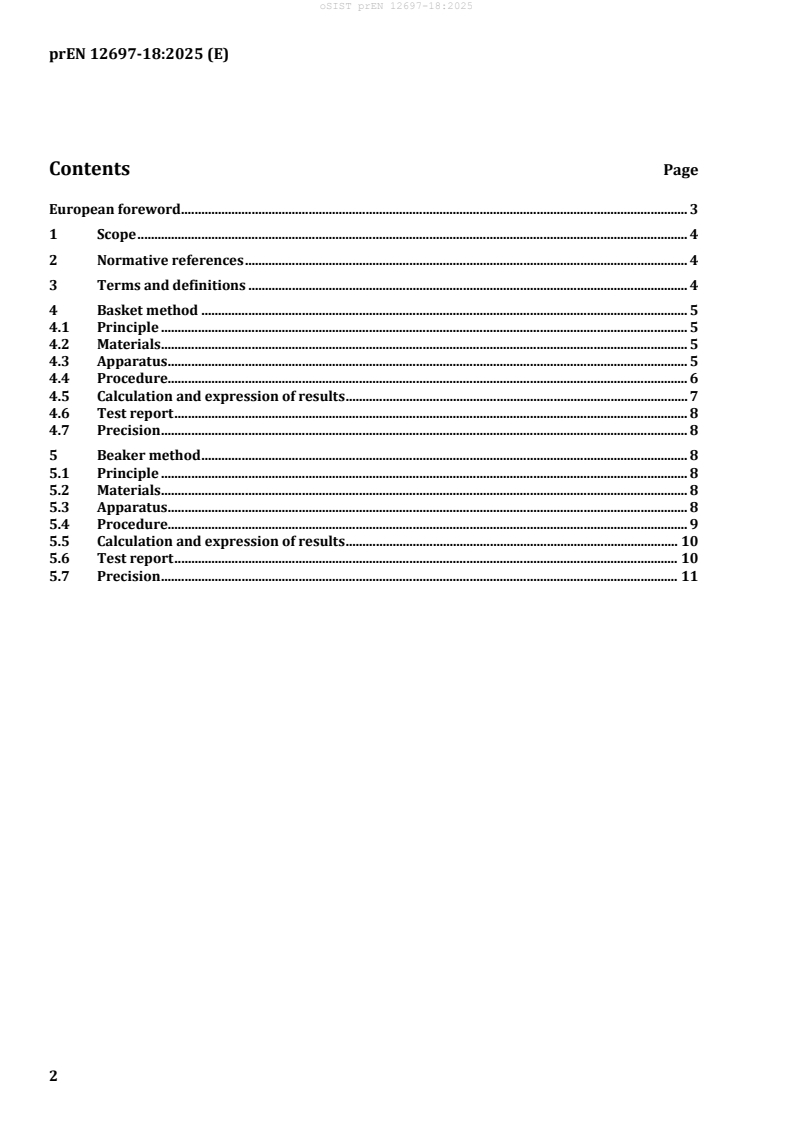
Contents Page
European foreword . 3
1 Scope . 4
2 Normative references . 4
3 Terms and definitions . 4
4 Basket method . 5
4.1 Principle . 5
4.2 Materials . 5
4.3 Apparatus . 5
4.4 Procedure. 6
4.5 Calculation and expression of results . 7
4.6 Test report . 8
4.7 Precision . 8
5 Beaker method . 8
5.1 Principle . 8
5.2 Materials . 8
5.3 Apparatus . 8
5.4 Procedure. 9
5.5 Calculation and expression of results . 10
5.6 Test report . 10
5.7 Precision . 11
oSIST prEN 12697-18:2025
prEN 12697-18:2025 (E)
European foreword
This document (prEN 12697-18:2025) has been prepared by Technical Committee CEN/TC 227 “Road
materials”, the secretariat of which is held by BSI.
This document is currently submitted to the CEN Enquiry.
This document will supersede EN 12697-18:2017.
prEN 12697-18:2024 includes the following significant technical changes with respect to EN 12697-
18:2017:
— [4.3.3] the wording “accuracy able to weigh to 0,1 g” amended to read “able to weigh to the nearest
0,1 g with a maximum permissible error of 0,2 g”;
— [4.3.4] the wording “able to measure the temperature to 1 °C” amended to read “able to measure
the temperature to the nearest 1 °C with a maximum permissible error of 2 °C;
— [4.5.1] NOTE 2 deleted. NOTE 1 amended to NOTE;
— [4.6] list of items in the test report has been revised in accordance with CEN/CENELEC Internal
Regulations, Part 3:2022;
— [5.3.3] the wording “accuracy able to weigh to 0,1 g” amended to read “able to weigh to the nearest
0,1 g with a maximum permissible error of 0,2 g”;
— [5.3.5] the wording “able to measure the temperature to 1 °C” amended to read “able to measure
the temperature to the nearest 1 °C with a maximum permissible error of 2 °C;
— [5.5.1] NOTE deleted;
— [5.6] list of items in the test report has been revised in accordance with CEN/CENELEC Internal
Regulations, Part 3:2022.
A list of all parts in the EN 12697 series can be found on the CEN website: www.cencenelec.eu.
oSIST prEN 12697-18:2025
prEN 12697-18:2025 (E)
1 Scope
This document describes two test methods:
— basket method (see Clause 4);
— beaker method (see Clause 5).
The basket method describes a method for determining binder drainage of bituminous mixtures. This
method directly measures binder drainage, but when carried out on bituminous mixtures with fibres or
mixtures whose mortar content is higher than in porous asphalt some clogging of the holes in the
drainage baskets can occur, limiting the drainage of the binder. The basket method can be used either
for determining the binder drainage for different binder content, or with a single binder content,
eliminating the successive repetitions. It also enables the effects of varying fine aggregate types or
including any anti-draining additive to be quantified.
The beaker method describes a method for determining binder drainage of bituminous mixtures. It is
applicable to asphalt materials that are not porous asphalt or for porous asphalt incorporating fibres. It
can be used either for determining the binder drainage for different binder content, or with a single
binder content, eliminating the successive repetitions. It also enables the effects of varying fine
aggregate types or including any anti-draining additive to be quantified.
2 Normative references
The following documents are referred to in the text in such a way that some or all of their content
constitutes requirements of this document. For dated references, only the edition cited applies. For
undated references, the latest edition of the referenced document (including any amendments) applies.
EN 12697-27, Bituminous mixtures — Test methods — Part 27: Sampling
EN 12697-35, Bituminous mixtures — Test methods — Part 35: Laboratory mixing
EN 14023, Bitumen and bituminous binders — Specification framework for polymer modified bitumens
ISO 3310-1, Test sieves — Technical requirements and testing — Part 1: Test sieves of metal wire cloth
ISO 3310-2, Test sieves — Technical requirements and testing — Part 2: Test sieves of perforated metal
plate
3 Terms and definitions
For the purposes of this document, the following terms and definitions apply.
ISO and IEC maintain terminology databases for use in standardization at the following addresses:
— ISO Online browsing platform: available at https://www.iso.org/obp
— IEC Electropedia: available at https://www.electropedia.org/
3.1
binder drainage
binder, fine particles and additives, if any, separated from the mixture after the mixing process or
during transport of the mixture to the site
oSIST prEN 12697-18:2025
prEN 12697-18:2025 (E)
4 Basket method
4.1 Principle
The quantity of material lost by drainage, after 3 h at the test temperature (see 4.4.1) is measured in
mixtures placed on baskets made out of perforated metal plates.
4.2 Materials
Sufficient aggregates and binder shall be prepared to manufacture at least 4 kg of asphalt material. If
more than one binder content is going to be tested, aggregates and binder to manufacture 2,5 kg of
asphalt material per each additional binder content shall be provided. The aggregates shall be dried to
constant mass and graded in the fractions appropriate to the specified grading.
The test can be carried out with samples taken during the factory production control. In that case,
sampling shall be in accordance with EN 12697-27.
4.3 Apparatus
4.3.1 Oven with closed ventilation system, vibration free, fitted with thermostatic control to
maintain the temperature in the vicinity of the samples to ±2 °C in the range of 80 °C to 200 °C.
4.3.2 Drainage baskets, constructed from 3,15 mm perforated plate sieves, in accordance with
ISO 3310-2, on sides and base to form (100 ± 2) mm cubes, with feet, at each corner of the base, of
approximately 3 mm diameter and approximately 5 mm height (see Figure 1).
...