

EN IEC 60947-2:2025
(Main)Low-voltage switchgear and controlgear - Part 2: Circuit-breakers
General Information
- Abstract
IEC 60947-2:2024 applies to circuit-breakers, intended to be installed and operated by instructed or skilled persons, the main contacts of which are intended to be connected to circuits, the rated voltage of which does not exceed 1 000 V AC or 1 500 V DC; it also contains additional requirements for integrally fused circuit-breakers. This document also applies to circuit-breakers with ratings at or below 1 000 V AC, additionally having one or more ratings above 1 000 V AC but not exceeding 1 500 V AC. This sixth edition cancels and replaces the fifth edition published in 2016 and its Amendment 1: 2019. This edition constitutes a technical revision. This edition includes the following significant technical changes with respect to the previous edition: a) suitability for isolation (see Clause 1); b) removal of the classification according to the interrupting medium, according to the design, according to the suitability for isolation (see Clause 4); c) adjustment of current settings with an external device connectable to the release (see 5.7.3); d) requirements for circuits with protective separation (see 8.2.3.8); e) additional tests for ground-fault overcurrent releases (see 9.3.4.2.5); f) additional tests concerning dielectric properties in tripped position (see 9.3.4.3); g) use of DC voltage for dielectric tests (see 9.3.4.6.2 and 9.4.6); h) tests of individual pole breaking capacity under phase-to-neutral AC voltage (see 9.3.11); i) improvement of measurement of power loss in Annex G; j) changes in EMC tests (see Annex J); k) introduction of CBI class W in Annex L.
- Status
- Published
- Publication Date
- 13-Feb-2025
- Technical Committee
- CLC/TC 121A - Low-voltage switchgear and controlgear
- Drafting Committee
- IEC/SC 121A - Low-voltage switchgear and controlgear
- Current Stage
- 6060 - Document made available - Publishing
- Start Date
- 14-Feb-2025
- Completion Date
- 14-Feb-2025

Overview - EN IEC 60947-2:2025 (Low-voltage switchgear - Circuit-breakers)
EN IEC 60947-2:2025 (identical to IEC 60947-2:2024, Edition 6) is the updated European/CENELEC standard for low-voltage circuit-breakers. It applies to circuit-breakers intended to be installed and operated by instructed or skilled persons, with main contact rated voltages up to 1 000 V AC or 1 500 V DC. The sixth edition replaces the 2016 edition (and Amendment 1:2019) and constitutes a technical revision that adds and tightens requirements for performance, testing and safety - including integrally fused circuit-breakers and devices with mixed AC ratings.
Key Topics and Technical Requirements
- Scope and ratings: Covers rated voltages ≤ 1 000 V AC and ≤ 1 500 V DC; includes devices that also have ratings above 1 000 V AC but not exceeding 1 500 V AC.
- Construction and safety: Requirements for operator safety, clearances/creepage, isolation and withdrawable designs.
- Releases and settings: Rules for overcurrent releases, including remote/current adjustability and tripping-time settings.
- Short-circuit capability: Tests and criteria for rated service and ultimate short‑circuit breaking capacity, short‑time withstand and individual pole breaking capacity under phase-to-neutral conditions.
- Dielectric and grounding tests: Additional dielectric tests (including in tripped position), use of DC for dielectric testing, and extra tests for ground-fault overcurrent releases.
- EMC and performance measurement: Updated electromagnetic compatibility tests (Annex J) and improved methods for measuring power loss (Annex G).
- Classification changes: Removal of some historical classification schemes and introduction of a new CBI class W (Annex L).
- Coordination: Requirements for integration with other protective devices and for integrally fused circuit-breakers.
Practical Applications - Who Uses EN IEC 60947-2:2025
- Manufacturers of low‑voltage circuit-breakers for design verification, type testing and CE/CENELEC compliance.
- Test laboratories performing type and routine tests (dielectric, breaking capacity, EMC, temperature-rise).
- Panel builders and switchgear OEMs selecting and specifying circuit-breakers for industrial, commercial and infrastructure systems.
- Electrical engineers, consultants and specifiers ensuring correct selection for short‑circuit protection, selectivity and isolation functions.
- Certification and conformity bodies assessing compliance with European and international requirements.
Related Standards
Commonly used with:
- IEC/EN 60947-1 (General rules for low-voltage switchgear and controlgear)
- IEC/EN 60947-3, 60947-4-1 (related LV devices)
- IEC 60664-1 (insulation coordination)
- IEC/EN 61000 series (EMC tests)
- IEC 60269 (fuses) - for coordination and integrally fused devices
EN IEC 60947-2:2025 is essential for anyone involved in the design, testing, procurement or regulatory approval of low‑voltage circuit‑breakers. Keywords: EN IEC 60947-2:2025, IEC 60947-2:2024, low-voltage switchgear, circuit-breakers, integrally fused circuit-breakers, dielectric tests, short-circuit breaking capacity, EMC.
Relations
- Effective Date
- 25-Jan-2023
- Effective Date
- 14-Jan-2020
- Effective Date
- 03-Feb-2026
- Refers
EN IEC 60068-2-14:2023 - Environmental testing - Part 2-14: Tests - Test N: Change of temperature - Effective Date
- 03-Feb-2026
- Effective Date
- 03-Feb-2026
- Refers
EN 61140:2016 - Protection against electric shock - Common aspects for installation and equipment - Effective Date
- 03-Feb-2026
- Effective Date
- 03-Feb-2026
- Effective Date
- 03-Feb-2026
- Effective Date
- 03-Feb-2026
- Effective Date
- 03-Feb-2026
- Effective Date
- 03-Feb-2026
- Effective Date
- 03-Feb-2026
- Effective Date
- 03-Feb-2026
- Effective Date
- 03-Feb-2026
- Effective Date
- 03-Feb-2026
Get Certified
Connect with accredited certification bodies for this standard

IMQ S.p.A. (Certification)
Italian electrical product certification.

SLG Prüf- und Zertifizierungs GmbH
German testing and certification body.

UL Solutions
Global safety science company with testing, inspection and certification.
Sponsored listings
Frequently Asked Questions
EN IEC 60947-2:2025 is a standard published by CLC. Its full title is "Low-voltage switchgear and controlgear - Part 2: Circuit-breakers". This standard covers: IEC 60947-2:2024 applies to circuit-breakers, intended to be installed and operated by instructed or skilled persons, the main contacts of which are intended to be connected to circuits, the rated voltage of which does not exceed 1 000 V AC or 1 500 V DC; it also contains additional requirements for integrally fused circuit-breakers. This document also applies to circuit-breakers with ratings at or below 1 000 V AC, additionally having one or more ratings above 1 000 V AC but not exceeding 1 500 V AC. This sixth edition cancels and replaces the fifth edition published in 2016 and its Amendment 1: 2019. This edition constitutes a technical revision. This edition includes the following significant technical changes with respect to the previous edition: a) suitability for isolation (see Clause 1); b) removal of the classification according to the interrupting medium, according to the design, according to the suitability for isolation (see Clause 4); c) adjustment of current settings with an external device connectable to the release (see 5.7.3); d) requirements for circuits with protective separation (see 8.2.3.8); e) additional tests for ground-fault overcurrent releases (see 9.3.4.2.5); f) additional tests concerning dielectric properties in tripped position (see 9.3.4.3); g) use of DC voltage for dielectric tests (see 9.3.4.6.2 and 9.4.6); h) tests of individual pole breaking capacity under phase-to-neutral AC voltage (see 9.3.11); i) improvement of measurement of power loss in Annex G; j) changes in EMC tests (see Annex J); k) introduction of CBI class W in Annex L.
IEC 60947-2:2024 applies to circuit-breakers, intended to be installed and operated by instructed or skilled persons, the main contacts of which are intended to be connected to circuits, the rated voltage of which does not exceed 1 000 V AC or 1 500 V DC; it also contains additional requirements for integrally fused circuit-breakers. This document also applies to circuit-breakers with ratings at or below 1 000 V AC, additionally having one or more ratings above 1 000 V AC but not exceeding 1 500 V AC. This sixth edition cancels and replaces the fifth edition published in 2016 and its Amendment 1: 2019. This edition constitutes a technical revision. This edition includes the following significant technical changes with respect to the previous edition: a) suitability for isolation (see Clause 1); b) removal of the classification according to the interrupting medium, according to the design, according to the suitability for isolation (see Clause 4); c) adjustment of current settings with an external device connectable to the release (see 5.7.3); d) requirements for circuits with protective separation (see 8.2.3.8); e) additional tests for ground-fault overcurrent releases (see 9.3.4.2.5); f) additional tests concerning dielectric properties in tripped position (see 9.3.4.3); g) use of DC voltage for dielectric tests (see 9.3.4.6.2 and 9.4.6); h) tests of individual pole breaking capacity under phase-to-neutral AC voltage (see 9.3.11); i) improvement of measurement of power loss in Annex G; j) changes in EMC tests (see Annex J); k) introduction of CBI class W in Annex L.
EN IEC 60947-2:2025 is classified under the following ICS (International Classification for Standards) categories: 29.130.20 - Low voltage switchgear and controlgear. The ICS classification helps identify the subject area and facilitates finding related standards.
EN IEC 60947-2:2025 has the following relationships with other standards: It is inter standard links to EN 60947-2:2017, EN 60947-2:2017/A1:2020, EN IEC 60664-1:2020, EN IEC 60068-2-14:2023, EN 55011:2016/A1:2017, EN 61140:2016, EN 55011:2016/A2:2021, EN IEC 60228:2024, EN 55011:2016, EN 61000-4-4:2012, EN IEC 60947-1:2021, EN IEC 61000-4-11:2020, EN IEC 60068-2-30:2025, EN 62475:2010, EN IEC 60947-4-1:2025. Understanding these relationships helps ensure you are using the most current and applicable version of the standard.
EN IEC 60947-2:2025 is associated with the following European legislation: EU Directives/Regulations: 2014/30/EU, 2014/35/EU; Standardization Mandates: M/511, M/552. When a standard is cited in the Official Journal of the European Union, products manufactured in conformity with it benefit from a presumption of conformity with the essential requirements of the corresponding EU directive or regulation.
EN IEC 60947-2:2025 is available in PDF format for immediate download after purchase. The document can be added to your cart and obtained through the secure checkout process. Digital delivery ensures instant access to the complete standard document.
Standards Content (Sample)
SLOVENSKI STANDARD
01-april-2025
Nizkonapetostne stikalne in krmilne naprave - 2. del: Odklopniki (IEC 60947-
2:2024)
Low-voltage switchgear and controlgear - Part 2: Circuit-breakers (IEC 60947-2:2024)
Niederspannungsschaltgeräte - Teil 2: Leistungsschalter (IEC 60947-2:2024)
Appareillage à basse tension - Partie 2: Disjoncteurs (IEC 60947-2:2024)
Ta slovenski standard je istoveten z: EN IEC 60947-2:2025
ICS:
29.130.20 Nizkonapetostne stikalne in Low voltage switchgear and
krmilne naprave controlgear
2003-01.Slovenski inštitut za standardizacijo. Razmnoževanje celote ali delov tega standarda ni dovoljeno.
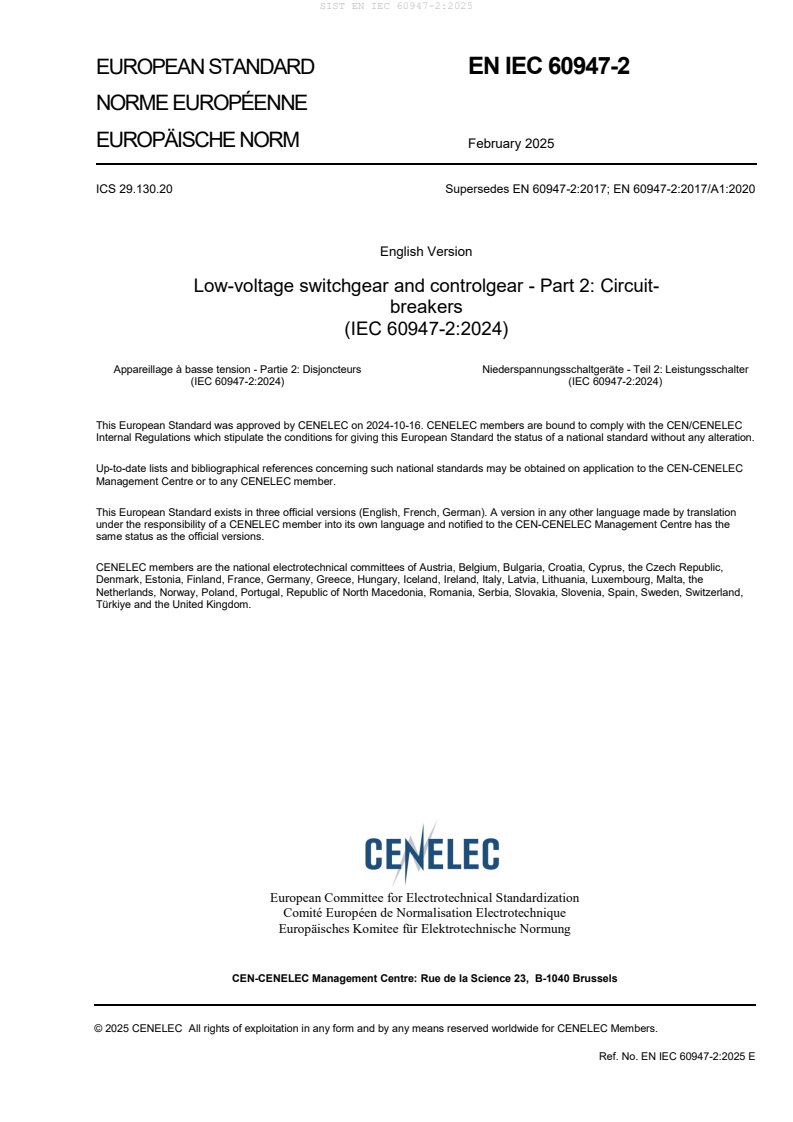
EUROPEAN STANDARD EN IEC 60947-2
NORME EUROPÉENNE
EUROPÄISCHE NORM February 2025
ICS 29.130.20 Supersedes EN 60947-2:2017; EN 60947-2:2017/A1:2020
English Version
Low-voltage switchgear and controlgear - Part 2: Circuit-
breakers
(IEC 60947-2:2024)
Appareillage à basse tension - Partie 2: Disjoncteurs Niederspannungsschaltgeräte - Teil 2: Leistungsschalter
(IEC 60947-2:2024) (IEC 60947-2:2024)
This European Standard was approved by CENELEC on 2024-10-16. CENELEC members are bound to comply with the CEN/CENELEC
Internal Regulations which stipulate the conditions for giving this European Standard the status of a national standard without any alteration.
Up-to-date lists and bibliographical references concerning such national standards may be obtained on application to the CEN-CENELEC
Management Centre or to any CENELEC member.
This European Standard exists in three official versions (English, French, German). A version in any other language made by translation
under the responsibility of a CENELEC member into its own language and notified to the CEN-CENELEC Management Centre has the
same status as the official versions.
CENELEC members are the national electrotechnical committees of Austria, Belgium, Bulgaria, Croatia, Cyprus, the Czech Republic,
Denmark, Estonia, Finland, France, Germany, Greece, Hungary, Iceland, Ireland, Italy, Latvia, Lithuania, Luxembourg, Malta, the
Netherlands, Norway, Poland, Portugal, Republic of North Macedonia, Romania, Serbia, Slovakia, Slovenia, Spain, Sweden, Switzerland,
Türkiye and the United Kingdom.
European Committee for Electrotechnical Standardization
Comité Européen de Normalisation Electrotechnique
Europäisches Komitee für Elektrotechnische Normung
CEN-CENELEC Management Centre: Rue de la Science 23, B-1040 Brussels
© 2025 CENELEC All rights of exploitation in any form and by any means reserved worldwide for CENELEC Members.
Ref. No. EN IEC 60947-2:2025 E
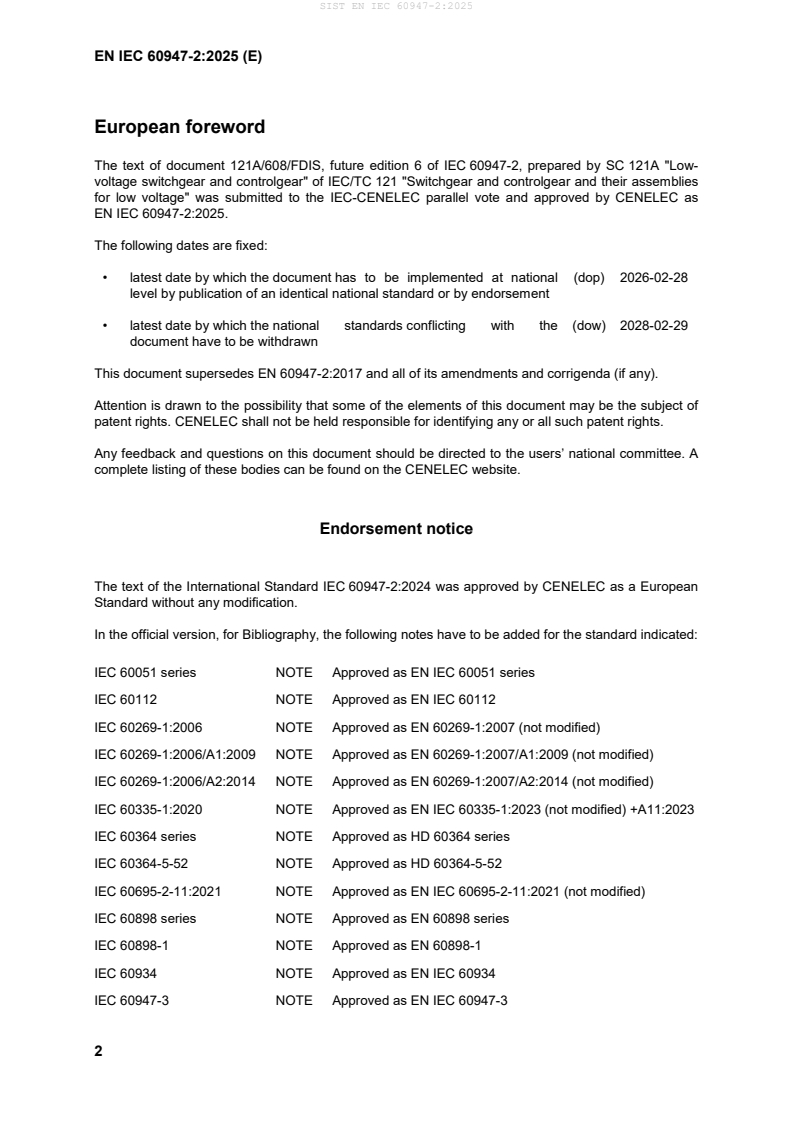
European foreword
The text of document 121A/608/FDIS, future edition 6 of IEC 60947-2, prepared by SC 121A "Low-
voltage switchgear and controlgear" of IEC/TC 121 "Switchgear and controlgear and their assemblies
for low voltage" was submitted to the IEC-CENELEC parallel vote and approved by CENELEC as
The following dates are fixed:
• latest date by which the document has to be implemented at national (dop) 2026-02-28
level by publication of an identical national standard or by endorsement
• latest date by which the national standards conflicting with the (dow) 2028-02-29
document have to be withdrawn
This document supersedes EN 60947-2:2017 and all of its amendments and corrigenda (if any).
Attention is drawn to the possibility that some of the elements of this document may be the subject of
patent rights. CENELEC shall not be held responsible for identifying any or all such patent rights.
Any feedback and questions on this document should be directed to the users’ national committee. A
complete listing of these bodies can be found on the CENELEC website.
Endorsement notice
The text of the International Standard IEC 60947-2:2024 was approved by CENELEC as a European
Standard without any modification.
In the official version, for Bibliography, the following notes have to be added for the standard indicated:
IEC 60051 series NOTE Approved as EN IEC 60051 series
IEC 60112 NOTE Approved as EN IEC 60112
IEC 60269-1:2006 NOTE Approved as EN 60269-1:2007 (not modified)
IEC 60269-1:2006/A1:2009 NOTE Approved as EN 60269-1:2007/A1:2009 (not modified)
IEC 60269-1:2006/A2:2014 NOTE Approved as EN 60269-1:2007/A2:2014 (not modified)
IEC 60335-1:2020 NOTE Approved as EN IEC 60335-1:2023 (not modified) +A11:2023
IEC 60364 series NOTE Approved as HD 60364 series
IEC 60364-5-52 NOTE Approved as HD 60364-5-52
IEC 60695-2-11:2021 NOTE Approved as EN IEC 60695-2-11:2021 (not modified)
IEC 60898 series NOTE Approved as EN 60898 series
IEC 60898-1 NOTE Approved as EN 60898-1
IEC 60934 NOTE Approved as EN IEC 60934
IEC 60947-3 NOTE Approved as EN IEC 60947-3
IEC 60947-5-1 NOTE Approved as EN 60947-5-1
IEC 61000-3-2 NOTE Approved as EN IEC 61000-3-2
IEC 61000-3-3 NOTE Approved as EN 61000-3-3
IEC 61000-4-13 NOTE Approved as EN 61000-4-13
IEC 61008-1:2010 NOTE Approved as EN 61008-1:2012 +A11:2015
IEC 61008-1:2010/A1:2012 NOTE Approved as EN 61008-1:2012/A1:2014
IEC 61008-1:2010/A2:2013 NOTE Approved as EN 61008-1:2012/A2:2014
IEC 61009-1:2010 NOTE Approved as EN 61009-1:2012 +A11:2015
IEC 61009-1:2010/A1:2012 NOTE Approved as EN 61009-1:2012/A1:2014
IEC 61009-1:2010/A2:2013 NOTE Approved as EN 61009-1:2012/A2:2014
IEC 61131-1:2003 NOTE Approved as EN 61131-1:2003 (not modified)
IEC 61238-1 series NOTE Approved as EN IEC 61238-1 series
IEC 61439 series NOTE Approved as EN IEC 61439 series
IEC/TR 63201 NOTE Approved as CLC IEC/TR 63201
IEC/TR 63216:2019 NOTE Approved as CLC IEC/TR 63216:2020 (not modified)
Annex ZA
(normative)
Normative references to international publications
with their corresponding European publications
The following documents are referred to in the text in such a way that some or all of their content
constitutes requirements of this document. For dated references, only the edition cited applies. For
undated references, the latest edition of the referenced document (including any amendments)
applies.
NOTE 1 Where an International Publication has been modified by common modifications, indicated by (mod),
the relevant EN/HD applies.
NOTE 2 Up-to-date information on the latest versions of the European Standards listed in this annex is available
here: www.cencenelec.eu.
Publication Year Title EN/HD Year
IEC 60068-2-14 - Environmental testing - Part 2-14: Tests - EN IEC 60068-2-14 -
Test N: Change of temperature
IEC 60068-2-30 - Environmental testing - Part 2-30: Tests - EN 60068-2-30 -
Test Db: Damp heat, cyclic (12 h + 12 h
cycle)
IEC 60228 - Conductors of insulated cables EN IEC 60228 -
IEC 60664-1 2020 Insulation coordination for equipment EN IEC 60664-1 2020
within low-voltage supply systems - Part 1:
Principles, requirements and tests
- - +AC 2020
IEC 60947-1 2020 Low-voltage switchgear and controlgear - EN IEC 60947-1 2021
Part 1: General rules
IEC 60947-4-1 - Low-voltage switchgear and controlgear - EN IEC 60947-4-1 -
Part 4-1: Contactors and motor-starters -
Electromechanical contactors and motor-
starters
IEC 61000-4-2 2008 Electromagnetic compatibility (EMC) - Part EN 61000-4-2 2009
4-2: Testing and measurement techniques
- Electrostatic discharge immunity test
IEC 61000-4-3 2020 Electromagnetic compatibility (EMC) - Part EN IEC 61000-4-3 2020
4-3 : Testing and measurement techniques
- Radiated, radio-frequency,
electromagnetic field immunity test
IEC 61000-4-4 2012 Electromagnetic compatibility (EMC) - Part EN 61000-4-4 2012
4-4: Testing and measurement techniques
- Electrical fast transient/burst immunity
test
IEC 61000-4-5 2014 Electromagnetic compatibility (EMC) - Part EN 61000-4-5 2014
4-5: Testing and measurement techniques
- Surge immunity test
+ A1 2017 + A1 2017
Publication Year Title EN/HD Year
IEC 61000-4-6 2023 Electromagnetic compatibility (EMC) - Part EN IEC 61000-4-6 2023
4-6: Testing and measurement techniques
- Immunity to conducted disturbances,
induced by radio-frequency fields
IEC 61000-4-11 2020 Electromagnetic compatibility (EMC) - Part EN IEC 61000-4-11 2020
4-11: Testing and measurement
techniques - Voltage dips, short
interruptions and voltage variations
immunity tests for equipment with input
current up to 16 A per phase
- - +AC 2020
- - +AC 2022
IEC 61140 2016 Protection against electric shock - EN 61140 2016
Common aspects for installation and
equipment
IEC 61545 1996 Connecting devices - Devices for the - -
connection of aluminium conductors in
clamping units of any material and copper
conductors in aluminium bodied clamping
units
IEC 62475 2010 High-current test techniques - Definitions EN 62475 2010
and requirements for test currents and
measuring systems
CISPR 11 (mod) 2015 Industrial, scientific and medical equipment EN 55011 2016
- Radio-frequency disturbance
characteristics - Limits and methods of
measurement
+ A1 2016 + A1 2017
- - + A11 2020
+ A2 2019 + A2 2021
CISPR 32 2015 Electromagnetic compatibility of multimedia EN 55032 2015
equipment - Emission requirements
- - +AC 2016
- - +A11 2020
IEC 60947-2 ®
Edition 6.0 2024-09
INTERNATIONAL
STANDARD
NORME
INTERNATIONALE
Low-voltage switchgear and controlgear –
Part 2: Circuit-breakers
Appareillage à basse tension –
Partie 2: Disjoncteurs
INTERNATIONAL
ELECTROTECHNICAL
COMMISSION
COMMISSION
ELECTROTECHNIQUE
INTERNATIONALE
ICS 29.130.20 ISBN 978-2-8322-9521-2
– 2 – IEC 60947-2:2024 © IEC 2024
CONTENTS
FOREWORD . 15
1 Scope . 17
2 Normative references . 18
3 Terms and definitions . 19
4 Classification . 23
4.1 According to the selectivity category, A or B (see 5.4). 23
4.2 According to the method of controlling the operating mechanism: . 23
4.3 According to the provision for maintenance: . 23
4.4 According to the method of installation:. 23
4.5 According to the degree of protection provided by the enclosure (see 8.1.12
of IEC 60947‑1:2020) . 23
5 Characteristics of circuit-breakers. 23
5.1 Summary of characteristics . 23
5.2 Type of circuit-breaker . 23
5.3 Rated and limiting values of the main circuit . 23
5.3.1 General . 23
5.3.2 Rated voltages . 24
5.3.3 Currents . 24
5.3.4 Rated frequency . 24
5.3.5 Rated duty . 24
5.3.6 Short-circuit characteristics . 25
5.4 Selectivity categories . 27
5.5 Control circuits . 27
5.5.1 Electrical control circuits . 27
5.5.2 Air-supply control circuits (pneumatic or electro-pneumatic) . 28
5.6 Auxiliary circuits . 28
5.7 Releases. 28
5.7.1 Types . 28
5.7.2 Characteristics. 28
5.7.3 Current setting of overcurrent releases . 29
5.7.4 Tripping time setting of overcurrent releases . 29
5.8 Integral fuses (integrally fused circuit-breakers) . 30
6 Product information . 30
6.1 Nature of the information . 30
6.2 Marking . 30
6.3 Instructions for installation, operation and maintenance . 32
7 Normal service, mounting and transport conditions . 32
8 Constructional and performance requirements . 32
8.1 Constructional requirements . 32
8.1.1 General . 32
8.1.2 Withdrawable circuit-breakers . 33
8.1.3 Isolation . 33
8.1.4 Clearances and creepage distances . 33
8.1.5 Requirements for the safety of the operator . 33
8.1.6 List of construction breaks . 33
8.1.7 Additional requirements for circuit-breakers provided with a neutral pole . 34
IEC 60947-2:2024 © IEC 2024 – 3 –
8.1.8 Digital inputs and outputs for use with programmable logic controllers
(PLCs) . 34
8.2 Performance requirements . 34
8.2.1 Operating conditions . 34
8.2.2 Temperature-rise . 37
8.2.3 Dielectric properties . 38
8.2.4 Ability to make and break under no load, normal load and overload
conditions . 39
8.2.5 Ability to make and break under short-circuit conditions . 40
8.2.6 Requirements for isolation . 40
8.2.7 Specific requirements for integrally fused circuit-breakers . 40
8.2.8 Coordination between a circuit-breaker and another short-circuit
protective device . 41
8.3 Electromagnetic compatibility (EMC) . 41
9 Tests . 41
9.1 Kind of tests . 41
9.1.1 General . 41
9.1.2 Type tests . 41
9.1.3 Routine tests . 41
9.1.4 Special tests . 41
9.2 Compliance with constructional requirements . 42
9.3 Type tests . 42
9.3.1 General . 42
9.3.2 Test sequences . 43
9.3.3 General test conditions . 50
9.3.4 Test sequence I: General performance characteristics . 58
9.3.5 Test sequence II: Rated service short-circuit breaking capacity . 68
9.3.6 Test sequence III: Rated ultimate short-circuit breaking capacity . 69
9.3.7 Test sequence IV: Rated short-time withstand current . 71
9.3.8 Test sequence V: Performance of integrally fused circuit-breakers . 72
9.3.9 Test sequence VI: Combined test sequence . 74
9.3.10 Test sequence VII: Critical DC load current . 76
9.3.11 Test sequence VIII: Rated individual pole ultimate short-circuit breaking
capacity at phase-to-neutral AC voltage. 77
9.4 Routine tests. 78
9.4.1 General . 78
9.4.2 Mechanical operation tests . 78
9.4.3 Verification of the calibration of overcurrent releases . 79
9.4.4 Verification of the operation of undervoltage and shunt releases . 79
9.4.5 Additional tests for CBRs . 80
9.4.6 Dielectric tests . 80
9.4.7 Test for the verification of clearances less than those corresponding to
case A of Table 13 of IEC 60947-1:2020 . 81
9.5 Special tests – Damp heat, salt mist, vibration and shock . 81
Annex A (normative) Coordination between a circuit-breaker and another short-circuit
protective device associated in the same circuit . 84
A.1 General . 84
A.2 Object . 84
A.3 General requirements for the co-ordination of a circuit-breaker with another
SCPD . 84
– 4 – IEC 60947-2:2024 © IEC 2024
A.4 Type and characteristics of the associated SCPD . 84
A.5 Verification of selectivity . 84
A.6 Verification of back-up protection . 84
Annex B (normative) Circuit-breakers incorporating residual current protection (CBRs) . 86
B.1 General . 86
B.1.1 Preamble . 86
B.1.2 Object . 86
B.2 Terms and definitions . 87
B.2.1 Terms and definitions relating to currents flowing from live parts to
earth . 87
B.2.2 Terms and definitions relating to the energization of a CBR . 87
B.2.3 Terms and definitions relating to the operation and the functions of a
CBR . 88
B.2.4 Terms and definitions relating to values and ranges of energizing
quantities . 89
B.3 Classification . 90
B.3.1 Classification according to the method of operation of the residual
current function . 90
B.3.2 Classification according to the possibility of adjusting the residual
operating current . 90
B.3.3 Classification according to time delay of the residual current function . 90
B.3.4 Classification according to behaviour in presence of a DC component . 90
B.4 Characteristics of CBRs concerning their residual current function . 90
B.4.1 Rated values . 90
B.4.2 Preferred and limiting values . 91
B.4.3 Value of the rated residual short-circuit making and breaking capacity
(I ) . 92
Δm
B.4.4 Operating characteristics in the case of an earth fault current in the
presence or absence of a DC component . 92
B.5 Marking . 93
B.6 Normal service, mounting and transport conditions . 95
B.7 Design and operating requirements . 95
B.7.1 Design requirements . 95
B.7.2 Operating requirements . 95
B.7.3 Electromagnetic compatibility . 99
B.8 Tests . 99
B.8.1 Test sequences . 99
B.8.2 Verification of the operating characteristics . 102
B.8.3 Verification of dielectric properties . 104
B.8.4 Verification of the operation of the test device at the limits of rated
voltage . 104
B.8.5 Verification of the limiting value of the non-operating current under
overcurrent conditions . 105
B.8.6 Verification of the resistance against unwanted tripping due to surge
currents resulting from impulse voltages . 105
B.8.7 Additional verifications for CBRs of types A and B . 106
B.8.8 Additional verifications for CBRs of type B . 108
B.8.9 Verification of the behaviour of CBRs functionally dependent on line
voltage classified under B.3.1.2.1 . 113
B.8.10 Verification of the behaviour of CBRs functionally dependent on line
voltage classified under B.3.1.2.2 . 113
IEC 60947-2:2024 © IEC 2024 – 5 –
B.8.11 Verification of the residual short-circuit making and breaking capacity . 114
B.8.12 Verification of the effects of environmental conditions . 115
B.8.13 Verification of electromagnetic compatibility . 116
B.8.14 Test for variations or interruptions of voltage and for voltage dips. 118
Annex C (normative) Individual pole short-circuit test sequence . 130
C.1 General . 130
C.2 Test of individual pole short-circuit breaking capacity . 130
C.3 Verification of dielectric withstand and leakage current . 130
C.4 Verification of overload releases . 130
Annex D (normative) Additional requirements for circuit-breakers intended for
connection of aluminium conductors . 131
D.1 General . 131
D.2 Terms and definitions . 131
D.3 Classification . 132
D.4 Characteristics . 132
D.5 Product information . 132
D.5.1 Nature of information . 132
D.5.2 Marking . 132
D.5.3 Instructions for installation, operation and maintenance . 132
D.6 Normal service, mounting and transport conditions . 132
D.7 Constructional and performance requirements . 133
D.8 Tests . 133
D.8.1 General . 133
D.8.2 Current cycling test. 134
D.8.3 Climatic test. 138
D.8.4 Mechanical properties of terminals . 139
D.8.5 Test for insertability of unprepared round aluminium conductors having
the maximum cross-section . 139
Annex E (informative) Items subject to agreement between manufacturer and user . 143
Annex F (normative) Additional tests for circuit-breakers with electronic overcurrent
protection . 144
F.1 General . 144
F.2 List of tests . 144
F.2.1 General . 144
F.2.2 Electromagnetic compatibility (EMC) tests . 144
F.2.3 Suitability for multiple frequencies . 145
F.2.4 Dry heat test . 145
F.2.5 Damp heat test . 145
F.2.6 Temperature variation cycles at a specified rate of change . 145
F.3 General test conditions . 145
F.3.1 General . 145
F.3.2 Electromagnetic compatibility tests . 145
F.4 Immunity tests . 146
F.4.1 Harmonic currents . 146
F.4.2 Electrostatic discharges . 147
F.4.3 Radiated RF electromagnetic fields . 147
F.4.4 Electrical fast transient/burst (EFT/B) . 148
F.4.5 Surges . 148
F.4.6 Conducted disturbances induced by RF fields (common mode) . 148
– 6 – IEC 60947-2:2024 © IEC 2024
F.4.7 Current dips . 149
F.5 Emission tests . 149
F.5.1 Harmonics . 149
F.5.2 Voltage fluctuations . 149
F.5.3 Conducted RF disturbances (150 kHz to 30 MHz) . 150
F.5.4 Radiated RF disturbances (30 MHz to 6 000 MHz) . 150
F.6 Suitability for multiple frequencies . 150
F.6.1 General . 150
F.6.2 Test conditions . 150
F.6.3 Test procedure . 150
F.6.4 Test results. 151
F.7 Dry heat test . 151
F.7.1 Test procedure . 151
F.7.2 Test results. 151
F.7.3 Verification of overload releases . 151
F.8 Damp heat test . 151
F.8.1 Test procedure . 151
F.8.2 Verification of overload releases . 152
F.9 Temperature variation cycles at a specified rate of change . 152
F.9.1 Test conditions . 152
F.9.2 Test procedure . 152
F.9.3 Test results. 152
F.9.4 Verification of overload releases . 152
Annex G (normative) Power loss . 167
G.1 General . 167
G.2 Determination method . 167
G.2.1 AC circuit-breakers of rated current exceeding 400 A . 167
G.2.2 AC circuit-breakers of rated current not exceeding 400 A . 168
G.2.3 DC circuit-breakers . 168
G.3 Test conditions . 168
G.4 Test method . 169
G.4.1 General . 169
G.4.2 Voltage drop measurements . 169
G.4.3 Current measurement . 169
Annex H (normative) Test sequence for circuit-breakers for IT systems . 172
H.1 General . 172
H.2 Individual pole short-circuit . 172
H.3 Verification of dielectric withstand and leakage current . 173
H.4 Verification of overload releases . 173
H.5 Marking . 173
Annex I Vacant . 174
Annex J (normative) Electromagnetic compatibility (EMC) – Requirements and test
methods for circuit-breakers. 175
J.1 General . 175
J.2 Immunity . 176
J.2.1 General . 176
J.2.2 Electrostatic discharges . 178
J.2.3 Radiated RF electromagnetic fields . 179
J.2.4 Electrical fast transients/bursts (EFT/B) . 179
IEC 60947-2:2024 © IEC 2024 – 7 –
J.2.5 Surges . 179
J.2.6 Conducted disturbances induced by RF fields (common mode) . 180
J.3 Emission . 180
J.3.1 General . 180
J.3.2 Conducted RF disturbances (150 kHz to 30 MHz) . 181
J.3.3 Radiated RF disturbances (30 MHz to 6 000 MHz) . 181
Annex K (informative) Glossary of symbols and graphical representation of
characteristics . 187
Annex L (normative) Circuit-breakers not fulfilling the requirements for overcurrent
protection (CBIs) . 196
L.1 General . 196
L.2 Terms and definitions . 196
L.3 Classification . 196
L.4 Characteristics . 197
L.4.1 Rated current (I ) . 197
n
L.4.2 Rated conditional short-circuit current (I ) . 197
cc
L.4.3 Other characteristics . 197
L.5 Product information . 197
L.6 Constructional and performance requirements . 198
L.7 Tests . 198
L.7.1 General . 198
L.7.2 Rated conditional short-circuit current tests . 200
L.7.3 Routine tests . 202
Annex M (normative) Modular residual current devices (without integral current
breaking device) . 203
M.1 General . 203
M.1.1 Preamble . 203
M.1.2 Object . 203
M.2 Terms and definitions . 203
M.2.1 Terms and definitions relating to the energization of an MRCD . 203
M.2.2 Terms and definitions relating to the operation and the functions of an
MRCD. 204
M.3 Classification . 204
M.3.1 Classification according to the configuration of the primary conductors . 204
M.3.2 Classification according to the method of operation . 204
M.3.3 Classification according to the possibility of adjusting the residual
operating current . 205
M.3.4 Classification according to time delay of the residual current function . 205
M.3.5 Classification according to behaviour in presence of a DC component . 205
M.4 Characteristics of MRCDs . 205
M.4.1 General characteristics . 205
M.4.2 Characteristics of MRCDs concerning their residual current function . 206
M.4.3 Behaviour under short-circuit conditions . 206
M.4.4 Preferred and limiting values . 207
M.5 Product information . 207
M.6 Normal service, mounting and transport conditions . 209
M.7 Design and operating requirements . 209
M.7.1 Design requirements . 209
M.7.2 Operating requirements . 209
– 8 – IEC 60947-2:2024 © IEC 2024
M.8 Tests . 212
M.8.1 General . 212
M.8.2 Compliance with constructional requirements . 213
M.8.3 Verification of the operating characteristics .
...