

EN IEC 62046:2026
(Main)Safety of machinery - Application of protective equipment to detect the presence of persons
- Status
- Published
- Publication Date
- 17-Sep-2026
- Technical Committee
- CLC/TC 44X - Safety of machinery: electrotchnical aspects
- Drafting Committee
- IEC/TC 44 - IEC_TC_44
- Current Stage
- 6060 - Document made available - Publishing
- Start Date
- 18-Sep-2026
- Due Date
- 30-Sep-2022
- Completion Date
- 18-Sep-2026

EN IEC 62046:2026 is a CLC standard on the safety of machinery. It specifies how to select, position, configure and commission sensitive protective equipment that detects the presence of persons so machinery can reduce risk from hazardous parts without using a physical barrier. The document is written for standards writers, machine designers, manufacturers, refurbishers, safety certification organizations, workplace authorities and integrators in industrial applications.
What does EN IEC 62046:2026 specify?
EN IEC 62046:2026 specifies requirements for protective equipment that detects momentary or continued presence of persons in industrial machinery applications. It covers electro-sensitive protective equipment (ESPE) from IEC 61496 and pressure-sensitive mats and floors from ISO 13856-1, and it is intended to be used together with ISO 13855.
The document is organized into scope, normative references, terms, a general overview, operational functions, optional functions, integration with the safety-related control system, inspection and test, and information for use. Clause 6 gives additional guidance for specific kinds of sensitive protective equipment, while the informative annexes give application examples and calculation approaches.
| Annex | What it covers |
|---|---|
| Annex A | Application examples of ESPE |
| Annex B | Additional recommendations for AOPDDRs |
| Annex C | Additional information for vision based protective devices using stereo vision techniques (VBPDST) |
| Annex D | A possible approach for calculating separation distance for Radar Protective Device (RPD) applications |
| Annex E | Examples of AOPD muting for applications where whole body access is possible |
| Annex F | Example of automatic selection of active detection zones |
| Annex G | ESPE types, including AOPD, AOPDDR, VBPDs, RPD, and pressure-sensitive mats and floors |
| Annex H | Estimation of SIL or PL for muting systems in ESPE applications |
What are the key requirements of EN IEC 62046:2026?
EN IEC 62046:2026 is mainly about matching the protective device to the machine, the environment and the way people can approach the hazard. It also sets out how to position the device, how to calculate separation distance, and how to manage functions such as blanking, muting, reduced resolution and restart control.
Selecting the right device and layout
Clause 4.2 requires the selection of SPE to take account of machine characteristics, user interaction, environmental characteristics, the hazard zone, human body dimensions, suitability of the SPE, safety integrity characteristics, and the properties of the specific sensing technology. In practice, the device must fit the real machine and site conditions, not just the nominal hazard.
Clause 4.3 requires consideration of how the ESPE could be defeated or bypassed. That means looking at both the motivation to bypass it and the practical ways someone could reach over, under, around or manipulate it.
Clause 4.4 ties positioning of the SPE or detection zone(s) to ISO 13855 and Annex A. In practice, the protective field has to be placed so people cannot reach the hazard from the foreseeable directions of approach.
Setting separation distance and stopping access
Clause 5.2 says a trip function must be installed at a sufficient distance from the hazard so the machine can stop or otherwise achieve the intended risk reduction before any part of the person reaches the danger. The separation distance is based on approach speed, overall system response time, reaching distance, effective detection capability and any supplemental distance factors.
Clause 5.2.1.5 requires the installation to minimize circumvention, including reaching over, under or around the detection zone, stepping over it, or changing the detection zone by reflection or repositioning. Where circumvention is foreseeable, supplementary protective measures are needed so access can only happen through the protected path and unexpected restart is prevented.
Clause 5.2.1.6 adds a specific check for vertical detection zones that can be stepped through. The response time must be short enough to prevent undetected passage, which matters whenever a person could walk through before the device reacts.
Using specific technologies correctly
Clause 4.2.8.2 sets conditions for AOPDs. The manufacturer’s guidance on reflective surfaces has to be followed, because reflections can reduce detection. Light beam devices used as trip devices for whole-body detection often need a restart interlock or presence-sensing device to avoid unexpected restart.
Clause 4.2.8.2.3 covers light curtains and their detection-zone orientations. The document requires the top and bottom limits of the zone to be set so people cannot reach over or under it, and it limits configuration changes such as blanking and reduced resolution to controlled, verifiable use.
Clause 4.2.8.3 covers AOPDDRs. Their zones must detect approach toward the hazard, avoid shadow zones, and take account of reflective surfaces, background effects, tolerance zones and installation limits. In mobile applications, the edge conditions, ground conditions and changing speeds also matter.
Clause 4.2.8.4 covers VBPD and says they shall follow IEC/TS 61496-4-2:2022 or IEC/TS 61496-4-3:2022. Their detection zone has to cover the hazard zone, avoid shadow zones, and follow the manufacturer’s instructions on lighting, background, minimum zone size, tolerance zones, nearby objects, and mounting geometry.
Clause 4.2.8.5 covers pressure-sensitive mats and floors. They have to be chosen for construction, environment, fault behaviour and operating conditions, and the document warns that some mats cannot detect a person already standing on them after power is restored, so those types shall not be used as SPE.
Managing safety functions and test intervals
Clause 5.5 requires manual functional testing to detect fault accumulation and undetected faults. That matters because some failures only show up if the installer or user actively checks the function.
Clause 4.2.7.4 addresses periodic testing. Where a Type 2 ESPE or a Category 2 mat system depends on periodic testing, the frequency must be higher than the frequency of exposure to the hazard, and an automatic test is required at each power-on. If the test duration can become too long, restart interlock has to be considered.
Clause 6 covers optional functions associated with the application of SPE, including performance monitoring systems, start interlock, restart interlock, muting, reinitiating of machine operation by the AOPD, EDM, and automatic selection of active detection zones. The practical point is that these functions are part of the safety design and have to be configured so they do not weaken the protective function.
Blanking and reduced resolution are allowed only under controlled conditions. The blanked area must be no larger than needed, the effect on detection capability has to be verified after each configuration, and the change in detection capability must be stated in the information for use.
Muting needs particular care where whole-body access is possible. The annexes show that timing, sequence, sensor placement, timeout control and muting enable signals are all used to reduce the chance of manipulation or unsafe access.
What terms does EN IEC 62046:2026 define?
- Active opto-electronic protective device (AOPD) - A device that detects interruption of optical radiation by an opaque object in its specified detection zone or on the beam axis.
- Active opto-electronic protective device responsive to diffuse reflection (AOPDDR) - A device that detects diffuse reflection from an object in a specified two-dimensional detection zone.
- Electro-sensitive protective equipment (ESPE) - An assembly of sensing, control/monitoring, and output devices used for protective tripping or presence sensing.
- Detection zone - The zone in which a specified test piece will be detected by the sensitive protective equipment.
- Effective detection capability - The detection parameter limit set by the integrator for the application.
- Integrator - The person or group responsible for selecting, configuring, installing or interfacing the SPE to achieve the required safeguarding.
- External device monitoring (EDM) - The function by which the ESPE monitors external control devices.
- Final switching device (FSD) - A machine control component that interrupts the circuit to the machine primary control element when the OSSD goes to OFF-state.
Who uses EN IEC 62046:2026?
EN IEC 62046:2026 is used by standards writing committees developing type-C standards for machines, because the document explains how protective sensing devices should be applied around specific hazards. It is also used by machine designers, manufacturers and refurbishers when they choose the device, set the distance, and decide how to combine it with restart, muting or other control functions.
Machine safety certification organizations and workplace authorities use EN IEC 62046:2026 when assessing whether a protective arrangement is appropriate for the application. Integrators and maintenance teams use it for installation, commissioning, inspection, testing and later changes to the machine or the protective zone.
What changed in EN IEC 62046:2026 from the previous edition?
EN IEC 62046:2026 cancels and replaces IEC 62046:2018. The document states these significant technical changes: restructuring of the document to make it easier to use, additional information on vision and radar systems, updated muting requirements, more coverage of whole-body access, and alignment with changes in ISO 13855.
Which standards are used with EN IEC 62046:2026?
EN IEC 62046:2026 uses several companion standards and product standards together with its own requirements.
- IEC 62061:2021 - provides the functional safety framework for safety-related electrical, electronic and programmable electronic control systems.
- ISO 12100:2010 - provides the general principles for design, including risk assessment and risk reduction.
- ISO 13849-1:2023 - provides the basis for safety-related parts of control systems and the use of PL.
- ISO 13855:2024 - provides the rules for positioning safeguards with respect to the approach of the human body.
- IEC 61496 (all parts) - provides the ESPE product family used by this standard.
- ISO 13856-1 - provides the product standard for pressure-sensitive mats and floors.
- IEC/TS 61496-4-2:2022 and IEC/TS 61496-4-3:2022 - provide the product basis for the VBPD and AOPDDR-related applications covered in the clauses and annexes.
- IEC/TS 61496-5:2023 - provides the product basis for RPD applications referenced in Annex D.
What does the EN IEC 62046:2026 document contain?
EN IEC 62046:2026 contains explanatory figures, application examples and worked approaches for sizing and positioning protective devices. The body includes figures on reflective surfaces, detection capability, blanking, reduced resolution, approach directions, stepping through vertical zones, and the behavior of muting sensor layouts.
Table 1 links ESPE types to achievable PL or SIL, and Annex H adds tables for muting-system safety performance using ISO 13849-1 and IEC 62061. Annex D gives a worked separation-distance method for RPD applications, and Annex C shows how detection zones and tolerance zones affect the overall separation distance for VBPDST.
Annex E is especially practical for conveyor and whole-body access cases because it shows several muting layouts, signal sequences and timeout concepts. Annex F shows how active detection zones can be selected automatically, and Annex G groups the device types covered by the document so users can see where each technology fits.
Relations
- Effective Date
- 05-Apr-2022
- Effective Date
- 25-Aug-2026
- Effective Date
- 25-Aug-2026
- Effective Date
- 25-Aug-2026
- Effective Date
- 25-Aug-2026
- Effective Date
- 22-Sep-2026
- Effective Date
- 05-Apr-2022
Get Certified
Connect with accredited certification bodies for this standard

CIS Institut d.o.o.
Personal Protective Equipment (PPE) certification body. Notified Body NB-2890 for EU Regulation 2016/425 PPE.

Kiwa BDA Testing
Building and construction product certification.
Kmetijski inštitut Slovenije
Agricultural Institute of Slovenia. Soil testing, plant health, agricultural product analysis.
Sponsored listings
Frequently Asked Questions
EN IEC 62046:2026 is a draft published by CLC. Its full title is "Safety of machinery - Application of protective equipment to detect the presence of persons". This standard covers: Safety of machinery - Application of protective equipment to detect the presence of persons
Safety of machinery - Application of protective equipment to detect the presence of persons
EN IEC 62046:2026 is classified under the following ICS (International Classification for Standards) categories: 13.110 - Safety of machinery. The ICS classification helps identify the subject area and facilitates finding related standards.
EN IEC 62046:2026 has the following relationships with other standards: It is inter standard links to EN IEC 62046:2018, EN IEC 62061:2021, EN ISO 13849-1:2023, EN IEC 62061:2021/A1:2024, EN ISO 13855:2024, EN 61496-1:2013, EN IEC 62046:2026. Understanding these relationships helps ensure you are using the most current and applicable version of the standard.
EN IEC 62046:2026 is available in PDF format for immediate download after purchase. The document can be added to your cart and obtained through the secure checkout process. Digital delivery ensures instant access to the complete standard document.
Standards Content (Sample)
SLOVENSKI STANDARD
oSIST prEN IEC 62046:2025
01-februar-2025
Varnost strojev - Uporaba zaščitne opreme za zaznavanje prisotnosti oseb
Safety of machinery - Application of protective equipment to detect the presence of
persons
Sicherheit von Maschinen - Anwendung von Schutzeinrichtungen zur
Anwesenheitserkennung von Personen
Sécurité des machines - Application des équipements de protection à la détection de la
présence de personnes
Ta slovenski standard je istoveten z: prEN IEC 62046:2024
ICS:
13.110 Varnost strojev Safety of machinery
13.340.01 Varovalna oprema na Protective equipment in
splošno general
oSIST prEN IEC 62046:2025 en,fr,de
2003-01.Slovenski inštitut za standardizacijo. Razmnoževanje celote ali delov tega standarda ni dovoljeno.
oSIST prEN IEC 62046:2025
oSIST prEN IEC 62046:2025
44/1052/CDV
COMMITTEE DRAFT FOR VOTE (CDV)
PROJECT NUMBER:
IEC 62046 ED2
DATE OF CIRCULATION: CLOSING DATE FOR VOTING:
2024-12-20 2025-03-14
SUPERSEDES DOCUMENTS:
44/997/CD, 44/1012/CC
IEC TC 44 : SAFETY OF MACHINERY - ELECTROTECHNICAL ASPECTS
SECRETARIAT: SECRETARY:
United Kingdom Mrs Nyomee Hla-Shwe Tun
OF INTEREST TO THE FOLLOWING COMMITTEES: HORIZONTAL FUNCTION(S):
ASPECTS CONCERNED:
Safety
SUBMITTED FOR CENELEC PARALLEL VOTING NOT SUBMITTED FOR CENELEC PARALLEL VOTING
Attention IEC-CENELEC parallel voting
The attention of IEC National Committees, members of
CENELEC, is drawn to the fact that this Committee Draft
for Vote (CDV) is submitted for parallel voting.
The CENELEC members are invited to vote through the
CENELEC online voting system.
This document is still under study and subject to change. It should not be used for reference purposes.
Recipients of this document are invited to submit, with their comments, notification of any relevant patent rights of
which they are aware and to provide supporting documentation.
Recipients of this document are invited to submit, with their comments, notification of any relevant “In Some
Countries” clauses to be included should this proposal proceed. Recipients are reminded that the CDV stage is
the final stage for submitting ISC clauses. (SEE AC/22/2007 OR NEW GUIDANCE DOC).
TITLE:
Safety of machinery - Application of protective equipment to detect the presence of persons
PROPOSED STABILITY DATE: 2025
NOTE FROM TC/SC OFFICERS:
download this electronic file, to make a copy and to print out the content for the sole purpose of preparing National
Committee positions. You may not copy or "mirror" the file or printed version of the document, or any part of it, for
any other purpose without permission in writing from IEC.
oSIST prEN IEC 62046:2025
IEC CDV 62046 ED2 © IEC 2024 – 2 – 44/1052/CDV
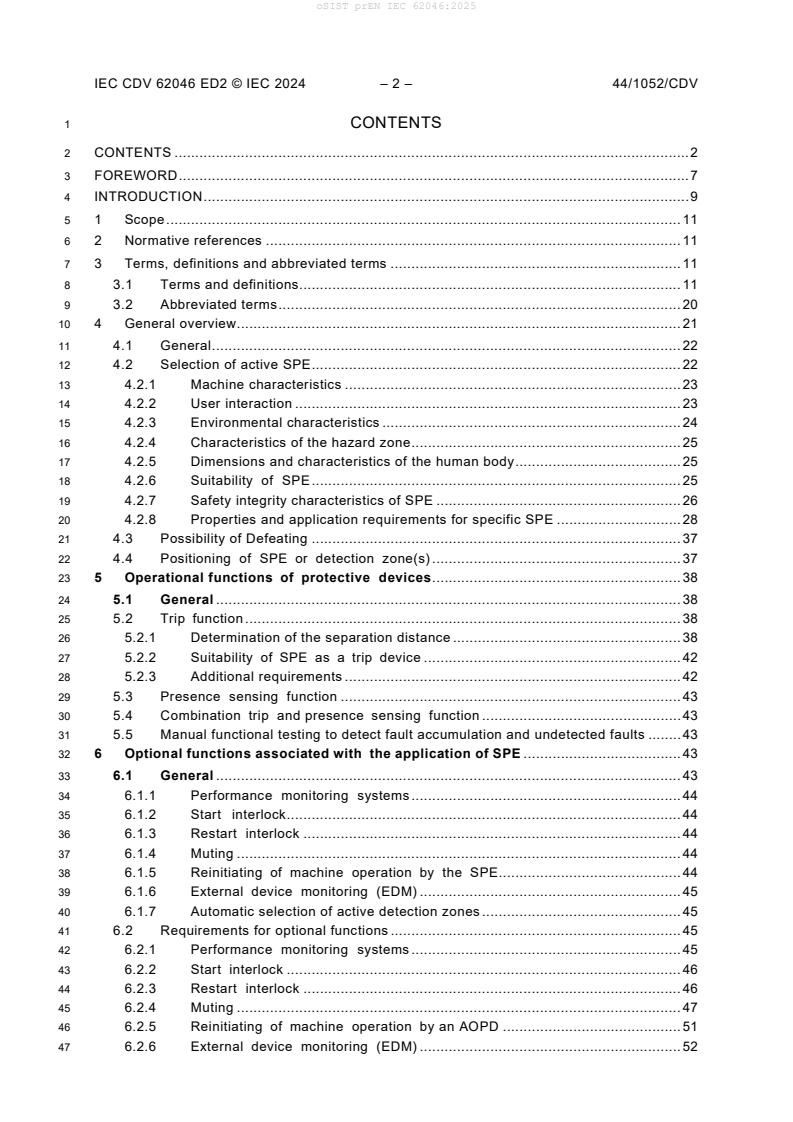
1 CONTENTS
2 CONTENTS . 2
3 FOREWORD . 7
4 INTRODUCTION . 9
5 1 Scope . 11
6 2 Normative references . 11
7 3 Terms, definitions and abbreviated terms . 11
8 3.1 Terms and definitions. 11
9 3.2 Abbreviated terms . 20
10 4 General overview. 21
11 4.1 General . 22
12 4.2 Selection of active SPE . 22
13 4.2.1 Machine characteristics . 23
14 4.2.2 User interaction . 23
15 4.2.3 Environmental characteristics . 24
16 4.2.4 Characteristics of the hazard zone . 25
17 4.2.5 Dimensions and characteristics of the human body . 25
18 4.2.6 Suitability of SPE . 25
19 4.2.7 Safety integrity characteristics of SPE . 26
20 4.2.8 Properties and application requirements for specific SPE . 28
21 4.3 Possibility of Defeating . 37
22 4.4 Positioning of SPE or detection zone(s) . 37
23 5 Operational functions of protective devices . 38
24 5.1 General . 38
25 5.2 Trip function . 38
26 5.2.1 Determination of the separation distance . 38
27 5.2.2 Suitability of SPE as a trip device . 42
28 5.2.3 Additional requirements . 42
29 5.3 Presence sensing function . 43
30 5.4 Combination trip and presence sensing function . 43
31 5.5 Manual functional testing to detect fault accumulation and undetected faults . 43
32 6 Optional functions associated with the application of SPE . 43
33 6.1 General . 43
34 6.1.1 Performance monitoring systems . 44
35 6.1.2 Start interlock . 44
36 6.1.3 Restart interlock . 44
37 6.1.4 Muting . 44
38 6.1.5 Reinitiating of machine operation by the SPE . 44
39 6.1.6 External device monitoring (EDM) . 45
40 6.1.7 Automatic selection of active detection zones . 45
41 6.2 Requirements for optional functions . 45
42 6.2.1 Performance monitoring systems . 45
43 6.2.2 Start interlock . 46
44 6.2.3 Restart interlock . 46
45 6.2.4 Muting . 47
46 6.2.5 Reinitiating of machine operation by an AOPD . 51
47 6.2.6 External device monitoring (EDM) . 52
oSIST prEN IEC 62046:2025
IEC CDV 62046 ED2 © IEC 2024 – 3 – 44/1052/CDV
48 6.2.7 Automatic selection of active detection zones . 52
49 7 Integration with the safety-related control system . 53
50 8 Inspection and test . 53
51 8.1 General . 53
52 8.2 Functional checks . 54
53 8.3 Periodic inspection. 54
54 8.4 Initial inspection and test . 55
55 8.5 Application specific tests . 56
56 9 Information for use . 57
57 Annex A (informative) Application examples of ESPE . 58
58 A.1 General . 58
59 A.2 ESPE used as a trip device . 58
60 A.3 Use of ESPE to provide a combination trip and presence sensing function. 59
61 A.3.1 Example 1 : Horizontal AOPD with combined trip and presence sensing
62 function . 59
63 A.3.2 Example 2 : Angled AOPD with combined trip and presence sensing
64 function . 59
65 A.3.3 Example 3: horizontal AOPD . 60
66 A.3.4 Example 4: vertical AOPD . 61
67 A.3.5 Example 5: vertical AOPD . 62
68 A.4 Perimeter safeguarding to establish a safeguarded space . 63
69 Annex B (informative) Additional recommendations for the application of AOPDDRs . 65
70 B.1 General . 65
71 B.2 AOPDDR used for the detection of the body or parts of a body with
72 orthogonal approach . 67
73 B.2.1 General . 67
74 B.2.2 Detection of a whole body. 68
75 B.2.3 Detection of parts of the body . 68
76 B.3 Examples of the use of an AOPDDR as a whole body trip device . 69
77 B.4 Examples for the use of an AOPDDR as parts of a body trip device . 70
78 Annex C (informative) Vision based protective devices using stereo vision techniques
79 (VBPDST) additional information . 72
80 C.1 Application example of VBPDST . 72
81 C.2 Examples of detection zone and tolerance zone . 74
82 Annex D . 80
83 D.1 General . 80
84 D.2 Separation distance calculation. 80
85 D.3 Reaching distance . 82
86 D.4 Example of calculation of the separation distance . 86
87 Annex E (informative) Examples of AOPD muting for applications where whole body
88 access is possible . 89
89 E.1 General . 89
90 E.2 Four muting sensors . 92
91 E.2.1 Four parallel beam muting sensors – positioning . 92
92 E.2.2 Four parallel beam muting sensors – sequence control . 95
93 E.2.3 Four parallel beam muting sensors – timing control . 96
94 E.2.4 Four parallel beam muting sensors - connection to a two input muting
95 control . 97
96 E.3 Two muting sensors . 98
oSIST prEN IEC 62046:2025
IEC CDV 62046 ED2 © IEC 2024 – 4 – 44/1052/CDV
97 E.3.1 Two crossed beam muting sensors – positioning . 98
98 E.3.2 Two crossed beam muting sensors – timing control . 100
99 E.3.3 Two crossed beam muting sensors – height of the crossing point . 101
100 E.3.4 Two parallel beam muting sensors – exit only . 102
101 E.4 Optional control measures of muting control systems . 104
102 E.4.1 Muting timeout control . 104
103 E.4.2 Muting enable . 106
104 E.4.3 Combination of muting enable and muting timeout control . 108
105 E.4.4 Lateral gap protection . 109
106 E.5 Example of protection of a conveyor system . 113
107 Annex F . 115
108 F.1 Example of automatic selection of active detection zones . 115
109 F.2 Examples of automatic selection of active detection zones to allow the
110 passage of materials into or out of a hazard zone . 116
111 Annex G . 118
112 G.1 ESPEs . 118
113 G.1.1 Types of ESPEs . 118
114 G.1.2 AOPD . 118
115 G.1.3 AOPDDR . 119
116 G.1.4 VBPDs . 120
117 G.1.5 RPD . 121
118 G.2 Pressure-sensitive mats and floors . 122
119 Annex H (informative) Estimation of SIL or PL for muting systems in ESPE
120 applications . 124
121 H.1 General . 124
122 H.2 Preconditions and Assumptions for the MS-SB . 124
123 H.3 Diagnostics . 125
124 H.4 Safety Structure . 125
125 H.4.1 2-Sensors MS-SB . 126
126 H.4.2 4-Sensors MS-SB . 126
127 H.5 Calculation examples . 127
128 H.5.1 Example according to ISO 13849-1 . 127
129 H.5.2 Example according to IEC 62061 . 128
130 H.6 Common Cause Failures . 130
131 Bibliography . 133
133 Figure 1 – Relationship of this International Standard to other standards . 10
134 Figure 2 – Risk reduction process . 21
135 Figure 3 – Example of the effect of reflective surfaces . 29
136 Figure 4 – Detection capability of single light beam device . 30
137 Figure 5 – Detection capability of a multiple light beam device . 31
138 Figure 6 – Example of use of blanking . 33
139 Figure 7 – Example of reduced resolution . 34
140 Figure 8 Person walking through a 2-dimensional detection zone . 41
141 Figure 9 Person walking through a horizontal or3-dimensional detection zone . 41
142 Figure A.1 – ESPE used as a trip device . 58
143 Figure A.2 – AOPD used to provide combination trip and presence sensing function –
144 Example 1 . 59
oSIST prEN IEC 62046:2025
IEC CDV 62046 ED2 © IEC 2024 – 5 – 44/1052/CDV
145 Figure A.3 – AOPD used to provide a combination trip and presence sensing function –
146 Example 2 . 59
147 Figure A.4 – Horizontal AOPD . 60
148 Figure A.5 – Vertical AOPD . 61
149 Figure A.6 – Increased separation distance . 62
150 Figure A.7 – Additional guards . 63
151 Figure A.8 – Use of a trip device . 63
152 Figure B.1 – Detection zone of an AOPDDR-2D . 66
153 Figure B.2 – Detection zone of an AOPDDR-3D . 67
154 Figure B.5 – Use of an AOPDDR as a whole body trip device – Example 1 . 69
155 Figure B.6 – Use of an AOPDDR as a whole body trip device – Example 2 . 69
156 Figure B.7 – Use of an AOPDDR as parts of a body trip device – Example 1 . 70
157 Figure B.8 – Use of an AOPDDR as parts of a body trip device – Example 2 . 71
158 Figure C.1 – Application example of a VBPDST . 74
159 Figure C.2 – Separation distance S – Example 1 . 74
160 Figure C3 – Overall separation distance S without tolerance zone – Example 1. 75
o
161 Figure C4 – Overall separation distance S including tolerance zone – Example 1 . 76
o
162 Figure C.5 – Separation distance S – Example 2 . 77
163 Figure C.6 – Overall separation distance S without tolerance zone – Example 2 . 78
o
164 Figure C.7 – Overall separation distance S including tolerance zone – Example 2 . 79
o
165 Figure D.1 - Parallel approach with H ≥ 1400 mm . 82
DT
166 Figure D.2 - Parallel approach with H ≤ 1000 mm . 83
DT
167 Figure D.3 - Reaching distance DDS for 1400 mm ≤ HDT ≤ 1000 mm . 84
168 Figure D.4 - Example of orthogonal approach - top view . 84
169 Figure D.5 - Example of orthogonal approach - front view . 85
170 Figure D.6 - Example of definition of H in case of parallel and orthogonal approaches . 86
DT
171 Figure D.8 - Example of separation distance in case of orthogonal approach . 88
172 Figure E.1 – T configuration with four parallel beam muting sensors, timing or
173 sequence control . 89
174 Figure E.2 – X configuration with two crossed beam muting sensors and timing control . 90
175 Figure E.3 – L configuration with two parallel beam muting sensors, timing or
176 sequence control . 90
177 Figure E.4 – Gap size beside the transported material, e. g. a pallet . 91
178 Figure E.5 – Four parallel beam muting sensors . 92
179 Figure E.6 – Minimum distances between MS1 and MS2 muting sensor beams . 93
180 Figure E.7 – Positioning of the muting sensors mounting height . 93
181 Figure E.8 – Avoidance of manipulation of muting by proximity sensors . 94
182 Figure E.9 – Crossed beam muting sensors not crossing the AOPD are not suitable. 94
183 Figure E.10 – Signal sequence: four parallel muting sensor beams with sequence
184 control . 95
185 FigureE.11 – Signal sequence: four parallel muting sensor beams with timing control . 96
186 Figure E.12 – Connection of four muting sensors to a control with two inputs . 97
187 Figure E.13 – Positioning of two crossed beam muting sensors . 98
oSIST prEN IEC 62046:2025
IEC CDV 62046 ED2 © IEC 2024 – 6 – 44/1052/CDV
188 Figure E.14 – Two crossed beam muting sensors with risk of entering the hazard zone . 99
189 Figure E.15 – Signal sequence and timing of two crossed beam muting sensors . 100
190 Figure E.16 – Height of crossing point . 101
191 Figure E.17 – Two parallel beam muting sensors – exit only . 102
192 Figure E.18 – Signal diagram; two parallel beam muting sensors – exit only, timing
193 control and muting terminated by the AOPD. 103
194 Figure E.19 – Signal diagram; two parallel beam muting sensors – exit only, sequence
195 control and muting terminated by timer . 103
196 Figure E.20 – Signal diagram; uncontrolled muting timeout with two beam muting . 104
197 Figure E.21 – Signal diagram; muting timeout controlled by conveyor signal . 105
198 Figure E.22 – Signal sequence example with static muting enable signal . 106
199 Figure E.23 – Signal sequence of a dynamic muting enable signal. 107
200 Figure E.24 – Signal sequence of a combined muting enable / timeout control signal . 108
201 Figure E.25 – Lateral gap protection with additional swing doors – top view. 109
202 Figure E.26 – lateral gap protection with additional swing doors – front view . 110
203 Figure E.27 – swing doors in combination with muting . 111
204 Figure E.29 – Production line incorporating two conveyors (2 hazard zone) (incorrect
205 application) . 113
206 Figure E.30 – Production line incorporating two conveyors (2 hazard zone) . 114
207 Figure F.1 – Example of automatic selection of active detection zones . 115
208 Figure F.2 — Example of automatic detection zone selection with an AOPD (light
209 curtain) . 116
210 Figure F.3 — Example of automatic detection zone selection with vertically mounted
211 AOPDDR . 117
212 Figure G.1 – Detection principle of through-beam AOPD. 118
213 Figure G.2 – Through-beam AOPD using mirrors . 119
214 Figure G.3 – Retro-reflective AOPD . 119
215 Figure G.4 – Detection principle of AOPDDR . 120
216 Figure G.5 – Detection principle of VBPDST . 121
217 Figure G.6 – Detection principle of RPD . 122
218 Figure H .1 – General safety block diagram for a muting system . 124
219 Figure H.2 Safety-related block diagram of a 2-sensors MS-SB . 126
220 Figure H.3 Safety-related block diagram of a 4-sensors MS-SB and its pre-
221 transformation. 127
223 Table 1 – ESPE Types and achievable PL or SIL . 27
224 TableE.1 – Truth table, four parallel beam muting sensors with sequence control . 95
225 Table H.1 – Safety performance of muting sensor subsystems according to ISO 13849-
226 1 128
227 Table H.2 – Safety performance of muting sensor subsystems according to IEC 62061 . 130
oSIST prEN IEC 62046:2025
IEC CDV 62046 ED2 © IEC 2024 – 7 – 44/1052/CDV
229 INTERNATIONAL ELECTROTECHNICAL COMMISSION
230 ____________
232 SAFETY OF MACHINERY – APPLICATION OF PROTECTIVE
233 EQUIPMENT TO DETECT THE PRESENCE OF PERSONS
235 FOREWORD
236 1) The International Electrotechnical Commission (IEC) is a worldwide organization for standardization comprising
237 all national electrotechnical committees (IEC National Committees). The object of IEC is to promote international
238 co-operation on all questions concerning standardization in the electrical and electronic fields. To this end and
239 in addition to other activities, IEC publishes International Standards, Technical Specifications, Technical Reports,
240 Publicly Available Specifications (PAS) and Guides (hereafter referred to as “IEC Publication(s)”). Their
241 preparation is entrusted to technical committees; any IEC National Committee interested in the subject dealt with
242 may participate in this preparatory work. International, governmental and non-governmental organizations liaising
243 with the IEC also participate in this preparation. IEC collaborates closely with the International Organization for
244 Standardization (ISO) in accordance with conditions determined by agreement between the two organizations.
245 2) The formal decisions or agreements of IEC on technical matters express, as nearly as possible, an international
246 consensus of opinion on the relevant subjects since each technical committee has representation from all
247 interested IEC National Committees.
248 3) IEC Publications have the form of recommendations for international use and are accepted by IEC National
249 Committees in that sense. While all reasonable efforts are made to ensure that the technical content of IEC
250 Publications is accurate, IEC cannot be held responsible for the way in which they are used or for any
251 misinterpretation by any end user.
252 4) In order to promote international uniformity, IEC National Committees undertake to apply IEC Publications
253 transparently to the maximum extent possible in their national and regional publications. Any divergence between
254 any IEC Publication and the corresponding national or regional publication shall be clearly indicated in the latter.
255 5) IEC itself does not provide any attestation of conformity. Independent certification bodies provide conformity
256 assessment services and, in some areas, access to IEC marks of conformity. IEC is not responsible for any
257 services carried out by independent certification bodies.
258 6) All users should ensure that they have the latest edition of this publication.
259 7) No liability shall attach to IEC or its directors, employees, servants or agents including individual experts and
260 members of its technical committees and IEC National Committees for any personal injury, property damage or
261 other damage of any nature whatsoever, whether direct or indirect, or for costs (including legal fees) and
262 expenses arising out of the publication, use of, or reliance upon, this IEC Publication or any other IEC
263 Publications.
264 8) Attention is drawn to the Normative references cited in this publication. Use of the referenced publications is
265 indispensable for the correct application of this publication.
266 9) Attention is drawn to the possibility that some of the elements of this IEC Publication may be the subject of patent
267 rights. IEC shall not be held responsible for identifying any or all such patent rights.
268 International Standard IEC 62046 has been prepared by IEC technical committee 44: Safety of
269 machinery – Electrotechnical aspects.
270 This bilingual version (2018-11) corresponds to the monolingual English version, published in
271 2018-03.
272 This second edition cancels and replaces IEC 62046, published in 2018. This edition
273 constitutes a technical revision.
274 This edition includes the following significant technical changes with respect to IEC 62046:2018:
275 a) restructuring of the document to aid the user,
276 b) additional information on vision and radar systems,
277 c) muting requirements have been updated,
278 d) information on whole body access has been added.
279 e) Whole body access has also been covered in more detail,
280 f) alignment to changes in ISO 13855.
oSIST prEN IEC 62046:2025
IEC CDV 62046 ED2 © IEC 2024 – 8 – 44/1052/CDV
281 The text of this International Standard is based on the following documents:
FDIS Report on voting
44/803/FDIS 44/812/RVD
283 Full information on the voting for the approval of this International Standard can be found in the
284 report on voting indicated in the above table.
285 The French version of this document has not been voted upon.
286 This document has been drafted in accordance with the ISO/IEC Directives, Part 2.
287 The committee has decided that the contents of this document will remain unchanged until the
288 stability date indicated on the IEC website under "http://webstore.iec.ch" in the data related to
289 the specific document. At this date, the document will be
290 • reconfirmed,
291 • withdrawn,
292 • replaced by a revised edition, or
293 • amended.
IMPORTANT – The 'colour inside' logo on the cover page of this publication indicates
that it contains colours which are considered to be useful for the correct understanding
of its contents. Users should therefore print this document using a colour printer.
oSIST prEN IEC 62046:2025
IEC CDV 62046 ED2 © IEC 2024 – 9 – 44/1052/CDV
297 INTRODUCTION
298 This International Standard provides requirements and information on the application of
299 sensitive protective equipment, which employs sensing devices to detect persons, in order to
300 reduce or minimize a risk from hazardous parts of machinery, without providing a physical
301 barrier.
302 The objective of this document is to assist standards writing committees responsible for
303 developing machine standards (type-C Standards), machine designers, manufacturers and
304 refurbishers, machine safety certification organizations, workplace authorities and others on
305 the proper application of sensitive protective equipment to machinery.
306 Figure 1 shows the general context and the intended use of this standard.
307 Clauses 1 to 5, 7 and 8 of this document apply to all sensitive protective equipment included in
308 the scope, Clause 6 contains guidance for the application of specific kinds of sensitive
309 protective equipment.
310 The principles of this document can be useful in the application of devices using other detection
311 technologies but this document does not give specific requirements for those devices.
312 This document considers devices standardised in the IEC 61496 series and the ISO 13856
313 series. Unless a product-specific safety-related standard for devices using other sensing
314 technologies is published, their suitability as the sole means of protection from machine hazards
315 is unknown. Great care should be taken in the selection and use of devices for which there is
316 no product-specific safety-related standard because their behaviour, particularly under fault
317 conditions, is not known to be sufficiently predictable.
318 A SIL (Safety Integrity Level see IEC 62061 or IEC 61508) or PL (Performance Level, see
319 ISO 13849-1) is not sufficient as an indication of a device's suitability for use as a safeguard.
320 Suitability depends on appropriate sensing means, environmental conditions especially those
321 that can affect the detection capability, behaviour under fault conditions, etc.
oSIST prEN IEC 62046:2025
IEC CDV 62046 ED2 © IEC 2024 – 10 – 44/1052/CDV
I
323 Figure 1 – Relationship of this International Standard
324 to other standards
oSIST prEN IEC 62046:2025
IEC CDV 62046 ED2 © IEC 2024 – 11 – 44/1052/CDV
326 SAFETY OF MACHINERY – APPLICATION OF PROTECTIVE
327 EQUIPMENT TO DETECT THE PRESENCE OF PERSONS
331 1 Scope
332 This International Standard specifies requirements for the selection, positioning, configuration
333 and commissioning of sensitive protective equipment to detect the momentary or continued
334 presence of persons in order to protect those persons from dangerous part(s) of machinery in
335 industrial applications. This standard covers the application of electro-sensitive protective
336 equipment (ESPE) specified in IEC 61496 (all parts) and pressure-sensitive mats and floors
337 specified in ISO 13856-1.
338 It takes into account the characteristics of the machinery, the sensitive protective equipment,
339 the environment and human interaction by persons of 14 years and older.
340 This document includes informative annexes to provide guidance on the application of sensitive
341 protective equipment to detect the presence of persons. These annexes contain examples to
342 illustrate the principles of this standard. These examples are not intended to be the only
343 solutions to a given application and are not intended to restrict innovation or advancement of
344 technology. The examples are provided only as representative solutions to illustrate some of
345 the concepts of integration of sensitive protective equipment, and have been simplified for
346 clarity, so they may be incomplete.
347 It is intended that this document is used in conjunction with ISO 13855.
348 2 Normative references
349 The following documents are referred to in the text in such a way that some or all of their content
350 constitutes requirements of this document. For dated references, only the edition cited applies.
351 For undated references, the latest edition of the referenced document (including any
352 amendments) applies.
353 IEC 62061:2021, Safety of machinery – Functional safety of safety-related electrical, electronic
354 and programmable electronic control systems
355 ISO 12100:2010, Safety of machinery – General principles for design – Risk assessment and
356 risk reduction
357 ISO 13849-1:2023, Safety of machinery – Safety-related parts of control systems
358 ISO 13855:2024, Safety of machinery – Positioning of safeguards with respect to the approach
359 of the human body
360 3 Terms, definitions and abbreviated terms
361 3.1 Terms and definitions
362 For the purposes of this document, the following terms and definitions apply.
363 ISO and IEC maintain terminological databases for use in standardization at the following
364 addresses:
365 • IEC Electropedia: available at http://www.electropedia.org/
oSIST prEN IEC 62046:2025
IEC CDV 62046 ED2 © IEC 2024 – 12 – 44/1052/CDV
366 • ISO Online browsing platform: available at http://www.iso.org/obp
367 3.1.1
368 active opto-electronic protective device
369 AOPD
370 device whose sensing function is performed by opto-electronic emitting and receiving elements
371 detecting the interruption of optical radiations generated, within the device, by an opaque object
372 present in the specified detection zone (or for a light beam device, on the axis of the light beam)
373 [SOURCE: IEC 61496-2:2020, 3.201]
374 3.1.2
375 active opto-electronic protective device responsive to diffuse reflection
376 AOPDDR
377 device, whose sensing function is performed by opto-electronic emitting and receiving
378 elements, that detects the diffuse reflection of optical radiations generated within the device by
379 an object present in a detection zone specified in two dimensions
380 [SOURCE: IEC 61496-3:2018, 3.301]
381 3.1.3
382 automatic selection of active detection zones
383 optional function that permits the selection/deselection of the active safety-related detection
384 zone of sensitive protective equipment while still providing protection during the hazardous
385 machine cycle
386 Note 1 to entry: Examples include selection of pre-defined blanking or reduced resolution configurations; see IEC
387 61496-2:2020, A.12.
388 Note 2 to entry: The safety-related logic for the automatic selection of active detection zones may be within the
389 sensitive protective equipment or may be applied externally from within the safety-related parts of the control system.
390 Note 3 to entry: The automatic selection of safety-related detection zones is not a muting function; see IEC 61496-
391 3:2018, A.10.1, Note 2.
392 3.1.4
393 blanking
394 optional function that permits an object of a size greater than the detection capability of the
395 ESPE to be located within the detection zone without causing an OFF-state of the OSSD(s)
396 Note 1 to entry: Blanked beams are monitored for continued interruption of light.
397 [SOURCE: IEC 61496-1:2020, 3.1, modified – Note 1 to entry has been modified, Note 2 to
398 entry has been removed]
399 3.1.5
400 detection capability
401 sensing function parameter limit specified by the supplier that will cause actuation of the
402 sensitive protective equipment
403 [SOURCE: IEC 61496-1:2020, 3.3, modified – "electro- " has been removed before "protective
404 equipment"]
405 3.1.6
406 detection zone
407 zone within which a specified test piece will be detected by the sensitive protective equipment
408 Note 1 to entry: The detection zone can also be a point, line, plane or volume.
409 Note 2 to entry: ISO 13856-1 uses the term “effective sensing area” when describing pressure-sensitive mats and
410 floors. In this document the terms “detection zone” and “effective sensing area” are used synonymously.
oSIST prEN IEC 62046:2025
IEC CDV 62046 ED2 © IEC 2024 – 13 – 44/1052/CDV
411 [SOURCE: 13855:2024, 3.1.7 , modified – “or volume” added to note 1 to entry]
412 3.1.7
413 effective detection capability
414 d
e
415 sensing function parameter limit set by the integrator of the device that will cause its actuation
416 [SOURCE: ISO 13855:2024, 3.1.4]
418 Note to entry: Some protective equipment provide a provision for the detection capability to be modified for the
419 application.
420 3.1.8
421 electro-sensitive protective equipment
422 ESPE
423 assembly of devices and/or components working together for protective tripping or presence-
424 sensing purposes and comprising as a minimum
425 – a sensing device;
426 – controlling/monitoring devices;
427 – output signal switching devices and/or a safety-related data interface
428 [SOURCE: IEC 61496-1:2020, 3.5, modified – (Notes 1 and 2 to entry have been removed]
429 3.1.9
430 external device monitoring
431 EDM
432 means by which the electro-sensitive protective equipment (ESPE) monitors the state of control
433 devices which are external to the ESPE
434 [SOURCE: IEC 61496-1:2020, 3.6]
435 3.1.10
436 failure,
437 termination of the ability of an item to perform a required function
438 Note 1 to entry: After failure the item has a fault.
439 Note 2 to entry: "Failure" is an event, as distinguished from "fault", which is a state.
440 Note 3 to entry: This concept as defined does not apply to items consisting of software on
...