


prEN IEC 63116:2025
(Main)Lighting systems - General requirements
Lighting systems - General requirements
Sistemi razsvetljave - Splošne zahteve
General Information
- Status
- Not Published
- Publication Date
- 18-Jul-2027
- Technical Committee
- CLC/TC 34 - 'Lamps and related equipment
- Current Stage
- 4060 - Enquiry results established and sent to TC, SR, BTTF - Enquiry
- Start Date
- 20-Mar-2026
- Completion Date
- 20-Mar-2026
Overview
prEN IEC 63116:2025 - Lighting systems - General requirements is a European draft standard developed by the International Electrotechnical Commission (IEC) and the European Committee for Electrotechnical Standardization (CLC). It establishes the general requirements for the design, installation, and maintenance of both indoor and outdoor electric lighting systems. As the lighting sector advances toward integrated and intelligent solutions, this standard addresses fundamental aspects necessary to ensure safe, functional, and interoperable lighting systems suitable for various applications.
Adhering to prEN IEC 63116:2025 enables manufacturers, designers, installers, and facility managers to ensure compliance with up-to-date best practices and regulatory requirements in lighting technology. The standard is applicable to a wide array of lighting installations, except those used for stage and studio environments.
Key Topics
prEN IEC 63116:2025 covers essential aspects that underpin reliable lighting system performance and safety:
- System Definition: Clarifies what constitutes a lighting system, including luminaires, controls, interfaces, software, user interfaces, and networking elements.
- Product Compliance: Emphasizes that components used in lighting systems must comply with relevant product standards for safety, performance, and compatibility.
- Classifications of Lighting Systems:
- Standalone luminaires
- Autonomous lighting systems
- Centrally controllable lighting systems
- Safety:
- Electrical safety: Protection against electrical hazards during operation and maintenance.
- Functional safety: Ensures correct system response to normal and abnormal inputs.
- Information and Cyber Security: Requirements for protecting lighting systems from unauthorized access, tampering, or data breaches.
- Installation and Maintenance: Guidance on proper setup, use, and ongoing care to maintain lighting system integrity.
- Performance and Functionality: Covers adaptive characteristics such as sensor integration, adjustable light output, and spectrum, as well as communication protocols.
- Instructions for Use: Ensures users are informed about safe operation, system interfaces, and maintenance needs.
Applications
prEN IEC 63116:2025 is designed to add value across a broad spectrum of lighting system applications:
- Commercial Buildings: Ensures reliable, energy-efficient, and safe lighting for offices, retail spaces, and public buildings.
- Industrial Facilities: Facilitates robust lighting systems for manufacturing, warehousing, and logistics centers, supporting occupational safety and process efficiency.
- Public Infrastructure: Applicable to street lighting, transportation hubs, and outdoor public spaces, enhancing security and visibility.
- Smart Lighting and IoT: Addresses integration with intelligent control systems, supporting automation, adaptive lighting, and remote management.
- Educational and Healthcare Environments: Promotes lighting quality and compliance in schools, universities, hospitals, and laboratories.
Following the standard supports interoperability, lowers maintenance costs, and mitigates operational risks. It also aids in meeting sustainability goals by addressing efficient system design and operation.
Related Standards
For comprehensive lighting system compliance and enhanced functionality, prEN IEC 63116:2025 references and aligns with several other key standards:
- IEC 62504: General lighting – LED products and related equipment – Terms and definitions
- IEC TS 63105: Lighting systems and related equipment – Vocabulary
- IEC TS 63117: General requirements for lighting systems – Safety
These referenced documents ensure consistent terminology, safety benchmarks, and performance criteria across all lighting system projects.
Keywords: lighting systems standard, IEC 63116, CLC lighting requirements, lighting installation safety, general requirements for lighting, indoor outdoor lighting standards, lighting system security, lighting system maintenance, smart lighting compliance

Get Certified
Connect with accredited certification bodies for this standard

Intertek Testing Services NA Inc.
Intertek certification services in North America.

UL Solutions
Global safety science company with testing, inspection and certification.

ANCE
Mexican certification and testing association.
Sponsored listings
Frequently Asked Questions
prEN IEC 63116:2025 is a draft published by CLC. Its full title is "Lighting systems - General requirements". This standard covers: Lighting systems - General requirements
Lighting systems - General requirements
prEN IEC 63116:2025 is classified under the following ICS (International Classification for Standards) categories: 29.140.01 - Lamps in general; 29.140.50 - Lighting installation systems. The ICS classification helps identify the subject area and facilitates finding related standards.
prEN IEC 63116:2025 is available in PDF format for immediate download after purchase. The document can be added to your cart and obtained through the secure checkout process. Digital delivery ensures instant access to the complete standard document.
Standards Content (Sample)
SLOVENSKI STANDARD
01-marec-2026
Sistemi razsvetljave - Splošne zahteve
Lighting systems - General requirements
Ta slovenski standard je istoveten z: prEN IEC 63116:2025
ICS:
29.140.50 Instalacijski sistemi za Lighting installation systems
razsvetljavo
2003-01.Slovenski inštitut za standardizacijo. Razmnoževanje celote ali delov tega standarda ni dovoljeno.
34/1408/CDV
COMMITTEE DRAFT FOR VOTE (CDV)
PROJECT NUMBER:
IEC 63116 ED1
DATE OF CIRCULATION: CLOSING DATE FOR VOTING:
2025-12-26 2026-03-20
SUPERSEDES DOCUMENTS:
34/1292/CD, 34/1332A/CC
IEC TC 34 : LIGHTING
SECRETARIAT: SECRETARY:
United Kingdom Mr Petar Luzajic
OF INTEREST TO THE FOLLOWING COMMITTEES: HORIZONTAL FUNCTION(S):
TC 23
ASPECTS CONCERNED:
SUBMITTED FOR CENELEC PARALLEL VOTING NOT SUBMITTED FOR CENELEC PARALLEL VOTING
Attention IEC-CENELEC parallel voting
The attention of IEC National Committees, members of
CENELEC, is drawn to the fact that this Committee Draft
for Vote (CDV) is submitted for parallel voting.
The CENELEC members are invited to vote through the
CENELEC online voting system.
This document is still under study and subject to change. It should not be used for reference purposes.
Recipients of this document are invited to submit, with their comments, notification of any relevant patent rights of
which they are aware and to provide supporting documentation.
Recipients of this document are invited to submit, with their comments, notification of any relevant “In Some
Countries” clauses to be included should this proposal proceed. Recipients are reminded that the CDV stage is the
final stage for submitting ISC clauses. (SEE AC/22/2007 OR NEW GUIDANCE DOC).
TITLE:
Lighting systems - General requirements
PROPOSED STABILITY DATE: 2029
NOTE FROM TC/SC OFFICERS:
download this electronic file, to make a copy and to print out the content for the sole purpose of preparing National
Committee positions. You may not copy or "mirror" the file or printed version of the document, o r any part of it,
for any other purpose without permission in writing from IEC.
IEC CDV 63116 © IEC 2025
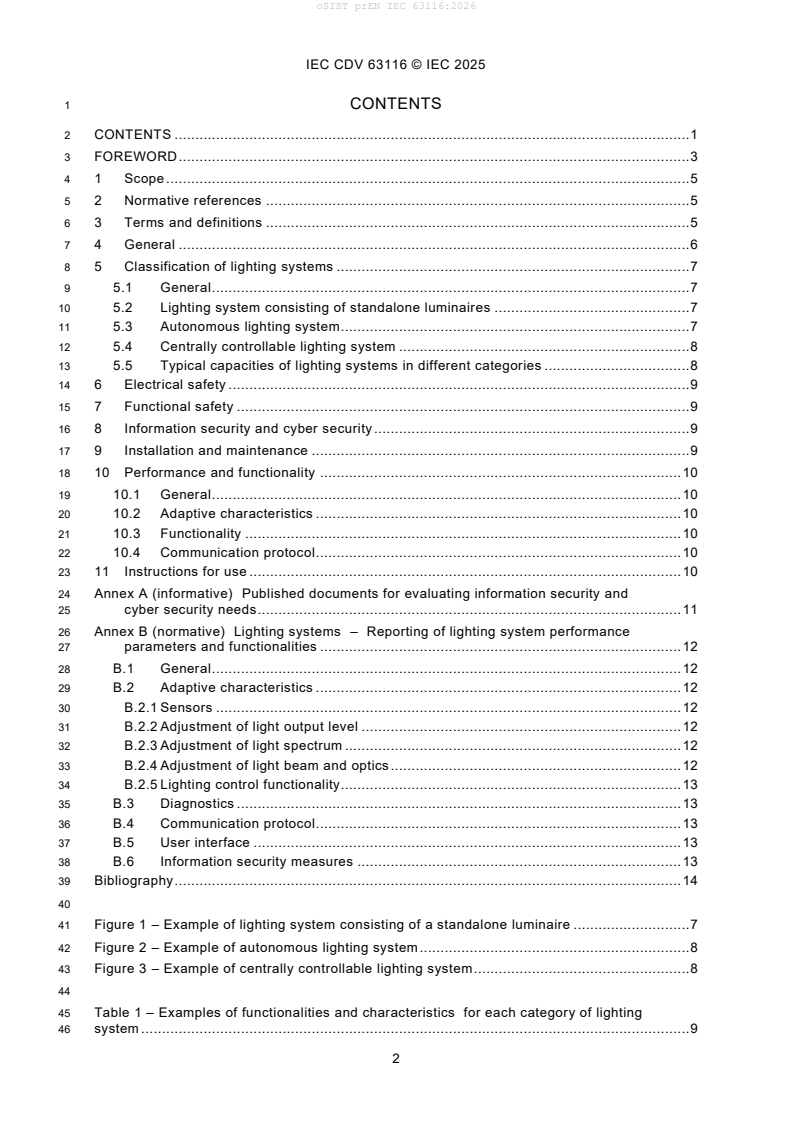
1 CONTENTS
2 CONTENTS . 1
3 FOREWORD . 3
4 1 Scope . 5
5 2 Normative references . 5
6 3 Terms and definitions . 5
7 4 General . 6
8 5 Classification of lighting systems . 7
9 5.1 General . 7
10 5.2 Lighting system consisting of standalone luminaires . 7
11 5.3 Autonomous lighting system. 7
12 5.4 Centrally controllable lighting system . 8
13 5.5 Typical capacities of lighting systems in different categories . 8
14 6 Electrical safety . 9
15 7 Functional safety . 9
16 8 Information security and cyber security . 9
17 9 Installation and maintenance . 9
18 10 Performance and functionality . 10
19 10.1 General . 10
20 10.2 Adaptive characteristics . 10
21 10.3 Functionality . 10
22 10.4 Communication protocol. 10
23 11 Instructions for use . 10
24 Annex A (informative) Published documents for evaluating information security and
25 cyber security needs . 11
26 Annex B (normative) Lighting systems – Reporting of lighting system performance
27 parameters and functionalities . 12
28 B.1 General . 12
29 B.2 Adaptive characteristics . 12
30 B.2.1 Sensors . 12
31 B.2.2 Adjustment of light output level . 12
32 B.2.3 Adjustment of light spectrum . 12
33 B.2.4 Adjustment of light beam and optics . 12
34 B.2.5 Lighting control functionality. 13
35 B.3 Diagnostics . 13
36 B.4 Communication protocol. 13
37 B.5 User interface . 13
38 B.6 Information security measures . 13
39 Bibliography . 14
41 Figure 1 – Example of lighting system consisting of a standalone luminaire . 7
42 Figure 2 – Example of autonomous lighting system . 8
43 Figure 3 – Example of centrally controllable lighting system . 8
45 Table 1 – Examples of functionalities and characteristics for each category of lighting
46 system . 9
IEC CDV 63116 © IEC 2025
47 INTERNATIONAL ELECTROTECHNICAL COMMISSION
48 ____________
50 LIGHTING SYSTEMS – GENERAL REQUIREMENTS
52 FOREWORD
53 1) The International Electrotechnical Commission (IEC) is a worldwide organization for standardization comprising
54 all national electrotechnical committees (IEC National Committees). The object of IEC is to promote international
55 co-operation on all questions concerning standardization in the electrical and electronic fields. To this end and
56 in addition to other activities, IEC publishes International Standards, Technical Specifications, Technical Reports,
57 Publicly Available Specifications (PAS) and Guides (hereafter referred to as “IEC Publication(s)”). Their
58 preparation is entrusted to technical committees; any IEC National Committee interested in the subject dealt with
59 may participate in this preparatory work. International, governmental and non-governmental organizations liaising
60 with the IEC also participate in this preparation. IEC collaborates closely with the International Organization for
61 Standardization (ISO) in accordance with conditions determined by agreement between the two organizations.
62 2) The formal decisions or agreements of IEC on technical matters express, as nearly as possible, an international
63 consensus of opinion on the relevant subjects since each technical committee has representation from all
64 interested IEC National Committees.
65 3) IEC Publications have the form of recommendations for international use and are accepted by IEC National
66 Committees in that sense. While all reasonable efforts are made to ensure that the technical content of IEC
67 Publications is accurate, IEC cannot be held responsible for the way in which they are used or for any
68 misinterpretation by any end user.
69 4) In order to promote international uniformity, IEC National Committees undertake to apply IEC Publications
70 transparently to the maximum extent possible in their national and regional publications. Any divergence between
71 any IEC Publication and the corresponding national or regional publication shall be clearly indicated in the latter.
72 5) IEC itself does not provide any attestation of conformity. Independent certification bodies provide conformity
73 assessment services and, in some areas, access to IEC marks of conformity. IEC is not responsible for any
74 services carried out by independent certification bodies.
75 6) All users should ensure that they have the latest edition of this publication.
76 7) No liability shall attach to IEC or its directors, employees, servants or agents including individual experts and
77 members of its technical committees and IEC National Committees for any personal injury, property damage or
78 other damage of any nature whatsoever, whether direct or indirect, or for costs (including legal fees) and
79 expenses arising out of the publication, use of, or reliance upon, this IEC Publication or any other IEC
80 Publications.
81 8) Attention is drawn to the Normative references cited in this publication. Use of the referenced publications is
82 indispensable for the correct application of this publication.
83 9) Attention is drawn to the possibility that some of the elements of this IEC Publication may be the subject of patent
84 rights. IEC shall not be held responsible for identifying any or all such patent rights.
85 IEC 63116 ED1 has been prepared by IEC technical committee 34: Lighting. It is based on IEC
86 TS 63116 ED1.1 with following major changes:
87 – Clarifying applicability of this document for outdoor and indoor lighting systems in scope;
88 – Reordering of clauses, placing clause 11 “Classification of lighting systems” at #5 and
89 shifting all other clauses 5 to 10 one position to clauses 6 to 11;
90 – Renaming clause 8 “Information security” into ”Information security and cyber security”
91 and amending its contents;
92 – Adding informative Annex A “Published documents for evaluating information security
93 and cyber security needs”; add the listed publications to the Bibliography
94 – Shifting the original Annex A to become Annex B.
95 The text of this International Standard is based on the following documents:
Draft Report on voting
34/xxx/FDIS 34/xxx/RVD
97 Full information on the voting for its approval can be found in the report on voting indicated in
98 the above table.
IEC CDV 63116 © IEC 2025
99 The language used for the development of this International Standard is English.
100 This document was drafted in accordance with ISO/IEC Directives, Part 2, and developed in
101 accordance with ISO/IEC Directives, Part 1 and ISO/IEC Directives, IEC Supplement, available
102 at www.iec.ch/members_experts/refdocs. The main document types developed by IEC are
103 described in greater detail at www.iec.ch/standardsdev/publications.
104 The committee has decided that the contents of this document and its amendment will remain
105 unchanged until the stability date indicated on the IEC website under webstore.iec.ch in the
106 data related to the specific document. At this date, the document will be
107 • reconfirmed,
108 • withdrawn,
109 • replaced by a revised edition, or
110 • amended.
IMPORTANT – The 'colour inside' logo on the cover page of this publication indicates
that it contains colours which are considered to be useful for the correct understanding
of its contents. Users should therefore print this document using a colour printer.
IEC CDV 63116 © IEC 2025
114 LIGHTING SYSTEMS – GENERAL REQUIREMENTS
118 1 Scope
119 This document specifies general requirements for design, installation and maintenance of a
120 lighting system providing electric lighting.
121 Note: Electric lighting is defined in IEC 60050-845, entry 845-29-025.
122 A lighting system comprises a set of products. Requirements of the products are specified in
123 product standards. For the general requirements of lighting systems, this document prevails.
124 Construction of lighting systems can vary in applications. This document is not intended to
125 provide detailed technical specifications for the construction of lighting systems but to specify
126 requirements in general that are necessary for lighting systems.
127 This document is applicable to outdoor and indoor lighting systems.
128 This document does not address stage and studio lighting systems.
129 2 Normative references
130 The following documents are referred to in the text in such a way that some or all of their content
131 constitutes requirements of this document. For dated references, only the edition cited applies.
132 For undated references, the latest edition of the referenced document (including any
133 amendments) applies.
134 IEC 62504, General lighting – Light emitting diode (LED) products and related equipment –
135 Terms and definitions
136 IEC TS 63105, Lighting systems and related equipment – Vocabulary
137 IEC TS 63117, General requirements for lighting systems – Safety
138 3 Terms and definitions
139 For the purposes of this document, the terms and definitions given in IEC TS 63105 and
140 IEC 62504 and the following apply.
141 ISO and IEC maintain terminological databases for use in standardization at the following
142 addresses:
143 • IEC Electropedia: available at http://www.electropedia.org/
144 • ISO Online browsing platform: available at http://www.iso.org/obp
145 3.1
146 lighting system
147 system designed to provide lighting
148 Note 1 to entry: The lighting system can be dedicated to
149 a) the support of one or more specified visual tasks under specified conditions considering other requirements such
150 as human comfort, safety, the appearance of the surrounding environment and energy consumption;
151 b) the support of other than human tasks.
152 Note 2 to entry: The lighting system can include a set of light sources, other physical components, communication
153 protocols, user interfaces, software and networks to provide control and monitoring functions.
154 Note 3 to entry: The light source(s) and the related equipment can be integrated in a single item, e. g. an LED
155 module, a lamp or a luminaire.
156 Note 4 to entry: A lighting system can be networked to provide central or remote control and monitoring functions.
157 Note 5 to entry: A lighting system can be connected to or integrated with other systems or devices.
IEC CDV 63116 © IEC 2025
158 [SOURCE: IEC 60050-845:2020, 845-27-010]
159 3.2
160 functional safety
161 part of the overall safety that depends on functional and physical units operating correctly in
162 response to their inputs
163 [SOURCE: IEC 60050-351:2013, 351-57-06, modified – The Note 1 to entry has been deleted.]
164 3.3
165 information security
166 protection of information against unauthorized disclosure, transfer, modification, or destruction,
167 whether accidental or intentional
168 Note 1 to entry: The term covers cyber-security.
169 [SOURCE: IEC 60050-721:1991, 721-08-57, modified – The Note 1 to entry has been added.]
170 3.4
171 communication protocol
172 set of rules for data transmission in a system interlinking several system components
173 Note 1 to entry: A communication protocol can define the conditions for establishing a connection to a transmission
174 medium, the rules gove
...
Questions, Comments and Discussion
Ask us and Technical Secretary will try to provide an answer. You can facilitate discussion about the standard in here.
Loading comments...