

EN IEC 61591:2023/A1:2026
(Amendment)Cooking fume extractors - Methods for measuring performance
- Status
- Published
- Publication Date
- 01-Oct-2026
- Technical Committee
- CLC/TC 59X - Consumer information related to household electrical appliances
- Current Stage
- 6060 - Document made available - Publishing
- Start Date
- 02-Oct-2026
- Due Date
- 27-Feb-2026
- Completion Date
- 02-Oct-2026

EN IEC 61591:2023/A1:2026 is an amendment to the standard for cooking fume extractors, issued by CLC/IEC. It updates the methods used to measure performance, with changes that affect standby mode testing, installation and positioning, lighting measurements, odour reduction, grease absorption, and uncertainty reporting. For manufacturers, test laboratories, and conformity assessment teams, it is the document that tells them how those performance tests are to be carried out and reported.
What does EN IEC 61591:2023/A1:2026 specify?
EN IEC 61591:2023/A1:2026 specifies amendments to the measurement methods for cooking fume extractors. It updates selected clauses of IEC 61591:2023 and adds an informative annex on uncertainty of measurement.
The amendment is organized by clause-by-clause changes and one new annex.
| Annex | What it covers |
|---|---|
| Annex B | Step-by-step instruction for measuring low-power modes |
| Annex C | Uncertainty of measurement |
The practical effect is that the way performance is tested and documented changes in several places, rather than the product requirements themselves.
What are the key requirements of EN IEC 61591:2023/A1:2026?
EN IEC 61591:2023/A1:2026 changes the test methods that are used to judge cooking fume extractor performance. The most important updates are in low-power mode testing, measuring setup, and the calculations used for performance figures.
Low-power modes and standby testing
Clause 2 replaces the dated reference to IEC 62301 with an undated reference and cancels the footnote to IEC 63474. Clause 3 replaces the definition of standby mode and adds protective function to the functions that may remain active. In practice, this matters because the test lab must classify appliance states consistently before measuring power consumption.
Clause 8.2.1 adds a requirement to apply IEC 62301 and IEC 63474 together with the clause’s own rules. It also changes the waiting time after appliance interaction to at least 20 minutes. Annex B follows the same approach for low-power mode testing. For users, this means the test sequence has to allow the appliance to settle before measurements are taken.
Clause 8.2.4 adds a specific instruction for networked standby: avoid interaction with the remote user interface during the waiting time and measurement. That prevents the test from being distorted by unintended wake-ups or status changes.
Installation, positioning, and measurement equipment
Clause 6.2 adds that, for the lowest level of the cooking fume extractor, any pull-out or swing-out mechanism is not considered. Clause 6.6 updates measurement equipment requirements for illuminance and adds linear dimensions for cabinets, countertop, and the width of the CFE. In practice, the installation height and dimensional checks must be done in the same way from one test to another.
Clause 12.2 changes how the distance for illuminance measurement is determined, using the aperture of the illuminance device instead of the highest level of the cooking appliance. Figure 3 is also updated with a dimensional tolerance note. This matters because lighting performance depends on the exact test geometry.
Performance calculations and special test setups
Clause 11.3.3 replaces the formula used to calculate fluid dynamic efficiency (FDE). The calculation method itself changes, so anyone reporting FDE has to use the revised equation.
Clause 13.2 revises the measuring setup for odour reduction. It distinguishes between CFEs installed above an electric hob and island or ceiling range hoods, and it adds a temperature condition for the cookware before the odour-reduction filter(s) are mounted. Clause 14.2 replaces Figure 5 for the grease absorption test setup. These setup rules are important because they make the test arrangement part of the result.
Uncertainty reporting
Annex C is new and informative. It explains how expanded uncertainties were assessed, using a 2024 round-robin test and the approach of IEC TR 63250. For users, Annex C helps interpret test results and understand how much variation comes from the measuring method itself.
What terms does EN IEC 61591:2023/A1:2026 define?
Cooking fume extractor (CFE) is the appliance covered by the standard, such as a range hood or similar extractor used over cooking equipment.
Standby mode is a condition where the appliance is connected to the mains and keeps only limited functions active.
Reactivation function is a function that allows the appliance to be brought back from standby by user interaction.
Protective function is a function that remains active to provide protection, such as an acoustic signal when controls are overflowed.
Networked standby is a standby condition where the appliance remains connected for network-related functions while low power use is measured.
Fluid dynamic efficiency (FDE) is the performance measure used in Clause 11 to evaluate how the extractor moves air.
Round-robin test (RRT) is the multi-laboratory test program used in Annex C to assess repeatability, reproducibility, and uncertainty.
Who uses EN IEC 61591:2023/A1:2026?
EN IEC 61591:2023/A1:2026 is used by manufacturers of cooking fume extractors, test laboratories, and conformity assessment bodies. It is also relevant to quality managers and product engineers who need repeatable test setups for measuring standby power, lighting, odour reduction, grease absorption, and fluid dynamic efficiency. Buyers and specifiers may use it to compare products on a common test basis.
What changed in EN IEC 61591:2023/A1:2026 from the previous edition?
EN IEC 61591:2023/A1:2026 amends EN IEC 61591:2023. The amendment revises the normative references, updates the definition of standby mode, changes installation and instrumentation details, increases the waiting time used in low-power mode testing, replaces the FDE formula, updates lighting and odour-reduction test setups, changes the grease absorption setup, and adds Annex C on uncertainty.
Which standards are used with EN IEC 61591:2023/A1:2026?
EN IEC 61591:2023/A1:2026 refers to IEC 62301 for standby power measurement conditions and to IEC 63474 in the low-power mode context. Annex C is based on IEC TR 63250:2021 for assessing repeatability, reproducibility, and uncertainty. The modified standby mode definition also notes IEC 60350-1:2023 as its source.
What does the EN IEC 61591:2023/A1:2026 document contain?
EN IEC 61591:2023/A1:2026 contains clause-level amendments to installation, measurement instrumentation, standby and networked standby testing, FDE calculation, illuminance measurement, odour reduction, and grease absorption. It includes revised tables and figures for measurement procedures, plus a step-by-step low-power mode instruction in Annex B. The new informative Annex C summarizes how uncertainty was evaluated from round-robin testing and how that uncertainty should be read alongside measured performance results.
Relations
- Effective Date
- 15-Sep-2026
- Effective Date
- 15-Sep-2026
- Effective Date
- 26-Nov-2024
Frequently Asked Questions
EN IEC 61591:2023/A1:2026 is a draft published by CLC. Its full title is "Cooking fume extractors - Methods for measuring performance". This standard covers: Cooking fume extractors - Methods for measuring performance
Cooking fume extractors - Methods for measuring performance
EN IEC 61591:2023/A1:2026 is classified under the following ICS (International Classification for Standards) categories: 97.040.20 - Cooking ranges, working tables, ovens and similar appliances. The ICS classification helps identify the subject area and facilitates finding related standards.
EN IEC 61591:2023/A1:2026 has the following relationships with other standards: It is inter standard links to EN ISO 80000-1:2022, EN IEC 62301:2026, EN IEC 61591:2023. Understanding these relationships helps ensure you are using the most current and applicable version of the standard.
EN IEC 61591:2023/A1:2026 is available in PDF format for immediate download after purchase. The document can be added to your cart and obtained through the secure checkout process. Digital delivery ensures instant access to the complete standard document.
Standards Content (Sample)
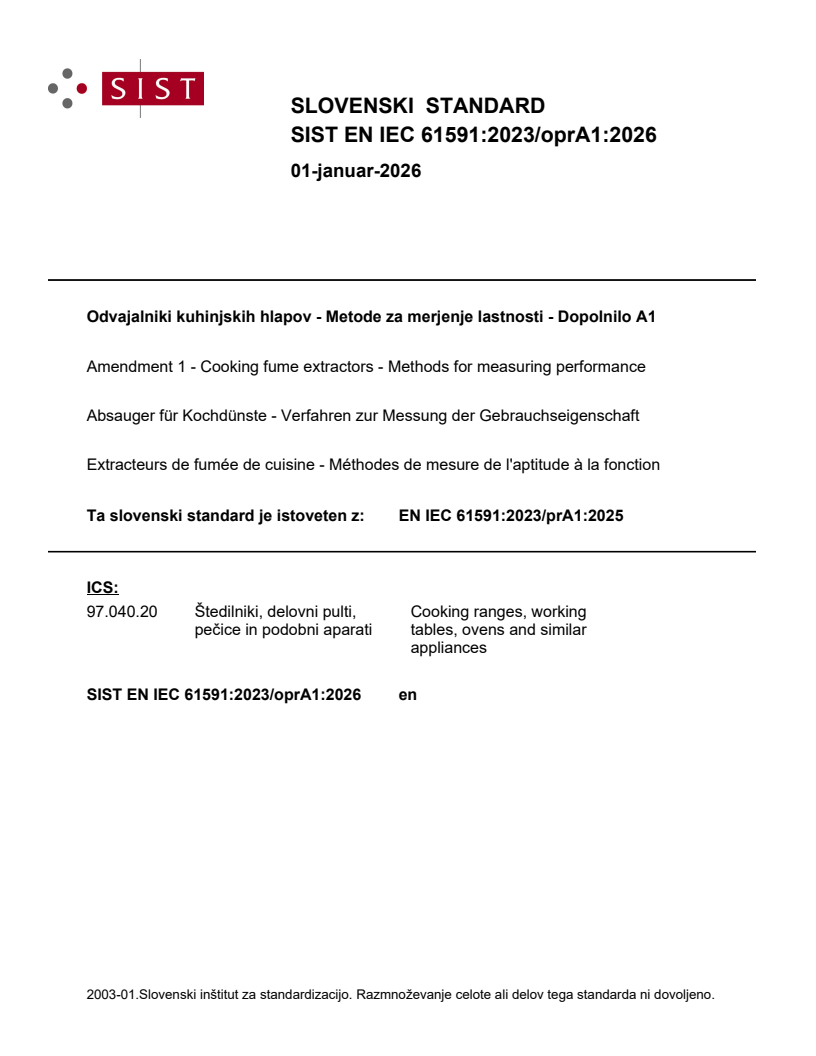
SLOVENSKI STANDARD
SIST EN IEC 61591:2023/oprA1:2026
01-januar-2026
Odvajalniki kuhinjskih hlapov - Metode za merjenje lastnosti - Dopolnilo A1
Amendment 1 - Cooking fume extractors - Methods for measuring performance
Absauger für Kochdünste - Verfahren zur Messung der Gebrauchseigenschaft
Extracteurs de fumée de cuisine - Méthodes de mesure de l'aptitude à la fonction
Ta slovenski standard je istoveten z: EN IEC 61591:2023/prA1:2025
ICS:
97.040.20 Štedilniki, delovni pulti, Cooking ranges, working
pečice in podobni aparati tables, ovens and similar
appliances
SIST EN IEC 61591:2023/oprA1:2026 en
2003-01.Slovenski inštitut za standardizacijo. Razmnoževanje celote ali delov tega standarda ni dovoljeno.
SIST EN IEC 61591:2023/oprA1:2026
SIST EN IEC 61591:2023/oprA1:2026
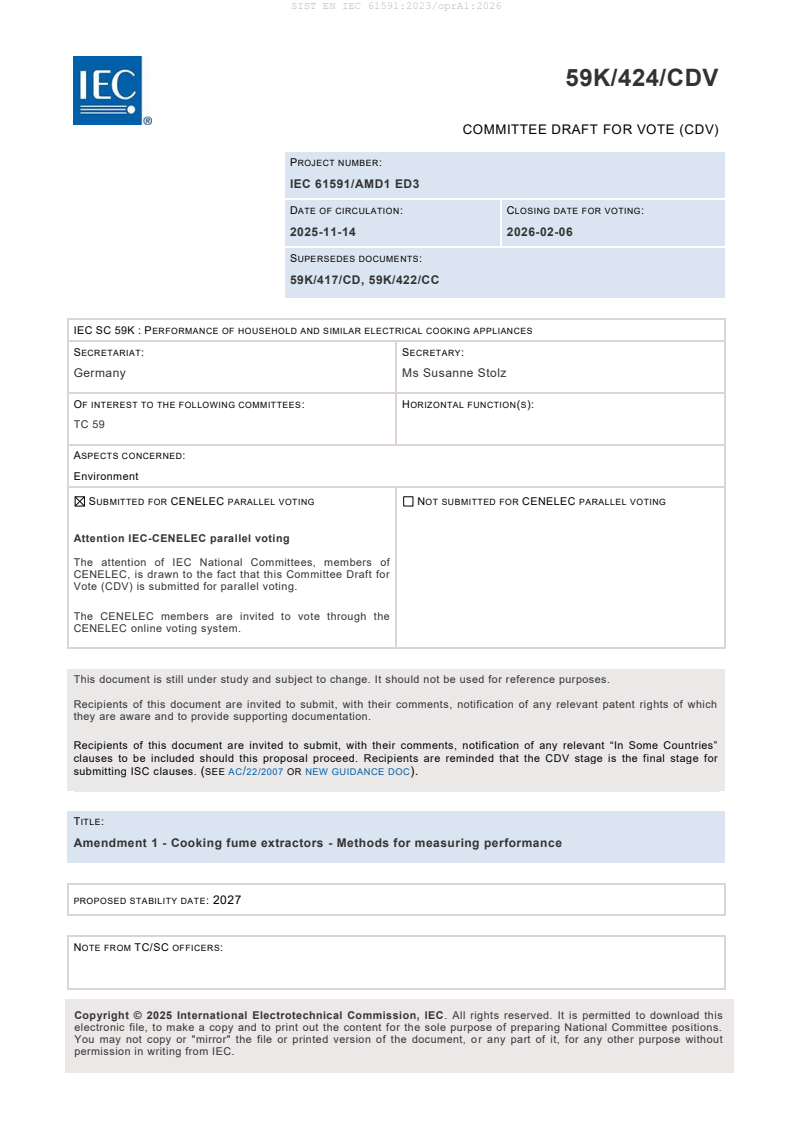
59K/424/CDV
COMMITTEE DRAFT FOR VOTE (CDV)
PROJECT NUMBER:
IEC 61591/AMD1 ED3
DATE OF CIRCULATION: CLOSING DATE FOR VOTING:
2025-11-14 2026-02-06
SUPERSEDES DOCUMENTS:
59K/417/CD, 59K/422/CC
IEC SC 59K : PERFORMANCE OF HOUSEHOLD AND SIMILAR ELECTRICAL COOKING APPLIANCES
SECRETARIAT: SECRETARY:
Germany Ms Susanne Stolz
OF INTEREST TO THE FOLLOWING COMMITTEES: HORIZONTAL FUNCTION(S):
TC 59
ASPECTS CONCERNED:
Environment
SUBMITTED FOR CENELEC PARALLEL VOTING NOT SUBMITTED FOR CENELEC PARALLEL VOTING
Attention IEC-CENELEC parallel voting
The attention of IEC National Committees, members of
CENELEC, is drawn to the fact that this Committee Draft for
Vote (CDV) is submitted for parallel voting.
The CENELEC members are invited to vote through the
CENELEC online voting system.
This document is still under study and subject to change. It should not be used for reference purposes.
Recipients of this document are invited to submit, with their comments, notification of any relevant patent rights of which
they are aware and to provide supporting documentation.
Recipients of this document are invited to submit, with their comments, notification of any relevant “In Some Countries”
clauses to be included should this proposal proceed. Recipients are reminded that the CDV stage is the final stage for
submitting ISC clauses. (SEE AC/22/2007 OR NEW GUIDANCE DOC).
TITLE:
Amendment 1 - Cooking fume extractors - Methods for measuring performance
PROPOSED STABILITY DATE: 2027
NOTE FROM TC/SC OFFICERS:
electronic file, to make a copy and to print out the content for the sole purpose of preparing National Committee positions.
You may not copy or "mirror" the file or printed version of the document, or any part of it, for any other purpose without
permission in writing from IEC.
SIST EN IEC 61591:2023/oprA1:2026
IEC CDV 61591:2023/AMD1 © IEC 2025
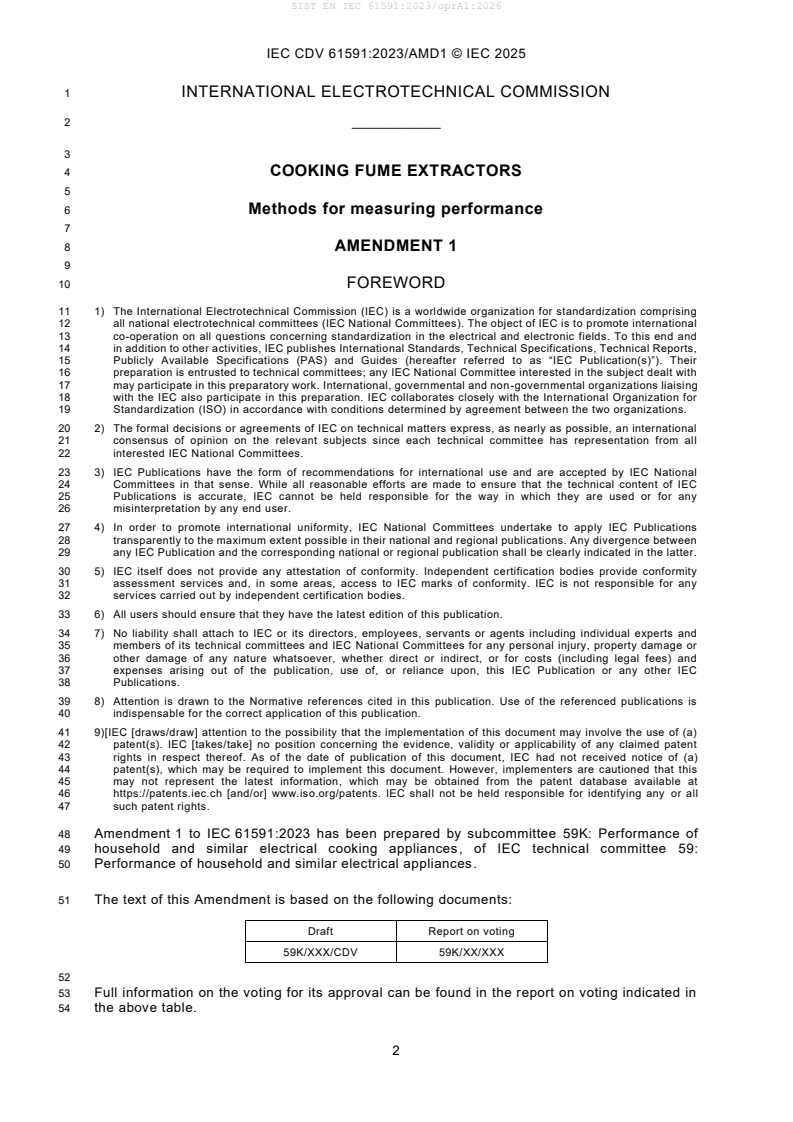
1 INTERNATIONAL ELECTROTECHNICAL COMMISSION
2 ____________
4 COOKING FUME EXTRACTORS
6 Methods for measuring performance
8 AMENDMENT 1
10 FOREWORD
11 1) The International Electrotechnical Commission (IEC) is a worldwide organization for standardization comprising
12 all national electrotechnical committees (IEC National Committees). The object of IEC is to promote international
13 co-operation on all questions concerning standardization in the electrical and electronic fields. To this end and
14 in addition to other activities, IEC publishes International Standards, Technical Specifications, Technical Reports,
15 Publicly Available Specifications (PAS) and Guides (hereafter referred to as “IEC Publication(s)”). Their
16 preparation is entrusted to technical committees; any IEC National Committee interested in the subject dealt with
17 may participate in this preparatory work. International, governmental and non-governmental organizations liaising
18 with the IEC also participate in this preparation. IEC collaborates closely with the International Organization for
19 Standardization (ISO) in accordance with conditions determined by agreement between the two organizations.
20 2) The formal decisions or agreements of IEC on technical matters express, as nearly as possible, an international
21 consensus of opinion on the relevant subjects since each technical committee has representation from all
22 interested IEC National Committees.
23 3) IEC Publications have the form of recommendations for international use and are accepted by IEC National
24 Committees in that sense. While all reasonable efforts are made to ensure that the technical content of IEC
25 Publications is accurate, IEC cannot be held responsible for the way in which they are used or for any
26 misinterpretation by any end user.
27 4) In order to promote international uniformity, IEC National Committees undertake to apply IEC Publications
28 transparently to the maximum extent possible in their national and regional publications. Any divergence between
29 any IEC Publication and the corresponding national or regional publication shall be clearly indicated in the latter.
30 5) IEC itself does not provide any attestation of conformity. Independent certification bodies provide conformity
31 assessment services and, in some areas, access to IEC marks of conformity. IEC is not responsible for any
32 services carried out by independent certification bodies.
33 6) All users should ensure that they have the latest edition of this publication.
34 7) No liability shall attach to IEC or its directors, employees, servants or agents including individual experts and
35 members of its technical committees and IEC National Committees for any personal injury, property damage or
36 other damage of any nature whatsoever, whether direct or indirect, or for costs (including legal fees) and
37 expenses arising out of the publication, use of, or reliance upon, this IEC Publication or any other IEC
38 Publications.
39 8) Attention is drawn to the Normative references cited in this publication. Use of the referenced publications is
40 indispensable for the correct application of this publication.
41 9)[IEC [draws/draw] attention to the possibility that the implementation of this document may involve the use of (a)
42 patent(s). IEC [takes/take] no position concerning the evidence, validity or applicability of any claimed patent
43 rights in respect thereof. As of the date of publication of this document, IEC had not received notice of (a)
44 patent(s), which may be required to implement this document. However, implementers are cautioned that this
45 may not represent the latest information, which may be obtained from the patent database available at
46 https://patents.iec.ch [and/or] www.iso.org/patents. IEC shall not be held responsible for identifying any or all
47 such patent rights.
48 Amendment 1 to IEC 61591:2023 has been prepared by subcommittee 59K: Performance of
49 household and similar electrical cooking appliances, of IEC technical committee 59:
50 Performance of household and similar electrical appliances.
51 The text of this Amendment is based on the following documents:
Draft Report on voting
59K/XXX/CDV 59K/XX/XXX
53 Full information on the voting for its approval can be found in the report on voting indicated in
54 the above table.
SIST EN IEC 61591:2023/oprA1:2026
IEC CDV 61591:2023/AMD1 © IEC 2025
55 The language used for the development of this Amendment is English.
56 This document was drafted in accordance with ISO/IEC Directives, Part 2, and developed in
57 accordance with ISO/IEC Directives, Part 1 and ISO/IEC Directives, IEC Supplement, available
58 at www.iec.ch/members_experts/refdocs. The main document types developed by IEC are
59 described in greater detail at www.iec.ch/publications/.
60 The committee has decided that the contents of this document will remain unchanged until the
61 stability date indicated on the IEC website under webstore.iec.ch in the data related to the
62 specific document. At this date, the document will be
63 • reconfirmed,
64 • withdrawn, or
65 • revised.
66 ___________
67 2 Normative references
68 Replace the dated reference to IEC 62301 by an undated reference
69 Cancel the footnote to IEC 63474
70 3 Terms and definitions
71 Change the definition 3.24 as follows:
72 3.24
73 Replace the definition with the following new definition:
74 standby mode
75 condition where the appliance is connected to the mains and provides only the following
76 functions, which can persist for an indefinite duration:
77 a) reactivation function, or reactivation function and a mere indication of enabled
78 reactivation function;
79 b) information or status display;
80 c) prot
...